
A English
Electric Current and Circuit Questions in English
Class 10 Science · Electricity · Electric Current and Circuit
72+
Questions
English
Language
100%
With Solutions
Showing 22 of 72 questions in English
51
EasyMCQ
Which of the following substances does not contain free electrons?
A
Copper
B
Silver
C
Aluminum
D
Plastic
Solution
(D) Free electrons are the charge carriers responsible for the flow of electric current in conductors.
Metals like $Copper$,$Silver$,and $Aluminum$ are good conductors of electricity because they possess a large number of free electrons in their atomic structure.
$Plastic$ is an insulator (non-conductor) of electricity.
In insulators,electrons are tightly bound to their respective atoms and are not free to move,which prevents the flow of electric current.
Therefore,$Plastic$ does not contain free electrons.
0 likes
View Solution52
EasyMCQ
Which law is used to calculate the magnitude of the electric force between two electric charges?
A
Coulomb's law
B
Ampere's law
C
Ohm's law
D
Faraday's law
Solution
(A) The electric force between two stationary point charges is determined by Coulomb's law.
According to Coulomb's law,the magnitude of the electrostatic force $(F)$ between two point charges ($q_1$ and $q_2$) separated by a distance $(r)$ is directly proportional to the product of the magnitudes of the charges and inversely proportional to the square of the distance between them.
The formula is given by: $F = k \cdot \frac{|q_1 \cdot q_2|}{r^2}$,where $k$ is Coulomb's constant.
0 likes
View Solution53
EasyMCQ
What is the electric charge passing through a cross-sectional area of the conductor per unit time called?
A
Electric potential
B
Electric current
C
Electric power
D
Resistance
Solution
(B) Electric current is defined as the rate of flow of electric charge through a cross-section of a conductor.
Mathematically,it is expressed as $I = Q / t$,where $I$ is the electric current,$Q$ is the net charge,and $t$ is the time taken.
The $SI$ unit of electric current is the Ampere $(A)$.
Mathematically,it is expressed as $I = Q / t$,where $I$ is the electric current,$Q$ is the net charge,and $t$ is the time taken.
The $SI$ unit of electric current is the Ampere $(A)$.
0 likes
View Solution54
EasyMCQ
What is the unit of electric current?
A
watt
B
volt
C
coulomb
D
ampere
Solution
(D) The $SI$ unit of electric current is the $Ampere$ $(A)$.
Electric current is defined as the rate of flow of electric charge through a conductor.
One $Ampere$ is equivalent to one $Coulomb$ of charge flowing per second $(1 \ A = 1 \ C/s)$.
Electric current is defined as the rate of flow of electric charge through a conductor.
One $Ampere$ is equivalent to one $Coulomb$ of charge flowing per second $(1 \ A = 1 \ C/s)$.
0 likes
View Solution55
EasyMCQ
The unit of electric current,$.......$,is also called an ampere,named after André-Marie Ampère.
A
$Coulomb/second$
B
$Joule/coulomb$
C
$Volt/ampere$
D
$Joule/second$
Solution
(A) Electric current $(I)$ is defined as the rate of flow of electric charge $(Q)$ through a conductor.
Mathematically,$I = Q / t$.
The $SI$ unit of charge $(Q)$ is the coulomb $(C)$ and the $SI$ unit of time $(t)$ is the second $(s)$.
Therefore,the unit of electric current is $Coulomb/second$ $(C/s)$,which is defined as an ampere $(A)$.
Mathematically,$I = Q / t$.
The $SI$ unit of charge $(Q)$ is the coulomb $(C)$ and the $SI$ unit of time $(t)$ is the second $(s)$.
Therefore,the unit of electric current is $Coulomb/second$ $(C/s)$,which is defined as an ampere $(A)$.
0 likes
View Solution56
EasyMCQ
$1\, mA = \dots A$
A
$10^{3}$
B
$10^{6}$
C
$10^{-6}$
D
$10^{-3}$
Solution
(D) The prefix $m$ stands for milli,which represents a factor of $10^{-3}$.
Therefore,$1\, mA = 1 \times 10^{-3}\, A$.
Thus,$1\, mA = 10^{-3}\, A$.
Therefore,$1\, mA = 1 \times 10^{-3}\, A$.
Thus,$1\, mA = 10^{-3}\, A$.
0 likes
View Solution57
EasyMCQ
$1 \, \mu A = \ldots \ldots \ldots \, A$
A
$10^{-3}$
B
$10^{3}$
C
$10^{6}$
D
$10^{-6}$
Solution
(D) The prefix $\mu$ (micro) represents a factor of $10^{-6}$.
Therefore,$1 \, \mu A$ is equal to $10^{-6} \, A$.
Therefore,$1 \, \mu A$ is equal to $10^{-6} \, A$.
0 likes
View Solution58
EasyMCQ
How many microamperes $(\mu A)$ are equal to $1$ milliampere $(mA)$?
A
$10^{-6}$
B
$10^{-3}$
C
$10^{6}$
D
$10^{3}$
Solution
(D) We know that $1 \text{ milliampere } (mA) = 10^{-3} \text{ amperes } (A)$.
We also know that $1 \text{ microampere } (\mu A) = 10^{-6} \text{ amperes } (A)$.
To find the value of $1 \text{ mA}$ in terms of $\mu A$,we set up the equation:
$1 \text{ mA} = x \times 1 \mu A$
$10^{-3} \text{ A} = x \times 10^{-6} \text{ A}$
$x = \frac{10^{-3}}{10^{-6}}$
$x = 10^{-3 - (-6)} = 10^{-3 + 6} = 10^{3}$
Therefore,$1 \text{ mA} = 10^{3} \mu A$.
0 likes
View Solution59
EasyMCQ
If $1 \text{ ampere}$ electric current passes through a conductor,how many electrons will pass per second?
A
$6.25 \times 10^{19}$
B
$6.25 \times 10^{18}$
C
$1.6 \times 10^{19}$
D
$1.6 \times 10^{18}$
Solution
(B) The formula for electric current is $I = Q / t$,where $I$ is current,$Q$ is total charge,and $t$ is time.
Given $I = 1 \text{ A}$ and $t = 1 \text{ s}$,the total charge $Q = I \times t = 1 \text{ A} \times 1 \text{ s} = 1 \text{ C}$.
The quantization of charge is given by $Q = n \times e$,where $n$ is the number of electrons and $e$ is the elementary charge $(e \approx 1.6 \times 10^{-19} \text{ C})$.
To find $n$,we rearrange the formula: $n = Q / e$.
Substituting the values: $n = 1 \text{ C} / (1.6 \times 10^{-19} \text{ C}) = 0.625 \times 10^{19} = 6.25 \times 10^{18}$.
Therefore,$6.25 \times 10^{18}$ electrons pass through the conductor per second.
0 likes
View Solution60
EasyMCQ
Which instrument is used to measure electric current?
A
Voltmeter
B
Galvanometer
C
Ammeter
D
Wattmeter
Solution
(C) An $Ammeter$ is an instrument used to measure the electric current in a circuit. It is always connected in series with the component through which the current is to be measured. $A$ $Voltmeter$ measures potential difference,a $Galvanometer$ detects small amounts of current,and a $Wattmeter$ measures electric power.
0 likes
View Solution61
EasyMCQ
What is the direction of conventional current?
A
Opposite to positive electric charge
B
In the direction to the flow of electrons
C
Opposite to the flow of electrons
D
From negative electrode to positive electrode
Solution
(C) By convention,the direction of electric current is taken as the direction of flow of positive charges.
Since electrons are negatively charged particles,they flow from the negative terminal to the positive terminal of a source.
Therefore,the direction of conventional current is considered to be opposite to the direction of the flow of electrons.
Since electrons are negatively charged particles,they flow from the negative terminal to the positive terminal of a source.
Therefore,the direction of conventional current is considered to be opposite to the direction of the flow of electrons.
0 likes
View Solution62
EasyMCQ
Who invented the simple battery?
A
Volta
B
Coulomb
C
Ampere
D
Ohm
Solution
(A) The simple battery,known as the voltaic pile,was invented by the Italian physicist Alessandro Volta in $1800$.
It was the first electrical battery that could provide a continuous current to a circuit.
Therefore,the correct option is $A$.
It was the first electrical battery that could provide a continuous current to a circuit.
Therefore,the correct option is $A$.
0 likes
View Solution63
EasyMCQ
In a Voltaic cell,what is the direction of the flow of electrons in the external circuit?
A
From positive electrode to negative electrode
B
From negative electrode to positive electrode
C
From copper plate to zinc plate
D
In the direction of conventional current
Solution
(B) In a Voltaic cell (or any electrochemical cell),the chemical reactions occur at the electrodes.
In the external circuit,electrons flow from the anode (negative electrode) to the cathode (positive electrode).
This flow of electrons constitutes the electric current,which is conventionally defined as flowing from the positive terminal to the negative terminal (opposite to the direction of electron flow).
Therefore,the correct direction of electron flow is from the negative electrode to the positive electrode.
0 likes
View Solution64
EasyMCQ
Which of the following is the symbol for an electric cell?
A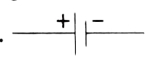
B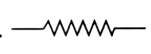
C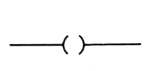
D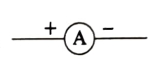
Solution
(A) In an electric circuit,the symbol for an electric cell consists of two parallel vertical lines of unequal length. The longer line represents the positive terminal $(+)$,and the shorter,thicker line represents the negative terminal $(-)$.
Option $A$ correctly represents this symbol.
Option $A$ correctly represents this symbol.
0 likes
View Solution65
EasyMCQ
The $SI$ unit of electric charge is $.........$
A
ampere
B
watt
C
coulomb
D
$kWh$
Solution
(C) The $SI$ unit of electric charge is the coulomb $(C)$.
$1$ coulomb is defined as the quantity of charge that passes through a point in a circuit when a current of $1$ ampere flows for $1$ second.
Therefore,the correct option is $C$.
$1$ coulomb is defined as the quantity of charge that passes through a point in a circuit when a current of $1$ ampere flows for $1$ second.
Therefore,the correct option is $C$.
0 likes
View Solution66
EasyMCQ
If a current of $0.5\;A$ is passed through an electric bulb for $1\;hour$, how much electric charge will pass through the bulb (in $C$)?
A
$0.5$
B
$30$
C
$1800$
D
$1800$
Solution
(C) Given:
Electric current $(I)$ = $0.5\;A$
Time $(t)$ = $1\;hour = 60 \times 60\;seconds = 3600\;s$
Formula:
Electric charge $(Q)$ = $I \times t$
Calculation:
$Q = 0.5\;A \times 3600\;s$
$Q = 1800\;C$
Therefore, the total electric charge passing through the bulb is $1800\;C$.
Electric current $(I)$ = $0.5\;A$
Time $(t)$ = $1\;hour = 60 \times 60\;seconds = 3600\;s$
Formula:
Electric charge $(Q)$ = $I \times t$
Calculation:
$Q = 0.5\;A \times 3600\;s$
$Q = 1800\;C$
Therefore, the total electric charge passing through the bulb is $1800\;C$.
0 likes
View Solution67
EasyMCQ
If $1800\,C$ of charge passes through an electric bulb in $1$ hour, what is the current flowing through the bulb (in $A$)?
A
$1.8$
B
$1$
C
$0.5$
D
$2$
Solution
(C) The formula for electric current $(I)$ is given by $I = \frac{Q}{t}$, where $Q$ is the charge and $t$ is the time in seconds.
Given: Charge $(Q) = 1800\,C$, Time $(t) = 1\,hour = 60 \times 60\,s = 3600\,s$.
Substituting the values into the formula: $I = \frac{1800}{3600} = 0.5\,A$.
Therefore, the current flowing through the bulb is $0.5\,A$.
Given: Charge $(Q) = 1800\,C$, Time $(t) = 1\,hour = 60 \times 60\,s = 3600\,s$.
Substituting the values into the formula: $I = \frac{1800}{3600} = 0.5\,A$.
Therefore, the current flowing through the bulb is $0.5\,A$.
0 likes
View Solution68
EasyMCQ
Which electrical appliance with the given rating will draw the maximum current from the source?
A
$110 \ V / 40 \ W$
B
$220 \ V / 75 \ W$
C
$110 \ V / 60 \ W$
D
$220 \ V / 100 \ W$
Solution
(C) The current $I$ drawn by an appliance is given by the formula $P = V \times I$,which implies $I = P / V$.
We calculate the current for each option:
$A) I = 40 \ W / 110 \ V \approx 0.36 \ A$
$B) I = 75 \ W / 220 \ V \approx 0.34 \ A$
$C) I = 60 \ W / 110 \ V \approx 0.54 \ A$
$D) I = 100 \ W / 220 \ V \approx 0.45 \ A$
Comparing these values,the appliance with the rating $110 \ V / 60 \ W$ draws the maximum current of approximately $0.54 \ A$.
0 likes
View Solution69
EasyMCQ
Which type of current is obtained from a battery?
A
$DC$
B
$AC$
C
Both $DC$ and $AC$
D
None of $A$ and $B$
Solution
(A) battery is a device that converts chemical energy into electrical energy.
It produces a steady flow of electrons in a single direction,which is known as Direct Current $(DC)$.
Unlike Alternating Current $(AC)$,which periodically reverses its direction,the current from a battery remains constant in its polarity and direction over time.
Therefore,the correct option is $A$.
It produces a steady flow of electrons in a single direction,which is known as Direct Current $(DC)$.
Unlike Alternating Current $(AC)$,which periodically reverses its direction,the current from a battery remains constant in its polarity and direction over time.
Therefore,the correct option is $A$.
0 likes
View Solution70
EasyMCQ
Which instrument is used to know the presence of an electric current in a circuit?
A
Fuse
B
Galvanometer
C
Voltmeter
D
Battery
Solution
(B) $Galvanometer$ is an electromechanical instrument used for detecting and indicating an electric current.
It works on the principle that a magnetic field exerts a torque on a current-carrying coil placed within it.
When a small current flows through the coil,it deflects,indicating the presence and direction of the current.
In contrast,a $Voltmeter$ measures potential difference,a $Fuse$ is a safety device,and a $Battery$ is a source of electric energy.
0 likes
View Solution71
EasyMCQ
What is the frequency of $220 \ V$ $DC$ voltage? (In $Hz$)
A
$50$
B
$60$
C
$110$
D
Zero
Solution
(D) Direct Current $(DC)$ is a type of electric current that flows in only one direction.
Unlike Alternating Current $(AC)$,which periodically reverses its direction and magnitude,$DC$ maintains a constant polarity and magnitude over time.
Frequency is defined as the number of cycles per second of an alternating waveform.
Since $DC$ voltage does not oscillate or change its direction,it does not complete any cycles.
Therefore,the frequency of $DC$ voltage is $0 \ Hz$.
0 likes
View Solution72
EasyMCQ
Which device uses direct current $(DC)$?
A
Refrigerator
B
Tubelight
C
Cellphone
D
Electric fan
Solution
(C) Direct current $(DC)$ is a unidirectional flow of electric charge.
Most electronic devices that contain batteries or sensitive electronic circuits,such as a cellphone,operate on $DC$.
Appliances like refrigerators,tubelights,and electric fans typically run on alternating current $(AC)$ supplied by the power grid.
Most electronic devices that contain batteries or sensitive electronic circuits,such as a cellphone,operate on $DC$.
Appliances like refrigerators,tubelights,and electric fans typically run on alternating current $(AC)$ supplied by the power grid.
0 likes
View SolutionElectricity — Electric Current and Circuit · Frequently Asked Questions
1Are these Electricity questions useful for JEE and NEET?
Yes. All questions in this section are mapped to JEE Main and NEET exam patterns. Previous year questions from JEE Main, NEET, GUJCET and state-level exams are included with full solutions.
2Can I switch to Hindi or Gujarati for these questions?
Yes. Use the language tabs in the hero section or the sidebar to view the same questions and solutions in English, Hindi or Gujarati.
3How do I generate a question paper from this subtopic?
Use the Vedclass Exam Paper Generator — select the chapter and subtopic, set difficulty, and generate Sets A, B, C, D automatically. First 3 chapters of every subject are free.
Vedclass Products
For Students
Vedclass Test Series
Mock tests in real JEE/NEET style with performance analysis. 5-day free trial.
Start Free TrialFor Teachers
Exam Paper Generator
Generate Set A/B/C/D papers from this chapter in 2 minutes. 3 chapters free.
Try FreeFor Institutes
Online Exam Module
Live online exams with unlimited students, 360° analytics & white-label branding.
See DemoFor Teachers & Institutes
Generate a Electricity Exam Paper in 2 Minutes
Select subtopic & difficulty — Sets A, B, C, D auto-generated with No Repeat logic.
First 3 chapters of every subject are free — no payment required.