
A English
Mirror Formula and Magnification Questions in English
Class 10 Science · Light – Reflection and Refraction · Mirror Formula and Magnification
51+
Questions
English
Language
100%
With Solutions
Showing 50 of 51 questions in English
1
MediumMCQ
$A$ concave mirror produces a three times magnified (enlarged) real image of an object placed at $10 \, cm$ in front of it. Where is the image located (in $cm$)?
A
$-30$
B
$-20$
C
$-10$
D
$-40$
Solution
(A) The magnification $(m)$ produced by a spherical mirror is given by the formula:
$m = -\frac{v}{u}$
Since the image is real and magnified three times,the magnification $m = -3$ (as real images are inverted).
Given,object distance $u = -10 \, cm$ (according to sign convention).
Substituting the values in the formula:
$-3 = -\frac{v}{-10}$
$-3 = \frac{v}{10}$
$v = -3 \times 10 = -30 \, cm$.
The negative sign indicates that the image is formed in front of the mirror at a distance of $30 \, cm$.
0 likes
View Solution2
DifficultMCQ
An object is placed at a distance of $10\, cm$ from a convex mirror of focal length $15\, cm$. Find the position and nature of the image.
A
$6\, cm$ behind the mirror,virtual and erect
B
$6\, cm$ in front of the mirror,real and inverted
C
$30\, cm$ behind the mirror,virtual and erect
D
$30\, cm$ in front of the mirror,real and inverted
Solution
(A) Focal length of convex mirror,$f = +15\, cm$.
Object distance,$u = -10\, cm$.
According to the mirror formula,$\frac{1}{v} + \frac{1}{u} = \frac{1}{f}$.
Substituting the values,$\frac{1}{v} = \frac{1}{f} - \frac{1}{u} = \frac{1}{15} - (\frac{1}{-10}) = \frac{1}{15} + \frac{1}{10}$.
$\frac{1}{v} = \frac{2 + 3}{30} = \frac{5}{30} = \frac{1}{6}$.
Therefore,$v = +6\, cm$.
The positive value of $v$ indicates that the image is formed $6\, cm$ behind the mirror.
Magnification,$m = -\frac{v}{u} = -(\frac{6}{-10}) = +0.6$.
The positive value of magnification indicates that the image formed is virtual and erect.
0 likes
View Solution3
MediumMCQ
The magnification produced by a plane mirror is $+1$. What does this mean?
A
The image is real and inverted.
B
The image is virtual,erect,and of the same size as the object.
C
The image is magnified.
D
The image is diminished.
Solution
(B) The magnification $(m)$ produced by a mirror is defined as the ratio of the height of the image $(H_i)$ to the height of the object $(H_o)$:
$m = \frac{H_i}{H_o}$
Given that the magnification produced by a plane mirror is $+1$:
$1$. The magnitude $1$ indicates that the height of the image is equal to the height of the object $(H_i = H_o)$,meaning the image is of the same size as the object.
$2$. The positive sign $(+)$ indicates that the image formed is virtual and erect.
0 likes
View Solution4
Difficult
An object $5.0\, cm$ in length is placed at a distance of $20\, cm$ in front of a convex mirror of radius of curvature $30\, cm$. Find the position of the image,its nature and size.
Solution
(N/A) Object distance,$u = -20\, cm$.
Object height,$h = 5\, cm$.
Radius of curvature,$R = 30\, cm$.
Focal length,$f = R/2 = 15\, cm$.
According to the mirror formula,$\frac{1}{v} + \frac{1}{u} = \frac{1}{f}$.
$\frac{1}{v} = \frac{1}{f} - \frac{1}{u} = \frac{1}{15} - (\frac{1}{-20}) = \frac{1}{15} + \frac{1}{20} = \frac{4+3}{60} = \frac{7}{60}$.
$v = \frac{60}{7} \approx 8.57\, cm$.
The positive value of $v$ indicates that the image is formed behind the mirror.
Magnification,$m = -\frac{v}{u} = -\frac{8.57}{-20} = 0.428$.
The positive value of magnification indicates that the image is virtual and erect.
Height of the image,$h' = m \times h = 0.428 \times 5 = 2.14\, cm$.
Thus,the image is virtual,erect,and $2.14\, cm$ in size,formed $8.57\, cm$ behind the mirror.
1 likes
View Solution5
DifficultMCQ
An object of size $7.0\, cm$ is placed at $27\, cm$ in front of a concave mirror of focal length $18\, cm$. At what distance from the mirror should a screen be placed,so that a sharp focussed image can be obtained? Find the size and the nature of the image.
A
Distance: $54\, cm$,Size: $14\, cm$,Nature: Real and Inverted
B
Distance: $27\, cm$,Size: $7\, cm$,Nature: Virtual and Erect
C
Distance: $54\, cm$,Size: $7\, cm$,Nature: Real and Inverted
D
Distance: $18\, cm$,Size: $14\, cm$,Nature: Virtual and Erect
Solution
(A) Object distance,$u = -27\, cm$.
Object height,$h = 7\, cm$.
Focal length,$f = -18\, cm$.
According to the mirror formula,$\frac{1}{v} + \frac{1}{u} = \frac{1}{f}$.
$\frac{1}{v} = \frac{1}{f} - \frac{1}{u} = \frac{1}{-18} - \frac{1}{-27} = \frac{-3 + 2}{54} = \frac{-1}{54}$.
Thus,$v = -54\, cm$.
The screen should be placed at a distance of $54\, cm$ in front of the mirror.
Magnification,$m = -\frac{v}{u} = -\frac{-54}{-27} = -2$.
The negative sign of magnification indicates that the image is real and inverted.
Magnification,$m = \frac{h'}{h} \implies h' = m \times h = -2 \times 7 = -14\, cm$.
The size of the image is $14\, cm$.
0 likes
View Solution6
MediumMCQ
$A$ $10\, mm$ long awl pin is placed vertically in front of a concave mirror. $A$ $5\, mm$ long image of the awl pin is formed at $30\, cm$ in front of the mirror. The focal length of this mirror is ......... $cm$.
A
$-30$
B
$-20$
C
$-40$
D
$-60$
Solution
(B) Given: Height of object $(h_o)$ = $10\, mm = 1\, cm$. Height of image $(h_i)$ = $-5\, mm = -0.5\, cm$ (since the image is real and inverted,it is formed in front of the mirror). Image distance $(v)$ = $-30\, cm$.
Magnification $(m)$ = $h_i / h_o = -v / u$.
Substituting the values: $-0.5 / 1 = -(-30) / u$.
$-0.5 = 30 / u$.
$u = 30 / -0.5 = -60\, cm$.
Using the mirror formula: $1/f = 1/v + 1/u$.
$1/f = 1/(-30) + 1/(-60)$.
$1/f = (-2 - 1) / 60 = -3 / 60$.
$1/f = -1 / 20$.
Therefore,$f = -20\, cm$.
Magnification $(m)$ = $h_i / h_o = -v / u$.
Substituting the values: $-0.5 / 1 = -(-30) / u$.
$-0.5 = 30 / u$.
$u = 30 / -0.5 = -60\, cm$.
Using the mirror formula: $1/f = 1/v + 1/u$.
$1/f = 1/(-30) + 1/(-60)$.
$1/f = (-2 - 1) / 60 = -3 / 60$.
$1/f = -1 / 20$.
Therefore,$f = -20\, cm$.
1 likes
View Solution7
MediumMCQ
Magnification produced by a rear-view mirror fitted in vehicles $....$
A
is less than one
B
is more than one
C
is equal to one
D
can be more than or less than one depending upon the position of the object in front of it
Solution
(A) rear-view mirror in vehicles is a convex mirror.
Convex mirrors always form virtual,erect,and diminished images of objects placed in front of them.
Since the image is always diminished (smaller than the object),the height of the image $(h')$ is always less than the height of the object $(h)$.
Magnification $(m)$ is defined as the ratio of the height of the image to the height of the object,i.e.,$m = h'/h$.
Because $h' < h$,the magnification $m$ is always less than $1$.
0 likes
View Solution8
Difficult
The size of an image of an object formed by a mirror with a focal length of $20\, cm$ is observed to be reduced to $1/3^{rd}$ of its size. At what distance is the object placed from the mirror? What is the nature of the image and the mirror?
Solution
(D) Given: Focal length $f = -20\, cm$ (for a concave mirror),Magnification $m = -1/3$ (for a real and inverted image).
Using the magnification formula $m = -v/u$,we get $-1/3 = -v/u$,which implies $v = u/3$.
Using the mirror formula $\frac{1}{v} + \frac{1}{u} = \frac{1}{f}$,substitute $v = u/3$:
$\frac{1}{u/3} + \frac{1}{u} = \frac{1}{-20}$
$\frac{3}{u} + \frac{1}{u} = -\frac{1}{20}$
$\frac{4}{u} = -\frac{1}{20}$
$u = -80\, cm$.
The object is placed at a distance of $80\, cm$ from the mirror.
The image is real and inverted,and the mirror is concave.
0 likes
View Solution9
EasyMCQ
What does positive magnification mean?
A
The image is real and inverted.
B
The image is virtual and erect.
C
The image is smaller than the object.
D
The image is larger than the object.
Solution
(B) Magnification $(m)$ is defined as the ratio of the height of the image $(h')$ to the height of the object $(h)$.
$m = h'/h$.
If the magnification is positive $(m > 0)$,it indicates that the image is formed above the principal axis.
This implies that the image is virtual and erect.
Therefore,the correct option is $B$.
$m = h'/h$.
If the magnification is positive $(m > 0)$,it indicates that the image is formed above the principal axis.
This implies that the image is virtual and erect.
Therefore,the correct option is $B$.
0 likes
View Solution10
EasyMCQ
What does negative magnification mean in the context of spherical mirrors?
A
The image is virtual and erect.
B
The image is real and inverted.
C
The image is magnified.
D
The image is diminished.
Solution
(B) In the context of spherical mirrors, magnification $(m)$ is defined as the ratio of the height of the image $(h')$ to the height of the object $(h)$.
If the magnification is negative $(m < 0)$, it indicates that the height of the image is negative relative to the height of the object.
Since the object is typically placed upright above the principal axis (positive height), a negative image height implies that the image is formed below the principal axis.
Therefore, a negative magnification signifies that the image is $real$ and $inverted$.
0 likes
View Solution11
Easy
Give the relationship of magnification with focal length of a spherical mirror.
Solution
(N/A) The magnification $m$ of a spherical mirror is defined as the ratio of the height of the image to the height of the object,which is also given by $m = -v/u$.
Using the mirror formula $\frac{1}{f} = \frac{1}{v} + \frac{1}{u}$,we can derive the relationship between magnification,focal length $(f)$,and object distance $(u)$ or image distance $(v)$.
By substituting $v = \frac{fu}{u-f}$ into $m = -v/u$,we get $m = \frac{f}{f-u}$.
Similarly,by substituting $u = \frac{fv}{v-f}$ into $m = -v/u$,we get $m = \frac{f-v}{f}$.
Thus,the relationship is $m = \frac{f-v}{f} = \frac{f}{f-u}$.
0 likes
View Solution12
EasyMCQ
The magnification of a mirror is $+1$. What does it mean?
A
The image is real and inverted.
B
The image is virtual and erect,and of the same size as the object.
C
The image is magnified.
D
The image is diminished.
Solution
(B) The magnification $m$ is defined as the ratio of the height of the image $(h')$ to the height of the object $(h)$,i.e.,$m = h'/h$.
Given $m = +1$,this implies $h'/h = +1$,which means $h' = h$.
Since the magnification is positive $(+)$,the image is virtual and erect.
Since the magnitude of magnification is $1$,the size of the image is exactly equal to the size of the object.
Therefore,the image is virtual,erect,and of the same size as the object.
0 likes
View Solution13
Easy
Define lateral magnification.
Solution
(N/A) Lateral magnification is defined as the ratio of the height of the image $(h')$ to the height of the object $(h)$.
Mathematically,it is expressed as $m = \frac{h'}{h}$.
It indicates how much larger or smaller the image is compared to the object.
Mathematically,it is expressed as $m = \frac{h'}{h}$.
It indicates how much larger or smaller the image is compared to the object.
0 likes
View Solution14
EasyMCQ
Write the relationship between object distance $(u)$,image distance $(v)$,and focal length $(f)$ for a spherical mirror.
A
$\frac{1}{v} - \frac{1}{u} = \frac{1}{f}$
B
$\frac{1}{v} + \frac{1}{u} = \frac{1}{f}$
C
$\frac{1}{u} + \frac{1}{v} = \frac{1}{f}$
D
$\frac{1}{f} + \frac{1}{v} = \frac{1}{u}$
Solution
(B) The relationship between object distance $(u)$,image distance $(v)$,and focal length $(f)$ for a spherical mirror is known as the mirror formula.
This formula is given by: $\frac{1}{v} + \frac{1}{u} = \frac{1}{f}$.
Here,$(u)$ is the distance of the object from the pole,$(v)$ is the distance of the image from the pole,and $(f)$ is the focal length of the mirror.
This formula is given by: $\frac{1}{v} + \frac{1}{u} = \frac{1}{f}$.
Here,$(u)$ is the distance of the object from the pole,$(v)$ is the distance of the image from the pole,and $(f)$ is the focal length of the mirror.
0 likes
View Solution15
EasyMCQ
Does the magnification equation change depending on whether the lens is a concave lens or a convex lens?
A
Yes,it changes for both.
B
No,it remains the same.
C
It changes only for concave lenses.
D
It changes only for convex lenses.
Solution
(B) The magnification $(m)$ for any spherical lens is defined as the ratio of the height of the image $(h')$ to the height of the object $(h)$.
Mathematically,this is expressed as $m = h'/h = v/u$,where $v$ is the image distance and $u$ is the object distance.
This formula is universal and applies to both convex and concave lenses.
While the sign conventions for $v$ and $u$ differ depending on the type of lens and the position of the object,the fundamental equation for magnification remains the same.
0 likes
View Solution16
MediumMCQ
If the magnification of a body of size $1\, m$ is $2$,what is the size of the image (in $m$)?
A
$1$
B
$2$
C
$0.5$
D
$4$
Solution
(B) Given: Magnification $(m)$ = $2$,Size of the object $(O)$ = $1\, m$.
The formula for magnification is $m = \frac{I}{O}$,where $I$ is the size of the image.
Rearranging the formula to find the image size: $I = m \times O$.
Substituting the values: $I = 2 \times 1\, m = 2\, m$.
Therefore,the size of the image is $2\, m$.
The formula for magnification is $m = \frac{I}{O}$,where $I$ is the size of the image.
Rearranging the formula to find the image size: $I = m \times O$.
Substituting the values: $I = 2 \times 1\, m = 2\, m$.
Therefore,the size of the image is $2\, m$.
0 likes
View Solution17
Medium
Define linear magnification produced by a spherical mirror. Also,give its relation.
Solution
(N/A) Linear magnification $(m)$ produced by a spherical mirror is defined as the ratio of the height of the image $(h^{\prime})$ to the height of the object $(h)$.
Mathematically,it is expressed as:
$m = \frac{\text{height of the image}}{\text{height of the object}} = \frac{h^{\prime}}{h}$
Additionally,it is related to the object distance $(u)$ and image distance $(v)$ as:
$m = \frac{h^{\prime}}{h} = -\frac{v}{u}$
Here,$u$ is the distance of the object from the mirror,and $v$ is the distance of the image from the mirror.
0 likes
View Solution18
Medium
Show that the mirror formula for spherical mirrors also holds for a plane mirror.
Solution
(N/A) The mirror formula is given by $\frac{1}{v} + \frac{1}{u} = \frac{1}{f}$.
For a plane mirror,the focal length $f$ is considered to be infinity $(\infty)$.
Substituting $f = \infty$ into the mirror formula,we get:
$\frac{1}{v} + \frac{1}{u} = \frac{1}{\infty}$
Since $\frac{1}{\infty} = 0$,the equation becomes:
$\frac{1}{v} + \frac{1}{u} = 0$
$\frac{1}{v} = -\frac{1}{u}$
$v = -u$
This result shows that for a plane mirror,the image distance $v$ is equal in magnitude to the object distance $u$ but opposite in sign,which is consistent with the properties of plane mirrors (virtual image formed at the same distance behind the mirror).
0 likes
View Solution19
Medium
$A$ $4.5 \, cm$ needle is placed $12 \, cm$ away from a convex mirror of focal length $15 \, cm$. Give the location of the image and the magnification. Describe what happens to the image as the needle is moved farther from the mirror.
Solution
(A) Given: Object height $h_{1} = 4.5 \, cm$,Object distance $u = -12 \, cm$,Focal length $f = +15 \, cm$ (for a convex mirror).
Using the mirror formula: $\frac{1}{f} = \frac{1}{v} + \frac{1}{u}$.
Substituting the values: $\frac{1}{15} = \frac{1}{v} + \frac{1}{-12}$.
Rearranging: $\frac{1}{v} = \frac{1}{15} + \frac{1}{12} = \frac{4 + 5}{60} = \frac{9}{60} = \frac{3}{20}$.
Thus,$v = \frac{20}{3} \approx +6.67 \, cm$.
The image is formed $6.67 \, cm$ behind the mirror.
Magnification $m = -\frac{v}{u} = -\frac{6.67}{-12} \approx +0.56$.
As the needle is moved farther from the mirror,the object distance $u$ increases. Consequently,the image moves closer to the focus $F$ and its size decreases.
0 likes
View Solution20
Medium
$A$ student wants to project the image of a candle flame on a screen $60\, cm$ in front of a mirror by keeping the flame at a distance of $15\, cm$ from its pole.
$(a)$ Write the type of mirror he should use.
$(b)$ Find the linear magnification of the image produced.
$(c)$ What is the distance between the object and its image?
$(d)$ Draw a ray diagram to show the image formation in this case.
$(a)$ Write the type of mirror he should use.
$(b)$ Find the linear magnification of the image produced.
$(c)$ What is the distance between the object and its image?
$(d)$ Draw a ray diagram to show the image formation in this case.
Solution
(A) Since the image is formed on a screen,it must be a real image. Only a concave mirror can form a real image.
$(b)$ Given: Object distance $u = -15\, cm$,Image distance $v = -60\, cm$ (as it is in front of the mirror).
Linear magnification $m = \frac{v}{u} = \frac{-60}{-15} = -4$.
$(c)$ The object is at $15\, cm$ from the pole and the image is at $60\, cm$ from the pole on the same side.
Distance between object and image $= |v - u| = |-60 - (-15)| = |-60 + 15| = |-45| = 45\, cm$.
$(d)$ The ray diagram shows the object placed between the focus $F$ and the pole $P$ is incorrect based on the values; however,for a real image,the object must be placed between $C$ and $F$. The provided diagram shows the object between $C$ and $F$ forming a real,inverted,and magnified image beyond $C$.
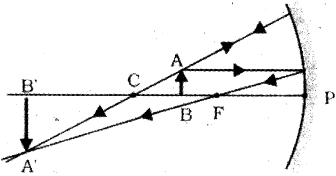
0 likes
View Solution21
Medium
State the relation between object distance,image distance,and focal length of a concave or convex mirror. $A$ concave mirror produces a two times magnified real image of an object placed at $10 \ cm$ from it. Find the position of the image.
Solution
(A) The mirror formula expressing the relationship between object distance $(u)$,image distance $(v)$,and focal length $(f)$ is given by: $\frac{1}{f} = \frac{1}{v} + \frac{1}{u}$.
Given that the image is real and magnified by $2$ times,the magnification $(m)$ is $-2$ (since real images are inverted).
The object distance $(u)$ is $-10 \ cm$ (using sign convention).
Using the magnification formula: $m = -\frac{v}{u}$.
Substituting the values: $-2 = -\frac{v}{-10}$.
Solving for $v$: $-2 = \frac{v}{10}$,which gives $v = -20 \ cm$.
Thus,the image is formed at a distance of $20 \ cm$ in front of the mirror.
0 likes
View Solution22
DifficultMCQ
The focal length of a concave mirror is $30 \, cm$. Find the position of the object in front of the mirror so that the image is three times the size of the object.
A
$40 \, cm$ and $20 \, cm$
B
$30 \, cm$ and $10 \, cm$
C
$60 \, cm$ and $30 \, cm$
D
$20 \, cm$ and $10 \, cm$
Solution
(A) $(i)$ If the image is real and inverted:
$m = -v/u = -3$,which implies $v = 3u$. Given $f = -30 \, cm$.
Using the mirror formula $\frac{1}{v} + \frac{1}{u} = \frac{1}{f}$:
$\frac{1}{3u} + \frac{1}{u} = \frac{1}{-30} \Rightarrow \frac{1+3}{3u} = \frac{1}{-30} \Rightarrow \frac{4}{3u} = \frac{1}{-30} \Rightarrow u = -40 \, cm$.
Thus,the object is placed at $40 \, cm$ in front of the mirror.
$(ii)$ If the image is virtual and erect:
$m = -v/u = +3$,which implies $v = -3u$. Given $f = -30 \, cm$.
Using the mirror formula $\frac{1}{v} + \frac{1}{u} = \frac{1}{f}$:
$\frac{1}{-3u} + \frac{1}{u} = \frac{1}{-30} \Rightarrow \frac{-1+3}{3u} = \frac{1}{-30} \Rightarrow \frac{2}{3u} = \frac{1}{-30} \Rightarrow u = -20 \, cm$.
Thus,the object is placed at $20 \, cm$ in front of the mirror.
0 likes
View Solution23
MediumMCQ
$A$ $4.5\, cm$ needle is placed $12\, cm$ away from a convex mirror of focal length $15\, cm$. Give the location of the image and its magnification.
A
Location: $6.7\, cm$ behind the mirror,Magnification: $0.56$
B
Location: $6.7\, cm$ in front of the mirror,Magnification: $0.56$
C
Location: $12\, cm$ behind the mirror,Magnification: $1.0$
D
Location: $15\, cm$ behind the mirror,Magnification: $0.4$
Solution
(A) Given: Object height $O = 4.5\, cm$,Object distance $u = -12\, cm$,Focal length $f = +15\, cm$.
Using the mirror formula: $\frac{1}{v} + \frac{1}{u} = \frac{1}{f}$.
Substituting the values: $\frac{1}{v} + \frac{1}{-12} = \frac{1}{15}$.
$\frac{1}{v} = \frac{1}{15} + \frac{1}{12} = \frac{4 + 5}{60} = \frac{9}{60}$.
$v = \frac{60}{9} \approx 6.67\, cm \approx 6.7\, cm$.
The positive sign indicates that the image is formed $6.7\, cm$ behind the mirror.
Magnification $m = -\frac{v}{u} = -\frac{6.67}{-12} \approx 0.56$.
Since $m$ is positive and less than $1$,the image is virtual,erect,and diminished.
0 likes
View Solution24
Difficult
$A$ convex mirror used on an automobile has $3\, m$ radius of curvature. If a bus is located at $5\, m$ from this mirror,find the position,nature,and size of the image.
Solution
(N/A) Given: Radius of curvature $R = +3\, m$,Focal length $f = R/2 = +1.5\, m$.
Object distance $u = -5\, m$.
Using the mirror formula: $\frac{1}{f} = \frac{1}{v} + \frac{1}{u}$.
Substituting the values: $\frac{1}{1.5} = \frac{1}{v} + \frac{1}{-5}$.
$\frac{1}{v} = \frac{1}{1.5} + \frac{1}{5} = \frac{5 + 1.5}{7.5} = \frac{6.5}{7.5}$.
$v = \frac{7.5}{6.5} \approx +1.15\, m$.
The image is formed at $1.15\, m$ behind the mirror.
Magnification $m = -\frac{v}{u} = -\frac{1.15}{-5} = +0.23$.
Since $v$ is positive,the image is virtual and erect. Since $m < 1$,the image is diminished (smaller in size) by a factor of $0.23$.
0 likes
View Solution25
MediumMCQ
An object,$4.0 \, cm$ in size,is placed $25.0 \, cm$ in front of a concave mirror of focal length $15.0 \, cm$. At what distance from the mirror should a screen be placed in order to obtain a sharp image? Find the nature and the size of the image.
A
$-37.5 \, cm$,Real,Inverted,$6.0 \, cm$
B
$37.5 \, cm$,Virtual,Erect,$6.0 \, cm$
C
$-37.5 \, cm$,Virtual,Inverted,$4.0 \, cm$
D
$37.5 \, cm$,Real,Erect,$4.0 \, cm$
Solution
(A) Given:
Object size,$h = +4.0 \, cm$
Object distance,$u = -25.0 \, cm$
Focal length,$f = -15.0 \, cm$
Using the mirror formula:
$\frac{1}{f} = \frac{1}{v} + \frac{1}{u}$
$\frac{1}{v} = \frac{1}{f} - \frac{1}{u} = \frac{1}{-15} - \frac{1}{-25} = \frac{-5 + 3}{75} = \frac{-2}{75}$
$v = -37.5 \, cm$
The negative sign indicates that the image is formed in front of the mirror,so a screen must be placed at $37.5 \, cm$ from the mirror on the same side as the object. The image is real.
Magnification,$m = \frac{h'}{h} = -\frac{v}{u}$
$h' = -\frac{v \cdot h}{u} = -\frac{(-37.5) \cdot (4.0)}{-25.0} = -6.0 \, cm$
The image size is $6.0 \, cm$. The negative sign indicates that the image is inverted.
0 likes
View Solution26
MediumMCQ
Find the position,nature,and size of the image of an object $3 \, cm$ high placed at a distance of $9 \, cm$ from a concave mirror of focal length $18 \, cm$.
A
Position: $18 \, cm$ behind the mirror,Nature: Virtual and erect,Size: $6 \, cm$
B
Position: $18 \, cm$ in front of the mirror,Nature: Real and inverted,Size: $6 \, cm$
C
Position: $9 \, cm$ behind the mirror,Nature: Virtual and erect,Size: $3 \, cm$
D
Position: $18 \, cm$ behind the mirror,Nature: Real and inverted,Size: $6 \, cm$
Solution
(A) Given: Object height $h = 3 \, cm$,Object distance $u = -9 \, cm$,Focal length $f = -18 \, cm$.
Using the mirror formula: $\frac{1}{f} = \frac{1}{v} + \frac{1}{u}$.
Substituting the values: $\frac{1}{-18} = \frac{1}{v} + \frac{1}{-9}$.
$\frac{1}{v} = \frac{1}{9} - \frac{1}{18} = \frac{2-1}{18} = \frac{1}{18}$.
Therefore,$v = +18 \, cm$. Since $v$ is positive,the image is formed $18 \, cm$ behind the mirror,which means it is virtual and erect.
Now,magnification $m = \frac{h'}{h} = -\frac{v}{u}$.
$h' = -\frac{v \times h}{u} = -\frac{18 \times 3}{-9} = 6 \, cm$.
Thus,the image is virtual,erect,$18 \, cm$ behind the mirror,and $6 \, cm$ in size.
0 likes
View Solution27
MediumMCQ
An object is placed at a distance of $12 \ cm$ in front of a concave mirror. It forms a real image four times larger than the object. Calculate the distance of the image from the mirror. (in $cm$)
A
$48$
B
$36$
C
$24$
D
$12$
Solution
(A) Given: Object distance $u = -12 \ cm$. Magnification $m = -4$ (since the image is real and inverted).
Using the magnification formula for a spherical mirror: $m = -\frac{v}{u}$.
Substituting the values: $-4 = -\frac{v}{-12}$.
Solving for $v$: $-4 = \frac{v}{12} \implies v = -48 \ cm$.
The negative sign indicates that the image is formed in front of the mirror,which is consistent with a real image. Thus,the distance of the image from the mirror is $48 \ cm$.
0 likes
View Solution28
MediumMCQ
An object $1 \, cm$ tall is placed at a distance of $15 \, cm$ from a concave mirror of focal length $10 \, cm$. Find the position,size,and nature of the image formed.
A
$v = -30 \, cm$,$I = -2 \, cm$,Real and Inverted
B
$v = 30 \, cm$,$I = 2 \, cm$,Virtual and Erect
C
$v = -15 \, cm$,$I = -1 \, cm$,Real and Inverted
D
$v = -30 \, cm$,$I = 2 \, cm$,Real and Erect
Solution
(A) Given: Object height $O = 1 \, cm$,Object distance $u = -15 \, cm$,Focal length $f = -10 \, cm$.
Using the mirror formula $\frac{1}{f} = \frac{1}{v} + \frac{1}{u}$:
$\frac{1}{v} = \frac{1}{f} - \frac{1}{u} = \frac{1}{-10} - \frac{1}{-15} = \frac{-3 + 2}{30} = \frac{-1}{30}$.
Thus,$v = -30 \, cm$. The negative sign indicates the image is formed in front of the mirror.
Magnification $m = \frac{I}{O} = -\frac{v}{u}$.
$I = -\frac{v}{u} \times O = -\frac{-30}{-15} \times 1 = -2 \, cm$.
The image is $30 \, cm$ in front of the mirror,$2 \, cm$ tall,and is real and inverted.
0 likes
View Solution29
EasyMCQ
The image formed by a convex mirror is only one-third of the size of the object. If the focal length of the mirror is $12 \, cm$,the image formed will be
A
$10 \, cm$ behind the mirror
B
$8 \, cm$ behind the mirror
C
$8 \, cm$ in front of the mirror
D
$10 \, cm$ in front of the mirror
Solution
(B) For a convex mirror,the magnification $m$ is given by $m = -v/u$. Given that the image size is one-third of the object size,$m = 1/3$.
Since $m = -v/u = 1/3$,we have $u = -3v$.
The mirror formula is $1/f = 1/v + 1/u$.
Given $f = +12 \, cm$ (for a convex mirror),we substitute the values: $1/12 = 1/v + 1/(-3v)$.
$1/12 = (3 - 1) / 3v = 2 / 3v$.
$3v = 24$,which gives $v = +8 \, cm$.
$A$ positive value for $v$ indicates that the image is formed $8 \, cm$ behind the mirror.
0 likes
View Solution30
EasyMCQ
$A$ convex mirror has a focal length $f$. $A$ real object is placed at a distance $f$ in front of it. The mirror produces an image at
A
infinity
B
$f / 2$
C
$f$
D
$2 f$
Solution
(B) For a convex mirror,the focal length $f$ is taken as positive $(+f)$.
The object distance $u$ is always taken as negative,so $u = -f$.
Using the mirror formula: $\frac{1}{f} = \frac{1}{v} + \frac{1}{u}$.
Substituting the values: $\frac{1}{f} = \frac{1}{v} + \frac{1}{-f}$.
Rearranging the terms: $\frac{1}{v} = \frac{1}{f} + \frac{1}{f} = \frac{2}{f}$.
Therefore,$v = f / 2$.
The image is formed at a distance of $f / 2$ behind the mirror.
0 likes
View Solution31
MediumMCQ
An object is placed at a distance of $40\, cm$ in front of a concave mirror of focal length $20\, cm$. The image produced is
A
real,inverted and of the same size as that of the object
B
virtual and inverted
C
real and erect
D
real,inverted and diminished
Solution
(A) Given: Object distance $u = -40\, cm$,Focal length $f = -20\, cm$.
Using the mirror formula: $\frac{1}{f} = \frac{1}{v} + \frac{1}{u}$.
Substituting the values: $\frac{1}{-20} = \frac{1}{v} + \frac{1}{-40}$.
$\frac{1}{v} = \frac{1}{40} - \frac{1}{20} = \frac{1 - 2}{40} = -\frac{1}{40}$.
So,$v = -40\, cm$.
The magnification $m = -\frac{v}{u} = -\frac{-40}{-40} = -1$.
$A$ magnification of $-1$ indicates that the image is real,inverted,and of the same size as the object.
0 likes
View Solution32
EasyMCQ
The mirror formula describes the relationship between the height of the image and the height of the object.
A
True
B
False
Solution
(B) The mirror formula is given by $\frac{1}{f} = \frac{1}{v} + \frac{1}{u}$,where $f$ is the focal length,$v$ is the image distance,and $u$ is the object distance.
It relates the focal length of a spherical mirror to the object distance and the image distance.
The relationship between the height of the image $(h')$ and the height of the object $(h)$ is defined by the magnification formula,which is $m = \frac{h'}{h} = -\frac{v}{u}$.
Therefore,the statement is false.
0 likes
View Solution33
EasyMCQ
The mirror formula is the same,irrespective of whether the mirror is a convex mirror or a concave mirror.
A
True
B
False
Solution
(A) The mirror formula is given by the expression $\frac{1}{f} = \frac{1}{v} + \frac{1}{u}$,where $f$ is the focal length,$v$ is the image distance,and $u$ is the object distance.
This formula is a universal relationship derived from the laws of reflection and geometry.
It applies to both spherical mirrors,i.e.,concave mirrors and convex mirrors,provided that the sign convention is applied correctly during calculation.
This formula is a universal relationship derived from the laws of reflection and geometry.
It applies to both spherical mirrors,i.e.,concave mirrors and convex mirrors,provided that the sign convention is applied correctly during calculation.
0 likes
View Solution34
EasyMCQ
The magnification equation is a relation between image distance and object distance.
A
True
B
False
Solution
(A) The magnification $(m)$ of a spherical mirror is defined as the ratio of the height of the image $(h')$ to the height of the object $(h)$.
It is also related to the object distance $(u)$ and image distance $(v)$ by the formula: $m = \frac{h'}{h} = -\frac{v}{u}$.
Therefore,the magnification equation establishes a direct relationship between the image distance and the object distance.
It is also related to the object distance $(u)$ and image distance $(v)$ by the formula: $m = \frac{h'}{h} = -\frac{v}{u}$.
Therefore,the magnification equation establishes a direct relationship between the image distance and the object distance.
0 likes
View Solution35
EasyMCQ
The magnification equation is the same for both convex and concave mirrors.
A
True
B
False
Solution
(A) The magnification $(m)$ produced by a spherical mirror is defined as the ratio of the height of the image $(h')$ to the height of the object $(h)$.
The formula is given by $m = \frac{h'}{h} = -\frac{v}{u}$,where $v$ is the image distance and $u$ is the object distance.
This formula is derived from the geometry of reflection and is universally applicable to all spherical mirrors,whether they are concave or convex,provided that the sign convention is followed correctly.
0 likes
View Solution36
EasyMCQ
The magnification in a plane mirror is always ........
A
more than $1$
B
$1$
C
less than $1$
D
zero
Solution
(B) The magnification $(m)$ of a mirror is defined as the ratio of the height of the image $(h_i)$ to the height of the object $(h_o)$,expressed as $m = h_i / h_o$.
In a plane mirror,the image formed is always virtual,erect,and of the same size as the object.
Since the height of the image is equal to the height of the object $(h_i = h_o)$,the magnification is $m = h_i / h_o = 1$.
Additionally,the image is erect,so the magnification is positive,resulting in $m = +1$.
0 likes
View Solution37
EasyMCQ
At what position should an object be placed in front of a concave mirror to obtain a magnification of $(- 2)$?
A
At the center of curvature
B
Between the principal focus and the center of curvature
C
Beyond the center of curvature
D
Between the principal focus and the pole
Solution
(B) For a concave mirror,magnification $m = -v/u$. Given $m = -2$.
Substituting this,$-2 = -v/u$,which implies $v = 2u$.
According to the mirror formula,$1/f = 1/v + 1/u$.
Substituting $v = 2u$,we get $1/f = 1/(2u) + 1/u = 3/(2u)$.
This gives $u = 1.5f$.
Since the focal length $f$ is between the pole and the center of curvature $(2f)$,an object placed at $1.5f$ lies between the principal focus $(F)$ and the center of curvature $(C)$.
Thus,the correct position is between the principal focus and the center of curvature.
0 likes
View Solution38
EasyMCQ
In Section $I$, the magnification of the image obtained by placing an object at various distances in front of a concave mirror is mentioned, and in Section $II$, the type and size of the image are mentioned. Which of the following is the correct pair connecting Section $I$ and Section $II$?
| Section $I$ | Section $II$ |
| $1.$ Magnification $(-1)$ | $a.$ Real and enlarged |
| $2.$ Magnification $(+5)$ | $b.$ Real and same size as object |
| $3.$ Magnification $(-5)$ | $c.$ Real and diminished |
| $4.$ Magnification $(-0.5)$ | $d.$ Virtual and enlarged |
A
$(1-b), (2-d), (3-a), (4-c)$
B
$(1-c), (2-b), (3-a), (4-d)$
C
$(1-d), (2-c), (3-b), (4-a)$
D
$(1-c), (2-a), (3-d), (4-b)$
Solution
(A) The magnification $m$ of a spherical mirror is given by $m = -v/u = h'/h$.
$1.$ Magnification $m = -1$: The negative sign indicates a real and inverted image. The magnitude $1$ indicates the image size is equal to the object size. Thus, $(1-b)$.
$2.$ Magnification $m = +5$: The positive sign indicates a virtual and erect image. The magnitude $5$ $( > 1)$ indicates an enlarged image. Thus, $(2-d)$.
$3.$ Magnification $m = -5$: The negative sign indicates a real and inverted image. The magnitude $5$ $( > 1)$ indicates an enlarged image. Thus, $(3-a)$.
$4.$ Magnification $m = -0.5$: The negative sign indicates a real and inverted image. The magnitude $0.5$ $( < 1)$ indicates a diminished image. Thus, $(4-c)$.
Therefore, the correct matching is $(1-b), (2-d), (3-a), (4-c)$.
0 likes
View Solution39
EasyMCQ
The magnification of a real image formed by a concave mirror is always ...
A
positive.
B
negative.
C
> $1$.
D
≤ $1$.
Solution
(B) For a concave mirror,a real image is always inverted.
According to the sign convention,the height of an inverted image is taken as negative $(h_i < 0)$ and the height of the object is taken as positive $(h_o > 0)$.
Magnification $(m)$ is defined as the ratio of the height of the image to the height of the object: $m = h_i / h_o$.
Since $h_i$ is negative and $h_o$ is positive,the magnification $m$ must be negative $(m < 0)$.
0 likes
View Solution40
EasyMCQ
For a concave mirror,if the object distance $u = \infty$,then the image distance $v = ..........$.
A
Zero
B
$f$
C
$R$
D
$f/2$
Solution
(B) According to the mirror formula,$\frac{1}{v} + \frac{1}{u} = \frac{1}{f}$.
Given that the object is at infinity,$u = \infty$.
Substituting this into the formula: $\frac{1}{v} + \frac{1}{\infty} = \frac{1}{f}$.
Since $\frac{1}{\infty} = 0$,we get $\frac{1}{v} + 0 = \frac{1}{f}$.
Therefore,$v = f$.
When an object is placed at infinity in front of a concave mirror,the rays of light are parallel to the principal axis,and the image is formed at the principal focus $(F)$.
0 likes
View Solution41
EasyMCQ
If the magnification of an image formed by a mirror is $(-\frac{1}{3})$,what type of mirror is it?
A
Plane
B
Concave
C
Convex
D
Plane and Concave
Solution
(B) The magnification $(m)$ of a mirror is given by the ratio of the height of the image $(h')$ to the height of the object $(h)$,which is also equal to $(-\frac{v}{u})$.
Given $m = -\frac{1}{3}$.
$1$. The negative sign $(-)$ indicates that the image is real and inverted.
$2$. The magnitude of magnification is $\frac{1}{3}$,which is less than $1$,indicating that the image is diminished.
$3$. $A$ plane mirror always produces a virtual,erect image with a magnification of $+1$.
$4$. $A$ convex mirror always produces a virtual,erect,and diminished image with a magnification between $0$ and $+1$.
$5$. $A$ concave mirror can produce real,inverted,and diminished images when the object is placed beyond the center of curvature $(C)$.
Therefore,the mirror must be a concave mirror.
0 likes
View Solution42
EasyMCQ
If the magnification $m$ of an image formed by a spherical mirror is negative,what is the nature of the image?
A
Smaller than the object
B
Larger than the object
C
Erect
D
Inverted
Solution
(D) In the context of spherical mirrors,the magnification $m$ is defined as the ratio of the height of the image $(h')$ to the height of the object $(h)$,i.e.,$m = h'/h$.
For real images,the image is formed below the principal axis,making the height of the image $(h')$ negative,while the object height $(h)$ is taken as positive.
Therefore,a negative magnification $(m < 0)$ indicates that the image is real and inverted.
Since all real images formed by spherical mirrors are inverted,the correct nature of the image is inverted.
0 likes
View Solution43
EasyMCQ
What can be said about the magnification of an image formed by a convex mirror?
A
It is positive.
B
It is negative.
C
It is both positive and negative.
D
It is greater than $1$.
Solution
(A) convex mirror always forms a virtual,erect,and diminished image for all positions of the object placed in front of it.
For an erect image,the height of the image $(h')$ and the height of the object $(h)$ are both taken as positive.
Magnification $(m)$ is defined as the ratio of the height of the image to the height of the object: $m = h'/h$.
Since both $h'$ and $h$ are positive for an erect image,the magnification $(m)$ is always positive.
Additionally,for a convex mirror,the image is always diminished,meaning the size of the image is smaller than the size of the object $(h' < h)$,so the magnification is always less than $1$ $(m < 1)$.
0 likes
View Solution44
EasyMCQ
What is the mirror formula for a spherical mirror?
A
$\frac{1}{v} + \frac{1}{u} = \frac{1}{f}$
B
$\frac{1}{v} - \frac{1}{u} = \frac{1}{f}$
C
$\frac{1}{u} - \frac{1}{v} = \frac{1}{f}$
D
$\frac{1}{u} + \frac{1}{v} = f$
Solution
(A) The mirror formula expresses the relationship between the object distance $(u)$,image distance $(v)$,and the focal length $(f)$ of a spherical mirror.
It is given by the equation: $\frac{1}{v} + \frac{1}{u} = \frac{1}{f}$.
Here,$u$ is the distance of the object from the pole,$v$ is the distance of the image from the pole,and $f$ is the focal length of the mirror.
It is given by the equation: $\frac{1}{v} + \frac{1}{u} = \frac{1}{f}$.
Here,$u$ is the distance of the object from the pole,$v$ is the distance of the image from the pole,and $f$ is the focal length of the mirror.
0 likes
View Solution45
EasyMCQ
Magnification is the ratio of which of the following?
A
Height of the image and height of the object
B
Height of the object and height of the image
C
Height of the image and object distance
D
Object distance and height of the image
Solution
(A) Magnification $(m)$ produced by a spherical mirror or lens is defined as the ratio of the height of the image $(h')$ to the height of the object $(h)$.
Mathematically,it is expressed as: $m = \frac{h'}{h}$.
Therefore,magnification is the ratio of the height of the image to the height of the object.
Mathematically,it is expressed as: $m = \frac{h'}{h}$.
Therefore,magnification is the ratio of the height of the image to the height of the object.
0 likes
View Solution46
EasyMCQ
If an object of $4 \, cm$ height is placed at a distance of $12 \, cm$ from a concave mirror,then its image is formed at a distance of $24 \, cm$ from the mirror and behind it. What will be the height of the image (in $, cm$)?
A
$2$
B
$4$
C
$6$
D
$8$
Solution
(D) Given: Object height $(h_o)$ = $4 \, cm$,Object distance $(u)$ = $-12 \, cm$ (by sign convention).
Since the image is formed behind the mirror,it is a virtual image. Thus,Image distance $(v)$ = $+24 \, cm$.
The magnification $(m)$ of a mirror is given by the formula: $m = \frac{h_i}{h_o} = -\frac{v}{u}$.
Substituting the values: $\frac{h_i}{4} = -\frac{24}{-12}$.
$\frac{h_i}{4} = 2$.
$h_i = 2 \times 4 = 8 \, cm$.
Therefore,the height of the image is $8 \, cm$.
0 likes
View Solution47
EasyMCQ
An object is placed at a distance of $18 \ cm$ in front of a concave mirror of focal length $12 \ cm$. Where will the image be formed?
A
At the center of curvature
B
Beyond the center of curvature
C
At the principal focus
D
Between the principal focus and the center of curvature
Solution
(B) Given: Focal length $(f)$ = $-12 \ cm$ (for a concave mirror),Object distance $(u)$ = $-18 \ cm$.
Using the mirror formula: $\frac{1}{f} = \frac{1}{v} + \frac{1}{u}$.
Substituting the values: $\frac{1}{-12} = \frac{1}{v} + \frac{1}{-18}$.
Rearranging: $\frac{1}{v} = \frac{1}{18} - \frac{1}{12}$.
Calculating the common denominator $(36)$: $\frac{1}{v} = \frac{2 - 3}{36} = -\frac{1}{36}$.
Therefore,$v = -36 \ cm$.
The center of curvature $(C)$ is at $2f = 2 \times 12 = 24 \ cm$.
Since the image distance $(36 \ cm)$ is greater than the center of curvature $(24 \ cm)$,the image is formed beyond the center of curvature.
0 likes
View Solution48
EasyMCQ
An object is placed at a distance of $20 \text{ cm}$ in front of a concave mirror of focal length $10 \text{ cm}$. Where will the image be formed?
A
Between the principal focus and the center of curvature
B
At the principal focus
C
Beyond the center of curvature
D
At the center of curvature
Solution
(D) Given: Focal length $f = -10 \text{ cm}$ (for a concave mirror),Object distance $u = -20 \text{ cm}$.
Using the mirror formula: $\frac{1}{f} = \frac{1}{v} + \frac{1}{u}$.
Substituting the values: $\frac{1}{-10} = \frac{1}{v} + \frac{1}{-20}$.
Rearranging: $\frac{1}{v} = \frac{1}{20} - \frac{1}{10} = \frac{1 - 2}{20} = -\frac{1}{20}$.
Therefore,$v = -20 \text{ cm}$.
Since the object is placed at $2f$ $(2 \times 10 \text{ cm} = 20 \text{ cm})$,the image is also formed at $2f$,which is the center of curvature.
0 likes
View Solution49
EasyMCQ
What is the nature of the image formed by an object placed at a distance of $10 \text{ cm}$ in front of a concave mirror with a focal length of $20 \text{ cm}$?
A
Real and magnified
B
Real and diminished
C
Virtual and magnified
D
Virtual and diminished
Solution
(C) Given: Focal length $(f)$ = $-20 \text{ cm}$ (for a concave mirror),Object distance $(u)$ = $-10 \text{ cm}$.
Using the mirror formula: $\frac{1}{f} = \frac{1}{v} + \frac{1}{u}$.
Substituting the values: $\frac{1}{-20} = \frac{1}{v} + \frac{1}{-10}$.
Rearranging: $\frac{1}{v} = \frac{1}{10} - \frac{1}{20} = \frac{2-1}{20} = \frac{1}{20}$.
So,$v = +20 \text{ cm}$.
Since the image distance $(v)$ is positive,the image is formed behind the mirror,which means it is virtual.
Magnification $(m)$ = $-\frac{v}{u} = -(\frac{20}{-10}) = +2$.
Since $m$ is positive and greater than $1$,the image is virtual and magnified.
0 likes
View Solution50
EasyMCQ
Which of the following can produce a magnification of $+0.5$?
A
Convex lens
B
Concave mirror
C
Plane mirror
D
Convex mirror
Solution
(D) The magnification $m$ is given by the ratio of the height of the image $(h')$ to the height of the object $(h)$,i.e.,$m = h'/h$.
Since the value of $m$ is $+0.5$,the positive sign indicates that the image is virtual and erect.
The magnitude $0.5$ (which is less than $1$) indicates that the image is diminished.
$A$ convex mirror always forms a virtual,erect,and diminished image for all positions of the object.
Therefore,a convex mirror can produce a magnification of $+0.5$.
0 likes
View SolutionLight – Reflection and Refraction — Mirror Formula and Magnification · Frequently Asked Questions
1Are these Light – Reflection and Refraction questions useful for JEE and NEET?
Yes. All questions in this section are mapped to JEE Main and NEET exam patterns. Previous year questions from JEE Main, NEET, GUJCET and state-level exams are included with full solutions.
2Can I switch to Hindi or Gujarati for these questions?
Yes. Use the language tabs in the hero section or the sidebar to view the same questions and solutions in English, Hindi or Gujarati.
3How do I generate a question paper from this subtopic?
Use the Vedclass Exam Paper Generator — select the chapter and subtopic, set difficulty, and generate Sets A, B, C, D automatically. First 3 chapters of every subject are free.
Vedclass Products
For Students
Vedclass Test Series
Mock tests in real JEE/NEET style with performance analysis. 5-day free trial.
Start Free TrialFor Teachers
Exam Paper Generator
Generate Set A/B/C/D papers from this chapter in 2 minutes. 3 chapters free.
Try FreeFor Institutes
Online Exam Module
Live online exams with unlimited students, 360° analytics & white-label branding.
See DemoFor Teachers & Institutes
Generate a Light – Reflection and Refraction Exam Paper in 2 Minutes
Select subtopic & difficulty — Sets A, B, C, D auto-generated with No Repeat logic.
First 3 chapters of every subject are free — no payment required.