
A English
Magnetic Field due to a Current-carrying Conductor Questions in English
Class 10 Science · Magnetic Effects of Electric Current · Magnetic Field due to a Current-carrying Conductor
93+
Questions
English
Language
100%
With Solutions
Showing 43 of 93 questions in English
51
Medium
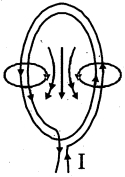
For the circular coil carrying current shown alongside,draw magnetic field lines. Decide which of its face behaves as North Pole and which face as South Pole. Give reason to justify your answer.
Solution
(N/A) The face of the circular coil where the current flows in an anti-clockwise direction behaves as the North Pole,as the magnetic field lines emerge from it.
Conversely,the face where the current flows in a clockwise direction behaves as the South Pole,as the magnetic field lines enter into it.
Based on the provided image,the front face shows current flow such that it acts as the North Pole (field lines emerging),and the rear face acts as the South Pole (field lines entering).
0 likes
View Solution52
Medium
The horizontal component of the Earth's magnetic field at a place is uniform and its direction is from south to north. $A$ high current flows through a horizontal power line at this place from west to east. Consider two points $A$ and $B$ at equal distances from the wire,respectively above and below it. Giving reasons,explain where the magnetic field is stronger: at $A$ or at $B$.
Solution
(B) According to the Right-Hand Thumb Rule,the direction of the magnetic field produced by the current at point $A$ (above the wire) is from north to south.
The direction of the magnetic field produced by the current at point $B$ (below the wire) is from south to north.
The Earth's horizontal magnetic field is directed from south to north.
At point $A$,the Earth's magnetic field and the magnetic field due to the current are in opposite directions,so the net magnetic field is the difference between the two.
At point $B$,the Earth's magnetic field and the magnetic field due to the current are in the same direction,so the net magnetic field is the sum of the two.
Therefore,the total magnetic field is stronger at point $B$.
0 likes
View Solution53
Medium
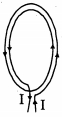
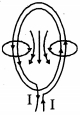
For the circular coil carrying current shown alongside,draw magnetic field lines. Decide which of its face behaves as north pole and which face as south pole. Give reason to justify your answer.
Solution
(N/A) The face of the circular coil in which the current flows in an anticlockwise direction behaves as the north pole,and the face in which the current flows in a clockwise direction behaves as the south pole.
Based on the provided image,the front face has current flowing in an anticlockwise direction,so it acts as the north pole.
The rear face has current flowing in a clockwise direction,so it acts as the south pole.
This is because magnetic field lines emerge from the north pole and enter the south pole.
0 likes
View Solution54
Medium
How will the magnetic field produced in a current-carrying circular coil change if we increase the:
$(i)$ value of current flowing through it?
$(ii)$ distance of point $P$ from the coil?
$(iii)$ number of turns of the coil?
$(i)$ value of current flowing through it?
$(ii)$ distance of point $P$ from the coil?
$(iii)$ number of turns of the coil?
Solution
(N/A) $(i)$ The magnetic field is directly proportional to the current flowing through the coil $(B \propto I)$. Therefore,increasing the current will increase the magnetic field.
$(ii)$ The magnetic field is inversely proportional to the distance from the coil. As the distance of point $P$ from the coil increases,the magnetic field at that point will decrease.
$(iii)$ The magnetic field is directly proportional to the number of turns in the coil $(B \propto N)$. Therefore,increasing the number of turns will increase the magnetic field.
0 likes
View Solution55
Medium
What happens to the deflection of the compass needle placed at a point near a current-carrying straight conductor:
$(a)$ If the current is increased?
$(b)$ If the direction of current in the conductor is changed (reversed)?
$(c)$ If the compass is moved away from the conductor?
$(a)$ If the current is increased?
$(b)$ If the direction of current in the conductor is changed (reversed)?
$(c)$ If the compass is moved away from the conductor?
Solution
(N/A) The deflection of the compass needle increases because the strength of the magnetic field produced by the conductor is directly proportional to the magnitude of the current flowing through it.
$(b)$ The direction of deflection in the compass needle changes (reverses) because the direction of the magnetic field lines around the conductor is reversed when the direction of the current is reversed.
$(c)$ The deflection of the compass needle decreases because the strength of the magnetic field decreases as the distance from the current-carrying conductor increases.
0 likes
View Solution56
Easy
Name any three factors on which the magnitude of the magnetic field due to a solenoid depends.
Solution
(N/A) The magnitude of the magnetic field produced by a solenoid depends on the following three factors:
$(i)$ The strength of the current flowing through the solenoid: The magnetic field strength is directly proportional to the current.
$(ii)$ The number of turns (loops) in the solenoid: The magnetic field strength increases as the number of turns per unit length increases.
$(iii)$ The nature of the core material: Placing a soft iron rod inside the solenoid significantly increases the magnetic field strength due to magnetization.
0 likes
View Solution57
Medium
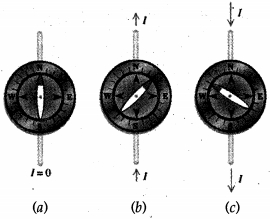
Draw a diagram to show how a magnetic needle deflects when it is placed above or below a straight conductor carrying current,depending on the direction of the current in the conductor.
Solution
(N/A) The diagram is as shown in the figure.
Consider a wire connected to a battery such that current flows through it. Place a magnetic compass directly over a horizontal wire. The needle points north when there is no current $(I = 0)$,as shown in Fig. $(a)$.
When a current is passed towards the north,the needle deflects towards the east,as shown in Fig. $(b)$.
When the current is passed towards the south,the needle deflects towards the west,as shown in Fig. $(c)$.
When the compass is placed directly below the wire,the direction of the needle's deflection is reversed.
Since a magnetic needle can be deflected only due to the presence of a magnetic field,it can be concluded that a magnetic field is produced around the current-carrying wire.
0 likes
View Solution58
Medium
$(a)$ An electric current is passed in a horizontal copper wire from east to west. Explain your observations when a compass needle is placed $(i)$ below this wire,$(ii)$ above the wire. Draw inference from your observations.
$(b)$ List the factors on which the strength of the magnetic field due to a straight conductor carrying current depend. How should these be changed to decrease magnetic field at a point?
$(b)$ List the factors on which the strength of the magnetic field due to a straight conductor carrying current depend. How should these be changed to decrease magnetic field at a point?
Solution
(A) According to Oersted's experiment and the Right-Hand Thumb Rule,when current flows from east to west,the magnetic field lines form concentric circles around the wire. $(i)$ When the compass is placed below the wire,the north pole of the needle will deflect towards the south. $(ii)$ When the compass is placed above the wire,the north pole of the needle will deflect towards the north. Inference: The direction of the magnetic field depends on the direction of the current and the position of the point relative to the wire.
$(b)$ The strength of the magnetic field $(B)$ due to a straight current-carrying conductor depends on: $(i)$ The magnitude of the electric current $(I)$: $B$ is directly proportional to $I$. $(ii)$ The perpendicular distance $(r)$ from the conductor: $B$ is inversely proportional to $r$. To decrease the magnetic field at a point,one should: $(i)$ Decrease the magnitude of the current flowing through the conductor. $(ii)$ Increase the perpendicular distance of the point from the conductor.
$(b)$ The strength of the magnetic field $(B)$ due to a straight current-carrying conductor depends on: $(i)$ The magnitude of the electric current $(I)$: $B$ is directly proportional to $I$. $(ii)$ The perpendicular distance $(r)$ from the conductor: $B$ is inversely proportional to $r$. To decrease the magnetic field at a point,one should: $(i)$ Decrease the magnitude of the current flowing through the conductor. $(ii)$ Increase the perpendicular distance of the point from the conductor.
0 likes
View Solution59
Medium
$(a)$ What is an electromagnet? What does it consist of?
$(b)$ Name one material in each case which is used to make a: $(i)$ permanent magnet $(ii)$ temporary magnet.
$(c)$ Describe an activity to show how you can make an electromagnet in your school laboratory.
$(b)$ Name one material in each case which is used to make a: $(i)$ permanent magnet $(ii)$ temporary magnet.
$(c)$ Describe an activity to show how you can make an electromagnet in your school laboratory.
Solution
(N/A) An electromagnet is a device that produces a magnetic field around its conductor coil when an electric current is passed through it. It consists of a core of soft iron or its alloy and a solenoid conductor coil wound around the core.
$(b)$ $(i)$ Alnico alloy is used for making permanent magnets.
$(ii)$ Soft iron is used for making temporary magnets.
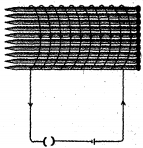
$(c)$ Take about $10$ iron nails of equal length and wrap an insulated copper wire around them in the form of a solenoid coil. Now,connect this arrangement to a battery and a key switch as shown in the diagram. When the current is passed through the coil,the nails inside the coil act as a core and become magnetized. Such an arrangement is called an electromagnet.
0 likes
View Solution60
Medium
Describe an activity to show that the magnetic field produced by a given current in a wire decreases as the distance from the wire increases.
Solution
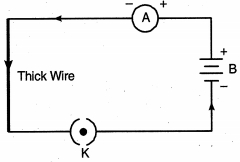
(N/A) To demonstrate this,we set up a circuit consisting of a battery $(12 \, V)$,a plug key $(K)$,an ammeter $(A)$,and a long thick copper wire as shown in the diagram.
$1$. Close the plug key $(K)$ to allow current to flow through the circuit.
$2$. Place a magnetic compass needle near the thick copper wire and observe its deflection.
$3$. Gradually move the compass needle away from the wire while keeping the current in the circuit constant.
$4$. We will observe that as the distance between the compass needle and the wire increases,the deflection of the needle decreases.
This observation confirms that the strength of the magnetic field produced by the current-carrying wire decreases as the distance from the wire increases.
0 likes
View Solution61
Easy
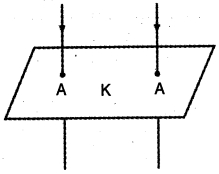
The following diagram shows two straight wires carrying current. Copy the diagram and draw the pattern of lines of force around them and mark their directions.
Solution
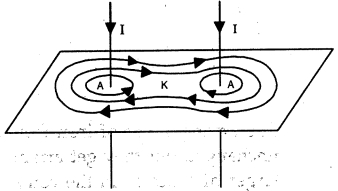
(N/A) According to the right-hand thumb rule,when current flows through a straight wire,the magnetic field lines form concentric circles around the wire.
Since both wires carry current in the same downward direction,the magnetic field lines around each wire will be in the clockwise direction.
As the lines of force from both wires interact,they form a combined pattern where the lines between the wires cancel each other out to some extent,resulting in the pattern shown in the figure below.
0 likes
View Solution62
Easy
State the energy change which takes place when a magnet is moved inside a coil having a galvanometer at its ends. Name this phenomenon.
Solution
(N/A) When a magnet is moved inside a coil,the mechanical work done in moving the magnet is converted into electrical energy,which is detected by the deflection in the galvanometer.
The phenomenon is known as electromagnetic induction.
The phenomenon is known as electromagnetic induction.
0 likes
View Solution63
Medium
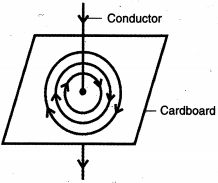
$A$ straight conductor passes vertically through a cardboard sprinkled with iron filings. Show the setting of iron filings when a weak current is passed in the downward direction and then the cardboard is gently tapped. Draw arrows to represent the direction of magnetic field lines.
What changes occur if,
$(i)$ the strength of current is increased?
$(ii)$ the single conductor is replaced by several parallel conductors each carrying same current flowing in the same direction?
What changes occur if,
$(i)$ the strength of current is increased?
$(ii)$ the single conductor is replaced by several parallel conductors each carrying same current flowing in the same direction?
Solution
(N/A) The image shows the pattern in which iron filings will set themselves. The arrows show the direction of magnetic field lines,which is clockwise for a downward current.
$(i)$ The arrangement of iron filings remains unchanged,but they get arranged up to a larger distance from the conductor when the strength of current is increased. This is because on increasing the strength of current,the strength of the magnetic field increases and it becomes effective up to a larger distance from the conductor.
$(ii)$ This increases the total magnetic field strength,as such the iron filings get arranged up to a larger distance from the conductors.
0 likes
View Solution64
Medium
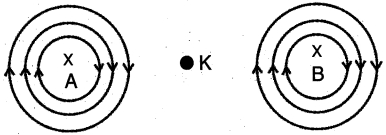
In the below figure,$A$ and $B$ represent two straight wires carrying equal currents in a direction at right angles to the plane of paper inwards. Sketch separately the magnetic field lines produced by each current. Give a reason why the magnetic field at $K$ (mid-point of the line joining $A$ and $B$) will be zero.
What will be the effect on the magnetic field at $K$ if the current in wire $B$ is reversed?
What will be the effect on the magnetic field at $K$ if the current in wire $B$ is reversed?

Solution
(N/A) The magnetic field lines produced by the current in wires $A$ and $B$ are concentric circles centered at the wires,with their direction determined by the Right-Hand Thumb Rule. Since both currents flow inwards,the field lines are clockwise.
Point $K$ is equidistant from wires $A$ and $B$. Since both wires carry equal currents,the magnetic fields produced at $K$ by wire $A$ and wire $B$ are equal in magnitude. According to the Right-Hand Thumb Rule,the magnetic field due to wire $A$ at $K$ points in one direction (e.g.,upwards),while the magnetic field due to wire $B$ at $K$ points in the opposite direction (e.g.,downwards). Because these two fields are equal in magnitude and opposite in direction,they cancel each other out,making the net magnetic field at point $K$ zero.
If the direction of current in wire $B$ is reversed (i.e.,it flows outwards),the direction of the magnetic field produced by wire $B$ at point $K$ also reverses. Consequently,both magnetic fields at point $K$ will now point in the same direction and add up,resulting in a non-zero net magnetic field.
0 likes
View Solution65
Medium
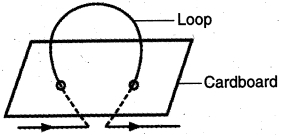
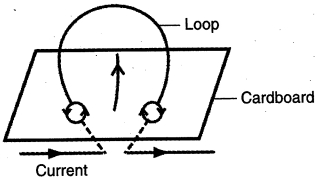
The figure below shows a current-carrying loop passing through a sheet of cardboard. Draw three magnetic field lines on the cardboard.
Give two factors on which the magnitude of the magnetic field at the centre of the loop depends.
Give two factors on which the magnitude of the magnetic field at the centre of the loop depends.
Solution
(N/A) The magnetic field lines around a current-carrying circular loop are concentric circles near the points where the wire passes through the cardboard. As we move towards the centre of the loop,the circles become larger and larger,and near the centre,the field lines appear as straight lines.
The magnitude of the magnetic field $(B)$ at the centre of a circular current-carrying loop depends on the following two factors:
$(i)$ The strength of the current $(I)$ flowing through the loop: The magnitude of the magnetic field is directly proportional to the current $(B \propto I)$.
$(ii)$ The radius of the loop $(r)$: The magnitude of the magnetic field is inversely proportional to the radius of the loop $(B \propto 1/r)$.
0 likes
View Solution66
Medium
$A$ student performs an experiment to study the magnetic effect of current around a current-carrying straight conductor. He reports that:
$(i)$ The direction of deflection of the north pole of a compass needle kept at a given point near the conductor remains unaffected even when the terminals of the battery sending current in the wire are interchanged.
$(ii)$ For a given battery,the degree of deflection of a $N$-pole decreases when the compass is kept at a point farther away from the conductor.
Which of the above observations of the student is incorrect and why?
Solution
(A) $(i)$ The first statement is incorrect because the direction of the magnetic field around the conductor is reversed when the direction of the current flowing in the conductor changes. Hence,the direction of deflection of the $N$-pole of the compass needle cannot remain unaffected when the terminals of the battery sending current in the wire or conductor are interchanged.
$(ii)$ The second statement is correct because the magnetic field strength decreases with an increase in the distance from the conductor.
$(ii)$ The second statement is correct because the magnetic field strength decreases with an increase in the distance from the conductor.
0 likes
View Solution67
MediumMCQ
By increasing the number of turns $3$ times in a toroidal solenoid,the magnetic field:
A
will remain unchanged
B
will become three times
C
will reduce to one-third
D
none of these
Solution
(B) The magnetic field $B$ inside a toroidal solenoid is given by the formula $B = \mu_0 n I$,where $n$ is the number of turns per unit length $(n = N / 2\pi r)$.
Substituting $n$,we get $B = \mu_0 (N / 2\pi r) I$.
Here,$N$ is the total number of turns,$I$ is the current,and $r$ is the radius of the toroid.
Since $B \propto N$,if the number of turns $N$ is increased by $3$ times,the magnetic field $B$ will also increase by $3$ times.
Substituting $n$,we get $B = \mu_0 (N / 2\pi r) I$.
Here,$N$ is the total number of turns,$I$ is the current,and $r$ is the radius of the toroid.
Since $B \propto N$,if the number of turns $N$ is increased by $3$ times,the magnetic field $B$ will also increase by $3$ times.
0 likes
View Solution68
EasyMCQ
$A$ soft iron bar is introduced inside a current-carrying solenoid. The magnetic field inside the solenoid:
A
will increase
B
will decrease
C
no change
D
uncertain
Solution
(A) When a soft iron bar is placed inside a current-carrying solenoid,it acts as a core.
Soft iron is a ferromagnetic material with high magnetic permeability.
When the solenoid is energized,the soft iron core gets strongly magnetized by the magnetic field of the solenoid.
The total magnetic field inside the solenoid becomes the sum of the magnetic field produced by the current in the solenoid and the magnetic field produced by the magnetized soft iron core.
Therefore,the overall magnetic field inside the solenoid increases significantly.
0 likes
View Solution69
EasyMCQ
Inside a current carrying solenoid,the magnetic field lines are:
A
circular and do not intersect
B
along the axis of the solenoid and parallel to each other
C
perpendicular to the axis of the solenoid
D
none of these
Solution
(B) solenoid is a long coil containing a large number of close turns of insulated copper wire.
When an electric current flows through the solenoid,it produces a magnetic field similar to that of a bar magnet.
Inside the solenoid,the magnetic field lines are in the form of parallel straight lines.
This indicates that the magnetic field is uniform at all points inside the solenoid and is directed along the axis of the solenoid.
0 likes
View Solution70
EasyMCQ
The material of the core of a strong electromagnet is:
A
steel
B
wrought iron
C
soft iron
D
brass
Solution
(C) An electromagnet is a type of magnet in which the magnetic field is produced by an electric current.
To create a strong electromagnet, the core material must have high magnetic permeability and low retentivity.
$soft \ iron$ is an ideal material for this purpose because it can be easily magnetized and demagnetized.
When the current is switched on, it becomes a strong magnet, and when the current is switched off, it loses its magnetism almost instantly.
Therefore, $soft \ iron$ is used for the core of a strong electromagnet.
0 likes
View Solution71
EasyMCQ
The magnetic field around a current-carrying straight conductor is:
A
directly proportional to $r$
B
inversely proportional to $r$
C
directly proportional to $r^{2}$
D
inversely proportional to $r^{2}$
Solution
(B) According to the Biot-Savart Law,the magnetic field $B$ produced by a long straight current-carrying conductor at a distance $r$ from the conductor is given by the formula: $B = \frac{\mu_{0}I}{2\pi r}$.
From this expression,it is clear that the magnetic field $B$ is inversely proportional to the distance $r$ from the conductor $(B \propto 1/r)$.
From this expression,it is clear that the magnetic field $B$ is inversely proportional to the distance $r$ from the conductor $(B \propto 1/r)$.
0 likes
View Solution72
EasyMCQ
The strength of the magnetic field of a solenoid does not depend upon:
A
current through it
B
number of turns of the coil
C
area of the coil
D
core of the coil
Solution
(C) The magnetic field strength $(B)$ inside a long solenoid is given by the formula $B = \mu_0 n I$,where $\mu_0$ is the permeability of free space,$n$ is the number of turns per unit length,and $I$ is the current flowing through the solenoid.
If a core material is used,the field becomes $B = \mu n I$,where $\mu$ is the permeability of the core material.
From this formula,it is clear that the magnetic field depends on the current $(I)$,the number of turns per unit length $(n)$,and the nature of the core material $(\mu)$.
The magnetic field strength of an ideal long solenoid does not depend on the cross-sectional area of the coil.
0 likes
View Solution73
EasyMCQ
If the direction of current is reversed,the direction of magnetic field is also reversed.
A
True
B
False
Solution
(A) According to the Right-Hand Thumb Rule,the direction of the magnetic field produced by a current-carrying conductor depends on the direction of the current flow.
If the direction of the current is reversed,the orientation of the magnetic field lines also reverses,as predicted by the rule.
If the direction of the current is reversed,the orientation of the magnetic field lines also reverses,as predicted by the rule.
0 likes
View Solution74
EasyMCQ
The magnetic field produced by a straight current-carrying conductor is in the form of concentric circles.
A
True
B
False
Solution
(A) According to the Right-Hand Thumb Rule,when a current flows through a straight conductor,the magnetic field lines generated around it are circular in shape.
These field lines are concentric,meaning they share the same center,which is the conductor itself.
As the distance from the conductor increases,the circles become larger and the magnetic field strength decreases.
These field lines are concentric,meaning they share the same center,which is the conductor itself.
As the distance from the conductor increases,the circles become larger and the magnetic field strength decreases.
0 likes
View Solution75
EasyMCQ
The magnetic field produced by a current-carrying solenoid depends directly upon the strength of the current.
A
True
B
False
Solution
(A) The magnetic field strength $(B)$ inside a current-carrying solenoid is given by the formula $B = \mu_0 n I$,where $\mu_0$ is the permeability of free space,$n$ is the number of turns per unit length,and $I$ is the current flowing through the solenoid.
Since $B \propto I$,the magnetic field is directly proportional to the strength of the current flowing through the solenoid.
Therefore,the statement is True.
Since $B \propto I$,the magnetic field is directly proportional to the strength of the current flowing through the solenoid.
Therefore,the statement is True.
0 likes
View Solution76
EasyMCQ
The strength of the induced potential difference depends on the relative speed between the coil and the magnet.
A
True
B
False
Solution
(A) According to Faraday's law of electromagnetic induction,the magnitude of the induced electromotive force $(EMF)$ or potential difference in a coil is directly proportional to the rate of change of magnetic flux linked with the coil.
When a magnet moves relative to a coil,the magnetic flux changes.
The rate of change of magnetic flux depends on the relative speed between the magnet and the coil.
Therefore,a higher relative speed results in a faster change in magnetic flux,which induces a stronger potential difference.
When a magnet moves relative to a coil,the magnetic flux changes.
The rate of change of magnetic flux depends on the relative speed between the magnet and the coil.
Therefore,a higher relative speed results in a faster change in magnetic flux,which induces a stronger potential difference.
0 likes
View Solution77
EasyMCQ
The magnetic field produced by a current in a straight wire has no poles.
A
True
B
False
Solution
(A) The magnetic field lines produced by a current-carrying straight wire are concentric circles around the wire. Unlike a bar magnet,which has distinct North and South poles,a magnetic field generated by a straight current-carrying conductor does not have defined poles. Therefore,the statement is True.
0 likes
View Solution78
EasyMCQ
The magnetic field produced in a straight conducting wire on passing the current through it is ............ .
A
in the direction of current
B
in the direction opposite to the current
C
circular around the wire
D
in the direction parallel to the wire
Solution
(C) When an electric current flows through a straight conducting wire,it generates a magnetic field around it. According to the Right-Hand Thumb Rule,the magnetic field lines are represented as concentric circles centered on the wire. Therefore,the magnetic field produced is circular around the wire.
0 likes
View Solution79
EasyMCQ
What is the nature of the magnetic field lines passing through the center of a current-carrying circular loop?
A
Circular
B
Straight line
C
Elliptical
D
No magnetic field at the center
Solution
(B) As we move away from the wire of a current-carrying circular loop,the concentric circles representing the magnetic field lines become larger and larger.
At the center of the circular loop,the arcs of these large circles appear as straight lines.
Therefore,the magnetic field lines passing through the center of a current-carrying circular loop are straight lines.
At the center of the circular loop,the arcs of these large circles appear as straight lines.
Therefore,the magnetic field lines passing through the center of a current-carrying circular loop are straight lines.
0 likes
View Solution80
EasyMCQ
Whose magnetic field is like a magnetic field of a bar magnet?
A
Current carrying wire
B
Current carrying ring
C
Current carrying solenoid
D
Current carrying rectangular loop
Solution
(C) current-carrying solenoid consists of a long coil of many circular turns of insulated copper wire wrapped in a cylindrical form.
When current flows through the solenoid,it produces a magnetic field pattern that is identical to that of a bar magnet.
The magnetic field lines emerge from one end (acting as the North pole) and enter the other end (acting as the South pole),forming closed loops both inside and outside the solenoid,just like a bar magnet.
0 likes
View Solution81
EasyMCQ
On which principle does an electric generator work?
A
It converts electrical energy into mechanical energy.
B
It converts electrical energy into heat energy.
C
It converts mechanical energy into electrical energy.
D
It converts electrical energy into light energy.
Solution
(C) An electric generator works on the principle of $Electromagnetic \text{ } Induction$.
It converts mechanical energy into electrical energy by rotating a coil within a magnetic field, which induces an electric current.
It converts mechanical energy into electrical energy by rotating a coil within a magnetic field, which induces an electric current.
0 likes
View Solution82
EasyMCQ
At the centre of which of the following four circular rings has the maximum magnetic field while passing equal current through each of them?
A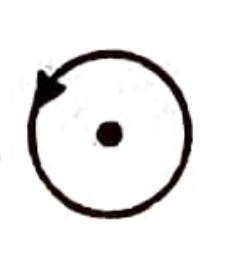
B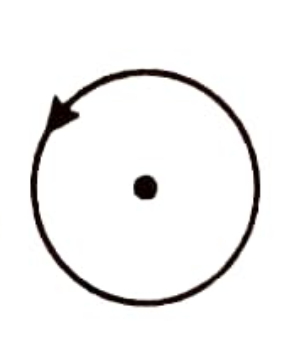
C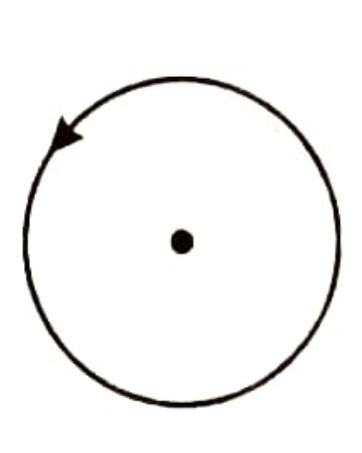
D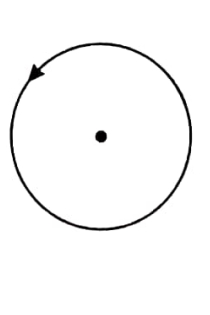
Solution
(A) The magnetic field $B$ at the centre of a circular current-carrying coil is given by the formula $B = \frac{\mu_0 I}{2R}$,where $\mu_0$ is the permeability of free space,$I$ is the current,and $R$ is the radius of the coil.
Since the current $I$ is equal for all rings,the magnetic field $B$ is inversely proportional to the radius $R$ of the ring $(B \propto \frac{1}{R})$.
Therefore,the smaller the radius $R$,the larger the magnetic field $B$ at the centre.
Thus,the ring with the smallest radius will have the maximum magnetic field at its centre.
0 likes
View Solution83
EasyMCQ
Which scientist discovered that an electric current can be produced using a magnetic field?
A
Oersted
B
Faraday
C
Volta
D
Joule
Solution
(B) Michael Faraday discovered the phenomenon of electromagnetic induction in $1831$. He demonstrated that a changing magnetic field can induce an electric current in a conductor. This principle is the basis for the operation of electric generators and transformers.
0 likes
View Solution84
EasyMCQ
How does the magnetic field produced by a current-carrying straight wire vary with the distance from the wire?
A
Directly proportional
B
Directly proportional to the square of the distance
C
Inversely proportional
D
Inversely proportional to the square of the distance
Solution
(C) According to the Biot-Savart Law,the magnetic field $B$ produced by a long straight current-carrying wire at a distance $r$ is given by the formula $B = \frac{\mu_0 I}{2 \pi r}$.
From this expression,it is clear that the magnetic field $B$ is inversely proportional to the distance $r$ from the wire $(B \propto \frac{1}{r})$.
Therefore,as the distance from the wire increases,the magnetic field decreases in inverse proportion to the distance.
From this expression,it is clear that the magnetic field $B$ is inversely proportional to the distance $r$ from the wire $(B \propto \frac{1}{r})$.
Therefore,as the distance from the wire increases,the magnetic field decreases in inverse proportion to the distance.
0 likes
View Solution85
EasyMCQ
The magnetic field produced by a current flowing through a straight conductor is inversely proportional to the $........$.
A
Current flowing
B
Distance
C
Radius of the wire
D
Length of the wire
Solution
(B) According to the Biot-Savart Law or the right-hand thumb rule application for a straight current-carrying conductor,the magnitude of the magnetic field $B$ at a distance $r$ from the conductor is given by the formula $B = \frac{\mu_0 I}{2 \pi r}$.
From this expression,it is clear that the magnetic field $B$ is directly proportional to the current $I$ $(B \propto I)$ and inversely proportional to the perpendicular distance $r$ from the conductor $(B \propto \frac{1}{r})$.
Therefore,the magnetic field is inversely proportional to the distance from the conductor.
0 likes
View Solution86
EasyMCQ
The direction of the magnetic field produced by a current-carrying straight wire depends on which of the following?
A
Magnitude of the electric current
B
Direction of the electric current
C
Length of the straight wire
D
Material of the straight wire
Solution
(B) According to the Right-Hand Thumb Rule,if you hold a current-carrying straight conductor in your right hand such that your thumb points in the direction of the current,then your fingers will wrap around the conductor in the direction of the magnetic field lines. Therefore,the direction of the magnetic field is determined by the direction of the electric current flowing through the wire.
0 likes
View Solution87
EasyMCQ
The magnetic field at the center of a circular loop carrying an electric current is inversely proportional to $..........$.
A
Electric current
B
Radius of the loop
C
Number of turns
D
Material of the loop
Solution
(B) The magnetic field $B$ at the center of a circular loop of radius $R$ carrying a current $I$ with $N$ turns is given by the formula: $B = \frac{\mu_0 N I}{2R}$.
From this formula,it is clear that the magnetic field $B$ is directly proportional to the current $I$ and the number of turns $N$,and inversely proportional to the radius $R$ of the loop.
Therefore,the magnetic field at the center is inversely proportional to the radius of the loop.
From this formula,it is clear that the magnetic field $B$ is directly proportional to the current $I$ and the number of turns $N$,and inversely proportional to the radius $R$ of the loop.
Therefore,the magnetic field at the center is inversely proportional to the radius of the loop.
0 likes
View Solution88
EasyMCQ
If a circular loop is made of $6$ closely wound turns instead of a single turn,the magnetic field produced at the center of the loop becomes $.........$ times stronger.
A
$2$
B
$3$
C
$6$
D
$12$
Solution
(C) The magnetic field $B$ at the center of a circular loop carrying current $I$ with radius $r$ and $N$ turns is given by the formula: $B = \frac{\mu_0 N I}{2r}$.
From this formula,it is clear that the magnetic field $B$ is directly proportional to the number of turns $N$ $(B \propto N)$.
If the number of turns increases from $1$ to $6$,the magnetic field will also increase by a factor of $6$.
Therefore,the magnetic field becomes $6$ times stronger.
From this formula,it is clear that the magnetic field $B$ is directly proportional to the number of turns $N$ $(B \propto N)$.
If the number of turns increases from $1$ to $6$,the magnetic field will also increase by a factor of $6$.
Therefore,the magnetic field becomes $6$ times stronger.
0 likes
View Solution89
EasyMCQ
What is the coil-like structure made of insulated copper wire wound in a cylindrical shape called?
A
Electromagnet
B
Computer
C
Solenoid
D
Cylindrical magnet
Solution
(C) coil of many circular turns of insulated copper wire wrapped closely in the shape of a cylinder is called a $Solenoid$.
When an electric current flows through the $Solenoid$,it produces a magnetic field similar to that of a bar magnet.
The magnetic field lines inside the $Solenoid$ are parallel to each other,indicating a uniform magnetic field.
When an electric current flows through the $Solenoid$,it produces a magnetic field similar to that of a bar magnet.
The magnetic field lines inside the $Solenoid$ are parallel to each other,indicating a uniform magnetic field.
0 likes
View Solution90
EasyMCQ
By placing an iron-like metal inside the solenoid,its magnetic field becomes $......$
A
stronger
B
weaker
C
steady
D
zero
Solution
(A) When a soft iron rod is placed inside a solenoid,it acts as a core.
Soft iron is a ferromagnetic material,which gets easily magnetized by the magnetic field produced by the current flowing through the solenoid.
This induced magnetism adds to the magnetic field of the solenoid,making the overall magnetic field significantly stronger.
This arrangement is commonly used to create an electromagnet.
0 likes
View Solution91
EasyMCQ
Which type of magnet is used in a crane to lift cars?
A
Electromagnet
B
Bar magnet
C
Needle magnet
D
Natural magnet
Solution
(A) An electromagnet is used in cranes to lift heavy loads like cars in junkyards.
This is because an electromagnet can be turned on and off by controlling the electric current.
When the current is switched on,the crane becomes magnetic and picks up the metal object.
When the current is switched off,the magnetic field disappears,allowing the load to be released easily.
This is because an electromagnet can be turned on and off by controlling the electric current.
When the current is switched on,the crane becomes magnetic and picks up the metal object.
When the current is switched off,the magnetic field disappears,allowing the load to be released easily.
0 likes
View Solution92
EasyMCQ
Four circular loops of radii $1 \; CM$,$2 \; CM$,$3 \; CM$,and $4 \; CM$ carry the same electric current. At the center of which loop will the magnetic field be the strongest?
A
$4 \; CM$ radius
B
$3 \; CM$ radius
C
$2 \; CM$ radius
D
$1 \; CM$ radius
Solution
(D) The magnetic field $B$ at the center of a circular current-carrying loop is given by the formula $B = \frac{\mu_0 I}{2R}$,where $\mu_0$ is the permeability of free space,$I$ is the current,and $R$ is the radius of the loop.
From this formula,it is clear that the magnetic field $B$ is inversely proportional to the radius $R$ $(B \propto \frac{1}{R})$.
Since the current $I$ is the same for all loops,the loop with the smallest radius will have the strongest magnetic field at its center.
Comparing the given radii ($1 \; CM$,$2 \; CM$,$3 \; CM$,and $4 \; CM$),the smallest radius is $1 \; CM$.
Therefore,the loop with a radius of $1 \; CM$ will have the strongest magnetic field at its center.
0 likes
View Solution93
EasyMCQ
According to Fleming's right-hand rule,what is indicated by the direction of the center finger?
A
Direction of magnetic force
B
Direction of motion of conductor
C
Direction of an induced electric current
D
Direction of magnetic field
Solution
(C) Fleming's right-hand rule is used to determine the direction of the induced current in a conductor moving in a magnetic field.
According to this rule,if we stretch the thumb,forefinger,and middle finger of the right hand such that they are mutually perpendicular to each other:
$1$. The thumb points in the direction of the motion of the conductor.
$2$. The forefinger points in the direction of the magnetic field.
$3$. The center (middle) finger points in the direction of the induced electric current.
0 likes
View SolutionMagnetic Effects of Electric Current — Magnetic Field due to a Current-carrying Conductor · Frequently Asked Questions
1Are these Magnetic Effects of Electric Current questions useful for JEE and NEET?
Yes. All questions in this section are mapped to JEE Main and NEET exam patterns. Previous year questions from JEE Main, NEET, GUJCET and state-level exams are included with full solutions.
2Can I switch to Hindi or Gujarati for these questions?
Yes. Use the language tabs in the hero section or the sidebar to view the same questions and solutions in English, Hindi or Gujarati.
3How do I generate a question paper from this subtopic?
Use the Vedclass Exam Paper Generator — select the chapter and subtopic, set difficulty, and generate Sets A, B, C, D automatically. First 3 chapters of every subject are free.
Vedclass Products
For Students
Vedclass Test Series
Mock tests in real JEE/NEET style with performance analysis. 5-day free trial.
Start Free TrialFor Teachers
Exam Paper Generator
Generate Set A/B/C/D papers from this chapter in 2 minutes. 3 chapters free.
Try FreeFor Institutes
Online Exam Module
Live online exams with unlimited students, 360° analytics & white-label branding.
See DemoFor Teachers & Institutes
Generate a Magnetic Effects of Electric Current Exam Paper in 2 Minutes
Select subtopic & difficulty — Sets A, B, C, D auto-generated with No Repeat logic.
First 3 chapters of every subject are free — no payment required.