
A English
Mix Examples - Magnetic Effects of Electric Current Questions in English
Class 10 Science · Magnetic Effects of Electric Current · Mix Examples - Magnetic Effects of Electric Current
53+
Questions
English
Language
100%
With Solutions
Showing 50 of 53 questions in English
1
EasyMCQ
Which sources produce alternating current?
A
Dry cell
B
Car battery
C
$AC$ generator
D
Button cell
Solution
(C) An alternating current $(AC)$ is a type of electrical current that periodically reverses its direction and changes its magnitude continuously with time.
$AC$ generators (alternators) are the primary sources that produce alternating current by rotating a coil within a magnetic field.
Power plants,such as hydroelectric,thermal,and nuclear power stations,also generate $AC$ electricity for distribution to homes and industries.
$AC$ generators (alternators) are the primary sources that produce alternating current by rotating a coil within a magnetic field.
Power plants,such as hydroelectric,thermal,and nuclear power stations,also generate $AC$ electricity for distribution to homes and industries.
0 likes
View Solution2
EasyMCQ
The device used for producing electric current is called a
A
motor
B
ammeter
C
galvanometer
D
generator
Solution
(D) An electric generator is a device that converts mechanical energy into electrical energy. It works on the principle of electromagnetic induction to produce an electric current.
0 likes
View Solution3
MediumMCQ
The essential difference between an $AC$ generator and a $DC$ generator is that
A
$AC$ generator has slip rings while the $DC$ generator has a commutator.
B
$AC$ generator has an electromagnet while a $DC$ generator has a permanent magnet.
C
$DC$ generator will generate a higher voltage.
D
$AC$ generator will generate a higher voltage.
Solution
(A) An $AC$ generator uses two slip rings to maintain continuous contact with the rotating coil,allowing the current to reverse direction periodically.
In contrast,a $DC$ generator uses a split-ring commutator,which reverses the connection of the coil to the external circuit every half rotation,ensuring that the current flows in only one direction in the external circuit.
Therefore,the fundamental difference lies in the type of ring assembly used.
In contrast,a $DC$ generator uses a split-ring commutator,which reverses the connection of the coil to the external circuit every half rotation,ensuring that the current flows in only one direction in the external circuit.
Therefore,the fundamental difference lies in the type of ring assembly used.
0 likes
View Solution4
MediumMCQ
State whether the following statements are true $(T)$ or false $(F)$.
$(a)$ An electric motor converts mechanical energy into electrical energy.
$(b)$ An electric generator works on the principle of electromagnetic induction.
$(a)$ An electric motor converts mechanical energy into electrical energy.
$(b)$ An electric generator works on the principle of electromagnetic induction.
A
$(a)-(T); (b)-(F)$
B
$(a)-(F); (b)-(F)$
C
$(a)-(F); (b)-(T)$
D
$(a)-(T); (b)-(T)$
Solution
(C) False.
An electric motor is a device that converts electrical energy into mechanical energy.
$(b)$ True.
An electric generator is a device that converts mechanical energy into electrical energy. It works on the principle of electromagnetic induction,where a changing magnetic flux through a coil induces an electromotive force $(EMF)$.
0 likes
View Solution5
Medium
Name some devices in which electric motors are used.
Solution
(N/A) Electric motors are devices that convert electrical energy into mechanical energy. Some common devices that use electric motors are as follows:
$(a)$ Water pumps
$(b)$ Electric fans
$(c)$ Electric mixers and grinders
$(d)$ Washing machines
$(e)$ Refrigerators
$(f)$ Electric drills
$(a)$ Water pumps
$(b)$ Electric fans
$(c)$ Electric mixers and grinders
$(d)$ Washing machines
$(e)$ Refrigerators
$(f)$ Electric drills
0 likes
View Solution6
MediumMCQ
State the rule to determine the direction of: $(i)$ a magnetic field produced around a straight current-carrying conductor,$(ii)$ force experienced by a current-carrying straight conductor placed in a magnetic field perpendicular to it,and $(iii)$ current induced in a coil due to its rotation in a magnetic field.
A
Maxwell's right-hand thumb rule,Fleming's left-hand rule,Fleming's right-hand rule
B
Fleming's right-hand rule,Fleming's left-hand rule,Maxwell's right-hand thumb rule
C
Right-hand thumb rule,Right-hand rule,Left-hand rule
D
None of the above
Solution
(A) $(i)$ Maxwell's right-hand thumb rule: If you hold a current-carrying conductor in your right hand such that your thumb points in the direction of the current,then your fingers will wrap around the conductor in the direction of the magnetic field lines.
$(ii)$ Fleming's left-hand rule: Stretch the thumb,forefinger,and middle finger of your left hand such that they are mutually perpendicular. If the forefinger points in the direction of the magnetic field,the middle finger in the direction of the current,then the thumb will point in the direction of the force experienced by the conductor.
$(iii)$ Fleming's right-hand rule: Stretch the thumb,forefinger,and middle finger of your right hand such that they are mutually perpendicular. If the forefinger points in the direction of the magnetic field and the thumb in the direction of the motion of the conductor,then the middle finger will point in the direction of the induced current.
0 likes
View Solution7
EasyMCQ
Commercial electric motors do not use
A
an electromagnet to rotate the armature
B
a permanent magnet to rotate the armature
C
effectively large number of turns of conducting wire in the current carrying coil
D
a soft iron core on which the coil is wound
Solution
(B) Commercial electric motors are designed for high power and efficiency.
$1$. They use an electromagnet instead of a permanent magnet because electromagnets can generate much stronger magnetic fields,which are essential for high-torque applications.
$2$. They use a large number of turns of conducting wire to increase the magnetic effect of the coil.
$3$. They use a soft iron core on which the coil is wound to increase the magnetic flux through the coil.
Therefore,commercial electric motors do not use a permanent magnet to rotate the armature.
0 likes
View Solution8
MediumMCQ
Choose the incorrect statement.
A
Fleming's right-hand rule is a simple rule to know the direction of induced current.
B
The right-hand thumb rule is used to find the direction of magnetic fields due to current-carrying conductors.
C
The difference between the direct and alternating currents is that the direct current always flows in one direction,whereas the alternating current reverses its direction periodically.
D
In India,the $AC$ changes direction after every $\frac{1}{50}$ second.
Solution
(D) The frequency of $AC$ in India is $50 \, Hz$. This means the current completes $50$ cycles in one second. Since the current reverses its direction twice in each cycle,the total number of reversals per second is $100$. Therefore,the direction of the current changes after every $\frac{1}{100}$ second. Thus,the statement in option $D$ is incorrect.
0 likes
View Solution9
Medium
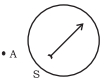
$A$ magnetic compass needle is placed in the plane of paper near point $A$ as shown in the figure. In which plane should a straight current-carrying conductor be placed so that it passes through $A$ and there is no change in the deflection of the compass? Under what condition is the deflection maximum and why?
Solution
(N/A) The conductor should be placed in the plane of the paper itself. Since the axis of the compass needle is vertical,the magnetic field produced by a current-carrying conductor lying in the same plane as the compass will also be vertical at the position of the needle. $A$ vertical magnetic field cannot exert a torque on a compass needle that is pivoted to rotate only in the horizontal plane,hence there is no change in deflection.
The deflection is maximum when the conductor passing through $A$ is placed perpendicular to the plane of the paper. In this orientation,the magnetic field lines produced by the current form concentric circles in the plane of the paper,exerting the maximum horizontal torque on the compass needle.
The deflection is maximum when the conductor passing through $A$ is placed perpendicular to the plane of the paper. In this orientation,the magnetic field lines produced by the current form concentric circles in the plane of the paper,exerting the maximum horizontal torque on the compass needle.
0 likes
View Solution10
Medium
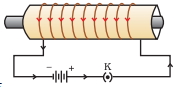
Under what conditions is a permanent magnet obtained if a current-carrying solenoid is used? Support your answer with the help of a labelled circuit diagram.
Solution
(N/A) To obtain a permanent magnet using a current-carrying solenoid,the following conditions must be met:
$(i)$ The core material placed inside the solenoid must be a magnetically hard material,such as steel,which retains its magnetism even after the current is switched off.
(ii) $A$ direct current $(DC)$ must be passed through the solenoid to magnetize the core material effectively.
(iii) Once the steel rod is placed inside the solenoid and the current is passed,it becomes a permanent magnet.
0 likes
View Solution11
MediumMCQ
What does the direction of the thumb indicate in the Right-Hand Thumb Rule? In what way is this rule different from Fleming's Left-Hand Rule?
A
Thumb indicates current direction; Fleming's rule indicates force direction.
B
Thumb indicates magnetic field; Fleming's rule indicates current direction.
C
Thumb indicates force direction; Fleming's rule indicates magnetic field.
D
Both rules indicate the same physical quantity.
Solution
(A) In the Right-Hand Thumb Rule,the thumb points in the direction of the conventional current flowing through a straight conductor,while the curled fingers represent the direction of the magnetic field lines around it.
In contrast,Fleming's Left-Hand Rule is used to determine the direction of the force (or motion) experienced by a current-carrying conductor when placed in an external magnetic field.
Therefore,the Right-Hand Thumb Rule relates current to magnetic field,whereas Fleming's Left-Hand Rule relates current,magnetic field,and force.
0 likes
View Solution12
MediumMCQ
Name four appliances wherein an electric motor,a rotating device that converts electrical energy to mechanical energy,is used as an important component. In what respect are motors different from generators?
A
Electric fans
B
Mixers
C
Washing machines
D
Computer drives
Solution
(A-D) Four appliances that use an electric motor as an important component are:
$1$. Electric fans
$2$. Mixers
$3$. Washing machines
$4$. Computer drives
Difference between motors and generators:
- An electric motor converts electrical energy into mechanical energy.
- $A$ generator converts mechanical energy into electrical energy.
$1$. Electric fans
$2$. Mixers
$3$. Washing machines
$4$. Computer drives
Difference between motors and generators:
- An electric motor converts electrical energy into mechanical energy.
- $A$ generator converts mechanical energy into electrical energy.
0 likes
View Solution13
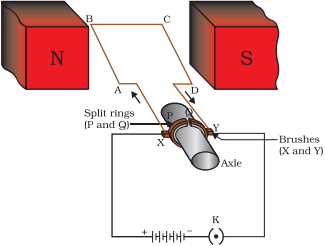
Draw a labelled circuit diagram of a simple electric motor and explain its working. In what way are these simple electric motors different from commercial motors?
Solution
(N/A) Working of an electric motor: An electric motor consists of a rectangular coil $ABCD$ of insulated copper wire placed between the two poles of a magnetic field. The ends of the coil are connected to the two halves $P$ and $Q$ of a split ring. The inner sides of these halves are insulated and attached to an axle. The external conducting edges of $P$ and $Q$ touch two conducting stationary brushes $X$ and $Y$. Current in the coil $ABCD$ enters from the source battery through conducting brush $X$ and flows back to the battery through brush $Y$. When current flows through the coil,a magnetic force acts on the arms $AB$ and $CD$. According to Fleming's Left-Hand Rule,the force on arm $AB$ pushes it downwards,while the force on arm $CD$ pushes it upwards. Thus,the coil and the axle rotate in an anti-clockwise direction. At half rotation,$Q$ makes contact with the brush $X$ and $P$ with brush $Y$. Therefore,the current in the coil gets reversed and flows along the path $DCBA$. This reversal of current reverses the direction of force acting on the two arms,and the coil continues to rotate in the same direction.
Differences from commercial motors:
$1$. Commercial motors use an electromagnet in place of a permanent magnet.
$2$. They use a large number of turns of conducting wire in the current-carrying coil.
$3$. They use a soft iron core on which the coil is wound to increase the magnetic field strength.
Differences from commercial motors:
$1$. Commercial motors use an electromagnet in place of a permanent magnet.
$2$. They use a large number of turns of conducting wire in the current-carrying coil.
$3$. They use a soft iron core on which the coil is wound to increase the magnetic field strength.
0 likes
View Solution14
Medium
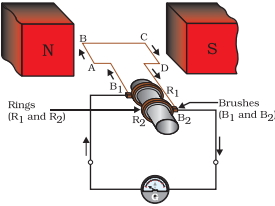
Describe the working of an $AC$ generator with the help of a labelled circuit diagram. What changes must be made in the arrangement to convert it to a $DC$ generator?
Solution
(N/A) Working of an $AC$ generator: An $AC$ generator consists of a rectangular coil placed between the poles of a strong permanent magnet. When the coil is rotated,the magnetic flux linked with it changes,inducing an alternating current $(AC)$ in the coil. The current flows through two slip rings ($R_1$ and $R_2$) and two stationary brushes ($B_1$ and $B_2$),which maintain contact with the rings.
Conversion to a $DC$ generator: To convert an $AC$ generator into a $DC$ generator,the slip rings must be replaced with a split-ring type commutator. This commutator reverses the direction of the current in the external circuit every half rotation,ensuring that the current flows in only one direction,thus producing direct current $(DC)$.
Conversion to a $DC$ generator: To convert an $AC$ generator into a $DC$ generator,the slip rings must be replaced with a split-ring type commutator. This commutator reverses the direction of the current in the external circuit every half rotation,ensuring that the current flows in only one direction,thus producing direct current $(DC)$.
0 likes
View Solution15
EasyMCQ
An alternating electric current has a frequency of $50 \ Hz$. How many times does it change its direction in one second (in $\times$)?
A
$50$
B
$100$
C
$25$
D
$200$
Solution
(B) An alternating current $(AC)$ completes one full cycle by changing its direction twice.
Given that the frequency of the current is $50 \ Hz$, it means the current completes $50$ cycles in $1 \ second$.
Since the current changes its direction twice in every cycle, the total number of times it changes its direction in $1 \ second$ is $50 \times 2 = 100$ times.
Given that the frequency of the current is $50 \ Hz$, it means the current completes $50$ cycles in $1 \ second$.
Since the current changes its direction twice in every cycle, the total number of times it changes its direction in $1 \ second$ is $50 \times 2 = 100$ times.
0 likes
View Solution16
EasyMCQ
Which of the following devices is used for producing electric current?
A
$(i)$ Generator
B
$(ii)$ Voltmeter
C
$(iii)$ Ammeter
D
$(iv)$ Galvanometer
Solution
(A) $(i)$ Generator. An electric generator is a device that converts mechanical energy into electrical energy, thereby producing an electric current.
$(ii)$ Voltmeter is used to measure the potential difference between two points in an electric circuit.
$(iii)$ Ammeter is used to measure the magnitude of electric current in a circuit.
$(iv)$ Galvanometer is used to detect the presence and direction of a small electric current in a circuit.
$(ii)$ Voltmeter is used to measure the potential difference between two points in an electric circuit.
$(iii)$ Ammeter is used to measure the magnitude of electric current in a circuit.
$(iv)$ Galvanometer is used to detect the presence and direction of a small electric current in a circuit.
0 likes
View Solution17
EasyMCQ
$A$ square coil moves in a plane with uniform velocity $v$ parallel to its sides. $A$ magnetic field $B$ points perpendicular and into the loop. What is the induced current in the coil?
A
Directly proportional to $v$
B
Directly proportional to $B$
C
Zero
D
Constant but non-zero
Solution
(C) According to Faraday's law of electromagnetic induction, an induced current is generated only when there is a change in the magnetic flux $(\Phi_B)$ linked with the coil.
Magnetic flux is given by $\Phi_B = B \cdot A \cdot \cos(\theta)$, where $A$ is the area of the coil and $\theta$ is the angle between the magnetic field and the area vector.
Since the coil is moving with a uniform velocity $v$ in a uniform magnetic field $B$ and the area $A$ remains constant, the magnetic flux $\Phi_B$ linked with the coil does not change over time.
Since $\frac{d\Phi_B}{dt} = 0$, the induced electromotive force $(e = -\frac{d\Phi_B}{dt})$ is zero.
Therefore, the induced current in the coil is zero.
0 likes
View Solution18
EasyMCQ
How is the induced current in a secondary coil related to the current in a primary coil?
A
It is always greater than the current in the primary coil.
B
It is always less than the current in the primary coil.
C
It is always equal to the current in the primary coil.
D
It may be greater than or less than the current in the primary coil.
Solution
(D) The induced current in a secondary coil depends on the number of turns in the primary and secondary coils ($N_p$ and $N_s$) and the rate of change of magnetic flux.
According to the transformer principle,the ratio of currents is inversely proportional to the ratio of the number of turns: $\frac{I_s}{I_p} = \frac{N_p}{N_s}$.
If $N_s > N_p$ (step-up transformer),the secondary current $I_s$ will be less than the primary current $I_p$.
If $N_s < N_p$ (step-down transformer),the secondary current $I_s$ will be greater than the primary current $I_p$.
Therefore,the induced current in the secondary coil may be greater than or less than the current in the primary coil depending on the transformer design.
0 likes
View Solution19
Medium
$(a)$ What is electromagnetic induction?
$(b)$ In what way can the magnitude of the induced current be increased?
$(b)$ In what way can the magnitude of the induced current be increased?
Solution
(N/A) Electromagnetic induction is the phenomenon of producing an induced current in a coil when the magnetic field associated with it changes with time.
$(b)$ The magnitude of the induced current can be increased by:
$1$. Increasing the strength of the magnetic field.
$2$. Increasing the speed of movement of the conductor relative to the magnetic field.
$3$. Increasing the number of turns in the coil.
$(b)$ The magnitude of the induced current can be increased by:
$1$. Increasing the strength of the magnetic field.
$2$. Increasing the speed of movement of the conductor relative to the magnetic field.
$3$. Increasing the number of turns in the coil.
0 likes
View Solution20
Medium
What is meant by electromagnetic induction? State the rule which helps in determining the direction of induced current.
Solution
(N/A) Electromagnetic induction: It is the phenomenon of generating an induced electromotive force $(EMF)$ or potential difference in a conductor due to a change in the magnetic field linked with a coil.
Fleming's Right-Hand Rule: Stretch the thumb,forefinger,and middle finger of your right hand such that they are mutually perpendicular to each other. If the forefinger points in the direction of the magnetic field and the thumb points in the direction of the motion of the conductor,then the middle finger indicates the direction of the induced current in the conductor.
Fleming's Right-Hand Rule: Stretch the thumb,forefinger,and middle finger of your right hand such that they are mutually perpendicular to each other. If the forefinger points in the direction of the magnetic field and the thumb points in the direction of the motion of the conductor,then the middle finger indicates the direction of the induced current in the conductor.
0 likes
View Solution21
Medium
List three sources of magnetic fields.
Solution
(N/A) $(i)$ Magnetic field produced by a permanent bar magnet.
$(ii)$ Magnetic field produced by a straight current-carrying conductor.
$(iii)$ Magnetic field produced by a current-carrying circular loop.
$(ii)$ Magnetic field produced by a straight current-carrying conductor.
$(iii)$ Magnetic field produced by a current-carrying circular loop.
0 likes
View Solution22
EasyMCQ
What does the direction of the thumb indicate in the Right-Hand Thumb Rule? In what way is this rule different from Fleming's Left-Hand Rule?
A
Thumb indicates current direction; Fleming's rule indicates force direction.
B
Thumb indicates magnetic field; Fleming's rule indicates current.
C
Thumb indicates force; Fleming's rule indicates magnetic field.
D
Both rules indicate the same physical quantity.
Solution
(A) In the Right-Hand Thumb Rule,the thumb points in the direction of the conventional current flowing through a straight conductor,while the curled fingers represent the direction of the magnetic field lines around it.
In contrast,Fleming's Left-Hand Rule is used to determine the direction of the magnetic force (or motion) experienced by a current-carrying conductor when placed in an external magnetic field.
Therefore,the Right-Hand Thumb Rule relates current to the magnetic field,whereas Fleming's Left-Hand Rule relates current,magnetic field,and force.
0 likes
View Solution23
Medium
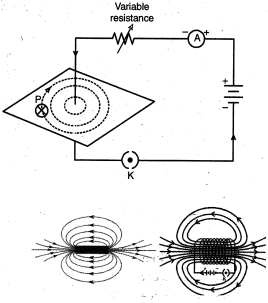
$(a)$ Describe an activity to show the pattern of magnetic field lines of a bar magnet,with the help of a cardboard piece and iron filings.
$(b)$ Compare the magnetic field of a bar magnet with that of a current-carrying solenoid with the help of a figure.
$(b)$ Compare the magnetic field of a bar magnet with that of a current-carrying solenoid with the help of a figure.
Solution
(N/A) Activity: Place a bar magnet on a sheet of white paper fixed on a drawing board. Sprinkle some iron filings uniformly around the bar magnet using a salt sprinkler. Gently tap the board. You will observe that the iron filings arrange themselves in a pattern representing the magnetic field lines of the bar magnet. The filings align along the field lines because each filing experiences a force in the magnetic field.
$(b)$ Comparison: The magnetic field lines produced by a current-carrying solenoid are very similar to those of a bar magnet. In both cases,the field lines emerge from the North pole and enter the South pole outside the magnet/solenoid. Inside,the field lines go from the South pole to the North pole. $A$ current-carrying solenoid behaves like a bar magnet with one end acting as the North pole and the other as the South pole.
$(b)$ Comparison: The magnetic field lines produced by a current-carrying solenoid are very similar to those of a bar magnet. In both cases,the field lines emerge from the North pole and enter the South pole outside the magnet/solenoid. Inside,the field lines go from the South pole to the North pole. $A$ current-carrying solenoid behaves like a bar magnet with one end acting as the North pole and the other as the South pole.
0 likes
View Solution24
Difficult
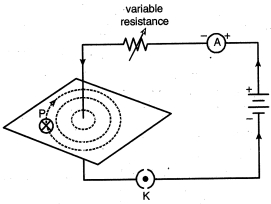
$(a)$ Describe an activity to determine the direction of magnetic field produced by a current-carrying straight conductor. Also,show that the direction of the magnetic field is reversed on reversing the direction of current.
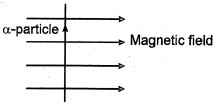
$(b)$ An $\alpha$-particle (which is a positively charged particle) enters a uniform magnetic field at right angles to it as shown below. Stating the relevant principle,explain in which direction will this $\alpha$-particle move?
$(b)$ An $\alpha$-particle (which is a positively charged particle) enters a uniform magnetic field at right angles to it as shown below. Stating the relevant principle,explain in which direction will this $\alpha$-particle move?
Solution
(N/A) Take a battery $(12\, V)$,a variable resistance (or a rheostat),an ammeter $(0-5\, A)$,a plug key,and a long straight thick copper wire. Insert the thick wire through the center,normal to the plane of a rectangular cardboard. Take care that the cardboard is fixed and does not slide.
Connect the copper wire vertically in series with the battery,a plug key,and a rheostat. Sprinkle some iron filings uniformly on the cardboard. Keep the rheostat at a fixed position and note the current through the ammeter. Close the key so that a current flows through the wire. Gently tap the cardboard a few times. You would find that the iron filings align themselves in a pattern of concentric circles around the copper wire. This represents the magnetic field around the current-carrying conductor.
If the direction of current through the straight conductor is reversed (by reversing the battery terminals),the direction of the magnetic field lines also gets reversed.
$(b)$ Here,the motion of the $\alpha$-particle ($+$ve charge) in the given direction represents the direction of conventional current. By using Fleming's left-hand rule,we find that the force acting on the $\alpha$-particle is directed perpendicular to the plane of the paper,pointing inward. Hence,the $\alpha$-particle will be deflected into the plane of the paper.
0 likes
View Solution25
Medium
Explain the meanings of the words "electromagnetic" and "induction" in the term electromagnetic induction. List three factors on which the value of induced current produced in a circuit depends. Name and state the rule used to determine the direction of induced current. State one practical application of this phenomenon in everyday life.
Solution
(N/A) Electromagnetic refers to the production of electric current in a coil under the influence of a magnetic field. Induction refers to the process of generating an electrical flow in a conductor without direct physical contact with a magnetized body.
Factors affecting the magnitude of induced current:
$(i)$ Number of turns in the coil.
$(ii)$ Strength of the magnetic field.
$(iii)$ Relative speed of the magnet with respect to the coil.
Rule: Fleming's Right-Hand Rule.
Statement: Stretch the thumb, forefinger, and middle finger of your right hand such that they are mutually perpendicular to each other. If the forefinger points in the direction of the magnetic field and the thumb indicates the direction of motion of the conductor, then the middle finger will point in the direction of the induced current.
Practical application: Electric Generator.
0 likes
View Solution26
Medium
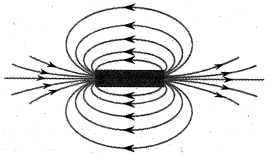
$(a)$ Draw magnetic field lines of a bar magnet. "Two magnetic field lines never intersect each other". Why?
$(b)$ An electric oven of $1.5 \, kW$ is operated in a domestic circuit $(220 \, V)$ that has a current rating of $5 \, A$. What result do you expect in this case? Explain.
$(b)$ An electric oven of $1.5 \, kW$ is operated in a domestic circuit $(220 \, V)$ that has a current rating of $5 \, A$. What result do you expect in this case? Explain.
Solution
(N/A) Magnetic field lines around a bar magnet originate from the North pole and enter the South pole outside the magnet, forming closed loops.
If two magnetic field lines were to intersect at a point, it would imply that there are two directions of the magnetic field at that single point, which is physically impossible.
$(b)$ Given: Power $(P) = 1.5 \, kW = 1500 \, W$, Voltage $(V) = 220 \, V$, Current rating $= 5 \, A$.
Using the formula $P = V \times I$, the current $(I)$ drawn by the oven is:
$I = \frac{P}{V} = \frac{1500 \, W}{220 \, V} \approx 6.82 \, A$.
Since the current drawn $(6.82 \, A)$ is significantly higher than the current rating of the circuit $(5 \, A)$, the circuit will experience an overload. This will likely cause the fuse to blow or the circuit breaker to trip, cutting off the power supply to prevent damage to the wiring.
0 likes
View Solution27
Medium
$(a)$ What is meant by a 'magnetic field'?
$(b)$ How is the direction of magnetic field at a point determined?
$(c)$ Describe an activity to demonstrate the direction of the magnetic field generated around a current-carrying conductor.
$(d)$ What is the direction of the magnetic field at the centre of a current-carrying circular loop?
$(b)$ How is the direction of magnetic field at a point determined?
$(c)$ Describe an activity to demonstrate the direction of the magnetic field generated around a current-carrying conductor.
$(d)$ What is the direction of the magnetic field at the centre of a current-carrying circular loop?
Solution
(N/A) magnetic field is the region surrounding a magnet or a current-carrying conductor in which its magnetic influence can be experienced by other magnetic materials.
$(b)$ The direction of the magnetic field at a point is determined using a magnetic compass. The north pole of the compass needle points in the direction of the magnetic field. It can also be determined using the Right-Hand Thumb Rule.
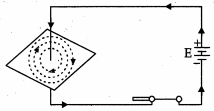
$(c)$ Activity: Take a piece of cardboard and pass a straight copper wire through its centre,perpendicular to the plane of the cardboard. Connect the ends of the wire to a battery and a switch. Sprinkle some iron filings uniformly on the cardboard. When the current is passed through the wire,tap the cardboard gently. You will observe that the iron filings align themselves in a pattern of concentric circles around the wire. These circles represent the magnetic field lines. The direction of these lines can be determined by placing a magnetic compass at different points on the circles. If the direction of the current is reversed,the direction of the magnetic field lines also reverses.
$(d)$ At the centre of a current-carrying circular loop,the magnetic field lines are straight and perpendicular to the plane of the loop.
0 likes
View Solution28
Difficult
Describe in short an activity to:
$(i)$ demonstrate the pattern of magnetic field lines around a straight current-carrying conductor, and
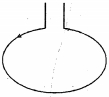
$(ii)$ find the direction of the magnetic field produced for a given direction of current in the conductor. Name and state the rule to find the direction of the magnetic field associated with a current-carrying conductor. Apply this rule to determine the direction of the magnetic field inside and outside a current-carrying circular loop lying horizontally on a table. Assume that the current through the loop is anticlockwise.
Solution
(N/A) $(i)$ Take a battery $(12 \, V)$, a variable resistance (or a rheostat), an ammeter $(0-5 \, A)$, a plug key, and a long straight thick copper wire. Insert the thick wire through the centre, normal to the plane of a rectangular cardboard. Take care that the cardboard is fixed and does not slide up or down. Connect the copper wire vertically between the points $X$ and $Y$ in series with the battery, a plug, and a key. Sprinkle some iron filings uniformly on the cardboard. Keep the variable of the rheostat at a fixed position and note the current through the ammeter. Close the key so that a current flows through the wire. Ensure that the copper wire placed between the points $X$ and $Y$ remains vertically straight. Gently tap the cardboard a few times. Observe the pattern of the iron filings. You would find that the iron filings align themselves showing a pattern of concentric circles around the copper wire.
$(ii)$ When a magnetic compass is placed on these lines, it experiences a force in the direction of the magnetic field. Thus, the direction of deflection of the needle of the compass gives the direction of the magnetic field. Now, when the current is reversed, the direction of deflection of the needle also reverses. This shows that the direction of the magnetic field has also reversed. The rule is the Right-Hand Thumb Rule. It states that: "Imagine that you are holding a current-carrying straight conductor in your right hand such that your thumb points towards the direction of current. Then your fingers will wrap around the conductor in the direction of the field lines of the magnetic field."
For a circular loop lying horizontally on a table with anticlockwise current: By applying the Right-Hand Thumb Rule, the magnetic field lines inside the loop will be directed vertically upwards, and outside the loop, they will be directed vertically downwards.
0 likes
View Solution29
Medium
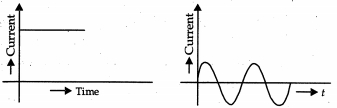
In our daily life,we use two types of electric current whose current-time graphs are given below:
$(i)$ Name the type of current in two cases.
$(ii)$ Identify any one source for each type of current.
$(iii)$ What is the frequency of current in case $(b)$ in our country?
$(iv)$ On the basis of these graphs,list two differences between the two currents.
$(v)$ Out of the two,which one is used in transmitting electric power over long distances and why?
Solution
(N/A) $(i)$ $(a)$ Direct current $(DC)$
$(b)$ Alternating current $(AC)$
$(ii)$ Source of direct current: Battery or cell. Source of alternating current: $AC$ generator or power plant.
$(iii)$ The frequency of $AC$ in our country is $50 \, Hz$.
$(iv)$ Two differences between the two currents are:
$1$. The magnitude of $DC$ remains constant with time,whereas the magnitude of $AC$ changes continuously with time.
$2$. The direction of $DC$ remains fixed,whereas the direction of $AC$ reverses periodically.
$(v)$ Alternating current $(AC)$ is used for transmitting electric power over long distances because it can be stepped up or down using transformers,which significantly reduces energy loss during transmission compared to $DC$.
0 likes
View Solution30
$(a)$ Which effect of the electric current is utilised in the working of an electrical fuse?
$(b)$ Is a fuse connected in series or in parallel in a household circuit?
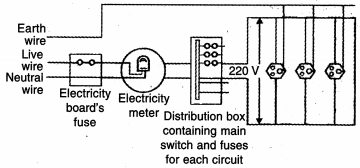
$(c)$ Draw a schematic labelled diagram of a domestic circuit which has a provision of a main fuse,meter,one light bulb,and a switch socket.
$(b)$ Is a fuse connected in series or in parallel in a household circuit?
$(c)$ Draw a schematic labelled diagram of a domestic circuit which has a provision of a main fuse,meter,one light bulb,and a switch socket.
Solution
(N/A) The heating effect of electric current is utilised in the working of an electrical fuse. When the current exceeds the safe limit,the wire melts due to excessive heat,breaking the circuit.
$(b)$ $A$ fuse is always connected in series with the live wire in a household circuit so that it can break the circuit if the current becomes too high.
$(c)$ The schematic diagram of a domestic circuit is provided below.
$(b)$ $A$ fuse is always connected in series with the live wire in a household circuit so that it can break the circuit if the current becomes too high.
$(c)$ The schematic diagram of a domestic circuit is provided below.
0 likes
View Solution31
Medium
Answer the following questions:
$(i)$ What is the direction of magnetic field lines outside a bar-magnet?
$(ii)$ Why two magnetic field lines cannot intersect each other?
$(iii)$ What is indicated by crowding of magnetic field lines in a given region?
$(iv)$ What is the frequency of $AC$ in India?
$(v)$ State one advantage of $AC$ over $DC$.
Solution
(N/A) $(i)$ Outside a bar magnet,the direction of magnetic field lines is from the North pole to the South pole.
$(ii)$ Two magnetic field lines cannot intersect each other because if they did,it would mean that at the point of intersection,the compass needle would point towards two different directions simultaneously,which is physically impossible.
$(iii)$ The crowding of magnetic field lines in a given region indicates that the magnetic field is stronger in that region.
$(iv)$ The frequency of $AC$ in India is $50 \, Hz$.
$(v)$ One major advantage of $AC$ over $DC$ is that $AC$ can be transmitted over long distances without significant loss of electrical energy.
0 likes
View Solution32
Medium
$(a)$ Define electromagnetic induction.
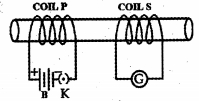
$(b)$ Two coils $P$ and $S$ are wound over the same iron core. Coil $P$ is connected to a battery and a key,and coil $S$ is connected to a galvanometer. Draw a suitable diagram of this arrangement and write your observations when:
$(i)$ current in the coil $P$ is started by closing the key.
$(ii)$ current continues to flow in coil $P$.
$(iii)$ current in coil $P$ is stopped by removing the key.
Explain the reason for such observations.
Solution
(N/A) Electromagnetic induction is the phenomenon of generating an electric current in a conductor by changing the magnetic field associated with it.
$(b)$ The diagram shows two coils $P$ (primary) and $S$ (secondary) wound on an iron core.
$(i)$ When the key is closed,the current in coil $P$ increases from zero to a maximum value. This causes a change in the magnetic field linked with coil $S$,resulting in a momentary deflection in the galvanometer.
$(ii)$ When the current flows steadily in coil $P$,the magnetic field associated with coil $S$ remains constant. Since there is no change in the magnetic flux,there is no induced current,and the galvanometer shows zero deflection.
$(iii)$ When the key is removed,the current in coil $P$ decreases to zero. This causes a rapid change in the magnetic field linked with coil $S$,resulting in a momentary deflection in the galvanometer in the opposite direction.
0 likes
View Solution33
Medium
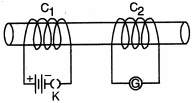
Two coils $C_{1}$ and $C_{2}$ are wrapped around a non-conducting cylinder. Coil $C_{1}$ is connected to a battery and a key $K$,and coil $C_{2}$ is connected to a galvanometer $G$. On pressing the key $K$,current starts flowing in the coil $C_{1}$. State your observations in the galvanometer for the following cases:
$(i)$ When key $K$ is pressed on.
$(ii)$ When current in the coil $C_{1}$ is switched off.
$(iii)$ When the current is passed continuously through coil $C_{1}$.
$(iv)$ Name and state the phenomenon responsible for the above observation. Write the name of the rule that is used to determine the direction of the induced current.
Solution
(N/A) $(i)$ The galvanometer will show a momentary deflection towards one side because the magnetic flux linked with coil $C_{2}$ changes as the current in $C_{1}$ increases from zero to a steady value.
$(ii)$ The galvanometer will show a momentary deflection in the direction opposite to the previous one because the magnetic flux linked with coil $C_{2}$ decreases as the current in $C_{1}$ drops to zero.
$(iii)$ The galvanometer will not show any deflection because the current in $C_{1}$ is steady,meaning the magnetic flux linked with $C_{2}$ remains constant.
$(iv)$ The phenomenon is electromagnetic induction. It is the process by which a changing magnetic field in one conductor induces an electromotive force $(EMF)$ and a current in another conductor placed near it. Fleming's right-hand rule is used to determine the direction of the induced current.
0 likes
View Solution34
Medium
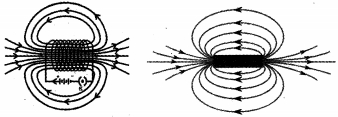
What is a solenoid? Draw the magnetic field lines for a solenoid and a bar magnet. Compare the two and state one similarity.
Solution
(N/A) solenoid is a coil of many circular turns of insulated copper wire wrapped closely in the shape of a cylinder.
The magnetic field lines for a solenoid and a bar magnet are shown in the provided image.
Comparison and Similarity:
$1$. Similarity: The pattern of magnetic field lines produced by a current-carrying solenoid is identical to that of a bar magnet. In both cases,the field lines emerge from the North pole and enter the South pole outside the magnet,and travel from South to North inside the magnet.
$2$. Comparison: $A$ solenoid acts as an electromagnet,meaning its magnetic field can be turned on or off by controlling the current,whereas a bar magnet is a permanent magnet with a constant magnetic field.
0 likes
View Solution35
Medium
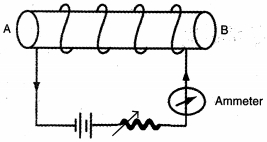
The diagram below shows a circuit containing a coil wound over a long and thin hollow cardboard tube. Copy the diagram and:
$(i)$ Show the polarity acquired by each face of the solenoid.
$(ii)$ Draw the magnetic field lines of force inside the coil and also show their direction.
$(iii)$ Mention two methods to increase the strength of the magnetic field inside the coil.
$(i)$ Show the polarity acquired by each face of the solenoid.
$(ii)$ Draw the magnetic field lines of force inside the coil and also show their direction.
$(iii)$ Mention two methods to increase the strength of the magnetic field inside the coil.
Solution
(N/A) $(i)$ Based on the direction of current flow,end $A$ acts as the North pole and end $B$ acts as the South pole.
$(ii)$ The magnetic field lines inside the solenoid are parallel to the axis of the solenoid,indicating a uniform magnetic field. The direction of the field lines is from the South pole to the North pole inside the coil.
$(iii)$ Two methods to increase the strength of the magnetic field inside the coil are:
$1$. Increase the magnitude of the current flowing through the coil.
$2$. Increase the number of turns in the coil or insert a soft iron core inside the solenoid.
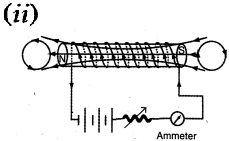
0 likes
View Solution36
Medium
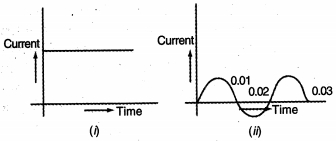
In the diagrams shown below:
$(i)$ Name the type of current in two cases.
$(ii)$ Identify any one source for each type of these currents.
$(iii)$ What is the frequency of current in case $(ii)$ in India?
$(iv)$ Use above graphs to write two differences between the current in two cases.
$(i)$ Name the type of current in two cases.
$(ii)$ Identify any one source for each type of these currents.
$(iii)$ What is the frequency of current in case $(ii)$ in India?
$(iv)$ Use above graphs to write two differences between the current in two cases.
Solution
(N/A) $(i)$ The current is direct current $(dc)$ in the first case and is alternating current $(ac)$ in the second case.
$(ii)$ $(a)$ Battery $(b)$ $ac$ generator.
$(iii)$ $50 \ Hz$.
$(iv)$
$(ii)$ $(a)$ Battery $(b)$ $ac$ generator.
$(iii)$ $50 \ Hz$.
$(iv)$
| $dc$ | $ac$ |
|---|---|
| Current always flows in the same direction. | Current changes magnitude and direction periodically. |
| Cannot be easily converted into $ac$. | Can be easily converted into $dc$. |
0 likes
View Solution37
Medium
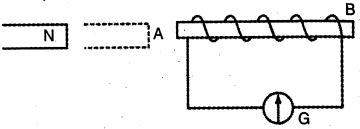
The diagram below shows a coil connected to a centre zero galvanometer $G$. The galvanometer shows a deflection to the right when the $N$ pole of a powerful magnet is moved to the right as shown.
$(i)$ Explain why the deflection occurs in the galvanometer.
$(ii)$ Does the direction of current in the coil appear clockwise or anticlockwise when viewed from end $A$?
$(iii)$ State the observation in $G$ when the coil is moved away from $N$.
$(iv)$ State the observation in $G$ when,both coil and the magnet,are moved to the right at the same speed.
Solution
(N/A) $(i)$ The deflection occurs due to the change in magnetic flux linked with the coil as the magnet moves. This change in magnetic flux induces an electromotive force $(emf)$ in the coil,which causes an induced current to flow through the galvanometer.
$(ii)$ According to Lenz's Law,the induced current will create a magnetic pole at end $A$ that opposes the approaching $N$ pole of the magnet. Thus,end $A$ acts as an $N$ pole. When viewed from end $A$,the direction of the current appears anticlockwise.
$(iii)$ When the coil is moved away from $N$,the magnetic flux linked with the coil decreases. This induces a current in the opposite direction,causing the galvanometer to show a deflection to the left.
$(iv)$ When both the coil and the magnet are moved to the right at the same speed,there is no relative motion between them. Consequently,there is no change in the magnetic flux linked with the coil,and the galvanometer shows no deflection (zero reading).
0 likes
View Solution38
EasyMCQ
$A$ current-carrying wire produces:
A
an electric field
B
a magnetic field
C
both electric and magnetic fields
D
neither electric nor magnetic field
Solution
(C) When a current flows through a wire,it creates a magnetic field around it,as demonstrated by Oersted's experiment. Additionally,because the wire contains charges (electrons) moving through it,there is also an electric field associated with the potential difference across the wire. Therefore,a current-carrying wire produces both electric and magnetic fields.
0 likes
View Solution39
EasyMCQ
The principle of which of these devices is based on electromagnetism?
A
Transformer
B
Motor
C
Galvanometer
D
All of these
Solution
(D) Electromagnetism is the physical phenomenon where an electric current produces a magnetic field.
$1$. $A$ transformer works on the principle of mutual induction,which is a direct application of electromagnetic induction.
$2$. An electric motor works on the principle that a current-carrying conductor placed in a magnetic field experiences a force (Lorentz force).
$3$. $A$ galvanometer works on the principle that a current-carrying coil placed in a magnetic field experiences a torque.
Since all these devices rely on the interaction between electricity and magnetism,they are all based on the principles of electromagnetism.
0 likes
View Solution40
MediumMCQ
The phenomenon of electromagnetic induction is:
A
the process of charging a body
B
the process of generating a magnetic field due to current passing through a coil
C
the process of rotating a coil of an electric motor
D
producing induced current in a coil by relative motion between a magnet and a coil
Solution
(D) Electromagnetic induction is the phenomenon where an electromotive force $(EMF)$ or current is induced in a conductor due to a changing magnetic field.
This occurs when there is relative motion between a magnet and a coil,which changes the magnetic flux linked with the coil.
According to Faraday's laws of induction,this change in magnetic flux induces an electric current in the circuit.
Therefore,option $D$ is the correct definition of electromagnetic induction.
0 likes
View Solution41
EasyMCQ
$A$ device used for producing current is:
A
generator
B
voltmeter
C
ammeter
D
galvanometer
Solution
(A) An electric generator is a device that converts mechanical energy into electrical energy,thereby producing an electric current.
$A$ voltmeter is used to measure the potential difference between two points in an electric circuit.
$An$ ammeter is used to measure the magnitude of electric current flowing through a circuit.
$A$ galvanometer is an instrument used to detect and measure small amounts of electric current in a circuit.
0 likes
View Solution42
EasyMCQ
Whenever the magnetic field through a coil is changed,a potential difference is produced in the coil.
A
True
B
False
Solution
(A) The statement is $True$. This phenomenon is known as electromagnetic induction. According to Faraday's law of electromagnetic induction,whenever the magnetic flux linked with a coil changes,an electromotive force $(EMF)$ or potential difference is induced in the coil. This induced $EMF$ causes a current to flow if the circuit is closed.
0 likes
View Solution43
EasyMCQ
Electric motor converts mechanical energy into electrical energy.
A
True
B
False
Solution
(B) The statement is $False$. An electric motor is a device that converts electrical energy into mechanical energy. Conversely,an electric generator is a device that converts mechanical energy into electrical energy.
0 likes
View Solution44
EasyMCQ
An electric generator works on the principle of electromagnetic induction.
A
True
B
False
Solution
(A) An electric generator is a device that converts mechanical energy into electrical energy. It operates based on the principle of electromagnetic induction,which states that a changing magnetic flux through a coil induces an electromotive force $(EMF)$ or current in the coil. When the coil rotates within a magnetic field,the magnetic flux linked with it changes,thereby inducing an electric current.
0 likes
View Solution45
EasyMCQ
An electric generator is a device that converts electrical energy into mechanical energy.
A
True
B
False
Solution
(B) The statement is False.
An electric generator is a device that converts mechanical energy into electrical energy.
Conversely,an electric motor is a device that converts electrical energy into mechanical energy.
An electric generator is a device that converts mechanical energy into electrical energy.
Conversely,an electric motor is a device that converts electrical energy into mechanical energy.
0 likes
View Solution46
Medium
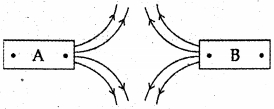
$(a)$ Magnetic field lines of two bar magnets $A$ and $B$ are as shown below. Name the poles of the magnets facing each other.
$(b)$ Two magnetic field lines never intersect each other. Why?
$(c)$ How does the strength of the magnetic field at the centre of a current-carrying circular coil depend on the
$(i)$ radius of the coil,
$(ii)$ number of turns in the coil, and
$(iii)$ strength of the current flowing in the coil?
$(b)$ Two magnetic field lines never intersect each other. Why?
$(c)$ How does the strength of the magnetic field at the centre of a current-carrying circular coil depend on the
$(i)$ radius of the coil,
$(ii)$ number of turns in the coil, and
$(iii)$ strength of the current flowing in the coil?
Solution
(N/A) The magnetic field lines are shown moving away from the poles of both magnets $A$ and $B$. Since magnetic field lines emerge from the North pole, the poles facing each other are both North poles.
$(b)$ Two magnetic field lines never intersect each other because if they did, the point of intersection would have two different directions for the magnetic field at the same time, which is physically impossible.
$(c)$ The strength of the magnetic field at the centre of a current-carrying circular coil depends on the following factors:
$(i)$ Radius of the coil: The magnetic field strength is inversely proportional to the radius of the coil $(B \propto 1/r)$. Thus, a larger radius results in a weaker magnetic field.
$(ii)$ Number of turns in the coil: The magnetic field strength is directly proportional to the number of turns $(B \propto n)$. Increasing the number of turns increases the magnetic field strength.
$(iii)$ Strength of the current: The magnetic field strength is directly proportional to the current flowing through the coil $(B \propto I)$. Increasing the current increases the magnetic field strength.
0 likes
View Solution47
EasyMCQ
The branch of science that covers the comprehensive study of electricity and magnetism is known as $.........$.
A
Electrostatics
B
Magnetism
C
Electromagnetism
D
Electric field
Solution
(C) Electromagnetism is the branch of physics that deals with the study of electromagnetic force,a type of physical interaction that occurs between electrically charged particles. It encompasses the study of both electricity and magnetism,as they are fundamentally linked phenomena. When electric charges are in motion,they create magnetic fields,and changing magnetic fields can induce electric currents,which is the core principle of electromagnetism.
0 likes
View Solution48
EasyMCQ
In which of the following devices is an electric motor $NOT$ used?
A
Mixer
B
Electric fan
C
Washing machine
D
Electric bell
Solution
(D) An electric motor is a device that converts electrical energy into mechanical energy.
Mixers,electric fans,and washing machines all utilize electric motors to produce rotational motion for their operation.
An electric bell,however,works on the principle of electromagnetism using an electromagnet to attract a clapper,which strikes the gong. It does not use a rotating electric motor.
Mixers,electric fans,and washing machines all utilize electric motors to produce rotational motion for their operation.
An electric bell,however,works on the principle of electromagnetism using an electromagnet to attract a clapper,which strikes the gong. It does not use a rotating electric motor.
0 likes
View Solution49
EasyMCQ
Which instrument converts mechanical energy to electrical energy?
A
Electric generator
B
Electric motor
C
Electric iron
D
Electric oven
Solution
(A) An electric generator is a device that converts mechanical energy into electrical energy.
It operates on the principle of electromagnetic induction,where a conductor moving in a magnetic field induces an electric current.
In contrast,an electric motor converts electrical energy into mechanical energy.
Electric irons and ovens convert electrical energy into heat energy.
It operates on the principle of electromagnetic induction,where a conductor moving in a magnetic field induces an electric current.
In contrast,an electric motor converts electrical energy into mechanical energy.
Electric irons and ovens convert electrical energy into heat energy.
0 likes
View Solution50
EasyMCQ
Which instrument works on the principle of 'Electromagnetic induction'?
A
Electric motor
B
Electric bell
C
Electric generator
D
Electric Bulb
Solution
(C) Electromagnetic induction is the phenomenon where a changing magnetic field induces an electromotive force $(EMF)$ or current in a conductor.
An electric generator works on the principle of electromagnetic induction,where mechanical energy is converted into electrical energy by rotating a coil within a magnetic field.
In contrast,an electric motor works on the principle of the magnetic effect of current (force on a current-carrying conductor in a magnetic field).
Therefore,the correct option is $C$.
0 likes
View SolutionMagnetic Effects of Electric Current — Mix Examples - Magnetic Effects of Electric Current · Frequently Asked Questions
1Are these Magnetic Effects of Electric Current questions useful for JEE and NEET?
Yes. All questions in this section are mapped to JEE Main and NEET exam patterns. Previous year questions from JEE Main, NEET, GUJCET and state-level exams are included with full solutions.
2Can I switch to Hindi or Gujarati for these questions?
Yes. Use the language tabs in the hero section or the sidebar to view the same questions and solutions in English, Hindi or Gujarati.
3How do I generate a question paper from this subtopic?
Use the Vedclass Exam Paper Generator — select the chapter and subtopic, set difficulty, and generate Sets A, B, C, D automatically. First 3 chapters of every subject are free.
Vedclass Products
For Students
Vedclass Test Series
Mock tests in real JEE/NEET style with performance analysis. 5-day free trial.
Start Free TrialFor Teachers
Exam Paper Generator
Generate Set A/B/C/D papers from this chapter in 2 minutes. 3 chapters free.
Try FreeFor Institutes
Online Exam Module
Live online exams with unlimited students, 360° analytics & white-label branding.
See DemoFor Teachers & Institutes
Generate a Magnetic Effects of Electric Current Exam Paper in 2 Minutes
Select subtopic & difficulty — Sets A, B, C, D auto-generated with No Repeat logic.
First 3 chapters of every subject are free — no payment required.