
A English
Refraction through a Prism and Dispersion Questions in English
Class 10 Science · The Human Eye and the Colourful World · Refraction through a Prism and Dispersion
68+
Questions
English
Language
100%
With Solutions
Showing 50 of 68 questions in English
1
EasyMCQ
What is a prism?
A
$A$ transparent optical element with flat,polished surfaces that refract light.
B
$A$ spherical glass object used to focus light.
C
$A$ flat mirror used for reflection.
D
$A$ concave lens used for magnification.
Solution
(A) prism is a transparent optical element with flat,polished surfaces that refract light.
It is typically a glass object with two triangular bases and three rectangular lateral surfaces inclined at an angle to each other.
It is typically a glass object with two triangular bases and three rectangular lateral surfaces inclined at an angle to each other.
0 likes
View Solution2
DifficultMCQ
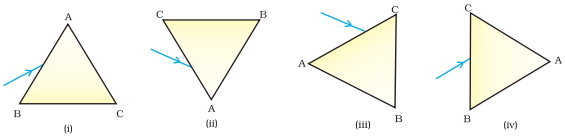
$A$ prism $ABC$ (with $BC$ as base) is placed in different orientations. $A$ narrow beam of white light is incident on the prism as shown in the figure. In which of the following cases,after dispersion,the third colour from the top corresponds to the colour of the sky?
A
$(i)$
B
$(iii)$
C
$(ii)$
D
$(iv)$
Solution
(C) When white light passes through a prism,it disperses into its constituent colours: Violet,Indigo,Blue,Green,Yellow,Orange,and Red $(VIBGYOR)$.
The light bends towards the base of the prism.
In case $(i)$,the base is $BC$. The light enters through face $AB$ and bends towards the base $BC$. The order of colours from top to bottom will be $Red, Orange, Yellow, Green, Blue, Indigo, Violet$.
The third colour from the top is Yellow.
In case $(ii)$,the prism is inverted,so the base is $BC$ at the top. The light bends towards the base (upwards). The order of colours from top to bottom will be $Violet, Indigo, Blue, Green, Yellow, Orange, Red$.
The third colour from the top is Blue,which corresponds to the colour of the sky.
Therefore,case $(ii)$ is the correct orientation.
0 likes
View Solution3
MediumMCQ
Which of the following phenomena of light are involved in the formation of a rainbow?
A
Refraction,dispersion and internal reflection
B
Refraction,dispersion and total internal reflection
C
Reflection,refraction and dispersion
D
Dispersion,scattering and total internal reflection
Solution
(B) The formation of a rainbow is a natural phenomenon caused by the dispersion of sunlight by tiny water droplets present in the atmosphere.
$1$. Refraction: As sunlight enters the water droplet,it bends due to the change in medium.
$2$. Dispersion: The white light splits into its constituent colors $(VIBGYOR)$ inside the droplet.
$3$. Total Internal Reflection: The light rays strike the inner surface of the droplet and are reflected back.
$4$. Refraction: Finally,the light rays refract again as they exit the droplet,reaching the observer's eye.
Therefore,the correct combination of phenomena is refraction,dispersion,and total internal reflection.
0 likes
View Solution4
MediumMCQ
Which of the following statements is correct regarding the propagation of light of different colours of white light in air?
A
Red light moves fastest
B
Blue light moves faster than green light
C
Yellow light moves with the mean speed as that of the red and the violet light
D
All the colours of the white light move with the same speed
Solution
(D) In a vacuum or air,all colours of white light travel with the same speed,which is approximately $3 \times 10^8 \ m/s$. Dispersion and differences in speed for different colours only occur when light travels through a dispersive medium like glass or water. Therefore,in air,all colours of white light move with the same speed.
0 likes
View Solution5
Medium
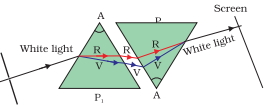
How will you use two identical prisms so that a narrow beam of white light incident on one prism emerges out of the second prism as white light? Draw the diagram.
Solution
(N/A) To obtain a beam of white light from a narrow beam of white light after passing through two prisms,the two identical prisms must be placed in an inverted position with respect to each other.
When a beam of white light enters the first prism $(P_1)$,it undergoes dispersion and splits into its constituent seven colors.
When these dispersed rays fall on the second prism $(P_2)$,which is placed in an inverted position,it recombines the colors to form a beam of white light that emerges from the second prism.
0 likes
View Solution6
Medium
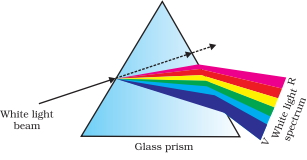
Draw a ray diagram showing the dispersion through a prism when a narrow beam of white light is incident on one of its refracting surfaces. Also,indicate the order of the colours of the spectrum obtained.
Solution
(N/A) When a narrow beam of white light is incident on one of the refracting surfaces of a glass prism,it splits into its constituent seven colours. This phenomenon is known as the dispersion of light.
The order of colours in the spectrum obtained,from the base of the prism upwards,is Violet $(V)$,Indigo $(I)$,Blue $(B)$,Green $(G)$,Yellow $(Y)$,Orange $(O)$,and Red $(R)$. This is commonly remembered by the acronym $VIBGYOR$.
Red light bends the least,while violet light bends the most because the refractive index of glass is different for different wavelengths of light.
0 likes
View Solution7
EasyMCQ
Why do we see a rainbow in the sky only after rainfall?
A
The sun is brighter after rain.
B
Water droplets act as prisms and disperse sunlight.
C
The air is cleaner after rain.
D
Raindrops reflect light like a mirror.
Solution
(B) rainbow is a natural spectrum appearing in the sky after a rain shower.
It is caused by the dispersion of sunlight by tiny water droplets,present in the atmosphere.
These water droplets act like small prisms.
They refract and disperse the incident sunlight,then reflect it internally,and finally refract it again when it comes out of the raindrop.
Due to the dispersion of light and internal reflection,we see a spectrum of colours in the form of a rainbow.
0 likes
View Solution8
Medium
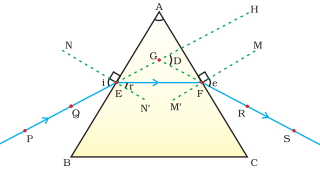
Explain the refraction of light through a triangular glass prism using a labelled ray diagram. Hence,define the angle of deviation.
Solution
(N/A) $1$. Refraction through a prism: When a light ray $PQ$ enters a triangular glass prism $ABC$,it undergoes refraction at the first surface $AB$ and bends towards the normal $NN'$.
$2$. Inside the prism,the ray travels as $EF$ and bends away from the normal $MM'$ at the second surface $AC$,emerging as ray $FS$.
$3$. The incident ray $PQ$ is extended forward,and the emergent ray $FS$ is extended backward to meet at point $G$.
$4$. Angle of deviation: The angle $D$ formed between the direction of the incident ray and the direction of the emergent ray is known as the angle of deviation.
0 likes
View Solution9
Medium
Explain the phenomenon of dispersion of white light through a glass prism,using a suitable ray diagram.
Solution
(N/A) Dispersion is the phenomenon of splitting of white light into its constituent colours when it passes through a glass prism.
When a beam of white light enters a glass prism,it gets refracted and splits into a band of seven colours: Violet,Indigo,Blue,Green,Yellow,Orange,and Red $(VIBGYOR)$.
This splitting occurs because different colours of light travel at different speeds in the glass medium,and thus,they undergo different amounts of deviation.
Violet light bends the most because it has the shortest wavelength,while red light bends the least because it has the longest wavelength.
The resulting band of colours is called a spectrum.
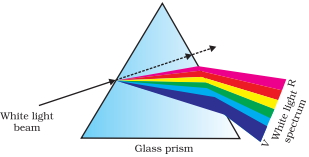
0 likes
View Solution10
EasyMCQ
Name the colours of the visible spectrum.
A
Violet,Indigo,Blue,Green,Yellow,Orange,Red
B
Red,Orange,Yellow,Green,Blue,Indigo,Violet
C
Both $A$ and $B$
D
None of the above
Solution
(C) The visible spectrum consists of seven colours,commonly remembered by the acronym $VIBGYOR$.
These colours are Violet,Indigo,Blue,Green,Yellow,Orange,and Red.
These colours are Violet,Indigo,Blue,Green,Yellow,Orange,and Red.
0 likes
View Solution11
Easy
Define dispersion of white light.
Solution
(N/A) The phenomenon of splitting of white light into its constituent colours (spectrum) when it passes through a transparent medium like a glass prism is known as dispersion of light.
0 likes
View Solution12
Easy
Give one example in nature where we can see the dispersion of white light.
Solution
(N/A) The rainbow formed in the sky after a rainy day is a natural phenomenon that demonstrates the dispersion of white light. When sunlight passes through tiny water droplets suspended in the atmosphere,these droplets act like small prisms,refracting and dispersing the white light into its constituent seven colors.
0 likes
View Solution13
EasyMCQ
Which scientist first explained the dispersion of light?
A
Isaac Newton
B
Albert Einstein
C
Thomas Young
D
Christian Huygens
Solution
(A) The phenomenon of the dispersion of light,which is the splitting of white light into its constituent colors (the spectrum) when passing through a prism,was first explained by Sir Isaac Newton in the $17^{th}$ century.
0 likes
View Solution14
EasyMCQ
Which colour of white light suffers $(i)$ least deviation and $(ii)$ maximum deviation when a beam of white light passes through a glass prism?
A
Red,Violet
B
Violet,Red
C
Blue,Green
D
Yellow,Orange
Solution
(A) When a beam of white light passes through a glass prism,it undergoes dispersion into its constituent seven colours.
$(i)$ The colour that suffers the least deviation is Red because it has the longest wavelength and travels fastest in the glass medium.
$(ii)$ The colour that suffers the maximum deviation is Violet because it has the shortest wavelength and travels slowest in the glass medium.
$(i)$ The colour that suffers the least deviation is Red because it has the longest wavelength and travels fastest in the glass medium.
$(ii)$ The colour that suffers the maximum deviation is Violet because it has the shortest wavelength and travels slowest in the glass medium.
0 likes
View Solution15
Easy
Name the two phenomena involved in the formation of a rainbow.
Solution
(N/A) The formation of a rainbow is primarily caused by the following two phenomena:
$(i)$ Dispersion: When sunlight enters a water droplet,it splits into its constituent colors due to the difference in refractive indices for different wavelengths.
$(ii)$ Total Internal Reflection: After dispersion,the light rays strike the inner surface of the water droplet and are reflected back inside,which is known as total internal reflection.
0 likes
View Solution16
Easy
Name the component of white light that deviates the least and the most while passing through a prism.
Solution
(N/A) When white light passes through a prism,it splits into its constituent colours due to the difference in their wavelengths and refractive indices. The red light has the longest wavelength and travels the fastest in the glass medium,resulting in the least deviation. Conversely,the violet light has the shortest wavelength and travels the slowest,resulting in the most deviation. Therefore,the component that deviates the least is red,and the component that deviates the most is violet.
0 likes
View Solution17
EasyMCQ
What is the wavelength range of visible light?
A
$4 \times 10^{-7} \; m$ to $8 \times 10^{-7} \; m$
B
$4 \times 10^{-9} \; m$ to $8 \times 10^{-9} \; m$
C
$4 \times 10^{-5} \; m$ to $8 \times 10^{-5} \; m$
D
$4 \times 10^{-6} \; m$ to $8 \times 10^{-6} \; m$
Solution
(A) The visible spectrum is the portion of the electromagnetic spectrum that is visible to the human eye.
Visible light typically has a wavelength range from approximately $380 \; nm$ to $750 \; nm$.
Converting these values to meters: $380 \; nm = 380 \times 10^{-9} \; m = 3.8 \times 10^{-7} \; m$ and $750 \; nm = 750 \times 10^{-9} \; m = 7.5 \times 10^{-7} \; m$.
Rounding these values,the range is approximately $4 \times 10^{-7} \; m$ to $8 \times 10^{-7} \; m$.
0 likes
View Solution18
EasyMCQ
The longest and the shortest wavelengths (in $\mu m$) for red and violet light are respectively:
A
$0.7, 0.4$
B
$0.4, 0.7$
C
$0.3, 0.6$
D
$0.7, 0.9$
Solution
(A) The visible spectrum of light ranges from approximately $0.4 \,\mu m$ to $0.7 \,\mu m$.
Violet light has the shortest wavelength, which is approximately $0.4 \,\mu m$.
Red light has the longest wavelength, which is approximately $0.7 \,\mu m$.
Therefore, the longest wavelength (red) is $0.7 \,\mu m$ and the shortest wavelength (violet) is $0.4 \,\mu m$.
Violet light has the shortest wavelength, which is approximately $0.4 \,\mu m$.
Red light has the longest wavelength, which is approximately $0.7 \,\mu m$.
Therefore, the longest wavelength (red) is $0.7 \,\mu m$ and the shortest wavelength (violet) is $0.4 \,\mu m$.
0 likes
View Solution19
Easy
Define dispersion of white light and name the colours of white light in order.
Solution
(N/A) The phenomenon of splitting of white light into its constituent seven colours when passing through a glass prism is known as the dispersion of light.
When white light passes through a prism,it disperses into the following colours in the order of increasing wavelength (from violet to red): $Violet$,$Indigo$,$Blue$,$Green$,$Yellow$,$Orange$,and $Red$ (often remembered by the acronym $VIBGYOR$).
When white light passes through a prism,it disperses into the following colours in the order of increasing wavelength (from violet to red): $Violet$,$Indigo$,$Blue$,$Green$,$Yellow$,$Orange$,and $Red$ (often remembered by the acronym $VIBGYOR$).
0 likes
View Solution20
EasyMCQ
What is meant by the spectrum of white light?
A
The bending of light through a prism.
B
The band of seven colours obtained on a screen when white light is dispersed.
C
The reflection of light from a glass surface.
D
The scattering of light by atmospheric particles.
Solution
(B) When white light passes through a prism,it splits into its constituent seven colours. This band of colours is known as a spectrum. The sequence of colours is violet,indigo,blue,green,yellow,orange,and red $(VIBGYOR)$. The phenomenon of splitting white light into its component colours is called dispersion.
0 likes
View Solution21
Medium
Which colour has the maximum wavelength and which has the minimum wavelength? Explain on the basis of wavelength which colour bends the most and which colour bends the least.
Solution
(N/A) Red colour has the maximum wavelength,while violet colour has the minimum wavelength. According to the relationship between wavelength and deviation,the amount of bending (deviation) is inversely proportional to the wavelength. Since red light has the longest wavelength,it bends the least. Conversely,violet light has the shortest wavelength,so it bends the most.
0 likes
View Solution22
Medium
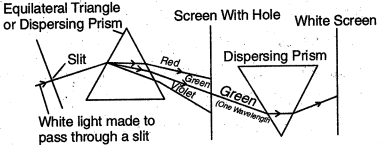
Describe an experiment to discuss the recombination of dispersed light.
Solution
(N/A) Isaac Newton was the first to use a glass prism to obtain the spectrum of sunlight. He tried to split the colours of the spectrum of white light further by using another similar prism. However,he could not get any more colours.
He then placed a second identical prism in an inverted position with respect to the first,as shown in the diagram. This allowed all the colours of the spectrum to pass through the second prism. He found a beam of white light emerging from the other side of the second prism. This observation gave Newton the idea that sunlight is made up of seven colours.
He then placed a second identical prism in an inverted position with respect to the first,as shown in the diagram. This allowed all the colours of the spectrum to pass through the second prism. He found a beam of white light emerging from the other side of the second prism. This observation gave Newton the idea that sunlight is made up of seven colours.
0 likes
View Solution23
Easy
Why do we observe the seven colours when white light passes through a glass prism? Which component of white light deviates the least?
Solution
(D) When white light passes through a glass prism,it undergoes dispersion because the prism offers different refractive indices for different wavelengths of light.
Since the speed of light of different colours is different in the glass medium,each colour bends (refracts) by a different angle.
Violet light has the shortest wavelength and bends the most,while red light has the longest wavelength and bends the least.
Therefore,the red light deviates the least.
Since the speed of light of different colours is different in the glass medium,each colour bends (refracts) by a different angle.
Violet light has the shortest wavelength and bends the most,while red light has the longest wavelength and bends the least.
Therefore,the red light deviates the least.
0 likes
View Solution24
Easy
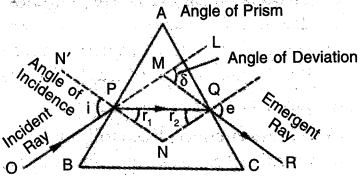
Draw a neat diagram to show the refraction of a light ray through a glass prism,and label on it the angle of incidence,and angle of deviation.
Solution
(N/A) The refraction of a light ray through a glass prism is shown in the diagram below.
Key components of the diagram:
$1$. $A$ is the apex of the prism.
$2$. $OP$ is the incident ray.
$3$. $i$ represents the angle of incidence.
$4$. $PQ$ is the refracted ray inside the prism.
$5$. $QR$ is the emergent ray.
$6$. $e$ is the angle of emergence.
$7$. $\delta$ represents the angle of deviation,which is the angle between the incident ray and the emergent ray.
0 likes
View Solution25
Easy
What is dispersion of light? Name the $(i)$ component of white light that deviates the least,$(ii)$ component of white light that deviates the most,while passing through a glass prism.
Solution
(N/A) Dispersion of light is the phenomenon of splitting of white light into its constituent seven colours when it passes through a transparent medium like a glass prism.
$(i)$ The component of white light that deviates the least is Red light because it has the longest wavelength.
$(ii)$ The component of white light that deviates the most is Violet light because it has the shortest wavelength.
$(i)$ The component of white light that deviates the least is Red light because it has the longest wavelength.
$(ii)$ The component of white light that deviates the most is Violet light because it has the shortest wavelength.
0 likes
View Solution26
Difficult
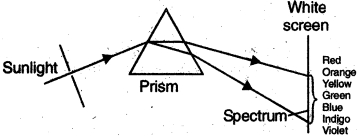
$(i)$ What is meant by dispersion of white light? Draw a diagram to show the dispersion of white light by a glass prism.
$(ii)$ Light of two colours $A$ and $B$ pass through a prism. $A$ deviates more than $B$ from its path of incidence. Which colour has a higher speed in the prism?
$(ii)$ Light of two colours $A$ and $B$ pass through a prism. $A$ deviates more than $B$ from its path of incidence. Which colour has a higher speed in the prism?
Solution
(B) $(i)$ The phenomenon of splitting of white light into its constituent colours (spectrum) when passing through a glass prism is called dispersion of light.
$(ii)$ The deviation of light depends on its refractive index in the medium. $A$ higher deviation implies a higher refractive index,and since refractive index is inversely proportional to the speed of light in that medium $(n = c/v)$,the colour that deviates more $(A)$ travels slower. Therefore,the colour that deviates less $(B)$ has a higher speed in the prism.
$(ii)$ The deviation of light depends on its refractive index in the medium. $A$ higher deviation implies a higher refractive index,and since refractive index is inversely proportional to the speed of light in that medium $(n = c/v)$,the colour that deviates more $(A)$ travels slower. Therefore,the colour that deviates less $(B)$ has a higher speed in the prism.
0 likes
View Solution27
Medium
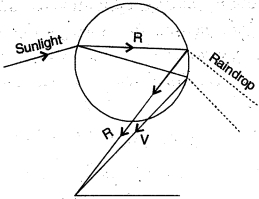
With the help of a diagram,explain the formation of a rainbow in the sky.
Solution
(N/A) rainbow is a natural spectrum appearing in the sky after a rainfall. It is caused by the dispersion of sunlight by tiny water droplets present in the atmosphere.
$1$. When sunlight enters a water droplet,it undergoes refraction and dispersion.
$2$. The light then undergoes internal reflection inside the droplet.
$3$. Finally,the light undergoes refraction again as it exits the droplet.
Due to these phenomena (refraction,dispersion,and internal reflection),different colours reach the observer's eye at different angles,resulting in the formation of a rainbow. The observer must always have their back towards the Sun to see a rainbow.
0 likes
View Solution28
Medium
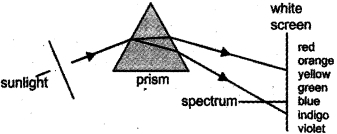
State the cause of dispersion when white light enters a glass prism. Explain with a diagram.
Solution
(N/A) The cause of dispersion is that white light is composed of different colours,each having a different wavelength.
When white light enters a glass prism,each colour travels at a different speed within the medium.
Because the refractive index of glass is different for different wavelengths,each colour bends through a different angle with respect to the incident ray.
Specifically,red light has the longest wavelength and bends the least,while violet light has the shortest wavelength and bends the most.
As a result,the rays of each colour emerge along different paths,becoming distinct and forming a band of colours known as a spectrum.
The diagram is as shown below:
0 likes
View Solution29
Medium
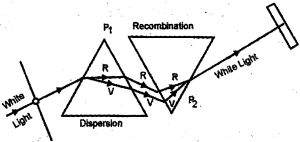
$(a)$ Explain with the help of a labelled diagram how a combination of two prisms can be used so that incident white light emerges out of the second prism as white light.
$(b)$ Name the scientist who first performed this activity.
$(c)$ Explain the term spectrum in brief.
$(b)$ Name the scientist who first performed this activity.
$(c)$ Explain the term spectrum in brief.
Solution
(N/A) prism $P_{1}$ in the path of white light disperses it into various colours. The red rays are deviated the least and the violet rays are deviated the most. The second prism $P_{2}$ is placed in an inverted position relative to $P_{1}$ such that its refracting edge is at the bottom. The second refracting surface of $P_{1}$ and the first refracting surface of $P_{2}$ are parallel. The dispersion produced by $P_{1}$ is neutralised by $P_{2}$. The colours recombine in prism $P_{2}$ and a beam of white light emerges from it.
$(b)$ Isaac Newton.
$(c)$ Spectrum: It is the band of coloured components of light $(VIBGYOR)$ that is obtained when a beam of white light is passed through a glass prism.
$(b)$ Isaac Newton.
$(c)$ Spectrum: It is the band of coloured components of light $(VIBGYOR)$ that is obtained when a beam of white light is passed through a glass prism.
0 likes
View Solution30
Medium
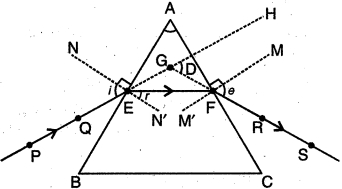
Draw a ray diagram showing the refraction of light through a glass prism and mark the following:
$(a)$ Incident ray
$(b)$ Emergent ray
$(c)$ Refracted ray
$(d)$ Angle of incidence
$(e)$ Angle of deviation
$(f)$ Angle of emergence
$(a)$ Incident ray
$(b)$ Emergent ray
$(c)$ Refracted ray
$(d)$ Angle of incidence
$(e)$ Angle of deviation
$(f)$ Angle of emergence
Solution
(N/A) The labelled diagram is as shown in the provided image.
Here,the components are as follows:
$(a)$ $PE$ - Incident ray
$(b)$ $FS$ - Emergent ray
$(c)$ $EF$ - Refracted ray
$(d)$ $\angle i$ - Angle of incidence
$(e)$ $\angle D$ - Angle of deviation
$(f)$ $\angle e$ - Angle of emergence
Here,the components are as follows:
$(a)$ $PE$ - Incident ray
$(b)$ $FS$ - Emergent ray
$(c)$ $EF$ - Refracted ray
$(d)$ $\angle i$ - Angle of incidence
$(e)$ $\angle D$ - Angle of deviation
$(f)$ $\angle e$ - Angle of emergence
0 likes
View Solution31
Medium
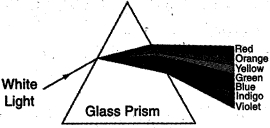
$(a)$ What is dispersion of white light? What is the cause of such dispersion? Draw a diagram to show the dispersion of white light by a glass prism.
$(b)$ $A$ glass prism is able to produce a spectrum when white light passes through it,but a glass slab does not produce any spectrum. Explain why this is so.
$(b)$ $A$ glass prism is able to produce a spectrum when white light passes through it,but a glass slab does not produce any spectrum. Explain why this is so.
Solution
(N/A) Dispersion: The splitting of white light into its constituent seven colours is called dispersion of light.
Cause: Ordinary white light is a superposition of waves of wavelengths extending throughout the visible spectrum. The speed of light in a vacuum is the same for all wavelengths,but the speed in a material substance is different for different wavelengths. As a result,different colours are deviated by different angles when they pass through a prism. This is called dispersion of light.
$(b)$ In a prism,the refraction of light takes place at the two slant surfaces. The dispersion of white light occurs at the first surface of the prism where its constituent colours are deviated through different angles. At the second surface,these split colours undergo further refraction and get separated more. However,in a rectangular glass slab,the refraction of light takes place at two parallel surfaces. At the first surface,although the white light splits into its constituent colours on refraction,these split colours,upon undergoing refraction at the second parallel surface,emerge as a parallel beam,which gives the impression of white light.
0 likes
View Solution32
Medium
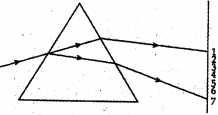
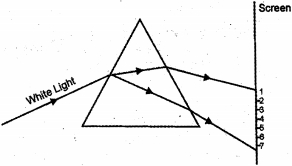
$A$ beam of white light falling on a glass prism gets split up into seven colours marked $1$ to $7$ as shown in the diagram.
$(a)$ The colours at positions marked $3$ and $5$ are similar to the colour of the sky and the colour of gold metal respectively. Is the above statement made by the student correct or incorrect? Justify.
$(b)$ Which of the above shown positions corresponds approximately to the colour of:
$(i)$ a brinjal
$(ii)$ danger signal
$(iii)$ neel (indigo) which is applied to clothes
$(iv)$ orange
Solution
(N/A) As a result of dispersion produced by the prism,the white light is split up into seven colours. These colours are represented by the acronym '$VIBGYOR$' in the order of increasing deviation: $1$ (Red),$2$ (Orange),$3$ (Yellow),$4$ (Green),$5$ (Blue),$6$ (Indigo),$7$ (Violet). Thus,the colour at position $3$ is yellow and at position $5$ is blue. The student's statement is incorrect because the sky is blue and gold is yellow,which corresponds to positions $5$ and $3$ respectively,not $3$ and $5$.
$(b)$ The positions of the colours of the given objects are represented by:
$(i)$ Brinjal (Violet) $- 7$
$(ii)$ Danger signal (Red) $- 1$
$(iii)$ Neel (Indigo) $- 6$
$(iv)$ Orange (Orange) $- 2$
$(b)$ The positions of the colours of the given objects are represented by:
$(i)$ Brinjal (Violet) $- 7$
$(ii)$ Danger signal (Red) $- 1$
$(iii)$ Neel (Indigo) $- 6$
$(iv)$ Orange (Orange) $- 2$
0 likes
View Solution33
Medium
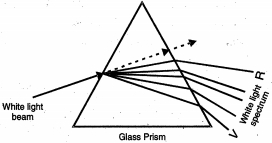
$(a)$ Demonstrate an activity with a well-labelled diagram to prove that white light is made up of seven colours.
$(b)$ Which colour of light bends least and which one the most while passing out from the prism? Also,state the reason for the same.
$(b)$ Which colour of light bends least and which one the most while passing out from the prism? Also,state the reason for the same.
Solution
(N/A) Take a thick sheet of cardboard and make a small hole or narrow slit in its middle. Allow sunlight to fall on the narrow slit. This gives a narrow beam of white light. Now,take a glass prism and allow the light from the slit to fall on one of its faces as shown in the figure.
Turn the prism slowly until the light that comes out of it appears on a nearby screen. We will observe that sunlight has split into seven colours. This shows that sunlight is made up of seven colours.
$(b)$ Red colour bends least while violet colour bends the most. The different colours bend at different angles with respect to the incident ray due to refraction. This happens because the speed of light of different colours is different in the glass medium,leading to different refractive indices for different wavelengths.
0 likes
View Solution34
Medium
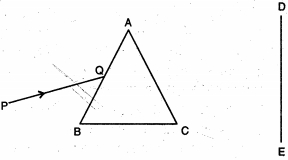
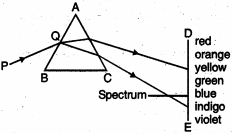
$A$ narrow beam $PQ$ of white light is passing through a glass prism $ABC$ as shown in the diagram.
Trace it on your answer sheet and show the path of the emergent beam as observed on the screen $DE$.
$(i)$ Write the name and cause of the phenomenon observed.
$(ii)$ Where else in nature is this phenomenon observed?
$(iii)$ Based on this observation,state the conclusion which can be drawn about the constituents of white light.
Solution
(N/A) The diagram is as shown in the reference image.
$(i)$ The phenomenon is called the dispersion of light. It occurs because different wavelengths of light travel with different speeds in the glass prism,causing them to bend at different angles.
$(ii)$ This phenomenon is observed in nature in the formation of a rainbow.
$(iii)$ White light consists of seven different colors (wavelengths),which are violet,indigo,blue,green,yellow,orange,and red.
0 likes
View Solution35
Medium
$A$ prism causes dispersion of white light while a rectangular glass block does not. Explain.
Solution
(N/A) In a prism,the refraction of light takes place at two slant surfaces that are not parallel to each other. The dispersion of white light occurs at the first surface of the prism,where its constituent colours are deviated through different angles. At the second surface,these split colours undergo further refraction and separation,resulting in a spectrum.
In a rectangular glass block,the refraction of light takes place at two parallel surfaces. At the first surface,white light splits into its constituent colours upon refraction. However,because the second surface is parallel to the first,these split colours undergo refraction at the second surface in such a way that they emerge as a parallel beam,which recombines to give the impression of white light.
In a rectangular glass block,the refraction of light takes place at two parallel surfaces. At the first surface,white light splits into its constituent colours upon refraction. However,because the second surface is parallel to the first,these split colours undergo refraction at the second surface in such a way that they emerge as a parallel beam,which recombines to give the impression of white light.
0 likes
View Solution36
Medium
$A$ beam of white light falling on a glass prism gets split up into seven colours marked $1$ to $7$ as shown in the diagram. $A$ student makes the following statements about the spectrum observed on the screen.
$(a)$ The colours at position marked $3$ and $5$ are similar to the colour of the core of a hard-boiled egg and the colour of the sky respectively. Is the statement made by the student correct or incorrect? Justify.
$(b)$ Which of the two positions correspond closely to the colour of $(i)$ a solution of potassium permanganate,$(ii)$ danger or stop signal lights?
Solution
(N/A) The colours at positions $3$ and $5$ are yellow and blue respectively. The student has identified them as yellow (i.e.,colour of the core of a hard-boiled egg) and blue (i.e.,colour of the sky) respectively. Hence,the statement is correct.
$(b)$ $(i)$ Position $7$ is the position of violet colour,which corresponds to the colour of a solution of potassium permanganate.
$(ii)$ Position $1$ is the position of red colour,which corresponds to the colour of danger or stop signal lights.
$(b)$ $(i)$ Position $7$ is the position of violet colour,which corresponds to the colour of a solution of potassium permanganate.
$(ii)$ Position $1$ is the position of red colour,which corresponds to the colour of danger or stop signal lights.
0 likes
View Solution37
Medium
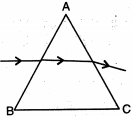
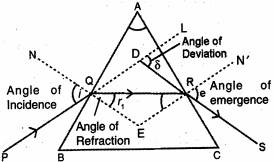
The figure below shows the refraction of a ray through a prism. Copy the diagram and,ignoring dispersion at the faces $AB$ and $AC$,mark the following angles: $(i)$ The angle of incidence,$(ii)$ the angle of refraction at the face $AB$,$(iii)$ the angle of emergence,and $(iv)$ the angle of deviation.
Solution
(N/A) To represent the refraction of a light ray through a prism,we follow these steps:
$1$. Draw a triangular prism $ABC$.
$2$. Draw an incident ray $PQ$ striking the face $AB$.
$3$. Draw a normal $N$ at the point of incidence $Q$ on face $AB$.
$4$. The angle between the incident ray $PQ$ and the normal $N$ is the angle of incidence,denoted by $i$.
$5$. The refracted ray $QR$ travels inside the prism. The angle between the refracted ray $QR$ and the normal $N$ at face $AB$ is the angle of refraction,denoted by $r_1$.
$6$. At face $AC$,the ray emerges as $RS$. Draw a normal $N'$ at the point of emergence $R$.
$7$. The angle between the emergent ray $RS$ and the normal $N'$ is the angle of emergence,denoted by $e$.
$8$. Extend the incident ray $PQ$ forward and the emergent ray $RS$ backward to meet at a point $D$. The angle between these two lines is the angle of deviation,denoted by $\delta$.
0 likes
View Solution38
Medium
The figure below shows a glass prism placed in the minimum deviation position. $A$ ray of monochromatic light is incident on its face $AB$. Copy the diagram and show the refracted and the emergent ray. Mark the angle of deviation. State any two factors on which the angle of deviation depends.
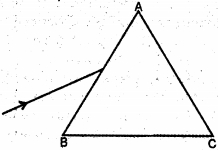
Solution
(N/A) In the minimum deviation position, the refracted ray inside the prism is parallel to the base $BC$. The emergent ray is shown in the provided solution image.
The angle of deviation $\delta$ depends upon the following factors:
$(i)$ The angle of the prism $(A)$.
$(ii)$ The refractive index of the material of the prism $\mu$.
$(iii)$ The angle of incidence $(i)$.
$(iv)$ The wavelength of the light used $\lambda$.
The angle of deviation $\delta$ depends upon the following factors:
$(i)$ The angle of the prism $(A)$.
$(ii)$ The refractive index of the material of the prism $\mu$.
$(iii)$ The angle of incidence $(i)$.
$(iv)$ The wavelength of the light used $\lambda$.
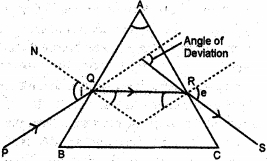
0 likes
View Solution39
Difficult
In the figure,a ray of light $PQ$ is incident normally on one face $AB$ of an equilateral glass prism. What are the angles of incidence at faces $AB$ and $AC$?
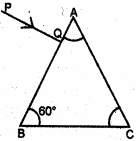
Solution
(N/A) We have the angle of incidence at the face $AB = 0^{\circ}$ as the ray $PQ$ falls normally on this face.
The normally incident ray $PQ$ passes through the prism undeviated and strikes the face $AC$ at the point $R$.
We draw the normal $MN$ to the face $AC$ at the point $R$.
The angle of incidence at the point $R$ is the angle $NRQ$.
From the geometry of the equilateral triangle $ABC$,the angle at vertex $A$ is $60^{\circ}$. In the triangle formed by the ray $PQ$ and the sides of the prism,the angle at $Q$ is $90^{\circ}$ and the angle at $A$ is $60^{\circ}$,so the angle at $R$ inside the triangle is $180^{\circ} - (90^{\circ} + 60^{\circ}) = 30^{\circ}$.
Since $MN$ is normal to $AC$,the angle of incidence $i = 90^{\circ} - 30^{\circ} = 60^{\circ}$.
Hence,the angle of incidence at face $AB = 0^{\circ}$ and the angle of incidence at face $AC = 60^{\circ}$.
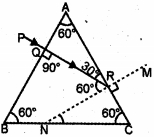
0 likes
View Solution40
Medium
$A$ glass slab is placed over a page on which the word $VIBGYOR$ is printed with each letter in its corresponding colour. $(i)$ Will the image of all the letters be in the same place? $(ii)$ If not, state which letter will be raised to the maximum. Give a reason for your answer.
Solution
$(i)$ No, the images of letters of different colours will be raised by slightly different heights.
$(ii)$ The letter $V$, corresponding to the violet colour, will be raised to the maximum. This is because the apparent depth is given by the formula: $\text{Apparent depth} = \frac{\text{Real depth}}{n}$. Since the refractive index $n$ is maximum for the violet colour, its apparent depth will be the least. Consequently, the shift (raised height) is maximum for the violet colour.
$(ii)$ The letter $V$, corresponding to the violet colour, will be raised to the maximum. This is because the apparent depth is given by the formula: $\text{Apparent depth} = \frac{\text{Real depth}}{n}$. Since the refractive index $n$ is maximum for the violet colour, its apparent depth will be the least. Consequently, the shift (raised height) is maximum for the violet colour.
0 likes
View Solution41
EasyMCQ
The colour of light which is deviated the least by a prism in the spectrum of white light is
A
red
B
green
C
violet
D
yellow
Solution
(A) When white light passes through a prism,it splits into its component colours,a phenomenon known as dispersion.
According to Cauchy's dispersion formula,the refractive index of a material depends on the wavelength of the light.
The refractive index is inversely proportional to the wavelength of light.
Red light has the longest wavelength in the visible spectrum,which results in the lowest refractive index for the prism material.
Since the angle of deviation is directly related to the refractive index,the colour with the lowest refractive index undergoes the least deviation.
Therefore,red light is deviated the least,while violet light,having the shortest wavelength,is deviated the most.
0 likes
View Solution42
EasyMCQ
Which of the following relationships regarding the wavelengths $\lambda$ of different colors of light is correct?
A
$\lambda_{\text{blue}} > \lambda_{\text{yellow}} > \lambda_{\text{green}}$
B
$\lambda_{\text{yellow}} > \lambda_{\text{green}} > \lambda_{\text{blue}}$
C
$\lambda_{\text{yellow}} > \lambda_{\text{blue}} > \lambda_{\text{green}}$
D
$\lambda_{\text{green}} > \lambda_{\text{blue}} > \lambda_{\text{yellow}}$
Solution
(B) The visible spectrum of light follows the order of $VIBGYOR$ (Violet, Indigo, Blue, Green, Yellow, Orange, Red).
In this spectrum, the wavelength $\lambda$ increases from violet to red.
Comparing the given colors: Blue, Green, and Yellow.
According to the $VIBGYOR$ sequence, the order of increasing wavelength is: $\lambda_{\text{blue}} < \lambda_{\text{green}} < \lambda_{\text{yellow}}$.
Therefore, the correct order of decreasing wavelength is $\lambda_{\text{yellow}} > \lambda_{\text{green}} > \lambda_{\text{blue}}$.
0 likes
View Solution43
MediumMCQ
Identify the correct statement regarding the propagation of light of different colours of white light in air.
A
All the colours of white light move with the same speed.
B
Red light moves fastest.
C
Blue light moves faster than green light.
D
Yellow light moves with the mean speed as that of the red and the violet light.
Solution
(A) In a vacuum or air,all colours of white light travel with the same speed,which is approximately $3 \times 10^8 \ m/s$.
While light of different colours travels at different speeds in a medium like glass or water (leading to dispersion),they do not exhibit this difference in air.
Therefore,all colours of white light propagate at the same speed in air.
While light of different colours travels at different speeds in a medium like glass or water (leading to dispersion),they do not exhibit this difference in air.
Therefore,all colours of white light propagate at the same speed in air.
0 likes
View Solution44
MediumMCQ
Identify the phenomena of light involved in the formation of a rainbow.
A
reflection,refraction and dispersion.
B
refraction,dispersion and total internal reflection.
C
dispersion,scattering and total internal reflection.
D
refraction,dispersion and internal reflection.
Solution
(B) The formation of a rainbow is a natural spectrum appearing in the sky after a rain shower.
It is caused by the dispersion of sunlight by tiny water droplets,present in the atmosphere.
These water droplets act like small prisms.
They refract and disperse the incident sunlight,then reflect it internally,and finally refract it again when it comes out of the raindrop.
Therefore,the phenomena involved are refraction,dispersion,and total internal reflection.
0 likes
View Solution45
MediumMCQ
$A$ prism $ABC,$ with base $BC,$ is placed in four different orientations as shown. $A$ narrow beam of white light is incident on the prism as shown. In which of the following cases,after dispersion,the third colour from the top corresponds to the colour of the sky?
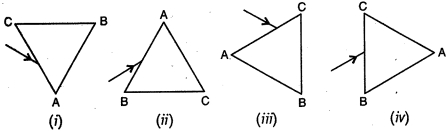
A
$(i)$
B
$(ii)$
C
$(iii)$
D
$(iv)$
Solution
(A) When white light passes through a prism,it disperses into its constituent colours: Violet,Indigo,Blue,Green,Yellow,Orange,and Red $(VIBGYOR)$.
In a standard prism orientation (where the base is at the bottom),the colours appear in the order $VIBGYOR$ from bottom to top.
If the prism is inverted (base at the top),the order of colours from top to bottom is $VIBGYOR$.
The third colour from the top in the inverted prism is Blue,which corresponds to the colour of the sky.
In the given options,case $(i)$ shows the prism with the vertex $A$ at the bottom,which is an inverted orientation. Therefore,the third colour from the top will be Blue.
0 likes
View Solution46
EasyMCQ
Light coming from the sun is white light and contains seven colours.
A
True
B
False
Solution
(A) The light emitted by the sun is known as white light. When this light passes through a prism or is dispersed by water droplets in the atmosphere (as in a rainbow),it splits into its constituent seven colours: Violet,Indigo,Blue,Green,Yellow,Orange,and Red $(VIBGYOR)$. Therefore,the statement is true.
0 likes
View Solution47
EasyMCQ
When a beam of white light is passed through a prism,violet colour bends the most and red colour the least.
A
True
B
False
Solution
(A) When white light passes through a prism,it splits into its constituent colours (dispersion).
According to Cauchy's equation,the refractive index of a material depends on the wavelength of light.
The refractive index is higher for shorter wavelengths (violet) and lower for longer wavelengths (red).
Since the angle of deviation is directly related to the refractive index,violet light (having the shortest wavelength) undergoes the maximum deviation (bends the most),while red light (having the longest wavelength) undergoes the minimum deviation (bends the least).
0 likes
View Solution48
EasyMCQ
Every colour travels with the same speed in a transparent medium.
A
True
B
False
Solution
(B) The statement is $False$. In a transparent medium (other than a vacuum),the speed of light depends on its wavelength (or frequency). This phenomenon is known as dispersion. Different colours of light have different wavelengths; therefore,they travel at different speeds in a medium like glass or water. Violet light,having a shorter wavelength,travels slower than red light,which has a longer wavelength.
0 likes
View Solution49
EasyMCQ
Dispersion of white light occurs because every colour travels with a different speed in a transparent medium.
A
True
B
False
Solution
(A) The phenomenon of dispersion is the splitting of white light into its constituent colours when it passes through a transparent medium like a glass prism.
This occurs because the refractive index of the medium is different for different wavelengths (colours) of light.
Since the speed of light in a medium is given by $v = c/n$ (where $c$ is the speed of light in vacuum and $n$ is the refractive index),different colours travel at different speeds in the medium.
Consequently,each colour undergoes a different amount of deviation,leading to the separation of colours.
0 likes
View Solution50
EasyMCQ
What is the wavelength range of visible light in $cm$?
A
$4 \times 10^{-7}\; cm$ to $8 \times 10^{-7}\; cm$
B
$4 \times 10^{-5}\; cm$ to $8 \times 10^{-5}\; cm$
C
$4 \times 10^{-9}\; cm$ to $8 \times 10^{-9}\; cm$
D
$400\; cm$ to $800\; cm$
Solution
(B) The wavelength range of visible light is approximately $400 \; nm$ to $750 \; nm$ (often rounded to $400 \; nm$ to $800 \; nm$).
To convert nanometers $(nm)$ to centimeters $(cm)$:
$1 \; nm = 10^{-9} \; m = 10^{-7} \; cm$.
Therefore,$400 \; nm = 400 \times 10^{-7} \; cm = 4 \times 10^{-5} \; cm$.
Similarly,$800 \; nm = 800 \times 10^{-7} \; cm = 8 \times 10^{-5} \; cm$.
Thus,the range is $4 \times 10^{-5} \; cm$ to $8 \times 10^{-5} \; cm$.
0 likes
View SolutionThe Human Eye and the Colourful World — Refraction through a Prism and Dispersion · Frequently Asked Questions
1Are these The Human Eye and the Colourful World questions useful for JEE and NEET?
Yes. All questions in this section are mapped to JEE Main and NEET exam patterns. Previous year questions from JEE Main, NEET, GUJCET and state-level exams are included with full solutions.
2Can I switch to Hindi or Gujarati for these questions?
Yes. Use the language tabs in the hero section or the sidebar to view the same questions and solutions in English, Hindi or Gujarati.
3How do I generate a question paper from this subtopic?
Use the Vedclass Exam Paper Generator — select the chapter and subtopic, set difficulty, and generate Sets A, B, C, D automatically. First 3 chapters of every subject are free.
Vedclass Products
For Students
Vedclass Test Series
Mock tests in real JEE/NEET style with performance analysis. 5-day free trial.
Start Free TrialFor Teachers
Exam Paper Generator
Generate Set A/B/C/D papers from this chapter in 2 minutes. 3 chapters free.
Try FreeFor Institutes
Online Exam Module
Live online exams with unlimited students, 360° analytics & white-label branding.
See DemoFor Teachers & Institutes
Generate a The Human Eye and the Colourful World Exam Paper in 2 Minutes
Select subtopic & difficulty — Sets A, B, C, D auto-generated with No Repeat logic.
First 3 chapters of every subject are free — no payment required.