
A English
First Law of Motion and Inertia Questions in English
Class 9 Science · FORCE AND LAWS OF MOTION · First Law of Motion and Inertia
58+
Questions
English
Language
100%
With Solutions
Showing 50 of 58 questions in English
1
Medium
Which of the following has more inertia: $(a)$ a rubber ball and a stone of the same size? $(b)$ a bicycle and a train? $(c)$ a five-rupee coin and a one-rupee coin?
Solution
(N/A) Inertia is the measure of the mass of an object. The greater the mass of the object,the greater is its inertia,and vice-versa.
$(a)$ $A$ stone has more mass than a rubber ball of the same size. Therefore,the stone has more inertia.
$(b)$ $A$ train has significantly more mass than a bicycle. Therefore,the train has more inertia.
$(c)$ $A$ five-rupee coin has more mass than a one-rupee coin. Therefore,the five-rupee coin has more inertia.
0 likes
View Solution2
Medium
Explain why some of the leaves may get detached from a tree if we vigorously shake its branch.
Solution
(N/A) When we shake the branch of a tree vigorously,the branch comes into motion. However,the leaves tend to remain in their state of rest due to the inertia of rest. Because the leaves resist the change in their state of motion,they experience a force that causes them to detach and fall from the tree.
0 likes
View Solution3
MediumMCQ
Why do you fall in the forward direction when a moving bus brakes to a stop and fall backwards when it accelerates from rest?
A
Due to the inertia of motion
B
Due to the inertia of rest
C
Due to the inertia of direction
D
Due to the inertia of mass
Solution
(A) This phenomenon occurs due to the $inertia$ of the passenger.
$1$. When a bus is moving, the passenger is also in a state of motion. When the driver applies brakes, the lower part of the passenger's body, which is in contact with the bus, comes to rest. However, the upper part of the body continues to be in a state of motion due to the $inertia$ of motion, causing the passenger to fall forward.
$2$. When the bus accelerates from rest, the lower part of the passenger's body starts moving with the bus, but the upper part tends to remain at rest due to the $inertia$ of rest. This causes the passenger to fall backward relative to the bus.
0 likes
View Solution4
Medium
An object experiences a net zero external unbalanced force. Is it possible for the object to be travelling with a non-zero velocity? If yes,state the conditions that must be placed on the magnitude and direction of the velocity. If no,provide a reason.
Solution
(N/A) Yes. According to Newton's First Law of Motion,an object will continue to be in a state of rest or of uniform motion along a straight line unless acted upon by an unbalanced force.
If the net external unbalanced force is zero,the object will maintain its state of motion.
Therefore,if the object is already moving with a non-zero velocity,it will continue to move with the same constant velocity (i.e.,constant magnitude and constant direction) in a straight line.
Thus,it is possible for an object to travel with a non-zero velocity under zero net external force,provided the velocity remains constant in both magnitude and direction.
1 likes
View Solution5
Medium
When a carpet is beaten with a stick,dust comes out of it. Explain.
Solution
(N/A) Inertia of an object tends to resist any change in its state of rest or state of motion. When a carpet is beaten with a stick,the carpet is set into motion. However,the dust particles present in the carpet tend to resist this change and remain in their state of rest due to the inertia of rest. According to Newton's first law of motion,an object at rest remains at rest unless acted upon by an external force. As the carpet moves away,the dust particles remain behind due to their inertia,causing them to fall out of the carpet.
0 likes
View Solution6
Medium
Why is it advised to tie any luggage kept on the roof of a bus with a rope?
Solution
(N/A) When the bus accelerates and moves forward,it acquires a state of motion. However,the luggage kept on the roof,owing to its inertia,tends to remain in its state of rest. Hence,with the forward movement of the bus,the luggage tends to remain at its original position and ultimately falls from the roof of the bus. To avoid this,it is advised to tie any luggage kept on the roof of a bus with a rope.
0 likes
View Solution7
MediumMCQ
$A$ batsman hits a cricket ball which then rolls on a level ground. After covering a short distance,the ball comes to rest. The ball slows to a stop because
A
the batsman did not hit the ball hard enough.
B
velocity is proportional to the force exerted on the ball.
C
there is no unbalanced force on the ball,so the ball would want to come to rest.
D
there is a force on the ball opposing the motion.
Solution
(D) batsman hits a cricket ball,which then rolls on a level ground. After covering a short distance,the ball comes to rest because there is a frictional force acting on the ball that opposes its motion.
Frictional force always acts in the direction opposite to the direction of motion. Hence,this force is responsible for slowing down and eventually stopping the cricket ball.
Frictional force always acts in the direction opposite to the direction of motion. Hence,this force is responsible for slowing down and eventually stopping the cricket ball.
0 likes
View Solution8
MediumMCQ
Can there be displacement of an object in the absence of any force acting on it?
A
Yes
B
No
C
Only if the object is at rest
D
Only if the object is moving in a circle
Solution
(A) Yes,it is true. There may be displacement in the absence of force.
We know that,$F = ma$.
In the absence of force,$F = 0$,then $ma = 0$.
Since $m \neq 0$,it follows that $a = 0$.
If $a = 0$,the object is either at rest or in a state of uniform motion in a straight line.
In the case where the object is already moving in a straight line,it will continue to move with a constant velocity,which results in displacement over time.
Therefore,in the absence of force,there may be displacement of an object.
0 likes
View Solution9
EasyMCQ
The inertia of an object tends to cause the object
A
to increase its speed
B
to decrease its speed
C
to decelerate due to friction
D
to resist any change in its state of motion
Solution
(D) Inertia is defined as the inherent property of a body by virtue of which it opposes or resists any change in its state of rest or uniform motion in a straight line.
According to Newton's first law of motion,an object will remain at rest or continue to move at a constant velocity unless acted upon by an external unbalanced force.
Therefore,inertia is the tendency of an object to resist any change in its state of motion.
According to Newton's first law of motion,an object will remain at rest or continue to move at a constant velocity unless acted upon by an external unbalanced force.
Therefore,inertia is the tendency of an object to resist any change in its state of motion.
0 likes
View Solution10
EasyMCQ
$A$ passenger in a moving train tosses a coin which falls behind him. It means that the motion of the train is
A
accelerated
B
uniform
C
retarded
D
along circular tracks
Solution
(A) According to the law of inertia,the coin and the passenger are moving with the same initial velocity as the train. When the coin is tossed,it maintains its horizontal velocity due to inertia. If the train were moving with uniform velocity,the coin would fall back into the passenger's hand. If the train were decelerating (retarded),the train would slow down while the coin continues at the higher initial velocity,causing the coin to fall in front of the passenger. Since the coin falls behind the passenger,the train must be accelerating,meaning the train's velocity increases while the coin is in the air,leaving the passenger ahead of the coin's landing position.
0 likes
View Solution11
EasyMCQ
An object of mass $2\, kg$ is sliding with a constant velocity of $4\, m\, s^{-1}$ on a frictionless horizontal table. The force required to keep the object moving with the same velocity is (in $, N$)
A
$32$
B
$0$
C
$2$
D
$8$
Solution
(B) According to Newton's first law of motion,an object in uniform motion will continue to move with the same velocity unless acted upon by an external unbalanced force.
Since the table is frictionless and the object is moving with a constant velocity,there is no opposing force (like friction) acting on it.
Therefore,no external force is required to maintain its state of motion.
Thus,the force required is $0\, N$.
Since the table is frictionless and the object is moving with a constant velocity,there is no opposing force (like friction) acting on it.
Therefore,no external force is required to maintain its state of motion.
Thus,the force required is $0\, N$.
0 likes
View Solution12
EasyMCQ
$A$ water tanker filled up to $2/3$ of its height is moving with a uniform speed. On sudden application of the brake,the water in the tank would
A
move backward
B
rise upwards
C
be unaffected
D
move forward
Solution
(D) According to Newton's first law of motion,an object in motion continues to be in motion unless acted upon by an external force.
When the tanker is moving at a uniform speed,the water inside it is also moving at the same speed.
When the brakes are applied suddenly,the tanker comes to rest,but the water inside continues to be in a state of motion due to inertia.
Therefore,the water in the tank would move forward.
When the tanker is moving at a uniform speed,the water inside it is also moving at the same speed.
When the brakes are applied suddenly,the tanker comes to rest,but the water inside continues to be in a state of motion due to inertia.
Therefore,the water in the tank would move forward.
0 likes
View Solution13
EasyMCQ
There are three solids made up of aluminium,steel,and wood,of the same shape and same volume. Which of them would have the highest inertia?
A
Aluminium
B
Steel
C
Wood
D
All have equal inertia
Solution
(B) Inertia is directly proportional to the mass of an object $(I \propto m)$.
Since all three solids have the same shape and volume,their masses depend on their densities $(m = \rho \times V)$.
Among aluminium,steel,and wood,steel has the highest density.
Therefore,the steel solid will have the greatest mass.
Since it has the greatest mass,it will possess the highest inertia.
0 likes
View Solution14
Medium
Two balls of the same size but of different materials,rubber and iron,are kept on the smooth floor of a moving train. The brakes are applied suddenly to stop the train. Will the balls start rolling? If so,in which direction? Will they move with the same speed? Give reasons for your answer.
Solution
(N/A) Yes,the balls will start rolling in the direction in which the train was moving.
Due to the application of the brakes,the train comes to rest,but due to the property of inertia,the balls try to remain in their state of motion; therefore,they begin to roll forward.
Since the masses of the rubber and iron balls are different,their inertia of motion is different.
Consequently,the inertial forces acting on them are not the same,and they will move with different speeds.
0 likes
View Solution15
Easy
$A$ horse continues to apply a force in order to move a cart with a constant speed. Explain why?
Solution
(N/A) When a cart moves on the road,it encounters frictional force between the wheels and the ground.
According to Newton's first law of motion,an object in motion will continue to move at a constant velocity only if the net external force acting on it is zero.
Since friction acts as an opposing force that tends to slow down the cart,the horse must apply an external force equal and opposite to the frictional force to maintain a net force of zero.
Therefore,the horse continues to apply a force to overcome friction and maintain a constant speed.
0 likes
View Solution16
EasyMCQ
Why does friction not roll a ball backward if no external force is pushing or pulling it?
A
Friction is a self-adjusting force.
B
Friction only acts to oppose relative motion or the tendency of motion.
C
Friction is a non-contact force.
D
Friction is always zero.
Solution
(B) Friction is a resistive force that acts only when there is relative motion or a tendency for relative motion between two surfaces in contact.
If a ball is at rest on a horizontal surface and no external force is applied to it,there is no tendency for the ball to move.
Therefore,the net force acting on the ball is zero,and the frictional force remains zero.
Friction does not initiate motion on its own; it only opposes the motion caused by an external force.
0 likes
View Solution17
EasyMCQ
Kicking a football requires less force than kicking a basketball. Why?
A
Football is lighter than a basketball.
B
Football is heavier than a basketball.
C
Football has more inertia than a basketball.
D
Both have equal mass.
Solution
(A) Inertia is the property of an object to resist a change in its state of motion or rest,and it is directly proportional to the mass of the object.
Since a basketball has a greater mass than a football,it possesses more inertia.
Therefore,a greater amount of force is required to overcome the inertia of the basketball compared to the football.
Since a basketball has a greater mass than a football,it possesses more inertia.
Therefore,a greater amount of force is required to overcome the inertia of the basketball compared to the football.
0 likes
View Solution18
Easy
When a carpet is beaten with a stick,it releases dust. Explain why?
Solution
(N/A) The dust particles lying on the carpet possess inertia of rest. When the carpet is beaten with a stick,the carpet moves suddenly,but the dust particles tend to remain in their state of rest due to inertia of rest. Consequently,the dust particles get separated from the carpet and fall down due to gravity.
0 likes
View Solution19
EasyMCQ
How does the safety belt in a car help when a moving car applies brakes suddenly?
A
It increases the speed of the passenger.
B
It exerts a force on the body to slow down its forward motion due to inertia.
C
It prevents the car from stopping.
D
It has no effect on the passenger.
Solution
(B) When the brakes are applied,the car slows down,but due to the law of inertia,the body of the passenger continues to be in the same state of motion.
Safety belts exert a force on the body to slow down its forward motion,thereby preventing the passenger from hitting the dashboard or windshield.
Safety belts exert a force on the body to slow down its forward motion,thereby preventing the passenger from hitting the dashboard or windshield.
0 likes
View Solution20
Easy
Name the physical quantity that measures inertia. State its $SI$ unit.
Solution
(N/A) The physical quantity that measures the inertia of an object is its mass.
Inertia is the inherent property of a body to resist any change in its state of rest or uniform motion.
Greater the mass of an object,greater is its inertia.
The $SI$ unit of mass is kilogram $(kg).$
Inertia is the inherent property of a body to resist any change in its state of rest or uniform motion.
Greater the mass of an object,greater is its inertia.
The $SI$ unit of mass is kilogram $(kg).$
0 likes
View Solution21
EasyMCQ
$A$ book of mass $2 \, kg$ is sliding with a constant velocity of $4 \, m s^{-1}$ on a frictionless horizontal table. What is the force required to keep the object moving with the same velocity (in $, N$)?
A
$0$
B
$2$
C
$4$
D
$8$
Solution
(A) According to Newton's First Law of Motion,an object moving with a constant velocity in a straight line will continue to do so unless acted upon by an external unbalanced force.
Since the book is moving with a constant velocity of $4 \, m s^{-1}$ on a frictionless surface,its acceleration is zero $(a = 0)$.
Using Newton's Second Law,$F = m \times a$,where $m = 2 \, kg$ and $a = 0$.
Therefore,$F = 2 \, kg \times 0 \, m s^{-2} = 0 \, N$.
Thus,zero force is required to maintain the same velocity.
0 likes
View Solution22
Easy
State and explain the law of inertia (or Newton's first law of motion).
Solution
(N/A) Newton's first law of motion,also known as the law of inertia,states that an object will remain at rest or continue to move at a constant velocity in a straight line unless acted upon by an external unbalanced force.
This law implies that objects have a natural tendency to resist changes in their state of motion,a property known as inertia.
For example,a book lying on a table will remain there until someone pushes it,and a ball rolling on a frictionless surface would theoretically continue moving forever unless stopped by an external force.
0 likes
View Solution23
EasyMCQ
Suppose the gravity of the $Earth$ suddenly becomes zero,then in which direction will the $Moon$ begin to move if no other celestial body affects it?
A
It will continue to move in a circular orbit.
B
It will move in a straight line tangential to its orbit at that instant.
C
It will move towards the $Earth$.
D
It will stop moving.
Solution
(B) The $Moon$ revolves around the $Earth$ due to the centripetal force provided by the gravitational pull of the $Earth$.
If the gravitational force of the $Earth$ suddenly becomes zero,the centripetal force will also become zero.
According to $Newton's$ first law of motion,an object in motion will continue to move in a straight line unless acted upon by an external force.
Therefore,the $Moon$ will begin to move in a straight line along the tangent to its circular orbit at the instant the gravity becomes zero.
0 likes
View Solution24
Easy
$A$ car manufacturer advertises that the brakes are so perfect that the car stops instantaneously. Comment.
Solution
(N/A) The claim made by the manufacturer is scientifically incorrect.
If a car stops instantaneously,the time taken $(t)$ for the change in velocity would be $0$.
According to the formula for acceleration $(a = \frac{v - u}{t})$,if $t = 0$,the acceleration (or retardation) becomes infinite $(a = \infty)$.
In physical reality,it is impossible for any object to experience infinite acceleration or retardation,as it would require an infinite amount of force.
0 likes
View Solution25
Easy
State Newton's first law of motion.
Solution
(N/A) Newton's first law of motion states that an object remains in a state of rest or of uniform motion in a straight line unless it is compelled to change that state by an applied external force.
This law is also known as the Law of Inertia,as it describes the tendency of objects to resist changes in their state of motion.
This law is also known as the Law of Inertia,as it describes the tendency of objects to resist changes in their state of motion.
0 likes
View Solution26
EasyMCQ
An athlete always runs some distance before taking a jump. Why?
A
To increase the friction between shoes and the ground.
B
To gain momentum,which helps in jumping a longer distance.
C
To relax the muscles before the jump.
D
To estimate the distance of the jump.
Solution
(B) An athlete runs before taking a jump to gain momentum.
According to Newton's first law of motion,an object in motion tends to stay in motion.
By running,the athlete's body acquires a state of inertia of motion.
This momentum helps the athlete to cover a longer distance during the jump.
According to Newton's first law of motion,an object in motion tends to stay in motion.
By running,the athlete's body acquires a state of inertia of motion.
This momentum helps the athlete to cover a longer distance during the jump.
0 likes
View Solution27
Easy
Why is it advised to tie luggage kept on the roof of a bus?
Solution
(N/A) When a speeding bus stops suddenly,the luggage continues to move forward due to the inertia of motion. This happens because the luggage is in a state of motion along with the bus,and according to Newton's first law of motion,it tends to maintain its state of motion. Consequently,if the luggage is not tied,it is likely to fall off the bus due to its inertia.
0 likes
View Solution28
Easy
Name the factor on which the inertia of a body depends.
Solution
(N/A) The inertia of a body depends on its $mass$. $A$ body with a larger $mass$ possesses greater inertia, while a body with a smaller $mass$ possesses lesser inertia. Therefore, $mass$ is the quantitative measure of the inertia of a body.
0 likes
View Solution29
EasyMCQ
Which has the highest inertia among solids made of aluminium,steel,and wood of the same shape and same volume?
A
Aluminium
B
Steel
C
Wood
D
All have equal inertia
Solution
(B) Inertia is directly proportional to the mass of an object $(I \propto m)$.
Since all objects have the same volume $(V)$,their mass $(m)$ depends on their density $(d)$ according to the formula $m = d \times V$.
Among aluminium,steel,and wood,steel has the highest density.
Therefore,the steel object will have the greatest mass,and consequently,it will possess the highest inertia.
0 likes
View Solution30
Medium
State the reason for the following:
$(i)$ Some leaves may get detached from a tree if we vigorously shake its branch.
$(ii)$ It is advised to tie any luggage kept on the roof of a bus with a rope.
$(i)$ Some leaves may get detached from a tree if we vigorously shake its branch.
$(ii)$ It is advised to tie any luggage kept on the roof of a bus with a rope.
Solution
(N/A) $(i)$ This happens due to the inertia of rest. When the branch is shaken,it comes into motion,but the leaves tend to remain in their state of rest due to inertia. As a result,the connection between the leaf and the branch breaks,causing the leaf to detach.
$(ii)$ It is advised to tie luggage with a rope to prevent it from falling off due to inertia of motion or rest. When a bus suddenly starts or stops,the luggage tends to maintain its previous state of motion or rest,which could cause it to slide or fall off the roof.
$(ii)$ It is advised to tie luggage with a rope to prevent it from falling off due to inertia of motion or rest. When a bus suddenly starts or stops,the luggage tends to maintain its previous state of motion or rest,which could cause it to slide or fall off the roof.
0 likes
View Solution31
Medium
Explain the following:
$(i)$ Why do we jerk wet clothes before spreading them on a line?
$(ii)$ Why does dust fly off when a carpet is hit with a stick?
$(iii)$ Why do fruits fall off the branches in a strong wind?
$(iv)$ Why does a pillion rider fall forward when the driver of a two-wheeler suddenly applies brakes?
$(i)$ Why do we jerk wet clothes before spreading them on a line?
$(ii)$ Why does dust fly off when a carpet is hit with a stick?
$(iii)$ Why do fruits fall off the branches in a strong wind?
$(iv)$ Why does a pillion rider fall forward when the driver of a two-wheeler suddenly applies brakes?
Solution
(N/A) $(i)$ Initially,both water and clothes are at rest. When wet clothes are jerked,the water particles tend to remain in their state of rest due to the inertia of rest. This causes the water droplets to detach from the clothes,helping them dry faster.
$(ii)$ When a carpet is struck with a stick,the carpet moves suddenly,but the dust particles tend to remain at rest due to the inertia of rest. Consequently,the dust separates from the carpet and flies off.
$(iii)$ Initially,the fruits on the branches are at rest. Due to the inertia of rest,the fruits tend to remain in their state of rest even when the branches are moved by a strong wind,causing the fruits to detach and fall.
$(iv)$ Initially,both the driver and the pillion rider are in a state of motion. When the driver applies brakes,the lower part of the pillion rider's body comes to rest with the vehicle,but the upper part continues to move forward due to the inertia of motion,causing the rider to fall forward.
0 likes
View Solution32
Medium
Write answers to the following:
$(i)$ Mention the direction in which the force of friction acts on a moving body. State its units.
$(ii)$ Name the property of bodies (or objects) to resist a change in their state of rest or of motion. Name the quantity that is a measure of this property.
$(iii)$ Name the physical quantity whose unit is $kg\, m s^{-1}$. Define this quantity.
Solution
(N/A) $(i)$ The force of friction acts in the direction opposite to the direction of motion of the body. Its $SI$ unit is the newton $(N)$.
$(ii)$ The property of bodies to resist a change in their state of rest or motion is called inertia. Mass is the quantitative measure of inertia.
$(iii)$ The physical quantity is momentum. Momentum is defined as the product of the mass and velocity of a body $(p = mv)$.
$(ii)$ The property of bodies to resist a change in their state of rest or motion is called inertia. Mass is the quantitative measure of inertia.
$(iii)$ The physical quantity is momentum. Momentum is defined as the product of the mass and velocity of a body $(p = mv)$.
0 likes
View Solution33
Medium
Identify the type of inertia experienced by the brain,when
$(a)$ the head is hit suddenly with a stick.
$(b)$ a car is suddenly made to stop using brakes.
$(c)$ a boxer punches another boxer in the face.
$(a)$ the head is hit suddenly with a stick.
$(b)$ a car is suddenly made to stop using brakes.
$(c)$ a boxer punches another boxer in the face.
Solution
(N/A) Inertia of rest: When the head is hit suddenly,the skull moves forward due to the impact,but the brain,due to its inertia of rest,tends to remain in its original position,causing it to strike against the inner wall of the skull.
$(b)$ Inertia of motion: When a car stops suddenly,the body and the brain are in a state of motion. Due to the inertia of motion,they continue to move forward even after the car has stopped,causing the brain to hit the front part of the skull.
$(c)$ Inertia of rest: When a boxer is punched,the head is pushed backward suddenly. The brain,due to its inertia of rest,tends to stay in its initial position,causing it to strike against the back wall of the skull.
0 likes
View Solution34
Medium
Explain the following:
$(i)$ Why do the doors of a corridor train open or shut when the train starts or stops?
$(ii)$ Why is it necessary to run along with a moving bus in the same direction while alighting from it?
$(iii)$ Why does a player run for some distance before taking a long jump?
$(iv)$ Why does a person fall off the back of a stationary horse if the horse starts off suddenly?
$(v)$ Why is a neat hole formed in a glass pane if a bullet is fired at it from a close range?
Solution
(N/A) $(i)$ The doors of a train tend to continue in their state of rest or motion due to the inertia of rest or motion when the train starts or stops suddenly. Thus,the doors swing due to the change in the state of the train.
$(ii)$ While alighting from a moving bus,the feet of the person come to rest upon touching the ground,while the upper body remains in a state of motion. To avoid falling forward due to inertia of motion,it is necessary to run in the same direction as the bus.
$(iii)$ $A$ player runs for some distance before taking a long jump to gain inertia of motion,which helps the player cover a greater distance during the jump.
$(iv)$ $A$ person falls backward when a stationary horse starts suddenly because the lower part of the person's body,which is in contact with the horse,moves forward,but the upper part of the body tends to remain in its state of rest due to the inertia of rest.
$(v)$ When a bullet is fired at a glass pane,a neat hole is formed because the bullet moves at a very high speed. Due to the inertia of rest,the glass particles in the immediate path of the bullet do not get enough time to move,while the rest of the glass pane remains stationary.
0 likes
View Solution35
Medium
$A$ javelin throw is marked foul if an athlete crosses over the line marked for throw. Explain why the athletes often fail to stop themselves before the line.
Solution
(N/A) This occurs due to the $inertia$ of motion. An athlete runs for a considerable distance to build up momentum,which helps in throwing the javelin a longer distance. However,the large momentum of the athlete makes it difficult to stop abruptly before the marked line,and as a result,the athlete may cross the line,causing the throw to be declared foul.
0 likes
View Solution36
Difficult
In oil tankers,some space is left at the top while filling them. Explain why.
Solution
(N/A) When a stationary tanker suddenly accelerates,the oil inside,due to the $inertia$ of rest,tends to remain in its state of rest. Consequently,the oil is pushed towards the rear wall,exerting a large force on it.
Conversely,when a moving tanker suddenly brakes,the oil continues to move forward due to the $inertia$ of motion,exerting a large force on the front wall.
These sudden forces can damage or crack the walls of the tanker.
Therefore,to allow for the free movement of oil and to prevent such damage,some space is left at the top of the tanker.
0 likes
View Solution37
DifficultMCQ
Why is it advised to tie luggage with a rope on the roof of buses?
A
To increase the weight of the bus.
B
To prevent the luggage from falling due to inertia.
C
To make the luggage look organized.
D
To reduce the air resistance on the luggage.
Solution
(B) When a bus suddenly starts,the luggage on its roof has a tendency to continue in its state of rest due to inertia of rest,causing it to fall backward.
Conversely,when a moving bus stops suddenly,the luggage on its top has a tendency to continue in its state of motion due to inertia of motion,causing it to fall forward.
Thus,to prevent the luggage from falling due to these changes in motion,it is tied with a rope to hold it securely in place.
Conversely,when a moving bus stops suddenly,the luggage on its top has a tendency to continue in its state of motion due to inertia of motion,causing it to fall forward.
Thus,to prevent the luggage from falling due to these changes in motion,it is tied with a rope to hold it securely in place.
0 likes
View Solution38
Medium
$(a)$ Why do we jerk wet clothes before spreading them on a clothesline?
$(b)$ Fruits fall off the branches when a strong wind blows. Give a reason.
$(b)$ Fruits fall off the branches when a strong wind blows. Give a reason.
Solution
(N/A) When we jerk wet clothes,the clothes suddenly come into motion,but the water droplets in them tend to remain in a state of rest due to the inertia of rest. As a result,the water droplets get detached from the fabric,causing the clothes to dry more quickly.
$(b)$ Initially,both the fruits and the branches are in a state of rest. When a strong wind blows,the branches suddenly come into motion,but the fruits tend to remain in a state of rest due to the inertia of rest. Consequently,the fruits get detached from the branches and fall down.
$(b)$ Initially,both the fruits and the branches are in a state of rest. When a strong wind blows,the branches suddenly come into motion,but the fruits tend to remain in a state of rest due to the inertia of rest. Consequently,the fruits get detached from the branches and fall down.
0 likes
View Solution39
Medium
$A$ body projected horizontally moves with the same horizontal velocity although it is under the action of the force of gravity,why?
Solution
(N/A) The force of gravity acts only in the vertically downward direction.
Since there is no force acting in the horizontal direction,there is no acceleration in the horizontal component of motion.
According to Newton's first law of motion,in the absence of an external horizontal force,the horizontal velocity remains constant throughout the flight.
Since there is no force acting in the horizontal direction,there is no acceleration in the horizontal component of motion.
According to Newton's first law of motion,in the absence of an external horizontal force,the horizontal velocity remains constant throughout the flight.
0 likes
View Solution40
Medium
$A$ body projected horizontally moves with the same horizontal velocity although it is under the action of the force of gravity,why?
Solution
(N/A) The force of gravity acts in the vertically downward direction.
According to Newton's first law of motion,an object continues to move with a constant velocity unless acted upon by an external force in that direction.
Since the force of gravity acts only vertically downwards,there is no force acting in the horizontal direction to change the horizontal velocity.
Therefore,the horizontal component of the velocity remains constant throughout the motion.
0 likes
View Solution41
EasyMCQ
State whether the following statement is True or False:
The inertia of an object depends upon its mass.
The inertia of an object depends upon its mass.
A
True
B
False
Solution
(A) The statement is True.
Inertia is defined as the inherent property of an object to resist any change in its state of rest or uniform motion.
According to Newton's first law of motion,mass is the measure of inertia.
Therefore,a heavier object has more inertia than a lighter object,confirming that inertia depends directly on the mass of the object.
0 likes
View Solution42
Medium
$(i)$ Name the property by virtue of which a body resists a change in its state of motion. Name the physical quantity which is a measure of this property.
$(ii)$ Explain why some of the leaves may get detached from a tree if we vigorously shake its branch.
$(ii)$ Explain why some of the leaves may get detached from a tree if we vigorously shake its branch.
Solution
(N/A) $(i)$ The property by virtue of which a body resists a change in its state of motion is called inertia. Mass is the measure of inertia.
$(ii)$ This phenomenon occurs due to the inertia of rest. Initially,the leaves are in a state of rest. When the tree branch is shaken vigorously,the branch comes into a state of motion,but the leaves tend to maintain their state of rest due to inertia. Consequently,they resist the change,get detached,and fall down due to gravity.
$(ii)$ This phenomenon occurs due to the inertia of rest. Initially,the leaves are in a state of rest. When the tree branch is shaken vigorously,the branch comes into a state of motion,but the leaves tend to maintain their state of rest due to inertia. Consequently,they resist the change,get detached,and fall down due to gravity.
0 likes
View Solution43
Medium
An object experiences a net zero external unbalanced force. Is it possible for the object to be moving with a non-zero velocity? If yes,state the conditions that must be placed on the magnitude and direction of the velocity. If no,provide a reason.
Solution
(A) When an object experiences a net zero external unbalanced force,in accordance with Newton's second law of motion $F = ma$,its acceleration is zero.
If the object was initially in a state of motion,then in accordance with Newton's first law of motion,the object will continue to move in the same direction with the same speed.
It means that the object may be travelling with a non-zero velocity,but the magnitude as well as the direction of the velocity must remain unchanged or constant throughout.
0 likes
View Solution44
Easy
When a fast-moving horse stops suddenly,a careless rider falls in the forward direction. Give the reason for this.
Solution
(N/A) This happens due to the $inertia$ of motion.
When the horse is in motion,the entire body of the rider is also in motion.
When the horse stops suddenly,the lower part of the rider's body,which is in contact with the horse,comes to rest due to the horse's deceleration.
However,the upper part of the rider's body continues to remain in a state of motion due to the $inertia$ of motion,causing the rider to fall forward.
0 likes
View Solution45
Easy
$A$ passenger in a moving car slips to one side of the seat when the car takes a sharp turn. Give the reason for this.
Solution
(N/A) This phenomenon occurs due to the $inertia$ of direction. According to Newton's first law of motion,a body continues to move in a straight line unless an external force acts upon it. When the car takes a sharp turn,the car changes its direction,but the passenger's body,due to $inertia$,tends to maintain its original straight-line path. Consequently,the passenger feels a push towards the opposite side of the turn.
0 likes
View Solution46
Medium
$(a)$ Define inertia. There are three solid balls, made of aluminium, steel, and wood, of the same shape and volume. Which of them would have the highest inertia? Why?
$(b)$ Describe in brief an activity to illustrate the property of inertia of rest.
$(b)$ Describe in brief an activity to illustrate the property of inertia of rest.
Solution
$(B)$ Inertia is the inherent property of a body to resist any change in its state of rest or uniform motion unless acted upon by an external unbalanced force.
Since all three balls have the same shape and volume, their mass depends on their density $(\text{Mass} = \text{Density} \times \text{Volume})$.
Steel has the highest density among aluminium, steel, and wood. Therefore, the steel ball has the highest mass and consequently the highest inertia.
$(b)$ Activity to illustrate inertia of rest:
$1$. Place an empty glass tumbler on a table and cover its mouth with a stiff playing card.
$2$. Place a five-rupee coin on the center of the card.
$3$. Give the card a sharp horizontal flick with your finger.
$4$. Observation: The card moves away quickly, while the coin falls vertically into the glass tumbler.
$5$. Conclusion: The coin remains in its state of rest due to inertia of rest, even when the card is removed suddenly.
0 likes
View Solution47
Medium
$(a)$ Define inertia. You are provided with three bodies made of wood,rubber,and iron of the same shape and size. Which one of them will have greater inertia? Explain it.
$(b)$ When a striker hits the bottom of the pile of coins placed at the centre of a carom board,only the lowest coin is removed. Give reason for it.
$(b)$ When a striker hits the bottom of the pile of coins placed at the centre of a carom board,only the lowest coin is removed. Give reason for it.
Solution
(D) Inertia is the property of a body by virtue of which it resists any change in its state of rest or of uniform motion in a straight line. Among wood,rubber,and iron of the same shape and size,the iron body will have the greatest inertia. This is because mass is the measure of inertia; since iron has the highest density and thus the greatest mass among the three,it possesses the greatest inertia.
$(b)$ This phenomenon is due to the inertia of rest. When the striker hits the lowest coin,it suddenly comes into motion due to the applied force. However,the rest of the coins in the pile remain in their state of rest due to their inertia of rest. Consequently,they fall vertically downwards into the same position as the bottom coin moves away.
$(b)$ This phenomenon is due to the inertia of rest. When the striker hits the lowest coin,it suddenly comes into motion due to the applied force. However,the rest of the coins in the pile remain in their state of rest due to their inertia of rest. Consequently,they fall vertically downwards into the same position as the bottom coin moves away.
0 likes
View Solution48
Medium
An object experiences a net zero external unbalanced force. Is it possible for the object to be moving with a non-$zero$ velocity? If yes, state the conditions that must be placed on the magnitude and direction of velocity. If no, provide a reason.
Solution
(A) Yes, it is possible for the object to be moving with a non-$zero$ velocity.
According to Newton's $First$ Law of Motion, an object will continue to be in a state of rest or of uniform motion along a straight line unless acted upon by an unbalanced force.
If the net external unbalanced force is $zero$, the object will maintain its state of motion.
Therefore, the object must move with a constant magnitude (speed) and a constant direction (straight line path) to maintain uniform motion.
0 likes
View Solution49
MediumMCQ
If a body is in motion,is it necessary that it is being acted upon by a force?
A
Yes,always.
B
No,not necessarily.
C
Only if the body is accelerating.
D
Only if the body is at rest.
Solution
(B) According to Newton's First Law of Motion,an object in uniform motion will continue to move in a straight line at a constant speed unless acted upon by an external unbalanced force.
Therefore,it is not necessary for a force to act on a body for it to remain in motion.
Force is only required to change the state of motion (i.e.,to accelerate,decelerate,or change the direction of the object).
Therefore,it is not necessary for a force to act on a body for it to remain in motion.
Force is only required to change the state of motion (i.e.,to accelerate,decelerate,or change the direction of the object).
0 likes
View Solution50
Medium
$A$ block is supported by a cord $A$ from a rigid support,and another cord $B$ is attached to the bottom of the block. If you give a sudden jerk to $B$,it will break. But if you pull on $B$ steadily,$A$ will break. Why?
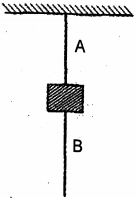
Solution
(N/A) When a sudden jerk is given to the lower cord $B$,the upper portion of the system is not able to receive the force of the jerk in a very short interval of time due to the inertia of the block,and the block tends to remain at rest. As a result,the tension in cord $B$ exceeds its breaking strength,and it breaks.
On pulling the cord $B$ steadily,the force gets sufficient time to be transmitted to the upper cord $A$. In this case,the total tension in cord $A$ becomes the sum of the force applied and the weight of the block $(T_A = F + mg)$,while the tension in cord $B$ is only the force applied $(T_B = F)$. Since the tension in $A$ is greater than in $B$,cord $A$ breaks first.
On pulling the cord $B$ steadily,the force gets sufficient time to be transmitted to the upper cord $A$. In this case,the total tension in cord $A$ becomes the sum of the force applied and the weight of the block $(T_A = F + mg)$,while the tension in cord $B$ is only the force applied $(T_B = F)$. Since the tension in $A$ is greater than in $B$,cord $A$ breaks first.
0 likes
View SolutionFORCE AND LAWS OF MOTION — First Law of Motion and Inertia · Frequently Asked Questions
1Are these FORCE AND LAWS OF MOTION questions useful for JEE and NEET?
Yes. All questions in this section are mapped to JEE Main and NEET exam patterns. Previous year questions from JEE Main, NEET, GUJCET and state-level exams are included with full solutions.
2Can I switch to Hindi or Gujarati for these questions?
Yes. Use the language tabs in the hero section or the sidebar to view the same questions and solutions in English, Hindi or Gujarati.
3How do I generate a question paper from this subtopic?
Use the Vedclass Exam Paper Generator — select the chapter and subtopic, set difficulty, and generate Sets A, B, C, D automatically. First 3 chapters of every subject are free.
Vedclass Products
For Students
Vedclass Test Series
Mock tests in real JEE/NEET style with performance analysis. 5-day free trial.
Start Free TrialFor Teachers
Exam Paper Generator
Generate Set A/B/C/D papers from this chapter in 2 minutes. 3 chapters free.
Try FreeFor Institutes
Online Exam Module
Live online exams with unlimited students, 360° analytics & white-label branding.
See DemoFor Teachers & Institutes
Generate a FORCE AND LAWS OF MOTION Exam Paper in 2 Minutes
Select subtopic & difficulty — Sets A, B, C, D auto-generated with No Repeat logic.
First 3 chapters of every subject are free — no payment required.