
A English
Universal Law of Gravitation Questions in English
Class 9 Science · GRAVITATION · Universal Law of Gravitation
54+
Questions
English
Language
100%
With Solutions
Showing 50 of 54 questions in English
1
Medium
State the universal law of gravitation.
Solution
(N/A) The universal law of gravitation states that every object in the universe attracts every other object with a force called the gravitational force.
The force acting between two objects is directly proportional to the product of their masses and inversely proportional to the square of the distance between their centers.
For two objects of masses $m_1$ and $m_2$ and the distance between them $r$,the force $(F)$ of attraction acting between them is given by the universal law of gravitation as:
$F = \frac{G m_1 m_2}{r^2}$
Where,$G$ is the universal gravitation constant and its value is $6.67 \times 10^{-11} \text{ Nm}^2 \text{ kg}^{-2}$.
0 likes
View Solution2
Easy
Write the formula to find the magnitude of the gravitational force between the Earth and an object on the surface of the Earth.
Solution
(N/A) Let $M_E$ be the mass of the Earth and $m$ be the mass of an object on its surface. If $R$ is the radius of the Earth,then according to the universal law of gravitation,the gravitational force $(F)$ acting between the Earth and the object is given by the relation:
$F = \frac{G M_E m}{R^2}$
Where:
$G$ is the universal gravitational constant,
$M_E$ is the mass of the Earth,
$m$ is the mass of the object,
$R$ is the distance between the center of the Earth and the object (which is equal to the radius of the Earth).
$F = \frac{G M_E m}{R^2}$
Where:
$G$ is the universal gravitational constant,
$M_E$ is the mass of the Earth,
$m$ is the mass of the object,
$R$ is the distance between the center of the Earth and the object (which is equal to the radius of the Earth).
0 likes
View Solution3
MediumMCQ
How does the gravitational force $(F)$ between two objects change when the distance between them is reduced to half?
A
$F'=F$
B
$F'=0.5F$
C
$F'=2F$
D
$F'=4F$
Solution
(D) According to the universal law of gravitation,the gravitational force $(F)$ acting between two objects is inversely proportional to the square of the distance $(r)$ between them,i.e.,
$F = G \frac{m_{1} m_{2}}{r^{2}}$
If the distance $r$ is reduced to $r/2$,the new gravitational force $(F')$ will be:
$F' = G \frac{m_{1} m_{2}}{(r/2)^{2}}$
$F' = G \frac{m_{1} m_{2}}{r^{2}/4}$
$F' = 4 \times (G \frac{m_{1} m_{2}}{r^{2}})$
$F' = 4F$
Therefore,if the distance is reduced to half,the gravitational force becomes four times the original value.
0 likes
View Solution4
Easy
The earth and the moon are attracted to each other by gravitational force. Does the earth attract the moon with a force that is greater or smaller or the same as the force with which the moon attracts the earth? Why?
Solution
(C) According to Newton's universal law of gravitation,every object in the universe attracts every other object with a force that is directly proportional to the product of their masses and inversely proportional to the square of the distance between them. This force is mutual. Therefore,the Earth attracts the moon with a force that is exactly the same as the force with which the moon attracts the Earth. This is in accordance with Newton's third law of motion,which states that for every action,there is an equal and opposite reaction.
0 likes
View Solution5
Medium
What happens to the force between two objects,if
$(i)$ the mass of one object is doubled?
$(ii)$ the distance between the objects is doubled and tripled?
$(iii)$ the masses of both objects are doubled?
$(i)$ the mass of one object is doubled?
$(ii)$ the distance between the objects is doubled and tripled?
$(iii)$ the masses of both objects are doubled?
Solution
(N/A) According to the universal law of gravitation,the force of gravitation between two objects is given by $F = \frac{G M m}{r^{2}}$.
$(i)$ $F$ is directly proportional to the masses of the objects. If the mass of one object is doubled,then the gravitational force will also get doubled.
$(ii)$ $F$ is inversely proportional to the square of the distance between the objects. If the distance is doubled,the gravitational force becomes one-fourth of its original value. Similarly,if the distance is tripled,the gravitational force becomes one-ninth of its original value.
$(iii)$ $F$ is directly proportional to the product of the masses of the objects. If the masses of both objects are doubled,the new force $F' = \frac{G(2M)(2m)}{r^{2}} = 4 \times \frac{G M m}{r^{2}} = 4F$. Thus,the gravitational force becomes four times the original value.
0 likes
View Solution6
MediumMCQ
Calculate the force of gravitation between the Earth and the Sun,given that the mass of the Earth $= 6 \times 10^{24} \, kg$ and of the Sun $= 2 \times 10^{30} \, kg$. The average distance between the two is $1.5 \times 10^{11} \, m$.
A
$4.25 \times 10^{22} \, N$
B
$3.25 \times 10^{22} \, N$
C
$3.57 \times 10^{22} \, N$
D
$4.57 \times 10^{22} \, N$
Solution
(C) According to the universal law of gravitation,the force of attraction between the Earth and the Sun is given by:
$F = \frac{G \times M_{\text{Sun}} \times M_{\text{Earth}}}{R^2}$
Where:
$M_{\text{Sun}} = 2 \times 10^{30} \, kg$
$M_{\text{Earth}} = 6 \times 10^{24} \, kg$
$R = 1.5 \times 10^{11} \, m$
$G = 6.7 \times 10^{-11} \, Nm^2 \, kg^{-2}$
Substituting the values:
$F = \frac{6.7 \times 10^{-11} \times 2 \times 10^{30} \times 6 \times 10^{24}}{(1.5 \times 10^{11})^2}$
$F = \frac{80.4 \times 10^{43}}{2.25 \times 10^{22}}$
$F = 35.73 \times 10^{21} \, N = 3.57 \times 10^{22} \, N$
Thus,the gravitational force is $3.57 \times 10^{22} \, N$.
0 likes
View Solution7
MCQ
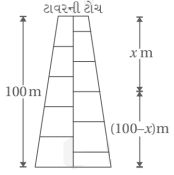
$A$ stone is allowed to fall from the top of a tower $100\, m$ high and at the same time another stone is projected vertically upwards from the ground with a velocity of $25\, m/s$. Calculate when and where the two stones will meet.
A
$45.4\, m$ and $31.6\, m$
B
$35.4\, m$ and $25.6\, m$
C
$25.4\, m$ and $19.6\, m$
D
$78.4\, m$ and $20.6\, m$
Solution
(D) Let the two stones meet after a time $t$.
For the stone dropped from the tower:
Initial velocity,$u = 0\, m/s$.
Let the displacement of the stone in time $t$ from the top of the tower be $s$.
Acceleration due to gravity,$g = 9.8\, m/s^2$.
Using the equation of motion,$s = ut + \frac{1}{2}at^2$:
$s = 0 \times t + \frac{1}{2} \times 9.8 \times t^2$
$s = 4.9t^2$ ............. $(1)$
For the stone thrown upwards:
Initial velocity,$u = 25\, m/s$.
Let the displacement of the stone from the ground in time $t$ be $s'$.
Acceleration due to gravity,$g = -9.8\, m/s^2$.
Using the equation of motion,$s' = ut + \frac{1}{2}at^2$:
$s' = 25t - \frac{1}{2} \times 9.8 \times t^2$
$s' = 25t - 4.9t^2$ ............. $(2)$
The sum of the displacements of both stones at the meeting point is equal to the total height of the tower,$100\, m$:
$s + s' = 100$
$4.9t^2 + 25t - 4.9t^2 = 100$
$25t = 100$
$t = 4\, s$
In $4\, s$,the distance covered by the falling stone from the top is:
$s = 4.9 \times (4)^2 = 4.9 \times 16 = 78.4\, m$.
Therefore,the stones will meet after $4\, s$ at a height of $(100 - 78.4) = 20.6\, m$ from the ground.
1 likes
View Solution8
MediumMCQ
The gravitational force between two objects is $F$. If the masses of both objects are halved without changing the distance between them,then the gravitational force would become:
A
$F$
B
$F/2$
C
$F/4$
D
$2F$
Solution
(C) According to Newton's law of universal gravitation,the force $F$ between two objects of masses $m_1$ and $m_2$ separated by a distance $r$ is given by $F = G \frac{m_1 m_2}{r^2}$.
When the masses of both objects are halved,the new masses become $m_1' = \frac{m_1}{2}$ and $m_2' = \frac{m_2}{2}$.
The new gravitational force $F'$ is $F' = G \frac{(\frac{m_1}{2})(\frac{m_2}{2})}{r^2} = G \frac{m_1 m_2}{4r^2} = \frac{1}{4} F$.
Therefore,the gravitational force becomes $F/4$.
When the masses of both objects are halved,the new masses become $m_1' = \frac{m_1}{2}$ and $m_2' = \frac{m_2}{2}$.
The new gravitational force $F'$ is $F' = G \frac{(\frac{m_1}{2})(\frac{m_2}{2})}{r^2} = G \frac{m_1 m_2}{4r^2} = \frac{1}{4} F$.
Therefore,the gravitational force becomes $F/4$.
0 likes
View Solution9
EasyMCQ
In the relation $F = G \frac{Mm}{d^2}$,the quantity $G$:
A
is greatest at the surface of the earth
B
is a universal constant of nature
C
is greatest at the poles of the earth
D
is used only when the earth is one of the two masses
Solution
(B) The relation $F = G \frac{Mm}{d^2}$ represents Newton's Law of Universal Gravitation.
In this formula,$G$ is known as the Universal Gravitational Constant.
It is called 'universal' because its value remains constant throughout the universe,regardless of the location,the nature of the masses,or the medium between them.
Its value is approximately $6.673 \times 10^{-11} \text{ N m}^2 \text{ kg}^{-2}$ everywhere.
Therefore,option $B$ is the correct statement.
0 likes
View Solution10
EasyMCQ
The law of gravitation gives the gravitational force between:
A
the earth and a point mass only
B
the earth and Sun only
C
any two bodies having some mass
D
two charged bodies only
Solution
(C) Newton's law of universal gravitation states that every particle of matter in the universe attracts every other particle with a force that is directly proportional to the product of their masses and inversely proportional to the square of the distance between their centers.
Mathematically,it is expressed as $F = G \frac{m_1 m_2}{r^2}$,where $F$ is the gravitational force,$G$ is the universal gravitational constant,$m_1$ and $m_2$ are the masses of the two bodies,and $r$ is the distance between them.
Since this law applies to all objects with mass,it describes the gravitational force between any two bodies having some mass in the universe.
0 likes
View Solution11
EasyMCQ
The value of the quantity $G$ in the law of gravitation:
A
depends on the mass of the earth only
B
depends on the radius of the earth only
C
depends on both the mass and radius of the earth
D
is independent of the mass and radius of the earth
Solution
(D) The quantity $G$ represents the Universal Gravitational Constant.
By definition,a universal constant has the same value throughout the universe,regardless of the location,the mass of the objects,or the distance between them.
Therefore,the value of $G$ is independent of the mass and radius of the earth.
By definition,a universal constant has the same value throughout the universe,regardless of the location,the mass of the objects,or the distance between them.
Therefore,the value of $G$ is independent of the mass and radius of the earth.
0 likes
View Solution12
MediumMCQ
Two particles are placed at some distance. If the mass of each of the two particles is doubled,keeping the distance between them unchanged,the value of gravitational force between them will be
A
$4$ times
B
$1/4$ times
C
$1/2$ times
D
unchanged
Solution
(A) According to Newton's law of universal gravitation,the force $F$ between two objects of masses $m_1$ and $m_2$ separated by a distance $r$ is given by $F = G \frac{m_1 m_2}{r^2}$.
If the mass of each particle is doubled,the new masses become $m_1' = 2m_1$ and $m_2' = 2m_2$.
The new gravitational force $F'$ is given by $F' = G \frac{(2m_1)(2m_2)}{r^2} = 4 \times (G \frac{m_1 m_2}{r^2}) = 4F$.
Therefore,the gravitational force becomes $4$ times the original value.
If the mass of each particle is doubled,the new masses become $m_1' = 2m_1$ and $m_2' = 2m_2$.
The new gravitational force $F'$ is given by $F' = G \frac{(2m_1)(2m_2)}{r^2} = 4 \times (G \frac{m_1 m_2}{r^2}) = 4F$.
Therefore,the gravitational force becomes $4$ times the original value.
0 likes
View Solution13
EasyMCQ
The atmosphere is held to the earth by
A
wind
B
gravity
C
clouds
D
earth's magnetic field
Solution
(B) The atmosphere is a layer of gases surrounding the Earth.
These gas molecules have mass and are subject to the Earth's gravitational pull.
Gravity acts as the force that keeps these gases close to the Earth's surface,preventing them from escaping into outer space.
Therefore,the atmosphere is held to the Earth by gravity.
These gas molecules have mass and are subject to the Earth's gravitational pull.
Gravity acts as the force that keeps these gases close to the Earth's surface,preventing them from escaping into outer space.
Therefore,the atmosphere is held to the Earth by gravity.
0 likes
View Solution14
EasyMCQ
The force of attraction between two unit point masses separated by a unit distance is called
A
gravitational potential
B
acceleration due to gravity
C
universal gravitational constant
D
gravitational field
Solution
(C) According to Newton's law of universal gravitation,the force $F$ between two point masses $m_1$ and $m_2$ separated by a distance $r$ is given by $F = G \frac{m_1 m_2}{r^2}$,where $G$ is the universal gravitational constant.
If $m_1 = 1 \text{ unit}$,$m_2 = 1 \text{ unit}$,and $r = 1 \text{ unit}$,then $F = G \frac{1 \times 1}{1^2} = G$.
Therefore,the force of attraction between two unit point masses separated by a unit distance is numerically equal to the universal gravitational constant $G$.
If $m_1 = 1 \text{ unit}$,$m_2 = 1 \text{ unit}$,and $r = 1 \text{ unit}$,then $F = G \frac{1 \times 1}{1^2} = G$.
Therefore,the force of attraction between two unit point masses separated by a unit distance is numerically equal to the universal gravitational constant $G$.
0 likes
View Solution15
Easy
What is the source of centripetal force that a planet requires to revolve around the Sun? On what factors does that force depend?
Solution
(N/A) The source of the centripetal force required for a planet to revolve around the Sun is the gravitational force exerted by the Sun on the planet.
According to Newton's law of universal gravitation,this force $F$ is given by the formula $F = G \frac{M \times m}{r^2}$,where $M$ is the mass of the Sun,$m$ is the mass of the planet,$r$ is the distance between them,and $G$ is the universal gravitational constant.
Therefore,the force depends on the product of the masses of the planet and the Sun $(M \times m)$ and is inversely proportional to the square of the distance $(r^2)$ between them.
0 likes
View Solution16
EasyMCQ
The Earth is acted upon by the gravitation of the Sun,even though it does not fall into the Sun. Why?
A
The Sun's gravity is too weak.
B
The Earth is moving too fast to fall.
C
The Sun's gravitational force provides the necessary centripetal force for the Earth's orbital motion.
D
The Earth is pushed away by solar radiation.
Solution
(C) The gravitational force of the Sun provides the necessary centripetal force to keep the Earth in its orbit.
This force acts perpendicular to the velocity of the Earth,constantly changing its direction to maintain a circular path.
Because the gravitational pull is exactly balanced by the requirements of the circular motion,the Earth neither falls into the Sun nor escapes into space.
This force acts perpendicular to the velocity of the Earth,constantly changing its direction to maintain a circular path.
Because the gravitational pull is exactly balanced by the requirements of the circular motion,the Earth neither falls into the Sun nor escapes into space.
0 likes
View Solution17
Easy
Define the "universal law of gravitation".
Solution
(N/A) The universal law of gravitation states that every object in the universe attracts every other object with a force that is directly proportional to the product of their masses $(M_1 \times M_2)$ and inversely proportional to the square of the distance $(r^2)$ between their centres.
Mathematically, this is expressed as $F = G \frac{M_1 M_2}{r^2}$, where $F$ is the gravitational force, $G$ is the universal gravitational constant, $M_1$ and $M_2$ are the masses of the two objects, and $r$ is the distance between them.
Mathematically, this is expressed as $F = G \frac{M_1 M_2}{r^2}$, where $F$ is the gravitational force, $G$ is the universal gravitational constant, $M_1$ and $M_2$ are the masses of the two objects, and $r$ is the distance between them.
0 likes
View Solution18
MediumMCQ
Do the gravitational forces obey Newton's third law of motion?
A
Yes
B
No
C
Only in vacuum
D
Only for large masses
Solution
(A) Yes,gravitational forces obey Newton's third law of motion.
According to Newton's third law,for every action,there is an equal and opposite reaction.
In the case of gravitation,if object $A$ exerts a gravitational force on object $B$,then object $B$ simultaneously exerts an equal and opposite gravitational force on object $A$.
According to Newton's third law,for every action,there is an equal and opposite reaction.
In the case of gravitation,if object $A$ exerts a gravitational force on object $B$,then object $B$ simultaneously exerts an equal and opposite gravitational force on object $A$.
0 likes
View Solution19
EasyMCQ
What is the ratio of the gravitational force between two masses kept at a certain distance in air to the force between them when kept in any other medium?
A
$1: 1$
B
$1: 2$
C
$2: 1$
D
$1: 4$
Solution
(A) The gravitational force between two masses $m_1$ and $m_2$ separated by a distance $r$ is given by Newton's Law of Gravitation: $F = G \frac{m_1 m_2}{r^2}$.
This force depends only on the masses of the objects and the distance between them.
The gravitational constant $G$ is a universal constant and does not depend on the medium between the masses.
Therefore,the gravitational force remains the same regardless of whether the objects are in air or any other medium.
Thus,the ratio of the force in air to the force in any other medium is $1: 1$.
0 likes
View Solution20
EasyMCQ
Is it possible to shield a body from a gravitational field?
A
Yes,by using a lead shield.
B
Yes,by using an insulating material.
C
No,it is not possible.
D
Yes,by using a vacuum chamber.
Solution
(C) No,it is not possible to shield a body from a gravitational field.
This is because the gravitational force is a fundamental interaction that acts between all masses in the universe.
Unlike electric or magnetic fields,which can be blocked by certain materials (like Faraday cages for electric fields),the gravitational force is independent of the nature of the medium present between two bodies.
Therefore,no material can act as a shield against gravity.
0 likes
View Solution21
Easy
State any one phenomenon related to the universal law of gravitation.
Solution
(N/A) One common phenomenon related to the universal law of gravitation is the motion of planets around the Sun. According to Newton's law of universal gravitation,every particle of matter in the universe attracts every other particle with a force that is directly proportional to the product of their masses and inversely proportional to the square of the distance between them. This gravitational force provides the necessary centripetal force that keeps planets in their respective orbits around the Sun.
0 likes
View Solution22
Easy
State the universal law of gravitation.
Solution
(N/A) The universal law of gravitation states that every object in the universe attracts every other object with a force that is directly proportional to the product of their masses ($M_1$ and $M_2$) and inversely proportional to the square of the distance $(d^2)$ between their centers.
Mathematically,this is expressed as: $F = G \frac{M_1 M_2}{d^2}$,where $F$ is the gravitational force and $G$ is the universal gravitational constant.
Mathematically,this is expressed as: $F = G \frac{M_1 M_2}{d^2}$,where $F$ is the gravitational force and $G$ is the universal gravitational constant.
0 likes
View Solution23
EasyMCQ
What will happen if the force of gravity disappears suddenly?
A
Objects will fall towards the Earth.
B
Objects will start floating in space.
C
Objects will move in a straight line tangent to their current path.
D
Objects will remain stationary.
Solution
(C) If the force of gravity disappears suddenly,all objects will lose the centripetal force required to maintain their circular motion around the Earth. According to Newton's first law of motion,objects will continue to move in a straight line tangent to their current path at the point where gravity vanished.
0 likes
View Solution24
Easy
Give reason: $A$ stone falls towards the earth,but the earth does not rise towards the stone.
Solution
(N/A) $(i)$ According to Newton's law of universal gravitation,every object in the universe attracts every other object with a force that is proportional to the product of their masses.
$(ii)$ The earth exerts a gravitational force on the stone,causing it to accelerate towards the earth.
$(iii)$ The stone also exerts an equal and opposite gravitational force on the earth.
$(iv)$ However,due to the extremely large mass of the earth compared to the stone,the acceleration produced in the earth is negligible,making its motion towards the stone imperceptible.
0 likes
View Solution25
Medium
Explain by giving reasons:
$(i)$ If a stone held in our hands is released,it falls towards the earth.
$(ii)$ Two objects kept in a room do not move towards each other as per the universal law of gravitation.
$(i)$ If a stone held in our hands is released,it falls towards the earth.
$(ii)$ Two objects kept in a room do not move towards each other as per the universal law of gravitation.
Solution
(N/A) $(i)$ The stone falls towards the earth because of the gravitational force exerted by the earth on the stone. According to the universal law of gravitation,every object in the universe attracts every other object with a force. Since the earth is massive,its gravitational pull on the stone is significant,causing the stone to accelerate towards it.
$(ii)$ According to the universal law of gravitation,the force of attraction between two objects is directly proportional to the product of their masses and inversely proportional to the square of the distance between them. Since the masses of ordinary objects in a room are very small,the gravitational force between them is extremely weak. This force is negligible compared to the frictional forces and the gravitational pull of the earth,which is why they do not move towards each other.
$(ii)$ According to the universal law of gravitation,the force of attraction between two objects is directly proportional to the product of their masses and inversely proportional to the square of the distance between them. Since the masses of ordinary objects in a room are very small,the gravitational force between them is extremely weak. This force is negligible compared to the frictional forces and the gravitational pull of the earth,which is why they do not move towards each other.
0 likes
View Solution26
Medium
All the planets are moving in circular orbits. What provides the necessary force for this motion and what is the direction of this force? What will happen if this force disappears suddenly?
Solution
(N/A) $1$. The gravitational force exerted by the Sun on the planets provides the necessary centripetal force for their motion along a circular orbit.
$2$. The direction of this force is always towards the center of the orbit (i.e.,towards the Sun).
$3$. If this force were to disappear suddenly,the planet would no longer be able to maintain its circular path and would continue to move in a straight line along the tangent to its orbit at that point,as per Newton's first law of motion.
0 likes
View Solution27
EasyMCQ
Calculate the force of gravitation between two objects of masses $10 \; kg$ and $20 \; kg$ at a distance of $10 \; m$ from each other. $\left[G = 6.67 \times 10^{-11} \; Nm^2 kg^{-2}\right]$
A
$6.67 \times 10^{-10} \; N$
B
$13.34 \times 10^{-11} \; N$
C
$1.334 \times 10^{-11} \; N$
D
$26.68 \times 10^{-10} \; N$
Solution
(B) The formula for the force of gravitation is $F = G \frac{m_1 m_2}{r^2}$.
Given:
$m_1 = 10 \; kg$
$m_2 = 20 \; kg$
$r = 10 \; m$
$G = 6.67 \times 10^{-11} \; Nm^2 kg^{-2}$
Substituting the values into the formula:
$F = \frac{6.67 \times 10^{-11} \times 10 \times 20}{(10)^2} \; N$
$F = \frac{6.67 \times 10^{-11} \times 200}{100} \; N$
$F = 6.67 \times 10^{-11} \times 2 \; N$
$F = 13.34 \times 10^{-11} \; N$
0 likes
View Solution28
EasyMCQ
Which is greater: the attraction of earth for $1 \,kg$ of lead or attraction of $1 \,kg$ of lead for earth?
A
Attraction of earth for lead
B
Attraction of lead for earth
C
Both are equal
D
None of these
Solution
(C) According to Newton's law of universal gravitation,the force of attraction between two objects is given by $F = G \frac{M_1 M_2}{r^2}$.
This force is mutual,meaning the earth exerts a force on the lead,and the lead exerts an equal and opposite force on the earth.
According to Newton's third law of motion,for every action,there is an equal and opposite reaction.
Therefore,the gravitational force exerted by the earth on $1 \,kg$ of lead is exactly equal in magnitude to the gravitational force exerted by the $1 \,kg$ of lead on the earth.
0 likes
View Solution29
Easy
If gravitation is the power by which all bodies tend towards each other,then why do all bodies tend towards the centre of the earth?
Solution
(N/A) According to Newton's law of universal gravitation,every object in the universe attracts every other object with a force proportional to the product of their masses and inversely proportional to the square of the distance between them $(F = G \frac{M_1 M_2}{r^2})$.
While all bodies do exert a gravitational force on each other,the magnitude of this force is extremely small for objects of ordinary size because their masses are negligible compared to the mass of the Earth.
In contrast,the Earth has an enormous mass. Therefore,the gravitational force exerted by the Earth on any object near its surface is significantly larger than the mutual gravitational forces between those objects.
Consequently,the Earth's gravitational pull dominates,causing all objects to be attracted towards the centre of the Earth.
0 likes
View Solution30
Medium
State the source of centripetal force that our earth requires to revolve around the sun. List the factors on which this force depends.
Solution
(N/A) $(i)$ The centripetal force required for the earth to revolve around the sun is provided by the gravitational force of attraction between the sun and the earth.
$(ii)$ According to the law of universal gravitation,the magnitude of this force depends on the mass of the sun $(M)$,the mass of the earth $(m)$,and the square of the distance $(r^2)$ between their centers. The formula is $F = G \frac{Mm}{r^2}$,where $G$ is the universal gravitational constant.
$(ii)$ According to the law of universal gravitation,the magnitude of this force depends on the mass of the sun $(M)$,the mass of the earth $(m)$,and the square of the distance $(r^2)$ between their centers. The formula is $F = G \frac{Mm}{r^2}$,where $G$ is the universal gravitational constant.
0 likes
View Solution31
Easy
Show that if the earth attracts two bodies $A$ and $B$ placed at the same distance from the centre of the earth with the same force,then their masses are equal.
Solution
(N/A) Let $m_{1}$ and $m_{2}$ be the masses of the two bodies and $M$ be the mass of the earth.
Let the distance of the two bodies from the centre of the earth be $r$.
According to Newton's law of universal gravitation,the force $F$ exerted by the earth on a body of mass $m$ at a distance $r$ is given by $F = \frac{GMm}{r^{2}}$,where $G$ is the universal gravitational constant.
For body $A$,the force is $F_{1} = \frac{GMm_{1}}{r^{2}}$.
For body $B$,the force is $F_{2} = \frac{GMm_{2}}{r^{2}}$.
Given that the forces are equal,$F_{1} = F_{2}$.
Therefore,$\frac{GMm_{1}}{r^{2}} = \frac{GMm_{2}}{r^{2}}$.
By cancelling the common terms $\frac{GM}{r^{2}}$ from both sides,we get $m_{1} = m_{2}$.
Thus,the masses of the two bodies are equal.
0 likes
View Solution32
Easy
State the universal law of gravitation. Write the $SI$ unit of $G$.
Solution
(N/A) The universal law of gravitation states that every object in the universe attracts every other object with a force that is directly proportional to the product of their masses and inversely proportional to the square of the distance between their centers.
Mathematically,$F = G \frac{M \times m}{d^2}$,where $F$ is the gravitational force,$M$ and $m$ are the masses of the two objects,and $d$ is the distance between them.
The $SI$ unit of the universal gravitational constant $G$ is $N \ m^2 \ kg^{-2}$.
Mathematically,$F = G \frac{M \times m}{d^2}$,where $F$ is the gravitational force,$M$ and $m$ are the masses of the two objects,and $d$ is the distance between them.
The $SI$ unit of the universal gravitational constant $G$ is $N \ m^2 \ kg^{-2}$.
0 likes
View Solution33
Medium
State the universal law of gravitation. How is the force between two bodies affected if the distance between them is tripled?
Solution
(N/A) The universal law of gravitation states that every object in the universe attracts every other object with a force that is directly proportional to the product of their masses and inversely proportional to the square of the distance between their centers.
Mathematically,$F = G \frac{m_1 m_2}{r^2}$,where $G$ is the universal gravitational constant.
If the distance $r$ is tripled,the new distance becomes $r' = 3r$.
The new force $F'$ will be $F' = G \frac{m_1 m_2}{(3r)^2} = G \frac{m_1 m_2}{9r^2} = \frac{1}{9} F$.
Therefore,the force becomes $\frac{1}{9}$ times the original force.
0 likes
View Solution34
Easy
State any two properties of gravitational force.
Solution
(N/A) $(i)$ It is the weakest force in nature.
$(ii)$ It is always attractive in nature and acts between any two objects having mass.
$(ii)$ It is always attractive in nature and acts between any two objects having mass.
0 likes
View Solution35
Medium
$(i)$ Why is Newton's law of gravitation called the universal law?
$(ii)$ What is the significance of this law in nature?
$(ii)$ What is the significance of this law in nature?
Solution
(N/A) $(i)$ Newton's law of gravitation is applicable to all objects in the universe,regardless of their size,mass,or distance,hence it is called the universal law of gravitation.
$(ii)$ The universal law of gravitation is significant because it successfully explains the following phenomena:
$(a)$ The gravitational force that binds us to the Earth.
$(b)$ The motion of the Moon around the Earth.
$(c)$ The motion of planets around the Sun.
$(d)$ The occurrence of tides in the oceans due to the gravitational pull of the Moon and the Sun.
0 likes
View Solution36
Medium
$(i)$ How is the force of attraction dependent on the masses of objects and the distance between them?
$(ii)$ The mass of the Earth is $6 \times 10^{24} \, kg$ and that of a natural satellite is $6.5 \times 10^{20} \, kg$. If the distance between them is $3.35 \times 10^{6} \, km$, calculate the force exerted by the Earth on it. $(G = 6.7 \times 10^{-11} \, Nm^{2} kg^{-2})$
$(ii)$ The mass of the Earth is $6 \times 10^{24} \, kg$ and that of a natural satellite is $6.5 \times 10^{20} \, kg$. If the distance between them is $3.35 \times 10^{6} \, km$, calculate the force exerted by the Earth on it. $(G = 6.7 \times 10^{-11} \, Nm^{2} kg^{-2})$
Solution
(N/A) $(i)$ The force of attraction between two objects is directly proportional to the product of their masses, i.e., $F \propto m_{1} m_{2}$.
The force of attraction between two objects is inversely proportional to the square of the distance between them, i.e., $F \propto \frac{1}{r^{2}}$.
$(ii)$ Given:
Mass of the Earth, $M = 6 \times 10^{24} \, kg$
Mass of the satellite, $m = 6.5 \times 10^{20} \, kg$
Distance between them, $r = 3.35 \times 10^{6} \, km = 3.35 \times 10^{9} \, m$
Gravitational constant, $G = 6.7 \times 10^{-11} \, Nm^{2} kg^{-2}$
Using the formula $F = G \frac{Mm}{r^{2}}$:
$F = \frac{6.7 \times 10^{-11} \times 6 \times 10^{24} \times 6.5 \times 10^{20}}{(3.35 \times 10^{9})^{2}}$
$F = \frac{261.3 \times 10^{33}}{11.2225 \times 10^{18}}$
$F \approx 23.28 \times 10^{15} \, N$ or $2.33 \times 10^{16} \, N$.
0 likes
View Solution37
Medium
What happens to the gravitational force between two objects,if
$(a)$ the mass of one object is doubled?
$(b)$ the distance between the objects is doubled?
$(c)$ the masses of both the objects are doubled? Give reason in each case.
$(a)$ the mass of one object is doubled?
$(b)$ the distance between the objects is doubled?
$(c)$ the masses of both the objects are doubled? Give reason in each case.
Solution
(N/A) The gravitational force between two objects is given by the expression $F = \frac{G m_1 m_2}{r^2}$.
$(a)$ If the mass of one object is doubled $(m_1' = 2m_1)$,the new force $F' = \frac{G(2m_1)m_2}{r^2} = 2F$. Thus,the force doubles.
$(b)$ If the distance between the objects is doubled $(r' = 2r)$,the new force $F' = \frac{G m_1 m_2}{(2r)^2} = \frac{G m_1 m_2}{4r^2} = \frac{1}{4}F$. Thus,the force becomes one-fourth of the original force.
$(c)$ If the masses of both objects are doubled ($m_1' = 2m_1$ and $m_2' = 2m_2$),the new force $F' = \frac{G(2m_1)(2m_2)}{r^2} = 4 \times \frac{G m_1 m_2}{r^2} = 4F$. Thus,the force becomes four times the original force.
0 likes
View Solution38
Medium
State the universal law of gravitation. Write the $SI$ unit of $G$. The gravitational force between two objects is $100 \, N$. How should the distance between the objects be changed so that the force between them becomes $50 \, N$?
Solution
(N/A) The universal law of gravitation states that every object in the universe attracts every other object with a force that is directly proportional to the product of their masses and inversely proportional to the square of the distance between their centers.
The $SI$ unit of the universal gravitational constant $G$ is $N \, m^2 \, kg^{-2}$.
Given:
Initial force $F_1 = 100 \, N$
Final force $F_2 = 50 \, N$
We know that the gravitational force $F$ is given by $F = \frac{G m_1 m_2}{r^2}$,which implies $F \propto \frac{1}{r^2}$.
Therefore,$\frac{F_1}{F_2} = \left(\frac{r_2}{r_1}\right)^2$.
Substituting the values:
$\frac{100}{50} = \left(\frac{r_2}{r_1}\right)^2$
$2 = \left(\frac{r_2}{r_1}\right)^2$
$\frac{r_2}{r_1} = \sqrt{2}$
Thus,the distance between the objects should be increased by a factor of $\sqrt{2}$ (approximately $1.414$ times the original distance) to make the force $50 \, N$.
0 likes
View Solution39
Easy
Newton's law of gravitation is called a universal law. Why?
Solution
(N/A) Newton's law of gravitation is called a universal law because it is applicable to all objects in the universe,regardless of their mass,size,shape,or the distance between them. It describes the gravitational force acting between any two particles of matter anywhere in the universe.
0 likes
View Solution40
EasyMCQ
According to Newton's law of gravitation,every particle of matter attracts every other particle. But bodies on the surface of the Earth never move towards each other on account of this force of attraction. Why?
A
The force is too weak.
B
The Earth's gravity dominates.
C
Friction prevents movement.
D
The bodies are too heavy.
Solution
(B) The gravitational force between two small objects on the surface of the Earth is extremely weak because their masses are very small.
In contrast,the mass of the Earth is enormous.
Due to this,the gravitational attraction between any object and the Earth is significantly stronger than the mutual attraction between the objects themselves.
Consequently,all objects are pulled towards the center of the Earth rather than towards each other.
0 likes
View Solution41
EasyMCQ
Is it possible to shield a body from gravitational effects?
A
Yes,by using a lead shield.
B
Yes,by using an electromagnetic shield.
C
No,it is not possible.
D
Yes,by using a vacuum chamber.
Solution
(C) No,it is not possible to shield a body from gravitational effects.
This is because gravitational interaction is a fundamental force that acts between all objects with mass.
Unlike electromagnetic forces,which can be shielded by placing a material between the charges,gravitational force does not depend on the nature of the intervening medium.
Therefore,gravity cannot be blocked or neutralized by any known material.
0 likes
View Solution42
EasyMCQ
Earth is continuously pulling the moon towards its centre,still it does not fall to the earth,why?
A
The moon is too far away from the earth.
B
The earth's gravitational force is balanced by the moon's own gravity.
C
The gravitational pull of the earth provides the necessary centripetal force for the moon to revolve in its orbit.
D
The moon has its own independent path and is not affected by earth's gravity.
Solution
(C) The gravitational force exerted by the earth on the moon provides the necessary centripetal force required for the moon to move in a circular orbit around the earth.
This gravitational force acts perpendicular to the direction of the moon's velocity,which changes the direction of the moon's motion continuously without changing its speed.
As a result,the moon keeps revolving in its orbit instead of falling towards the earth.
This gravitational force acts perpendicular to the direction of the moon's velocity,which changes the direction of the moon's motion continuously without changing its speed.
As a result,the moon keeps revolving in its orbit instead of falling towards the earth.
0 likes
View Solution43
EasyMCQ
Calculate the force of gravitation between two objects of masses $50 \, kg$ and $120 \, kg$ respectively,kept at a distance of $10 \, m$ from each other. $(G = 6.673 \times 10^{-11} \, N \, m^2 \, kg^{-2})$
A
$4.0 \times 10^{-9} \, N$
B
$4.0 \times 10^{-8} \, N$
C
$6.673 \times 10^{-9} \, N$
D
$2.0 \times 10^{-9} \, N$
Solution
(A) The universal law of gravitation is given by the formula $F = \frac{G m_1 m_2}{r^2}$.
Given:
Mass of the first object,$m_1 = 50 \, kg$.
Mass of the second object,$m_2 = 120 \, kg$.
Distance between the objects,$r = 10 \, m$.
Gravitational constant,$G = 6.673 \times 10^{-11} \, N \, m^2 \, kg^{-2}$.
Substituting these values into the formula:
$F = \frac{6.673 \times 10^{-11} \times 50 \times 120}{10^2}$
$F = \frac{6.673 \times 10^{-11} \times 6000}{100}$
$F = 6.673 \times 10^{-11} \times 60$
$F = 400.38 \times 10^{-11} \, N$
$F = 4.0038 \times 10^{-9} \, N \approx 4.0 \times 10^{-9} \, N$.
0 likes
View Solution44
EasyMCQ
The mass of the planet Jupiter is $1.9 \times 10^{27} \, kg$ and that of the Sun is $1.99 \times 10^{30} \, kg$. The mean distance of the Sun from Jupiter is $7.8 \times 10^{11} \, m$. Calculate the gravitational force which the Sun exerts on Jupiter.
A
$1.1 \times 10^{24} \, N$
B
$2.2 \times 10^{23} \, N$
C
$8.8 \times 10^{22} \, N$
D
$4.4 \times 10^{23} \, N$
Solution
(D) Given:
Mass of Jupiter,$M_1 = 1.9 \times 10^{27} \, kg$
Mass of Sun,$M_2 = 1.99 \times 10^{30} \, kg$
Distance between Jupiter and Sun,$r = 7.8 \times 10^{11} \, m$
Gravitational constant,$G = 6.67 \times 10^{-11} \, N \cdot m^2 \cdot kg^{-2}$
Using the universal law of gravitation formula,$F = \frac{G M_1 M_2}{r^2}$:
$F = \frac{6.67 \times 10^{-11} \times 1.9 \times 10^{27} \times 1.99 \times 10^{30}}{(7.8 \times 10^{11})^2}$
$F = \frac{6.67 \times 1.9 \times 1.99 \times 10^{46}}{60.84 \times 10^{22}}$
$F \approx 4.146 \times 10^{23} \, N$
Rounding to the nearest provided option,the gravitational force is $4.4 \times 10^{23} \, N$.
0 likes
View Solution45
MediumMCQ
The gravitational force between objects is $100 \, N$. How should the distance between these objects be changed so that the force between them becomes $50 \, N$?
A
Increase by a factor of $\sqrt{2}$
B
Decrease by a factor of $\sqrt{2}$
C
Increase by a factor of $2$
D
Decrease by a factor of $2$
Solution
(A) According to Newton's law of universal gravitation,the force $F$ is inversely proportional to the square of the distance $r$ between the objects: $F \propto \frac{1}{r^2}$.
Given initial force $F_1 = 100 \, N$ and final force $F_2 = 50 \, N$.
We have the ratio: $\frac{F_2}{F_1} = \frac{r_1^2}{r_2^2}$.
Substituting the values: $\frac{50}{100} = \frac{r_1^2}{r_2^2} \implies \frac{1}{2} = \frac{r_1^2}{r_2^2}$.
Taking the square root on both sides: $\frac{1}{\sqrt{2}} = \frac{r_1}{r_2}$.
Therefore,$r_2 = \sqrt{2} \, r_1$.
Thus,the distance must be increased by a factor of $\sqrt{2}$.
0 likes
View Solution46
EasyMCQ
The force of gravitation between two bodies varies with the distance $r$ as:
A
$r$
B
$r^2$
C
$\frac{1}{r^2}$
D
$\frac{1}{r}$
Solution
(C) According to Newton's law of universal gravitation,the gravitational force $F$ between two bodies of masses $m_1$ and $m_2$ separated by a distance $r$ is given by the formula:
$F = G \frac{m_1 m_2}{r^2}$
Here,$G$ is the universal gravitational constant.
From this formula,it is clear that the force $F$ is inversely proportional to the square of the distance $r$ between the two bodies.
Therefore,$F \propto \frac{1}{r^2}$.
$F = G \frac{m_1 m_2}{r^2}$
Here,$G$ is the universal gravitational constant.
From this formula,it is clear that the force $F$ is inversely proportional to the square of the distance $r$ between the two bodies.
Therefore,$F \propto \frac{1}{r^2}$.
0 likes
View Solution47
EasyMCQ
Which of the following is the evidence to show that there must be a force acting on the earth and directed towards the sun?
A
revolution of the earth around the sun
B
deviation of falling bodies towards the east
C
phenomenon of day and night
D
apparent motion of sun around the earth
Solution
(A) According to Newton's first law of motion,an object in motion will continue to move in a straight line at a constant speed unless acted upon by an external force.
Since the earth moves in a nearly circular orbit around the sun,its direction of motion is constantly changing at every point.
$A$ change in direction implies a change in velocity,which constitutes acceleration.
According to Newton's second law,acceleration requires a net force.
Therefore,the revolution of the earth around the sun serves as evidence that a centripetal force (gravitational force) must be acting on the earth,directed towards the sun.
0 likes
View Solution48
EasyMCQ
The value of the gravitational constant $(G)$ depends upon:
A
temperature of the atmosphere
B
masses
C
distance between the masses
D
none of these
Solution
(D) The gravitational constant $(G)$ is a universal constant.
It is defined as the force of attraction between two unit masses separated by a unit distance.
Its value is $6.674 \times 10^{-11} \ N \ m^2/kg^2$.
Since it is a universal constant,it does not depend on the masses of the objects,the distance between them,the temperature of the medium,or any other physical conditions.
Therefore,the correct option is $D$.
0 likes
View Solution49
MediumMCQ
The equation $F = G \frac{m_1 m_2}{r^2}$ is valid only for:
A
spherical bodies
B
linear bodies
C
elliptical bodies
D
circular bodies
Solution
(A) The universal law of gravitation,expressed as $F = G \frac{m_1 m_2}{r^2}$,describes the gravitational force between two point masses.
For extended objects,this formula is strictly valid only when the objects are spherical and their mass distribution is uniform (spherically symmetric).
In such cases,the entire mass of the sphere can be considered to be concentrated at its center,allowing the distance $r$ to be measured between the centers of the two spheres.
0 likes
View Solution50
MediumMCQ
If the distance between two objects is doubled,the gravitational force between them :
A
remains the same
B
gets doubled
C
gets halved
D
becomes one-fourth
Solution
(D) According to Newton's law of universal gravitation,the force $F$ between two objects of masses $m_1$ and $m_2$ separated by a distance $r$ is given by the formula: $F = G \frac{m_1 m_2}{r^2}$.
Here,$G$ is the universal gravitational constant.
If the distance $r$ is doubled,the new distance becomes $r' = 2r$.
The new gravitational force $F'$ will be: $F' = G \frac{m_1 m_2}{(2r)^2} = G \frac{m_1 m_2}{4r^2}$.
This can be rewritten as: $F' = \frac{1}{4} \times (G \frac{m_1 m_2}{r^2}) = \frac{1}{4} F$.
Therefore,the gravitational force becomes one-fourth of its original value.
0 likes
View SolutionGRAVITATION — Universal Law of Gravitation · Frequently Asked Questions
1Are these GRAVITATION questions useful for JEE and NEET?
Yes. All questions in this section are mapped to JEE Main and NEET exam patterns. Previous year questions from JEE Main, NEET, GUJCET and state-level exams are included with full solutions.
2Can I switch to Hindi or Gujarati for these questions?
Yes. Use the language tabs in the hero section or the sidebar to view the same questions and solutions in English, Hindi or Gujarati.
3How do I generate a question paper from this subtopic?
Use the Vedclass Exam Paper Generator — select the chapter and subtopic, set difficulty, and generate Sets A, B, C, D automatically. First 3 chapters of every subject are free.
Vedclass Products
For Students
Vedclass Test Series
Mock tests in real JEE/NEET style with performance analysis. 5-day free trial.
Start Free TrialFor Teachers
Exam Paper Generator
Generate Set A/B/C/D papers from this chapter in 2 minutes. 3 chapters free.
Try FreeFor Institutes
Online Exam Module
Live online exams with unlimited students, 360° analytics & white-label branding.
See DemoFor Teachers & Institutes
Generate a GRAVITATION Exam Paper in 2 Minutes
Select subtopic & difficulty — Sets A, B, C, D auto-generated with No Repeat logic.
First 3 chapters of every subject are free — no payment required.