
A English
Change of State and Evaporation Questions in English
Class 9 Science · MATTER IN OUR SURROUNDINGS · Change of State and Evaporation
91+
Questions
English
Language
100%
With Solutions
Showing 50 of 91 questions in English
1
EasyMCQ
Convert the following temperatures to the Celsius scale:
$a.$ $300 \, K$
$b.$ $573 \, K$
$a.$ $300 \, K$
$b.$ $573 \, K$
A
$27 \, ^\circ C$ and $300 \, ^\circ C$
B
$270 \, ^\circ C$ and $30 \, ^\circ C$
C
$25 \, ^\circ C$ and $330 \, ^\circ C$
D
$40 \, ^\circ C$ and $270 \, ^\circ C$
Solution
(A) To convert temperature from the Kelvin scale to the Celsius scale,we use the following formula:
$t \, ^\circ C = T \, K - 273$
$(a)$ For $300 \, K$:
$300 - 273 = 27 \, ^\circ C$
$(b)$ For $573 \, K$:
$573 - 273 = 300 \, ^\circ C$
Therefore,the correct answer is $27 \, ^\circ C$ and $300 \, ^\circ C$.
$t \, ^\circ C = T \, K - 273$
$(a)$ For $300 \, K$:
$300 - 273 = 27 \, ^\circ C$
$(b)$ For $573 \, K$:
$573 - 273 = 300 \, ^\circ C$
Therefore,the correct answer is $27 \, ^\circ C$ and $300 \, ^\circ C$.
0 likes
View Solution2
Easy
What is the physical state of water at:
$(a)$ $250\,^{\circ}\text{C}$
$(b)$ $100\,^{\circ}\text{C}$?
$(a)$ $250\,^{\circ}\text{C}$
$(b)$ $100\,^{\circ}\text{C}$?
Solution
(N/A) The boiling point of water is $100\,^{\circ}\text{C}$.
$(a)$ At $250\,^{\circ}\text{C}$,which is above the boiling point,water exists as steam or water vapour,i.e.,in a gaseous state.
$(b)$ At $100\,^{\circ}\text{C}$,water is at its boiling point where a phase transition occurs. Therefore,at this temperature,water exists in both liquid and gaseous states simultaneously.
0 likes
View Solution3
MediumMCQ
For any substance,why does the temperature remain constant during the change of state?
A
Because the heat is used to increase the kinetic energy of the particles.
B
Because the heat is used to overcome the forces of attraction between the particles.
C
Because the heat is lost to the surroundings.
D
Because the substance stops absorbing heat.
Solution
(B) During the change of state of a substance,the temperature remains constant.
This happens because the heat energy supplied is used to overcome the forces of attraction between the particles of the substance.
This hidden heat is known as latent heat.
Since this energy is consumed in changing the state rather than increasing the kinetic energy of the particles,the temperature does not rise during the phase transition.
0 likes
View Solution4
EasyMCQ
Suggest a method to liquefy atmospheric gases.
A
Increasing pressure and increasing temperature
B
Applying pressure and reducing temperature
C
Reducing pressure and increasing temperature
D
Reducing pressure and reducing temperature
Solution
(B) Atmospheric gases can be liquefied by applying high pressure and simultaneously reducing the temperature.
This process works because increasing pressure brings gas particles closer together,while decreasing the temperature reduces their kinetic energy,allowing intermolecular forces to hold the particles together in a liquid state.
This process works because increasing pressure brings gas particles closer together,while decreasing the temperature reduces their kinetic energy,allowing intermolecular forces to hold the particles together in a liquid state.
0 likes
View Solution5
Medium
Why does a desert cooler cool better on a hot dry day?
Solution
(N/A) desert cooler functions on the principle of evaporative cooling.
The rate of evaporation is directly proportional to the temperature and inversely proportional to the humidity of the air.
On a hot and dry day,the temperature is high and the humidity is low,which significantly increases the rate of evaporation.
Since evaporation causes a cooling effect,the increased rate of evaporation leads to better cooling by the desert cooler.
0 likes
View Solution6
MediumMCQ
How does the water kept in an earthen pot (matka) become cool during summer?
A
Due to the absorption of heat from the surroundings.
B
Due to the process of evaporation which causes cooling.
C
Due to the condensation of water vapor on the outer surface.
D
Due to the chemical reaction between clay and water.
Solution
(B) An earthen pot (matka) has a large number of tiny pores on its surface.
Water seeps through these pores and reaches the outer surface of the pot.
This water evaporates continuously due to the heat of the surroundings.
Since the process of evaporation is an endothermic process that requires energy (latent heat of vaporization),it absorbs this heat from the remaining water inside the pot.
As a result,the temperature of the water inside the pot decreases,making it cool.
0 likes
View Solution7
MediumMCQ
Why does our palm feel cold when we put some acetone,petrol,or perfume on it?
A
Due to the absorption of latent heat of vaporization from the palm.
B
Due to the release of heat into the palm.
C
Due to the chemical reaction between the liquid and the skin.
D
Due to the high temperature of the liquid.
Solution
(A) Acetone,petrol,and perfume are volatile substances that evaporate rapidly when exposed to air.
During the process of evaporation,these substances absorb the necessary latent heat of vaporization from the surface of the palm.
Since the palm loses heat to the liquid,the temperature of the palm decreases,causing a cooling sensation.
During the process of evaporation,these substances absorb the necessary latent heat of vaporization from the surface of the palm.
Since the palm loses heat to the liquid,the temperature of the palm decreases,causing a cooling sensation.
0 likes
View Solution8
EasyMCQ
Why are we able to sip hot tea or milk faster from a saucer rather than a cup?
A
The saucer has a smaller surface area.
B
The saucer has a larger surface area,which increases the rate of evaporation.
C
The cup is made of a different material.
D
The saucer is made of a different material.
Solution
(B) Evaporation is a surface phenomenon.
When tea or milk is poured into a saucer,it spreads out,providing a larger surface area compared to a cup.
$A$ larger surface area allows more particles of the liquid to escape into the atmosphere as vapor,thereby increasing the rate of evaporation.
Since evaporation causes cooling,the liquid in the saucer cools down much faster than in a cup,allowing us to sip it more quickly.
0 likes
View Solution9
MediumMCQ
What type of clothes should we wear in summer?
A
Dark colored synthetic clothes
B
Light colored cotton clothes
C
Dark colored cotton clothes
D
Light colored synthetic clothes
Solution
(B) We should wear light-colored cotton clothes in summer because:
$1.$ Cotton is a good absorber of water/sweat. It provides more surface area for the sweat to evaporate.
$2.$ Light colors absorb less heat.
Therefore,wearing light-colored cotton clothes helps us feel cool and comfortable.
$1.$ Cotton is a good absorber of water/sweat. It provides more surface area for the sweat to evaporate.
$2.$ Light colors absorb less heat.
Therefore,wearing light-colored cotton clothes helps us feel cool and comfortable.
0 likes
View Solution10
EasyMCQ
Convert the following temperatures to the Celsius scale.
$(a)$ $293 \, K$
$(b)$ $470 \, K$
$(a)$ $293 \, K$
$(b)$ $470 \, K$
A
$200 \, ^\circ C$ and $190 \, ^\circ C$
B
$20 \, ^\circ C$ and $197 \, ^\circ C$
C
$15 \, ^\circ C$ and $200 \, ^\circ C$
D
$25 \, ^\circ C$ and $195 \, ^\circ C$
Solution
(B) To convert temperature from the Kelvin scale to the Celsius scale,we subtract $273$ from the given value,as the relationship is defined by the formula: $^\circ C = K - 273$.
$(a)$ For $293 \, K$: $293 - 273 = 20 \, ^\circ C$.
$(b)$ For $470 \, K$: $470 - 273 = 197 \, ^\circ C$.
$(a)$ For $293 \, K$: $293 - 273 = 20 \, ^\circ C$.
$(b)$ For $470 \, K$: $470 - 273 = 197 \, ^\circ C$.
0 likes
View Solution11
MediumMCQ
Seema visited a Natural Gas Compressing Unit and found that the gas can be liquefied under specific conditions of temperature and pressure. While sharing her experience with friends,she got confused. Help her to identify the correct set of conditions.
A
Low temperature,low pressure
B
Low temperature,high pressure
C
High temperature,low pressure
D
High temperature,high pressure
Solution
(B) Low temperature reduces the kinetic energy of the gas particles,which slows down their movement.
High pressure reduces the intermolecular space between the particles,bringing them closer together.
Combining these two conditions allows the gas particles to come close enough to form intermolecular bonds,thereby converting the gas into a liquid state.
High pressure reduces the intermolecular space between the particles,bringing them closer together.
Combining these two conditions allows the gas particles to come close enough to form intermolecular bonds,thereby converting the gas into a liquid state.
0 likes
View Solution12
MediumMCQ
During summer,water kept in an earthen pot becomes cool because of the phenomenon of
A
diffusion
B
transpiration
C
osmosis
D
evaporation
Solution
(D) Evaporation is a surface phenomenon where particles from the surface of the liquid gain energy from the surroundings to overcome the forces of attraction and change into vapor. This process absorbs heat from the remaining water and the earthen pot,thereby reducing the temperature of the water inside and making it cool.
0 likes
View Solution13
MediumMCQ
Choose the correct statement from the following:
A
Conversion of solid into vapours without passing through the liquid state is called vapourisation.
B
Conversion of vapours into solid without passing through the liquid state is called freezing.
C
Conversion of solid into vapours without passing through the liquid state is called sublimation.
D
Conversion of solid into liquid is called sublimation.
Solution
(C) The conversion of a solid directly into vapours without passing through the liquid state is called sublimation.
The direct conversion of vapours into solid without passing through the liquid state is called deposition.
The direct conversion of vapours into solid without passing through the liquid state is called deposition.
0 likes
View Solution14
EasyMCQ
The boiling points of diethyl ether, acetone, and $n-$butyl alcohol are $35\,^\circ\text{C}$, $56\,^\circ\text{C}$, and $118\,^\circ\text{C}$ respectively. Which one of the following correctly represents their boiling points in the Kelvin scale?
A
$306\text{ K}, 329\text{ K}, 391\text{ K}$
B
$308\text{ K}, 329\text{ K}, 392\text{ K}$
C
$329\text{ K}, 392\text{ K}, 308\text{ K}$
D
$308\text{ K}, 329\text{ K}, 391\text{ K}$
Solution
(D) To convert the temperature from Celsius scale to Kelvin scale, we use the formula: $T(K) = T(^\circ\text{C}) + 273$.
For diethyl ether: $35 + 273 = 308\text{ K}$.
For acetone: $56 + 273 = 329\text{ K}$.
For $n-$butyl alcohol: $118 + 273 = 391\text{ K}$.
Thus, the correct sequence is $308\text{ K}, 329\text{ K}, 391\text{ K}$.
For diethyl ether: $35 + 273 = 308\text{ K}$.
For acetone: $56 + 273 = 329\text{ K}$.
For $n-$butyl alcohol: $118 + 273 = 391\text{ K}$.
Thus, the correct sequence is $308\text{ K}, 329\text{ K}, 391\text{ K}$.
0 likes
View Solution15
EasyMCQ
Which condition out of the following will increase the evaporation of water?
A
Increase in temperature of water
B
Decrease in temperature of water
C
Less exposed surface area of water
D
Adding common salt to water
Solution
(A) Evaporation is a surface phenomenon.
Increasing the temperature of water provides more kinetic energy to the water molecules,allowing them to overcome the forces of attraction and escape into the vapor phase more rapidly.
Decreasing the temperature reduces kinetic energy,thereby decreasing evaporation.
$A$ smaller surface area limits the number of molecules available at the surface to escape,thus reducing evaporation.
Adding common salt increases the boiling point and decreases the vapor pressure of the solution,which generally hinders the rate of evaporation.
0 likes
View Solution16
Medium
Water as ice has a cooling effect,whereas water as steam may cause severe burns. Explain these observations.
Solution
(N/A) $1$. Ice at $0^{\circ}C$ has less energy than water at the same temperature because it lacks the latent heat of fusion. When ice comes in contact with the skin,it absorbs heat energy from the body to melt,resulting in a cooling sensation.
$2$. Steam at $100^{\circ}C$ contains more energy than boiling water at the same temperature due to the latent heat of vaporization. When steam touches the skin,it releases this extra latent heat,causing more severe burns compared to boiling water.
$2$. Steam at $100^{\circ}C$ contains more energy than boiling water at the same temperature due to the latent heat of vaporization. When steam touches the skin,it releases this extra latent heat,causing more severe burns compared to boiling water.
0 likes
View Solution17
Easy
Alka was making tea in a kettle. Suddenly she felt intense heat from the puff of steam gushing out of the spout of the kettle. She wondered whether the temperature of the steam was higher than that of the water boiling in the kettle. Comment.
Solution
(N/A) The temperature of both boiling water and steam is $100\,^{\circ}\text{C}$.
However,steam causes more severe burns than boiling water because it contains additional energy in the form of latent heat of vaporisation.
When steam condenses into water,it releases this extra latent heat,which is why the steam feels hotter and causes more intense heat sensation.
However,steam causes more severe burns than boiling water because it contains additional energy in the form of latent heat of vaporisation.
When steam condenses into water,it releases this extra latent heat,which is why the steam feels hotter and causes more intense heat sensation.
0 likes
View Solution18
Medium
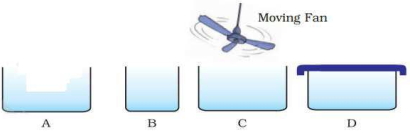
Look at the figure and suggest in which of the vessels $A$,$B$,$C$,or $D$ the rate of evaporation will be the highest? Explain.
Solution
(C) The rate of evaporation will be the highest in vessel $C$.
Explanation:
$1$. Evaporation is a surface phenomenon,meaning it occurs only at the surface of a liquid. Therefore,the rate of evaporation increases with an increase in the surface area of the liquid exposed to the atmosphere.
$2$. Vessel $C$ has the largest surface area compared to vessels $A$ and $B$.
$3$. Additionally,the presence of a moving fan above vessel $C$ increases the wind speed. An increase in wind speed causes the water vapour particles to move away faster,thereby increasing the rate of evaporation.
$4$. Vessel $D$ is covered,which prevents evaporation from occurring effectively.
0 likes
View Solution19
Medium
$(a)$ Conversion of solid to vapour is called sublimation. Name the term used to denote the conversion of vapour to solid.
$(b)$ Conversion of solid state to liquid state is called fusion; what is meant by latent heat of fusion?
$(b)$ Conversion of solid state to liquid state is called fusion; what is meant by latent heat of fusion?
Solution
(N/A) The term used to denote the conversion of vapour to solid is deposition.
The amount of heat energy required to convert $1\, kg$ of a solid into liquid at atmospheric pressure at its melting point is known as its latent heat of fusion.
The amount of heat energy required to convert $1\, kg$ of a solid into liquid at atmospheric pressure at its melting point is known as its latent heat of fusion.
0 likes
View Solution20
EasyMCQ
It is a hot summer day,Priyanshi and Ali are wearing cotton and nylon clothes respectively. Who do you think would be more comfortable and why?
A
Priyanshi,because cotton absorbs sweat and allows evaporation.
B
Ali,because nylon is more durable.
C
Both are equally comfortable.
D
Neither is comfortable.
Solution
(A) Cotton is a better absorber of water than nylon. It helps in the absorption of sweat from the body,followed by its evaporation into the atmosphere. The process of evaporation causes a cooling effect. Therefore,Priyanshi is more comfortable,whereas Ali is not as comfortable.
0 likes
View Solution21
MediumMCQ
You want to wear your favourite shirt to a party,but the problem is that it is still wet after a wash. What steps would you take to dry it faster?
A
Keep it in a dark room.
B
Fold it and keep it in a cupboard.
C
Spread it out under a fan or in the sun.
D
Keep it in a closed container.
Solution
(C) The rate of evaporation of water can be increased by the following methods:
$(a)$ Increasing the surface area: By spreading the shirt out,more surface area is exposed to the air,which increases the rate of evaporation.
$(b)$ Increasing the temperature: Placing the shirt under the sun provides heat energy,which increases the kinetic energy of water molecules,leading to faster evaporation.
$(c)$ Increasing wind speed: Spreading the shirt under a fan increases the wind speed,which carries away the water vapour from the surface,thereby increasing the rate of evaporation.
0 likes
View Solution22
MediumMCQ
Why does the temperature of a substance remain constant during its melting point or boiling point?
A
Because the heat supplied is used to increase the kinetic energy of the particles.
B
Because the heat supplied is used to overcome the forces of attraction between the particles to change the state.
C
Because the substance stops absorbing heat at these points.
D
Because the heat supplied is lost to the surroundings.
Solution
(B) The temperature of a substance remains constant at its melting and boiling points until all the substance melts or boils because the heat supplied is continuously used up in changing the state of the substance by overcoming the forces of attraction between the particles.
This heat energy,which is absorbed without showing any rise in temperature,is known as latent heat of fusion or latent heat of vaporization.
This heat energy,which is absorbed without showing any rise in temperature,is known as latent heat of fusion or latent heat of vaporization.
0 likes
View Solution23
Easy
Why does perspiration keep our body cool?
Solution
(N/A) During the process of evaporation of sweat,the latent heat of vaporization is absorbed from the body surface. This loss of heat from the body results in a cooling effect,thereby helping to maintain our body temperature.
0 likes
View Solution24
Easy
Explain why the temperature remains constant during the process of sublimation.
Solution
(N/A) During the process of sublimation,the heat energy supplied to the substance is entirely consumed to overcome the forces of attraction between the particles of the solid. This energy is known as the latent heat of sublimation. Since this heat is used for the phase change from solid to vapour rather than increasing the kinetic energy of the particles,the temperature of the substance remains constant until the entire solid has transformed into vapour.
0 likes
View Solution25
EasyMCQ
Why do we see water droplets on the outer surface of a glass containing ice-cold water?
A
Condensation of water vapor from the air.
B
Evaporation of water from the glass.
C
Sublimation of ice.
D
Diffusion of water through the glass.
Solution
(A) When water vapor present in the surrounding air comes in contact with the cold surface of the glass containing ice-cold water,the water vapor loses energy (heat).
Due to this loss of energy,the water vapor undergoes a phase change from a gaseous state to a liquid state,appearing as water droplets on the outer surface of the glass.
This process is known as condensation.
Due to this loss of energy,the water vapor undergoes a phase change from a gaseous state to a liquid state,appearing as water droplets on the outer surface of the glass.
This process is known as condensation.
0 likes
View Solution26
EasyMCQ
What is evaporation?
A
The process of conversion of a solid into a liquid.
B
The phenomenon of change of a liquid into vapours at any temperature below its boiling point.
C
The process of conversion of a gas into a liquid.
D
The process of conversion of a liquid into a solid.
Solution
(B) Evaporation is a surface phenomenon in which liquid molecules at the surface,having higher kinetic energy than the average,escape into the vapour state at any temperature below its boiling point.
This process leads to a cooling effect in the remaining liquid.
This process leads to a cooling effect in the remaining liquid.
0 likes
View Solution27
Easy
Why is evaporation called a surface phenomenon?
Solution
(N/A) Evaporation is considered a surface phenomenon because only the particles present at the surface of the liquid possess enough kinetic energy to overcome the intermolecular forces of attraction exerted by the particles below them. Once these surface particles gain sufficient energy,they escape the liquid phase and convert into vapour,while the particles in the bulk of the liquid remain unaffected.
0 likes
View Solution28
MediumMCQ
$A$ change in the physical state can be brought about:
A
only when energy is given to the system
B
when energy is either given to,or taken out from the system
C
only when energy is taken out from the system
D
without any energy change
Solution
(B) change in the physical state of matter involves the absorption or release of energy.
When a substance changes from a solid to a liquid (melting) or from a liquid to a gas (vaporization),energy is absorbed by the system.
Conversely,when a substance changes from a gas to a liquid (condensation) or from a liquid to a solid (freezing),energy is released by the system.
Therefore,a change in physical state occurs when energy is either given to or taken out from the system.
0 likes
View Solution29
Medium
If a potted plant is covered with a glass jar,water vapours appear on the wall of the glass jar. Explain why?
Solution
(N/A) Transpiration is the process by which plants lose water in the form of water vapour through the stomata present on their leaves. When a potted plant is covered with a glass jar,the water vapour released during transpiration gets trapped inside the jar. As this water vapour comes into contact with the cooler surface of the glass jar,it undergoes condensation and forms fine water droplets on the inner walls of the jar.
0 likes
View Solution30
EasyMCQ
During summer,if you go near the lake,you feel relief from the heat,why?
A
Water absorbs heat from the surroundings.
B
Water evaporates,causing a cooling effect.
C
The lake water is naturally cold.
D
The wind near the lake is always cool.
Solution
(B) The water from the surface of a lake continuously undergoes evaporation.
Evaporation is an endothermic process,meaning it absorbs latent heat from the surroundings to change from a liquid state to a gaseous state.
This absorption of heat creates a cooling effect in the immediate environment.
Therefore,when we go near a lake during summer,we feel relief from the heat.
Evaporation is an endothermic process,meaning it absorbs latent heat from the surroundings to change from a liquid state to a gaseous state.
This absorption of heat creates a cooling effect in the immediate environment.
Therefore,when we go near a lake during summer,we feel relief from the heat.
0 likes
View Solution31
EasyMCQ
Convert the following temperatures to the Kelvin scale:
$(a)$ $25\,^{\circ}C$
$(b)$ $373\,^{\circ}C$
$(a)$ $25\,^{\circ}C$
$(b)$ $373\,^{\circ}C$
A
$273\, K$ and $373\, K$
B
$330\, K$ and $270\, K$
C
$298\, K$ and $646\, K$
D
$270\, K$ and $650\, K$
Solution
(C) To convert temperature from the Celsius scale to the Kelvin scale,we add $273$ to the given Celsius value,as the relationship is defined by the formula:
$K = ^{\circ}C + 273$
$(a)$ For $25\,^{\circ}C$:
$25 + 273 = 298\, K$
$(b)$ For $373\,^{\circ}C$:
$373 + 273 = 646\, K$
Therefore,the correct values are $298\, K$ and $646\, K$.
$K = ^{\circ}C + 273$
$(a)$ For $25\,^{\circ}C$:
$25 + 273 = 298\, K$
$(b)$ For $373\,^{\circ}C$:
$373 + 273 = 646\, K$
Therefore,the correct values are $298\, K$ and $646\, K$.
0 likes
View Solution32
EasyMCQ
Why is ice at $273 \ K$ more effective in cooling than water at the same temperature?
A
Ice absorbs latent heat of fusion from the surroundings.
B
Water has more kinetic energy than ice at the same temperature.
C
Ice has higher density than water.
D
Water releases heat to the surroundings.
Solution
(A) At $273 \ K$,ice and water are at the same temperature,but they differ in their energy content.
Ice requires additional energy,known as the latent heat of fusion,to change its state from solid to liquid.
When ice is used for cooling,it absorbs this latent heat from the substance being cooled,thereby providing more effective cooling compared to water at the same temperature,which does not have this additional heat-absorbing capacity.
0 likes
View Solution33
EasyMCQ
What produces more severe burns,boiling water or steam?
A
Boiling water
B
Steam
C
Both produce equal burns
D
None of the above
Solution
(B) Steam causes more severe burns than boiling water.
This is because steam contains an additional amount of heat known as latent heat of vaporization.
When steam comes into contact with the skin,it condenses into water and releases this extra latent heat,causing more intense damage to the skin tissues compared to boiling water at the same temperature.
1 likes
View Solution34
Medium
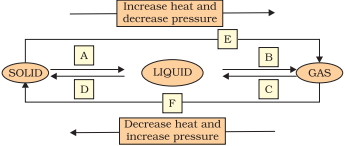
Name $A$,$B$,$C$,$D$,$E$ and $F$ in the following diagram showing the change in states of matter.
Solution
(N/A) $A =$ Melting or fusion,where solid changes into liquid.
$B =$ Evaporation or vaporization,where liquid changes into gas.
$C =$ Condensation,where gas changes into liquid.
$D =$ Freezing or solidification,where liquid changes into solid.
$E =$ Sublimation,where solid directly changes into gas without passing through the liquid state.
$F =$ Deposition,where gas directly changes into solid without passing through the liquid state.
0 likes
View Solution35
MediumMCQ
What happens when you pour some acetone on your palm?
A
It gets hot due to chemical reaction.
B
It causes a cooling sensation due to evaporation.
C
It remains at the same temperature.
D
It freezes the palm instantly.
Solution
(B) Acetone has a very low boiling point. When we pour some acetone on our palm,its particles gain thermal energy from our palm and evaporate rapidly. This process of evaporation absorbs heat from the palm,which causes a cooling sensation.
0 likes
View Solution36
EasyMCQ
At what temperature does solid ice and liquid water co-exist together (in $0^{\circ} C$)?
A
$0$
B
$100$
C
$25$
D
$37$
Solution
(A) Solid ice and liquid water co-exist at the melting point of ice.
The melting point of ice is $0^{\circ} C$ (or $273.15 \ K$).
At this specific temperature, the phase transition between solid and liquid is in equilibrium, meaning both states can exist simultaneously.
The melting point of ice is $0^{\circ} C$ (or $273.15 \ K$).
At this specific temperature, the phase transition between solid and liquid is in equilibrium, meaning both states can exist simultaneously.
0 likes
View Solution37
Easy
What is dry ice? What happens when the pressure under which it is stored is decreased to $1$ atmosphere?
Solution
(N/A) Dry ice is solid carbon dioxide $(CO_2)$.
It is stored under high pressure to maintain its solid state.
When the pressure is decreased to $1$ atmosphere,dry ice undergoes sublimation,meaning it converts directly from a solid state to a gaseous state without passing through the liquid phase.
It is stored under high pressure to maintain its solid state.
When the pressure is decreased to $1$ atmosphere,dry ice undergoes sublimation,meaning it converts directly from a solid state to a gaseous state without passing through the liquid phase.
0 likes
View Solution38
EasyMCQ
With which name is the phenomenon of changing of a liquid into its vapours at a temperature below its boiling point known?
A
Boiling
B
Evaporation
C
Condensation
D
Sublimation
Solution
(B) The phenomenon of changing of a liquid into its vapours at any temperature below its boiling point is known as $Evaporation$. Unlike boiling, which occurs at a specific temperature throughout the bulk of the liquid, evaporation is a surface phenomenon that can occur at any temperature.
0 likes
View Solution39
MediumMCQ
What happens when you open a bottle of perfume?
A
The perfume remains inside the bottle.
B
The perfume particles diffuse into the air and spread,allowing us to smell them even at a distance.
C
The perfume turns into a solid.
D
The perfume particles settle down at the bottom of the bottle.
Solution
(B) When a bottle of perfume is opened,the liquid perfume evaporates into gas particles. These particles possess high kinetic energy and move randomly in all directions. Through the process of diffusion,these particles mix with the air molecules and spread throughout the room,which is why we can smell the fragrance even from a distance.
0 likes
View Solution40
Easy
The molecules of water have more energy as compared to molecules of ice at the same temperature. Justify this statement.
Solution
(N/A) At the same temperature,water molecules possess more energy than ice molecules because of the latent heat of fusion.
When ice changes into water,it absorbs a specific amount of heat energy known as the latent heat of fusion,which is used to overcome the forces of attraction between the particles of ice to change its state from solid to liquid.
Since this energy is absorbed by the water molecules without increasing the temperature,the water molecules contain this additional energy,making them more energetic than ice molecules at the same temperature.
0 likes
View Solution41
EasyMCQ
Convert $300 \ K$ into Celsius scale and $-10^{\circ}C$ into Kelvin scale.
A
$27^{\circ}C, 263 \ K$
B
$30^{\circ}C, 283 \ K$
C
$273^{\circ}C, 273 \ K$
D
$0^{\circ}C, 263 \ K$
Solution
(A) To convert temperature from Kelvin $(K)$ to Celsius $(^{\circ}C)$,use the formula: $T(^{\circ}C) = T(K) - 273$.
For $300 \ K$: $300 - 273 = 27^{\circ}C$.
To convert temperature from Celsius $(^{\circ}C)$ to Kelvin $(K)$,use the formula: $T(K) = T(^{\circ}C) + 273$.
For $-10^{\circ}C$: $-10 + 273 = 263 \ K$.
For $300 \ K$: $300 - 273 = 27^{\circ}C$.
To convert temperature from Celsius $(^{\circ}C)$ to Kelvin $(K)$,use the formula: $T(K) = T(^{\circ}C) + 273$.
For $-10^{\circ}C$: $-10 + 273 = 263 \ K$.
0 likes
View Solution42
Medium
How does the melting point of a substance indicate the strength of its intermolecular forces of attraction?
Solution
(N/A) The melting point of a substance is a direct measure of the strength of its intermolecular forces of attraction.
Stronger intermolecular forces require more energy (in the form of heat) to overcome the attraction between particles and transition the substance from a solid state to a liquid state.
Therefore,a higher melting point indicates that the particles are held together by stronger intermolecular forces,while a lower melting point indicates weaker forces.
0 likes
View Solution43
MediumMCQ
What happens to the heat energy that is supplied to a solid once it starts melting?
A
It increases the kinetic energy of the particles.
B
It is used to overcome the forces of attraction between the particles.
C
It increases the temperature of the substance.
D
It is released as light energy.
Solution
(B) When a solid starts melting,the heat energy supplied is used to overcome the forces of attraction between the particles of the solid.
This energy is known as the latent heat of fusion.
Because this energy is consumed in changing the state from solid to liquid,it does not increase the kinetic energy of the particles,and therefore,the temperature of the substance remains constant until the entire solid has melted.
This energy is known as the latent heat of fusion.
Because this energy is consumed in changing the state from solid to liquid,it does not increase the kinetic energy of the particles,and therefore,the temperature of the substance remains constant until the entire solid has melted.
0 likes
View Solution44
EasyMCQ
When suffering from a fever,which will lower your body temperature more effectively: ice or ice-cold water? Why?
A
Ice
B
Ice-cold water
C
Both are equally effective
D
None of the above
Solution
(A) Ice is more effective at lowering body temperature.
Reason: Ice at $0^{\circ}C$ absorbs more heat energy from the body than water at $0^{\circ}C$ because it undergoes a phase change from solid to liquid. This process requires the absorption of latent heat of fusion,which is approximately $334 \ J/g$. Therefore,ice extracts significantly more heat from the body to melt,resulting in a greater cooling effect compared to water at the same temperature.
Reason: Ice at $0^{\circ}C$ absorbs more heat energy from the body than water at $0^{\circ}C$ because it undergoes a phase change from solid to liquid. This process requires the absorption of latent heat of fusion,which is approximately $334 \ J/g$. Therefore,ice extracts significantly more heat from the body to melt,resulting in a greater cooling effect compared to water at the same temperature.
0 likes
View Solution45
Medium
$(a)$ What temperature in Kelvin scale is equal to $50^{\circ} C$?
$(b)$ Describe an activity to show that the rate of evaporation increases with surface area.
$(b)$ Describe an activity to show that the rate of evaporation increases with surface area.
Solution
(A) To convert Celsius to Kelvin,we use the formula: $T(K) = T(^{\circ}C) + 273.15$. Therefore,$50^{\circ}C = 50 + 273.15 = 323.15 K$ (or approximately $323 K$).
$(b)$ Activity: Take two containers,a narrow glass and a wide saucer. Pour an equal amount of water into both. Place them in the same environment for the same duration. After some time,observe the water level. The water level in the saucer will decrease more than in the glass,demonstrating that a larger surface area leads to a higher rate of evaporation.
$(b)$ Activity: Take two containers,a narrow glass and a wide saucer. Pour an equal amount of water into both. Place them in the same environment for the same duration. After some time,observe the water level. The water level in the saucer will decrease more than in the glass,demonstrating that a larger surface area leads to a higher rate of evaporation.
0 likes
View Solution46
Medium
$(a)$ "Evaporation causes cooling." Explain the reason for this effect.
$(b)$ Explain two examples from our daily life where we feel the effect of cooling due to evaporation.
$(b)$ Explain two examples from our daily life where we feel the effect of cooling due to evaporation.
Solution
(N/A) During the process of evaporation, the particles of the liquid absorb energy from the surroundings to overcome the force of attraction and change into the vapor state. This absorption of energy from the surroundings makes the surroundings lose heat, thereby causing a cooling effect.
$(b)$ Two examples from daily life are:
$1.$ Wearing cotton clothes in summer: Cotton is a good absorber of water, which helps in absorbing sweat from our body and exposing it to the atmosphere for easy evaporation. The latent heat of vaporization required for this evaporation is taken from our body surface, making us feel cool.
$2.$ Cooling by desert coolers: The water inside the cooler evaporates, which absorbs heat from the surrounding air, resulting in a decrease in the temperature of the air blown into the room.
0 likes
View Solution47
Medium
Archit dropped a crystal of potassium permanganate into two beakers $A$ and $B$ containing hot water and cold water respectively. After keeping the beakers undisturbed for some time,what did he observe and why?
Solution
(N/A) Observation: The purple color of potassium permanganate spreads more rapidly throughout the beaker containing hot water $(A)$ compared to the beaker containing cold water $(B)$.
Reason: Diffusion is the movement of particles from a region of higher concentration to a region of lower concentration. The rate of diffusion is directly proportional to temperature. As the temperature of the water increases,the kinetic energy of the water molecules increases,which causes the potassium permanganate particles to move and mix more quickly.
Reason: Diffusion is the movement of particles from a region of higher concentration to a region of lower concentration. The rate of diffusion is directly proportional to temperature. As the temperature of the water increases,the kinetic energy of the water molecules increases,which causes the potassium permanganate particles to move and mix more quickly.
0 likes
View Solution48
Easy
Explain the interconversion of three states of matter in terms of force of attraction and kinetic energy of the molecules.
Solution
(N/A) The interconversion of the three states of matter depends on the balance between the $KE$ (kinetic energy) of the molecules and the intermolecular force of attraction.
$1$. When temperature increases,the $KE$ of the molecules increases,which helps them overcome the intermolecular force of attraction,leading to a change from solid to liquid and liquid to gas.
$2$. Conversely,when temperature decreases,the $KE$ of the molecules decreases,allowing the intermolecular force of attraction to become more effective,which leads to a change from gas to liquid and liquid to solid.
0 likes
View Solution49
Medium
$(a)$ Define evaporation. Out of nylon and cotton clothes,which will be more comfortable during summer and why?
$(b)$ Are evaporation and boiling the same? If not,then why?
$(b)$ Are evaporation and boiling the same? If not,then why?
Solution
(N/A) Evaporation: The phenomenon of change of a liquid into vapours at any temperature below its boiling point is called evaporation. Cotton is a better absorber of water than nylon. During summer,cotton clothes absorb sweat,which upon evaporation causes cooling of the body.
$(b)$ No,they are not the same. Boiling is a bulk phenomenon that occurs at a specific temperature called the boiling point. In contrast,evaporation is a surface phenomenon that can occur at any temperature below the boiling point.
$(b)$ No,they are not the same. Boiling is a bulk phenomenon that occurs at a specific temperature called the boiling point. In contrast,evaporation is a surface phenomenon that can occur at any temperature below the boiling point.
0 likes
View Solution50
Medium
Name the factors on which evaporation depends.
Solution
(N/A) Evaporation depends upon the following factors:
$(i)$ The surface area of the liquid: Increasing the surface area increases the rate of evaporation.
$(ii)$ The temperature of the liquid: Higher temperatures increase the kinetic energy of particles,leading to faster evaporation.
$(iii)$ Humidity (dryness of the air): Lower humidity allows for faster evaporation as the air can hold more water vapor.
$(iv)$ Wind speed: Increased wind speed removes water vapor particles from the surface,accelerating evaporation.
$(v)$ Nature of the liquid: Liquids with lower boiling points evaporate more quickly.
$(vi)$ Pressure on the surface: Decreasing atmospheric pressure increases the rate of evaporation.
0 likes
View SolutionMATTER IN OUR SURROUNDINGS — Change of State and Evaporation · Frequently Asked Questions
1Are these MATTER IN OUR SURROUNDINGS questions useful for JEE and NEET?
Yes. All questions in this section are mapped to JEE Main and NEET exam patterns. Previous year questions from JEE Main, NEET, GUJCET and state-level exams are included with full solutions.
2Can I switch to Hindi or Gujarati for these questions?
Yes. Use the language tabs in the hero section or the sidebar to view the same questions and solutions in English, Hindi or Gujarati.
3How do I generate a question paper from this subtopic?
Use the Vedclass Exam Paper Generator — select the chapter and subtopic, set difficulty, and generate Sets A, B, C, D automatically. First 3 chapters of every subject are free.
Vedclass Products
For Students
Vedclass Test Series
Mock tests in real JEE/NEET style with performance analysis. 5-day free trial.
Start Free TrialFor Teachers
Exam Paper Generator
Generate Set A/B/C/D papers from this chapter in 2 minutes. 3 chapters free.
Try FreeFor Institutes
Online Exam Module
Live online exams with unlimited students, 360° analytics & white-label branding.
See DemoFor Teachers & Institutes
Generate a MATTER IN OUR SURROUNDINGS Exam Paper in 2 Minutes
Select subtopic & difficulty — Sets A, B, C, D auto-generated with No Repeat logic.
First 3 chapters of every subject are free — no payment required.