
A English
Change of State and Evaporation Questions in English
Class 9 Science · MATTER IN OUR SURROUNDINGS · Change of State and Evaporation
91+
Questions
English
Language
100%
With Solutions
Showing 41 of 91 questions in English
51
Difficult
Give reasons:
$(a)$ Steam produces more severe burns than boiling water.
$(b)$ We are able to sip hot tea faster from a saucer rather than a cup.
$(c)$ Water kept in an earthen pot becomes cool during summer.
$(a)$ Steam produces more severe burns than boiling water.
$(b)$ We are able to sip hot tea faster from a saucer rather than a cup.
$(c)$ Water kept in an earthen pot becomes cool during summer.
Solution
(N/A) Steam at $373 K$ $(100^{\circ} C)$ contains more energy than boiling water at the same temperature because it possesses additional latent heat of vaporisation.
$(b)$ $A$ saucer has a larger surface area than a cup. Since evaporation is a surface phenomenon,a larger surface area increases the rate of evaporation,leading to faster cooling of the tea.
$(c)$ An earthen pot has numerous microscopic pores. Water continuously evaporates through these pores. The energy required for this evaporation is absorbed from the remaining water inside the pot,causing the water to cool down.
0 likes
View Solution52
Difficult
Give reasons for the following:
$(a)$ Water droplets appear on the outer surface of a tumbler containing ice-cold water.
$(b)$ People prefer to wear cotton clothes in summer.
$(c)$ On a hot sunny day,people sprinkle water on the roof or open ground.
$(a)$ Water droplets appear on the outer surface of a tumbler containing ice-cold water.
$(b)$ People prefer to wear cotton clothes in summer.
$(c)$ On a hot sunny day,people sprinkle water on the roof or open ground.
Solution
(N/A) The water vapour present in the air,upon coming in contact with the cold surface of the glass tumbler,loses energy,gets condensed,and converts into liquid water droplets.
$(b)$ Cotton is a good absorber of water. It absorbs sweat from our body and exposes it to the atmosphere for easy evaporation. This process of evaporation causes a cooling effect on our skin.
$(c)$ The sprinkled water evaporates by absorbing a large amount of latent heat of vaporisation from the roof or open ground and the surrounding air,which results in the cooling of the area.
0 likes
View Solution53
Medium
How do the following factors affect the rate of evaporation of a liquid?
$(a)$ Surface area
$(b)$ Temperature
$(c)$ Humidity
$(a)$ Surface area
$(b)$ Temperature
$(c)$ Humidity
Solution
(N/A) Surface area: As the surface area increases,more particles are exposed to the surface,leading to a higher rate of evaporation.
$(b)$ Temperature: With an increase in temperature,the kinetic energy of the liquid particles increases,allowing more particles to escape into the vapor state,thus increasing the rate of evaporation.
$(c)$ Humidity: Humidity refers to the amount of water vapor present in the air. As humidity increases,the air becomes saturated,which decreases the rate of evaporation.
0 likes
View Solution54
Medium
Carbon dioxide was taken in an enclosed cylinder and compressed by applying pressure.
$(a)$ Which state of matter will we obtain after completion of the process?
$(b)$ Name and define this process.
$(c)$ What is the common name of the product obtained in the above process?
$(a)$ Which state of matter will we obtain after completion of the process?
$(b)$ Name and define this process.
$(c)$ What is the common name of the product obtained in the above process?
Solution
(N/A) The state of matter obtained is solid.
$(b)$ The process is called sublimation. Sublimation is defined as the phase transition in which a substance changes directly from a solid state to a gaseous state or vice-versa without passing through the liquid state.
$(c)$ The common name of the product obtained is dry ice.
$(b)$ The process is called sublimation. Sublimation is defined as the phase transition in which a substance changes directly from a solid state to a gaseous state or vice-versa without passing through the liquid state.
$(c)$ The common name of the product obtained is dry ice.
0 likes
View Solution55
Medium
$(a)$ Enumerate the changes that take place inside the matter during the change of states.
$(b)$ When a solid melts,its temperature remains the same. Give reason.
$(b)$ When a solid melts,its temperature remains the same. Give reason.
Solution
(N/A) During a change of state,the heat energy supplied increases the kinetic energy $(KE)$ of the particles,which helps them overcome the intermolecular forces of attraction. This leads to a change in the arrangement of particles,causing the matter to transition from one state to another (e.g.,solid to liquid).
$(b)$ When a solid melts,the temperature remains constant because the heat energy supplied is entirely consumed as latent heat of fusion. This energy is used to overcome the strong intermolecular forces of attraction holding the solid particles together,rather than increasing the kinetic energy of the particles.
$(b)$ When a solid melts,the temperature remains constant because the heat energy supplied is entirely consumed as latent heat of fusion. This energy is used to overcome the strong intermolecular forces of attraction holding the solid particles together,rather than increasing the kinetic energy of the particles.
0 likes
View Solution56
Difficult
Define the melting point of a solid. At what temperature in the Kelvin scale does ice melt? In the experiment to determine the melting point of ice,why does the temperature not rise until all the ice melts,even though heat is continuously supplied? What is this heat energy called?
Solution
(N/A) The temperature at which a solid melts to become a liquid at atmospheric pressure is called its melting point.
$(b)$ Ice melts at $273.16 K$ (or $273 K$).
$(c)$ The temperature does not rise because the heat supplied is used up in changing the state of the substance by overcoming the forces of attraction between the particles.
$(d)$ This heat energy is known as the latent heat of fusion.
$(b)$ Ice melts at $273.16 K$ (or $273 K$).
$(c)$ The temperature does not rise because the heat supplied is used up in changing the state of the substance by overcoming the forces of attraction between the particles.
$(d)$ This heat energy is known as the latent heat of fusion.
0 likes
View Solution57
Medium
$(a)$ $CO_2$ is a gas. Write its two gaseous properties to justify it.
$(b)$ How can we liquefy a gas?
$(c)$ Solid $CO_2$ is also known as dry ice. Why?
$(d)$ Write the full form of:
$(i)$ $CNG$
$(ii)$ $LPG$
$(b)$ How can we liquefy a gas?
$(c)$ Solid $CO_2$ is also known as dry ice. Why?
$(d)$ Write the full form of:
$(i)$ $CNG$
$(ii)$ $LPG$
Solution
(N/A) Gases have large interparticle spaces and no fixed shape or volume,which justifies that $CO_2$ is a gas.
$(b)$ $A$ gas can be liquefied by increasing the pressure and decreasing the temperature,which brings the particles closer together.
$(c)$ Solid $CO_2$ is called dry ice because it undergoes sublimation,meaning it converts directly from a solid state to a gaseous state without passing through the liquid phase.
$(d) (i)$ $CNG$: Compressed Natural Gas.
$(ii)$ $LPG$: Liquefied Petroleum Gas.
0 likes
View Solution58
Difficult
$(a)$ Enumerate the changes that take place in a liquid during evaporation.
$(b)$ How is the rate of evaporation affected by changes in the following? Justify your answer.
$(i)$ Temperature
$(ii)$ Wind speed
$(iii)$ Humidity
$(b)$ How is the rate of evaporation affected by changes in the following? Justify your answer.
$(i)$ Temperature
$(ii)$ Wind speed
$(iii)$ Humidity
Solution
(N/A) During evaporation,a small fraction of particles at the surface having higher $KE$ (Kinetic Energy) is able to break away from the force of attraction of other particles and gets converted into vapour.
$(b)$ $(i)$ Rate of evaporation increases with temperature because an increase in temperature provides more $KE$ to the particles,allowing more particles to escape the surface.
$(ii)$ Rate of evaporation increases with wind speed because the moving air carries away the water vapour particles,thereby decreasing the concentration of water vapour in the surrounding area.
$(iii)$ Rate of evaporation decreases with humidity because the air is already saturated with water vapour,leaving less space for additional water molecules to evaporate.
0 likes
View Solution59
Medium
$(a)$ State one similarity and one difference between evaporation and boiling.
$(b)$ Account for the following:
$(i)$ We wear cotton clothes in summer.
$(ii)$ $A$ wet handkerchief is placed on the forehead of a person suffering from high fever.
$(iii)$ Wet clothes dry slowly during the rainy season.
$(b)$ Account for the following:
$(i)$ We wear cotton clothes in summer.
$(ii)$ $A$ wet handkerchief is placed on the forehead of a person suffering from high fever.
$(iii)$ Wet clothes dry slowly during the rainy season.
Solution
(N/A) Similarity: In both processes,a liquid is converted into vapours.
Difference: Evaporation is a surface phenomenon,whereas boiling is a bulk phenomenon.
$(b)$ $(i)$ Cotton is a good absorber of water. It absorbs perspiration from our body and exposes it to the atmosphere for evaporation,which causes a cooling effect.
$(ii)$ $A$ wet handkerchief placed on the forehead absorbs heat from the body as the water evaporates. This process of evaporation causes cooling,which helps in lowering the body temperature.
$(iii)$ During the rainy season,the humidity in the atmosphere is high. Since the air is already saturated with water vapours,the rate of evaporation decreases,causing wet clothes to dry slowly.
0 likes
View Solution60
Medium
Which of the following will cause more severe burns and why?
$(a)$ Steam at $373 \, K$
$(b)$ Water at $373 \, K$
$(a)$ Steam at $373 \, K$
$(b)$ Water at $373 \, K$
Solution
(A) Steam at $373 \, K$ will cause more severe burns.
This is because steam contains additional energy known as the latent heat of vaporization.
At $373 \, K$,water molecules in the steam state have absorbed extra heat to change their phase from liquid to gas.
When steam comes into contact with the skin,it releases this latent heat along with its thermal energy,resulting in more severe burns compared to water at the same temperature.
0 likes
View Solution61
MediumMCQ
Which physical quantities are to be altered for liquefying gases?
A
Pressure and Volume
B
Pressure and Temperature
C
Temperature and Density
D
Volume and Density
Solution
(B) To liquefy gases,the following two physical quantities must be altered:
$(i)$ Pressure is increased: Increasing pressure brings the gas particles closer together,which decreases the interparticle space.
$(ii)$ Temperature is reduced: Decreasing the temperature reduces the kinetic energy of the particles,which increases the interparticle forces of attraction,allowing the gas to condense into a liquid state.
0 likes
View Solution62
Medium
$(a)$ 'Evaporation causes cooling'. Comment on this statement.
$(b)$ Explain how water kept in an earthen pot becomes cool during summer?
$(b)$ Explain how water kept in an earthen pot becomes cool during summer?
Solution
(N/A) During the process of evaporation,the particles of the liquid absorb energy from the surroundings to overcome the force of attraction and change into the vapour state. This absorption of energy from the surroundings makes the surroundings cold.
$(b)$ An earthen pot has a large number of extremely small pores on its surface. Water continuously seeps out through these pores and evaporates. The energy required for this evaporation is taken from the remaining water inside the pot. As the heat is lost from the water,it cools down.
$(b)$ An earthen pot has a large number of extremely small pores on its surface. Water continuously seeps out through these pores and evaporates. The energy required for this evaporation is taken from the remaining water inside the pot. As the heat is lost from the water,it cools down.
0 likes
View Solution63
Easy
What is the effect of a change in pressure on the physical state of matter? Explain with an example of a gas.
Solution
(N/A) The physical state of matter can be changed by increasing or decreasing the pressure applied to it.
For example,a gas can be liquefied by applying high pressure. This occurs because,under high pressure,the molecules of the gas are forced to come closer to each other,which increases the intermolecular forces of attraction,thereby converting the gas into a liquid state.
For example,a gas can be liquefied by applying high pressure. This occurs because,under high pressure,the molecules of the gas are forced to come closer to each other,which increases the intermolecular forces of attraction,thereby converting the gas into a liquid state.
0 likes
View Solution64
Medium
Define the latent heat of fusion. Why does the temperature remain constant during the melting of ice?
Solution
(N/A) Latent heat of fusion is the amount of energy required to change $1 \, kg$ of a solid into a liquid at its melting point.
During the process of melting ice,the heat supplied is used up in changing the state of the substance by overcoming the forces of attraction between the particles. Since this energy is consumed to break the intermolecular bonds rather than increasing the kinetic energy of the particles,the temperature does not rise and remains constant.
During the process of melting ice,the heat supplied is used up in changing the state of the substance by overcoming the forces of attraction between the particles. Since this energy is consumed to break the intermolecular bonds rather than increasing the kinetic energy of the particles,the temperature does not rise and remains constant.
0 likes
View Solution65
Medium
Why does water as steam cause severe burns,whereas water as ice has a cooling effect? Explain.
Solution
(N/A) Steam contains water particles that possess high kinetic energy due to the latent heat of vaporization. When steam comes in contact with the skin,it releases this extra heat energy,causing severe burns.
Conversely,in the case of ice,the water particles possess lower energy. When ice comes in contact with the skin,it absorbs heat energy from the surroundings (or the body) to undergo a phase change from solid to liquid,thereby producing a cooling effect.
Conversely,in the case of ice,the water particles possess lower energy. When ice comes in contact with the skin,it absorbs heat energy from the surroundings (or the body) to undergo a phase change from solid to liquid,thereby producing a cooling effect.
0 likes
View Solution66
EasyMCQ
How can the interconversion of states of matter be achieved?
A
By changing the temperature
B
By changing the pressure
C
Both $(A)$ and $(B)$
D
None of the above
Solution
(C) The interconversion of the states of matter can be achieved in the following two ways:
$(i)$ By changing the temperature: Increasing or decreasing the temperature can cause a substance to change its state (e.g.,melting of ice into water or freezing of water into ice).
$(ii)$ By changing the pressure: Increasing or decreasing the pressure can also change the state of matter,especially in gases (e.g.,liquefaction of gases by applying high pressure and lowering the temperature).
0 likes
View Solution67
Easy
What is meant by melting point? How is it different from fusion?
Solution
(N/A) The melting point is defined as the temperature at which a solid substance changes its state from solid to liquid at atmospheric pressure.
Fusion is the physical process of a substance changing from a solid state to a liquid state.
In scientific terminology,melting and fusion refer to the exact same process of phase transition from solid to liquid.
Fusion is the physical process of a substance changing from a solid state to a liquid state.
In scientific terminology,melting and fusion refer to the exact same process of phase transition from solid to liquid.
0 likes
View Solution68
Medium
Why does the temperature of a substance not rise during a change of state?
Solution
(N/A) During the change of state,the heat energy supplied is used up in overcoming the force of attraction between the particles of the substance. This energy is known as latent heat. Since this energy does not increase the kinetic energy of the particles,the temperature of the substance remains constant during the phase transition.
0 likes
View Solution69
Medium
What is meant by evaporation? How is this process different from boiling?
Solution
(N/A) Evaporation is the phenomenon of the change of a liquid into vapours at any temperature below its boiling point.
| Evaporation | Boiling |
| $1.$ Evaporation occurs on its own at all temperatures. | $1.$ Boiling occurs at a particular temperature when the liquid is heated. |
| $2.$ Evaporation is a surface phenomenon,i.e.,it takes place only from the surface of the liquid. | $2.$ Boiling is a bulk phenomenon,i.e.,it involves the formation of vapours from the entire liquid. |
| $3.$ Evaporation causes a cooling effect. | $3.$ Boiling does not cause any cooling effect. |
0 likes
View Solution70
EasyMCQ
Evaporation is called as
A
Bulk phenomenon
B
Surface phenomenon
C
Both surface and bulk phenomenon
D
Unique phenomenon
Solution
(B) Evaporation is a process in which liquid changes into vapor at any temperature below its boiling point.
This process occurs only at the surface of the liquid because the particles at the surface have higher kinetic energy than the particles in the bulk of the liquid,allowing them to overcome the forces of attraction and escape into the atmosphere.
Therefore,evaporation is considered a surface phenomenon.
0 likes
View Solution71
EasyMCQ
During the evaporation process,the heat is:
A
Evolved
B
First absorbed then evolved
C
Absorbed
D
Initially evolved and then absorbed
Solution
(C) Evaporation is a surface phenomenon where particles at the surface of a liquid gain enough kinetic energy to overcome the forces of attraction and escape into the vapor state.
To overcome these intermolecular forces of attraction,the particles require energy.
This energy is taken from the surroundings or the liquid itself,which leads to a cooling effect.
Therefore,heat is absorbed during the process of evaporation.
To overcome these intermolecular forces of attraction,the particles require energy.
This energy is taken from the surroundings or the liquid itself,which leads to a cooling effect.
Therefore,heat is absorbed during the process of evaporation.
0 likes
View Solution72
EasyMCQ
Boiling process is a
A
Surface phenomenon
B
Both surface and bulk phenomenon
C
Rare phenomenon
D
Bulk phenomenon
Solution
(D) Boiling is a process in which a liquid changes into a gas at a constant temperature called the boiling point.
Unlike evaporation,which occurs only at the surface of a liquid,boiling occurs throughout the entire volume of the liquid.
Therefore,heat is supplied to the entire mass of the liquid,and bubbles of vapor form within the bulk of the liquid and rise to the surface.
Thus,boiling is considered a bulk phenomenon.
0 likes
View Solution73
EasyMCQ
The gases can be liquefied by
A
Lowering temperature and pressure
B
Lowering temperature and raising pressure
C
Raising temperature and pressure
D
Lowering pressure only
Solution
(B) Gases can be liquefied by applying high pressure and reducing the temperature.
Increasing the pressure brings the gas particles closer together,while decreasing the temperature reduces their kinetic energy,allowing intermolecular forces to hold the particles together in a liquid state.
Increasing the pressure brings the gas particles closer together,while decreasing the temperature reduces their kinetic energy,allowing intermolecular forces to hold the particles together in a liquid state.
0 likes
View Solution74
MediumMCQ
Evaporation of a liquid takes place at
A
$A$ fixed temperature lower than its boiling point.
B
$A$ fixed temperature higher than its boiling point.
C
$A$ fixed temperature and pressure.
D
All temperatures.
Solution
(D) Evaporation is a surface phenomenon where liquid molecules at the surface gain enough kinetic energy to overcome the intermolecular forces and escape into the vapor phase.
Unlike boiling,which occurs at a specific boiling point throughout the bulk of the liquid,evaporation can occur at any temperature.
As the temperature increases,the rate of evaporation increases because more molecules possess sufficient kinetic energy to escape the surface.
Unlike boiling,which occurs at a specific boiling point throughout the bulk of the liquid,evaporation can occur at any temperature.
As the temperature increases,the rate of evaporation increases because more molecules possess sufficient kinetic energy to escape the surface.
0 likes
View Solution75
EasyMCQ
When water gets solidified into ice,then heat is
A
Evolved
B
Absorbed
C
First absorbed then evolved
D
Initially evolved and then absorbed
Solution
(A) The process of water turning into ice is known as freezing or solidification. During this phase change,water molecules lose kinetic energy and transition from a liquid state to a solid state. According to the principles of thermodynamics,when a substance changes from a higher energy state (liquid) to a lower energy state (solid),it must release energy to the surroundings. Therefore,heat is evolved (released) during the solidification of water into ice.
0 likes
View Solution76
EasyMCQ
Boiling of a liquid takes place at
A
$A$ fixed temperature lower than its boiling point.
B
$A$ fixed temperature and normal atmospheric pressure.
C
$A$ fixed temperature higher than its boiling point.
D
$A$ fixed temperature and higher atmospheric pressure.
Solution
(B) The boiling point of a liquid is defined as the fixed temperature at which the vapor pressure of the liquid becomes equal to the atmospheric pressure.
Under normal atmospheric pressure $(1 \text{ atm})$,every pure liquid boils at a specific,constant temperature known as its boiling point.
Therefore,boiling occurs at a fixed temperature under normal atmospheric pressure.
Under normal atmospheric pressure $(1 \text{ atm})$,every pure liquid boils at a specific,constant temperature known as its boiling point.
Therefore,boiling occurs at a fixed temperature under normal atmospheric pressure.
0 likes
View Solution77
EasyMCQ
Which condition out of the following increases the evaporation of water?
A
Adding sugar to water
B
Decrease in surface area of water
C
Increase in pressure of water
D
Increase in temperature of water
Solution
(D) Evaporation is a surface phenomenon where liquid molecules gain enough kinetic energy to escape into the vapor phase.
Factors that increase the rate of evaporation include:
$1$. Increase in surface area: More molecules are exposed to the surface.
$2$. Increase in temperature: Molecules gain higher kinetic energy,allowing more to escape.
$3$. Decrease in humidity: The air can hold more water vapor.
$4$. Increase in wind speed: Water vapor particles are moved away,creating space for more evaporation.
Therefore,an increase in the temperature of water increases the rate of evaporation.
0 likes
View Solution78
EasyMCQ
Which is the correct statement?
A
Conversion of solid into liquid is called sublimation.
B
Conversion of solid into vapours without passing through the liquid state is called vaporisation.
C
Conversion of vapours into solid without passing through the liquid state is called sublimation.
D
Conversion of vapours into solid without passing through the liquid state is called freezing.
Solution
(C) Sublimation is the process of transition of a substance directly from the solid to the gas phase or from the gas phase directly to the solid phase,without passing through the intermediate liquid state.
Option $A$ is incorrect because the conversion of solid to liquid is called melting or fusion.
Option $B$ is incorrect because the conversion of solid to vapour is called sublimation.
Option $C$ is correct as it describes the deposition process,which is a type of sublimation.
Option $D$ is incorrect because the conversion of vapour to solid is called deposition,not freezing.
0 likes
View Solution79
Easy
State whether the following statement is true or false:
$-273^{\circ} C = 0 K$
$-273^{\circ} C = 0 K$
Solution
(TRUE) The statement is True.
The relationship between the Celsius scale and the Kelvin scale is given by the formula: $T(K) = T(^{\circ}C) + 273.15$.
For standard calculations,we use the approximation $T(K) = T(^{\circ}C) + 273$.
Substituting $T(^{\circ}C) = -273$,we get $T(K) = -273 + 273 = 0 K$.
Therefore,$-273^{\circ} C$ is equivalent to absolute zero,which is $0 K$.
0 likes
View Solution80
Easy
State whether the following statement is true or false:
The term $vapor$ describes the gaseous state of a substance that normally exists as a liquid or solid.
The term $vapor$ describes the gaseous state of a substance that normally exists as a liquid or solid.
Solution
(TRUE) The statement is $True$.
In physics and chemistry,the term $vapor$ refers to a substance in the gas phase at a temperature lower than its critical temperature. This means that the substance can be condensed to a liquid or solid state by increasing the pressure on it without lowering the temperature. Substances like water,which are liquid at room temperature,exist as $vapor$ when they evaporate.
In physics and chemistry,the term $vapor$ refers to a substance in the gas phase at a temperature lower than its critical temperature. This means that the substance can be condensed to a liquid or solid state by increasing the pressure on it without lowering the temperature. Substances like water,which are liquid at room temperature,exist as $vapor$ when they evaporate.
0 likes
View Solution81
Easy
State whether the following statement is true or false:
Latent heat means the heat which can be seen easily.
Latent heat means the heat which can be seen easily.
Solution
(B) The statement is False.
Latent heat is defined as the amount of heat energy absorbed or released by a substance during a change of state (e.g.,from solid to liquid or liquid to gas) without any change in its temperature.
It is called 'latent' (which means 'hidden') because this heat does not cause a rise in temperature and cannot be detected by a thermometer,nor can it be seen visually.
0 likes
View Solution82
Easy
State whether the following statement is true or false:
Gases can be liquefied easily by applying pressure and reducing temperature.
Gases can be liquefied easily by applying pressure and reducing temperature.
Solution
(TRUE) The statement is True.
Explanation:
$1$. Gases consist of particles that are far apart and move randomly at high speeds.
$2$. By applying high pressure,the distance between gas particles is reduced,bringing them closer together.
$3$. By reducing the temperature,the kinetic energy of the gas particles decreases,causing them to slow down.
$4$. When particles are brought close enough and their kinetic energy is sufficiently low,the intermolecular forces of attraction become strong enough to hold them together,resulting in the transition of the gas into a liquid state.
0 likes
View Solution83
Medium
Why is the interconversion of states of matter considered a physical change? Give three reasons to justify your answer.
Solution
(N/A) $(i)$ The chemical composition of the substance remains unchanged during the process.
$(ii)$ No new chemical substance is formed; the identity of the matter remains the same.
$(iii)$ The change is often reversible,and the substance exhibits different physical properties (like shape or state) while maintaining its original chemical identity.
$(ii)$ No new chemical substance is formed; the identity of the matter remains the same.
$(iii)$ The change is often reversible,and the substance exhibits different physical properties (like shape or state) while maintaining its original chemical identity.
0 likes
View Solution84
EasyMCQ
The substances that sublime can be made to liquefy by
A
Cooling them under pressure
B
Heating them at low pressure
C
Heating them under pressure
D
Cooling them at low pressure
Solution
(C) Sublimation is the process where a solid directly changes into a gas without passing through the liquid state at atmospheric pressure.
To liquefy a substance that normally sublimes,we must increase the pressure on the substance.
By applying high pressure,the intermolecular forces become strong enough to maintain the liquid phase.
Therefore,substances that sublime can be made to liquefy by heating or compressing them under high pressure,which prevents them from transitioning directly to the gaseous state.
0 likes
View Solution85
MediumMCQ
The substances that sublime easily are
A
Petrol,acetone,camphor,iodine and solid $CO_2$
B
Iodine,solid $CO_2$,ammonium chloride,kerosene and diesel
C
Iodine,acetone,camphor,petrol and naphthalene
D
Iodine,camphor,ammonium chloride,anthracene and naphthalene
Solution
(D) Sublimation is the process in which a solid changes directly into a gas without passing through the liquid state.
Substances that exhibit this property are known as sublimable substances.
Iodine,camphor,ammonium chloride $(NH_4Cl)$,anthracene,and naphthalene are well-known examples of substances that sublime easily upon heating.
Petrol,acetone,kerosene,and diesel are liquids at room temperature and do not sublime.
Therefore,the correct group of substances is iodine,camphor,ammonium chloride,anthracene,and naphthalene.
0 likes
View Solution86
EasyMCQ
$A$ change in the physical state of matter can be brought about:
A
when energy is either given to,or taken out from the system
B
only when energy is given to the system
C
only when energy is taken out from the system
D
without any energy change
Solution
(A) The physical state of matter (solid,liquid,or gas) is determined by the kinetic energy of its particles and the intermolecular forces of attraction.
To change the physical state,one must either increase the kinetic energy (by heating/supplying energy) to overcome intermolecular forces or decrease the kinetic energy (by cooling/removing energy) to allow particles to come closer.
Therefore,a change in physical state requires an exchange of energy with the surroundings,either by adding or removing it.
0 likes
View Solution87
Medium
Once Ram's mother Sunita went to her friend's home along with Ram. On visiting there,Ram saw a wet khus-khus screen hung at the door of the room. He asked his mother why they had hung this screen,and his mother answered that it keeps the room cool. Ram was satisfied and smiled.
$(a)$ According to you,what qualities are possessed by Ram?
$(b)$ How does a wet khus-khus screen hung at the door keep the room cool?
$(a)$ According to you,what qualities are possessed by Ram?
$(b)$ How does a wet khus-khus screen hung at the door keep the room cool?
Solution
(N/A) The qualities possessed by Ram are:
$(i)$ Keen observation skills.
$(ii)$ Curiosity to learn from elders.
$(iii)$ Respectful and communicative relationship with his mother.
$(b)$ $A$ wet khus-khus screen keeps the room cool due to the process of evaporation. When the air passes through the wet screen,the water present in the khus-khus absorbs heat from the incoming air to undergo phase change (evaporation). As the air loses heat,its temperature decreases,resulting in a cooling effect inside the room.
0 likes
View Solution88
Medium
Sameer once went to his granny's home with his family and he saw his granny serving water from an earthen pot and was surprised to see that and asked granny why she has kept that earthen pot for storing water. His granny then answered him that it keeps the water cool during summers,he then smiled and thanked her.
$(a)$ According to you,how does water kept in an earthen pot become cool during summers?
$(b)$ What kind of qualities are shown by Sameer?
$(a)$ According to you,how does water kept in an earthen pot become cool during summers?
$(b)$ What kind of qualities are shown by Sameer?
Solution
(N/A) An earthen pot has small pores on its surface from which water evaporates continuously. The latent heat of vaporization required for the process of evaporation is taken from the remaining water inside the pot. As the heat is removed from the water,its temperature decreases,making the water cool during summers.
$(b)$ The qualities shown by Sameer are:
$(i)$ Respectful behavior towards elders.
$(ii)$ Curiosity and being a good observer.
$(b)$ The qualities shown by Sameer are:
$(i)$ Respectful behavior towards elders.
$(ii)$ Curiosity and being a good observer.
0 likes
View Solution89
Medium
Once Ravi and Aman were cooking rice in the kitchen and accidentally Aman's hand got a severe burn while opening the lid of the cooking vessel. Immediately,Ravi applied ice on his hand,then applied an ointment,and told him to cook carefully as he had been hurt by steam,and steam causes more severe burns. Aman thanked Ravi and smiled.
$(a)$ According to you,what kind of qualities are shown by Ravi?
$(b)$ How does steam produce more severe burns than boiling water?
$(a)$ According to you,what kind of qualities are shown by Ravi?
$(b)$ How does steam produce more severe burns than boiling water?
Solution
(N/A) The qualities shown by Ravi are:
$(i)$ Presence of mind and in-depth knowledge.
$(ii)$ Caring and helpful nature.
$(iii)$ Being a true and responsible friend.
$(b)$ Steam at $373 \ K$ $(100^{\circ}C)$ causes more severe burns than boiling water at the same temperature. This is because the particles in steam possess extra energy in the form of latent heat of vaporisation,which is the amount of heat energy required to change $1 \ kg$ of liquid to gas at atmospheric pressure at its boiling point.
0 likes
View Solution90
Medium
Differentiate between diffusion and osmosis. Write any two examples where a living organism uses osmosis to absorb water.
Solution
(N/A) Diffusion is the spontaneous movement of a substance from a region of higher concentration to a region of lower concentration. Osmosis is the movement of water molecules from a region of higher water concentration to a region of lower water concentration through a semipermeable membrane.
$(i)$ Unicellular freshwater organisms,such as Amoeba,gain water through osmosis.
$(ii)$ Plant roots absorb water from the soil through osmosis.
$(i)$ Unicellular freshwater organisms,such as Amoeba,gain water through osmosis.
$(ii)$ Plant roots absorb water from the soil through osmosis.
0 likes
View Solution91
Medium
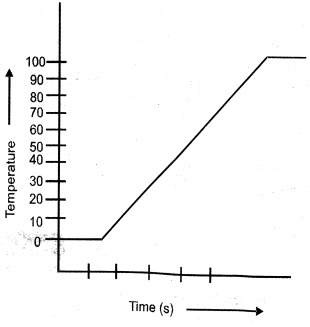
The graph below shows the change of ice to steam. Observe the change of state from ice to water and water to steam,and write two inferences that can be drawn from this graph about these changes of state.
Solution
(N/A) $(i)$ During melting,the temperature of the ice remains constant at $0^{\circ} C$. It starts rising only after all the ice has melted into water.
$(ii)$ At $100^{\circ} C$,water starts boiling and the temperature remains constant during the conversion of water into steam (latent heat of vaporization).
$(ii)$ At $100^{\circ} C$,water starts boiling and the temperature remains constant during the conversion of water into steam (latent heat of vaporization).
0 likes
View SolutionMATTER IN OUR SURROUNDINGS — Change of State and Evaporation · Frequently Asked Questions
1Are these MATTER IN OUR SURROUNDINGS questions useful for JEE and NEET?
Yes. All questions in this section are mapped to JEE Main and NEET exam patterns. Previous year questions from JEE Main, NEET, GUJCET and state-level exams are included with full solutions.
2Can I switch to Hindi or Gujarati for these questions?
Yes. Use the language tabs in the hero section or the sidebar to view the same questions and solutions in English, Hindi or Gujarati.
3How do I generate a question paper from this subtopic?
Use the Vedclass Exam Paper Generator — select the chapter and subtopic, set difficulty, and generate Sets A, B, C, D automatically. First 3 chapters of every subject are free.
Vedclass Products
For Students
Vedclass Test Series
Mock tests in real JEE/NEET style with performance analysis. 5-day free trial.
Start Free TrialFor Teachers
Exam Paper Generator
Generate Set A/B/C/D papers from this chapter in 2 minutes. 3 chapters free.
Try FreeFor Institutes
Online Exam Module
Live online exams with unlimited students, 360° analytics & white-label branding.
See DemoFor Teachers & Institutes
Generate a MATTER IN OUR SURROUNDINGS Exam Paper in 2 Minutes
Select subtopic & difficulty — Sets A, B, C, D auto-generated with No Repeat logic.
First 3 chapters of every subject are free — no payment required.