
A English
Structural Organisation of a Cell Questions in English
Class 9 Science · THE FUNDAMENTAL UNIT OF LIFE · Structural Organisation of a Cell
82+
Questions
English
Language
100%
With Solutions
Showing 50 of 82 questions in English
1
Medium
How do substances like $CO_2$ and water move in and out of the cell? Discuss.
Solution
(N/A) Substances like $CO_2$ move in and out of the cell through the process of diffusion. When $CO_2$ accumulates in high concentration inside the cell,a concentration gradient is created between the internal and external environment. $CO_2$ moves from a region of high concentration to a region of low concentration outside the cell via diffusion. Similarly,water moves in and out of the cell through a specialized process called osmosis,which is the movement of water molecules from a region of higher water concentration to a region of lower water concentration through a selectively permeable membrane.
0 likes
View Solution2
Medium
Why is the plasma membrane called a selectively permeable membrane?
Solution
(N/A) The plasma membrane is called a selectively permeable membrane because it selectively allows the movement of certain substances into and out of the cell. It permits the passage of specific molecules while preventing the movement of others,thereby maintaining the internal environment of the cell.
0 likes
View Solution3
Easy
Fill in the gaps in the following table illustrating differences between prokaryotic and eukaryotic cells.
| Prokaryotic Cell | Eukaryotic Cell |
| $1.$ Size: generally small $(1-10 \,\mu m)$ $1 \,\mu m = 10^{-6} \,m$ | $1.$ Size: generally large $(5-100 \,\mu m)$ |
| $2.$ Nuclear region: ................... and ............... | $2.$ Nuclear region: well defined and surrounded by a nuclear membrane |
| $3.$ Chromosome: single | $3.$ More than one chromosome |
| $4.$ Membrane-bound cell organelles absent | $4.$ ......................... |
Solution
(N/A) The completed table is as follows:
| Prokaryotic Cell | Eukaryotic Cell |
| $1.$ Size: generally small $(1-10 \,\mu m)$ | $1.$ Size: generally large $(5-100 \,\mu m)$ |
| $2.$ Nuclear region: poorly defined due to the absence of a nuclear membrane,known as nucleoid | $2.$ Nuclear region: well defined and surrounded by a nuclear membrane |
| $3.$ Chromosome: single | $3.$ More than one chromosome |
| $4.$ Membrane-bound cell organelles absent | $4.$ Membrane-bound cell organelles (e.g.,mitochondria,plastids) are present |
1 likes
View Solution4
EasyMCQ
If the organization of a cell is destroyed due to some physical or chemical influence,what will happen?
A
The cell will continue to function normally.
B
The cell will not be able to perform its basic functions and will die after some time.
C
The cell will immediately divide into two.
D
The cell will become a new type of cell.
Solution
(B) The cell is the fundamental structural and functional unit of life. Its organization is maintained by various organelles and biochemical processes. If this organization is destroyed due to physical or chemical influence,the cell loses its ability to perform essential life processes such as respiration,nutrition,and waste excretion. Consequently,the cell will not be able to perform its basic functions and will die after some time.
0 likes
View Solution5
Medium
Make a comparison and write down ways in which plant cells are different from animal cells.
Solution
(N/A) Comparison of plant cell and animal cell:
$1$. Cell Wall: Plant cells possess a rigid cell wall outside the plasma membrane,whereas animal cells lack a cell wall.
$2$. Shape: Plant cells generally have a fixed,regular shape due to the cell wall,while animal cells are generally irregular or flexible in shape.
$3$. Size: Plant cells are typically larger in size compared to animal cells.
$4$. Plastids: Plant cells contain plastids (like chloroplasts) for photosynthesis,which are absent in animal cells (except in some protists like $Euglena$).
$5$. Vacuoles: Plant cells contain a single,large,permanent central vacuole,whereas animal cells have many small,temporary vacuoles.
1 likes
View Solution6
Medium
How is a prokaryotic cell different from a eukaryotic cell?
Solution
(N/A)
| Prokaryotic Cell | Eukaryotic Cell |
|---|---|
| $1$. Size: Generally small $(1-10 \,\mu m)$ where $1 \,\mu m = 10^{-6} \,m$. | $1$. Size: Generally large $(5-100 \,\mu m)$. |
| $2$. Nuclear region: Poorly defined due to the absence of a nuclear membrane; known as nucleoid. | $2$. Nuclear region: Well-defined and surrounded by a nuclear membrane. |
| $3$. Chromosome: Single. | $3$. More than one chromosome. |
| $4$. Membrane-bound cell organelles are absent. | $4$. Membrane-bound organelles like mitochondria and plastids are present. |
0 likes
View Solution7
EasyMCQ
What would happen if the plasma membrane ruptures or breaks down?
A
The cell will continue to function normally.
B
The cell will lose its integrity and die.
C
The cell will start dividing rapidly.
D
The cell will become more efficient.
Solution
(B) If the plasma membrane ruptures or breaks down:
$1$. The cell will lose its structural integrity and its ability to maintain homeostasis.
$2$. All the useful substances (like proteins,ions,and nutrients) will move out of the cell.
$3$. There will be no difference between the cell content and its external environment,leading to the death of the cell.
$4$. The cell will lose its normal shape and eventually disintegrate.
0 likes
View Solution8
EasyMCQ
What is osmosis?
A
The movement of solute from high concentration to low concentration.
B
The movement of solvent from a region of its high concentration to a region of its low concentration through a semipermeable membrane.
C
The movement of water molecules from low concentration to high concentration.
D
The movement of particles against the concentration gradient.
Solution
(B) Osmosis is defined as the movement of solvent molecules (typically water) from a region of their higher concentration to a region of their lower concentration through a semipermeable membrane.
During this process,water molecules are free to move across the plasma membrane in both directions,but the net movement occurs from the region of higher water concentration to the region of lower water concentration.
During this process,water molecules are free to move across the plasma membrane in both directions,but the net movement occurs from the region of higher water concentration to the region of lower water concentration.
0 likes
View Solution9
EasyMCQ
Which of the following can be crystallized?
A
$A$ Virus
B
An Amoeba
C
$A$ Bacterium
D
$A$ Sperm
Solution
(A) Unlike the other options,a virus is not a cell. $A$ virus consists of genetic material ($DNA$ or $RNA$) enclosed within a protein coat called a capsid. Because of this simple structure,viruses can be crystallized and stored like non-living chemicals,a property first demonstrated by Wendell Stanley in $1935$.
0 likes
View Solution10
MediumMCQ
$A$ cell will swell up if
A
The concentration of water molecules in the cell is higher than the concentration of water molecules in the surrounding medium.
B
The concentration of water molecules in the surrounding medium is higher than the concentration of water molecules in the cell.
C
The concentration of water molecules is the same in the cell and in the surrounding medium.
D
The concentration of water molecules does not matter.
Solution
(B) If the concentration of water molecules in the surrounding medium is higher than the concentration of water molecules in the cell,the cell is placed in a hypotonic solution.
According to the process of osmosis,water molecules move from a region of higher water concentration to a region of lower water concentration through a semi-permeable membrane.
Therefore,water will move into the cell,causing it to swell up.
According to the process of osmosis,water molecules move from a region of higher water concentration to a region of lower water concentration through a semi-permeable membrane.
Therefore,water will move into the cell,causing it to swell up.
0 likes
View Solution11
EasyMCQ
Chromosomes are made up of
A
$DNA$
B
protein
C
$DNA$ and protein
D
$RNA$
Solution
(C) Chromosomes are composed of $DNA$ and proteins. In eukaryotic cells,$DNA$ is tightly coiled around histone proteins to form structures called nucleosomes,which further condense to form chromosomes.
0 likes
View Solution12
MediumMCQ
Following are a few definitions of osmosis. Read carefully and select the correct definition.
A
Movement of solvent molecules from its higher concentration to lower concentration.
B
Movement of water molecules from a region of higher concentration to a region of lower concentration through a semipermeable membrane.
C
Movement of solvent molecules from higher concentration to lower concentration of solution through a permeable membrane.
D
Movement of solute molecules from lower concentration to higher concentration of solution through a semipermeable membrane.
Solution
(B) Osmosis is defined as the spontaneous net movement of solvent molecules (usually water) through a selectively permeable membrane into a region of higher solute concentration (which is equivalent to a region of lower solvent concentration) in the direction that tends to equalize the solute concentrations on the two sides. Therefore,the movement of water molecules from a region of higher water concentration to a region of lower water concentration through a semipermeable membrane is the correct definition.
0 likes
View Solution13
MediumMCQ
Plasmolysis in a plant cell is defined as
A
break down (lysis) of plasma membrane in hypotonic medium
B
shrinkage of nucleoplasm
C
shrinkage of cytoplasm in hypertonic medium
D
none of them
Solution
(C) Plasmolysis is the process where the cytoplasm of a plant cell shrinks away from the cell wall.
This occurs when the cell is placed in a hypertonic solution (a solution with a higher solute concentration than the cell sap).
Due to the concentration gradient,water moves out of the cell through the process of exosmosis.
As water leaves the cell,the protoplast shrinks,causing the cytoplasm to pull away from the cell wall.
1 likes
View Solution14
MediumMCQ
The undefined nuclear region of prokaryotes is also known as:
A
nucleoid
B
nucleolus
C
nucleic acid
D
nucleus
Solution
(A) In prokaryotic cells,the genetic material is not enclosed by a nuclear membrane. This undefined nuclear region,which contains only nucleic acids,is called the nucleoid.
0 likes
View Solution15
EasyMCQ
Amoeba acquires its food through a process,termed
A
exocytosis
B
exocytosis and endocytosis both
C
plasmolysis
D
endocytosis
Solution
(D) The term endocytosis is composed of two parts: 'endo' means towards the inside and 'cytosis' means movement related to the cell. Amoeba uses its flexible cell membrane to engulf food particles from its external environment,a process known as endocytosis (specifically phagocytosis).
0 likes
View Solution16
EasyMCQ
$1 \, \mu m$ is equal to:
A
$10^{-9} \, m$
B
$10^{-6} \, m$
C
$10^{-10} \, m$
D
$10^{-3} \, m$
Solution
(B) The prefix $\mu$ (micro) represents a factor of $10^{-6}$. Therefore,$1 \, \mu m$ (micrometer) is equal to $10^{-6} \, m$ (meters). This unit is commonly used in biology to measure the size of cells and organelles.
0 likes
View Solution17
MediumMCQ
Select the odd one out.
A
Plasma membranes contain chitin sugar in plants.
B
Membranes are made of organic molecules like proteins and lipids.
C
Molecules soluble in organic solvents can easily pass through the membrane.
D
The movement of water across a semipermeable membrane is affected by the amount of substances dissolved in it.
Solution
(A) Option $A$ is the odd one out because it is a false statement. Plant cell membranes are primarily composed of lipids and proteins,not chitin. Chitin is a structural polysaccharide found in the cell walls of fungi and the exoskeletons of arthropods,not in plant plasma membranes. Options $B$,$C$,and $D$ are scientifically accurate descriptions of membrane composition and transport properties.
0 likes
View Solution18
EasyMCQ
Why does the skin of your finger shrink when you wash clothes for a long time?
A
Due to the absorption of water by the skin cells.
B
Due to the loss of water from the skin cells via osmosis.
C
Due to the chemical reaction between soap and skin proteins.
D
Due to the physical friction caused by washing clothes.
Solution
(B) When you wash clothes for a long time,the soap solution acts as a hypertonic solution relative to the cells of your skin.
According to the process of osmosis,water moves from a region of higher water concentration to a region of lower water concentration through a semi-permeable membrane.
Since the soap solution is more concentrated (hypertonic) than the cytoplasm of your skin cells,water moves out of the finger cells into the soap solution.
This loss of water causes the skin cells to shrink,resulting in the wrinkled appearance of your fingers.
0 likes
View Solution19
Easy
Why is endocytosis found in animals only?
Solution
(N/A) Endocytosis is the process by which cells engulf materials from their surroundings by forming vesicles from the plasma membrane.
In animal cells,the plasma membrane is the outermost boundary because a rigid cell wall is absent.
This flexibility allows the plasma membrane to fold inward and engulf external substances.
In contrast,plant cells possess a rigid,protective cell wall outside the plasma membrane,which prevents the membrane from invaginating or engulfing large particles,thus making endocytosis impossible in plant cells.
0 likes
View Solution20
Easy
$A$ person takes a concentrated solution of salt; after some time,he starts vomiting. What is the phenomenon responsible for this situation? Explain.
Solution
(N/A) The phenomenon responsible for this situation is $Exosmosis$. When a person consumes a concentrated salt solution (a hypertonic solution),the concentration of salt outside the cells of the alimentary canal becomes much higher than inside the cells. Due to the difference in concentration,water moves out of the cells into the surrounding medium through the process of $Exosmosis$. This leads to severe dehydration of the cells lining the digestive tract,which triggers the body's protective reflex to expel the irritant,resulting in vomiting.
0 likes
View Solution21
EasyMCQ
We eat food composed of all the nutrients like carbohydrates,proteins,fats,vitamins,minerals,and water. After digestion,these are absorbed in the form of glucose,amino acids,fatty acids,glycerol,etc. What mechanisms are involved in the absorption of digested food and water?
A
Active transport and osmosis
B
Diffusion and osmosis
C
Facilitated diffusion and active transport
D
Osmosis and diffusion
Solution
(B) The absorption of digested food nutrients (like glucose and amino acids) primarily occurs through diffusion (simple or facilitated) and active transport across the intestinal epithelium.
Water is absorbed primarily through the process of osmosis,which is the movement of water molecules from a region of higher water potential to a region of lower water potential across a semi-permeable membrane.
Water is absorbed primarily through the process of osmosis,which is the movement of water molecules from a region of higher water potential to a region of lower water potential across a semi-permeable membrane.
0 likes
View Solution22
EasyMCQ
If you are provided with some vegetables to cook,you generally add salt into the vegetables during the cooking process. After adding salt,vegetables release water. What mechanism is responsible for this?
A
Endosmosis
B
Exosmosis
C
Diffusion
D
Active transport
Solution
(B) When salt is added to vegetables,the concentration of the surrounding medium becomes hypertonic compared to the cytoplasm of the vegetable cells.
Due to this concentration gradient,water moves out of the vegetable cells into the surrounding medium through the cell membrane.
This process of movement of water from a region of higher water potential (inside the cell) to a region of lower water potential (outside the cell) through a semi-permeable membrane is known as $Exosmosis$.
0 likes
View Solution23
Medium
How is a bacterial cell different from an onion peel cell?
Solution
(N/A) bacterial cell is a prokaryotic cell,whereas an onion peel cell is a eukaryotic plant cell. The differences are summarized below:
| Bacterial Cell | Onion Peel Cell |
| $(i)$ Cell wall is made of peptidoglycan. | $(i)$ Cell wall is made of cellulose. |
| $(ii)$ Nucleus is absent (nucleoid present). | $(ii)$ Nucleus is present. |
| $(iii)$ Membrane-bound organelles are absent. | $(iii)$ Membrane-bound organelles are present. |
| $(iv)$ These are prokaryotes. | $(iv)$ These are eukaryotes. |
0 likes
View Solution24
MediumMCQ
How do substances like carbon dioxide $(CO_2)$ and water $(H_2O)$ move in and out of the cell?
A
Active transport
B
Diffusion and Osmosis
C
Endocytosis
D
Exocytosis
Solution
(B) Carbon dioxide $(CO_2)$ moves in and out of the cell through the process of diffusion,which is the spontaneous movement of a substance from a region of higher concentration to a region of lower concentration.
Water $(H_2O)$ moves in and out of the cell through the process of osmosis,which is the movement of water molecules through a selectively permeable membrane from a region of higher water concentration to a region of lower water concentration.
Water $(H_2O)$ moves in and out of the cell through the process of osmosis,which is the movement of water molecules through a selectively permeable membrane from a region of higher water concentration to a region of lower water concentration.
0 likes
View Solution25
Medium
How are chromatin,chromatid,and chromosomes related to each other?
Solution
(N/A) Chromatin is the loose,thread-like form of $DNA$ and proteins found in the nucleus during interphase. When a cell prepares to divide,this chromatin condenses into thicker,distinct structures called chromatids. $A$ chromosome is the structural unit formed by one or two identical chromatids (sister chromatids) joined at the centromere,which serves to package and organize genetic material for cell division.
0 likes
View Solution26
Medium
What are the consequences of the following conditions?
$(a)$ $A$ cell containing higher water concentration than the surrounding medium.
$(b)$ $A$ cell having lower water concentration than the surrounding medium.
$(c)$ $A$ cell having equal water concentration to its surrounding medium.
$(a)$ $A$ cell containing higher water concentration than the surrounding medium.
$(b)$ $A$ cell having lower water concentration than the surrounding medium.
$(c)$ $A$ cell having equal water concentration to its surrounding medium.
Solution
(N/A) When a cell has a higher water concentration than the surrounding medium,water moves out of the cell into the medium. This process is known as exosmosis,which causes the cell to shrink or become plasmolysed.
$(b)$ When a cell has a lower water concentration than the surrounding medium,water moves from the medium into the cell. This process is known as endosmosis,which causes the cell to swell or become turgid.
$(c)$ When a cell has an equal water concentration to its surrounding medium,there is no net movement of water across the cell membrane. The cell remains in an isotonic state,and its size and shape remain unchanged.
1 likes
View Solution27
EasyMCQ
Which cell organelle is living and which is dead out of cell membrane and cell wall?
A
Cell membrane is dead,cell wall is living.
B
Cell membrane is living,cell wall is dead.
C
Both are living.
D
Both are dead.
Solution
(B) The cell membrane is a living structure composed of lipids and proteins that regulates the movement of substances in and out of the cell.
The cell wall is a non-living,rigid outer covering found in plant cells,fungi,and bacteria,primarily composed of cellulose,which provides structural support and protection.
The cell wall is a non-living,rigid outer covering found in plant cells,fungi,and bacteria,primarily composed of cellulose,which provides structural support and protection.
0 likes
View Solution28
Easy
Name the following:
$(i)$ The cells which have a changing shape.
$(ii)$ The cells which have a typical shape.
$(i)$ The cells which have a changing shape.
$(ii)$ The cells which have a typical shape.
Solution
(N/A) $(i)$ $Amoeba$ is a unicellular organism that constantly changes its shape by forming pseudopodia to move and capture food.
$(ii)$ $Nerve$ $cell$ (neuron) has a fixed,typical shape with a long axon and dendrites to facilitate the transmission of electrical impulses throughout the body.
$(ii)$ $Nerve$ $cell$ (neuron) has a fixed,typical shape with a long axon and dendrites to facilitate the transmission of electrical impulses throughout the body.
0 likes
View Solution29
EasyMCQ
Name the smallest known cell.
A
Bacteria
B
Mycoplasma $(PPLO)$
C
Virus
D
Red Blood Cell
Solution
(B) The smallest known cell is the $PPLO$ (Pleuro-Pneumonia Like Organism),also known as $Mycoplasma$.
It is approximately $0.1\, \mu m$ in diameter.
These organisms lack a cell wall,which allows them to change their shape and survive without oxygen.
It is approximately $0.1\, \mu m$ in diameter.
These organisms lack a cell wall,which allows them to change their shape and survive without oxygen.
0 likes
View Solution30
EasyMCQ
Name the largest known cell.
A
Nerve cell
B
Ostrich egg
C
Bacteria
D
Mycoplasma
Solution
(B) The largest known isolated single cell is the egg of an ostrich.
Its size is approximately $170\, mm \times 135\, mm$.
Its size is approximately $170\, mm \times 135\, mm$.
0 likes
View Solution31
EasyMCQ
Name the longest cell of the human body.
A
Muscle cell
B
Nerve cell
C
Blood cell
D
Bone cell
Solution
(B) The nerve cell (neuron) is the longest cell in the human body. These cells can reach lengths of up to $1 \ m$ or more,extending from the spinal cord to the extremities.
0 likes
View Solution32
Easy
Name two unicellular animals.
Solution
(N/A) Two examples of unicellular animals are $Amoeba$ and $Paramecium$. These organisms consist of a single cell that performs all essential life functions,such as respiration,nutrition,and reproduction.
0 likes
View Solution33
Easy
What is the full form of $RNA$ and $DNA$?
Solution
(N/A) $RNA$ stands for Ribonucleic acid.
$DNA$ stands for Deoxyribonucleic acid.
$DNA$ stands for Deoxyribonucleic acid.
0 likes
View Solution34
Easy
Give examples of prokaryotic cells.
Solution
(N/A) Prokaryotic cells are cells that lack a well-defined nucleus and membrane-bound organelles. Examples of organisms with prokaryotic cells include bacteria and blue-green algae (also known as cyanobacteria).
0 likes
View Solution35
EasyMCQ
What are chromosomes made of?
A
$DNA$ and $RNA$
B
$DNA$ and histone proteins
C
$RNA$ and proteins
D
Only $DNA$
Solution
(B) Chromosomes are thread-like structures located inside the nucleus of animal and plant cells.
Each chromosome is made of protein and a single molecule of deoxyribonucleic acid $(DNA)$.
These proteins are primarily histone proteins,which help in the packaging of $DNA$ into compact structures.
Each chromosome is made of protein and a single molecule of deoxyribonucleic acid $(DNA)$.
These proteins are primarily histone proteins,which help in the packaging of $DNA$ into compact structures.
0 likes
View Solution36
EasyMCQ
Where are genes located?
A
In the cytoplasm
B
On the chromosomes
C
In the mitochondria
D
In the ribosomes
Solution
(B) Genes are the functional units of heredity and are segments of $DNA$. These genes are physically located on the chromosomes,which are thread-like structures found within the nucleus of eukaryotic cells.
0 likes
View Solution37
EasyMCQ
What is a nucleoid?
A
$A$ membrane-bound nucleus
B
The genetic material of a prokaryotic cell
C
$A$ type of ribosome
D
$A$ storage organelle
Solution
(B) In prokaryotic cells,the genetic material is not enclosed by a nuclear membrane. This undefined nuclear region containing only nucleic acids is known as the nucleoid.
0 likes
View Solution38
EasyMCQ
What is endocytosis?
A
The process of taking in food and other substances by the cell through its plasma membrane.
B
The process of releasing waste materials from the cell.
C
The process of cell division.
D
The process of protein synthesis.
Solution
(A) Endocytosis is the cellular process by which cells ingest external materials,such as nutrients or fluids,by engulfing them within the plasma membrane.
This process involves the plasma membrane folding inward to form a vesicle that encloses the substance,which is then transported into the cytoplasm.
This process involves the plasma membrane folding inward to form a vesicle that encloses the substance,which is then transported into the cytoplasm.
0 likes
View Solution39
EasyMCQ
What is osmosis?
A
The movement of solute particles from high to low concentration.
B
The movement of water molecules from a region of high water concentration to a region of low water concentration through a selectively permeable membrane.
C
The movement of gases across a cell membrane.
D
The process of energy production in cells.
Solution
(B) Osmosis is a special case of diffusion.
It is defined as the net movement of water molecules from a region of higher water concentration (or higher water potential) to a region of lower water concentration (or lower water potential) through a selectively permeable membrane.
This process continues until equilibrium is reached.
It is defined as the net movement of water molecules from a region of higher water concentration (or higher water potential) to a region of lower water concentration (or lower water potential) through a selectively permeable membrane.
This process continues until equilibrium is reached.
0 likes
View Solution40
Easy
Name the processes by which $CO_{2}$ and $H_{2}O$ move into and out of the cell.
Solution
(N/A) The movement of $CO_{2}$ into and out of the cell occurs through the process of diffusion,which is the spontaneous movement of a substance from a region of higher concentration to a region of lower concentration.
The movement of $H_{2}O$ into and out of the cell occurs through the process of osmosis,which is the movement of water molecules from a region of higher water potential to a region of lower water potential through a selectively permeable membrane.
The movement of $H_{2}O$ into and out of the cell occurs through the process of osmosis,which is the movement of water molecules from a region of higher water potential to a region of lower water potential through a selectively permeable membrane.
0 likes
View Solution41
EasyMCQ
What is lacking in a virus which makes it dependent on a living cell to multiply?
A
Cell wall
B
Metabolic machinery
C
Genetic material
D
Ribosomes
Solution
(B) virus lacks its own metabolic machinery,such as ribosomes,enzymes,and energy-generating systems,which are necessary for protein synthesis and replication. Because it lacks these essential components,it must hijack the metabolic machinery of a living host cell to multiply.
0 likes
View Solution42
EasyMCQ
When a living plant cell loses water through osmosis,there is contraction of the contents of the cell away from the cell wall. What is this phenomenon called?
A
Plasmolysis
B
Endosmosis
C
Diffusion
D
Active transport
Solution
(A) When a living plant cell is placed in a hypertonic solution,water moves out of the cell due to osmosis.
This loss of water causes the protoplast to shrink and pull away from the cell wall.
This specific phenomenon is known as Plasmolysis.
This loss of water causes the protoplast to shrink and pull away from the cell wall.
This specific phenomenon is known as Plasmolysis.
0 likes
View Solution43
EasyMCQ
Name the functional unit of $DNA$ that carries genetic information.
A
Chromosome
B
Gene
C
Nucleotide
D
Ribosome
Solution
(B) The functional unit of $DNA$ that carries genetic information is known as a $Gene$. Genes are specific segments of $DNA$ sequences that code for functional molecules,typically proteins,which determine the traits and characteristics of an organism.
0 likes
View Solution44
EasyMCQ
The raisins added to porridge swell up after some time. Name the process involved.
A
Diffusion
B
Osmosis
C
Active transport
D
Plasmolysis
Solution
(B) The process involved is $Osmosis$.
When raisins are placed in a liquid medium like porridge,the concentration of water inside the raisins is lower than the concentration of water in the surrounding medium.
Due to this concentration gradient,water molecules move from the surrounding medium into the raisins through their semi-permeable cell membranes.
This movement of water from a region of higher water concentration to a region of lower water concentration through a semi-permeable membrane is known as $Osmosis$.
0 likes
View Solution45
EasyMCQ
How is $DNA$ present in a cell which is:
$(a)$ dividing?
$(b)$ not dividing?
$(a)$ dividing?
$(b)$ not dividing?
A
Chromosomes
B
Chromatin material
C
Nucleoplasm
D
Cytoplasm
Solution
(A) In a dividing cell,$DNA$ is organized into compact,thread-like structures called chromosomes.
$(b)$ In a non-dividing cell,$DNA$ is present as a loose,tangled network of thread-like structures known as chromatin material.
$(b)$ In a non-dividing cell,$DNA$ is present as a loose,tangled network of thread-like structures known as chromatin material.
0 likes
View Solution46
Easy
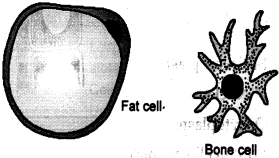
Draw any two cell shapes to justify the statement that cells come in a variety of shapes.
Solution
(N/A) Cells exhibit a wide variety of shapes and sizes,which are often related to their specific functions in an organism.
For example:
$1$. Fat cells are generally spherical or oval in shape,which helps them in storing fat droplets efficiently.
$2$. Bone cells (osteocytes) have a branched or star-like shape,which allows them to connect with other cells and form a structural network in the bone tissue.
These differences in shape demonstrate that cell morphology is adapted to perform specialized tasks within the body.
0 likes
View Solution47
Medium
Differentiate between: Nucleus and nucleoid.
Solution
(N/A)
| Nucleus | Nucleoid |
|---|---|
| $1.$ Nuclear membrane is present. | $1.$ Nuclear membrane is absent. |
| $2.$ Chromatin network and more than one chromosome are present. | $2.$ Only one circular chromosome is present. |
0 likes
View Solution48
Medium
Explain how cell walls permit the cells of fungi to withstand very dilute external media without bursting.
Solution
(N/A) Fungi can withstand very dilute (hypotonic) external media without bursting due to the presence of rigid cell walls. When placed in a hypotonic solution,water enters the fungal cells through osmosis,causing them to swell. As the cell expands,it exerts turgor pressure against the cell wall. The cell wall,being rigid and strong,exerts an equal and opposite wall pressure,which prevents the cell from bursting.
0 likes
View Solution49
Medium
$(a)$ What is $DNA$? Where is it found?
$(b)$ Name the functional segment of $DNA$.
$(b)$ Name the functional segment of $DNA$.
Solution
(N/A) $DNA$ stands for Deoxyribonucleic acid. It is a complex molecule that contains the genetic instructions necessary for the development, functioning, growth, and reproduction of all known organisms. In a non-dividing cell, $DNA$ is found within the nucleus as a component of chromatin material. When the cell prepares to divide, this chromatin material condenses and organizes into structures called chromosomes.
$(b)$ The functional segments of $DNA$ are known as genes. Genes are the basic units of heredity and are responsible for the transmission of traits from parents to offspring.
$(b)$ The functional segments of $DNA$ are known as genes. Genes are the basic units of heredity and are responsible for the transmission of traits from parents to offspring.
0 likes
View Solution50
Easy
What are genes? What is their function?
Solution
(N/A) Genes are the segments of $DNA$ occupying specific positions on the chromosomes.
These are the fundamental units of heredity that are transmitted from one generation to another via chromosomes.
They carry the genetic information required for the synthesis of proteins,which in turn control various cellular activities,determine specific cell functions,and regulate the expression of traits.
0 likes
View SolutionTHE FUNDAMENTAL UNIT OF LIFE — Structural Organisation of a Cell · Frequently Asked Questions
1Are these THE FUNDAMENTAL UNIT OF LIFE questions useful for JEE and NEET?
Yes. All questions in this section are mapped to JEE Main and NEET exam patterns. Previous year questions from JEE Main, NEET, GUJCET and state-level exams are included with full solutions.
2Can I switch to Hindi or Gujarati for these questions?
Yes. Use the language tabs in the hero section or the sidebar to view the same questions and solutions in English, Hindi or Gujarati.
3How do I generate a question paper from this subtopic?
Use the Vedclass Exam Paper Generator — select the chapter and subtopic, set difficulty, and generate Sets A, B, C, D automatically. First 3 chapters of every subject are free.
Vedclass Products
For Students
Vedclass Test Series
Mock tests in real JEE/NEET style with performance analysis. 5-day free trial.
Start Free TrialFor Teachers
Exam Paper Generator
Generate Set A/B/C/D papers from this chapter in 2 minutes. 3 chapters free.
Try FreeFor Institutes
Online Exam Module
Live online exams with unlimited students, 360° analytics & white-label branding.
See DemoFor Teachers & Institutes
Generate a THE FUNDAMENTAL UNIT OF LIFE Exam Paper in 2 Minutes
Select subtopic & difficulty — Sets A, B, C, D auto-generated with No Repeat logic.
First 3 chapters of every subject are free — no payment required.