
A English
Structural Organisation of a Cell Questions in English
Class 9 Science · THE FUNDAMENTAL UNIT OF LIFE · Structural Organisation of a Cell
82+
Questions
English
Language
100%
With Solutions
Showing 32 of 82 questions in English
51
Medium
Differentiate between the plasma membrane and cell wall.
Solution
(N/A)
| Plasma Membrane | Cell Wall |
|---|---|
| $(1)$ It is made up of lipids and proteins. | $(1)$ It is made up of cellulose. |
| $(2)$ It is a living structure. | $(2)$ It is a dead structure. |
| $(3)$ It is present in both plant and animal cells. | $(3)$ It is found exclusively in plant cells. |
0 likes
View Solution52
Easy
Name two biologically important compounds in which nitrogen is present.
Solution
(N/A) Two biologically important compounds containing nitrogen are:
$1$. Proteins: These are complex organic molecules made up of amino acids,which contain nitrogen in their amino group $(-NH_2)$.
$2$. Nucleic Acids ($DNA$ and $RNA$): These are the genetic materials of living organisms,and their nitrogenous bases (adenine,guanine,cytosine,thymine,and uracil) contain nitrogen.
0 likes
View Solution53
Medium
Ram's teacher was showing the structure of a cell under a compound microscope,highlighting different parts like the cell wall,cell membrane,and nucleus. The teacher explained the difference between plant and animal cells,noting that the cell wall is found only in plant cells. Everyone observed the structure carefully and understood its structural importance.
$(a)$ What kind of qualities are shown by Ram?
$(b)$ Why is the cell called the structural and functional unit of life?
$(a)$ What kind of qualities are shown by Ram?
$(b)$ Why is the cell called the structural and functional unit of life?
Solution
(N/A)
$(i)$ Respectful attitude towards teachers.
$(ii)$ Attentiveness and curiosity.
$(iii)$ Good observation skills.
$(b)$ $A$ cell is called the structural and functional unit of life because:
$(i)$ It is the basic building block of all living organisms (structural unit).
$(ii)$ It contains specialized organelles that perform all essential life processes like respiration,nutrition,and excretion,which are necessary for the survival of the organism (functional unit).
0 likes
View Solution54
Medium
Ria was studying about $DNA$ in her textbook,learning that $DNA$ molecules are responsible for constructing and organizing cells and are present as part of chromatin material in the nucleus to transfer hereditary information. Ria was confused about how she could know if she possesses all the hereditary information from her parents. Her mother explained that through their hair or cells,the $DNA$ of parents and a child can be matched.
$(a)$ What kind of qualities are shown by Ria's mother?
$(b)$ In which part of a cell is $DNA$ found? State its function.
$(a)$ What kind of qualities are shown by Ria's mother?
$(b)$ In which part of a cell is $DNA$ found? State its function.
Solution
(N/A) The qualities shown by Ria's mother are:
$(i)$ In-depth knowledge of biological concepts.
$(ii)$ Care,concern,and patience in guiding her daughter.
$(b)$ $DNA$ is primarily found in the nucleus of a cell. Its function is to store and transmit hereditary information from parents to offspring and to provide instructions for constructing and organizing cells.
0 likes
View Solution55
Medium
Classify the organisms on the basis of the number of cells. Give two examples each.
Solution
(N/A) Unicellular organisms: These are organisms made up of a single cell only.
Examples: $Chlamydomonas$,$Amoeba$,$Bacteria$,$Paramecium$ (any two).
$(b)$ Multicellular organisms: These are organisms in which many cells group together in a single body to perform different functions and form various body parts.
Examples: Fungi,plants,and animals (any two).
Examples: $Chlamydomonas$,$Amoeba$,$Bacteria$,$Paramecium$ (any two).
$(b)$ Multicellular organisms: These are organisms in which many cells group together in a single body to perform different functions and form various body parts.
Examples: Fungi,plants,and animals (any two).
0 likes
View Solution56
Medium
Identify the type of cell and write one characteristic feature for each of the following descriptions:
$(i)$ Large vacuole,nucleus pushed to the periphery.
$(ii)$ Cell does not burst even in a very dilute medium.
$(iii)$ Nuclear region is not well-defined and is known as the nucleoid.
$(i)$ Large vacuole,nucleus pushed to the periphery.
$(ii)$ Cell does not burst even in a very dilute medium.
$(iii)$ Nuclear region is not well-defined and is known as the nucleoid.
Solution
(A)
| $(i)$ Type of Cell | Characteristic Feature |
|---|---|
| Plant cell | Presence of a large central vacuole that occupies most of the cell volume,pushing the nucleus to the periphery. |
| $(ii)$ Type of Cell | Characteristic Feature |
| Plant cell | The rigid cell wall provides structural support and prevents the cell from bursting due to osmotic pressure in a hypotonic (dilute) medium. |
| $(iii)$ Type of Cell | Characteristic Feature |
| Prokaryotic cell | The nuclear region is not surrounded by a nuclear membrane and is referred to as the nucleoid; membrane-bound organelles are absent. |
0 likes
View Solution57
Medium
$(i)$ Why is the cell called the structural and functional unit of life?
$(ii)$ Why is the plasma membrane called a selectively permeable membrane?
$(iii)$ Name the factor which decides the movement of water across the plasma membrane.
$(ii)$ Why is the plasma membrane called a selectively permeable membrane?
$(iii)$ Name the factor which decides the movement of water across the plasma membrane.
Solution
(N/A) $(i)$ Cells are the smallest units that constitute the body of all living organisms and perform basic life processes essential for survival. Therefore,the cell is known as the structural and functional unit of life.
$(ii)$ The plasma membrane is called a selectively permeable membrane because it allows the movement of only certain selected substances into and out of the cell,while restricting the movement of others.
$(iii)$ The concentration of dissolved substances (solutes) in the water determines the movement of water across the plasma membrane,a process known as osmosis.
0 likes
View Solution58
Medium
$(a)$ List any two structural differences and two similarities between a plant cell and an animal cell.
$(b)$ What would happen if an animal cell is kept in distilled water for $24$ hours?
$(b)$ What would happen if an animal cell is kept in distilled water for $24$ hours?
Solution
(N/A) Differences:
Similarities:
$(i)$ Both possess a cell membrane.
$(ii)$ Both contain a nucleus.
$(iii)$ Both contain cytoplasm and various cell organelles.
$(b)$ When an animal cell is placed in distilled water (a hypotonic solution),water enters the cell through the process of osmosis. As a result,the cell will swell and eventually burst because animal cells lack a rigid cell wall to withstand the internal turgor pressure.
| Plant Cell | Animal Cell |
| $(i)$ Presence of cell wall. | $(i)$ Cell wall is absent. |
| $(ii)$ Large central vacuole is present. | $(ii)$ Vacuoles are small or absent. |
| $(iii)$ Plastids are present. | $(iii)$ Plastids are absent. |
Similarities:
$(i)$ Both possess a cell membrane.
$(ii)$ Both contain a nucleus.
$(iii)$ Both contain cytoplasm and various cell organelles.
$(b)$ When an animal cell is placed in distilled water (a hypotonic solution),water enters the cell through the process of osmosis. As a result,the cell will swell and eventually burst because animal cells lack a rigid cell wall to withstand the internal turgor pressure.
0 likes
View Solution59
Medium
$(a)$ Write two points of difference between the nuclear region of a bacterial cell and the nuclear region of an animal cell.
$(b)$ Which structure present in the nuclear region of a living cell bears genes?
$(b)$ Which structure present in the nuclear region of a living cell bears genes?
Solution
(N/A)
$(b)$ The structure present in the nuclear region that bears genes is the $DNA$ (Deoxyribonucleic acid) molecule,which is organized into chromosomes.
| Nuclear region of a bacterial cell | Nuclear region of an animal cell |
|---|---|
| $(i)$ Poorly defined and lacks a nuclear membrane. | $(i)$ Well-defined and membrane-bound. |
| $(ii)$ Contains a single chromosome. | $(ii)$ Contains more than one chromosome. |
$(b)$ The structure present in the nuclear region that bears genes is the $DNA$ (Deoxyribonucleic acid) molecule,which is organized into chromosomes.
0 likes
View Solution60
Medium
Mention the differences seen between prokaryotic and eukaryotic cells regarding:
$(i)$ Nuclear region
$(ii)$ Cell organelles
$(iii)$ Chlorophyll.
$(i)$ Nuclear region
$(ii)$ Cell organelles
$(iii)$ Chlorophyll.
Solution
(N/A)
| Parameter | Prokaryotic Cell | Eukaryotic Cell |
|---|---|---|
| $(i)$ Nuclear region | Poorly defined due to the absence of a nuclear membrane; known as nucleoid. | Well-defined and surrounded by a nuclear membrane. |
| $(ii)$ Cell organelles | Membrane-bound cell organelles are absent. | Membrane-bound cell organelles are present. |
| $(iii)$ Chlorophyll | Associated with membranous vesicles (bag-like structures),not with plastids. | Associated with plastids (chloroplasts). |
0 likes
View Solution61
Medium
$(a)$ What are the consequences of the following conditions?
$(i)$ $A$ cell having higher water concentration than the surrounding medium.
$(ii)$ $A$ cell having lower water concentration than the surrounding medium.
$(iii)$ $A$ cell having equal water concentration to its surrounding medium.
$(b)$ Name the materials of which the cell membrane and cell wall are composed.
Solution
(N/A) $(i)$ The cell will lose water by osmosis; therefore,the cell will shrink. This occurs in a hypertonic solution.
$(ii)$ The cell will gain water by osmosis; therefore,the cell will swell up. This occurs in a hypotonic solution.
$(iii)$ In the case of equal concentration,there will be no net movement of water; therefore,the cell will stay at the same size. This occurs in an isotonic solution.
$(b)$ The cell membrane is composed of lipids and proteins.
The cell wall is composed of cellulose.
0 likes
View Solution62
Medium
Give the chemical composition and functions of plasma membrane and cell wall. Differentiate between the two.
Solution
(N/A) The plasma membrane is primarily composed of lipids and proteins,while the cell wall is mainly made up of cellulose.
Functions:
- Plasma membrane: It regulates the movement of substances into and out of the cell (selectively permeable) and provides protection.
- Cell wall: It provides structural support,shape,and protection to the plant cell.
Functions:
- Plasma membrane: It regulates the movement of substances into and out of the cell (selectively permeable) and provides protection.
- Cell wall: It provides structural support,shape,and protection to the plant cell.
| Cell wall | Plasma membrane |
|---|---|
| $1$. It is non-living. | $1$. It is living. |
| $2$. It is permeable. | $2$. It is semipermeable. |
| $3$. It is found only in plant cells. | $3$. It is found in both plant and animal cells. |
| $4$. It is rigid. | $4$. It is flexible. |
0 likes
View Solution63
Medium
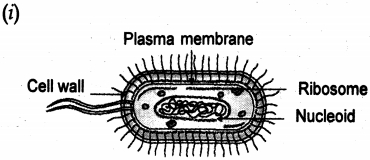
$(i)$ Draw a diagram of a prokaryotic cell and label the following parts on it: Cell wall,ribosome,nucleoid,plasma membrane.
$(ii)$ Why are organisms like bacteria called prokaryotes?
$(ii)$ Why are organisms like bacteria called prokaryotes?
Solution
(N/A) $(i)$ The diagram of a prokaryotic cell is provided in the image.
$(ii)$ In bacteria,the nuclear region is poorly developed or undefined because it lacks a nuclear membrane. Such an undefined nuclear region,which contains only nucleic acids,is called a nucleoid. Organisms that possess such cells with an undefined nuclear region are called prokaryotes (pro = primitive,karyote = nucleus).
$(ii)$ In bacteria,the nuclear region is poorly developed or undefined because it lacks a nuclear membrane. Such an undefined nuclear region,which contains only nucleic acids,is called a nucleoid. Organisms that possess such cells with an undefined nuclear region are called prokaryotes (pro = primitive,karyote = nucleus).
0 likes
View Solution64
Medium
Differentiate between prokaryotic and eukaryotic cells.
Solution
(N/A)
| Prokaryotic Cell | Eukaryotic Cell |
| $1$. Size is generally small $(0.5-10 \mu m)$. | $1$. Size is generally larger $(1-100 \mu m)$. |
| $2$. Nuclear region is not surrounded by a nuclear membrane. | $2$. Nuclear region is surrounded by a nuclear membrane. |
| $3$. Membrane-bound organelles such as mitochondria,lysosomes,and endoplasmic reticulum are absent. | $3$. All membrane-bound organelles are present. |
| $4$. Nucleolus is absent. | $4$. Nucleolus is present. |
| $5$. Cell division occurs by fission or budding (no mitosis). | $5$. Cell division is mitotic or meiotic. |
| $6$. They always have a single chromosome. | $6$. They have more than one chromosome. |
| $7$. $DNA$ is circular and lies free in the cytoplasm (no true nucleus). | $7$. $DNA$ is linear and contained within a nucleus. |
| $8$. $DNA$ is naked (not associated with histones). e.g.,$PPLO$,bacteria,and blue-green algae. | $8$. $DNA$ is associated with proteins (histones) to form chromosomes. e.g.,Plants and animals. |
0 likes
View Solution65
Medium
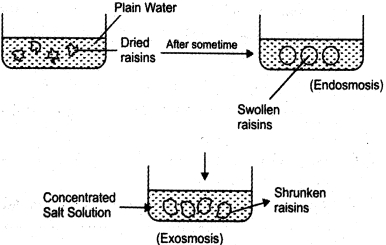
Describe an activity to demonstrate endosmosis and exosmosis. Draw a diagram also.
Solution
Activity to show endosmosis and exosmosis:
Put dried raisins in plain water and leave them for some time. Then,place these swollen raisins into a concentrated salt solution.
Observation:
$(i)$ When dried raisins are placed in plain water,they swell up due to the osmotic entry of water into the raisins. Plain water acts as a hypotonic medium for the raisins.
$(ii)$ When the swollen raisins are transferred to a concentrated salt solution,they shrink again. The concentrated solution acts as a hypertonic medium for the swollen raisins. Exosmosis occurs,and the raisins lose water.
0 likes
View Solution66
EasyMCQ
Name the stain used to prepare slides like that of onion peel and cheek cell. Why is the use of stain necessary? Do all organelles absorb stain equally?
A
Safranin
B
Methylene blue
C
Iodine
D
All of the above
Solution
(D) $(i)$ The stain commonly used for onion peel is $Iodine$ solution,and for cheek cells,$Methylene$ $blue$ is typically used. $Safranin$ is also used for plant tissues.
$(ii)$ Stains are necessary because they provide contrast to the transparent or colorless cellular components,making them clearly visible under a microscope.
$(iii)$ No,all organelles do not absorb stain equally. The absorption of stain depends on the chemical composition and density of the specific organelle.
0 likes
View Solution67
Medium
Give short answers:
$(i)$ What is the role of proteins and lipids in the plasma membrane?
$(ii)$ Why is the plasma membrane called selectively permeable?
$(iii)$ What is the role of cellulose in the cell wall?
$(iv)$ What is meant by plasmolysis?
$(v)$ What is the advantage of the flexibility of the cell membrane?
$(vi)$ Name the process which is useful for the movement of substances like $CO_{2}$ and $O_{2}$ across the cell membrane.
Solution
(N/A) $(i)$ Proteins and lipids provide structural flexibility and integrity to the plasma membrane.
$(ii)$ The plasma membrane is called selectively permeable because it regulates the entry and exit of specific substances while preventing the movement of others.
$(iii)$ Cellulose provides structural strength and rigidity to the plant cell wall. It also helps in water retention,preventing the desiccation of the cell.
$(iv)$ Plasmolysis is the phenomenon where a living plant cell loses water through osmosis,causing the cell contents to shrink away from the cell wall.
$(v)$ The flexibility of the cell membrane allows the cell to engulf food and other materials from its external environment through a process called endocytosis,which is essential for organisms like $Amoeba$.
$(vi)$ The process is known as diffusion.
0 likes
View Solution68
Medium
Define and explain the importance of the following phenomena in living cells:
$(a)$ Diffusion
$(b)$ Osmosis.
$(a)$ Diffusion
$(b)$ Osmosis.
Solution
(N/A) Diffusion: This is a phenomenon of the spontaneous movement of molecules from a region of higher concentration to a region of lower concentration. This process is faster in the gaseous phase than in liquids and solids. This process leads to a uniform concentration within a cell.
Importance: Substances (molecules,ions) such as $CO_2, O_2, H_2O$,etc.,can move across the plasma membrane by the process of diffusion.
$(b)$ Osmosis: It involves the movement of water molecules (solvent particles) from a region of their higher concentration to a region of lower concentration through a semipermeable membrane.
Importance: It is a purely mechanical diffusion process by which cells absorb water without spending any metabolic energy.
0 likes
View Solution69
Medium
Define osmosis. Give a few examples where osmosis is helpful.
Solution
(N/A) Osmosis is the spontaneous net movement of water molecules from a region of higher water potential to a region of lower water potential through a selectively permeable membrane,such as the plasma membrane. This is a passive process,meaning it does not require the expenditure of cellular energy.
Examples where osmosis is helpful:
$(i)$ Freshwater organisms like $Amoeba$ and $Paramecium$ maintain their internal water balance through osmosis.
$(ii)$ The movement of water into and out of plant cells occurs primarily due to osmosis.
$(iii)$ Absorption of water from the soil by root hairs is facilitated by osmosis.
$(iv)$ It plays a crucial role in the opening and closing of stomata by regulating the turgor pressure of guard cells.
$(v)$ It is responsible for the seismonastic movements (thigmonasty) in the 'touch-me-not' plant ($Mimosa$ $pudica$).
$(vi)$ This process helps plant cells,tissues,and soft organs like leaves,young shoots,and flowers maintain turgidity and structural integrity.
0 likes
View Solution70
Easy
Define the following terms:
$(i)$ Endocytosis
$(ii)$ Phagocytosis
$(iii)$ Exocytosis
$(i)$ Endocytosis
$(ii)$ Phagocytosis
$(iii)$ Exocytosis
Solution
(N/A) $(i)$ Endocytosis: It is the process of ingestion of material by the cells through the plasma membrane.
$(ii)$ Phagocytosis: It is a common method of feeding in some organisms such as $Amoeba$ and sponges. Biologically, it means "cell eating". The $WBCs$ engulf cell debris and microbes with the help of this process.
$(iii)$ Exocytosis: It is the process by which the plasma membrane removes its contents to the surrounding medium.
0 likes
View Solution71
EasyMCQ
Which of the following can be made into crystal?
A
$A$ Virus
B
$A$ Bacterium
C
An Amoeba
D
$A$ Sperm
Solution
(A) Viruses are considered to be at the border of living and non-living organisms. Unlike bacteria,amoebae,or sperm cells,which are cellular organisms,viruses consist of genetic material ($DNA$ or $RNA$) enclosed in a protein coat called a capsid. Because they lack cellular machinery and metabolic processes,they can be crystallized and stored like chemical substances,a property characteristic of non-living matter. Therefore,the correct answer is $A$.
0 likes
View Solution72
EasyMCQ
$A$ cell will swell up if
A
The concentration of water molecules in the cell is higher than the concentration of water molecules in the surrounding medium.
B
The concentration of water molecules in the surrounding medium is higher than the concentration of water molecules in the cell.
C
The concentration of water molecules is the same in the cell and in the surrounding medium.
D
The concentration of water molecules does not matter.
Solution
(B) cell swells up when it is placed in a hypotonic solution.
In a hypotonic solution,the concentration of water molecules in the surrounding medium is higher than the concentration of water molecules inside the cell.
Due to the process of osmosis,water molecules move from the region of higher water concentration (outside) to the region of lower water concentration (inside the cell) through the semi-permeable plasma membrane.
This net movement of water into the cell causes it to swell.
0 likes
View Solution73
EasyMCQ
Chromosomes are made-up of
A
$DNA$
B
Protein
C
$DNA$ and Protein
D
$RNA$
Solution
(C) Chromosomes are thread-like structures located inside the nucleus of animal and plant cells.
Each chromosome is made of protein and a single molecule of deoxyribonucleic acid $(DNA)$.
These components are essential for the packaging of genetic material within the cell nucleus.
Each chromosome is made of protein and a single molecule of deoxyribonucleic acid $(DNA)$.
These components are essential for the packaging of genetic material within the cell nucleus.
0 likes
View Solution74
EasyMCQ
Plasmolysis in a plant cell is defined as
A
Shrinkage of cytoplasm in hypertonic medium
B
Breakdown (lysis) of plasma membrane in hypotonic medium
C
Shrinkage of nucleoplasm
D
None of them
Solution
(A) Plasmolysis is the process in which cells lose water in a hypertonic solution.
When a plant cell is placed in a hypertonic solution (a solution with a higher solute concentration than the cell sap),water moves out of the cell due to osmosis.
As water leaves the cell,the cytoplasm shrinks away from the cell wall.
This phenomenon is known as plasmolysis.
When a plant cell is placed in a hypertonic solution (a solution with a higher solute concentration than the cell sap),water moves out of the cell due to osmosis.
As water leaves the cell,the cytoplasm shrinks away from the cell wall.
This phenomenon is known as plasmolysis.
0 likes
View Solution75
EasyMCQ
Functional segments of $DNA$ are called
A
Genes
B
$RNA$
C
Ribosomes
D
Chromosomes
Solution
(A) The functional segments of $DNA$ are known as genes.
Genes are the basic units of heredity and are responsible for the transmission of traits from parents to offspring.
Each gene contains the instructions required to synthesize a specific protein or functional $RNA$ molecule.
Genes are the basic units of heredity and are responsible for the transmission of traits from parents to offspring.
Each gene contains the instructions required to synthesize a specific protein or functional $RNA$ molecule.
0 likes
View Solution76
MediumMCQ
Select the odd one out.
A
The movement of water across a semipermeable membrane is affected by the amount of substances dissolved in it.
B
Plasma membranes contain chitin sugar in plants.
C
Membranes are made of organic molecules like proteins and lipids.
D
Molecules soluble in organic solvents can easily pass through the membrane.
Solution
(B) The correct answer is $B$.
$A$ is correct: Osmosis is the movement of water across a semipermeable membrane,which depends on the solute concentration.
$B$ is incorrect: Plasma membranes in plants are composed of lipids and proteins; they do not contain chitin. Chitin is a structural polysaccharide found in the cell walls of fungi and the exoskeletons of arthropods,not in plant plasma membranes.
$C$ is correct: Biological membranes are primarily composed of a phospholipid bilayer with embedded proteins.
$D$ is correct: Since the membrane is lipid-based,substances that are lipid-soluble (soluble in organic solvents) can diffuse through the membrane easily.
0 likes
View Solution77
EasyMCQ
The undefined nuclear region of prokaryotes is also known as:
A
Nucleoid
B
Nucleus
C
Nucleolus
D
Nucleic acid
Solution
(A) In prokaryotic cells,the nuclear region is not well-defined because it lacks a nuclear membrane. This undefined nuclear region,which contains only nucleic acids,is called the $Nucleoid$.
0 likes
View Solution78
EasyMCQ
Amoeba acquires its food through a process,termed
A
Exocytosis
B
Plasmolysis
C
Exocytosis and endocytosis both
D
Endocytosis
Solution
(D) $Amoeba$ is a unicellular organism that captures its food using temporary finger-like extensions of its cell surface called pseudopodia.
This process of engulfing food particles from the external environment into the cell is known as endocytosis.
Once the food is inside,it is enclosed in a food vacuole where digestion occurs.
Therefore,the correct term for the acquisition of food by $Amoeba$ is endocytosis.
This process of engulfing food particles from the external environment into the cell is known as endocytosis.
Once the food is inside,it is enclosed in a food vacuole where digestion occurs.
Therefore,the correct term for the acquisition of food by $Amoeba$ is endocytosis.
0 likes
View Solution79
EasyMCQ
The cell wall of which of these is not made up of cellulose?
A
Bacteria
B
Hydrilla
C
Mango tree
D
Cactus
Solution
(A) The cell wall of plants,such as $Hydrilla$,$Mango$ $tree$,and $Cactus$,is primarily composed of cellulose,which provides structural support and rigidity.
In contrast,the cell wall of $Bacteria$ is made up of peptidoglycan (also known as murein),which consists of sugars and amino acids.
Therefore,the correct option is $A$.
In contrast,the cell wall of $Bacteria$ is made up of peptidoglycan (also known as murein),which consists of sugars and amino acids.
Therefore,the correct option is $A$.
0 likes
View Solution80
EasyMCQ
In a non-dividing cell,$DNA$ is present as part of chromatin material which can be seen as
A
Thick rod like structures
B
Fine granules
C
Entangled mass of thread like structures
D
Crystalline structures
Solution
(C) In a non-dividing cell,the genetic material is present in the form of chromatin material.
Chromatin is a complex of $DNA$ and proteins (histones).
It appears as an entangled mass of thread-like structures within the nucleus.
When the cell prepares to divide,this chromatin condenses into distinct,thick,rod-like structures known as chromosomes.
Chromatin is a complex of $DNA$ and proteins (histones).
It appears as an entangled mass of thread-like structures within the nucleus.
When the cell prepares to divide,this chromatin condenses into distinct,thick,rod-like structures known as chromosomes.
0 likes
View Solution81
EasyMCQ
Purkinje identified the fluid substance of the cell and named it as
A
Nucleolus
B
Cytoplasm
C
Nucleoplasm
D
Protoplasm
Solution
(D) In $1839$,the Czech physiologist $Jan$ $Evangelista$ $Purkinje$ coined the term $Protoplasm$ for the fluid substance of the cell.
$Protoplasm$ is the living content of the cell,which includes both the cytoplasm and the nucleus.
Therefore,the correct option is $D$.
$Protoplasm$ is the living content of the cell,which includes both the cytoplasm and the nucleus.
Therefore,the correct option is $D$.
0 likes
View Solution82
Easy
State whether the following statement is true or false:
An undefined nuclear region containing only nucleic acids is called a nucleolus.
An undefined nuclear region containing only nucleic acids is called a nucleolus.
Solution
(FALSE) The statement is False.
An undefined nuclear region containing only nucleic acids (and lacking a nuclear membrane) is known as the nucleoid,which is characteristic of prokaryotic cells.
$A$ nucleolus is a distinct,spherical,non-membrane-bound structure found within the nucleus of eukaryotic cells,primarily involved in ribosome synthesis.
0 likes
View SolutionTHE FUNDAMENTAL UNIT OF LIFE — Structural Organisation of a Cell · Frequently Asked Questions
1Are these THE FUNDAMENTAL UNIT OF LIFE questions useful for JEE and NEET?
Yes. All questions in this section are mapped to JEE Main and NEET exam patterns. Previous year questions from JEE Main, NEET, GUJCET and state-level exams are included with full solutions.
2Can I switch to Hindi or Gujarati for these questions?
Yes. Use the language tabs in the hero section or the sidebar to view the same questions and solutions in English, Hindi or Gujarati.
3How do I generate a question paper from this subtopic?
Use the Vedclass Exam Paper Generator — select the chapter and subtopic, set difficulty, and generate Sets A, B, C, D automatically. First 3 chapters of every subject are free.
Vedclass Products
For Students
Vedclass Test Series
Mock tests in real JEE/NEET style with performance analysis. 5-day free trial.
Start Free TrialFor Teachers
Exam Paper Generator
Generate Set A/B/C/D papers from this chapter in 2 minutes. 3 chapters free.
Try FreeFor Institutes
Online Exam Module
Live online exams with unlimited students, 360° analytics & white-label branding.
See DemoFor Teachers & Institutes
Generate a THE FUNDAMENTAL UNIT OF LIFE Exam Paper in 2 Minutes
Select subtopic & difficulty — Sets A, B, C, D auto-generated with No Repeat logic.
First 3 chapters of every subject are free — no payment required.