
A English
Trigonometric Identities Questions in English
Class 10 Mathematics · Introduction to Trigonometry · Trigonometric Identities
97+
Questions
English
Language
100%
With Solutions
Showing 50 of 97 questions in English
1
Medium
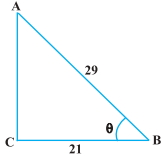
Consider $\triangle ACB$,right-angled at $C$,in which $AB = 29$ units,$BC = 21$ units and $\angle ABC = \theta$. Determine the values of:
$(i)$ $\cos^2 \theta + \sin^2 \theta$
$(ii)$ $\cos^2 \theta - \sin^2 \theta$
$(i)$ $\cos^2 \theta + \sin^2 \theta$
$(ii)$ $\cos^2 \theta - \sin^2 \theta$
Solution
(N/A) In $\triangle ACB$,we have:
$AC = \sqrt{AB^2 - BC^2} = \sqrt{(29)^2 - (21)^2}$
$= \sqrt{(29 - 21)(29 + 21)} = \sqrt{(8)(50)} = \sqrt{400} = 20$ units.
So,$\sin \theta = \frac{AC}{AB} = \frac{20}{29}$ and $\cos \theta = \frac{BC}{AB} = \frac{21}{29}$.
Now,
$(i)$ $\cos^2 \theta + \sin^2 \theta = \left(\frac{21}{29}\right)^2 + \left(\frac{20}{29}\right)^2 = \frac{441 + 400}{841} = \frac{841}{841} = 1$.
$(ii)$ $\cos^2 \theta - \sin^2 \theta = \left(\frac{21}{29}\right)^2 - \left(\frac{20}{29}\right)^2 = \frac{441 - 400}{841} = \frac{41}{841}$.
0 likes
View Solution2
MediumMCQ
If $\sin 3A = \cos(A - 26^{\circ})$,where $3A$ is an acute angle,find the value of $A$.
A
$29$
B
$32$
C
$20$
D
$25$
Solution
(A) Given equation: $\sin 3A = \cos(A - 26^{\circ})$
We know that $\sin \theta = \cos(90^{\circ} - \theta)$.
Therefore,$\sin 3A = \cos(90^{\circ} - 3A)$.
Substituting this into the given equation:
$\cos(90^{\circ} - 3A) = \cos(A - 26^{\circ})$
Since the angles are acute,we can equate them:
$90^{\circ} - 3A = A - 26^{\circ}$
Rearranging the terms to solve for $A$:
$90^{\circ} + 26^{\circ} = A + 3A$
$116^{\circ} = 4A$
$A = \frac{116^{\circ}}{4} = 29^{\circ}$
Thus,the value of $A$ is $29^{\circ}$.
0 likes
View Solution3
MediumMCQ
The value of the expression $\left[\operatorname{cosec}(75^{\circ}+\theta)-\sec(15^{\circ}-\theta)-\tan(55^{\circ}+\theta)+\cot(35^{\circ}-\theta)\right]$ is
A
$-1$
B
$1$
C
$0$
D
$\frac{3}{2}$
Solution
(C) Given expression: $E = \operatorname{cosec}(75^{\circ}+\theta) - \sec(15^{\circ}-\theta) - \tan(55^{\circ}+\theta) + \cot(35^{\circ}-\theta)$
Using the complementary angle identities $\operatorname{cosec}(90^{\circ}-A) = \sec A$ and $\cot(90^{\circ}-A) = \tan A$:
$1$. $\operatorname{cosec}(75^{\circ}+\theta) = \operatorname{cosec}(90^{\circ}-(15^{\circ}-\theta)) = \sec(15^{\circ}-\theta)$
$2$. $\cot(35^{\circ}-\theta) = \cot(90^{\circ}-(55^{\circ}+\theta)) = \tan(55^{\circ}+\theta)$
Substituting these into the expression:
$E = \sec(15^{\circ}-\theta) - \sec(15^{\circ}-\theta) - \tan(55^{\circ}+\theta) + \tan(55^{\circ}+\theta)$
$E = 0$
Thus,the value of the expression is $0$.
0 likes
View Solution4
MediumMCQ
If $\cos (\alpha+\beta)=0,$ then $\sin (\alpha-\beta)$ can be reduced to
A
$\cos 2 \beta$
B
$\cos \beta$
C
$\sin \alpha$
D
$\sin 2 \alpha$
Solution
(A) Given,$\cos (\alpha+\beta)=0=\cos 90^{\circ}$ $\left[\because \cos 90^{\circ}=0\right]$
$\Rightarrow \alpha+\beta=90^{\circ}$
$\Rightarrow \alpha=90^{\circ}-\beta$ ......$(i)$
Now,$\sin (\alpha-\beta)=\sin (90^{\circ}-\beta-\beta)$ [substituting the value from Eq. $(i)$]
$= \sin (90^{\circ}-2 \beta)$
$= \cos 2 \beta$ $\left[\because \sin (90^{\circ}-\theta)=\cos \theta\right]$
Hence,$\sin (\alpha-\beta)$ can be reduced to $\cos 2 \beta$.
0 likes
View Solution5
MediumMCQ
The value of $(\tan 1^{\circ} \tan 2^{\circ} \tan 3^{\circ} \ldots \tan 89^{\circ})$ is
A
$0$
B
$1$
C
$2$
D
$\frac{1}{2}$
Solution
(B) We have the expression: $P = \tan 1^{\circ} \cdot \tan 2^{\circ} \cdot \tan 3^{\circ} \ldots \tan 89^{\circ}$.
Using the property $\tan(90^{\circ} - \theta) = \cot \theta$,we can write $\tan 89^{\circ} = \cot 1^{\circ}$,$\tan 88^{\circ} = \cot 2^{\circ}$,and so on.
Since $\cot \theta = \frac{1}{\tan \theta}$,we have $\tan 89^{\circ} = \frac{1}{\tan 1^{\circ}}$,$\tan 88^{\circ} = \frac{1}{\tan 2^{\circ}}$,etc.
Substituting these into the expression:
$P = (\tan 1^{\circ} \cdot \cot 1^{\circ}) \cdot (\tan 2^{\circ} \cdot \cot 2^{\circ}) \ldots (\tan 44^{\circ} \cdot \cot 44^{\circ}) \cdot \tan 45^{\circ}$.
Since $\tan \theta \cdot \cot \theta = 1$ and $\tan 45^{\circ} = 1$,the expression becomes:
$P = 1 \cdot 1 \cdot 1 \ldots \cdot 1 = 1$.
0 likes
View Solution6
DifficultMCQ
If $\sin A + \sin^2 A = 1$,then the value of the expression $(\cos^2 A + \cos^4 A)$ is
A
$1$
B
$\frac{1}{2}$
C
$2$
D
$3$
Solution
(A) Given,$\sin A + \sin^2 A = 1$.
From this,we can write $\sin A = 1 - \sin^2 A$.
Using the identity $\sin^2 A + \cos^2 A = 1$,we know that $1 - \sin^2 A = \cos^2 A$.
Therefore,$\sin A = \cos^2 A$.
Squaring both sides,we get $\sin^2 A = (\cos^2 A)^2 = \cos^4 A$.
Now,substitute $\sin^2 A = 1 - \cos^2 A$ into the equation:
$1 - \cos^2 A = \cos^4 A$.
Rearranging the terms,we get $\cos^2 A + \cos^4 A = 1$.
0 likes
View Solution7
DifficultMCQ
The value of the expression $\left[\frac{\sin ^{2} 22^{\circ}+\sin ^{2} 68^{\circ}}{\cos ^{2} 22^{\circ}+\cos ^{2} 68^{\circ}}+\sin ^{2} 63^{\circ}+\cos 63^{\circ} \sin 27^{\circ}\right]$ is:
A
$3$
B
$1$
C
$2$
D
$0$
Solution
(C) Given expression: $\frac{\sin ^{2} 22^{\circ}+\sin ^{2} 68^{\circ}}{\cos ^{2} 22^{\circ}+\cos ^{2} 68^{\circ}}+\sin ^{2} 63^{\circ}+\cos 63^{\circ} \sin 27^{\circ}$
Using the identity $\sin(90^{\circ}-\theta) = \cos \theta$ and $\cos(90^{\circ}-\theta) = \sin \theta$:
Step $1$: Simplify the fraction.
$\sin 68^{\circ} = \sin(90^{\circ}-22^{\circ}) = \cos 22^{\circ}$
$\cos 22^{\circ} = \cos(90^{\circ}-68^{\circ}) = \sin 68^{\circ}$
So,the fraction becomes $\frac{\sin ^{2} 22^{\circ}+\cos ^{2} 22^{\circ}}{\sin ^{2} 68^{\circ}+\cos ^{2} 68^{\circ}} = \frac{1}{1} = 1$.
Step $2$: Simplify the remaining terms.
$\sin 27^{\circ} = \sin(90^{\circ}-63^{\circ}) = \cos 63^{\circ}$
So,$\sin ^{2} 63^{\circ}+\cos 63^{\circ} \sin 27^{\circ} = \sin ^{2} 63^{\circ}+\cos 63^{\circ} \cdot \cos 63^{\circ} = \sin ^{2} 63^{\circ}+\cos ^{2} 63^{\circ} = 1$.
Step $3$: Add the results.
$1 + 1 = 2$.
0 likes
View Solution8
MediumMCQ
If $\sin \theta - \cos \theta = 0$,then the value of $(\sin^4 \theta + \cos^4 \theta)$ is
A
$\frac{1}{2}$
B
$\frac{3}{4}$
C
$1$
D
$\frac{1}{4}$
Solution
(A) Given,$\sin \theta - \cos \theta = 0$.
$\sin \theta = \cos \theta \Rightarrow \frac{\sin \theta}{\cos \theta} = 1$.
$\tan \theta = 1$ $[\because \tan \theta = \frac{\sin \theta}{\cos \theta}$ and $\tan 45^{\circ} = 1]$.
$\tan \theta = \tan 45^{\circ}$.
$\theta = 45^{\circ}$.
Now,$\sin^4 \theta + \cos^4 \theta = \sin^4 45^{\circ} + \cos^4 45^{\circ}$.
$= (\frac{1}{\sqrt{2}})^4 + (\frac{1}{\sqrt{2}})^4$ $[\because \sin 45^{\circ} = \cos 45^{\circ} = \frac{1}{\sqrt{2}}]$.
$= \frac{1}{4} + \frac{1}{4} = \frac{2}{4} = \frac{1}{2}$.
0 likes
View Solution9
EasyMCQ
$\sin (45^{\circ}+\theta)-\cos (45^{\circ}-\theta)$ is equal to
A
$2 \cos \theta$
B
$0$
C
$2 \sin \theta$
D
$1$
Solution
(B) We know that $\sin (90^{\circ}-\theta) = \cos \theta$ and $\cos (90^{\circ}-\theta) = \sin \theta$.
Given expression: $\sin (45^{\circ}+\theta)-\cos (45^{\circ}-\theta)$
Using the identity $\sin A = \cos (90^{\circ}-A)$:
$\sin (45^{\circ}+\theta) = \cos (90^{\circ}-(45^{\circ}+\theta))$
$= \cos (90^{\circ}-45^{\circ}-\theta)$
$= \cos (45^{\circ}-\theta)$
Substituting this back into the original expression:
$\cos (45^{\circ}-\theta)-\cos (45^{\circ}-\theta) = 0$
0 likes
View Solution10
Easy
Write 'True' or 'False' and justify your answer.
The value of $\sin \theta + \cos \theta$ is always greater than $1$.
The value of $\sin \theta + \cos \theta$ is always greater than $1$.
Solution
(B) False.
The expression $\sin \theta + \cos \theta$ can be written as $\sqrt{2} (\frac{1}{\sqrt{2}} \sin \theta + \frac{1}{\sqrt{2}} \cos \theta) = \sqrt{2} \sin(\theta + 45^{\circ})$.
For $\theta = 0^{\circ}$,the value is $\sin 0^{\circ} + \cos 0^{\circ} = 0 + 1 = 1$.
Since the value can be equal to $1$ (e.g.,at $\theta = 0^{\circ}$ or $\theta = 90^{\circ}$),the statement that it is 'always greater than $1$' is false.
0 likes
View Solution11
MediumMCQ
Write 'True' or 'False' and justify your answer.
The value of the expression $(\cos^{2} 23^{\circ} - \sin^{2} 67^{\circ})$ is positive.
The value of the expression $(\cos^{2} 23^{\circ} - \sin^{2} 67^{\circ})$ is positive.
A
True
B
False
Solution
(B) False
We know that $\sin(90^{\circ} - \theta) = \cos \theta$.
Therefore,$\sin 67^{\circ} = \sin(90^{\circ} - 23^{\circ}) = \cos 23^{\circ}$.
Substituting this into the expression:
$\cos^{2} 23^{\circ} - \sin^{2} 67^{\circ} = \cos^{2} 23^{\circ} - (\cos 23^{\circ})^{2}$
$= \cos^{2} 23^{\circ} - \cos^{2} 23^{\circ}$
$= 0$.
Since $0$ is neither positive nor negative,the statement that the value is positive is False.
0 likes
View Solution12
Easy
Write 'True' or 'False' and justify your answer.
$\sqrt{(1-\cos^2 \theta) \sec^2 \theta} = \tan \theta$
$\sqrt{(1-\cos^2 \theta) \sec^2 \theta} = \tan \theta$
Solution
(A) True.
Given expression: $\sqrt{(1-\cos^2 \theta) \sec^2 \theta}$
Using the identity $\sin^2 \theta + \cos^2 \theta = 1$,we have $1 - \cos^2 \theta = \sin^2 \theta$.
Substituting this into the expression: $\sqrt{\sin^2 \theta \cdot \sec^2 \theta}$
Since $\sec \theta = \frac{1}{\cos \theta}$,we can write: $\sqrt{\sin^2 \theta \cdot \frac{1}{\cos^2 \theta}} = \sqrt{\frac{\sin^2 \theta}{\cos^2 \theta}}$
Using the identity $\tan \theta = \frac{\sin \theta}{\cos \theta}$,we get: $\sqrt{\tan^2 \theta} = \tan \theta$.
Thus,the statement is true.
0 likes
View Solution13
Medium
State whether the following is 'True' or 'False' and justify your answer:
If $\cos A + \cos^2 A = 1$,then $\sin^2 A + \sin^4 A = 1$.
If $\cos A + \cos^2 A = 1$,then $\sin^2 A + \sin^4 A = 1$.
Solution
(A) True.
Given that $\cos A + \cos^2 A = 1$.
Rearranging the terms,we get $\cos A = 1 - \cos^2 A$.
Using the identity $\sin^2 A + \cos^2 A = 1$,we know that $1 - \cos^2 A = \sin^2 A$.
Therefore,$\cos A = \sin^2 A$.
Squaring both sides,we get $\cos^2 A = (\sin^2 A)^2 = \sin^4 A$.
We know that $\cos^2 A = 1 - \sin^2 A$.
Substituting this into the equation $\cos^2 A = \sin^4 A$,we get $1 - \sin^2 A = \sin^4 A$.
Rearranging the terms,we get $\sin^2 A + \sin^4 A = 1$.
0 likes
View Solution14
Easy
Write 'True' or 'False' and justify your answer.
$(\tan \theta+2)(2 \tan \theta+1)=5 \tan \theta+\sec ^{2} \theta$
$(\tan \theta+2)(2 \tan \theta+1)=5 \tan \theta+\sec ^{2} \theta$
Solution
(B) False.
$L$.$H$.$S$. $= (\tan \theta + 2)(2 \tan \theta + 1)$
$= 2 \tan^2 \theta + \tan \theta + 4 \tan \theta + 2$
$= 2 \tan^2 \theta + 5 \tan \theta + 2$
Using the identity $\tan^2 \theta = \sec^2 \theta - 1$:
$= 2(\sec^2 \theta - 1) + 5 \tan \theta + 2$
$= 2 \sec^2 \theta - 2 + 5 \tan \theta + 2$
$= 2 \sec^2 \theta + 5 \tan \theta$
Since $2 \sec^2 \theta + 5 \tan \theta \neq 5 \tan \theta + \sec^2 \theta$,the given statement is False.
0 likes
View Solution15
Medium
Prove that $\sin^{6} \theta + \cos^{6} \theta + 3 \sin^{2} \theta \cos^{2} \theta = 1$.
Solution
(N/A) We know the fundamental trigonometric identity: $\sin^{2} \theta + \cos^{2} \theta = 1$.
Taking the cube of both sides,we get:
$(\sin^{2} \theta + \cos^{2} \theta)^{3} = (1)^{3}$
Using the algebraic identity $(a + b)^{3} = a^{3} + b^{3} + 3ab(a + b)$,where $a = \sin^{2} \theta$ and $b = \cos^{2} \theta$:
$(\sin^{2} \theta)^{3} + (\cos^{2} \theta)^{3} + 3(\sin^{2} \theta)(\cos^{2} \theta)(\sin^{2} \theta + \cos^{2} \theta) = 1$
Since $\sin^{2} \theta + \cos^{2} \theta = 1$,the equation becomes:
$\sin^{6} \theta + \cos^{6} \theta + 3 \sin^{2} \theta \cos^{2} \theta (1) = 1$
Thus,$\sin^{6} \theta + \cos^{6} \theta + 3 \sin^{2} \theta \cos^{2} \theta = 1$. Hence proved.
0 likes
View Solution16
Medium
Prove that $(\sin^{4} \theta - \cos^{4} \theta + 1) \operatorname{cosec}^{2} \theta = 2$.
Solution
(N/A) $L$.$H$.$S$. $= (\sin^{4} \theta - \cos^{4} \theta + 1) \operatorname{cosec}^{2} \theta$
$= [(\sin^{2} \theta - \cos^{2} \theta)(\sin^{2} \theta + \cos^{2} \theta) + 1] \operatorname{cosec}^{2} \theta$
Since $\sin^{2} \theta + \cos^{2} \theta = 1$,we have:
$= (\sin^{2} \theta - \cos^{2} \theta + 1) \operatorname{cosec}^{2} \theta$
Substitute $1 - \cos^{2} \theta = \sin^{2} \theta$:
$= (\sin^{2} \theta + \sin^{2} \theta) \operatorname{cosec}^{2} \theta$
$= (2 \sin^{2} \theta) \operatorname{cosec}^{2} \theta$
$= 2 (\sin^{2} \theta \cdot \operatorname{cosec}^{2} \theta)$
Since $\sin \theta \cdot \operatorname{cosec} \theta = 1$,we get:
$= 2(1) = 2 = \text{R.H.S.}$
0 likes
View Solution17
Easy
Given that $\alpha + \beta = 90^{\circ}$,show that $\sqrt{\cos \alpha \operatorname{cosec} \beta - \cos \alpha \sin \beta} = \sin \alpha$.
Solution
(N/A) Given $\alpha + \beta = 90^{\circ}$,we have $\beta = 90^{\circ} - \alpha$.
Substituting $\beta$ in the expression:
$\sqrt{\cos \alpha \operatorname{cosec} \beta - \cos \alpha \sin \beta} = \sqrt{\cos \alpha \operatorname{cosec}(90^{\circ} - \alpha) - \cos \alpha \sin(90^{\circ} - \alpha)}$
Using trigonometric identities $\operatorname{cosec}(90^{\circ} - \alpha) = \sec \alpha$ and $\sin(90^{\circ} - \alpha) = \cos \alpha$:
$= \sqrt{\cos \alpha \sec \alpha - \cos \alpha \cos \alpha}$
Since $\cos \alpha \sec \alpha = 1$ and $\cos \alpha \cos \alpha = \cos^{2} \alpha$:
$= \sqrt{1 - \cos^{2} \alpha}$
Using the identity $1 - \cos^{2} \alpha = \sin^{2} \alpha$:
$= \sqrt{\sin^{2} \alpha} = \sin \alpha$.
Hence,the expression is proved.
0 likes
View Solution18
Medium
If $\sin \theta + \cos \theta = \sqrt{3}$,then prove that $\tan \theta + \cot \theta = 1$.
Solution
(N/A) Given: $\sin \theta + \cos \theta = \sqrt{3}$.
Squaring both sides:
$(\sin \theta + \cos \theta)^2 = (\sqrt{3})^2$
$\sin^2 \theta + \cos^2 \theta + 2 \sin \theta \cos \theta = 3$
Since $\sin^2 \theta + \cos^2 \theta = 1$,we have:
$1 + 2 \sin \theta \cos \theta = 3$
$2 \sin \theta \cos \theta = 2$
$\sin \theta \cos \theta = 1$.
Now,consider the expression $\tan \theta + \cot \theta$:
$\tan \theta + \cot \theta = \frac{\sin \theta}{\cos \theta} + \frac{\cos \theta}{\sin \theta} = \frac{\sin^2 \theta + \cos^2 \theta}{\sin \theta \cos \theta}$.
Substituting $\sin^2 \theta + \cos^2 \theta = 1$ and $\sin \theta \cos \theta = 1$:
$\tan \theta + \cot \theta = \frac{1}{1} = 1$.
Hence,proved.
0 likes
View Solution19
Medium
Prove that,
$\frac{\sin \theta}{1+\cos \theta}+\frac{1+\cos \theta}{\sin \theta}=2 \operatorname{cosec} \theta$
$\frac{\sin \theta}{1+\cos \theta}+\frac{1+\cos \theta}{\sin \theta}=2 \operatorname{cosec} \theta$
Solution
(N/A) $L$.$H$.$S$. $= \frac{\sin \theta}{1+\cos \theta} + \frac{1+\cos \theta}{\sin \theta}$
$= \frac{\sin^2 \theta + (1+\cos \theta)^2}{\sin \theta(1+\cos \theta)}$
$= \frac{\sin^2 \theta + 1 + \cos^2 \theta + 2 \cos \theta}{\sin \theta(1+\cos \theta)}$ $\quad [\because (a+b)^2 = a^2 + b^2 + 2ab]$
$= \frac{(\sin^2 \theta + \cos^2 \theta) + 1 + 2 \cos \theta}{\sin \theta(1+\cos \theta)}$
$= \frac{1 + 1 + 2 \cos \theta}{\sin \theta(1+\cos \theta)}$ $\quad [\because \sin^2 \theta + \cos^2 \theta = 1]$
$= \frac{2 + 2 \cos \theta}{\sin \theta(1+\cos \theta)}$
$= \frac{2(1+\cos \theta)}{\sin \theta(1+\cos \theta)}$
$= \frac{2}{\sin \theta} = 2 \operatorname{cosec} \theta = \text{R.H.S.}$ $\quad [\because \operatorname{cosec} \theta = \frac{1}{\sin \theta}]$
0 likes
View Solution20
Medium
Prove that,
$\frac{\tan A}{1+\sec A} + \frac{\tan A}{\sec A-1} = 2 \operatorname{cosec} A$
$\frac{\tan A}{1+\sec A} + \frac{\tan A}{\sec A-1} = 2 \operatorname{cosec} A$
Solution
(N/A) $L$.$H$.$S$. $= \frac{\tan A}{1+\sec A} + \frac{\tan A}{\sec A-1}$
$= \tan A \left( \frac{\sec A - 1 + 1 + \sec A}{(\sec A + 1)(\sec A - 1)} \right)$
$= \tan A \left( \frac{2 \sec A}{\sec^2 A - 1} \right)$
$= \tan A \left( \frac{2 \sec A}{\tan^2 A} \right) \quad [\because \sec^2 A - 1 = \tan^2 A]$
$= \frac{2 \sec A}{\tan A} = \frac{2 \cdot \frac{1}{\cos A}}{\frac{\sin A}{\cos A}} = \frac{2}{\sin A} = 2 \operatorname{cosec} A = \text{R.H.S.}$
0 likes
View Solution21
Medium
Prove that,$(\sin \alpha+\cos \alpha)(\tan \alpha+\cot \alpha)=\sec \alpha+\operatorname{cosec} \alpha$
Solution
$LHS$ $= (\sin \alpha + \cos \alpha)(\tan \alpha + \cot \alpha)$
$= (\sin \alpha + \cos \alpha) \left( \frac{\sin \alpha}{\cos \alpha} + \frac{\cos \alpha}{\sin \alpha} \right)$ $\left[ \because \tan \alpha = \frac{\sin \alpha}{\cos \alpha} \text{ and } \cot \alpha = \frac{\cos \alpha}{\sin \alpha} \right]$
$= (\sin \alpha + \cos \alpha) \left( \frac{\sin^2 \alpha + \cos^2 \alpha}{\sin \alpha \cos \alpha} \right)$
$= (\sin \alpha + \cos \alpha) \cdot \frac{1}{\sin \alpha \cos \alpha}$ $\left[ \because \sin^2 \alpha + \cos^2 \alpha = 1 \right]$
$= \frac{\sin \alpha}{\sin \alpha \cos \alpha} + \frac{\cos \alpha}{\sin \alpha \cos \alpha}$
$= \frac{1}{\cos \alpha} + \frac{1}{\sin \alpha}$
$= \sec \alpha + \operatorname{cosec} \alpha = \text{RHS}$
0 likes
View Solution22
Medium
Prove that,
$1 + \frac{\cot^{2} \alpha}{1 + \operatorname{cosec} \alpha} = \operatorname{cosec} \alpha$
$1 + \frac{\cot^{2} \alpha}{1 + \operatorname{cosec} \alpha} = \operatorname{cosec} \alpha$
Solution
(N/A) $L$.$H$.$S$. $= 1 + \frac{\cot^{2} \alpha}{1 + \operatorname{cosec} \alpha}$
$= 1 + \frac{\cos^{2} \alpha / \sin^{2} \alpha}{1 + 1 / \sin \alpha} \quad [\because \cot \theta = \frac{\cos \theta}{\sin \theta} \text{ and } \operatorname{cosec} \theta = \frac{1}{\sin \theta}]$
$= 1 + \frac{\cos^{2} \alpha}{\sin \alpha(1 + \sin \alpha)} = \frac{\sin \alpha(1 + \sin \alpha) + \cos^{2} \alpha}{\sin \alpha(1 + \sin \alpha)}$
$= \frac{\sin \alpha + (\sin^{2} \alpha + \cos^{2} \alpha)}{\sin \alpha(1 + \sin \alpha)} \quad [\because \sin^{2} \theta + \cos^{2} \theta = 1]$
$= \frac{\sin \alpha + 1}{\sin \alpha(1 + \sin \alpha)} = \frac{1}{\sin \alpha} \quad [\because \operatorname{cosec} \theta = \frac{1}{\sin \theta}]$
$= \operatorname{cosec} \alpha = \text{R.H.S.}$
0 likes
View Solution23
Medium
Show that:
$(i)$ $\tan 48^{\circ} \tan 23^{\circ} \tan 42^{\circ} \tan 67^{\circ} = 1$
$(ii)$ $\cos 38^{\circ} \cos 52^{\circ} - \sin 38^{\circ} \sin 52^{\circ} = 0$
$(i)$ $\tan 48^{\circ} \tan 23^{\circ} \tan 42^{\circ} \tan 67^{\circ} = 1$
$(ii)$ $\cos 38^{\circ} \cos 52^{\circ} - \sin 38^{\circ} \sin 52^{\circ} = 0$
Solution
(N/A) $(i)$ We know that $\tan(90^{\circ} - \theta) = \cot \theta$.
$\tan 48^{\circ} \tan 23^{\circ} \tan 42^{\circ} \tan 67^{\circ} = \tan(90^{\circ} - 42^{\circ}) \tan(90^{\circ} - 67^{\circ}) \tan 42^{\circ} \tan 67^{\circ}$
$= \cot 42^{\circ} \cot 67^{\circ} \tan 42^{\circ} \tan 67^{\circ}$
$= (\cot 42^{\circ} \tan 42^{\circ}) (\cot 67^{\circ} \tan 67^{\circ})$
$= (1)(1) = 1$.
$(ii)$ We know that $\cos(90^{\circ} - \theta) = \sin \theta$ and $\sin(90^{\circ} - \theta) = \cos \theta$.
$\cos 38^{\circ} \cos 52^{\circ} - \sin 38^{\circ} \sin 52^{\circ} = \cos(90^{\circ} - 52^{\circ}) \cos(90^{\circ} - 38^{\circ}) - \sin 38^{\circ} \sin 52^{\circ}$
$= \sin 52^{\circ} \sin 38^{\circ} - \sin 38^{\circ} \sin 52^{\circ} = 0$.
0 likes
View Solution24
Easy
If $\tan A = \cot B$,prove that $A + B = 90^{\circ}$.
Solution
(N/A) Given that,$\tan A = \cot B$.
We know that $\cot B = \tan(90^{\circ} - B)$.
Substituting this into the given equation,we get $\tan A = \tan(90^{\circ} - B)$.
Since the tangent functions are equal,their angles must be equal: $A = 90^{\circ} - B$.
Rearranging the terms,we get $A + B = 90^{\circ}$.
We know that $\cot B = \tan(90^{\circ} - B)$.
Substituting this into the given equation,we get $\tan A = \tan(90^{\circ} - B)$.
Since the tangent functions are equal,their angles must be equal: $A = 90^{\circ} - B$.
Rearranging the terms,we get $A + B = 90^{\circ}$.
0 likes
View Solution25
EasyMCQ
If $\sec 4A = \operatorname{cosec}(A - 20^{\circ})$,where $4A$ is an acute angle,find the value of $A$ (in $^{\circ}$).
A
$110$
B
$22$
C
$50$
D
$90$
Solution
(B) Given that,$\sec 4A = \operatorname{cosec}(A - 20^{\circ})$.
We know that $\sec \theta = \operatorname{cosec}(90^{\circ} - \theta)$.
Therefore,$\operatorname{cosec}(90^{\circ} - 4A) = \operatorname{cosec}(A - 20^{\circ})$.
Equating the angles,we get $90^{\circ} - 4A = A - 20^{\circ}$.
Rearranging the terms,$90^{\circ} + 20^{\circ} = A + 4A$.
$110^{\circ} = 5A$.
$A = \frac{110^{\circ}}{5} = 22^{\circ}$.
Thus,the value of $A$ is $22^{\circ}$.
0 likes
View Solution26
Medium
If $A, B$ and $C$ are interior angles of a triangle $ABC$,then show that $\sin \left(\frac{B+C}{2}\right) = \cos \frac{A}{2}$.
Solution
(N/A) We know that for a triangle $ABC$,the sum of interior angles is $180^{\circ}$.
$\angle A + \angle B + \angle C = 180^{\circ}$
$\angle B + \angle C = 180^{\circ} - \angle A$
Dividing both sides by $2$,we get:
$\frac{\angle B + \angle C}{2} = \frac{180^{\circ} - \angle A}{2} = 90^{\circ} - \frac{\angle A}{2}$
Taking the sine on both sides:
$\sin \left(\frac{B+C}{2}\right) = \sin \left(90^{\circ} - \frac{A}{2}\right)$
Using the trigonometric identity $\sin(90^{\circ} - \theta) = \cos \theta$,we have:
$\sin \left(\frac{B+C}{2}\right) = \cos \left(\frac{A}{2}\right)$
Hence,it is proved.
0 likes
View Solution27
Medium
Express the ratios $\cos A$,$\tan A$,and $\sec A$ in terms of $\sin A$.
Solution
(N/A) We know the fundamental trigonometric identity: $\cos^2 A + \sin^2 A = 1$.
$1$. To express $\cos A$ in terms of $\sin A$:
$\cos^2 A = 1 - \sin^2 A$
$\cos A = \sqrt{1 - \sin^2 A}$ (taking the positive root for acute angle $A$)
$2$. To express $\tan A$ in terms of $\sin A$:
$\tan A = \frac{\sin A}{\cos A}$
Substituting the value of $\cos A$:
$\tan A = \frac{\sin A}{\sqrt{1 - \sin^2 A}}$
$3$. To express $\sec A$ in terms of $\sin A$:
$\sec A = \frac{1}{\cos A}$
Substituting the value of $\cos A$:
$\sec A = \frac{1}{\sqrt{1 - \sin^2 A}}$
0 likes
View Solution28
Difficult
Prove that $\sec A(1-\sin A)(\sec A+\tan A)=1$.
Solution
(A) $LHS = \sec A(1-\sin A)(\sec A+\tan A)$
$= \left(\frac{1}{\cos A}\right)(1-\sin A)\left(\frac{1}{\cos A} + \frac{\sin A}{\cos A}\right)$
$= \left(\frac{1-\sin A}{\cos A}\right)\left(\frac{1+\sin A}{\cos A}\right)$
$= \frac{(1-\sin A)(1+\sin A)}{\cos^2 A}$
$= \frac{1-\sin^2 A}{\cos^2 A}$
$= \frac{\cos^2 A}{\cos^2 A} = 1 = RHS$
Hence,the identity is proved.
0 likes
View Solution29
Medium
Prove that $\frac{\cot A - \cos A}{\cot A + \cos A} = \frac{\operatorname{cosec} A - 1}{\operatorname{cosec} A + 1}$.
Solution
(N/A) We start with the Left Hand Side $(LHS)$:
$LHS = \frac{\cot A - \cos A}{\cot A + \cos A}$
Substitute $\cot A = \frac{\cos A}{\sin A}$:
$LHS = \frac{\frac{\cos A}{\sin A} - \cos A}{\frac{\cos A}{\sin A} + \cos A}$
Factor out $\cos A$ from the numerator and the denominator:
$LHS = \frac{\cos A \left( \frac{1}{\sin A} - 1 \right)}{\cos A \left( \frac{1}{\sin A} + 1 \right)}$
Cancel $\cos A$ from both:
$LHS = \frac{\frac{1}{\sin A} - 1}{\frac{1}{\sin A} + 1}$
Since $\operatorname{cosec} A = \frac{1}{\sin A}$,we substitute it:
$LHS = \frac{\operatorname{cosec} A - 1}{\operatorname{cosec} A + 1} = RHS$
Hence,the identity is proved.
0 likes
View Solution30
Difficult
Prove that $\frac{\sin \theta-\cos \theta+1}{\sin \theta+\cos \theta-1}=\frac{1}{\sec \theta-\tan \theta},$ using the identity $\sec ^{2} \theta=1+\tan ^{2} \theta.$
Solution
(A) To prove the identity,we divide the numerator and the denominator of the $LHS$ by $\cos \theta$ to express it in terms of $\tan \theta$ and $\sec \theta.$
$LHS = \frac{\sin \theta - \cos \theta + 1}{\sin \theta + \cos \theta - 1} = \frac{\tan \theta - 1 + \sec \theta}{\tan \theta + 1 - \sec \theta}$
Rearranging the terms,we get:
$LHS = \frac{(\tan \theta + \sec \theta) - 1}{(\tan \theta - \sec \theta) + 1}$
Using the identity $\sec^2 \theta - \tan^2 \theta = 1,$ we substitute $1$ in the numerator:
$LHS = \frac{(\tan \theta + \sec \theta) - (\sec^2 \theta - \tan^2 \theta)}{(\tan \theta - \sec \theta) + 1}$
Factorizing the numerator using $a^2 - b^2 = (a - b)(a + b)$:
$LHS = \frac{(\tan \theta + \sec \theta) - (\sec \theta - \tan \theta)(\sec \theta + \tan \theta)}{(\tan \theta - \sec \theta) + 1}$
Taking $(\tan \theta + \sec \theta)$ as a common factor:
$LHS = \frac{(\tan \theta + \sec \theta) [1 - (\sec \theta - \tan \theta)]}{(\tan \theta - \sec \theta) + 1}$
$LHS = \frac{(\tan \theta + \sec \theta) [1 - \sec \theta + \tan \theta]}{(\tan \theta - \sec \theta + 1)}$
Canceling the common term $(\tan \theta - \sec \theta + 1)$:
$LHS = \tan \theta + \sec \theta$
To get the $RHS,$ multiply and divide by $(\sec \theta - \tan \theta)$:
$LHS = \frac{(\sec \theta + \tan \theta)(\sec \theta - \tan \theta)}{\sec \theta - \tan \theta} = \frac{\sec^2 \theta - \tan^2 \theta}{\sec \theta - \tan \theta} = \frac{1}{\sec \theta - \tan \theta} = RHS.$
0 likes
View Solution31
Difficult
Express the trigonometric ratios $\sin A$,$\sec A$,and $\tan A$ in terms of $\cot A$.
Solution
(N/A) We know that,$\operatorname{cosec}^{2} A = 1 + \cot^{2} A$.
Since $\sin A = \frac{1}{\operatorname{cosec} A}$,we have $\sin^{2} A = \frac{1}{\operatorname{cosec}^{2} A} = \frac{1}{1 + \cot^{2} A}$.
Taking the square root,$\sin A = \frac{1}{\sqrt{1 + \cot^{2} A}}$.
Next,we know that $\tan A = \frac{1}{\cot A}$.
Finally,using the identity $\sec^{2} A = 1 + \tan^{2} A$,we substitute $\tan A = \frac{1}{\cot A}$:
$\sec^{2} A = 1 + \left(\frac{1}{\cot A}\right)^{2} = 1 + \frac{1}{\cot^{2} A} = \frac{\cot^{2} A + 1}{\cot^{2} A}$.
Taking the square root,$\sec A = \frac{\sqrt{1 + \cot^{2} A}}{\cot A}$.
0 likes
View Solution32
Medium
Write all the other trigonometric ratios of $\angle A$ in terms of $\sec A$.
Solution
We know that,$\cos A = \frac{1}{\sec A}$.
Using the identity $\sin^2 A + \cos^2 A = 1$,we have $\sin^2 A = 1 - \cos^2 A = 1 - \frac{1}{\sec^2 A} = \frac{\sec^2 A - 1}{\sec^2 A}$.
Thus,$\sin A = \frac{\sqrt{\sec^2 A - 1}}{\sec A}$.
Using the identity $\tan^2 A + 1 = \sec^2 A$,we have $\tan^2 A = \sec^2 A - 1$.
Thus,$\tan A = \sqrt{\sec^2 A - 1}$.
Since $\cot A = \frac{1}{\tan A}$,we have $\cot A = \frac{1}{\sqrt{\sec^2 A - 1}}$.
Since $\operatorname{cosec} A = \frac{1}{\sin A}$,we have $\operatorname{cosec} A = \frac{\sec A}{\sqrt{\sec^2 A - 1}}$.
1 likes
View Solution33
MediumMCQ
Evaluate:
$\sin 25^{\circ} \cos 65^{\circ} + \cos 25^{\circ} \sin 65^{\circ}$
$\sin 25^{\circ} \cos 65^{\circ} + \cos 25^{\circ} \sin 65^{\circ}$
A
$2$
B
$-1$
C
$0$
D
$1$
Solution
(D) The given expression is $\sin 25^{\circ} \cos 65^{\circ} + \cos 25^{\circ} \sin 65^{\circ}$.
We know that $\cos(90^{\circ} - \theta) = \sin \theta$ and $\sin(90^{\circ} - \theta) = \cos \theta$.
Substituting $\cos 65^{\circ} = \cos(90^{\circ} - 25^{\circ}) = \sin 25^{\circ}$ and $\sin 65^{\circ} = \sin(90^{\circ} - 25^{\circ}) = \cos 25^{\circ}$:
$= (\sin 25^{\circ})(\sin 25^{\circ}) + (\cos 25^{\circ})(\cos 25^{\circ})$
$= \sin^{2} 25^{\circ} + \cos^{2} 25^{\circ}$
Using the identity $\sin^{2} A + \cos^{2} A = 1$,we get:
$= 1$
0 likes
View Solution34
EasyMCQ
$9 \sec^{2} A - 9 \tan^{2} A = \dots$
A
$9$
B
$1$
C
$8$
D
$0$
Solution
(A) Given expression: $9 \sec^{2} A - 9 \tan^{2} A$
Factor out the common term $9$:
$= 9(\sec^{2} A - \tan^{2} A)$
Using the trigonometric identity $\sec^{2} A - \tan^{2} A = 1$:
$= 9(1)$
$= 9$
Factor out the common term $9$:
$= 9(\sec^{2} A - \tan^{2} A)$
Using the trigonometric identity $\sec^{2} A - \tan^{2} A = 1$:
$= 9(1)$
$= 9$
0 likes
View Solution35
DifficultMCQ
$(1+\tan \theta+\sec \theta)(1+\cot \theta-\operatorname{cosec} \theta) = \dots$
A
$0$
B
$2$
C
$1$
D
$-1$
Solution
(B) Given expression: $(1+\tan \theta+\sec \theta)(1+\cot \theta-\operatorname{cosec} \theta)$
Convert the trigonometric ratios into $\sin \theta$ and $\cos \theta$:
$= \left(1 + \frac{\sin \theta}{\cos \theta} + \frac{1}{\cos \theta}\right) \left(1 + \frac{\cos \theta}{\sin \theta} - \frac{1}{\sin \theta}\right)$
Simplify the terms inside the brackets:
$= \left(\frac{\cos \theta + \sin \theta + 1}{\cos \theta}\right) \left(\frac{\sin \theta + \cos \theta - 1}{\sin \theta}\right)$
Apply the algebraic identity $(a+b)(a-b) = a^2 - b^2$,where $a = (\sin \theta + \cos \theta)$ and $b = 1$:
$= \frac{(\sin \theta + \cos \theta)^2 - (1)^2}{\sin \theta \cos \theta}$
Expand the numerator using $(a+b)^2 = a^2 + b^2 + 2ab$:
$= \frac{\sin^2 \theta + \cos^2 \theta + 2 \sin \theta \cos \theta - 1}{\sin \theta \cos \theta}$
Using the identity $\sin^2 \theta + \cos^2 \theta = 1$:
$= \frac{1 + 2 \sin \theta \cos \theta - 1}{\sin \theta \cos \theta}$
$= \frac{2 \sin \theta \cos \theta}{\sin \theta \cos \theta} = 2$
0 likes
View Solution36
MediumMCQ
$(\sec A + \tan A)(1 - \sin A) = \dots$
A
$\sec A$
B
$\sin A$
C
$\cos A$
D
$\operatorname{cosec} A$
Solution
(C) Given expression: $(\sec A + \tan A)(1 - \sin A)$
Step $1$: Convert $\sec A$ and $\tan A$ into terms of $\sin A$ and $\cos A$:
$(\frac{1}{\cos A} + \frac{\sin A}{\cos A})(1 - \sin A)$
Step $2$: Combine the fractions:
$(\frac{1 + \sin A}{\cos A})(1 - \sin A)$
Step $3$: Multiply the numerators:
$\frac{(1 + \sin A)(1 - \sin A)}{\cos A}$
Step $4$: Use the identity $(a + b)(a - b) = a^2 - b^2$:
$\frac{1 - \sin^2 A}{\cos A}$
Step $5$: Use the identity $1 - \sin^2 A = \cos^2 A$:
$\frac{\cos^2 A}{\cos A} = \cos A$
0 likes
View Solution37
EasyMCQ
$\frac{1+\tan ^{2} A}{1+\cot ^{2} A} = \dots$
A
$\sec ^{2} A$
B
$-1$
C
$\cot ^{2} A$
D
$\tan ^{2} A$
Solution
(D) We know the trigonometric identities: $1 + \tan^2 A = \sec^2 A$ and $1 + \cot^2 A = \csc^2 A$.
Substituting these into the expression:
$\frac{1+\tan ^{2} A}{1+\cot ^{2} A} = \frac{\sec^2 A}{\csc^2 A}$
Since $\sec A = \frac{1}{\cos A}$ and $\csc A = \frac{1}{\sin A}$,we have:
$= \frac{\frac{1}{\cos^2 A}}{\frac{1}{\sin^2 A}} = \frac{\sin^2 A}{\cos^2 A} = \tan^2 A$.
Substituting these into the expression:
$\frac{1+\tan ^{2} A}{1+\cot ^{2} A} = \frac{\sec^2 A}{\csc^2 A}$
Since $\sec A = \frac{1}{\cos A}$ and $\csc A = \frac{1}{\sin A}$,we have:
$= \frac{\frac{1}{\cos^2 A}}{\frac{1}{\sin^2 A}} = \frac{\sin^2 A}{\cos^2 A} = \tan^2 A$.
0 likes
View Solution38
Medium
Prove the following identity,where the angles involved are acute angles for which the expressions are defined:
$(\operatorname{cosec} \theta - \cot \theta)^2 = \frac{1 - \cos \theta}{1 + \cos \theta}$
$(\operatorname{cosec} \theta - \cot \theta)^2 = \frac{1 - \cos \theta}{1 + \cos \theta}$
Solution
(A) To prove: $(\operatorname{cosec} \theta - \cot \theta)^2 = \frac{1 - \cos \theta}{1 + \cos \theta}$
Consider the $L.H.S. = (\operatorname{cosec} \theta - \cot \theta)^2$
Using the trigonometric identities $\operatorname{cosec} \theta = \frac{1}{\sin \theta}$ and $\cot \theta = \frac{\cos \theta}{\sin \theta}$,we get:
$L.H.S. = \left( \frac{1}{\sin \theta} - \frac{\cos \theta}{\sin \theta} \right)^2$
$= \left( \frac{1 - \cos \theta}{\sin \theta} \right)^2 = \frac{(1 - \cos \theta)^2}{\sin^2 \theta}$
Using the identity $\sin^2 \theta = 1 - \cos^2 \theta$,we get:
$= \frac{(1 - \cos \theta)^2}{1 - \cos^2 \theta}$
Since $a^2 - b^2 = (a - b)(a + b)$,we can write $1 - \cos^2 \theta = (1 - \cos \theta)(1 + \cos \theta)$:
$= \frac{(1 - \cos \theta)^2}{(1 - \cos \theta)(1 + \cos \theta)}$
$= \frac{1 - \cos \theta}{1 + \cos \theta} = R.H.S.$
Hence,$L.H.S. = R.H.S.$
0 likes
View Solution39
Medium
Prove the following identity,where the angles involved are acute angles for which the expressions are defined:
$\frac{\cos A}{1+\sin A}+\frac{1+\sin A}{\cos A}=2 \sec A$
$\frac{\cos A}{1+\sin A}+\frac{1+\sin A}{\cos A}=2 \sec A$
Solution
(N/A) To prove: $\frac{\cos A}{1+\sin A}+\frac{1+\sin A}{\cos A}=2 \sec A$
$L.H.S. = \frac{\cos A}{1+\sin A}+\frac{1+\sin A}{\cos A}$
Taking the common denominator:
$= \frac{\cos^2 A + (1+\sin A)^2}{(1+\sin A)(\cos A)}$
Expanding the numerator:
$= \frac{\cos^2 A + 1 + \sin^2 A + 2\sin A}{(1+\sin A)(\cos A)}$
Using the identity $\sin^2 A + \cos^2 A = 1$:
$= \frac{(\sin^2 A + \cos^2 A) + 1 + 2\sin A}{(1+\sin A)(\cos A)}$
$= \frac{1 + 1 + 2\sin A}{(1+\sin A)(\cos A)}$
$= \frac{2 + 2\sin A}{(1+\sin A)(\cos A)}$
Factoring out $2$:
$= \frac{2(1+\sin A)}{(1+\sin A)(\cos A)}$
$= \frac{2}{\cos A} = 2 \sec A$
$= R.H.S.$
0 likes
View Solution40
Difficult
Prove the following identity,where the angles involved are acute angles for which the expressions are defined:
$\frac{\tan \theta}{1-\cot \theta}+\frac{\cot \theta}{1-\tan \theta}=1+\sec \theta \operatorname{cosec} \theta$
$\frac{\tan \theta}{1-\cot \theta}+\frac{\cot \theta}{1-\tan \theta}=1+\sec \theta \operatorname{cosec} \theta$
Solution
(A) $L.H.S. = \frac{\tan \theta}{1-\cot \theta} + \frac{\cot \theta}{1-\tan \theta}$
$= \frac{\frac{\sin \theta}{\cos \theta}}{1-\frac{\cos \theta}{\sin \theta}} + \frac{\frac{\cos \theta}{\sin \theta}}{1-\frac{\sin \theta}{\cos \theta}}$
$= \frac{\frac{\sin \theta}{\cos \theta}}{\frac{\sin \theta-\cos \theta}{\sin \theta}} + \frac{\frac{\cos \theta}{\sin \theta}}{\frac{\cos \theta-\sin \theta}{\cos \theta}}$
$= \frac{\sin^2 \theta}{\cos \theta(\sin \theta-\cos \theta)} - \frac{\cos^2 \theta}{\sin \theta(\sin \theta-\cos \theta)}$
$= \frac{1}{(\sin \theta-\cos \theta)} \left[ \frac{\sin^2 \theta}{\cos \theta} - \frac{\cos^2 \theta}{\sin \theta} \right]$
$= \left( \frac{1}{\sin \theta-\cos \theta} \right) \left[ \frac{\sin^3 \theta-\cos^3 \theta}{\sin \theta \cos \theta} \right]$
$= \left( \frac{1}{\sin \theta-\cos \theta} \right) \left[ \frac{(\sin \theta-\cos \theta)(\sin^2 \theta+\cos^2 \theta+\sin \theta \cos \theta)}{\sin \theta \cos \theta} \right]$
$= \frac{1+\sin \theta \cos \theta}{\sin \theta \cos \theta}$
$= \frac{1}{\sin \theta \cos \theta} + \frac{\sin \theta \cos \theta}{\sin \theta \cos \theta}$
$= \operatorname{cosec} \theta \sec \theta + 1 = R.H.S.$
0 likes
View Solution41
Medium
Prove the following identity,where the angles involved are acute angles for which the expressions are defined:
$\frac{1+\sec A}{\sec A} = \frac{\sin^2 A}{1-\cos A}$
$\frac{1+\sec A}{\sec A} = \frac{\sin^2 A}{1-\cos A}$
Solution
(A) To prove: $\frac{1+\sec A}{\sec A} = \frac{\sin^2 A}{1-\cos A}$
Step $1$: Simplify the Left Hand Side $(L.H.S.)$.
$L.H.S. = \frac{1+\sec A}{\sec A} = \frac{1 + \frac{1}{\cos A}}{\frac{1}{\cos A}}$
Step $2$: Simplify the fraction.
$= \frac{\frac{\cos A + 1}{\cos A}}{\frac{1}{\cos A}} = \cos A + 1$
Step $3$: Simplify the Right Hand Side $(R.H.S.)$ to match the $L.H.S.$ or multiply the $L.H.S.$ by $\frac{1-\cos A}{1-\cos A}$.
$= (1 + \cos A) \times \frac{1-\cos A}{1-\cos A}$
Step $4$: Use the identity $\sin^2 A + \cos^2 A = 1$,so $1 - \cos^2 A = \sin^2 A$.
$= \frac{1 - \cos^2 A}{1 - \cos A} = \frac{\sin^2 A}{1 - \cos A}$
Thus,$L.H.S. = R.H.S.$
0 likes
View Solution42
Difficult
Prove the following identity,where the angles involved are acute angles for which the expressions are defined:
$\frac{\cos A-\sin A+1}{\cos A+\sin A-1}=\operatorname{cosec} A+\cot A$,using the identity $\operatorname{cosec}^{2} A=1+\cot ^{2} A$.
$\frac{\cos A-\sin A+1}{\cos A+\sin A-1}=\operatorname{cosec} A+\cot A$,using the identity $\operatorname{cosec}^{2} A=1+\cot ^{2} A$.
Solution
(N/A) To prove: $\frac{\cos A-\sin A+1}{\cos A+\sin A-1}=\operatorname{cosec} A+\cot A$
$L.H.S. = \frac{\cos A - \sin A + 1}{\cos A + \sin A - 1}$
Divide the numerator and the denominator by $\sin A$:
$= \frac{\frac{\cos A}{\sin A} - \frac{\sin A}{\sin A} + \frac{1}{\sin A}}{\frac{\cos A}{\sin A} + \frac{\sin A}{\sin A} - \frac{1}{\sin A}}$
$= \frac{\cot A - 1 + \operatorname{cosec} A}{\cot A + 1 - \operatorname{cosec} A}$
Using the identity $1 = \operatorname{cosec}^{2} A - \cot^{2} A$ in the numerator:
$= \frac{\cot A + \operatorname{cosec} A - (\operatorname{cosec}^{2} A - \cot^{2} A)}{\cot A - \operatorname{cosec} A + 1}$
$= \frac{(\cot A + \operatorname{cosec} A) - (\operatorname{cosec} A - \cot A)(\operatorname{cosec} A + \cot A)}{\cot A - \operatorname{cosec} A + 1}$
Factor out $(\cot A + \operatorname{cosec} A)$:
$= \frac{(\cot A + \operatorname{cosec} A) [1 - (\operatorname{cosec} A - \cot A)]}{\cot A - \operatorname{cosec} A + 1}$
$= \frac{(\cot A + \operatorname{cosec} A) (1 - \operatorname{cosec} A + \cot A)}{\cot A - \operatorname{cosec} A + 1}$
Since $(1 - \operatorname{cosec} A + \cot A) = (\cot A - \operatorname{cosec} A + 1)$,they cancel out:
$= \cot A + \operatorname{cosec} A = R.H.S.$
0 likes
View Solution43
Medium
Prove the following identity,where the angle involved is an acute angle for which the expression is defined:
$\sqrt{\frac{1+\sin A}{1-\sin A}} = \sec A + \tan A$
$\sqrt{\frac{1+\sin A}{1-\sin A}} = \sec A + \tan A$
Solution
(N/A) To prove the identity $\sqrt{\frac{1+\sin A}{1-\sin A}} = \sec A + \tan A$:
$L.H.S. = \sqrt{\frac{1+\sin A}{1-\sin A}}$
Multiply the numerator and denominator inside the square root by $(1 + \sin A)$:
$= \sqrt{\frac{(1+\sin A)(1+\sin A)}{(1-\sin A)(1+\sin A)}}$
Using the identity $(1 - \sin^2 A) = \cos^2 A$:
$= \sqrt{\frac{(1+\sin A)^2}{1-\sin^2 A}} = \sqrt{\frac{(1+\sin A)^2}{\cos^2 A}}$
Taking the square root:
$= \frac{1+\sin A}{\cos A}$
$= \frac{1}{\cos A} + \frac{\sin A}{\cos A} = \sec A + \tan A$
$= R.H.S.$
0 likes
View Solution44
Difficult
Prove the following identity,where the angles involved are acute angles for which the expressions are defined:
$\frac{\sin \theta - 2 \sin^3 \theta}{2 \cos^3 \theta - \cos \theta} = \tan \theta$
$\frac{\sin \theta - 2 \sin^3 \theta}{2 \cos^3 \theta - \cos \theta} = \tan \theta$
Solution
(A) Given: $L.H.S. = \frac{\sin \theta - 2 \sin^3 \theta}{2 \cos^3 \theta - \cos \theta}$
Step $1$: Factor out $\sin \theta$ from the numerator and $\cos \theta$ from the denominator.
$L.H.S. = \frac{\sin \theta (1 - 2 \sin^2 \theta)}{\cos \theta (2 \cos^2 \theta - 1)}$
Step $2$: Use the identity $\sin^2 \theta + \cos^2 \theta = 1$,which implies $\cos^2 \theta = 1 - \sin^2 \theta$.
Substitute this into the denominator:
$L.H.S. = \frac{\sin \theta (1 - 2 \sin^2 \theta)}{\cos \theta [2(1 - \sin^2 \theta) - 1]}$
Step $3$: Simplify the expression inside the bracket in the denominator.
$2(1 - \sin^2 \theta) - 1 = 2 - 2 \sin^2 \theta - 1 = 1 - 2 \sin^2 \theta$
Step $4$: Substitute back into the expression.
$L.H.S. = \frac{\sin \theta (1 - 2 \sin^2 \theta)}{\cos \theta (1 - 2 \sin^2 \theta)}$
Step $5$: Cancel the common term $(1 - 2 \sin^2 \theta)$.
$L.H.S. = \frac{\sin \theta}{\cos \theta} = \tan \theta = R.H.S.$
Hence,the identity is proved.
0 likes
View Solution45
Medium
Prove the following identity,where the angles involved are acute angles for which the expressions are defined:
$(\sin A + \operatorname{cosec} A)^2 + (\cos A + \sec A)^2 = 7 + \tan^2 A + \cot^2 A$
$(\sin A + \operatorname{cosec} A)^2 + (\cos A + \sec A)^2 = 7 + \tan^2 A + \cot^2 A$
Solution
(N/A) To prove: $(\sin A + \operatorname{cosec} A)^2 + (\cos A + \sec A)^2 = 7 + \tan^2 A + \cot^2 A$
$L.H.S. = (\sin A + \operatorname{cosec} A)^2 + (\cos A + \sec A)^2$
Using the identity $(a + b)^2 = a^2 + b^2 + 2ab$:
$= (\sin^2 A + \operatorname{cosec}^2 A + 2 \sin A \operatorname{cosec} A) + (\cos^2 A + \sec^2 A + 2 \cos A \sec A)$
$= (\sin^2 A + \cos^2 A) + \operatorname{cosec}^2 A + \sec^2 A + 2 \sin A \left(\frac{1}{\sin A}\right) + 2 \cos A \left(\frac{1}{\cos A}\right)$
Since $\sin^2 A + \cos^2 A = 1$,$\operatorname{cosec}^2 A = 1 + \cot^2 A$,and $\sec^2 A = 1 + \tan^2 A$:
$= 1 + (1 + \cot^2 A) + (1 + \tan^2 A) + 2(1) + 2(1)$
$= 1 + 1 + \cot^2 A + 1 + \tan^2 A + 2 + 2$
$= 7 + \tan^2 A + \cot^2 A$
$= R.H.S.$
0 likes
View Solution46
Medium
Prove the following identity,where the angles involved are acute angles for which the expressions are defined:
$(\operatorname{cosec} A - \sin A)(\sec A - \cos A) = \frac{1}{\tan A + \cot A}$
$(\operatorname{cosec} A - \sin A)(\sec A - \cos A) = \frac{1}{\tan A + \cot A}$
Solution
(A) To prove: $(\operatorname{cosec} A - \sin A)(\sec A - \cos A) = \frac{1}{\tan A + \cot A}$
$L.H.S. = (\operatorname{cosec} A - \sin A)(\sec A - \cos A)$
$= (\frac{1}{\sin A} - \sin A)(\frac{1}{\cos A} - \cos A)$
$= (\frac{1 - \sin^2 A}{\sin A})(\frac{1 - \cos^2 A}{\cos A})$
$= (\frac{\cos^2 A}{\sin A})(\frac{\sin^2 A}{\cos A})$
$= \sin A \cos A$
$R.H.S. = \frac{1}{\tan A + \cot A}$
$= \frac{1}{\frac{\sin A}{\cos A} + \frac{\cos A}{\sin A}}$
$= \frac{1}{\frac{\sin^2 A + \cos^2 A}{\sin A \cos A}}$
$= \frac{\sin A \cos A}{\sin^2 A + \cos^2 A}$
$= \frac{\sin A \cos A}{1} = \sin A \cos A$
Since $L.H.S. = R.H.S.$,the identity is proved.
0 likes
View Solution47
Difficult
Prove the following identities,where the angles involved are acute angles for which the expressions are defined:
$\left(\frac{1+\tan ^{2} A}{1+\cot ^{2} A}\right)=\left(\frac{1-\tan A}{1-\cot A}\right)^{2}=\tan ^{2} A$
$\left(\frac{1+\tan ^{2} A}{1+\cot ^{2} A}\right)=\left(\frac{1-\tan A}{1-\cot A}\right)^{2}=\tan ^{2} A$
Solution
(A) First,consider the expression $\frac{1+\tan ^{2} A}{1+\cot ^{2} A}$.
Using the identities $1+\tan ^{2} A = \sec ^{2} A$ and $1+\cot ^{2} A = \operatorname{cosec}^{2} A$,we get:
$\frac{\sec ^{2} A}{\operatorname{cosec}^{2} A} = \frac{1/\cos ^{2} A}{1/\sin ^{2} A} = \frac{\sin ^{2} A}{\cos ^{2} A} = \tan ^{2} A$.
Next,consider the expression $\left(\frac{1-\tan A}{1-\cot A}\right)^{2}$.
Substitute $\cot A = \frac{1}{\tan A}$:
$\left(\frac{1-\tan A}{1-\frac{1}{\tan A}}\right)^{2} = \left(\frac{1-\tan A}{\frac{\tan A - 1}{\tan A}}\right)^{2} = \left(\frac{(1-\tan A) \cdot \tan A}{-(1-\tan A)}\right)^{2} = (-\tan A)^{2} = \tan ^{2} A$.
Since both parts equal $\tan ^{2} A$,the identity is proved.
0 likes
View Solution48
Medium
Prove that,$\tan \theta + \tan (90^{\circ} - \theta) = \sec \theta \sec (90^{\circ} - \theta)$
Solution
(N/A) $L$.$H$.$S$. $= \tan \theta + \tan (90^{\circ} - \theta)$
Since $\tan (90^{\circ} - \theta) = \cot \theta$,we have:
$= \tan \theta + \cot \theta$
$= \frac{\sin \theta}{\cos \theta} + \frac{\cos \theta}{\sin \theta}$
$= \frac{\sin^2 \theta + \cos^2 \theta}{\sin \theta \cos \theta}$
Since $\sin^2 \theta + \cos^2 \theta = 1$,we get:
$= \frac{1}{\sin \theta \cos \theta}$
$= \frac{1}{\cos \theta} \cdot \frac{1}{\sin \theta}$
$= \sec \theta \operatorname{cosec} \theta$
Since $\operatorname{cosec} \theta = \sec (90^{\circ} - \theta)$,we get:
$= \sec \theta \sec (90^{\circ} - \theta) = \text{R.H.S.}$
0 likes
View Solution49
MediumMCQ
Simplify $(1+\tan ^{2} \theta)(1-\sin \theta)(1+\sin \theta)$
A
$1$
B
$0$
C
$-1$
D
$0.5$
Solution
(A) Given expression: $(1+\tan ^{2} \theta)(1-\sin \theta)(1+\sin \theta)$
Using the algebraic identity $(a-b)(a+b) = a^{2}-b^{2}$,we have $(1-\sin \theta)(1+\sin \theta) = 1-\sin ^{2} \theta$.
So,the expression becomes $(1+\tan ^{2} \theta)(1-\sin ^{2} \theta)$.
We know that $1+\tan ^{2} \theta = \sec ^{2} \theta$ and $1-\sin ^{2} \theta = \cos ^{2} \theta$.
Substituting these,we get $\sec ^{2} \theta \cdot \cos ^{2} \theta$.
Since $\sec \theta = \frac{1}{\cos \theta}$,we have $\sec ^{2} \theta = \frac{1}{\cos ^{2} \theta}$.
Therefore,$\frac{1}{\cos ^{2} \theta} \cdot \cos ^{2} \theta = 1$.
0 likes
View Solution50
MediumMCQ
If $2 \sin^{2} \theta - \cos^{2} \theta = 2$,then find the value of $\theta$. (in $^{\circ}$)
A
$30$
B
$90$
C
$0$
D
$120$
Solution
(B) Given equation: $2 \sin^{2} \theta - \cos^{2} \theta = 2$
Using the identity $\cos^{2} \theta = 1 - \sin^{2} \theta$,we substitute it into the equation:
$2 \sin^{2} \theta - (1 - \sin^{2} \theta) = 2$
Simplify the expression:
$2 \sin^{2} \theta - 1 + \sin^{2} \theta = 2$
$3 \sin^{2} \theta - 1 = 2$
Add $1$ to both sides:
$3 \sin^{2} \theta = 3$
Divide by $3$:
$\sin^{2} \theta = 1$
Taking the square root:
$\sin \theta = 1$ (considering the principal value)
Since $\sin 90^{\circ} = 1$,we have:
$\theta = 90^{\circ}$
1 likes
View SolutionIntroduction to Trigonometry — Trigonometric Identities · Frequently Asked Questions
1Are these Introduction to Trigonometry questions useful for JEE and NEET?
Yes. All questions in this section are mapped to JEE Main and NEET exam patterns. Previous year questions from JEE Main, NEET, GUJCET and state-level exams are included with full solutions.
2Can I switch to Hindi or Gujarati for these questions?
Yes. Use the language tabs in the hero section or the sidebar to view the same questions and solutions in English, Hindi or Gujarati.
3How do I generate a question paper from this subtopic?
Use the Vedclass Exam Paper Generator — select the chapter and subtopic, set difficulty, and generate Sets A, B, C, D automatically. First 3 chapters of every subject are free.
Vedclass Products
For Students
Vedclass Test Series
Mock tests in real JEE/NEET style with performance analysis. 5-day free trial.
Start Free TrialFor Teachers
Exam Paper Generator
Generate Set A/B/C/D papers from this chapter in 2 minutes. 3 chapters free.
Try FreeFor Institutes
Online Exam Module
Live online exams with unlimited students, 360° analytics & white-label branding.
See DemoFor Teachers & Institutes
Generate a Introduction to Trigonometry Exam Paper in 2 Minutes
Select subtopic & difficulty — Sets A, B, C, D auto-generated with No Repeat logic.
First 3 chapters of every subject are free — no payment required.