
अ Hindi
Trigonometric Identities Questions in Hindi
Class 10 Mathematics · Introduction to Trigonometry · Trigonometric Identities
97+
Questions
Hindi
Language
100%
With Solutions
Showing 50 of 97 questions in Hindi
1
Medium
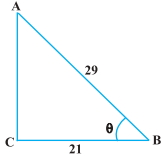
$\triangle ACB$ पर विचार करें,जो $C$ पर समकोण है,जिसमें $AB = 29$ इकाई,$BC = 21$ इकाई और $\angle ABC = \theta$ है। निम्नलिखित के मान ज्ञात कीजिए:
$(i)$ $\cos^2 \theta + \sin^2 \theta$
$(ii)$ $\cos^2 \theta - \sin^2 \theta$
$(i)$ $\cos^2 \theta + \sin^2 \theta$
$(ii)$ $\cos^2 \theta - \sin^2 \theta$
Solution
(N/A) $\triangle ACB$ में,हमारे पास है:
$AC = \sqrt{AB^2 - BC^2} = \sqrt{(29)^2 - (21)^2}$
$= \sqrt{(29 - 21)(29 + 21)} = \sqrt{(8)(50)} = \sqrt{400} = 20$ इकाई।
अतः,$\sin \theta = \frac{AC}{AB} = \frac{20}{29}$ और $\cos \theta = \frac{BC}{AB} = \frac{21}{29}$।
अब,
$(i)$ $\cos^2 \theta + \sin^2 \theta = \left(\frac{21}{29}\right)^2 + \left(\frac{20}{29}\right)^2 = \frac{441 + 400}{841} = \frac{841}{841} = 1$।
$(ii)$ $\cos^2 \theta - \sin^2 \theta = \left(\frac{21}{29}\right)^2 - \left(\frac{20}{29}\right)^2 = \frac{441 - 400}{841} = \frac{41}{841}$।
0 likes
View Solution2
MediumMCQ
यदि $\sin 3A = \cos(A - 26^{\circ})$ है,जहाँ $3A$ एक न्यून कोण है,तो $A$ का मान ज्ञात कीजिए।
A
$29$
B
$32$
C
$20$
D
$25$
Solution
(A) दिया गया समीकरण: $\sin 3A = \cos(A - 26^{\circ})$
हम जानते हैं कि $\sin \theta = \cos(90^{\circ} - \theta)$ होता है।
इसलिए,$\sin 3A = \cos(90^{\circ} - 3A)$।
इस मान को दिए गए समीकरण में प्रतिस्थापित करने पर:
$\cos(90^{\circ} - 3A) = \cos(A - 26^{\circ})$
चूँकि कोण न्यून कोण हैं,हम उन्हें बराबर रख सकते हैं:
$90^{\circ} - 3A = A - 26^{\circ}$
$A$ के लिए हल करने हेतु पदों को व्यवस्थित करने पर:
$90^{\circ} + 26^{\circ} = A + 3A$
$116^{\circ} = 4A$
$A = \frac{116^{\circ}}{4} = 29^{\circ}$
अतः,$A$ का मान $29^{\circ}$ है।
0 likes
View Solution3
MediumMCQ
व्यंजक $\left[\operatorname{cosec}(75^{\circ}+\theta)-\sec(15^{\circ}-\theta)-\tan(55^{\circ}+\theta)+\cot(35^{\circ}-\theta)\right]$ का मान है
A
$-1$
B
$1$
C
$0$
D
$\frac{3}{2}$
Solution
(C) दिया गया व्यंजक: $E = \operatorname{cosec}(75^{\circ}+\theta) - \sec(15^{\circ}-\theta) - \tan(55^{\circ}+\theta) + \cot(35^{\circ}-\theta)$
पूरक कोण सर्वसमिकाओं $\operatorname{cosec}(90^{\circ}-A) = \sec A$ और $\cot(90^{\circ}-A) = \tan A$ का उपयोग करने पर:
$1$. $\operatorname{cosec}(75^{\circ}+\theta) = \operatorname{cosec}(90^{\circ}-(15^{\circ}-\theta)) = \sec(15^{\circ}-\theta)$
$2$. $\cot(35^{\circ}-\theta) = \cot(90^{\circ}-(55^{\circ}+\theta)) = \tan(55^{\circ}+\theta)$
इन मानों को व्यंजक में प्रतिस्थापित करने पर:
$E = \sec(15^{\circ}-\theta) - \sec(15^{\circ}-\theta) - \tan(55^{\circ}+\theta) + \tan(55^{\circ}+\theta)$
$E = 0$
अतः,दिए गए व्यंजक का मान $0$ है।
0 likes
View Solution4
MediumMCQ
यदि $\cos (\alpha+\beta)=0$ है,तो $\sin (\alpha-\beta)$ को किसमें बदला जा सकता है?
A
$\cos 2 \beta$
B
$\cos \beta$
C
$\sin \alpha$
D
$\sin 2 \alpha$
Solution
(A) दिया गया है,$\cos (\alpha+\beta)=0=\cos 90^{\circ}$ $\left[\because \cos 90^{\circ}=0\right]$
$\Rightarrow \alpha+\beta=90^{\circ}$
$\Rightarrow \alpha=90^{\circ}-\beta$ ......$(i)$
अब,$\sin (\alpha-\beta)=\sin (90^{\circ}-\beta-\beta)$ [समीकरण $(i)$ से मान रखने पर]
$= \sin (90^{\circ}-2 \beta)$
$= \cos 2 \beta$ $\left[\because \sin (90^{\circ}-\theta)=\cos \theta\right]$
अतः,$\sin (\alpha-\beta)$ को $\cos 2 \beta$ में बदला जा सकता है।
0 likes
View Solution5
MediumMCQ
$(\tan 1^{\circ} \tan 2^{\circ} \tan 3^{\circ} \ldots \tan 89^{\circ})$ का मान है
A
$0$
B
$1$
C
$2$
D
$\frac{1}{2}$
Solution
(B) हमारे पास व्यंजक है: $P = \tan 1^{\circ} \cdot \tan 2^{\circ} \cdot \tan 3^{\circ} \ldots \tan 89^{\circ}$.
गुणधर्म $\tan(90^{\circ} - \theta) = \cot \theta$ का उपयोग करते हुए,हम लिख सकते हैं कि $\tan 89^{\circ} = \cot 1^{\circ}$,$\tan 88^{\circ} = \cot 2^{\circ}$,आदि।
चूंकि $\cot \theta = \frac{1}{\tan \theta}$,इसलिए $\tan 89^{\circ} = \frac{1}{\tan 1^{\circ}}$,$\tan 88^{\circ} = \frac{1}{\tan 2^{\circ}}$,आदि।
इन मानों को व्यंजक में रखने पर:
$P = (\tan 1^{\circ} \cdot \cot 1^{\circ}) \cdot (\tan 2^{\circ} \cdot \cot 2^{\circ}) \ldots (\tan 44^{\circ} \cdot \cot 44^{\circ}) \cdot \tan 45^{\circ}$.
चूंकि $\tan \theta \cdot \cot \theta = 1$ और $\tan 45^{\circ} = 1$,इसलिए व्यंजक का मान:
$P = 1 \cdot 1 \cdot 1 \ldots \cdot 1 = 1$.
0 likes
View Solution6
DifficultMCQ
यदि $\sin A + \sin^2 A = 1$ है,तो व्यंजक $(\cos^2 A + \cos^4 A)$ का मान क्या है?
A
$1$
B
$\frac{1}{2}$
C
$2$
D
$3$
Solution
(A) दिया गया है,$\sin A + \sin^2 A = 1$.
इससे,हम लिख सकते हैं $\sin A = 1 - \sin^2 A$.
सर्वसमिका $\sin^2 A + \cos^2 A = 1$ का उपयोग करते हुए,हम जानते हैं कि $1 - \sin^2 A = \cos^2 A$.
अतः,$\sin A = \cos^2 A$.
दोनों पक्षों का वर्ग करने पर,हमें प्राप्त होता है $\sin^2 A = (\cos^2 A)^2 = \cos^4 A$.
अब,समीकरण में $\sin^2 A = 1 - \cos^2 A$ प्रतिस्थापित करने पर:
$1 - \cos^2 A = \cos^4 A$.
पदों को व्यवस्थित करने पर,हमें प्राप्त होता है $\cos^2 A + \cos^4 A = 1$.
0 likes
View Solution7
DifficultMCQ
व्यंजक $\left[\frac{\sin ^{2} 22^{\circ}+\sin ^{2} 68^{\circ}}{\cos ^{2} 22^{\circ}+\cos ^{2} 68^{\circ}}+\sin ^{2} 63^{\circ}+\cos 63^{\circ} \sin 27^{\circ}\right]$ का मान ज्ञात कीजिए।
A
$3$
B
$1$
C
$2$
D
$0$
Solution
(C) दिया गया व्यंजक: $\frac{\sin ^{2} 22^{\circ}+\sin ^{2} 68^{\circ}}{\cos ^{2} 22^{\circ}+\cos ^{2} 68^{\circ}}+\sin ^{2} 63^{\circ}+\cos 63^{\circ} \sin 27^{\circ}$
सर्वसमिका $\sin(90^{\circ}-\theta) = \cos \theta$ और $\cos(90^{\circ}-\theta) = \sin \theta$ का उपयोग करते हुए:
चरण $1$: भिन्न का सरलीकरण करें।
$\sin 68^{\circ} = \sin(90^{\circ}-22^{\circ}) = \cos 22^{\circ}$
$\cos 22^{\circ} = \cos(90^{\circ}-68^{\circ}) = \sin 68^{\circ}$
अतः,भिन्न $\frac{\sin ^{2} 22^{\circ}+\cos ^{2} 22^{\circ}}{\sin ^{2} 68^{\circ}+\cos ^{2} 68^{\circ}} = \frac{1}{1} = 1$ हो जाएगा।
चरण $2$: शेष पदों का सरलीकरण करें।
$\sin 27^{\circ} = \sin(90^{\circ}-63^{\circ}) = \cos 63^{\circ}$
अतः,$\sin ^{2} 63^{\circ}+\cos 63^{\circ} \sin 27^{\circ} = \sin ^{2} 63^{\circ}+\cos 63^{\circ} \cdot \cos 63^{\circ} = \sin ^{2} 63^{\circ}+\cos ^{2} 63^{\circ} = 1$ हो जाएगा।
चरण $3$: परिणामों को जोड़ें।
$1 + 1 = 2$.
0 likes
View Solution8
MediumMCQ
यदि $\sin \theta - \cos \theta = 0$ है,तो $(\sin^4 \theta + \cos^4 \theta)$ का मान क्या होगा?
A
$\frac{1}{2}$
B
$\frac{3}{4}$
C
$1$
D
$\frac{1}{4}$
Solution
(A) दिया गया है,$\sin \theta - \cos \theta = 0$.
$\sin \theta = \cos \theta \Rightarrow \frac{\sin \theta}{\cos \theta} = 1$.
$\tan \theta = 1$ $[\because \tan \theta = \frac{\sin \theta}{\cos \theta}$ और $\tan 45^{\circ} = 1]$.
$\tan \theta = \tan 45^{\circ}$.
$\theta = 45^{\circ}$.
अब,$\sin^4 \theta + \cos^4 \theta = \sin^4 45^{\circ} + \cos^4 45^{\circ}$.
$= (\frac{1}{\sqrt{2}})^4 + (\frac{1}{\sqrt{2}})^4$ $[\because \sin 45^{\circ} = \cos 45^{\circ} = \frac{1}{\sqrt{2}}]$.
$= \frac{1}{4} + \frac{1}{4} = \frac{2}{4} = \frac{1}{2}$.
0 likes
View Solution9
EasyMCQ
$\sin (45^{\circ}+\theta)-\cos (45^{\circ}-\theta)$ का मान किसके बराबर है?
A
$2 \cos \theta$
B
$0$
C
$2 \sin \theta$
D
$1$
Solution
(B) हम जानते हैं कि $\sin (90^{\circ}-\theta) = \cos \theta$ और $\cos (90^{\circ}-\theta) = \sin \theta$ होता है।
दी गई व्यंजक: $\sin (45^{\circ}+\theta)-\cos (45^{\circ}-\theta)$
सर्वसमिका $\sin A = \cos (90^{\circ}-A)$ का उपयोग करने पर:
$\sin (45^{\circ}+\theta) = \cos (90^{\circ}-(45^{\circ}+\theta))$
$= \cos (90^{\circ}-45^{\circ}-\theta)$
$= \cos (45^{\circ}-\theta)$
इस मान को मूल व्यंजक में प्रतिस्थापित करने पर:
$\cos (45^{\circ}-\theta)-\cos (45^{\circ}-\theta) = 0$
0 likes
View Solution10
Easy
'True' (सत्य) या 'False' (असत्य) लिखिए और अपने उत्तर का औचित्य बताइए।
$\sin \theta + \cos \theta$ का मान सदैव $1$ से अधिक होता है।
$\sin \theta + \cos \theta$ का मान सदैव $1$ से अधिक होता है।
Solution
(B) असत्य।
व्यंजक $\sin \theta + \cos \theta$ को $\sqrt{2} (\frac{1}{\sqrt{2}} \sin \theta + \frac{1}{\sqrt{2}} \cos \theta) = \sqrt{2} \sin(\theta + 45^{\circ})$ के रूप में लिखा जा सकता है।
$\theta = 0^{\circ}$ के लिए,इसका मान $\sin 0^{\circ} + \cos 0^{\circ} = 0 + 1 = 1$ होता है।
चूंकि इसका मान $1$ के बराबर हो सकता है (उदाहरण के लिए,$\theta = 0^{\circ}$ या $\theta = 90^{\circ}$ पर),इसलिए यह कथन कि 'यह सदैव $1$ से अधिक होता है' असत्य है।
0 likes
View Solution11
MediumMCQ
'True' (सत्य) या 'False' (असत्य) लिखिए और अपने उत्तर का औचित्य बताइए।
व्यंजक $(\cos^{2} 23^{\circ} - \sin^{2} 67^{\circ})$ का मान धनात्मक है।
व्यंजक $(\cos^{2} 23^{\circ} - \sin^{2} 67^{\circ})$ का मान धनात्मक है।
A
True
B
False
Solution
(B) False (असत्य)
हम जानते हैं कि $\sin(90^{\circ} - \theta) = \cos \theta$ होता है।
अतः,$\sin 67^{\circ} = \sin(90^{\circ} - 23^{\circ}) = \cos 23^{\circ}$।
इस मान को व्यंजक में प्रतिस्थापित करने पर:
$\cos^{2} 23^{\circ} - \sin^{2} 67^{\circ} = \cos^{2} 23^{\circ} - (\cos 23^{\circ})^{2}$
$= \cos^{2} 23^{\circ} - \cos^{2} 23^{\circ}$
$= 0$।
चूंकि $0$ न तो धनात्मक है और न ही ऋणात्मक,इसलिए यह कथन कि इसका मान धनात्मक है,असत्य है।
0 likes
View Solution12
Easy
'True' (सत्य) या 'False' (असत्य) लिखिए और अपने उत्तर का औचित्य सिद्ध कीजिए।
$\sqrt{(1-\cos^2 \theta) \sec^2 \theta} = \tan \theta$
$\sqrt{(1-\cos^2 \theta) \sec^2 \theta} = \tan \theta$
Solution
(A) सत्य।
दिया गया व्यंजक: $\sqrt{(1-\cos^2 \theta) \sec^2 \theta}$
सर्वसमिका $\sin^2 \theta + \cos^2 \theta = 1$ का उपयोग करने पर,हमें प्राप्त होता है $1 - \cos^2 \theta = \sin^2 \theta$।
इस मान को व्यंजक में प्रतिस्थापित करने पर: $\sqrt{\sin^2 \theta \cdot \sec^2 \theta}$
चूंकि $\sec \theta = \frac{1}{\cos \theta}$,हम लिख सकते हैं: $\sqrt{\sin^2 \theta \cdot \frac{1}{\cos^2 \theta}} = \sqrt{\frac{\sin^2 \theta}{\cos^2 \theta}}$
सर्वसमिका $\tan \theta = \frac{\sin \theta}{\cos \theta}$ का उपयोग करने पर,हमें प्राप्त होता है: $\sqrt{\tan^2 \theta} = \tan \theta$।
अतः,दिया गया कथन सत्य है।
0 likes
View Solution13
Medium
बताइए कि निम्नलिखित कथन 'सत्य' है या 'असत्य' और अपने उत्तर का औचित्य दीजिए:
यदि $\cos A + \cos^2 A = 1$ है,तो $\sin^2 A + \sin^4 A = 1$ होगा।
यदि $\cos A + \cos^2 A = 1$ है,तो $\sin^2 A + \sin^4 A = 1$ होगा।
Solution
(A) सत्य।
दिया गया है कि $\cos A + \cos^2 A = 1$ है।
पदों को पुनर्व्यवस्थित करने पर,हमें प्राप्त होता है $\cos A = 1 - \cos^2 A$।
सर्वसमिका $\sin^2 A + \cos^2 A = 1$ का उपयोग करते हुए,हम जानते हैं कि $1 - \cos^2 A = \sin^2 A$ होता है।
अतः,$\cos A = \sin^2 A$।
दोनों पक्षों का वर्ग करने पर,हमें प्राप्त होता है $\cos^2 A = (\sin^2 A)^2 = \sin^4 A$।
हम जानते हैं कि $\cos^2 A = 1 - \sin^2 A$ होता है।
इस मान को समीकरण $\cos^2 A = \sin^4 A$ में प्रतिस्थापित करने पर,हमें प्राप्त होता है $1 - \sin^2 A = \sin^4 A$।
पदों को पुनर्व्यवस्थित करने पर,हमें प्राप्त होता है $\sin^2 A + \sin^4 A = 1$।
0 likes
View Solution14
Easy
'True' (सत्य) या 'False' (असत्य) लिखिए और अपने उत्तर का औचित्य बताइए।
$(\tan \theta+2)(2 \tan \theta+1)=5 \tan \theta+\sec ^{2} \theta$
$(\tan \theta+2)(2 \tan \theta+1)=5 \tan \theta+\sec ^{2} \theta$
Solution
(B) असत्य (False)।
$L$.$H$.$S$. $= (\tan \theta + 2)(2 \tan \theta + 1)$
$= 2 \tan^2 \theta + \tan \theta + 4 \tan \theta + 2$
$= 2 \tan^2 \theta + 5 \tan \theta + 2$
सर्वसमिका $\tan^2 \theta = \sec^2 \theta - 1$ का उपयोग करने पर:
$= 2(\sec^2 \theta - 1) + 5 \tan \theta + 2$
$= 2 \sec^2 \theta - 2 + 5 \tan \theta + 2$
$= 2 \sec^2 \theta + 5 \tan \theta$
चूंकि $2 \sec^2 \theta + 5 \tan \theta \neq 5 \tan \theta + \sec^2 \theta$,इसलिए दिया गया कथन असत्य है।
0 likes
View Solution15
Medium
सिद्ध कीजिए कि $\sin^{6} \theta + \cos^{6} \theta + 3 \sin^{2} \theta \cos^{2} \theta = 1$.
Solution
(N/A) हम जानते हैं कि आधारभूत त्रिकोणमितीय सर्वसमिका: $\sin^{2} \theta + \cos^{2} \theta = 1$ है।
दोनों पक्षों का घन करने पर,हमें प्राप्त होता है:
$(\sin^{2} \theta + \cos^{2} \theta)^{3} = (1)^{3}$
बीजगणितीय सर्वसमिका $(a + b)^{3} = a^{3} + b^{3} + 3ab(a + b)$ का उपयोग करते हुए,जहाँ $a = \sin^{2} \theta$ और $b = \cos^{2} \theta$ है:
$(\sin^{2} \theta)^{3} + (\cos^{2} \theta)^{3} + 3(\sin^{2} \theta)(\cos^{2} \theta)(\sin^{2} \theta + \cos^{2} \theta) = 1$
चूंकि $\sin^{2} \theta + \cos^{2} \theta = 1$ है,इसलिए समीकरण इस प्रकार होगा:
$\sin^{6} \theta + \cos^{6} \theta + 3 \sin^{2} \theta \cos^{2} \theta (1) = 1$
अतः,$\sin^{6} \theta + \cos^{6} \theta + 3 \sin^{2} \theta \cos^{2} \theta = 1$. इति सिद्धम्।
0 likes
View Solution16
Medium
सिद्ध कीजिए कि $(\sin^{4} \theta - \cos^{4} \theta + 1) \operatorname{cosec}^{2} \theta = 2$.
Solution
(N/A) $L$.$H$.$S$. $= (\sin^{4} \theta - \cos^{4} \theta + 1) \operatorname{cosec}^{2} \theta$
$= [(\sin^{2} \theta - \cos^{2} \theta)(\sin^{2} \theta + \cos^{2} \theta) + 1] \operatorname{cosec}^{2} \theta$
चूँकि $\sin^{2} \theta + \cos^{2} \theta = 1$,इसलिए:
$= (\sin^{2} \theta - \cos^{2} \theta + 1) \operatorname{cosec}^{2} \theta$
$1 - \cos^{2} \theta = \sin^{2} \theta$ प्रतिस्थापित करने पर:
$= (\sin^{2} \theta + \sin^{2} \theta) \operatorname{cosec}^{2} \theta$
$= (2 \sin^{2} \theta) \operatorname{cosec}^{2} \theta$
$= 2 (\sin^{2} \theta \cdot \operatorname{cosec}^{2} \theta)$
चूँकि $\sin \theta \cdot \operatorname{cosec} \theta = 1$,इसलिए:
$= 2(1) = 2 = \text{R.H.S.}$
0 likes
View Solution17
Easy
दिया गया है कि $\alpha + \beta = 90^{\circ}$,तो सिद्ध कीजिए कि $\sqrt{\cos \alpha \operatorname{cosec} \beta - \cos \alpha \sin \beta} = \sin \alpha$.
Solution
(N/A) दिया गया है कि $\alpha + \beta = 90^{\circ}$,इसलिए $\beta = 90^{\circ} - \alpha$ है।
व्यंजक में $\beta$ का मान रखने पर:
$\sqrt{\cos \alpha \operatorname{cosec} \beta - \cos \alpha \sin \beta} = \sqrt{\cos \alpha \operatorname{cosec}(90^{\circ} - \alpha) - \cos \alpha \sin(90^{\circ} - \alpha)}$
त्रिकोणमितीय सर्वसमिकाओं $\operatorname{cosec}(90^{\circ} - \alpha) = \sec \alpha$ और $\sin(90^{\circ} - \alpha) = \cos \alpha$ का उपयोग करने पर:
$= \sqrt{\cos \alpha \sec \alpha - \cos \alpha \cos \alpha}$
चूंकि $\cos \alpha \sec \alpha = 1$ और $\cos \alpha \cos \alpha = \cos^{2} \alpha$:
$= \sqrt{1 - \cos^{2} \alpha}$
सर्वसमिका $1 - \cos^{2} \alpha = \sin^{2} \alpha$ का उपयोग करने पर:
$= \sqrt{\sin^{2} \alpha} = \sin \alpha$.
अतः,व्यंजक सिद्ध हुआ।
0 likes
View Solution18
Medium
यदि $\sin \theta + \cos \theta = \sqrt{3}$ है,तो सिद्ध कीजिए कि $\tan \theta + \cot \theta = 1$ है।
Solution
(N/A) दिया गया है: $\sin \theta + \cos \theta = \sqrt{3}$.
दोनों पक्षों का वर्ग करने पर:
$(\sin \theta + \cos \theta)^2 = (\sqrt{3})^2$
$\sin^2 \theta + \cos^2 \theta + 2 \sin \theta \cos \theta = 3$
चूंकि $\sin^2 \theta + \cos^2 \theta = 1$,इसलिए:
$1 + 2 \sin \theta \cos \theta = 3$
$2 \sin \theta \cos \theta = 2$
$\sin \theta \cos \theta = 1$.
अब,व्यंजक $\tan \theta + \cot \theta$ पर विचार करें:
$\tan \theta + \cot \theta = \frac{\sin \theta}{\cos \theta} + \frac{\cos \theta}{\sin \theta} = \frac{\sin^2 \theta + \cos^2 \theta}{\sin \theta \cos \theta}$.
$\sin^2 \theta + \cos^2 \theta = 1$ और $\sin \theta \cos \theta = 1$ का मान रखने पर:
$\tan \theta + \cot \theta = \frac{1}{1} = 1$.
अतः,सिद्ध हुआ।
0 likes
View Solution19
Medium
सिद्ध कीजिए कि,
$\frac{\sin \theta}{1+\cos \theta}+\frac{1+\cos \theta}{\sin \theta}=2 \operatorname{cosec} \theta$
$\frac{\sin \theta}{1+\cos \theta}+\frac{1+\cos \theta}{\sin \theta}=2 \operatorname{cosec} \theta$
Solution
(N/A) बा.प. $= \frac{\sin \theta}{1+\cos \theta} + \frac{1+\cos \theta}{\sin \theta}$
$= \frac{\sin^2 \theta + (1+\cos \theta)^2}{\sin \theta(1+\cos \theta)}$
$= \frac{\sin^2 \theta + 1 + \cos^2 \theta + 2 \cos \theta}{\sin \theta(1+\cos \theta)}$ $\quad [\because (a+b)^2 = a^2 + b^2 + 2ab]$
$= \frac{(\sin^2 \theta + \cos^2 \theta) + 1 + 2 \cos \theta}{\sin \theta(1+\cos \theta)}$
$= \frac{1 + 1 + 2 \cos \theta}{\sin \theta(1+\cos \theta)}$ $\quad [\because \sin^2 \theta + \cos^2 \theta = 1]$
$= \frac{2 + 2 \cos \theta}{\sin \theta(1+\cos \theta)}$
$= \frac{2(1+\cos \theta)}{\sin \theta(1+\cos \theta)}$
$= \frac{2}{\sin \theta} = 2 \operatorname{cosec} \theta = \text{दा.प.}$ $\quad [\because \operatorname{cosec} \theta = \frac{1}{\sin \theta}]$
0 likes
View Solution20
Medium
सिद्ध कीजिए कि,
$\frac{\tan A}{1+\sec A} + \frac{\tan A}{\sec A-1} = 2 \operatorname{cosec} A$
$\frac{\tan A}{1+\sec A} + \frac{\tan A}{\sec A-1} = 2 \operatorname{cosec} A$
Solution
(N/A) बा.प. $= \frac{\tan A}{1+\sec A} + \frac{\tan A}{\sec A-1}$
$= \tan A \left( \frac{\sec A - 1 + 1 + \sec A}{(\sec A + 1)(\sec A - 1)} \right)$
$= \tan A \left( \frac{2 \sec A}{\sec^2 A - 1} \right)$
$= \tan A \left( \frac{2 \sec A}{\tan^2 A} \right) \quad [\because \sec^2 A - 1 = \tan^2 A]$
$= \frac{2 \sec A}{\tan A} = \frac{2 \cdot \frac{1}{\cos A}}{\frac{\sin A}{\cos A}} = \frac{2}{\sin A} = 2 \operatorname{cosec} A = \text{दा.प.}$
0 likes
View Solution21
Medium
सिद्ध कीजिए कि,$(\sin \alpha+\cos \alpha)(\tan \alpha+\cot \alpha)=\sec \alpha+\operatorname{cosec} \alpha$
Solution
बा.प. $= (\sin \alpha + \cos \alpha)(\tan \alpha + \cot \alpha)$
$= (\sin \alpha + \cos \alpha) \left( \frac{\sin \alpha}{\cos \alpha} + \frac{\cos \alpha}{\sin \alpha} \right)$ $\left[ \because \tan \alpha = \frac{\sin \alpha}{\cos \alpha} \text{ और } \cot \alpha = \frac{\cos \alpha}{\sin \alpha} \right]$
$= (\sin \alpha + \cos \alpha) \left( \frac{\sin^2 \alpha + \cos^2 \alpha}{\sin \alpha \cos \alpha} \right)$
$= (\sin \alpha + \cos \alpha) \cdot \frac{1}{\sin \alpha \cos \alpha}$ $\left[ \because \sin^2 \alpha + \cos^2 \alpha = 1 \right]$
$= \frac{\sin \alpha}{\sin \alpha \cos \alpha} + \frac{\cos \alpha}{\sin \alpha \cos \alpha}$
$= \frac{1}{\cos \alpha} + \frac{1}{\sin \alpha}$
$= \sec \alpha + \operatorname{cosec} \alpha = \text{दा.प.}$
0 likes
View Solution22
Medium
सिद्ध कीजिए कि,
$1 + \frac{\cot^{2} \alpha}{1 + \operatorname{cosec} \alpha} = \operatorname{cosec} \alpha$
$1 + \frac{\cot^{2} \alpha}{1 + \operatorname{cosec} \alpha} = \operatorname{cosec} \alpha$
Solution
(N/A) $L$.$H$.$S$. $= 1 + \frac{\cot^{2} \alpha}{1 + \operatorname{cosec} \alpha}$
$= 1 + \frac{\cos^{2} \alpha / \sin^{2} \alpha}{1 + 1 / \sin \alpha} \quad [\because \cot \theta = \frac{\cos \theta}{\sin \theta} \text{ तथा } \operatorname{cosec} \theta = \frac{1}{\sin \theta}]$
$= 1 + \frac{\cos^{2} \alpha}{\sin \alpha(1 + \sin \alpha)} = \frac{\sin \alpha(1 + \sin \alpha) + \cos^{2} \alpha}{\sin \alpha(1 + \sin \alpha)}$
$= \frac{\sin \alpha + (\sin^{2} \alpha + \cos^{2} \alpha)}{\sin \alpha(1 + \sin \alpha)} \quad [\because \sin^{2} \theta + \cos^{2} \theta = 1]$
$= \frac{\sin \alpha + 1}{\sin \alpha(1 + \sin \alpha)} = \frac{1}{\sin \alpha} \quad [\because \operatorname{cosec} \theta = \frac{1}{\sin \theta}]$
$= \operatorname{cosec} \alpha = \text{R.H.S.}$
0 likes
View Solution23
Medium
सिद्ध कीजिए कि:
$(i)$ $\tan 48^{\circ} \tan 23^{\circ} \tan 42^{\circ} \tan 67^{\circ} = 1$
$(ii)$ $\cos 38^{\circ} \cos 52^{\circ} - \sin 38^{\circ} \sin 52^{\circ} = 0$
$(i)$ $\tan 48^{\circ} \tan 23^{\circ} \tan 42^{\circ} \tan 67^{\circ} = 1$
$(ii)$ $\cos 38^{\circ} \cos 52^{\circ} - \sin 38^{\circ} \sin 52^{\circ} = 0$
Solution
(N/A) $(i)$ हम जानते हैं कि $\tan(90^{\circ} - \theta) = \cot \theta$ होता है।
$\tan 48^{\circ} \tan 23^{\circ} \tan 42^{\circ} \tan 67^{\circ} = \tan(90^{\circ} - 42^{\circ}) \tan(90^{\circ} - 67^{\circ}) \tan 42^{\circ} \tan 67^{\circ}$
$= \cot 42^{\circ} \cot 67^{\circ} \tan 42^{\circ} \tan 67^{\circ}$
$= (\cot 42^{\circ} \tan 42^{\circ}) (\cot 67^{\circ} \tan 67^{\circ})$
$= (1)(1) = 1$.
$(ii)$ हम जानते हैं कि $\cos(90^{\circ} - \theta) = \sin \theta$ और $\sin(90^{\circ} - \theta) = \cos \theta$ होता है।
$\cos 38^{\circ} \cos 52^{\circ} - \sin 38^{\circ} \sin 52^{\circ} = \cos(90^{\circ} - 52^{\circ}) \cos(90^{\circ} - 38^{\circ}) - \sin 38^{\circ} \sin 52^{\circ}$
$= \sin 52^{\circ} \sin 38^{\circ} - \sin 38^{\circ} \sin 52^{\circ} = 0$.
0 likes
View Solution24
Easy
यदि $\tan A = \cot B$ है,तो सिद्ध कीजिए कि $A + B = 90^{\circ}$ है।
Solution
(N/A) दिया गया है कि,$\tan A = \cot B$.
हम जानते हैं कि $\cot B = \tan(90^{\circ} - B)$.
इस मान को दिए गए समीकरण में प्रतिस्थापित करने पर,हमें प्राप्त होता है $\tan A = \tan(90^{\circ} - B)$.
चूंकि स्पर्शज्या (tangent) फलन समान हैं,इसलिए उनके कोण भी समान होंगे: $A = 90^{\circ} - B$.
पदों को व्यवस्थित करने पर,हमें प्राप्त होता है $A + B = 90^{\circ}$.
0 likes
View Solution25
EasyMCQ
यदि $\sec 4A = \operatorname{cosec}(A - 20^{\circ})$ है,जहाँ $4A$ एक न्यून कोण है,तो $A$ का मान ज्ञात कीजिए ($\circ$ में)।
A
$110$
B
$22$
C
$50$
D
$90$
Solution
(B) दिया गया है कि,$\sec 4A = \operatorname{cosec}(A - 20^{\circ})$.
हम जानते हैं कि $\sec \theta = \operatorname{cosec}(90^{\circ} - \theta)$.
अतः,$\operatorname{cosec}(90^{\circ} - 4A) = \operatorname{cosec}(A - 20^{\circ})$.
कोणों की तुलना करने पर,हमें प्राप्त होता है $90^{\circ} - 4A = A - 20^{\circ}$.
पदों को व्यवस्थित करने पर,$90^{\circ} + 20^{\circ} = A + 4A$.
$110^{\circ} = 5A$.
$A = \frac{110^{\circ}}{5} = 22^{\circ}$.
अतः,$A$ का मान $22^{\circ}$ है।
0 likes
View Solution26
Medium
यदि $A, B$ और $C$ एक त्रिभुज $ABC$ के अंतःकोण हैं,तो दर्शाइए कि $\sin \left(\frac{B+C}{2}\right) = \cos \frac{A}{2}$.
Solution
(N/A) हम जानते हैं कि त्रिभुज $ABC$ के लिए,अंतःकोणों का योग $180^{\circ}$ होता है।
$\angle A + \angle B + \angle C = 180^{\circ}$
$\angle B + \angle C = 180^{\circ} - \angle A$
दोनों पक्षों को $2$ से विभाजित करने पर,हमें प्राप्त होता है:
$\frac{\angle B + \angle C}{2} = \frac{180^{\circ} - \angle A}{2} = 90^{\circ} - \frac{\angle A}{2}$
दोनों पक्षों का ज्या $(sin)$ लेने पर:
$\sin \left(\frac{B+C}{2}\right) = \sin \left(90^{\circ} - \frac{A}{2}\right)$
त्रिकोणमितीय सर्वसमिका $\sin(90^{\circ} - \theta) = \cos \theta$ का उपयोग करने पर,हमें प्राप्त होता है:
$\sin \left(\frac{B+C}{2}\right) = \cos \left(\frac{A}{2}\right)$
अतः,यह सिद्ध हुआ।
0 likes
View Solution27
Medium
अनुपातों $\cos A$,$\tan A$ और $\sec A$ को $\sin A$ के पदों में व्यक्त कीजिए।
Solution
(N/A) हम मूलभूत त्रिकोणमितीय सर्वसमिका जानते हैं: $\cos^2 A + \sin^2 A = 1$।
$1$. $\cos A$ को $\sin A$ के पदों में व्यक्त करने के लिए:
$\cos^2 A = 1 - \sin^2 A$
$\cos A = \sqrt{1 - \sin^2 A}$ (न्यूनकोण $A$ के लिए धनात्मक वर्गमूल लेने पर)
$2$. $\tan A$ को $\sin A$ के पदों में व्यक्त करने के लिए:
$\tan A = \frac{\sin A}{\cos A}$
$\cos A$ का मान प्रतिस्थापित करने पर:
$\tan A = \frac{\sin A}{\sqrt{1 - \sin^2 A}}$
$3$. $\sec A$ को $\sin A$ के पदों में व्यक्त करने के लिए:
$\sec A = \frac{1}{\cos A}$
$\cos A$ का मान प्रतिस्थापित करने पर:
$\sec A = \frac{1}{\sqrt{1 - \sin^2 A}}$
0 likes
View Solution28
Difficult
सिद्ध कीजिए कि $\sec A(1-\sin A)(\sec A+\tan A)=1$.
Solution
(A) $LHS = \sec A(1-\sin A)(\sec A+\tan A)$
$= \left(\frac{1}{\cos A}\right)(1-\sin A)\left(\frac{1}{\cos A} + \frac{\sin A}{\cos A}\right)$
$= \left(\frac{1-\sin A}{\cos A}\right)\left(\frac{1+\sin A}{\cos A}\right)$
$= \frac{(1-\sin A)(1+\sin A)}{\cos^2 A}$
$= \frac{1-\sin^2 A}{\cos^2 A}$
$= \frac{\cos^2 A}{\cos^2 A} = 1 = RHS$
अतः,सर्वसमिका सिद्ध हुई।
0 likes
View Solution29
Medium
सिद्ध कीजिए कि $\frac{\cot A - \cos A}{\cot A + \cos A} = \frac{\operatorname{cosec} A - 1}{\operatorname{cosec} A + 1}$.
Solution
(N/A) बाएँ पक्ष $(LHS)$ से शुरू करते हैं:
$LHS = \frac{\cot A - \cos A}{\cot A + \cos A}$
$\cot A = \frac{\cos A}{\sin A}$ प्रतिस्थापित करने पर:
$LHS = \frac{\frac{\cos A}{\sin A} - \cos A}{\frac{\cos A}{\sin A} + \cos A}$
अंश और हर से $\cos A$ को उभयनिष्ठ (common) लेने पर:
$LHS = \frac{\cos A \left( \frac{1}{\sin A} - 1 \right)}{\cos A \left( \frac{1}{\sin A} + 1 \right)}$
$\cos A$ को काटने पर:
$LHS = \frac{\frac{1}{\sin A} - 1}{\frac{1}{\sin A} + 1}$
चूँकि $\operatorname{cosec} A = \frac{1}{\sin A}$,इसे प्रतिस्थापित करने पर:
$LHS = \frac{\operatorname{cosec} A - 1}{\operatorname{cosec} A + 1} = RHS$
अतः,सर्वसमिका सिद्ध हुई।
0 likes
View Solution30
Difficult
सिद्ध कीजिए कि $\frac{\sin \theta-\cos \theta+1}{\sin \theta+\cos \theta-1}=\frac{1}{\sec \theta-\tan \theta},$ सर्वसमिका $\sec ^{2} \theta=1+\tan ^{2} \theta$ का उपयोग करके।
Solution
(A) इस सर्वसमिका को सिद्ध करने के लिए,हम $LHS$ के अंश और हर को $\cos \theta$ से विभाजित करते हैं ताकि इसे $\tan \theta$ और $\sec \theta$ के पदों में व्यक्त किया जा सके।
$LHS = \frac{\sin \theta - \cos \theta + 1}{\sin \theta + \cos \theta - 1} = \frac{\tan \theta - 1 + \sec \theta}{\tan \theta + 1 - \sec \theta}$
पदों को पुनर्व्यवस्थित करने पर:
$LHS = \frac{(\tan \theta + \sec \theta) - 1}{(\tan \theta - \sec \theta) + 1}$
सर्वसमिका $\sec^2 \theta - \tan^2 \theta = 1$ का उपयोग करते हुए,अंश में $1$ का मान रखने पर:
$LHS = \frac{(\tan \theta + \sec \theta) - (\sec^2 \theta - \tan^2 \theta)}{(\tan \theta - \sec \theta) + 1}$
$a^2 - b^2 = (a - b)(a + b)$ का उपयोग करके अंश का गुणनखंड करने पर:
$LHS = \frac{(\tan \theta + \sec \theta) - (\sec \theta - \tan \theta)(\sec \theta + \tan \theta)}{(\tan \theta - \sec \theta) + 1}$
$(\tan \theta + \sec \theta)$ को उभयनिष्ठ (common) लेने पर:
$LHS = \frac{(\tan \theta + \sec \theta) [1 - (\sec \theta - \tan \theta)]}{(\tan \theta - \sec \theta) + 1}$
$LHS = \frac{(\tan \theta + \sec \theta) [1 - \sec \theta + \tan \theta]}{(\tan \theta - \sec \theta + 1)}$
समान पद $(\tan \theta - \sec \theta + 1)$ को काटने पर:
$LHS = \tan \theta + \sec \theta$
$RHS$ प्राप्त करने के लिए,$(\sec \theta - \tan \theta)$ से गुणा और भाग करने पर:
$LHS = \frac{(\sec \theta + \tan \theta)(\sec \theta - \tan \theta)}{\sec \theta - \tan \theta} = \frac{\sec^2 \theta - \tan^2 \theta}{\sec \theta - \tan \theta} = \frac{1}{\sec \theta - \tan \theta} = RHS.$
0 likes
View Solution31
Difficult
त्रिकोणमितीय अनुपातों $\sin A$,$\sec A$ और $\tan A$ को $\cot A$ के पदों में व्यक्त कीजिए।
Solution
(N/A) हम जानते हैं कि,$\operatorname{cosec}^{2} A = 1 + \cot^{2} A$.
चूंकि $\sin A = \frac{1}{\operatorname{cosec} A}$,इसलिए $\sin^{2} A = \frac{1}{\operatorname{cosec}^{2} A} = \frac{1}{1 + \cot^{2} A}$ होता है।
वर्गमूल लेने पर,$\sin A = \frac{1}{\sqrt{1 + \cot^{2} A}}$ प्राप्त होता है।
इसके बाद,हम जानते हैं कि $\tan A = \frac{1}{\cot A}$.
अंत में,सर्वसमिका $\sec^{2} A = 1 + \tan^{2} A$ का उपयोग करके,$\tan A = \frac{1}{\cot A}$ रखने पर:
$\sec^{2} A = 1 + \left(\frac{1}{\cot A}\right)^{2} = 1 + \frac{1}{\cot^{2} A} = \frac{\cot^{2} A + 1}{\cot^{2} A}$.
वर्गमूल लेने पर,$\sec A = \frac{\sqrt{1 + \cot^{2} A}}{\cot A}$ प्राप्त होता है।
0 likes
View Solution32
Medium
$\angle A$ के सभी अन्य त्रिकोणमितीय अनुपातों को $\sec A$ के पदों में लिखिए।
Solution
हम जानते हैं कि,$\cos A = \frac{1}{\sec A}$।
सर्वसमिका $\sin^2 A + \cos^2 A = 1$ का उपयोग करते हुए,$\sin^2 A = 1 - \cos^2 A = 1 - \frac{1}{\sec^2 A} = \frac{\sec^2 A - 1}{\sec^2 A}$ प्राप्त होता है।
अतः,$\sin A = \frac{\sqrt{\sec^2 A - 1}}{\sec A}$।
सर्वसमिका $\tan^2 A + 1 = \sec^2 A$ का उपयोग करते हुए,$\tan^2 A = \sec^2 A - 1$ प्राप्त होता है।
अतः,$\tan A = \sqrt{\sec^2 A - 1}$।
चूंकि $\cot A = \frac{1}{\tan A}$,इसलिए $\cot A = \frac{1}{\sqrt{\sec^2 A - 1}}$।
चूंकि $\operatorname{cosec} A = \frac{1}{\sin A}$,इसलिए $\operatorname{cosec} A = \frac{\sec A}{\sqrt{\sec^2 A - 1}}$।
1 likes
View Solution33
MediumMCQ
मान ज्ञात कीजिए:
$\sin 25^{\circ} \cos 65^{\circ} + \cos 25^{\circ} \sin 65^{\circ}$
$\sin 25^{\circ} \cos 65^{\circ} + \cos 25^{\circ} \sin 65^{\circ}$
A
$2$
B
$-1$
C
$0$
D
$1$
Solution
(D) दिया गया व्यंजक $\sin 25^{\circ} \cos 65^{\circ} + \cos 25^{\circ} \sin 65^{\circ}$ है।
हम जानते हैं कि $\cos(90^{\circ} - \theta) = \sin \theta$ और $\sin(90^{\circ} - \theta) = \cos \theta$ होता है।
$\cos 65^{\circ} = \cos(90^{\circ} - 25^{\circ}) = \sin 25^{\circ}$ और $\sin 65^{\circ} = \sin(90^{\circ} - 25^{\circ}) = \cos 25^{\circ}$ प्रतिस्थापित करने पर:
$= (\sin 25^{\circ})(\sin 25^{\circ}) + (\cos 25^{\circ})(\cos 25^{\circ})$
$= \sin^{2} 25^{\circ} + \cos^{2} 25^{\circ}$
सर्वसमिका $\sin^{2} A + \cos^{2} A = 1$ का उपयोग करने पर,हमें प्राप्त होता है:
$= 1$
0 likes
View Solution34
EasyMCQ
$9 \sec^{2} A - 9 \tan^{2} A = \dots$
A
$9$
B
$1$
C
$8$
D
$0$
Solution
(A) दी गई व्यंजक: $9 \sec^{2} A - 9 \tan^{2} A$
उभयनिष्ठ पद $9$ को बाहर लेने पर:
$= 9(\sec^{2} A - \tan^{2} A)$
त्रिकोणमितीय सर्वसमिका $\sec^{2} A - \tan^{2} A = 1$ का उपयोग करने पर:
$= 9(1)$
$= 9$
उभयनिष्ठ पद $9$ को बाहर लेने पर:
$= 9(\sec^{2} A - \tan^{2} A)$
त्रिकोणमितीय सर्वसमिका $\sec^{2} A - \tan^{2} A = 1$ का उपयोग करने पर:
$= 9(1)$
$= 9$
0 likes
View Solution35
DifficultMCQ
$(1+\tan \theta+\sec \theta)(1+\cot \theta-\operatorname{cosec} \theta) = \dots$
A
$0$
B
$2$
C
$1$
D
$-1$
Solution
(B) दिया गया व्यंजक: $(1+\tan \theta+\sec \theta)(1+\cot \theta-\operatorname{cosec} \theta)$
त्रिकोणमितीय अनुपातों को $\sin \theta$ और $\cos \theta$ में बदलने पर:
$= \left(1 + \frac{\sin \theta}{\cos \theta} + \frac{1}{\cos \theta}\right) \left(1 + \frac{\cos \theta}{\sin \theta} - \frac{1}{\sin \theta}\right)$
कोष्ठक के अंदर के पदों को सरल करने पर:
$= \left(\frac{\cos \theta + \sin \theta + 1}{\cos \theta}\right) \left(\frac{\sin \theta + \cos \theta - 1}{\sin \theta}\right)$
बीजगणितीय सर्वसमिका $(a+b)(a-b) = a^2 - b^2$ का उपयोग करने पर,जहाँ $a = (\sin \theta + \cos \theta)$ और $b = 1$ है:
$= \frac{(\sin \theta + \cos \theta)^2 - (1)^2}{\sin \theta \cos \theta}$
अंश का विस्तार $(a+b)^2 = a^2 + b^2 + 2ab$ का उपयोग करके करने पर:
$= \frac{\sin^2 \theta + \cos^2 \theta + 2 \sin \theta \cos \theta - 1}{\sin \theta \cos \theta}$
सर्वसमिका $\sin^2 \theta + \cos^2 \theta = 1$ का उपयोग करने पर:
$= \frac{1 + 2 \sin \theta \cos \theta - 1}{\sin \theta \cos \theta}$
$= \frac{2 \sin \theta \cos \theta}{\sin \theta \cos \theta} = 2$
0 likes
View Solution36
MediumMCQ
$(\sec A + \tan A)(1 - \sin A) = \dots$
A
$\sec A$
B
$\sin A$
C
$\cos A$
D
$\operatorname{cosec} A$
Solution
(C) दिया गया व्यंजक: $(\sec A + \tan A)(1 - \sin A)$
चरण $1$: $\sec A$ और $\tan A$ को $\sin A$ और $\cos A$ के पदों में बदलें:
$(\frac{1}{\cos A} + \frac{\sin A}{\cos A})(1 - \sin A)$
चरण $2$: भिन्नों को जोड़ें:
$(\frac{1 + \sin A}{\cos A})(1 - \sin A)$
चरण $3$: अंशों का गुणा करें:
$\frac{(1 + \sin A)(1 - \sin A)}{\cos A}$
चरण $4$: सर्वसमिका $(a + b)(a - b) = a^2 - b^2$ का उपयोग करें:
$\frac{1 - \sin^2 A}{\cos A}$
चरण $5$: सर्वसमिका $1 - \sin^2 A = \cos^2 A$ का उपयोग करें:
$\frac{\cos^2 A}{\cos A} = \cos A$
0 likes
View Solution37
EasyMCQ
$\frac{1+\tan ^{2} A}{1+\cot ^{2} A} = \dots$
A
$\sec ^{2} A$
B
$-1$
C
$\cot ^{2} A$
D
$\tan ^{2} A$
Solution
(D) हम त्रिकोणमितीय सर्वसमिकाएँ जानते हैं: $1 + \tan^2 A = \sec^2 A$ और $1 + \cot^2 A = \csc^2 A$।
इन मानों को व्यंजक में प्रतिस्थापित करने पर:
$\frac{1+\tan ^{2} A}{1+\cot ^{2} A} = \frac{\sec^2 A}{\csc^2 A}$
चूँकि $\sec A = \frac{1}{\cos A}$ और $\csc A = \frac{1}{\sin A}$,इसलिए:
$= \frac{\frac{1}{\cos^2 A}}{\frac{1}{\sin^2 A}} = \frac{\sin^2 A}{\cos^2 A} = \tan^2 A$।
इन मानों को व्यंजक में प्रतिस्थापित करने पर:
$\frac{1+\tan ^{2} A}{1+\cot ^{2} A} = \frac{\sec^2 A}{\csc^2 A}$
चूँकि $\sec A = \frac{1}{\cos A}$ और $\csc A = \frac{1}{\sin A}$,इसलिए:
$= \frac{\frac{1}{\cos^2 A}}{\frac{1}{\sin^2 A}} = \frac{\sin^2 A}{\cos^2 A} = \tan^2 A$।
0 likes
View Solution38
Medium
निम्नलिखित सर्वसमिका को सिद्ध कीजिए,जहाँ कोण न्यून कोण हैं जिनके लिए व्यंजक परिभाषित हैं:
$(\operatorname{cosec} \theta - \cot \theta)^2 = \frac{1 - \cos \theta}{1 + \cos \theta}$
$(\operatorname{cosec} \theta - \cot \theta)^2 = \frac{1 - \cos \theta}{1 + \cos \theta}$
Solution
(A) सिद्ध करना है: $(\operatorname{cosec} \theta - \cot \theta)^2 = \frac{1 - \cos \theta}{1 + \cos \theta}$
बायां पक्ष ($L$.$H$.$S$.) लीजिए = $(\operatorname{cosec} \theta - \cot \theta)^2$
त्रिकोणमितीय सर्वसमिकाओं $\operatorname{cosec} \theta = \frac{1}{\sin \theta}$ और $\cot \theta = \frac{\cos \theta}{\sin \theta}$ का उपयोग करने पर:
$L.H.S. = \left( \frac{1}{\sin \theta} - \frac{\cos \theta}{\sin \theta} \right)^2$
$= \left( \frac{1 - \cos \theta}{\sin \theta} \right)^2 = \frac{(1 - \cos \theta)^2}{\sin^2 \theta}$
सर्वसमिका $\sin^2 \theta = 1 - \cos^2 \theta$ का उपयोग करने पर:
$= \frac{(1 - \cos \theta)^2}{1 - \cos^2 \theta}$
चूंकि $a^2 - b^2 = (a - b)(a + b)$,इसलिए हम $1 - \cos^2 \theta = (1 - \cos \theta)(1 + \cos \theta)$ लिख सकते हैं:
$= \frac{(1 - \cos \theta)^2}{(1 - \cos \theta)(1 + \cos \theta)}$
$= \frac{1 - \cos \theta}{1 + \cos \theta} = R.H.S.$
अतः,$L.H.S. = R.H.S.$ सिद्ध हुआ।
0 likes
View Solution39
Medium
निम्नलिखित सर्वसमिका को सिद्ध कीजिए,जहाँ कोण न्यून कोण हैं जिनके लिए व्यंजक परिभाषित हैं:
$\frac{\cos A}{1+\sin A}+\frac{1+\sin A}{\cos A}=2 \sec A$
$\frac{\cos A}{1+\sin A}+\frac{1+\sin A}{\cos A}=2 \sec A$
Solution
(N/A) सिद्ध करना है: $\frac{\cos A}{1+\sin A}+\frac{1+\sin A}{\cos A}=2 \sec A$
$L.H.S. = \frac{\cos A}{1+\sin A}+\frac{1+\sin A}{\cos A}$
हर समान करने पर:
$= \frac{\cos^2 A + (1+\sin A)^2}{(1+\sin A)(\cos A)}$
अंश का विस्तार करने पर:
$= \frac{\cos^2 A + 1 + \sin^2 A + 2\sin A}{(1+\sin A)(\cos A)}$
सर्वसमिका $\sin^2 A + \cos^2 A = 1$ का उपयोग करने पर:
$= \frac{(\sin^2 A + \cos^2 A) + 1 + 2\sin A}{(1+\sin A)(\cos A)}$
$= \frac{1 + 1 + 2\sin A}{(1+\sin A)(\cos A)}$
$= \frac{2 + 2\sin A}{(1+\sin A)(\cos A)}$
$2$ कॉमन लेने पर:
$= \frac{2(1+\sin A)}{(1+\sin A)(\cos A)}$
$= \frac{2}{\cos A} = 2 \sec A$
$= R.H.S.$
0 likes
View Solution40
Difficult
निम्नलिखित सर्वसमिका को सिद्ध कीजिए,जहाँ शामिल कोण न्यून कोण हैं जिनके लिए व्यंजक परिभाषित हैं:
$\frac{\tan \theta}{1-\cot \theta}+\frac{\cot \theta}{1-\tan \theta}=1+\sec \theta \operatorname{cosec} \theta$
$\frac{\tan \theta}{1-\cot \theta}+\frac{\cot \theta}{1-\tan \theta}=1+\sec \theta \operatorname{cosec} \theta$
Solution
(A) $L.H.S. = \frac{\tan \theta}{1-\cot \theta} + \frac{\cot \theta}{1-\tan \theta}$
$= \frac{\frac{\sin \theta}{\cos \theta}}{1-\frac{\cos \theta}{\sin \theta}} + \frac{\frac{\cos \theta}{\sin \theta}}{1-\frac{\sin \theta}{\cos \theta}}$
$= \frac{\frac{\sin \theta}{\cos \theta}}{\frac{\sin \theta-\cos \theta}{\sin \theta}} + \frac{\frac{\cos \theta}{\sin \theta}}{\frac{\cos \theta-\sin \theta}{\cos \theta}}$
$= \frac{\sin^2 \theta}{\cos \theta(\sin \theta-\cos \theta)} - \frac{\cos^2 \theta}{\sin \theta(\sin \theta-\cos \theta)}$
$= \frac{1}{(\sin \theta-\cos \theta)} \left[ \frac{\sin^2 \theta}{\cos \theta} - \frac{\cos^2 \theta}{\sin \theta} \right]$
$= \left( \frac{1}{\sin \theta-\cos \theta} \right) \left[ \frac{\sin^3 \theta-\cos^3 \theta}{\sin \theta \cos \theta} \right]$
$= \left( \frac{1}{\sin \theta-\cos \theta} \right) \left[ \frac{(\sin \theta-\cos \theta)(\sin^2 \theta+\cos^2 \theta+\sin \theta \cos \theta)}{\sin \theta \cos \theta} \right]$
$= \frac{1+\sin \theta \cos \theta}{\sin \theta \cos \theta}$
$= \frac{1}{\sin \theta \cos \theta} + \frac{\sin \theta \cos \theta}{\sin \theta \cos \theta}$
$= \operatorname{cosec} \theta \sec \theta + 1 = R.H.S.$
0 likes
View Solution41
Medium
निम्नलिखित सर्वसमिका को सिद्ध कीजिए,जहाँ कोण न्यून कोण हैं जिनके लिए व्यंजक परिभाषित हैं:
$\frac{1+\sec A}{\sec A} = \frac{\sin^2 A}{1-\cos A}$
$\frac{1+\sec A}{\sec A} = \frac{\sin^2 A}{1-\cos A}$
Solution
(A) सिद्ध करना है: $\frac{1+\sec A}{\sec A} = \frac{\sin^2 A}{1-\cos A}$
चरण $1$: बाएँ पक्ष $(L.H.S.)$ को सरल कीजिए।
$L.H.S. = \frac{1+\sec A}{\sec A} = \frac{1 + \frac{1}{\cos A}}{\frac{1}{\cos A}}$
चरण $2$: भिन्न को सरल कीजिए।
$= \frac{\frac{\cos A + 1}{\cos A}}{\frac{1}{\cos A}} = \cos A + 1$
चरण $3$: दाएँ पक्ष $(R.H.S.)$ को $L.H.S.$ के बराबर लाने के लिए $L.H.S.$ को $\frac{1-\cos A}{1-\cos A}$ से गुणा कीजिए।
$= (1 + \cos A) \times \frac{1-\cos A}{1-\cos A}$
चरण $4$: सर्वसमिका $\sin^2 A + \cos^2 A = 1$ का उपयोग करते हुए,इसलिए $1 - \cos^2 A = \sin^2 A$।
$= \frac{1 - \cos^2 A}{1 - \cos A} = \frac{\sin^2 A}{1 - \cos A}$
अतः,$L.H.S. = R.H.S.$
0 likes
View Solution42
Difficult
निम्नलिखित सर्वसमिका को सिद्ध कीजिए,जहाँ कोण न्यून कोण हैं जिनके लिए व्यंजक परिभाषित हैं:
$\frac{\cos A-\sin A+1}{\cos A+\sin A-1}=\operatorname{cosec} A+\cot A$,सर्वसमिका $\operatorname{cosec}^{2} A=1+\cot ^{2} A$ का प्रयोग करके।
$\frac{\cos A-\sin A+1}{\cos A+\sin A-1}=\operatorname{cosec} A+\cot A$,सर्वसमिका $\operatorname{cosec}^{2} A=1+\cot ^{2} A$ का प्रयोग करके।
Solution
(N/A) सिद्ध करना है: $\frac{\cos A-\sin A+1}{\cos A+\sin A-1}=\operatorname{cosec} A+\cot A$
$L.H.S. = \frac{\cos A - \sin A + 1}{\cos A + \sin A - 1}$
अंश और हर को $\sin A$ से भाग देने पर:
$= \frac{\frac{\cos A}{\sin A} - \frac{\sin A}{\sin A} + \frac{1}{\sin A}}{\frac{\cos A}{\sin A} + \frac{\sin A}{\sin A} - \frac{1}{\sin A}}$
$= \frac{\cot A - 1 + \operatorname{cosec} A}{\cot A + 1 - \operatorname{cosec} A}$
अंश में सर्वसमिका $1 = \operatorname{cosec}^{2} A - \cot^{2} A$ का उपयोग करने पर:
$= \frac{\cot A + \operatorname{cosec} A - (\operatorname{cosec}^{2} A - \cot^{2} A)}{\cot A - \operatorname{cosec} A + 1}$
$= \frac{(\cot A + \operatorname{cosec} A) - (\operatorname{cosec} A - \cot A)(\operatorname{cosec} A + \cot A)}{\cot A - \operatorname{cosec} A + 1}$
$(\cot A + \operatorname{cosec} A)$ को कॉमन लेने पर:
$= \frac{(\cot A + \operatorname{cosec} A) [1 - (\operatorname{cosec} A - \cot A)]}{\cot A - \operatorname{cosec} A + 1}$
$= \frac{(\cot A + \operatorname{cosec} A) (1 - \operatorname{cosec} A + \cot A)}{\cot A - \operatorname{cosec} A + 1}$
चूँकि $(1 - \operatorname{cosec} A + \cot A) = (\cot A - \operatorname{cosec} A + 1)$,वे कट जाएंगे:
$= \cot A + \operatorname{cosec} A = R.H.S.$
0 likes
View Solution43
Medium
निम्नलिखित सर्वसमिका को सिद्ध कीजिए,जहाँ कोण न्यून कोण हैं जिनके लिए व्यंजक परिभाषित हैं:
$\sqrt{\frac{1+\sin A}{1-\sin A}} = \sec A + \tan A$
$\sqrt{\frac{1+\sin A}{1-\sin A}} = \sec A + \tan A$
Solution
(N/A) सर्वसमिका $\sqrt{\frac{1+\sin A}{1-\sin A}} = \sec A + \tan A$ को सिद्ध करने के लिए:
$L.H.S. = \sqrt{\frac{1+\sin A}{1-\sin A}}$
वर्गमूल के अंदर अंश और हर को $(1 + \sin A)$ से गुणा करने पर:
$= \sqrt{\frac{(1+\sin A)(1+\sin A)}{(1-\sin A)(1+\sin A)}}$
सर्वसमिका $(1 - \sin^2 A) = \cos^2 A$ का उपयोग करने पर:
$= \sqrt{\frac{(1+\sin A)^2}{1-\sin^2 A}} = \sqrt{\frac{(1+\sin A)^2}{\cos^2 A}}$
वर्गमूल लेने पर:
$= \frac{1+\sin A}{\cos A}$
$= \frac{1}{\cos A} + \frac{\sin A}{\cos A} = \sec A + \tan A$
$= R.H.S.$
0 likes
View Solution44
Difficult
निम्नलिखित सर्वसमिका को सिद्ध कीजिए,जहाँ कोण न्यून कोण हैं जिनके लिए व्यंजक परिभाषित हैं:
$\frac{\sin \theta - 2 \sin^3 \theta}{2 \cos^3 \theta - \cos \theta} = \tan \theta$
$\frac{\sin \theta - 2 \sin^3 \theta}{2 \cos^3 \theta - \cos \theta} = \tan \theta$
Solution
(A) दिया गया है: $L.H.S. = \frac{\sin \theta - 2 \sin^3 \theta}{2 \cos^3 \theta - \cos \theta}$
चरण $1$: अंश से $\sin \theta$ और हर से $\cos \theta$ उभयनिष्ठ (common) लेने पर।
$L.H.S. = \frac{\sin \theta (1 - 2 \sin^2 \theta)}{\cos \theta (2 \cos^2 \theta - 1)}$
चरण $2$: सर्वसमिका $\sin^2 \theta + \cos^2 \theta = 1$ का उपयोग करने पर,जिसका अर्थ है $\cos^2 \theta = 1 - \sin^2 \theta$।
इसे हर में प्रतिस्थापित करने पर:
$L.H.S. = \frac{\sin \theta (1 - 2 \sin^2 \theta)}{\cos \theta [2(1 - \sin^2 \theta) - 1]}$
चरण $3$: हर में कोष्ठक के अंदर के व्यंजक को सरल करने पर।
$2(1 - \sin^2 \theta) - 1 = 2 - 2 \sin^2 \theta - 1 = 1 - 2 \sin^2 \theta$
चरण $4$: व्यंजक में मान वापस रखने पर।
$L.H.S. = \frac{\sin \theta (1 - 2 \sin^2 \theta)}{\cos \theta (1 - 2 \sin^2 \theta)}$
चरण $5$: उभयनिष्ठ पद $(1 - 2 \sin^2 \theta)$ को काटने पर।
$L.H.S. = \frac{\sin \theta}{\cos \theta} = \tan \theta = R.H.S.$
अतः,सर्वसमिका सिद्ध हुई।
0 likes
View Solution45
Medium
निम्नलिखित सर्वसमिका को सिद्ध कीजिए,जहाँ कोण न्यून कोण हैं जिनके लिए व्यंजक परिभाषित हैं:
$(\sin A + \operatorname{cosec} A)^2 + (\cos A + \sec A)^2 = 7 + \tan^2 A + \cot^2 A$
$(\sin A + \operatorname{cosec} A)^2 + (\cos A + \sec A)^2 = 7 + \tan^2 A + \cot^2 A$
Solution
(N/A) सिद्ध करना है: $(\sin A + \operatorname{cosec} A)^2 + (\cos A + \sec A)^2 = 7 + \tan^2 A + \cot^2 A$
$L.H.S. = (\sin A + \operatorname{cosec} A)^2 + (\cos A + \sec A)^2$
सर्वसमिका $(a + b)^2 = a^2 + b^2 + 2ab$ का उपयोग करने पर:
$= (\sin^2 A + \operatorname{cosec}^2 A + 2 \sin A \operatorname{cosec} A) + (\cos^2 A + \sec^2 A + 2 \cos A \sec A)$
$= (\sin^2 A + \cos^2 A) + \operatorname{cosec}^2 A + \sec^2 A + 2 \sin A \left(\frac{1}{\sin A}\right) + 2 \cos A \left(\frac{1}{\cos A}\right)$
चूँकि $\sin^2 A + \cos^2 A = 1$,$\operatorname{cosec}^2 A = 1 + \cot^2 A$,और $\sec^2 A = 1 + \tan^2 A$:
$= 1 + (1 + \cot^2 A) + (1 + \tan^2 A) + 2(1) + 2(1)$
$= 1 + 1 + \cot^2 A + 1 + \tan^2 A + 2 + 2$
$= 7 + \tan^2 A + \cot^2 A$
$= R.H.S.$
0 likes
View Solution46
Medium
निम्नलिखित सर्वसमिका को सिद्ध कीजिए,जहाँ कोण न्यून कोण हैं जिनके लिए व्यंजक परिभाषित हैं:
$(\operatorname{cosec} A - \sin A)(\sec A - \cos A) = \frac{1}{\tan A + \cot A}$
$(\operatorname{cosec} A - \sin A)(\sec A - \cos A) = \frac{1}{\tan A + \cot A}$
Solution
(A) सिद्ध करना है: $(\operatorname{cosec} A - \sin A)(\sec A - \cos A) = \frac{1}{\tan A + \cot A}$
$L.H.S. = (\operatorname{cosec} A - \sin A)(\sec A - \cos A)$
$= (\frac{1}{\sin A} - \sin A)(\frac{1}{\cos A} - \cos A)$
$= (\frac{1 - \sin^2 A}{\sin A})(\frac{1 - \cos^2 A}{\cos A})$
$= (\frac{\cos^2 A}{\sin A})(\frac{\sin^2 A}{\cos A})$
$= \sin A \cos A$
$R.H.S. = \frac{1}{\tan A + \cot A}$
$= \frac{1}{\frac{\sin A}{\cos A} + \frac{\cos A}{\sin A}}$
$= \frac{1}{\frac{\sin^2 A + \cos^2 A}{\sin A \cos A}}$
$= \frac{\sin A \cos A}{\sin^2 A + \cos^2 A}$
$= \frac{\sin A \cos A}{1} = \sin A \cos A$
चूँकि $L.H.S. = R.H.S.$,अतः सर्वसमिका सिद्ध हुई।
0 likes
View Solution47
Difficult
निम्नलिखित सर्वसमिकाओं को सिद्ध कीजिए,जहाँ कोण न्यून कोण हैं जिनके लिए व्यंजक परिभाषित हैं:
$\left(\frac{1+\tan ^{2} A}{1+\cot ^{2} A}\right)=\left(\frac{1-\tan A}{1-\cot A}\right)^{2}=\tan ^{2} A$
$\left(\frac{1+\tan ^{2} A}{1+\cot ^{2} A}\right)=\left(\frac{1-\tan A}{1-\cot A}\right)^{2}=\tan ^{2} A$
Solution
(A) सबसे पहले,व्यंजक $\frac{1+\tan ^{2} A}{1+\cot ^{2} A}$ पर विचार करें।
सर्वसमिकाओं $1+\tan ^{2} A = \sec ^{2} A$ और $1+\cot ^{2} A = \operatorname{cosec}^{2} A$ का उपयोग करने पर,हमें प्राप्त होता है:
$\frac{\sec ^{2} A}{\operatorname{cosec}^{2} A} = \frac{1/\cos ^{2} A}{1/\sin ^{2} A} = \frac{\sin ^{2} A}{\cos ^{2} A} = \tan ^{2} A$.
अब,व्यंजक $\left(\frac{1-\tan A}{1-\cot A}\right)^{2}$ पर विचार करें।
$\cot A = \frac{1}{\tan A}$ प्रतिस्थापित करने पर:
$\left(\frac{1-\tan A}{1-\frac{1}{\tan A}}\right)^{2} = \left(\frac{1-\tan A}{\frac{\tan A - 1}{\tan A}}\right)^{2} = \left(\frac{(1-\tan A) \cdot \tan A}{-(1-\tan A)}\right)^{2} = (-\tan A)^{2} = \tan ^{2} A$.
चूँकि दोनों भाग $\tan ^{2} A$ के बराबर हैं,इसलिए सर्वसमिका सिद्ध होती है।
0 likes
View Solution48
Medium
सिद्ध कीजिए कि,$\tan \theta + \tan (90^{\circ} - \theta) = \sec \theta \sec (90^{\circ} - \theta)$
Solution
(N/A) बायाँ पक्ष ($L$.$H$.$S$.) $= \tan \theta + \tan (90^{\circ} - \theta)$
चूँकि $\tan (90^{\circ} - \theta) = \cot \theta$,इसलिए:
$= \tan \theta + \cot \theta$
$= \frac{\sin \theta}{\cos \theta} + \frac{\cos \theta}{\sin \theta}$
$= \frac{\sin^2 \theta + \cos^2 \theta}{\sin \theta \cos \theta}$
चूँकि $\sin^2 \theta + \cos^2 \theta = 1$,इसलिए:
$= \frac{1}{\sin \theta \cos \theta}$
$= \frac{1}{\cos \theta} \cdot \frac{1}{\sin \theta}$
$= \sec \theta \operatorname{cosec} \theta$
चूँकि $\operatorname{cosec} \theta = \sec (90^{\circ} - \theta)$,इसलिए:
$= \sec \theta \sec (90^{\circ} - \theta) = \text{दायाँ पक्ष (R.H.S.)}$
0 likes
View Solution49
MediumMCQ
$(1+\tan ^{2} \theta)(1-\sin \theta)(1+\sin \theta)$ को सरल कीजिए।
A
$1$
B
$0$
C
$-1$
D
$0.5$
Solution
(A) दिया गया व्यंजक: $(1+\tan ^{2} \theta)(1-\sin \theta)(1+\sin \theta)$
बीजगणितीय सर्वसमिका $(a-b)(a+b) = a^{2}-b^{2}$ का उपयोग करने पर,$(1-\sin \theta)(1+\sin \theta) = 1-\sin ^{2} \theta$ प्राप्त होता है।
अतः,व्यंजक $(1+\tan ^{2} \theta)(1-\sin ^{2} \theta)$ हो जाता है।
हम जानते हैं कि $1+\tan ^{2} \theta = \sec ^{2} \theta$ और $1-\sin ^{2} \theta = \cos ^{2} \theta$ होता है।
इन मानों को प्रतिस्थापित करने पर,हमें $\sec ^{2} \theta \cdot \cos ^{2} \theta$ प्राप्त होता है।
चूंकि $\sec \theta = \frac{1}{\cos \theta}$,इसलिए $\sec ^{2} \theta = \frac{1}{\cos ^{2} \theta}$ होता है।
अतः,$\frac{1}{\cos ^{2} \theta} \cdot \cos ^{2} \theta = 1$।
0 likes
View Solution50
MediumMCQ
यदि $2 \sin^{2} \theta - \cos^{2} \theta = 2$ है,तो $\theta$ का मान ज्ञात कीजिए। ($^{\circ}$ में)
A
$30$
B
$90$
C
$0$
D
$120$
Solution
(B) दिया गया समीकरण: $2 \sin^{2} \theta - \cos^{2} \theta = 2$
सर्वसमिका $\cos^{2} \theta = 1 - \sin^{2} \theta$ का उपयोग करते हुए,हम इसे समीकरण में प्रतिस्थापित करते हैं:
$2 \sin^{2} \theta - (1 - \sin^{2} \theta) = 2$
व्यंजक को सरल करने पर:
$2 \sin^{2} \theta - 1 + \sin^{2} \theta = 2$
$3 \sin^{2} \theta - 1 = 2$
दोनों पक्षों में $1$ जोड़ने पर:
$3 \sin^{2} \theta = 3$
$3$ से भाग देने पर:
$\sin^{2} \theta = 1$
वर्गमूल लेने पर:
$\sin \theta = 1$ (मुख्य मान को ध्यान में रखते हुए)
चूँकि $\sin 90^{\circ} = 1$,इसलिए:
$\theta = 90^{\circ}$
1 likes
View SolutionIntroduction to Trigonometry — Trigonometric Identities · Frequently Asked Questions
1Are these Introduction to Trigonometry questions useful for JEE and NEET?
Yes. All questions in this section are mapped to JEE Main and NEET exam patterns. Previous year questions from JEE Main, NEET, GUJCET and state-level exams are included with full solutions.
2Can I switch to Hindi or Gujarati for these questions?
Yes. Use the language tabs in the hero section or the sidebar to view the same questions and solutions in English, Hindi or Gujarati.
3How do I generate a question paper from this subtopic?
Use the Vedclass Exam Paper Generator — select the chapter and subtopic, set difficulty, and generate Sets A, B, C, D automatically. First 3 chapters of every subject are free.
Vedclass Products
For Students
Vedclass Test Series
Mock tests in real JEE/NEET style with performance analysis. 5-day free trial.
Start Free TrialFor Teachers
Exam Paper Generator
Generate Set A/B/C/D papers from this chapter in 2 minutes. 3 chapters free.
Try FreeFor Institutes
Online Exam Module
Live online exams with unlimited students, 360° analytics & white-label branding.
See DemoFor Teachers & Institutes
Generate a Introduction to Trigonometry Exam Paper in 2 Minutes
Select subtopic & difficulty — Sets A, B, C, D auto-generated with No Repeat logic.
First 3 chapters of every subject are free — no payment required.