
A English
Relationship between Zeroes and Coefficients of a Polynomial Questions in English
Class 10 Mathematics · Polynomials · Relationship between Zeroes and Coefficients of a Polynomial
186+
Questions
English
Language
100%
With Solutions
Showing 50 of 186 questions in English
51
Difficult
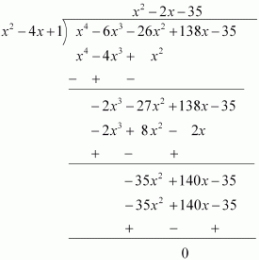
If two zeroes of the polynomial $x^{4}-6 x^{3}-26 x^{2}+138 x-35$ are $2 \pm \sqrt{3},$ find other zeroes.
Solution
(7, -5) Given that $2+\sqrt{3}$ and $2-\sqrt{3}$ are zeroes of the given polynomial.
Therefore,$(x-(2+\sqrt{3}))(x-(2-\sqrt{3})) = ((x-2)-\sqrt{3})((x-2)+\sqrt{3}) = (x-2)^{2} - (\sqrt{3})^{2} = x^{2}-4x+4-3 = x^{2}-4x+1$ is a factor of the given polynomial.
To find the remaining zeroes,we divide the polynomial $x^{4}-6 x^{3}-26 x^{2}+138 x-35$ by $x^{2}-4 x+1$:
$x^{4}-6 x^{3}-26 x^{2}+138 x-35 = (x^{2}-4 x+1)(x^{2}-2 x-35)$
Now,we factorize the quadratic polynomial $x^{2}-2 x-35$:
$x^{2}-2 x-35 = x^{2}-7x+5x-35 = x(x-7)+5(x-7) = (x-7)(x+5)$
Setting these factors to zero,we get $x-7=0$ or $x+5=0$,which gives $x=7$ or $x=-5$.
Hence,the other two zeroes are $7$ and $-5$.
0 likes
View Solution52
DifficultMCQ
If $x+1$ is a factor of $2x^{3}+ax^{2}+2bx+1$,then find the values of $a$ and $b$ given that $2a-3b=4$.
A
$2, 9$
B
$10, 19$
C
$6, 7$
D
$5, 2$
Solution
(D) Given that $(x+1)$ is a factor of $f(x) = 2x^{3} + ax^{2} + 2bx + 1$,by the Factor Theorem,$f(-1) = 0$.
Substituting $x = -1$ into the polynomial:
$2(-1)^{3} + a(-1)^{2} + 2b(-1) + 1 = 0$
$-2 + a - 2b + 1 = 0$
$a - 2b = 1$ ... $(i)$
We are also given the equation $2a - 3b = 4$ ... $(ii)$.
From equation $(i)$,we have $a = 2b + 1$.
Substituting this into equation $(ii)$:
$2(2b + 1) - 3b = 4$
$4b + 2 - 3b = 4$
$b + 2 = 4$
$b = 2$
Now,substitute $b = 2$ into $a = 2b + 1$:
$a = 2(2) + 1 = 5$.
Thus,the values are $a = 5$ and $b = 2$.
0 likes
View Solution53
Medium
For each of the following,find a quadratic polynomial whose sum and product of the zeroes are as given respectively. Also,find the zeroes of these polynomials by factorisation.
Sum of zeroes $= -\frac{8}{3}$,Product of zeroes $= \frac{4}{3}$
Sum of zeroes $= -\frac{8}{3}$,Product of zeroes $= \frac{4}{3}$
Solution
(N/A) Given that,sum of zeroes $(S) = -\frac{8}{3}$ and product of zeroes $(P) = \frac{4}{3}$.
The general form of a quadratic polynomial is $f(x) = k(x^2 - Sx + P)$,where $k$ is a non-zero constant.
Substituting the values,we get $f(x) = x^2 - (-\frac{8}{3})x + \frac{4}{3} = x^2 + \frac{8}{3}x + \frac{4}{3}$.
To simplify,we can write the polynomial as $3x^2 + 8x + 4$.
To find the zeroes,we factorise $3x^2 + 8x + 4$:
$3x^2 + 6x + 2x + 4 = 3x(x + 2) + 2(x + 2) = (3x + 2)(x + 2)$.
Setting $f(x) = 0$,we get $(3x + 2)(x + 2) = 0$.
Therefore,$3x + 2 = 0 \implies x = -\frac{2}{3}$ and $x + 2 = 0 \implies x = -2$.
Hence,the zeroes of the polynomial are $-2$ and $-\frac{2}{3}$.
0 likes
View Solution54
Medium
For each of the following,find a quadratic polynomial whose sum and product of the zeroes are $\frac{21}{8}$ and $\frac{5}{16}$ respectively. Also,find the zeroes of these polynomials by factorisation.
Solution
(A) Given that,the sum of zeroes $S = \frac{21}{8}$ and the product of zeroes $P = \frac{5}{16}$.
The required quadratic polynomial is given by $f(x) = k(x^2 - Sx + P)$,where $k$ is a constant. Taking $k = 16$ to clear the denominators:
$f(x) = 16(x^2 - \frac{21}{8}x + \frac{5}{16}) = 16x^2 - 42x + 5$.
To find the zeroes,set $f(x) = 0$:
$16x^2 - 42x + 5 = 0$.
Splitting the middle term: $16x^2 - 40x - 2x + 5 = 0$.
$8x(2x - 5) - 1(2x - 5) = 0$.
$(8x - 1)(2x - 5) = 0$.
Thus,the zeroes are $x = \frac{1}{8}$ and $x = \frac{5}{2}$.
0 likes
View Solution55
Difficult
For the given sum and product of zeroes,find the quadratic polynomial. Also,find the zeroes of this polynomial by factorization:
Sum of zeroes = $-2 \sqrt{3}$,Product of zeroes = $-9$.
Sum of zeroes = $-2 \sqrt{3}$,Product of zeroes = $-9$.
Solution
(N/A) Given that,sum of zeroes $(S)$ = $-2 \sqrt{3}$ and product of zeroes $(P)$ = $-9$.
The general form of a quadratic polynomial is $f(x) = x^{2} - Sx + P$.
Substituting the values,we get $f(x) = x^{2} - (-2 \sqrt{3})x + (-9) = x^{2} + 2 \sqrt{3}x - 9$.
To find the zeroes by factorization,we split the middle term $2 \sqrt{3}x$ into $3 \sqrt{3}x - \sqrt{3}x$:
$f(x) = x^{2} + 3 \sqrt{3}x - \sqrt{3}x - 9$
$f(x) = x(x + 3 \sqrt{3}) - \sqrt{3}(x + 3 \sqrt{3})$
$f(x) = (x + 3 \sqrt{3})(x - \sqrt{3})$
Setting $f(x) = 0$,we get $x + 3 \sqrt{3} = 0$ or $x - \sqrt{3} = 0$.
Therefore,the zeroes are $-3 \sqrt{3}$ and $\sqrt{3}$.
0 likes
View Solution56
Medium
For the given sum and product of zeroes,find a quadratic polynomial. Also,find the zeroes of this polynomial by factorisation:
Sum of zeroes = $\frac{-3}{2 \sqrt{5}}$,Product of zeroes = $-\frac{1}{2}$
Sum of zeroes = $\frac{-3}{2 \sqrt{5}}$,Product of zeroes = $-\frac{1}{2}$
Solution
(N/A) Given that,Sum of zeroes $(S)$ = $-\frac{3}{2 \sqrt{5}}$ and Product of zeroes $(P)$ = $-\frac{1}{2}$.
The general form of a quadratic polynomial is $f(x) = k(x^2 - Sx + P)$,where $k$ is a constant.
Substituting the values,$f(x) = x^2 - (-\frac{3}{2 \sqrt{5}})x + (-\frac{1}{2}) = x^2 + \frac{3}{2 \sqrt{5}}x - \frac{1}{2}$.
To simplify,we can multiply by $2\sqrt{5}$ to get the polynomial $2\sqrt{5}x^2 + 3x - \sqrt{5}$.
Now,factorising $2\sqrt{5}x^2 + 3x - \sqrt{5}$:
$= 2\sqrt{5}x^2 + 5x - 2x - \sqrt{5}$
$= \sqrt{5}x(2x + \sqrt{5}) - 1(2x + \sqrt{5})$
$= (2x + \sqrt{5})(\sqrt{5}x - 1)$
Setting $f(x) = 0$,we get $2x + \sqrt{5} = 0$ or $\sqrt{5}x - 1 = 0$.
Therefore,the zeroes are $x = -\frac{\sqrt{5}}{2}$ and $x = \frac{1}{\sqrt{5}}$.
0 likes
View Solution57
Difficult
Given that the zeroes of the cubic polynomial $x^{3}-6x^{2}+3x+10$ are of the form $a, a+b, a+2b$ for some real numbers $a$ and $b$,find the values of $a$ and $b$ as well as the zeroes of the given polynomial.
Solution
(A) Let $f(x) = x^{3}-6x^{2}+3x+10$.
Given that $a, (a+b),$ and $(a+2b)$ are the zeroes of $f(x)$.
Sum of the zeroes $= -\frac{\text{Coefficient of } x^{2}}{\text{Coefficient of } x^{3}} = -\frac{-6}{1} = 6$.
So,$a + (a+b) + (a+2b) = 6 \Rightarrow 3a + 3b = 6 \Rightarrow a+b = 2 \Rightarrow b = 2-a \dots (i)$.
Product of the zeroes $= -\frac{\text{Constant term}}{\text{Coefficient of } x^{3}} = -\frac{10}{1} = -10$.
So,$a(a+b)(a+2b) = -10$.
Substituting $a+b=2$ and $b=2-a$,we get $a(2)(a+2(2-a)) = -10$.
$2a(a+4-2a) = -10 \Rightarrow 2a(4-a) = -10 \Rightarrow 8a - 2a^{2} = -10$.
$2a^{2} - 8a - 10 = 0 \Rightarrow a^{2} - 4a - 5 = 0$.
$(a-5)(a+1) = 0$.
Thus,$a = 5$ or $a = -1$.
If $a = 5$,then $b = 2-5 = -3$. The zeroes are $5, 5-3, 5-6$,i.e.,$5, 2, -1$.
If $a = -1$,then $b = 2-(-1) = 3$. The zeroes are $-1, -1+3, -1+6$,i.e.,$-1, 2, 5$.
Thus,the values are $(a=5, b=-3)$ or $(a=-1, b=3)$,and the zeroes are $-1, 2, 5$.
0 likes
View Solution58
DifficultMCQ
Given that $\sqrt{2}$ is a zero of the cubic polynomial $6x^{3}+\sqrt{2}x^{2}-10x-4\sqrt{2}$,find its other two zeroes.
A
$\frac{1}{\sqrt{2}}, -\frac{4}{3\sqrt{2}}$
B
$-\frac{1}{\sqrt{2}}, -\frac{4}{3\sqrt{2}}$
C
$-\frac{1}{\sqrt{2}}, \frac{4}{3\sqrt{2}}$
D
$\frac{1}{\sqrt{2}}, \frac{4}{3\sqrt{2}}$
Solution
(B) Let $f(x) = 6x^{3}+\sqrt{2}x^{2}-10x-4\sqrt{2}$.
Since $\sqrt{2}$ is a zero of $f(x)$,$(x-\sqrt{2})$ is a factor of $f(x)$.
Dividing $f(x)$ by $(x-\sqrt{2})$:
$6x^{3}+\sqrt{2}x^{2}-10x-4\sqrt{2} = (x-\sqrt{2})(6x^{2}+7\sqrt{2}x+4)$.
Now,factorize the quadratic polynomial $6x^{2}+7\sqrt{2}x+4$:
$6x^{2}+4\sqrt{2}x+3\sqrt{2}x+4 = 2\sqrt{2}x(\sqrt{3}x+2) + ...$ (Wait,let's simplify correctly).
$6x^{2}+7\sqrt{2}x+4 = 6x^{2}+3\sqrt{2}x+4\sqrt{2}x+4 = 3\sqrt{2}x(\sqrt{2}x+1) + 4(\sqrt{2}x+1) = (3\sqrt{2}x+4)(\sqrt{2}x+1)$.
Setting these factors to zero:
$\sqrt{2}x+1 = 0 \implies x = -\frac{1}{\sqrt{2}}$.
$3\sqrt{2}x+4 = 0 \implies x = -\frac{4}{3\sqrt{2}}$.
Thus,the other two zeroes are $-\frac{1}{\sqrt{2}}$ and $-\frac{4}{3\sqrt{2}}$.
0 likes
View Solution59
EasyMCQ
Identify the type of the given polynomial based on its degree: $p(x) = 3.14x^2 + 1.57x + 1$.
A
Linear polynomial
B
Quadratic polynomial
C
Cubic polynomial
D
Constant polynomial
Solution
(B) The given polynomial is $p(x) = 3.14x^2 + 1.57x + 1$.
The degree of a polynomial is the highest power of the variable present in the expression.
In this expression,the highest power of $x$ is $2$.
$A$ polynomial of degree $2$ is known as a quadratic polynomial.
Therefore,$p(x)$ is a quadratic polynomial.
The degree of a polynomial is the highest power of the variable present in the expression.
In this expression,the highest power of $x$ is $2$.
$A$ polynomial of degree $2$ is known as a quadratic polynomial.
Therefore,$p(x)$ is a quadratic polynomial.
0 likes
View Solution60
EasyMCQ
Identify the type of the given polynomial based on its degree: $p(x) = 2012x + 2011$.
A
Constant polynomial
B
Linear polynomial
C
Quadratic polynomial
D
Cubic polynomial
Solution
(B) The given polynomial is $p(x) = 2012x + 2011$.
The highest power of the variable $x$ in this expression is $1$.
$A$ polynomial with a degree of $1$ is known as a linear polynomial.
Therefore,$p(x) = 2012x + 2011$ is a linear polynomial.
The highest power of the variable $x$ in this expression is $1$.
$A$ polynomial with a degree of $1$ is known as a linear polynomial.
Therefore,$p(x) = 2012x + 2011$ is a linear polynomial.
0 likes
View Solution61
EasyMCQ
Identify the type of the given polynomial based on its degree: $p(x) = 9x^{2} + \frac{7}{2}x^{3} + 5$.
A
Linear polynomial
B
Quadratic polynomial
C
Cubic polynomial
D
Biquadratic polynomial
Solution
(C) The given polynomial is $p(x) = 9x^{2} + \frac{7}{2}x^{3} + 5$.
Rearranging the terms in descending order of their powers,we get $p(x) = \frac{7}{2}x^{3} + 9x^{2} + 5$.
The degree of a polynomial is the highest power of the variable present in the expression.
Here,the highest power of $x$ is $3$.
Since the degree of the polynomial is $3$,it is classified as a cubic polynomial.
0 likes
View Solution62
EasyMCQ
State the degree of the given polynomial: $p(x) = x^{2} - \sqrt{3}x^{3} + 4x^{7} + 9$.
A
$6$
B
$7$
C
$2$
D
$3$
Solution
(B) The given polynomial is $p(x) = x^{2} - \sqrt{3}x^{3} + 4x^{7} + 9$.
To find the degree,we first arrange the terms in descending order of their exponents:
$p(x) = 4x^{7} - \sqrt{3}x^{3} + x^{2} + 9$.
The degree of a polynomial is defined as the highest power of the variable present in the polynomial.
In this expression,the powers of $x$ are $7, 3, 2,$ and $0$ (since $9 = 9x^{0}$).
The maximum power is $7$.
Therefore,the degree of the polynomial is $7$.
0 likes
View Solution63
EasyMCQ
State the degree of the given polynomial: $p(x) = 5x^{100} - (x^{10})^{20} + 3(x^2)^{25} + 2x^{25} - 7$
A
$100$
B
$89$
C
$200$
D
$50$
Solution
(C) Given polynomial is $p(x) = 5x^{100} - (x^{10})^{20} + 3(x^2)^{25} + 2x^{25} - 7$.
First,simplify the exponents using the power rule $(x^a)^b = x^{a \cdot b}$:
$(x^{10})^{20} = x^{10 \cdot 20} = x^{200}$
$(x^2)^{25} = x^{2 \cdot 25} = x^{50}$
Substitute these back into the polynomial:
$p(x) = 5x^{100} - x^{200} + 3x^{50} + 2x^{25} - 7$
Rearrange the terms in descending order of their powers:
$p(x) = -x^{200} + 5x^{100} + 3x^{50} + 2x^{25} - 7$
The degree of a polynomial is the highest power of the variable $x$ present in the expression.
Here,the highest power is $200$.
Therefore,the degree of the polynomial is $200$.
0 likes
View Solution64
EasyMCQ
State the degree of the given polynomial: $p(x) = \frac{7}{2} x - 9$
A
$0$
B
$2$
C
$\frac{7}{2}$
D
$1$
Solution
(D) The given polynomial is $p(x) = \frac{7}{2} x - 9$.
The degree of a polynomial is defined as the highest power of the variable $x$ present in the expression.
In the expression $\frac{7}{2} x - 9$,the variable $x$ has an exponent of $1$ (since $x = x^1$).
Therefore,the degree of the polynomial is $1$.
The degree of a polynomial is defined as the highest power of the variable $x$ present in the expression.
In the expression $\frac{7}{2} x - 9$,the variable $x$ has an exponent of $1$ (since $x = x^1$).
Therefore,the degree of the polynomial is $1$.
0 likes
View Solution65
EasyMCQ
State the degree of the given polynomial: $p(x) = 5x - 2x^2 + 3$
A
$2$
B
$3$
C
$0$
D
$5$
Solution
(A) The given polynomial is $p(x) = 5x - 2x^2 + 3$.
Rearranging the terms in descending order of their powers,we get $p(x) = -2x^2 + 5x + 3$.
The degree of a polynomial is defined as the highest power of the variable present in the polynomial.
In this polynomial,the highest power of the variable $x$ is $2$ (from the term $-2x^2$).
Therefore,the degree of the polynomial is $2$.
0 likes
View Solution66
Medium
Prove that $x+2$ is a factor of $p(x)=2x^{3}-4x^{2}+5x+42$.
Solution
(N/A) According to the Factor Theorem,if $(x-a)$ is a factor of a polynomial $p(x)$,then $p(a)=0$.
Here,we need to check if $(x+2)$ is a factor of $p(x)=2x^{3}-4x^{2}+5x+42$.
Comparing $(x+2)$ with $(x-a)$,we get $a = -2$.
Now,we calculate $p(-2)$:
$p(-2) = 2(-2)^{3} - 4(-2)^{2} + 5(-2) + 42$
$p(-2) = 2(-8) - 4(4) - 10 + 42$
$p(-2) = -16 - 16 - 10 + 42$
$p(-2) = -42 + 42$
$p(-2) = 0$
Since $p(-2) = 0$,by the Factor Theorem,$(x+2)$ is a factor of $p(x)$.
0 likes
View Solution67
EasyMCQ
Identify the type of the following polynomial based on its degree: $p(x) = 7x^2 - 5x^3 + 3$.
A
None of these
B
Linear
C
Quadratic
D
Cubic
Solution
(D) The degree of a polynomial is the highest power of the variable present in the expression.
For the given polynomial $p(x) = 7x^2 - 5x^3 + 3$,the powers of $x$ are $2$,$3$,and $0$ (since $3 = 3x^0$).
The highest power is $3$.
$A$ polynomial with a degree of $3$ is called a cubic polynomial.
Therefore,the correct option is $D$.
For the given polynomial $p(x) = 7x^2 - 5x^3 + 3$,the powers of $x$ are $2$,$3$,and $0$ (since $3 = 3x^0$).
The highest power is $3$.
$A$ polynomial with a degree of $3$ is called a cubic polynomial.
Therefore,the correct option is $D$.
0 likes
View Solution68
EasyMCQ
Identify the type of the following polynomial based on its degree: $p(x) = 7 - 5x$.
A
linear
B
quadratic
C
cubic
D
None of these
Solution
(A) The degree of a polynomial is the highest power of the variable present in the expression.
In the given polynomial $p(x) = 7 - 5x$,the variable is $x$ and its highest power is $1$.
$A$ polynomial of degree $1$ is called a linear polynomial.
Therefore,$p(x) = 7 - 5x$ is a linear polynomial.
In the given polynomial $p(x) = 7 - 5x$,the variable is $x$ and its highest power is $1$.
$A$ polynomial of degree $1$ is called a linear polynomial.
Therefore,$p(x) = 7 - 5x$ is a linear polynomial.
0 likes
View Solution69
EasyMCQ
Identify the type of the following polynomial based on its degree: $p(x) = (x - 15)(x + 15)$
A
cubic
B
quadratic
C
linear
D
None of these
Solution
(B) To identify the type of polynomial,we first simplify the expression $p(x) = (x - 15)(x + 15)$.
Using the algebraic identity $(a - b)(a + b) = a^2 - b^2$,we get:
$p(x) = x^2 - 15^2$
$p(x) = x^2 - 225$
The highest power (degree) of the variable $x$ in this polynomial is $2$.
$A$ polynomial with a degree of $2$ is called a quadratic polynomial.
Therefore,the correct option is $B$.
Using the algebraic identity $(a - b)(a + b) = a^2 - b^2$,we get:
$p(x) = x^2 - 15^2$
$p(x) = x^2 - 225$
The highest power (degree) of the variable $x$ in this polynomial is $2$.
$A$ polynomial with a degree of $2$ is called a quadratic polynomial.
Therefore,the correct option is $B$.
0 likes
View Solution70
EasyMCQ
Identify the type of the following polynomial based on its degree: $p(x) = \frac{3}{2} - 0.75x - x^{2}$
A
linear
B
cubic
C
quadratic
D
None of these
Solution
(C) The given polynomial is $p(x) = \frac{3}{2} - 0.75x - x^{2}$.
To determine the type of polynomial,we look at the highest power of the variable $x$ present in the expression.
Here,the powers of $x$ are $0$ (in $\frac{3}{2}$),$1$ (in $-0.75x$),and $2$ (in $-x^{2}$).
The highest power (degree) of the polynomial is $2$.
$A$ polynomial of degree $2$ is called a quadratic polynomial.
Therefore,the correct option is $C$.
0 likes
View Solution71
EasyMCQ
State the degree of the following polynomial: $p(x) = 5x^8 - 6(x^2)^5 - 4x^3 - 14$.
A
$9$
B
$8$
C
$0$
D
$10$
Solution
(D) To find the degree of the polynomial $p(x) = 5x^8 - 6(x^2)^5 - 4x^3 - 14$,we first simplify the expression.
Using the power rule $(x^a)^b = x^{a \times b}$,we simplify the term $6(x^2)^5$ as $6x^{10}$.
Now,the polynomial becomes $p(x) = 5x^8 - 6x^{10} - 4x^3 - 14$.
The degree of a polynomial is defined as the highest power of the variable $x$ present in the expression.
Comparing the powers of $x$ $(8, 10, 3)$,the highest power is $10$.
Therefore,the degree of the polynomial is $10$.
0 likes
View Solution72
EasyMCQ
State the degree of the following polynomial: $p(x) = (x^{1/2})^{50} - 5x^{10} - 9x^2 + 15$.
A
$25$
B
$10$
C
$15$
D
$9$
Solution
(A) To find the degree of the polynomial $p(x) = (x^{1/2})^{50} - 5x^{10} - 9x^2 + 15$,we first simplify the expression.
Using the power of a power rule $(a^m)^n = a^{m \cdot n}$,we simplify the first term:
$(x^{1/2})^{50} = x^{(1/2) \cdot 50} = x^{25}$.
Now,the polynomial becomes $p(x) = x^{25} - 5x^{10} - 9x^2 + 15$.
The degree of a polynomial is defined as the highest power of the variable $x$ present in the expression.
Comparing the exponents of $x$ in the terms $x^{25}$,$x^{10}$,and $x^2$,the highest exponent is $25$.
Therefore,the degree of the polynomial is $25$.
0 likes
View Solution73
EasyMCQ
State the degree of the following polynomial: $p(x) = 6 - 5x^3 + 4x^5 - 5x^2$.
A
$1$
B
$5$
C
$3$
D
$7$
Solution
(B) The degree of a polynomial is defined as the highest power of the variable present in the polynomial expression.
Given the polynomial: $p(x) = 6 - 5x^3 + 4x^5 - 5x^2$.
The powers of the variable $x$ in the terms are $0$ (in $6$),$3$ (in $-5x^3$),$5$ (in $4x^5$),and $2$ (in $-5x^2$).
The highest power among these is $5$.
Therefore,the degree of the polynomial $p(x)$ is $5$.
Given the polynomial: $p(x) = 6 - 5x^3 + 4x^5 - 5x^2$.
The powers of the variable $x$ in the terms are $0$ (in $6$),$3$ (in $-5x^3$),$5$ (in $4x^5$),and $2$ (in $-5x^2$).
The highest power among these is $5$.
Therefore,the degree of the polynomial $p(x)$ is $5$.
0 likes
View Solution74
EasyMCQ
If one factor of $x^{3}+4 x^{2}+8 x+a$ is $(x+2)$,then find the value of $a$.
A
$4$
B
$5$
C
$8$
D
$10$
Solution
(C) Let the polynomial be $p(x) = x^{3} + 4x^{2} + 8x + a$.
According to the Factor Theorem,if $(x+2)$ is a factor of $p(x)$,then $p(-2) = 0$.
Substituting $x = -2$ into the polynomial:
$p(-2) = (-2)^{3} + 4(-2)^{2} + 8(-2) + a = 0$
$-8 + 4(4) - 16 + a = 0$
$-8 + 16 - 16 + a = 0$
$-8 + a = 0$
$a = 8$
Therefore,the value of $a$ is $8$.
According to the Factor Theorem,if $(x+2)$ is a factor of $p(x)$,then $p(-2) = 0$.
Substituting $x = -2$ into the polynomial:
$p(-2) = (-2)^{3} + 4(-2)^{2} + 8(-2) + a = 0$
$-8 + 4(4) - 16 + a = 0$
$-8 + 16 - 16 + a = 0$
$-8 + a = 0$
$a = 8$
Therefore,the value of $a$ is $8$.
0 likes
View Solution75
Easy
Examine the validity of the following statement: $(x+3)$ is a factor of $(x^{2}+10x+21)$.
Solution
(TRUE) To determine if $(x+3)$ is a factor of $p(x) = x^{2}+10x+21$,we use the Factor Theorem.
According to the Factor Theorem,$(x-a)$ is a factor of $p(x)$ if $p(a) = 0$.
Here,$(x+3) = (x - (-3))$,so $a = -3$.
Now,calculate $p(-3)$:
$p(-3) = (-3)^{2} + 10(-3) + 21$
$p(-3) = 9 - 30 + 21$
$p(-3) = 30 - 30 = 0$.
Since $p(-3) = 0$,the statement is True.
According to the Factor Theorem,$(x-a)$ is a factor of $p(x)$ if $p(a) = 0$.
Here,$(x+3) = (x - (-3))$,so $a = -3$.
Now,calculate $p(-3)$:
$p(-3) = (-3)^{2} + 10(-3) + 21$
$p(-3) = 9 - 30 + 21$
$p(-3) = 30 - 30 = 0$.
Since $p(-3) = 0$,the statement is True.
0 likes
View Solution76
EasyMCQ
Examine the validity of the following statement: $(x-2)$ is a factor of $x^{3}+5x^{2}-2x-25$.
A
True
B
False
Solution
(B) To check if $(x-2)$ is a factor of the polynomial $p(x) = x^{3}+5x^{2}-2x-25$,we use the Factor Theorem.
According to the Factor Theorem,$(x-a)$ is a factor of $p(x)$ if and only if $p(a) = 0$.
Here,$a = 2$.
Substitute $x = 2$ into the polynomial:
$p(2) = (2)^{3} + 5(2)^{2} - 2(2) - 25$
$p(2) = 8 + 5(4) - 4 - 25$
$p(2) = 8 + 20 - 4 - 25$
$p(2) = 28 - 29$
$p(2) = -1$
Since $p(2) \neq 0$,$(x-2)$ is not a factor of the given polynomial.
Therefore,the statement is False.
0 likes
View Solution77
EasyMCQ
Examine the validity of the statement: $(x+3)$ is a factor of $x^{3}+6x^{2}+5x-12$.
A
True
B
False
Solution
(A) To check if $(x+3)$ is a factor of $p(x) = x^{3}+6x^{2}+5x-12$,we use the Factor Theorem.
According to the Factor Theorem,$(x-a)$ is a factor of $p(x)$ if $p(a) = 0$.
Here,$x+3 = x-(-3)$,so we need to evaluate $p(-3)$.
$p(-3) = (-3)^{3} + 6(-3)^{2} + 5(-3) - 12$
$p(-3) = -27 + 6(9) - 15 - 12$
$p(-3) = -27 + 54 - 15 - 12$
$p(-3) = 54 - 54 = 0$.
Since $p(-3) = 0$,$(x+3)$ is indeed a factor of the given polynomial.
Therefore,the statement is True.
0 likes
View Solution78
EasyMCQ
Factorize the following polynomial: $p(x) = 25x^2 - 40x + 16$.
A
$(4x - 5)^3$
B
$(4x - 5)^2$
C
$(5x - 4)^2$
D
$(5x - 5)^3$
Solution
(C) To factorize the polynomial $p(x) = 25x^2 - 40x + 16$,we observe that it is in the form of the algebraic identity $a^2 - 2ab + b^2 = (a - b)^2$.
Here,$25x^2 = (5x)^2$,so $a = 5x$.
Also,$16 = 4^2$,so $b = 4$.
Checking the middle term: $-2ab = -2(5x)(4) = -40x$,which matches the given polynomial.
Therefore,$25x^2 - 40x + 16 = (5x)^2 - 2(5x)(4) + 4^2 = (5x - 4)^2$.
Here,$25x^2 = (5x)^2$,so $a = 5x$.
Also,$16 = 4^2$,so $b = 4$.
Checking the middle term: $-2ab = -2(5x)(4) = -40x$,which matches the given polynomial.
Therefore,$25x^2 - 40x + 16 = (5x)^2 - 2(5x)(4) + 4^2 = (5x - 4)^2$.
0 likes
View Solution79
EasyMCQ
Find the number of real zeros of the following polynomial: $p(x) = x^{2} - 2x$.
A
$2$
B
$0$
C
$1$
D
$4$
Solution
(A) To find the zeros of the polynomial $p(x) = x^{2} - 2x$,we set $p(x) = 0$.
$x^{2} - 2x = 0$
Factor out $x$ from the expression:
$x(x - 2) = 0$
This gives two possible values for $x$:
$x = 0$ or $x - 2 = 0$,which implies $x = 2$.
Thus,the zeros of the polynomial are $0$ and $2$.
Since there are two distinct real values,the number of real zeros is $2$.
$x^{2} - 2x = 0$
Factor out $x$ from the expression:
$x(x - 2) = 0$
This gives two possible values for $x$:
$x = 0$ or $x - 2 = 0$,which implies $x = 2$.
Thus,the zeros of the polynomial are $0$ and $2$.
Since there are two distinct real values,the number of real zeros is $2$.
0 likes
View Solution80
EasyMCQ
Find the number of real zeros of the following polynomial: $p(x) = 4x^2 + 11x + 10$.
A
$2$
B
$0$
C
$1$
D
$3$
Solution
(B) To find the number of real zeros of the quadratic polynomial $p(x) = ax^2 + bx + c$,we calculate the discriminant $D = b^2 - 4ac$.
For the given polynomial $p(x) = 4x^2 + 11x + 10$,we have $a = 4$,$b = 11$,and $c = 10$.
Substituting these values into the discriminant formula:
$D = (11)^2 - 4(4)(10)$
$D = 121 - 160$
$D = -39$
Since the discriminant $D < 0$,the quadratic equation $p(x) = 0$ has no real roots.
Therefore,the polynomial has $0$ real zeros.
0 likes
View Solution81
EasyMCQ
Find the number of real zeros of the following polynomial: $p(x) = x^{3} - 9x$.
A
$1$
B
$0$
C
$2$
D
$3$
Solution
(D) To find the zeros of the polynomial $p(x) = x^{3} - 9x$,we set $p(x) = 0$.
$x^{3} - 9x = 0$
Factor out $x$ from the expression:
$x(x^{2} - 9) = 0$
Using the difference of squares formula $a^{2} - b^{2} = (a - b)(a + b)$,we can factor $x^{2} - 9$ as $(x - 3)(x + 3)$:
$x(x - 3)(x + 3) = 0$
Setting each factor to zero,we get:
$x = 0$,$x - 3 = 0 \implies x = 3$,and $x + 3 = 0 \implies x = -3$.
Thus,the zeros of the polynomial are $0, 3, -3$.
Since there are $3$ distinct real values,the number of real zeros is $3$.
0 likes
View Solution82
EasyMCQ
Verify that $\frac{-2}{3}$ is a zero of the linear polynomial $p(x)=3x+2$.
A
Yes
B
No
C
Cannot be determined
D
None of these
Solution
(A) To verify if $\frac{-2}{3}$ is a zero of the polynomial $p(x)=3x+2$,we substitute $x = \frac{-2}{3}$ into the polynomial.
$p\left(\frac{-2}{3}\right) = 3\left(\frac{-2}{3}\right) + 2$
$p\left(\frac{-2}{3}\right) = -2 + 2$
$p\left(\frac{-2}{3}\right) = 0$
Since the value of the polynomial at $x = \frac{-2}{3}$ is $0$,it is verified that $\frac{-2}{3}$ is a zero of the linear polynomial $p(x)=3x+2$.
$p\left(\frac{-2}{3}\right) = 3\left(\frac{-2}{3}\right) + 2$
$p\left(\frac{-2}{3}\right) = -2 + 2$
$p\left(\frac{-2}{3}\right) = 0$
Since the value of the polynomial at $x = \frac{-2}{3}$ is $0$,it is verified that $\frac{-2}{3}$ is a zero of the linear polynomial $p(x)=3x+2$.
0 likes
View Solution83
Medium
Find the zeros of the quadratic polynomial $p(x) = 10x^2 - 14x - 12$ and also find the sum and the product of the zeros of the polynomial.
Solution
(N/A) Given polynomial is $p(x) = 10x^2 - 14x - 12$.
To find the zeros,we factorize the polynomial:
$10x^2 - 14x - 12 = 10x^2 - 20x + 6x - 12$
$= 10x(x - 2) + 6(x - 2)$
$= (10x + 6)(x - 2)$
Setting $p(x) = 0$,we get $(10x + 6)(x - 2) = 0$.
This gives $x = -6/10 = -3/5$ or $x = 2$.
Thus,the zeros are $-3/5$ and $2$.
Using the relationship between zeros and coefficients for $ax^2 + bx + c$:
Sum of zeros $= -b/a = -(-14)/10 = 14/10 = 7/5$.
Product of zeros $= c/a = -12/10 = -6/5$.
0 likes
View Solution84
Difficult
Find the zeros of the cubic polynomial $p(x)=4 x^{3}+10 x^{2}+6 x$ and also verify the relationship between the zeros and the coefficients.
Solution
(N/A) To find the zeros of $p(x),$ set $p(x)=0$.
$4 x^{3}+10 x^{2}+6 x=0$
$2 x(2 x^{2}+5 x+3)=0$
$2 x(2 x^{2}+2 x+3 x+3)=0$
$2 x(2 x(x+1)+3(x+1))=0$
$2 x(2 x+3)(x+1)=0$
Thus,the zeros are $x=0, x=-\frac{3}{2}, x=-1$.
For $p(x)=4 x^{3}+10 x^{2}+6 x+0$,we have $a=4, b=10, c=6, d=0$.
Sum of zeros: $0 + (-\frac{3}{2}) + (-1) = -\frac{5}{2} = -\frac{10}{4} = -\frac{b}{a}$.
Sum of product of zeros taken two at a time: $(0)(-\frac{3}{2}) + (-\frac{3}{2})(-1) + (-1)(0) = 0 + \frac{3}{2} + 0 = \frac{3}{2} = \frac{6}{4} = \frac{c}{a}$.
Product of zeros: $(0)(-\frac{3}{2})(-1) = 0 = -\frac{0}{4} = -\frac{d}{a}$.
0 likes
View Solution85
MediumMCQ
Find the zeros of the following quadratic polynomial: $p(x)=\sqrt{3} x^{2}-8 x+4 \sqrt{3}$
A
$\frac{2}{\sqrt{3}}$,$2 \sqrt{3}$
B
$\frac{3}{\sqrt{2}}$,$4 \sqrt{9}$
C
$\frac{5}{\sqrt{3}}$,$2 \sqrt{4}$
D
$\frac{3}{\sqrt{3}}$,$7\sqrt{3}$
Solution
(A) To find the zeros of $p(x)$,we set $p(x) = 0$.
$\sqrt{3} x^{2} - 8 x + 4 \sqrt{3} = 0$
We split the middle term $-8x$ into $-6x - 2x$ because $(\sqrt{3}) \times (4\sqrt{3}) = 12$,and we need two numbers whose product is $12$ and sum is $-8$.
$\sqrt{3} x^{2} - 6x - 2x + 4 \sqrt{3} = 0$
$\sqrt{3} x(x - 2\sqrt{3}) - 2(x - 2\sqrt{3}) = 0$
$(x - 2\sqrt{3})(\sqrt{3} x - 2) = 0$
Setting each factor to zero:
$x - 2\sqrt{3} = 0 \implies x = 2\sqrt{3}$
$\sqrt{3} x - 2 = 0 \implies x = \frac{2}{\sqrt{3}}$
Thus,the zeros are $\frac{2}{\sqrt{3}}$ and $2\sqrt{3}$.
0 likes
View Solution86
MediumMCQ
Find the zeros of the following quadratic polynomial: $p(x) = 4x^2 - 256$.
A
$4, -2$
B
$-8, 8$
C
$5, -7$
D
$8, 9$
Solution
(B) To find the zeros of $p(x)$,we set $p(x) = 0$.
$4x^2 - 256 = 0$
Divide the entire equation by $4$:
$x^2 - 64 = 0$
This can be written as a difference of squares:
$x^2 - 8^2 = 0$
$(x - 8)(x + 8) = 0$
Setting each factor to zero:
$x - 8 = 0 \implies x = 8$
$x + 8 = 0 \implies x = -8$
Thus,the zeros of the quadratic polynomial are $-8$ and $8$.
$4x^2 - 256 = 0$
Divide the entire equation by $4$:
$x^2 - 64 = 0$
This can be written as a difference of squares:
$x^2 - 8^2 = 0$
$(x - 8)(x + 8) = 0$
Setting each factor to zero:
$x - 8 = 0 \implies x = 8$
$x + 8 = 0 \implies x = -8$
Thus,the zeros of the quadratic polynomial are $-8$ and $8$.
0 likes
View Solution87
MediumMCQ
Find the zeros of the following quadratic polynomial: $p(x) = x^{2} + x - 12$.
A
$7, -3$
B
$-5, 6$
C
$-4, 3$
D
$9, -2$
Solution
(C) To find the zeros of $p(x)$,we set $p(x) = 0$.
$x^{2} + x - 12 = 0$
We factorize the quadratic equation by splitting the middle term:
$x^{2} + 4x - 3x - 12 = 0$
$x(x + 4) - 3(x + 4) = 0$
$(x + 4)(x - 3) = 0$
Setting each factor to zero:
$x + 4 = 0 \implies x = -4$
$x - 3 = 0 \implies x = 3$
Therefore,the zeros of the quadratic polynomial $p(x)$ are $-4$ and $3$.
0 likes
View Solution88
MediumMCQ
Find the zeros of the following quadratic polynomial: $p(x) = 3x^2 + 15x$. (in $, -5$)
A
$7$
B
$2$
C
$5$
D
$0$
Solution
(D) To find the zeros of the polynomial $p(x)$,we set $p(x) = 0$.
$3x^2 + 15x = 0$
Factor out the common term $3x$:
$3x(x + 5) = 0$
Since $3 \neq 0$,we have:
$x(x + 5) = 0$
This implies either $x = 0$ or $x + 5 = 0$.
Therefore,$x = 0$ or $x = -5$.
Thus,the zeros of the quadratic polynomial $p(x)$ are $0$ and $-5$.
$3x^2 + 15x = 0$
Factor out the common term $3x$:
$3x(x + 5) = 0$
Since $3 \neq 0$,we have:
$x(x + 5) = 0$
This implies either $x = 0$ or $x + 5 = 0$.
Therefore,$x = 0$ or $x = -5$.
Thus,the zeros of the quadratic polynomial $p(x)$ are $0$ and $-5$.
0 likes
View Solution89
Easy
Verify that $3$ is a zero of the linear polynomial $p(x) = 4x - 12$.
Solution
(N/A) To verify that $3$ is a zero of the polynomial $p(x) = 4x - 12$,we need to evaluate the polynomial at $x = 3$.
Substituting $x = 3$ into the given polynomial:
$p(3) = 4(3) - 12$
$p(3) = 12 - 12$
$p(3) = 0$
Since $p(3) = 0$,it is verified that $3$ is a zero of the polynomial $p(x) = 4x - 12$.
Substituting $x = 3$ into the given polynomial:
$p(3) = 4(3) - 12$
$p(3) = 12 - 12$
$p(3) = 0$
Since $p(3) = 0$,it is verified that $3$ is a zero of the polynomial $p(x) = 4x - 12$.
0 likes
View Solution90
EasyMCQ
Obtain the sum and the product of the zeros of the following quadratic polynomial without finding the zeros: $4x^{2} - 4x + 1$.
A
$1, \frac{1}{4}$
B
$2, \frac{1}{3}$
C
$2, \frac{2}{7}$
D
$3, \frac{2}{4}$
Solution
(A) For a quadratic polynomial of the form $ax^{2} + bx + c$,the sum of the zeros is given by $-\frac{b}{a}$ and the product of the zeros is given by $\frac{c}{a}$.
Given the polynomial $4x^{2} - 4x + 1$,we have $a = 4$,$b = -4$,and $c = 1$.
Sum of the zeros $= -\frac{b}{a} = -\frac{-4}{4} = 1$.
Product of the zeros $= \frac{c}{a} = \frac{1}{4}$.
Thus,the sum is $1$ and the product is $\frac{1}{4}$.
Given the polynomial $4x^{2} - 4x + 1$,we have $a = 4$,$b = -4$,and $c = 1$.
Sum of the zeros $= -\frac{b}{a} = -\frac{-4}{4} = 1$.
Product of the zeros $= \frac{c}{a} = \frac{1}{4}$.
Thus,the sum is $1$ and the product is $\frac{1}{4}$.
0 likes
View Solution91
EasyMCQ
Obtain the sum and the product of the zeros of the quadratic polynomial $6x^{2} - 7x - 3$ without finding the zeros.
A
$\frac{7}{6}, -\frac{1}{2}$
B
$\frac{3}{2}, -\frac{1}{3}$
C
$\frac{7}{6}, -\frac{1}{3}$
D
$\frac{1}{6}, -\frac{1}{7}$
Solution
(A) For a quadratic polynomial of the form $ax^{2} + bx + c$,the sum of the zeros is given by $-\frac{b}{a}$ and the product of the zeros is given by $\frac{c}{a}$.
Given polynomial: $6x^{2} - 7x - 3$.
Here,$a = 6$,$b = -7$,and $c = -3$.
Sum of zeros = $-\frac{b}{a} = -(\frac{-7}{6}) = \frac{7}{6}$.
Product of zeros = $\frac{c}{a} = \frac{-3}{6} = -\frac{1}{2}$.
Thus,the sum and product are $\frac{7}{6}$ and $-\frac{1}{2}$ respectively.
Given polynomial: $6x^{2} - 7x - 3$.
Here,$a = 6$,$b = -7$,and $c = -3$.
Sum of zeros = $-\frac{b}{a} = -(\frac{-7}{6}) = \frac{7}{6}$.
Product of zeros = $\frac{c}{a} = \frac{-3}{6} = -\frac{1}{2}$.
Thus,the sum and product are $\frac{7}{6}$ and $-\frac{1}{2}$ respectively.
0 likes
View Solution92
MediumMCQ
Obtain the sum and the product of the zeros of the following quadratic polynomial without finding the zeros: $3x^2 + x - 4$.
A
$-\frac{7}{3}, -\frac{5}{3}$
B
$-\frac{9}{3}, -\frac{9}{3}$
C
$-\frac{2}{3}, -\frac{4}{2}$
D
$-\frac{1}{3}, -\frac{4}{3}$
Solution
(D) For a quadratic polynomial of the form $ax^2 + bx + c$,the sum of the zeros is given by $-\frac{b}{a}$ and the product of the zeros is given by $\frac{c}{a}$.
Given the polynomial $3x^2 + x - 4$,we have $a = 3$,$b = 1$,and $c = -4$.
Sum of zeros $= -\frac{b}{a} = -\frac{1}{3}$.
Product of zeros $= \frac{c}{a} = \frac{-4}{3} = -\frac{4}{3}$.
Thus,the sum and product are $-\frac{1}{3}$ and $-\frac{4}{3}$ respectively.
Given the polynomial $3x^2 + x - 4$,we have $a = 3$,$b = 1$,and $c = -4$.
Sum of zeros $= -\frac{b}{a} = -\frac{1}{3}$.
Product of zeros $= \frac{c}{a} = \frac{-4}{3} = -\frac{4}{3}$.
Thus,the sum and product are $-\frac{1}{3}$ and $-\frac{4}{3}$ respectively.
0 likes
View Solution93
MediumMCQ
Obtain the sum and the product of the zeros of the following quadratic polynomial without finding the zeros: $x^{2}-7x+10$.
A
$7, 10$
B
$9, 7$
C
$3, 5$
D
$8, 13$
Solution
(A) For a quadratic polynomial of the form $ax^{2} + bx + c$,the sum of the zeros is given by $-\frac{b}{a}$ and the product of the zeros is given by $\frac{c}{a}$.
Given the polynomial $x^{2} - 7x + 10$,we have $a = 1$,$b = -7$,and $c = 10$.
Sum of the zeros $= -\frac{b}{a} = -\frac{-7}{1} = 7$.
Product of the zeros $= \frac{c}{a} = \frac{10}{1} = 10$.
Therefore,the sum and the product of the zeros are $7$ and $10$ respectively.
Given the polynomial $x^{2} - 7x + 10$,we have $a = 1$,$b = -7$,and $c = 10$.
Sum of the zeros $= -\frac{b}{a} = -\frac{-7}{1} = 7$.
Product of the zeros $= \frac{c}{a} = \frac{10}{1} = 10$.
Therefore,the sum and the product of the zeros are $7$ and $10$ respectively.
0 likes
View Solution94
MediumMCQ
Obtain the zeros of $p(x) = 6x^2 - x - 2$. Also,verify the relationship between the zeros and the coefficients of $p(x)$.
A
$7/3, -1/3$
B
$2/3, -1/2$
C
$9/3, -1/3$
D
$1/5, -1/8$
Solution
(B) To find the zeros of $p(x) = 6x^2 - x - 2$,we set $p(x) = 0$.
$6x^2 - x - 2 = 0$
$6x^2 - 4x + 3x - 2 = 0$
$2x(3x - 2) + 1(3x - 2) = 0$
$(2x + 1)(3x - 2) = 0$
Thus,the zeros are $x = -1/2$ and $x = 2/3$.
Let $\alpha = 2/3$ and $\beta = -1/2$.
For a quadratic polynomial $ax^2 + bx + c$,the sum of zeros is $-b/a$ and the product of zeros is $c/a$.
Here,$a = 6, b = -1, c = -2$.
Sum of zeros: $\alpha + \beta = 2/3 + (-1/2) = (4 - 3)/6 = 1/6$. Also,$-b/a = -(-1)/6 = 1/6$. Thus,$\alpha + \beta = -b/a$.
Product of zeros: $\alpha \cdot \beta = (2/3) \cdot (-1/2) = -2/6 = -1/3$. Also,$c/a = -2/6 = -1/3$. Thus,$\alpha \cdot \beta = c/a$.
Hence,the relationship is verified.
0 likes
View Solution95
MediumMCQ
Obtain a quadratic polynomial $p(x) = ax^2 + bx + c$,where the sum of zeros is $\sqrt{2}$ and the product of zeros is $\frac{1}{3}$,given that $a < 0$.
A
$k(-x^2 + \sqrt{9}x - 6)$
B
$k(-x^2 + \sqrt{4}x - \frac{1}{2})$
C
$k(-x^2 + \sqrt{2}x - \frac{1}{3})$
D
$k(-x^6 + \frac{1}{5}x - 3)$
Solution
(C) quadratic polynomial is given by the formula $p(x) = k[x^2 - (\text{sum of zeros})x + (\text{product of zeros})]$,where $k$ is a non-zero constant.
Given that the sum of zeros is $\sqrt{2}$ and the product of zeros is $\frac{1}{3}$,we substitute these values into the formula:
$p(x) = k[x^2 - (\sqrt{2})x + \frac{1}{3}]$
Since the condition $a < 0$ is specified,we multiply the expression by $-1$ (setting $k$ to a negative value or simply distributing the negative sign):
$p(x) = k[-x^2 + \sqrt{2}x - \frac{1}{3}]$
Thus,the required polynomial is $k(-x^2 + \sqrt{2}x - \frac{1}{3})$.
0 likes
View Solution96
EasyMCQ
Find the zeros of the following quadratic polynomial: $5x^2 + 8x + 3$.
A
$1, -\frac{7}{5}$
B
$-1, \frac{2}{4}$
C
$4, -\frac{9}{5}$
D
$-1, -\frac{3}{5}$
Solution
(D) To find the zeros of the quadratic polynomial $p(x) = 5x^2 + 8x + 3$,we set $p(x) = 0$.
$5x^2 + 8x + 3 = 0$
We split the middle term $8x$ into $5x + 3x$:
$5x^2 + 5x + 3x + 3 = 0$
Factor by grouping:
$5x(x + 1) + 3(x + 1) = 0$
$(5x + 3)(x + 1) = 0$
Setting each factor to zero:
$5x + 3 = 0 \implies x = -\frac{3}{5}$
$x + 1 = 0 \implies x = -1$
Thus,the zeros are $-1$ and $-\frac{3}{5}$.
$5x^2 + 8x + 3 = 0$
We split the middle term $8x$ into $5x + 3x$:
$5x^2 + 5x + 3x + 3 = 0$
Factor by grouping:
$5x(x + 1) + 3(x + 1) = 0$
$(5x + 3)(x + 1) = 0$
Setting each factor to zero:
$5x + 3 = 0 \implies x = -\frac{3}{5}$
$x + 1 = 0 \implies x = -1$
Thus,the zeros are $-1$ and $-\frac{3}{5}$.
0 likes
View Solution97
EasyMCQ
Find the zeros of the following quadratic polynomial: $-21x^2 + 16x + 5$.
A
$1, -\frac{5}{21}$
B
$3, \frac{7}{5}$
C
$\frac{7}{5}, \frac{3}{5}$
D
$\frac{5}{3}, 9$
Solution
(A) To find the zeros of the quadratic polynomial $p(x) = -21x^2 + 16x + 5$,we set $p(x) = 0$.
$-21x^2 + 16x + 5 = 0$
Multiply the entire equation by $-1$ to simplify:
$21x^2 - 16x - 5 = 0$
We need to find two numbers that multiply to $(21 \times -5) = -105$ and add to $-16$. These numbers are $-21$ and $5$.
$21x^2 - 21x + 5x - 5 = 0$
Factor by grouping:
$21x(x - 1) + 5(x - 1) = 0$
$(21x + 5)(x - 1) = 0$
Setting each factor to zero:
$21x + 5 = 0 \implies x = -\frac{5}{21}$
$x - 1 = 0 \implies x = 1$
Thus,the zeros are $1$ and $-\frac{5}{21}$.
0 likes
View Solution98
MediumMCQ
Find the zeros of the following quadratic polynomial: $15x^2 + 16x + 4$.
A
$-1, -\frac{3}{5}$
B
$-\frac{2}{3}, -\frac{2}{5}$
C
$\frac{2}{3}, -\frac{1}{2}$
D
$\frac{7}{6}, -\frac{1}{2}$
Solution
(B) To find the zeros of the quadratic polynomial $p(x) = 15x^2 + 16x + 4$,we set $p(x) = 0$.
$15x^2 + 16x + 4 = 0$
We split the middle term $16x$ into two parts such that their sum is $16x$ and their product is $15 \times 4 = 60x^2$. The factors are $10x$ and $6x$.
$15x^2 + 10x + 6x + 4 = 0$
$5x(3x + 2) + 2(3x + 2) = 0$
$(5x + 2)(3x + 2) = 0$
Setting each factor to zero:
$5x + 2 = 0 \implies x = -\frac{2}{5}$
$3x + 2 = 0 \implies x = -\frac{2}{3}$
Thus,the zeros are $-\frac{2}{3}$ and $-\frac{2}{5}$.
0 likes
View Solution99
EasyMCQ
Obtain a quadratic polynomial with the following conditions:
The sum of the zeros $= \frac{1}{4}$;
The product of the zeros $= -1$.
The sum of the zeros $= \frac{1}{4}$;
The product of the zeros $= -1$.
A
$k(4x^2 - x - 4)$
B
$k(4x^2 + x - 4)$
C
$k(x^2 - \frac{1}{4}x - 1)$
D
$k(4x^2 - x + 4)$
Solution
(A) quadratic polynomial is given by the formula: $p(x) = k[x^2 - (\text{sum of zeros})x + (\text{product of zeros})]$.
Given:
Sum of zeros $= \frac{1}{4}$
Product of zeros $= -1$
Substituting these values into the formula:
$p(x) = k[x^2 - (\frac{1}{4})x + (-1)]$
$p(x) = k[x^2 - \frac{1}{4}x - 1]$
To simplify,we can take $k = 4$:
$p(x) = 4[x^2 - \frac{1}{4}x - 1] = 4x^2 - x - 4$.
Thus,the polynomial is $k(4x^2 - x - 4)$.
0 likes
View Solution100
MediumMCQ
Obtain a quadratic polynomial with the following conditions:
The sum of the zeros $= -\frac{1}{4}$;
The product of the zeros $= \frac{1}{4}$.
The sum of the zeros $= -\frac{1}{4}$;
The product of the zeros $= \frac{1}{4}$.
A
$k(x^{2} - \frac{1}{4}x - 1)$
B
$k(-x^{2} + \sqrt{2}x - \frac{1}{3})$
C
$k(7x^{3} + \frac{1}{3}x + 9)$
D
$k(4x^{2} + x + 1)$
Solution
(D) quadratic polynomial is given by the formula $p(x) = k[x^{2} - (\text{sum of zeros})x + (\text{product of zeros})]$,where $k$ is a non-zero real constant.
Given that the sum of the zeros $= -\frac{1}{4}$ and the product of the zeros $= \frac{1}{4}$.
Substituting these values into the formula:
$p(x) = k[x^{2} - (-\frac{1}{4})x + \frac{1}{4}]$
$p(x) = k[x^{2} + \frac{1}{4}x + \frac{1}{4}]$
To simplify,we can take $k = 4$ (or any multiple of $4$):
$p(x) = 4[x^{2} + \frac{1}{4}x + \frac{1}{4}]$
$p(x) = 4x^{2} + x + 1$
Thus,the general form is $k(4x^{2} + x + 1)$.
0 likes
View SolutionPolynomials — Relationship between Zeroes and Coefficients of a Polynomial · Frequently Asked Questions
1Are these Polynomials questions useful for JEE and NEET?
Yes. All questions in this section are mapped to JEE Main and NEET exam patterns. Previous year questions from JEE Main, NEET, GUJCET and state-level exams are included with full solutions.
2Can I switch to Hindi or Gujarati for these questions?
Yes. Use the language tabs in the hero section or the sidebar to view the same questions and solutions in English, Hindi or Gujarati.
3How do I generate a question paper from this subtopic?
Use the Vedclass Exam Paper Generator — select the chapter and subtopic, set difficulty, and generate Sets A, B, C, D automatically. First 3 chapters of every subject are free.
Vedclass Products
For Students
Vedclass Test Series
Mock tests in real JEE/NEET style with performance analysis. 5-day free trial.
Start Free TrialFor Teachers
Exam Paper Generator
Generate Set A/B/C/D papers from this chapter in 2 minutes. 3 chapters free.
Try FreeFor Institutes
Online Exam Module
Live online exams with unlimited students, 360° analytics & white-label branding.
See DemoFor Teachers & Institutes
Generate a Polynomials Exam Paper in 2 Minutes
Select subtopic & difficulty — Sets A, B, C, D auto-generated with No Repeat logic.
First 3 chapters of every subject are free — no payment required.