
A English
Volume of a Combination of Solids Questions in English
Class 10 Mathematics · Surface Areas and Volumes · Volume of a Combination of Solids
173+
Questions
English
Language
100%
With Solutions
Showing 50 of 173 questions in English
1
EasyMCQ
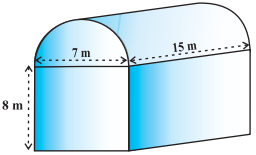
Shanta runs an industry in a shed which is in the shape of a cuboid surmounted by a half cylinder (see figure). If the base of the shed is of dimension $7\,m \times 15\,m,$ and the height of the cuboidal portion is $8\,m,$ find the volume of air that the shed can hold. Further,suppose the machinery in the shed occupies a total space of $300\,m^3,$ and there are $20$ workers,each of whom occupy about $0.08\,m^3$ space on an average. Then,how much air is in the shed? (in $m^3$) (Take $\pi = \frac{22}{7}$)
A
$700.50$
B
$827.15$
C
$486.90$
D
$1020$
Solution
(B) The volume of air inside the shed (when there are no people or machinery) is given by the sum of the volume of the cuboid and the volume of the half cylinder.
The dimensions of the cuboid are $length = 15\,m,$ $breadth = 7\,m,$ and $height = 8\,m.$
Volume of cuboid $= length \times breadth \times height = 15 \times 7 \times 8 = 840\,m^3.$
The half cylinder has a diameter of $7\,m,$ so its radius $r = 3.5\,m = \frac{7}{2}\,m.$ The length of the cylinder is $15\,m.$
Volume of half cylinder $= \frac{1}{2} \times (\pi r^2 h) = \frac{1}{2} \times \frac{22}{7} \times \frac{7}{2} \times \frac{7}{2} \times 15 = 288.75\,m^3.$
Total volume of the shed $= 840 + 288.75 = 1128.75\,m^3.$
Space occupied by machinery $= 300\,m^3.$
Space occupied by $20$ workers $= 20 \times 0.08 = 1.6\,m^3.$
Total space occupied $= 300 + 1.6 = 301.6\,m^3.$
Volume of air in the shed $= 1128.75 - 301.6 = 827.15\,m^3.$
0 likes
View Solution2
DifficultMCQ
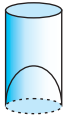
$A$ juice seller was serving his customers using glasses as shown in the figure. The inner diameter of the cylindrical glass was $5 \, cm$,but the bottom of the glass had a hemispherical raised portion which reduced the capacity of the glass. If the height of a glass was $10 \, cm$,find the apparent capacity of the glass and its actual capacity (in $cm^3$). (Use $\pi = 3.14$)
A
$150$
B
$175.50$
C
$163.54$
D
$196.25$
Solution
(C) Given,inner diameter of the cylindrical glass $= 5 \, cm$,so radius $r = 2.5 \, cm$. Height $h = 10 \, cm$.
The apparent capacity of the glass is the volume of the cylinder:
Apparent capacity $= \pi r^2 h = 3.14 \times (2.5)^2 \times 10 = 3.14 \times 6.25 \times 10 = 196.25 \, cm^3$.
The actual capacity is reduced by the volume of the hemispherical raised portion at the base:
Volume of hemisphere $= \frac{2}{3} \pi r^3 = \frac{2}{3} \times 3.14 \times (2.5)^3 = \frac{2}{3} \times 3.14 \times 15.625 = 32.70833... \approx 32.71 \, cm^3$.
Actual capacity $= \text{Apparent capacity} - \text{Volume of hemisphere} = 196.25 - 32.71 = 163.54 \, cm^3$.
0 likes
View Solution3
MediumMCQ
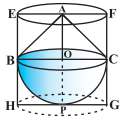
$A$ solid toy is in the form of a hemisphere surmounted by a right circular cone. The height of the cone is $2 \, cm$ and the diameter of the base is $4 \, cm$. Determine the volume of the toy. If a right circular cylinder circumscribes the toy,find the difference of the volumes of the cylinder and the toy. (in $cm^3$) (Take $\pi = 3.14$)
A
$4$
B
$50$
C
$36.50$
D
$25.12$
Solution
(D) Let $BPC$ be the hemisphere and $ABC$ be the cone standing on the base of the hemisphere.
The radius $BO$ of the hemisphere (as well as of the cone) $= \frac{1}{2} \times 4 \, cm = 2 \, cm$.
So,the volume of the toy $= \frac{2}{3} \pi r^3 + \frac{1}{3} \pi r^2 h$.
$= \left[ \frac{2}{3} \times 3.14 \times (2)^3 + \frac{1}{3} \times 3.14 \times (2)^2 \times 2 \right] \, cm^3 = 25.12 \, cm^3$.
Now,let the right circular cylinder $EFGH$ circumscribe the given solid. The radius of the base of the right circular cylinder $= HP = BO = 2 \, cm$,and its height is $EH = AO + OP = (2 + 2) \, cm = 4 \, cm$.
So,the required volume difference $=$ volume of the right circular cylinder $-$ volume of the toy.
$= (3.14 \times 2^2 \times 4 - 25.12) \, cm^3$.
$= (50.24 - 25.12) \, cm^3 = 25.12 \, cm^3$.
Hence,the required difference of the two volumes $= 25.12 \, cm^3$.
0 likes
View Solution4
Easy
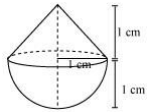
$A$ solid is in the shape of a cone standing on a hemisphere with both their radii being equal to $1\, cm$ and the height of the cone is equal to its radius. Find the volume of the solid in terms of $\pi$.
Solution
(N/A) Given that,
Height $(h)$ of the conical part $=$ Radius $(r)$ of the conical part $= 1\, cm$.
Radius $(r)$ of the hemispherical part $=$ Radius of the conical part $(r)$ $= 1\, cm$.
Volume of the solid $=$ Volume of the conical part $+$ Volume of the hemispherical part.
Volume of the solid $= \frac{1}{3} \pi r^2 h + \frac{2}{3} \pi r^3$.
Substituting the values:
Volume of the solid $= \frac{1}{3} \pi (1)^2 (1) + \frac{2}{3} \pi (1)^3$.
Volume of the solid $= \frac{1}{3} \pi + \frac{2}{3} \pi = \frac{3}{3} \pi = \pi\, cm^3$.
0 likes
View Solution5
MediumMCQ
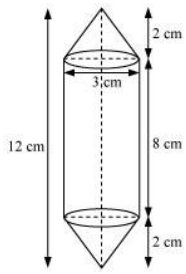
Rachel,an engineering student,was asked to make a model shaped like a cylinder with two cones attached at its two ends by using a thin aluminium sheet. The diameter of the model is $3\, cm$ and its total length is $12\, cm$. If each cone has a height of $2\, cm$,find the volume of air contained in the model that Rachel made. (Assume the outer and inner dimensions of the model to be nearly the same.) Unless stated otherwise,take $\pi = \frac{22}{7}$. (in $cm^3$)
A
$8$
B
$66$
C
$50$
D
$88$
Solution
(B) From the figure,it can be observed that:
Height $(h_1)$ of each conical part $= 2\, cm$.
Height $(h_2)$ of the cylindrical part $= 12 - (2 \times \text{height of conical part}) = 12 - (2 \times 2) = 12 - 4 = 8\, cm$.
Radius $(r)$ of the cylindrical part $=$ Radius of the conical part $= \frac{3}{2} = 1.5\, cm$.
Volume of air present in the model $=$ Volume of cylinder $+ 2 \times$ Volume of cones.
Volume $= \pi r^2 h_2 + 2 \times (\frac{1}{3} \pi r^2 h_1)$.
Volume $= \pi r^2 (h_2 + \frac{2}{3} h_1) = \pi \times (\frac{3}{2})^2 \times (8 + \frac{2}{3} \times 2)$.
Volume $= \pi \times \frac{9}{4} \times (8 + \frac{4}{3}) = \pi \times \frac{9}{4} \times (\frac{24+4}{3}) = \pi \times \frac{9}{4} \times \frac{28}{3}$.
Volume $= \pi \times 3 \times 7 = 21 \pi$.
Using $\pi = \frac{22}{7}$,Volume $= 21 \times \frac{22}{7} = 3 \times 22 = 66\, cm^3$.
0 likes
View Solution6
MediumMCQ
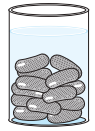
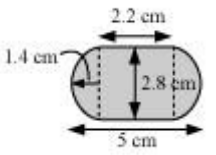
$A$ gulab jamun contains sugar syrup up to about $30\%$ of its volume. Find approximately how much syrup would be found in $45$ gulab jamuns,each shaped like a cylinder with two hemispherical ends with length $5\,cm$ and diameter $2.8\,cm$ (see figure) (in $cm^3$) [take $\pi=\frac{22}{7}$].
A
$25.05$
B
$45$
C
$338$
D
$300$
Solution
(C) It can be observed that:
Radius $(r)$ of cylindrical part $=$ Radius $(r)$ of hemispherical part $= \frac{2.8}{2} = 1.4\,cm$.
Length of each hemispherical part $=$ Radius of hemispherical part $= 1.4\,cm$.
Length $(h)$ of cylindrical part $= 5 - 2 \times$ (Length of hemispherical part) $= 5 - 2 \times 1.4 = 2.2\,cm$.
Volume of one gulab jamun $=$ Volume of cylindrical part $+ 2 \times$ Volume of hemispherical part
$= \pi r^2 h + 2 \times (\frac{2}{3} \pi r^3) = \pi r^2 h + \frac{4}{3} \pi r^3$
$= \frac{22}{7} \times (1.4)^2 \times 2.2 + \frac{4}{3} \times \frac{22}{7} \times (1.4)^3$
$= 13.552 + 11.49866... \approx 25.05\,cm^3$.
Volume of $45$ gulab jamuns $= 45 \times 25.05 = 1127.25\,cm^3$.
Volume of sugar syrup $= 30\%$ of total volume
$= \frac{30}{100} \times 1127.25 = 338.175\,cm^3$.
Rounding to the nearest whole number,the volume is approximately $338\,cm^3$.
0 likes
View Solution7
MediumMCQ
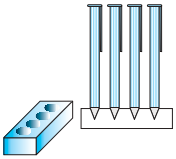
$A$ pen stand made of wood is in the shape of a cuboid with four conical depressions to hold pens. The dimensions of the cuboid are $15 \, cm$ by $10 \, cm$ by $3.5 \, cm$. The radius of each of the depressions is $0.5 \, cm$ and the depth is $1.4 \, cm$. Find the volume of wood in the entire stand (in $cm^3$). [Take $\pi = \frac{22}{7}$]
A
$525$
B
$550.50$
C
$560$
D
$523.53$
Solution
(D) The volume of the wooden stand is equal to the volume of the cuboid minus the volume of the four conical depressions.
Dimensions of the cuboid: Length $(l) = 15 \, cm$,Breadth $(b) = 10 \, cm$,Height $(H) = 3.5 \, cm$.
Volume of the cuboid $= l \times b \times H = 15 \times 10 \times 3.5 = 525 \, cm^3$.
Dimensions of each conical depression: Radius $(r) = 0.5 \, cm$,Depth $(h) = 1.4 \, cm$.
Volume of one cone $= \frac{1}{3} \pi r^2 h = \frac{1}{3} \times \frac{22}{7} \times (0.5)^2 \times 1.4$.
Volume of four cones $= 4 \times \left( \frac{1}{3} \times \frac{22}{7} \times 0.25 \times 1.4 \right) = 4 \times \left( \frac{1}{3} \times 22 \times 0.25 \times 0.2 \right) = 4 \times \left( \frac{1.1}{3} \right) = \frac{4.4}{3} \approx 1.4667 \, cm^3$.
Volume of wood $= 525 - 1.4667 = 523.5333 \, cm^3$.
Rounding to two decimal places,the volume is $523.53 \, cm^3$.
0 likes
View Solution8
EasyMCQ
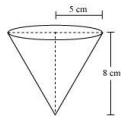
$A$ vessel is in the form of an inverted cone. Its height is $8 \, cm$ and the radius of its top,which is open,is $5 \, cm$. It is filled with water up to the brim. When lead shots,each of which is a sphere of radius $0.5 \, cm$,are dropped into the vessel,one-fourth of the water flows out. Find the number of lead shots dropped in the vessel. [Take $\pi = \frac{22}{7}$.]
A
$100$
B
$150$
C
$200$
D
$50$
Solution
(A) Height $(h)$ of the conical vessel $= 8 \, cm$.
Radius $(r_1)$ of the conical vessel $= 5 \, cm$.
Radius $(r_2)$ of each lead shot $= 0.5 \, cm$.
Let $n$ be the number of lead shots dropped into the vessel.
According to the problem,the volume of water that flows out is equal to the total volume of the lead shots dropped.
Volume of water spilled $= \frac{1}{4} \times$ Volume of the cone.
$\frac{1}{4} \times (\frac{1}{3} \pi r_1^2 h) = n \times (\frac{4}{3} \pi r_2^3)$.
Canceling $\frac{1}{3} \pi$ from both sides:
$\frac{1}{4} r_1^2 h = 4 n r_2^3$.
$r_1^2 h = 16 n r_2^3$.
Substituting the values:
$5^2 \times 8 = 16 \times n \times (0.5)^3$.
$25 \times 8 = 16 \times n \times (\frac{1}{2})^3$.
$200 = 16 \times n \times \frac{1}{8}$.
$200 = 2n$.
$n = 100$.
Thus,the number of lead shots dropped in the vessel is $100$.
1 likes
View Solution9
MediumMCQ
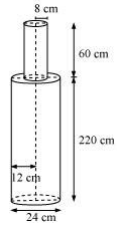
$A$ solid iron pole consists of a cylinder of height $220 \,cm$ and base diameter $24 \,cm$,which is surmounted by another cylinder of height $60 \,cm$ and radius $8 \,cm$. Find the mass of the pole,given that $1 \,cm^3$ of iron has approximately $8 \,g$ mass. (in $kg$) (Use $\pi = 3.14$)
A
$111.532$
B
$892.262$
C
$220$
D
$144$
Solution
(B) From the figure,it can be observed that:
Height $(h_1)$ of the larger cylinder $= 220 \,cm$
Radius $(r_1)$ of the larger cylinder $= \frac{24}{2} = 12 \,cm$
Height $(h_2)$ of the smaller cylinder $= 60 \,cm$
Radius $(r_2)$ of the smaller cylinder $= 8 \,cm$
Total volume of the pole $=$ Volume of the larger cylinder $+$ Volume of the smaller cylinder
$= \pi r_1^2 h_1 + \pi r_2^2 h_2$
$= \pi(12)^2 \times 220 + \pi(8)^2 \times 60$
$= \pi(144 \times 220 + 64 \times 60)$
$= 3.14 \times (31680 + 3840)$
$= 3.14 \times 35520 = 111532.8 \,cm^3$
Mass of $1 \,cm^3$ of iron $= 8 \,g$
Total mass of the pole $= 111532.8 \times 8 = 892262.4 \,g$
Since $1 \,kg = 1000 \,g$,the mass in $kg$ is $\frac{892262.4}{1000} = 892.2624 \,kg \approx 892.262 \,kg$.
0 likes
View Solution10
DifficultMCQ
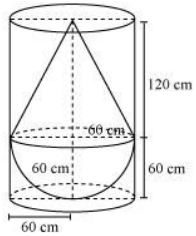
$A$ solid consisting of a right circular cone of height $120\, cm$ and radius $60\, cm$ standing on a hemisphere of radius $60\, cm$ is placed upright in a right circular cylinder full of water such that it touches the bottom. Find the volume of water left in the cylinder,if the radius of the cylinder is $60\, cm$ and its height is $180\, cm$. [Take $\pi = \frac{22}{7}$.] (in $m^3$)
A
$31.42$
B
$2.857$
C
$1.131$
D
$6.728$
Solution
(C) Radius $(r)$ of the hemispherical part = Radius $(r)$ of the conical part = $60\, cm$.
Height $(h_2)$ of the conical part of the solid = $120\, cm$.
Height $(h_1)$ of the cylinder = $180\, cm$.
Radius $(r)$ of the cylinder = $60\, cm$.
The volume of water left in the cylinder = Volume of the cylinder - Volume of the solid.
Volume of the solid = Volume of the cone + Volume of the hemisphere = $\frac{1}{3}\pi r^2 h_2 + \frac{2}{3}\pi r^3$.
Volume of water left = $\pi r^2 h_1 - (\frac{1}{3}\pi r^2 h_2 + \frac{2}{3}\pi r^3)$.
Substituting the values: $\pi(60)^2(180) - (\frac{1}{3}\pi(60)^2 \times 120 + \frac{2}{3}\pi(60)^3)$.
$= \pi(60)^2 [180 - (40 + 40)] = \pi(3600)(100) = 360,000\pi\, cm^3$.
Using $\pi = \frac{22}{7}$,Volume $\approx 360,000 \times 3.14159 = 1,130,973.36\, cm^3$.
Since $1\, m^3 = 1,000,000\, cm^3$,the volume in $m^3$ is $\approx 1.131\, m^3$.
0 likes
View Solution11
MediumMCQ
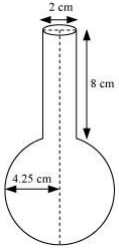
$A$ spherical glass vessel has a cylindrical neck $8 \, cm$ long and $2 \, cm$ in diameter. The diameter of the spherical part is $8.5 \, cm$. By measuring the amount of water it holds,a child finds its volume to be $345 \, cm^{3}$. Check whether she is correct,taking the above as the inside measurements,and $\pi = 3.14$. (in $, cm^{3}$)
A
$330.25$
B
$325.12$
C
$760.768$
D
$346.51$
Solution
(D) Height $(h)$ of the cylindrical part $= 8 \, cm$.
Radius $(r_{2})$ of the cylindrical part $= \frac{2}{2} = 1 \, cm$.
Radius $(r_{1})$ of the spherical part $= \frac{8.5}{2} = 4.25 \, cm$.
Volume of the vessel $=$ Volume of the sphere $+$ Volume of the cylinder.
Volume $= \frac{4}{3} \pi r_{1}^{3} + \pi r_{2}^{2} h$.
Volume $= \frac{4}{3} \times 3.14 \times (4.25)^{3} + 3.14 \times (1)^{2} \times 8$.
Volume $= \frac{4}{3} \times 3.14 \times 76.765625 + 3.14 \times 8$.
Volume $= 321.392 + 25.12 = 346.512 \, cm^{3}$.
Since the calculated volume is $346.512 \, cm^{3}$,the child's measurement of $345 \, cm^{3}$ is incorrect.
0 likes
View Solution12
EasyMCQ
$A$ cone of height $24\, cm$ and radius of base $6\, cm$ is made up of modelling clay. $A$ child reshapes it in the form of a sphere. Find the radius of the sphere (in $cm$).
A
$6$
B
$4$
C
$2$
D
$8$
Solution
(A) The volume of the cone is given by the formula $V = \frac{1}{3} \pi r^2 h$.
Substituting the given values,$r = 6\, cm$ and $h = 24\, cm$:
$V = \frac{1}{3} \times \pi \times 6^2 \times 24 = \frac{1}{3} \times \pi \times 36 \times 24 = 288\pi\, cm^3$.
Let the radius of the sphere be $R$. The volume of the sphere is given by $V = \frac{4}{3} \pi R^3$.
Since the volume of the clay remains the same after reshaping,we equate the two volumes:
$\frac{4}{3} \pi R^3 = 288\pi$.
Dividing both sides by $\pi$ and multiplying by $\frac{3}{4}$:
$R^3 = 288 \times \frac{3}{4} = 72 \times 3 = 216$.
Taking the cube root of both sides:
$R = \sqrt[3]{216} = 6\, cm$.
Thus,the radius of the sphere is $6\, cm$.
0 likes
View Solution13
Medium
Selvi's house has an overhead tank in the shape of a cylinder. This is filled by pumping water from a sump (an underground tank) which is in the shape of a cuboid. The sump has dimensions $1.57 \, m \times 1.44 \, m \times 95 \, cm$. The overhead tank has a radius of $60 \, cm$ and a height of $95 \, cm$. Find the height of the water left in the sump after the overhead tank has been completely filled with water from the sump which had been full. Compare the capacity of the tank with that of the sump. (Use $\pi = 3.14$)
Solution
(D) The volume of water in the overhead tank equals the volume of water removed from the sump.
Volume of the overhead tank (cylinder) $= \pi r^2 h = 3.14 \times 0.6 \, m \times 0.6 \, m \times 0.95 \, m = 1.07388 \, m^3$.
Volume of the sump (cuboid) $= l \times b \times h = 1.57 \, m \times 1.44 \, m \times 0.95 \, m = 2.14776 \, m^3$.
Volume of water left in the sump $= 2.14776 \, m^3 - 1.07388 \, m^3 = 1.07388 \, m^3$.
Let the height of the water left in the sump be $H$. Since the base area of the sump remains constant,$l \times b \times H = 1.07388 \, m^3$.
$1.57 \, m \times 1.44 \, m \times H = 1.07388 \, m^3$.
$2.2608 \, m^2 \times H = 1.07388 \, m^3$.
$H = \frac{1.07388}{2.2608} \, m = 0.475 \, m = 47.5 \, cm$.
Ratio of capacities $= \frac{\text{Capacity of tank}}{\text{Capacity of sump}} = \frac{1.07388}{2.14776} = \frac{1}{2}$.
Thus,the capacity of the tank is half the capacity of the sump.
0 likes
View Solution14
MediumMCQ
$A$ copper rod of diameter $1 \,cm$ and length $8 \,cm$ is drawn into a wire of length $18 \,m$ of uniform thickness. Find the thickness of the wire. (in $mm$)
A
$0.67$
B
$0.50$
C
$0.33$
D
$1.00$
Solution
(A) The volume of the copper rod is given by the formula for the volume of a cylinder: $V = \pi r^2 h$.
Given diameter $= 1 \,cm$,so radius $r = 0.5 \,cm$. Length $h = 8 \,cm$.
Volume $= \pi \times (0.5)^2 \times 8 = \pi \times 0.25 \times 8 = 2\pi \,cm^3$.
When the rod is drawn into a wire,the volume remains constant.
The length of the new wire is $18 \,m = 1800 \,cm$.
Let the radius of the wire be $r_w$. The volume of the wire is $\pi \times r_w^2 \times 1800$.
Equating the volumes: $\pi \times r_w^2 \times 1800 = 2\pi$.
$r_w^2 = \frac{2\pi}{1800\pi} = \frac{1}{900}$.
$r_w = \sqrt{\frac{1}{900}} = \frac{1}{30} \,cm$.
The thickness (diameter) of the wire is $2 \times r_w = 2 \times \frac{1}{30} = \frac{1}{15} \,cm$.
$\frac{1}{15} \,cm \approx 0.0667 \,cm = 0.67 \,mm$.
0 likes
View Solution15
Medium
$A$ hemispherical tank full of water is emptied by a pipe at the rate of $3 \frac{4}{7}$ $litres$ per $second.$ How much time will it take to empty half the tank,if it is $3 \,m$ in $diameter?$ (in $minutes$) (Take $\pi=\frac{22}{7}$)
Solution
(16.5) The radius of the hemispherical tank is $r = \frac{3}{2} \, m = 1.5 \, m$.
The total volume of the hemispherical tank is $V = \frac{2}{3} \pi r^3 = \frac{2}{3} \times \frac{22}{7} \times (1.5)^3 = \frac{2}{3} \times \frac{22}{7} \times \frac{27}{8} = \frac{99}{14} \, m^3$.
Since $1 \, m^3 = 1000 \, litres$,the total volume in litres is $\frac{99}{14} \times 1000 = \frac{99000}{14} \, litres$.
We need to empty half of the tank,so the volume to be emptied is $\frac{1}{2} \times \frac{99000}{14} = \frac{99000}{28} \, litres$.
The rate of emptying is $3 \frac{4}{7} = \frac{25}{7} \, litres/second$.
Time taken in seconds $= \frac{\text{Volume}}{\text{Rate}} = \frac{99000}{28} \div \frac{25}{7} = \frac{99000}{28} \times \frac{7}{25} = \frac{99000}{100} = 990 \, seconds$.
To convert into minutes,divide by $60$: $990 \div 60 = 16.5 \, minutes$.
0 likes
View Solution16
DifficultMCQ
$A$ metallic sphere of radius $4.2 \, cm$ is melted and recast into the shape of a cylinder of radius $6 \, cm$. Find the height of the cylinder. (in $cm$) [Take $\pi = \frac{22}{7}$]
A
$2.744$
B
$3.6$
C
$4.25$
D
$6.69$
Solution
(A) Radius of the sphere $(r_1) = 4.2 \, cm$.
Radius of the cylinder $(r_2) = 6 \, cm$.
Let the height of the cylinder be $h$.
Since the sphere is melted and recast into a cylinder,their volumes remain equal.
Volume of sphere = Volume of cylinder
$\frac{4}{3} \pi r_1^3 = \pi r_2^2 h$
$\frac{4}{3} \times (4.2)^3 = (6)^2 \times h$
$\frac{4}{3} \times 4.2 \times 4.2 \times 4.2 = 36 \times h$
$h = \frac{4 \times 4.2 \times 4.2 \times 4.2}{3 \times 36}$
$h = \frac{4 \times 74.088}{108}$
$h = \frac{296.352}{108} = 2.744 \, cm$.
Thus,the height of the cylinder is $2.744 \, cm$.
0 likes
View Solution17
MediumMCQ
Metallic spheres of radii $6 \, cm$,$8 \, cm$,and $10 \, cm$,respectively,are melted to form a single solid sphere. Find the radius of the resulting sphere (in $cm$).
A
$1728$
B
$12$
C
$18$
D
$28$
Solution
(B) Let the radii of the three metallic spheres be $r_1 = 6 \, cm$,$r_2 = 8 \, cm$,and $r_3 = 10 \, cm$.
Let the radius of the new solid sphere be $r$.
Since the spheres are melted to form a single sphere,the volume of the new sphere is equal to the sum of the volumes of the three individual spheres.
Volume of a sphere $= \frac{4}{3} \pi r^3$.
Therefore,$\frac{4}{3} \pi r^3 = \frac{4}{3} \pi r_1^3 + \frac{4}{3} \pi r_2^3 + \frac{4}{3} \pi r_3^3$.
Dividing both sides by $\frac{4}{3} \pi$,we get $r^3 = r_1^3 + r_2^3 + r_3^3$.
Substituting the values: $r^3 = 6^3 + 8^3 + 10^3$.
$r^3 = 216 + 512 + 1000 = 1728$.
Taking the cube root on both sides: $r = \sqrt[3]{1728} = 12 \, cm$.
Thus,the radius of the resulting sphere is $12 \, cm$.
0 likes
View Solution18
DifficultMCQ
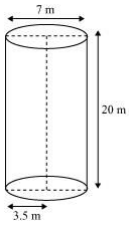
$A$ $20\, m$ deep well with diameter $7\, m$ is dug and the earth from digging is evenly spread out to form a platform $22\, m$ by $14\, m$. Find the height of the platform. (in $m$) [Take $\pi=\frac{22}{7}$]
A
$5.5$
B
$3.5$
C
$2.5$
D
$5.4$
Solution
(C) The shape of the well is cylindrical.
Depth $(h)$ of the well $= 20\, m$.
Radius $(r)$ of the circular end of the well $= \frac{7}{2}\, m = 3.5\, m$.
Area of the platform $= \text{Length} \times \text{Breadth} = 22\, m \times 14\, m = 308\, m^2$.
Let the height of the platform be $H$.
Since the volume of the soil dug from the well is equal to the volume of the soil spread on the platform:
Volume of soil from well $= \pi r^2 h = \frac{22}{7} \times (3.5)^2 \times 20 = \frac{22}{7} \times \frac{49}{4} \times 20 = 22 \times 7 \times 5 = 770\, m^3$.
Volume of soil on platform $= \text{Area of platform} \times H = 308 \times H$.
Equating the volumes: $308 \times H = 770$.
$H = \frac{770}{308} = 2.5\, m$.
Therefore,the height of the platform is $2.5\, m$.
0 likes
View Solution19
MediumMCQ
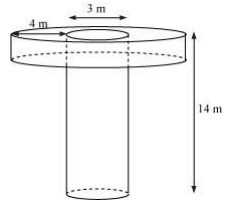
$A$ well of diameter $3 \, m$ is dug $14 \, m$ deep. The earth taken out of it has been spread evenly all around it in the shape of a circular ring of width $4 \, m$ to form an embankment. Find the height of the embankment (in $m$). Take $\pi = \frac{22}{7}$.
A
$9.8$
B
$3.685$
C
$5.142$
D
$1.125$
Solution
(D) The shape of the well is cylindrical.
Depth $(h_1)$ of the well $= 14 \, m$.
Radius $(r_1)$ of the circular end of the well $= \frac{3}{2} \, m = 1.5 \, m$.
Width of the embankment $= 4 \, m$.
The embankment is in the shape of a hollow cylinder (circular ring) with inner radius $r_1 = 1.5 \, m$ and outer radius $r_2 = r_1 + \text{width} = 1.5 + 4 = 5.5 \, m = \frac{11}{2} \, m$.
Let the height of the embankment be $h_2$.
Volume of soil dug from the well = Volume of earth used to form the embankment.
$\pi \times r_1^2 \times h_1 = \pi \times (r_2^2 - r_1^2) \times h_2$
$\pi \times (1.5)^2 \times 14 = \pi \times ((5.5)^2 - (1.5)^2) \times h_2$
$2.25 \times 14 = (30.25 - 2.25) \times h_2$
$31.5 = 28 \times h_2$
$h_2 = \frac{31.5}{28} = 1.125 \, m$.
Therefore,the height of the embankment is $1.125 \, m$.
0 likes
View Solution20
MediumMCQ
$A$ container shaped like a right circular cylinder having diameter $12 \, cm$ and height $15 \, cm$ is full of ice cream. The ice cream is to be filled into cones of height $12 \, cm$ and diameter $6 \, cm$,having a hemispherical shape on the top. Find the number of such cones which can be filled with ice cream. [Take $\pi = \frac{22}{7}$]
A
$10$
B
$14$
C
$12$
D
$8$
Solution
(A) Height $(h_1)$ of the cylindrical container $= 15 \, cm$.
Radius $(r_1)$ of the cylindrical container $= \frac{12}{2} = 6 \, cm$.
Volume of the cylindrical container $= \pi r_1^2 h_1 = \pi \times (6)^2 \times 15 = 540\pi \, cm^3$.
For the ice-cream cone,radius $(r_2) = \frac{6}{2} = 3 \, cm$ and height $(h_2) = 12 \, cm$.
The cone has a hemispherical top with the same radius $r_2 = 3 \, cm$.
Volume of one ice-cream cone $= \text{Volume of cone} + \text{Volume of hemisphere} = \frac{1}{3} \pi r_2^2 h_2 + \frac{2}{3} \pi r_2^3$.
Volume of one ice-cream cone $= \frac{1}{3} \pi (3)^2 (12) + \frac{2}{3} \pi (3)^3 = 36\pi + 18\pi = 54\pi \, cm^3$.
Let $n$ be the number of cones that can be filled.
$n = \frac{\text{Volume of cylinder}}{\text{Volume of one ice-cream cone}} = \frac{540\pi}{54\pi} = 10$.
Therefore,$10$ ice-cream cones can be filled.
0 likes
View Solution21
EasyMCQ
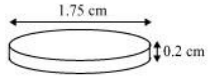
How many silver coins,$1.75 \,cm$ in diameter and of thickness $2 \,mm$,must be melted to form a cuboid of dimensions $5.5 \,cm \times 10 \,cm \times 3.5 \,cm$? [Take $\pi = \frac{22}{7}$]
A
$300$
B
$400$
C
$500$
D
$600$
Solution
(B) Coins are cylindrical in shape.
Height $(h_1)$ of cylindrical coins $= 2 \,mm = 0.2 \,cm$.
Radius $(r)$ of circular end of coins $= \frac{1.75}{2} = 0.875 \,cm$.
Let $n$ coins be melted to form the required cuboid.
Volume of $n$ coins $=$ Volume of cuboid
$n \times \pi \times r^2 \times h_1 = l \times b \times h$
$n \times \frac{22}{7} \times (0.875)^2 \times 0.2 = 5.5 \times 10 \times 3.5$
$n = \frac{5.5 \times 10 \times 3.5 \times 7}{22 \times (0.875)^2 \times 0.2}$
$n = \frac{192.5 \times 7}{22 \times 0.765625 \times 0.2} = \frac{1347.5}{3.36875} = 400$.
Therefore,the number of coins melted to form such a cuboid is $400$.
0 likes
View Solution22
Difficult
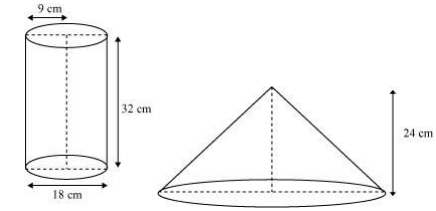
$A$ cylindrical bucket,$32 \, cm$ high and with a base radius of $18 \, cm$,is filled with sand. This bucket is emptied on the ground and a conical heap of sand is formed. If the height of the conical heap is $24 \, cm$,find the radius and slant height of the heap. [Take $\pi = \frac{22}{7}$]
Solution
(N/A) Height $(h_1)$ of the cylindrical bucket $= 32 \, cm$.
Radius $(r_1)$ of the base of the bucket $= 18 \, cm$.
Height $(h_2)$ of the conical heap $= 24 \, cm$.
Let the radius of the base of the conical heap be $r_2$.
Since the volume of sand remains the same:
Volume of sand in the cylindrical bucket $=$ Volume of sand in the conical heap.
$\pi \times r_1^2 \times h_1 = \frac{1}{3} \pi \times r_2^2 \times h_2$
$\pi \times 18^2 \times 32 = \frac{1}{3} \pi \times r_2^2 \times 24$
$18^2 \times 32 = r_2^2 \times 8$
$r_2^2 = \frac{324 \times 32}{8} = 324 \times 4 = 1296$
$r_2 = \sqrt{1296} = 36 \, cm$.
Now,the slant height $(l)$ of the cone is given by $l = \sqrt{r_2^2 + h_2^2}$.
$l = \sqrt{36^2 + 24^2} = \sqrt{1296 + 576} = \sqrt{1872}$.
$l = \sqrt{144 \times 13} = 12\sqrt{13} \, cm$.
Thus,the radius is $36 \, cm$ and the slant height is $12\sqrt{13} \, cm$.
0 likes
View Solution23
Medium
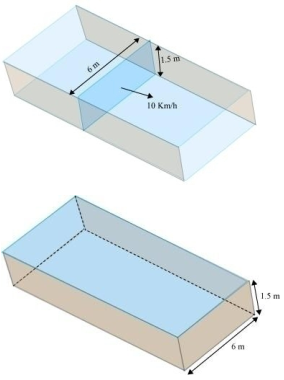
Water in a canal,$6 \, m$ wide and $1.5 \, m$ deep,is flowing with a speed of $10 \, km/h$. How much area will it irrigate in $30 \, minutes$,if $8 \, cm$ of standing water is needed?
Solution
(N/A) The cross-sectional area of the canal is $6 \, m \times 1.5 \, m = 9 \, m^2$.
The speed of water is $10 \, km/h = \frac{10000 \, m}{60 \, min} = \frac{500}{3} \, m/min$.
The volume of water that flows from the canal in $30 \, minutes$ is:
$V = \text{Area} \times \text{Speed} \times \text{Time} = 9 \, m^2 \times \frac{500}{3} \, m/min \times 30 \, min = 45000 \, m^3$.
Let the irrigated area be $A$. The volume of water required for irrigation is $A \times \text{depth}$.
Given depth $= 8 \, cm = 0.08 \, m$.
Equating the volumes:
$A \times 0.08 \, m = 45000 \, m^3$
$A = \frac{45000}{0.08} \, m^2 = 562500 \, m^2$.
Thus,the area irrigated in $30 \, minutes$ is $562500 \, m^2$.
0 likes
View Solution24
MediumMCQ
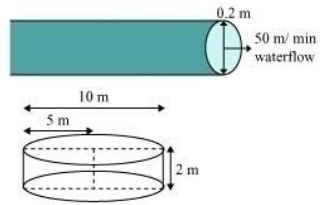
$A$ farmer connects a pipe of internal diameter $20 \,cm$ from a canal into a cylindrical tank in her field,which is $10 \,m$ in diameter and $2 \,m$ deep. If water flows through the pipe at the rate of $3 \,km/h$,in how much time will the tank be filled? (in $minutes$) [Take $\pi = \frac{22}{7}$]
A
$100$
B
$50$
C
$200$
D
$130$
Solution
(A) Radius of the pipe $(r_1) = \frac{20 \,cm}{2} = 10 \,cm = 0.1 \,m$.
Area of cross-section of the pipe $= \pi r_1^2 = \pi \times (0.1)^2 = 0.01 \pi \,m^2$.
Speed of water $= 3 \,km/h = \frac{3000 \,m}{60 \,min} = 50 \,m/min$.
Volume of water flowing through the pipe in $1 \,minute = \text{Area} \times \text{Speed} = 0.01 \pi \times 50 = 0.5 \pi \,m^3$.
Radius of the cylindrical tank $(r_2) = \frac{10 \,m}{2} = 5 \,m$.
Depth of the cylindrical tank $(h_2) = 2 \,m$.
Volume of the cylindrical tank $= \pi r_2^2 h_2 = \pi \times (5)^2 \times 2 = 50 \pi \,m^3$.
Let the time taken to fill the tank be $t \,minutes$.
Volume of water in $t \,minutes = t \times 0.5 \pi \,m^3$.
Equating the volumes: $t \times 0.5 \pi = 50 \pi$.
$t = \frac{50}{0.5} = 100 \,minutes$.
Thus,the tank will be filled in $100 \,minutes$.
0 likes
View Solution25
MediumMCQ
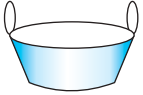
Hanumappa and his wife Gangamma are busy making jaggery out of sugarcane juice. They have processed the sugarcane juice to make the molasses,which is poured into moulds in the shape of a frustum of a cone having the diameters of its two circular faces as $30 \,cm$ and $35 \,cm$ and the vertical height of the mould is $14 \,cm$ (see figure). If each $cm^3$ of molasses has a mass of about $1.2 \,g$,find the mass of the molasses that can be poured into each mould (in $kg$). [Take $\pi = \frac{22}{7}$]
A
$15$
B
$12$
C
$14$
D
$18$
Solution
(C) The mould is in the shape of a frustum of a cone.
Given: Diameters of the circular faces are $d_1 = 35 \,cm$ and $d_2 = 30 \,cm$.
Radii are $r_1 = \frac{35}{2} = 17.5 \,cm$ and $r_2 = \frac{30}{2} = 15 \,cm$.
Vertical height $h = 14 \,cm$.
The volume $V$ of a frustum of a cone is given by $V = \frac{1}{3} \pi h (r_1^2 + r_2^2 + r_1 r_2)$.
$V = \frac{1}{3} \times \frac{22}{7} \times 14 \times (17.5^2 + 15^2 + 17.5 \times 15) \,cm^3$.
$V = \frac{1}{3} \times 22 \times 2 \times (306.25 + 225 + 262.5) \,cm^3$.
$V = \frac{44}{3} \times 793.75 \,cm^3 = 11641.66... \,cm^3 \approx 11641.67 \,cm^3$.
Given that the mass of $1 \,cm^3$ of molasses is $1.2 \,g$.
Total mass $= 11641.67 \times 1.2 \,g = 13970.004 \,g$.
Converting to $kg$: $13970.004 \div 1000 = 13.97 \,kg$.
Rounding to the nearest whole number,the mass is approximately $14 \,kg$.
0 likes
View Solution26
EasyMCQ
If a marble of radius $2.1 \, cm$ is put into a cylindrical cup full of water of radius $5 \, cm$ and height $6 \, cm$,then how much water flows out of the cylindrical cup? (in $cm^3$)
A
$55.4$
B
$38.8$
C
$19.4$
D
$471.4$
Solution
(B) When an object is submerged in a container completely full of water,the volume of water that overflows is equal to the volume of the submerged object.
Here,the object is a spherical marble with radius $r = 2.1 \, cm$.
The volume of a sphere is given by the formula $V = \frac{4}{3} \pi r^3$.
Substituting the values: $V = \frac{4}{3} \times \frac{22}{7} \times (2.1)^3$.
$V = \frac{4}{3} \times \frac{22}{7} \times 2.1 \times 2.1 \times 2.1$.
$V = 4 \times 22 \times 0.1 \times 2.1 \times 2.1$.
$V = 88 \times 0.1 \times 4.41$.
$V = 8.8 \times 4.41 = 38.808 \, cm^3$.
Rounding to one decimal place,the volume of water that flows out is $38.8 \, cm^3$.
0 likes
View Solution27
MediumMCQ
$A$ cubical ice cream brick of edge $22 \, cm$ is to be distributed among some children by filling ice cream cones of radius $2 \, cm$ and height $7 \, cm$ up to its brim. How many children will get the ice cream cones?
A
$163$
B
$263$
C
$363$
D
$463$
Solution
(C) The volume of the cubical ice cream brick is given by $V_{cube} = a^3$,where $a = 22 \, cm$.
$V_{cube} = 22 \times 22 \times 22 = 10648 \, cm^3$.
The volume of one ice cream cone is given by $V_{cone} = \frac{1}{3} \pi r^2 h$,where $r = 2 \, cm$ and $h = 7 \, cm$.
Using $\pi = \frac{22}{7}$,we get $V_{cone} = \frac{1}{3} \times \frac{22}{7} \times 2^2 \times 7 = \frac{1}{3} \times 22 \times 4 = \frac{88}{3} \, cm^3$.
The number of children who will get the ice cream is the total volume of the brick divided by the volume of one cone.
Number of children $= \frac{V_{cube}}{V_{cone}} = \frac{10648}{88/3} = \frac{10648 \times 3}{88}$.
$10648 \div 88 = 121$.
Number of children $= 121 \times 3 = 363$.
0 likes
View Solution28
EasyMCQ
The radii of the ends of a frustum of a cone of height $h \text{ cm}$ are $r_{1} \text{ cm}$ and $r_{2} \text{ cm}$. The volume in $\text{cm}^{3}$ of the frustum of the cone is:
A
$\frac{1}{3} \pi h [r_{1}^{2} - r_{2}^{2} - r_{1} r_{2}]$
B
$\frac{1}{3} \pi h [r_{1}^{2} - r_{2}^{2} + r_{1} r_{2}]$
C
$\frac{1}{3} \pi h [r_{1}^{2} + r_{2}^{2} - r_{1} r_{2}]$
D
$\frac{1}{3} \pi h [r_{1}^{2} + r_{2}^{2} + r_{1} r_{2}]$
Solution
(D) frustum of a cone is formed by cutting a cone with a plane parallel to its base.
Let the height of the frustum be $h$,and the radii of the two circular ends be $r_{1}$ and $r_{2}$.
The formula for the volume $V$ of a frustum of a cone is derived from the difference between the volumes of the original large cone and the smaller cone removed from the top.
The standard formula for the volume of a frustum of a cone is given by:
$V = \frac{1}{3} \pi h (r_{1}^{2} + r_{2}^{2} + r_{1} r_{2})$
Thus,the correct option is $D$.
0 likes
View Solution29
EasyMCQ
The volume of the largest right circular cone that can be cut out from a cube of edge $4.2 \,cm$ is (in $cm^3$)
A
$19.4$
B
$58.2$
C
$77.6$
D
$9.7$
Solution
(A) To find the volume of the largest right circular cone that can be cut from a cube,the diameter of the base of the cone must be equal to the edge of the cube,and the height of the cone must be equal to the edge of the cube.
Given edge of the cube,$a = 4.2 \,cm$.
Therefore,the radius of the cone,$r = \frac{a}{2} = \frac{4.2}{2} = 2.1 \,cm$.
The height of the cone,$h = a = 4.2 \,cm$.
The volume of a cone is given by the formula $V = \frac{1}{3} \pi r^2 h$.
Substituting the values: $V = \frac{1}{3} \times \frac{22}{7} \times (2.1)^2 \times 4.2$.
$V = \frac{1}{3} \times \frac{22}{7} \times 4.41 \times 4.2$.
$V = \frac{1}{3} \times 22 \times 0.63 \times 4.2$.
$V = 22 \times 0.21 \times 4.2$.
$V = 4.62 \times 4.2 = 19.404 \,cm^3$.
Rounding to one decimal place,we get $19.4 \,cm^3$.
0 likes
View Solution30
DifficultMCQ
$A$ hollow cube of internal edge $22 \, cm$ is filled with spherical marbles of diameter $0.5 \, cm$. It is assumed that $\frac{1}{8}$ of the space of the cube remains unfilled. The number of marbles that the cube can accommodate is:
A
$142244$
B
$142344$
C
$142444$
D
$142544$
Solution
(A) Given,edge of the cube $= 22 \, cm$.
Volume of the cube $= (22)^3 = 10648 \, cm^3$.
Since $\frac{1}{8}$ of the space remains unfilled,the space filled by marbles $= 10648 \times (1 - \frac{1}{8}) = 10648 \times \frac{7}{8} = 9317 \, cm^3$.
Diameter of a marble $= 0.5 \, cm$,so radius $r = 0.25 \, cm$.
Volume of one spherical marble $= \frac{4}{3} \pi r^3 = \frac{4}{3} \times \frac{22}{7} \times (0.25)^3 = \frac{4}{3} \times \frac{22}{7} \times \frac{1}{64} = \frac{88}{1344} = \frac{11}{168} \approx 0.065476 \, cm^3$.
Number of marbles $= \frac{\text{Filled volume}}{\text{Volume of one marble}} = \frac{9317}{11/168} = \frac{9317 \times 168}{11} = 847 \times 168 = 142296$.
Rounding to the nearest provided option,the correct answer is $142244$.
0 likes
View Solution31
DifficultMCQ
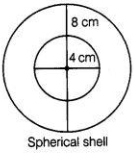
$A$ metallic spherical shell of internal and external diameters $4 \, cm$ and $8 \, cm$,respectively,is melted and recast into the form of a cone of base diameter $8 \, cm$. The height of the cone is (in $cm$):
A
$12$
B
$14$
C
$15$
D
$18$
Solution
(B) Given,internal diameter of the spherical shell $= 4 \, cm$ and external diameter $= 8 \, cm$.
Internal radius of the spherical shell,$r_1 = \frac{4}{2} = 2 \, cm$.
External radius of the spherical shell,$r_2 = \frac{8}{2} = 4 \, cm$.
Volume of the spherical shell $= \frac{4}{3} \pi (r_2^3 - r_1^3) = \frac{4}{3} \pi (4^3 - 2^3) = \frac{4}{3} \pi (64 - 8) = \frac{4}{3} \pi (56) = \frac{224}{3} \pi \, cm^3$.
Let the height of the cone be $h \, cm$ and the radius of the base be $R = \frac{8}{2} = 4 \, cm$.
Since the shell is recast into a cone,their volumes are equal:
Volume of cone $= \frac{1}{3} \pi R^2 h = \frac{1}{3} \pi (4)^2 h = \frac{16}{3} \pi h$.
Equating the volumes: $\frac{16}{3} \pi h = \frac{224}{3} \pi$.
$16h = 224$.
$h = \frac{224}{16} = 14 \, cm$.
Thus,the height of the cone is $14 \, cm$.
0 likes
View Solution32
DifficultMCQ
$A$ solid piece of iron in the form of a cuboid of dimensions $49 \, cm \times 33 \, cm \times 24 \, cm$ is moulded to form a solid sphere. The radius of the sphere is (in $cm$):
A
$25$
B
$23$
C
$21$
D
$19$
Solution
(C) Given,dimensions of the cuboid $= 49 \, cm \times 33 \, cm \times 24 \, cm$.
Volume of the cuboid $= \text{length} \times \text{breadth} \times \text{height} = 49 \times 33 \times 24 = 38808 \, cm^3$.
Let the radius of the sphere be $r$.
Volume of the sphere $= \frac{4}{3} \pi r^3$.
Since the cuboid is moulded into a sphere,their volumes are equal:
$\frac{4}{3} \pi r^3 = 38808$
$\frac{4}{3} \times \frac{22}{7} \times r^3 = 38808$
$r^3 = \frac{38808 \times 3 \times 7}{4 \times 22}$
$r^3 = 441 \times 21 = 9261$
$r = \sqrt[3]{9261} = 21 \, cm$.
Thus,the radius of the sphere is $21 \, cm$.
0 likes
View Solution33
DifficultMCQ
$A$ mason constructs a wall of dimensions $270 \,cm \times 300 \,cm \times 350 \,cm$ with bricks each of size $22.5 \,cm \times 11.25 \,cm \times 8.75 \,cm$. If $\frac{1}{8}$ of the total volume of the wall is occupied by mortar,find the number of bricks used to construct the wall.
A
$11000$
B
$11100$
C
$11300$
D
$11200$
Solution
(D) Volume of the wall $= 270 \times 300 \times 350 = 28,350,000 \,cm^3$.
Since $\frac{1}{8}$ of the wall's volume is occupied by mortar,the volume occupied by the bricks is $\frac{7}{8}$ of the total volume.
Volume occupied by bricks $= 28,350,000 \times \frac{7}{8} = 24,806,250 \,cm^3$.
Volume of one brick $= 22.5 \times 11.25 \times 8.75 = 2,214.84375 \,cm^3$.
Number of bricks $= \frac{\text{Volume occupied by bricks}}{\text{Volume of one brick}} = \frac{24,806,250}{2,214.84375} = 11,200$.
Therefore,the number of bricks used is $11,200$.
0 likes
View Solution34
DifficultMCQ
Twelve solid spheres of the same size are made by melting a solid metallic cylinder of base diameter $2 \, cm$ and height $16 \, cm$. The diameter of each sphere is (in $cm$):
A
$2$
B
$6$
C
$3$
D
$4$
Solution
(A) Given,diameter of the cylinder $= 2 \, cm$.
Therefore,radius of the cylinder $(R) = 1 \, cm$ and height $(h) = 16 \, cm$.
Volume of the cylinder $= \pi R^2 h = \pi \times (1)^2 \times 16 = 16 \pi \, cm^3$.
Let the radius of each solid sphere be $r \, cm$.
Volume of one sphere $= \frac{4}{3} \pi r^3$.
Since $12$ spheres are made from the cylinder,the total volume of $12$ spheres equals the volume of the cylinder.
$12 \times (\frac{4}{3} \pi r^3) = 16 \pi$.
$16 \pi r^3 = 16 \pi$.
$r^3 = 1$,which implies $r = 1 \, cm$.
Diameter of each sphere $= 2r = 2 \times 1 = 2 \, cm$.
0 likes
View Solution35
MediumMCQ
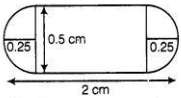
$A$ medicine capsule is in the shape of a cylinder of diameter $0.5\, cm$ with two hemispheres stuck to each of its ends. The length of the entire capsule is $2\, cm$. The capacity of the capsule is (in $cm^3$):
A
$0.34$
B
$0.35$
C
$0.36$
D
$0.33$
Solution
(C) Given,diameter of cylinder $=$ Diameter of hemisphere $= 0.5\, cm$ (since both hemispheres are attached to the cylinder).
$\therefore$ Radius of cylinder $(r) =$ radius of hemisphere $(r) = \frac{0.5}{2} = 0.25\, cm$ (since diameter $= 2 \times$ radius).
Total length of capsule $= 2\, cm$.
Length of the cylindrical part of the capsule $(h) = \text{Total length} - (\text{Radius of left hemisphere} + \text{Radius of right hemisphere})$.
$h = 2 - (0.25 + 0.25) = 2 - 0.5 = 1.5\, cm$.
Now,capacity of the capsule $=$ Volume of cylindrical part $+ 2 \times$ Volume of hemisphere.
Capacity $= \pi r^2 h + 2 \times (\frac{2}{3} \pi r^3) = \pi r^2 (h + \frac{4}{3} r)$.
Substituting the values:
Capacity $= \frac{22}{7} \times (0.25)^2 \times (1.5 + \frac{4}{3} \times 0.25)$.
Capacity $= \frac{22}{7} \times 0.0625 \times (1.5 + 0.3333) = \frac{22}{7} \times 0.0625 \times 1.8333 \approx 0.36\, cm^3$.
Hence,the capacity of the capsule is $0.36\, cm^3$.
0 likes
View Solution36
EasyMCQ
During the conversion of a solid from one shape to another,the volume of the new shape will
A
increase
B
remain unaltered
C
decrease
D
be doubled
Solution
(B) When a solid object is reshaped into another form,the total amount of material used remains the same. Therefore,the volume of the new shape remains unaltered.
0 likes
View Solution37
MediumMCQ
The diameters of the two circular ends of the bucket are $44 \, cm$ and $24 \, cm$. The height of the bucket is $35 \, cm$. The capacity of the bucket is (in $L$): (in $.7$)
A
$34$
B
$33$
C
$32$
D
$31$
Solution
(C) Given,diameter of the upper end of the bucket $D = 44 \, cm$,so radius $R = 22 \, cm$.
Diameter of the lower end of the bucket $d = 24 \, cm$,so radius $r = 12 \, cm$.
Height of the bucket $h = 35 \, cm$.
The shape of the bucket is a frustum of a cone.
The capacity (volume) of the bucket is given by the formula: $V = \frac{1}{3} \pi h (R^2 + r^2 + Rr)$.
Substituting the values: $V = \frac{1}{3} \times \frac{22}{7} \times 35 \times (22^2 + 12^2 + 22 \times 12)$.
$V = \frac{1}{3} \times 22 \times 5 \times (484 + 144 + 264)$.
$V = \frac{110}{3} \times 892$.
$V = \frac{98120}{3} \approx 32706.67 \, cm^3$.
Since $1000 \, cm^3 = 1 \, L$,the capacity is $32706.67 / 1000 \approx 32.7 \, L$.
0 likes
View Solution38
EasyMCQ
Write 'True' or 'False' and justify your answer:
$A$ spherical steel ball is melted to make eight new identical balls. Then,the radius of each new ball is $\frac{1}{8}$th the radius of the original ball.
$A$ spherical steel ball is melted to make eight new identical balls. Then,the radius of each new ball is $\frac{1}{8}$th the radius of the original ball.
A
True
B
False
Solution
(B) False.
Let $r$ be the radius of the original steel ball and $r_{1}$ be the radius of each new ball formed after melting.
The volume of the original ball is $V = \frac{4}{3} \pi r^{3}$.
The volume of eight new balls is $8 \times V_{1} = 8 \times \left( \frac{4}{3} \pi r_{1}^{3} \right)$.
Since the volume remains constant during melting,we have $\frac{4}{3} \pi r^{3} = 8 \times \frac{4}{3} \pi r_{1}^{3}$.
Dividing both sides by $\frac{4}{3} \pi$,we get $r^{3} = 8 r_{1}^{3}$.
Taking the cube root on both sides,we get $r = 2 r_{1}$,which implies $r_{1} = \frac{r}{2}$.
Therefore,the radius of each new ball is $\frac{1}{2}$ of the original radius,not $\frac{1}{8}$.
0 likes
View Solution39
Easy
Write 'True' or 'False' and justify your answer:
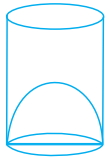
The actual capacity of a vessel as shown in the figure is equal to the difference between the volume of the cylinder and the volume of the hemisphere.
The actual capacity of a vessel as shown in the figure is equal to the difference between the volume of the cylinder and the volume of the hemisphere.
Solution
(A) True.
The actual capacity of a vessel is defined as the total volume of the empty space inside it that can be filled with a substance. In the given figure,a hemispherical depression is carved out from the base of the cylinder. Therefore,the volume of the space available inside the vessel is the volume of the cylinder minus the volume of the hemisphere.
The actual capacity of a vessel is defined as the total volume of the empty space inside it that can be filled with a substance. In the given figure,a hemispherical depression is carved out from the base of the cylinder. Therefore,the volume of the space available inside the vessel is the volume of the cylinder minus the volume of the hemisphere.
0 likes
View Solution40
Medium
Write 'True' or 'False' and justify your answer:
$A$ solid ball is exactly fitted inside a cubical box of side $a$. The volume of the ball is $\frac{4}{3} \pi a^{3}$.
$A$ solid ball is exactly fitted inside a cubical box of side $a$. The volume of the ball is $\frac{4}{3} \pi a^{3}$.
Solution
(B) False.
Since the solid ball is exactly fitted inside the cubical box of side $a$,the diameter of the ball must be equal to the side of the cube,which is $a$.
Therefore,the radius of the ball $r = \frac{a}{2}$.
The volume of a sphere is given by the formula $V = \frac{4}{3} \pi r^{3}$.
Substituting $r = \frac{a}{2}$ into the formula,we get:
$V = \frac{4}{3} \pi \left( \frac{a}{2} \right)^{3} = \frac{4}{3} \pi \left( \frac{a^{3}}{8} \right) = \frac{1}{6} \pi a^{3}$.
Since $\frac{1}{6} \pi a^{3} \neq \frac{4}{3} \pi a^{3}$,the given statement is False.
0 likes
View Solution41
Easy
Write 'True' or 'False' and justify your answer:
The volume of the frustum of a cone is $\frac{1}{3} \pi h[r_{1}^{2} + r_{2}^{2}-r_{1} r_{2}],$ where $h$ is the vertical height of the frustum and $r_{1}, r_{2}$ are the radii of the ends.
The volume of the frustum of a cone is $\frac{1}{3} \pi h[r_{1}^{2} + r_{2}^{2}-r_{1} r_{2}],$ where $h$ is the vertical height of the frustum and $r_{1}, r_{2}$ are the radii of the ends.
Solution
(B) False.
The correct formula for the volume of the frustum of a cone is $V = \frac{1}{3} \pi h(r_{1}^{2} + r_{2}^{2} + r_{1}r_{2}),$ where $h$ is the vertical height of the frustum and $r_{1}, r_{2}$ are the radii of the circular ends. The given expression contains a negative sign instead of a positive sign for the term $r_{1}r_{2}$.
The correct formula for the volume of the frustum of a cone is $V = \frac{1}{3} \pi h(r_{1}^{2} + r_{2}^{2} + r_{1}r_{2}),$ where $h$ is the vertical height of the frustum and $r_{1}, r_{2}$ are the radii of the circular ends. The given expression contains a negative sign instead of a positive sign for the term $r_{1}r_{2}$.
0 likes
View Solution42
Medium
Write 'True' or 'False' and justify your answer:
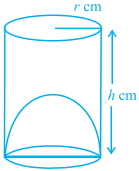
The capacity of a cylindrical vessel with a hemispherical portion raised upward at the bottom as shown in the figure is $\frac{\pi r^{2}}{3} [3 h-2 r]$.
The capacity of a cylindrical vessel with a hemispherical portion raised upward at the bottom as shown in the figure is $\frac{\pi r^{2}}{3} [3 h-2 r]$.
Solution
(TRUE) True.
We know that the capacity (volume) of a cylindrical vessel is given by $V_{cylinder} = \pi r^{2} h$.
The capacity (volume) of a hemisphere is given by $V_{hemisphere} = \frac{2}{3} \pi r^{3}$.
From the figure,the hemispherical portion is raised upward at the bottom,which means it occupies space inside the cylinder. Therefore,the capacity of the vessel is the volume of the cylinder minus the volume of the hemisphere.
Capacity of the vessel = $V_{cylinder} - V_{hemisphere}$
$= \pi r^{2} h - \frac{2}{3} \pi r^{3}$
$= \pi r^{2} (h - \frac{2}{3} r)$
$= \frac{\pi r^{2}}{3} (3h - 2r)$.
0 likes
View Solution43
EasyMCQ
$A$ solid metallic sphere of radius $10.5 \, cm$ is melted and recast into a number of smaller cones,each of radius $3.5 \, cm$ and height $3 \, cm$. Find the number of cones so formed.
A
$130$
B
$127$
C
$125$
D
$126$
Solution
(D) The volume of the solid metallic sphere is given by the formula $V_s = \frac{4}{3} \pi r^3$,where $r = 10.5 \, cm$.
$V_s = \frac{4}{3} \pi (10.5)^3 \, cm^3$.
The volume of one cone is given by the formula $V_c = \frac{1}{3} \pi r^2 h$,where $r = 3.5 \, cm$ and $h = 3 \, cm$.
$V_c = \frac{1}{3} \pi (3.5)^2 \times 3 \, cm^3 = \pi (3.5)^2 \, cm^3$.
The number of cones formed is equal to the total volume of the sphere divided by the volume of one cone.
$\text{Number of cones} = \frac{V_s}{V_c} = \frac{\frac{4}{3} \pi (10.5)^3}{\pi (3.5)^2} = \frac{4 \times 10.5 \times 10.5 \times 10.5}{3 \times 3.5 \times 3.5} = 4 \times 3 \times 3 \times 3.5 = 126$.
0 likes
View Solution44
Medium
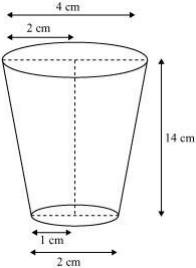
$A$ drinking glass is in the shape of a frustum of a cone of height $14 \, cm$. The diameters of its two circular ends are $4 \, cm$ and $2 \, cm$. Find the capacity of the glass. [Use $\pi = \frac{22}{7}$]
Solution
(N/A) Radius $(r_1)$ of the upper base of the glass $= \frac{4}{2} = 2 \, cm$.
Radius $(r_2)$ of the lower base of the glass $= \frac{2}{2} = 1 \, cm$.
Height $(h)$ of the glass $= 14 \, cm$.
Capacity of the glass $=$ Volume of the frustum of a cone
$= \frac{1}{3} \pi h (r_1^2 + r_2^2 + r_1 r_2)$
$= \frac{1}{3} \times \frac{22}{7} \times 14 \times (2^2 + 1^2 + 2 \times 1)$
$= \frac{1}{3} \times 22 \times 2 \times (4 + 1 + 2)$
$= \frac{44}{3} \times 7 = \frac{308}{3} \, cm^3 = 102 \frac{2}{3} \, cm^3$.
Therefore,the capacity of the glass is $102 \frac{2}{3} \, cm^3$.
0 likes
View Solution45
DifficultMCQ
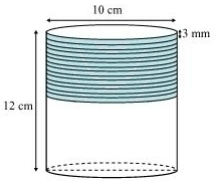
$A$ copper wire,$3 \,mm$ in diameter,is wound about a cylinder whose length is $12 \,cm$ and diameter $10 \,cm$,so as to cover the curved surface of the cylinder. Find the mass of the wire,assuming the density of copper to be $8.88 \,g/cm^3$. (in $g$)
A
$770.80$
B
$789.41$
C
$888.98$
D
$125.7$
Solution
(B) It can be observed that $1$ round of wire will cover $3 \,mm$ $(0.3 \,cm)$ height of the cylinder.
Number of rounds $= \frac{\text{Height of cylinder}}{\text{Diameter of wire}} = \frac{12 \,cm}{0.3 \,cm} = 40$ rounds.
Length of wire required in $1$ round $=$ Circumference of the base of the cylinder $= 2 \pi r = 2 \pi \times 5 = 10 \pi \,cm$.
Total length of wire in $40$ rounds $= 40 \times 10 \pi = 400 \pi \,cm = 400 \times 3.14159 \approx 1256.64 \,cm$.
Radius of the wire $= \frac{0.3 \,cm}{2} = 0.15 \,cm$.
Volume of the wire $=$ Area of cross-section of wire $\times$ Total length of wire $= \pi (0.15)^2 \times 1256.64 \approx 88.826 \,cm^3$.
Mass of the wire $=$ Volume $\times$ Density $= 88.826 \,cm^3 \times 8.88 \,g/cm^3 \approx 788.77 \,g$.
Using $\pi \approx \frac{22}{7}$ for calculation: Length $= 400 \times \frac{22}{7} = \frac{8800}{7} \approx 1257.14 \,cm$. Volume $= \pi \times (0.15)^2 \times \frac{8800}{7} = \frac{22}{7} \times 0.0225 \times \frac{8800}{7} \approx 88.93 \,cm^3$. Mass $= 88.93 \times 8.88 \approx 789.7 \,g$. The closest option is $789.41 \,g$.
0 likes
View Solution46
MediumMCQ
$A$ cistern,internally measuring $150 \,cm \times 120 \,cm \times 110 \,cm$,has $129600 \,cm^3$ of water in it. Porous bricks are placed in the water until the cistern is full to the brim. Each brick absorbs one-seventeenth of its own volume of water. How many bricks can be put in without overflowing the water,each brick being $22.5 \,cm \times 7.5 \,cm \times 6.5 \,cm$?
A
$1535$
B
$1700$
C
$1770$
D
$1792$
Solution
(D) The total volume of the cistern is $V_{cistern} = 150 \times 120 \times 110 = 1980000 \,cm^3$.
The volume of water already present is $129600 \,cm^3$.
The volume to be filled is $V_{fill} = 1980000 - 129600 = 1850400 \,cm^3$.
Let $n$ be the number of bricks. The volume of one brick is $V_{brick} = 22.5 \times 7.5 \times 6.5 = 1096.875 \,cm^3$.
Each brick absorbs $\frac{1}{17}$ of its volume,so the effective volume occupied by one brick in the water is $V_{eff} = V_{brick} - \frac{1}{17} V_{brick} = \frac{16}{17} V_{brick}$.
To fill the cistern,the total volume of $n$ bricks must equal the volume to be filled: $n \times V_{eff} = V_{fill}$.
$n \times \frac{16}{17} \times 1096.875 = 1850400$.
$n \times \frac{16}{17} \times \frac{8775}{8} = 1850400$.
$n \times \frac{2 \times 8775}{17} = 1850400$.
$n = \frac{1850400 \times 17}{17550} = 1792$.
0 likes
View Solution47
Medium
In one fortnight of a given month,there was a rainfall of $10 \, cm$ in a river valley. If the area of the valley is $7280 \, km^2$,show that the total rainfall was approximately equivalent to the addition to the normal water of three rivers each $1072 \, km$ long,$75 \, m$ wide,and $3 \, m$ deep.
Solution
(N/A) Area of the valley $= 7280 \, km^2 = 7280 \times (1000 \, m)^2 = 7.28 \times 10^9 \, m^2$.
Rainfall depth $= 10 \, cm = 0.1 \, m$.
Total volume of rainfall $= \text{Area} \times \text{Depth} = 7.28 \times 10^9 \, m^2 \times 0.1 \, m = 7.28 \times 10^8 \, m^3$.
Volume of one river $= \text{length} \times \text{width} \times \text{depth} = 1072 \, km \times 75 \, m \times 3 \, m = 1072000 \, m \times 75 \, m \times 3 \, m = 2.412 \times 10^8 \, m^3$.
Volume of three such rivers $= 3 \times 2.412 \times 10^8 \, m^3 = 7.236 \times 10^8 \, m^3$.
Since $7.28 \times 10^8 \, m^3 \approx 7.236 \times 10^8 \, m^3$,the total rainfall is approximately equivalent to the volume of three such rivers.
0 likes
View Solution48
Difficult
Derive the formula for the volume of the frustum of a cone.
Solution
(N/A) Let $ABC$ be a cone. $A$ frustum $DECB$ is cut by a plane parallel to its base.
Let $r_{1}$ and $r_{2}$ be the radii of the ends of the frustum of the cone and $h$ be the height of the frustum of the cone.
In $\triangle ABG$ and $\triangle ADF,$ $DF \parallel BG.$
$\therefore \triangle ABG \sim \triangle ADF.$
$\frac{DF}{BG} = \frac{AF}{AG} = \frac{AD}{AB}.$
$\frac{r_{2}}{r_{1}} = \frac{h_{1}-h}{h_{1}} = 1 - \frac{h}{h_{1}}.$
$\frac{h}{h_{1}} = 1 - \frac{r_{2}}{r_{1}} = \frac{r_{1}-r_{2}}{r_{1}}.$
$h_{1} = \frac{r_{1}h}{r_{1}-r_{2}}.$
Volume of frustum of cone $=$ Volume of cone $ABC$ $-$ Volume of cone $ADE.$
$= \frac{1}{3} \pi r_{1}^{2} h_{1} - \frac{1}{3} \pi r_{2}^{2}(h_{1}-h).$
$= \frac{\pi}{3} [r_{1}^{2} h_{1} - r_{2}^{2}(h_{1}-h)].$
$= \frac{\pi}{3} [r_{1}^{2} (\frac{r_{1}h}{r_{1}-r_{2}}) - r_{2}^{2} (\frac{r_{1}h}{r_{1}-r_{2}} - h)].$
$= \frac{\pi}{3} [\frac{r_{1}^{3}h}{r_{1}-r_{2}} - r_{2}^{2} (\frac{r_{1}h - r_{1}h + r_{2}h}{r_{1}-r_{2}})].$
$= \frac{\pi}{3} [\frac{r_{1}^{3}h - r_{2}^{3}h}{r_{1}-r_{2}}].$
$= \frac{\pi h}{3} [\frac{r_{1}^{3} - r_{2}^{3}}{r_{1}-r_{2}}].$
$= \frac{\pi h}{3} [\frac{(r_{1}-r_{2})(r_{1}^{2} + r_{2}^{2} + r_{1}r_{2})}{r_{1}-r_{2}}].$
$= \frac{1}{3} \pi h (r_{1}^{2} + r_{2}^{2} + r_{1}r_{2}).$

0 likes
View Solution49
MediumMCQ
$A$ canal is $300 \,cm$ wide and $120 \,cm$ deep. The water in the canal is flowing with a speed of $20 \,km/h$. How much area will it irrigate in $20 \,minutes$ if $8 \,cm$ of standing water is desired? (in $hectares$)
A
$30$
B
$300$
C
$3000$
D
$3$
Solution
(A) First,convert all dimensions to meters: Width $= 300 \,cm = 3 \,m$,Depth $= 120 \,cm = 1.2 \,m$,Speed $= 20 \,km/h = 20000 \,m/h$.
Volume of water flowing through the canal in $1 \,hour$ $= \text{Width} \times \text{Depth} \times \text{Speed} = 3 \times 1.2 \times 20000 = 72000 \,m^3$.
Volume of water flowing in $20 \,minutes$ $= \frac{72000 \times 20}{60} = 24000 \,m^3$.
Let the area to be irrigated be $A \,m^2$. The volume of water required for irrigation is $\text{Area} \times \text{Height of standing water}$.
Given height $= 8 \,cm = 0.08 \,m$.
So,$A \times 0.08 = 24000$.
$A = \frac{24000}{0.08} = 300000 \,m^2$.
Since $1 \,hectare = 10000 \,m^2$,the area in hectares $= \frac{300000}{10000} = 30 \,hectares$.
0 likes
View Solution50
MediumMCQ
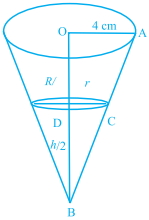
$A$ cone of radius $4 \, cm$ is divided into two parts by drawing a plane through the midpoint of its axis and parallel to its base. Compare the volumes of the two parts.
A
$1:2$
B
$1:7$
C
$2:3$
D
$7:1$
Solution
(B) Let $h$ be the height of the given cone. On dividing the cone through the midpoint of its axis and parallel to its base into two parts,we obtain a smaller cone at the top and a frustum at the bottom.
In two similar triangles,the ratio of corresponding sides is equal. Let $r$ be the radius of the smaller cone. By similarity of triangles,we have $\frac{r}{4} = \frac{h/2}{h} = \frac{1}{2}$.
Therefore,$r = 2 \, cm$.
Volume of the smaller cone $(V_1)$ = $\frac{1}{3} \pi r^2 (h/2) = \frac{1}{3} \pi (2)^2 (h/2) = \frac{2}{3} \pi h$.
Volume of the original cone $(V)$ = $\frac{1}{3} \pi (4)^2 h = \frac{16}{3} \pi h$.
Volume of the frustum $(V_2)$ = $V - V_1 = \frac{16}{3} \pi h - \frac{2}{3} \pi h = \frac{14}{3} \pi h$.
Ratio of the volume of the smaller cone to the volume of the frustum = $\frac{V_1}{V_2} = \frac{\frac{2}{3} \pi h}{\frac{14}{3} \pi h} = \frac{2}{14} = \frac{1}{7}$.
Thus,the ratio is $1:7$.
0 likes
View SolutionSurface Areas and Volumes — Volume of a Combination of Solids · Frequently Asked Questions
1Are these Surface Areas and Volumes questions useful for JEE and NEET?
Yes. All questions in this section are mapped to JEE Main and NEET exam patterns. Previous year questions from JEE Main, NEET, GUJCET and state-level exams are included with full solutions.
2Can I switch to Hindi or Gujarati for these questions?
Yes. Use the language tabs in the hero section or the sidebar to view the same questions and solutions in English, Hindi or Gujarati.
3How do I generate a question paper from this subtopic?
Use the Vedclass Exam Paper Generator — select the chapter and subtopic, set difficulty, and generate Sets A, B, C, D automatically. First 3 chapters of every subject are free.
Vedclass Products
For Students
Vedclass Test Series
Mock tests in real JEE/NEET style with performance analysis. 5-day free trial.
Start Free TrialFor Teachers
Exam Paper Generator
Generate Set A/B/C/D papers from this chapter in 2 minutes. 3 chapters free.
Try FreeFor Institutes
Online Exam Module
Live online exams with unlimited students, 360° analytics & white-label branding.
See DemoFor Teachers & Institutes
Generate a Surface Areas and Volumes Exam Paper in 2 Minutes
Select subtopic & difficulty — Sets A, B, C, D auto-generated with No Repeat logic.
First 3 chapters of every subject are free — no payment required.