
A English
Criteria for Similarity of Triangles Questions in English
Class 10 Mathematics · Triangles · Criteria for Similarity of Triangles
236+
Questions
English
Language
100%
With Solutions
Showing 50 of 236 questions in English
151
MediumMCQ
If $\Delta ABC \sim \Delta XYZ$ under the correspondence $ABC \leftrightarrow XZY$,then $BC^2 : YZ^2 = \ldots \ldots \ldots$ (Wait,the question asks for $ABC : XYZ = BC^2 : \ldots$ which refers to the ratio of areas). Given $\Delta ABC \sim \Delta XZY$,the ratio of their areas is equal to the ratio of the squares of their corresponding sides. Thus,$\frac{\text{Area}(\Delta ABC)}{\text{Area}(\Delta XZY)} = \frac{BC^2}{ZY^2}$.
A
$CZ^2$
B
$BZ^2$
C
$AZ^2$
D
$YZ^2$
Solution
(D) According to the theorem of the ratio of areas of two similar triangles,if $\Delta ABC \sim \Delta XZY$,then the ratio of their areas is equal to the ratio of the squares of their corresponding sides.
Specifically,$\frac{\text{Area}(\Delta ABC)}{\text{Area}(\Delta XZY)} = \frac{AB^2}{XZ^2} = \frac{BC^2}{ZY^2} = \frac{AC^2}{XY^2}$.
Given the correspondence $ABC \leftrightarrow XZY$,the side $BC$ corresponds to the side $ZY$ (or $YZ$).
Therefore,the ratio of the areas is $BC^2 : YZ^2$.
Thus,the missing term is $YZ^2$.
0 likes
View Solution152
MediumMCQ
In $\Delta ABC$ and $\Delta PQR$,$\angle A \cong \angle P$ and $\angle B \cong \angle R$. Then,the correspondence $ABC \leftrightarrow \ldots$ is a similarity.
A
$PRQ$
B
$PQR$
C
$RPQ$
D
$RQP$
Solution
(A) Given that in $\Delta ABC$ and $\Delta PQR$,$\angle A = \angle P$ and $\angle B = \angle R$.
By the Angle-Angle $(AA)$ similarity criterion,if two angles of one triangle are respectively equal to two angles of another triangle,then the two triangles are similar.
Since $\angle A$ corresponds to $\angle P$ and $\angle B$ corresponds to $\angle R$,the third angle $\angle C$ must correspond to $\angle Q$ (as the sum of angles in a triangle is $180^{\circ}$).
Therefore,the correspondence $ABC \leftrightarrow PRQ$ represents the similarity $\Delta ABC \sim \Delta PRQ$.
0 likes
View Solution153
MediumMCQ
$\Delta ABC \sim \Delta PQR$ for the correspondence $ABC \leftrightarrow RPQ$. If $m \angle A + m \angle C = m \angle B$,then in $\Delta PQR$,$\ldots \ldots \ldots$ is a right angle.
A
$\angle R$
B
$\angle Q$
C
$\angle P$
D
$\angle PQR$
Solution
(C) Given that $\Delta ABC \sim \Delta PQR$ under the correspondence $ABC \leftrightarrow RPQ$. This implies that $\angle A = \angle R$,$\angle B = \angle P$,and $\angle C = \angle Q$.
In $\Delta ABC$,the sum of angles is $m \angle A + m \angle B + m \angle C = 180^{\circ}$.
Given $m \angle A + m \angle C = m \angle B$,we substitute this into the sum equation: $m \angle B + m \angle B = 180^{\circ}$,which gives $2(m \angle B) = 180^{\circ}$,so $m \angle B = 90^{\circ}$.
Since $\angle B = \angle P$ from the correspondence,it follows that $m \angle P = 90^{\circ}$.
Therefore,$\angle P$ is a right angle.
0 likes
View Solution154
MediumMCQ
In $\Delta ABC$ and $\Delta PQR$,$\angle A \cong \angle R$ and $\angle B \cong \angle P$. If $AB = 6$,$BC = 8$ and $PR = 9$,then $PQ = \ldots$
A
$8$
B
$10$
C
$6$
D
$12$
Solution
(D) Given that in $\Delta ABC$ and $\Delta PQR$,$\angle A = \angle R$ and $\angle B = \angle P$.
By the $AA$ similarity criterion,$\Delta ABC \sim \Delta R P Q$.
Since the triangles are similar,the ratios of their corresponding sides are equal:
$\frac{AB}{RP} = \frac{BC}{PQ} = \frac{AC}{RQ}$.
We are given $AB = 6$,$BC = 8$,and $PR = 9$.
Substituting the values into the ratio $\frac{AB}{RP} = \frac{BC}{PQ}$:
$\frac{6}{9} = \frac{8}{PQ}$.
Simplifying the fraction $\frac{6}{9}$ gives $\frac{2}{3}$.
So,$\frac{2}{3} = \frac{8}{PQ}$.
$2 \times PQ = 8 \times 3$.
$2 \times PQ = 24$.
$PQ = \frac{24}{2} = 12$.
Therefore,$PQ = 12$.
0 likes
View Solution155
MediumMCQ
In $\Delta ABC$ and $\Delta DEF$,$\angle A \cong \angle E$ and $m \angle A + m \angle B = m \angle D + m \angle E$. Then the correspondence $ABC \leftrightarrow \ldots$ between them is a similarity.
A
$EDF$
B
$DFE$
C
$FED$
D
$DEF$
Solution
(A) Given that $\angle A \cong \angle E$,so $m \angle A = m \angle E$.
Given the equation $m \angle A + m \angle B = m \angle D + m \angle E$.
Substituting $m \angle A = m \angle E$ into the equation,we get $m \angle E + m \angle B = m \angle D + m \angle E$.
Subtracting $m \angle E$ from both sides,we get $m \angle B = m \angle D$.
Since two angles of $\Delta ABC$ are congruent to two angles of $\Delta DEF$ (specifically $\angle A \cong \angle E$ and $\angle B \cong \angle D$),by the $AA$ similarity criterion,the triangles are similar.
The correspondence must match the congruent angles: $A$ corresponds to $E$,$B$ corresponds to $D$,and therefore $C$ must correspond to $F$.
Thus,the correspondence is $ABC \leftrightarrow EDF$.
0 likes
View Solution156
MediumMCQ
For $\Delta ABC$ and $\Delta XYZ$,$\frac{AB}{XZ} = \frac{BC}{XY} = \frac{AC}{YZ}$. Then,the correspondence $ABC \leftrightarrow \ldots \ldots$ between them is a similarity.
A
$XYZ$
B
$ZXY$
C
$ZYX$
D
$XZY$
Solution
(D) Given the ratio of the sides of the two triangles: $\frac{AB}{XZ} = \frac{BC}{XY} = \frac{AC}{YZ}$.
According to the $SSS$ (Side-Side-Side) similarity criterion,two triangles are similar if their corresponding sides are in the same ratio.
By observing the ratios:
$AB$ corresponds to $XZ$
$BC$ corresponds to $XY$
$AC$ corresponds to $YZ$
Therefore,the vertices $A, B, C$ of $\Delta ABC$ correspond to the vertices $X, Z, Y$ of $\Delta XYZ$ respectively.
Thus,the correspondence is $\Delta ABC \sim \Delta XZY$.
0 likes
View Solution157
MediumMCQ
In $\square ABCD$,$\overline{AB} \parallel \overline{CD}$ and $\overline{AC} \cap \overline{BD} = \{M\}$. If $MA = 6$,$MB = 9$ and $MC = 8$,then $MD = \dots$
A
$12$
B
$\frac{48}{9}$
C
$11$
D
$\frac{54}{9}$
Solution
(A) Given that $\square ABCD$ is a quadrilateral where $\overline{AB} \parallel \overline{CD}$.
Since $\overline{AB} \parallel \overline{CD}$,the alternate interior angles are equal,i.e.,$\angle MAB = \angle MCD$ and $\angle MBA = \angle MDC$.
By the $AA$ similarity criterion,$\triangle MAB \sim \triangle MCD$.
For similar triangles,the ratio of corresponding sides is equal: $\frac{MA}{MC} = \frac{MB}{MD}$.
Substituting the given values: $\frac{6}{8} = \frac{9}{MD}$.
Cross-multiplying gives: $6 \times MD = 8 \times 9$.
$6 \times MD = 72$.
$MD = \frac{72}{6} = 12$.
0 likes
View Solution158
MediumMCQ
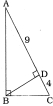
In $\Delta ABC$,$m \angle B = 90^{\circ}$ and $\overline{BD}$ is an altitude to the hypotenuse $AC$. If $AD = 9$ and $CD = 4$,find $BD$.
A
$10$
B
$6$
C
$15$
D
$12$
Solution
(B) In a right-angled triangle,the altitude drawn from the right-angle vertex to the hypotenuse divides the triangle into two triangles that are similar to the original triangle and to each other.
By the property of geometric mean in a right triangle,the altitude $BD$ to the hypotenuse $AC$ satisfies the relation:
$BD^2 = AD \times CD$
Given $AD = 9$ and $CD = 4$,we have:
$BD^2 = 9 \times 4$
$BD^2 = 36$
Taking the square root on both sides:
$BD = \sqrt{36} = 6$
Thus,the length of $BD$ is $6$.
0 likes
View Solution159
Medium
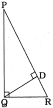
In $\Delta PQR$,$m \angle Q = 90^{\circ}$ and $\overline{QD}$ is an altitude. If $PD = 9RD$,prove that $PQ = 3QR$.
Solution
(N/A) Given: In $\Delta PQR$,$m \angle Q = 90^{\circ}$,$\overline{QD}$ is an altitude to the hypotenuse $PR$,and $PD = 9RD$.
To prove: $PQ = 3QR$.
Proof: In $\Delta PQR$,since $m \angle Q = 90^{\circ}$ and $\overline{QD} \perp \overline{PR}$,by the geometric mean theorem (or properties of similar triangles formed by an altitude to the hypotenuse):
$PQ^2 = PD \times PR$ and $QR^2 = RD \times PR$.
Dividing the two equations:
$\frac{PQ^2}{QR^2} = \frac{PD \times PR}{RD \times PR} = \frac{PD}{RD}$.
Substituting $PD = 9RD$ into the equation:
$\frac{PQ^2}{QR^2} = \frac{9RD}{RD} = 9$.
Taking the square root on both sides:
$\frac{PQ}{QR} = 3$.
Therefore,$PQ = 3QR$.
0 likes
View Solution160
MediumMCQ
In $\Delta ABC$,$m\angle B = 90^{\circ}$ and $\overline{BM}$ is an altitude to the hypotenuse $\overline{AC}$. If $AM = 12$ and $BM = 12$,find $AC$.
A
$24$
B
$30$
C
$12$
D
$18$
Solution
(A) In $\Delta ABC$,$\angle B = 90^{\circ}$ and $\overline{BM} \perp \overline{AC}$.
By the geometric mean theorem (or properties of similar triangles $\Delta AMB \sim \Delta BMC$),we have $BM^2 = AM \cdot MC$.
Given $AM = 12$ and $BM = 12$,we substitute these values into the equation:
$12^2 = 12 \cdot MC$
$144 = 12 \cdot MC$
$MC = \frac{144}{12} = 12$.
Since $AC = AM + MC$,we have:
$AC = 12 + 12 = 24$.
0 likes
View Solution161
MediumMCQ
In $\Delta ABC$,$m \angle B = 90^{\circ}$ and $\overline{BM}$ is an altitude to the hypotenuse $\overline{AC}$. If $AB = 2\sqrt{10}$ and $AM = 5$,find $CM$.
A
$5$
B
$10$
C
$15$
D
$3$
Solution
(D) In $\Delta ABC$,$\angle B = 90^{\circ}$ and $\overline{BM} \perp \overline{AC}$.
According to the geometric mean theorem (or properties of similar triangles),in a right-angled triangle,the altitude to the hypotenuse creates two triangles similar to the original triangle and to each other.
Specifically,$\Delta ABM \sim \Delta ACB$.
From the property of the altitude in a right triangle: $AB^2 = AM \cdot AC$.
Given $AB = 2\sqrt{10}$,we have $AB^2 = (2\sqrt{10})^2 = 4 \cdot 10 = 40$.
Given $AM = 5$,we substitute these values into the equation: $40 = 5 \cdot AC$.
Solving for $AC$: $AC = 40 / 5 = 8$.
Since $AC = AM + CM$,we have $8 = 5 + CM$.
Therefore,$CM = 8 - 5 = 3$.
0 likes
View Solution162
MediumMCQ
In $\Delta ABC$,$m\angle B = 90^{\circ}$ and $\overline{BM}$ is an altitude to the hypotenuse $\overline{AC}$. If $AM = 2x^2$ and $CM = 8x^2$,find $BM$,$AB$,and $BC$.
A
$BM = 4x^2, AB = 2\sqrt{5}x^2, BC = 4\sqrt{5}x^2$
B
$BM = 2x^2, AB = 4\sqrt{5}x^2, BC = 2\sqrt{5}x^2$
C
$BM = 8x^2, AB = 2\sqrt{5}x^2, BC = 4\sqrt{5}x^2$
D
$BM = 4x^2, AB = 4\sqrt{5}x^2, BC = 2\sqrt{5}x^2$
Solution
(A) In a right-angled triangle,the altitude to the hypotenuse divides the triangle into two triangles similar to the original triangle and to each other.
By the geometric mean theorem,$BM^2 = AM \cdot CM$.
Substituting the given values: $BM^2 = (2x^2)(8x^2) = 16x^4$.
Taking the square root: $BM = 4x^2$.
Using the Pythagorean theorem in $\Delta ABM$: $AB^2 = AM^2 + BM^2 = (2x^2)^2 + (4x^2)^2 = 4x^4 + 16x^4 = 20x^4$.
Thus,$AB = \sqrt{20x^4} = 2\sqrt{5}x^2$.
Using the Pythagorean theorem in $\Delta BCM$: $BC^2 = CM^2 + BM^2 = (8x^2)^2 + (4x^2)^2 = 64x^4 + 16x^4 = 80x^4$.
Thus,$BC = \sqrt{80x^4} = 4\sqrt{5}x^2$.
0 likes
View Solution163
MediumMCQ
In $\Delta PQR$, $m \angle Q = 90^{\circ}$ and $\overline{QM}$ is an altitude to the hypotenuse $PR$. If $QM = 14$ and $RM = 7$, find $PQ$. (in $\sqrt{5}$)
A
$30$
B
$25$
C
$14$
D
$20$
Solution
(C) In a right-angled triangle $\Delta PQR$ where $\angle Q = 90^{\circ}$, $\overline{QM}$ is the altitude to the hypotenuse $PR$.
By the geometric mean theorem for right triangles, the altitude to the hypotenuse divides the triangle into two triangles similar to the original triangle and to each other.
Specifically, $\Delta QMR \sim \Delta PMQ$.
From the similarity $\Delta QMR \sim \Delta PMQ$, we have the ratio of corresponding sides: $\frac{QM}{RM} = \frac{PM}{QM}$.
Substituting the given values: $\frac{14}{7} = \frac{PM}{14}$.
$PM = \frac{14 \times 14}{7} = 2 \times 14 = 28$.
Now, in the right-angled triangle $\Delta PMQ$, by the Pythagorean theorem: $PQ^2 = PM^2 + QM^2$.
$PQ^2 = 28^2 + 14^2$.
$PQ^2 = 784 + 196 = 980$.
$PQ = \sqrt{980} = \sqrt{196 \times 5} = 14 \sqrt{5}$.
0 likes
View Solution164
MediumMCQ
In $\Delta XYZ$,$m\angle Y = 90^{\circ}$ and $\overline{YM}$ is an altitude to the hypotenuse $\overline{XZ}$. If $YM = 12$ and $XM = 8$,find $XZ$.
A
$26$
B
$30$
C
$35$
D
$38$
Solution
(A) In a right-angled triangle $\Delta XYZ$ where $\angle Y = 90^{\circ}$,$\overline{YM}$ is the altitude to the hypotenuse $\overline{XZ}$.
According to the geometric mean theorem for right triangles,the altitude to the hypotenuse divides the triangle into two triangles similar to the original triangle and to each other.
Specifically,$YM^2 = XM \cdot MZ$.
Given $YM = 12$ and $XM = 8$,we substitute these values into the equation:
$12^2 = 8 \cdot MZ$
$144 = 8 \cdot MZ$
$MZ = 144 / 8 = 18$.
The length of the hypotenuse $XZ$ is the sum of the segments $XM$ and $MZ$:
$XZ = XM + MZ = 8 + 18 = 26$.
Therefore,the correct option is $A$.
0 likes
View Solution165
MediumMCQ
In $\Delta ABC$,$m \angle B = 90^{\circ}$ and $\overline{BM}$ is an altitude to the hypotenuse $\overline{AC}$. If $AM = 4$ and $CM = 5$,find $AB$ and $BM$.
A
$AB = 6, BM = 2\sqrt{5}$
B
$AB = 2\sqrt{5}, BM = 6$
C
$AB = 3, BM = 4$
D
$AB = 5, BM = 4$
Solution
(A) In a right-angled triangle,the altitude to the hypotenuse creates two triangles similar to the original triangle and to each other.
By the geometric mean theorem for the altitude: $BM^2 = AM \cdot CM$.
Substituting the given values: $BM^2 = 4 \cdot 5 = 20$.
Therefore,$BM = \sqrt{20} = 2\sqrt{5}$.
In $\Delta ABM$,by the Pythagorean theorem: $AB^2 = AM^2 + BM^2$.
$AB^2 = 4^2 + (2\sqrt{5})^2 = 16 + 20 = 36$.
Therefore,$AB = \sqrt{36} = 6$.
0 likes
View Solution166
MediumMCQ
In $\Delta ABC$,$m \angle B = 90^{\circ}$ and $\overline{BM}$ is an altitude to the hypotenuse $\overline{AC}$. If $AM = 12$ and $CM = 3$,find $BM$.
A
$10$
B
$15$
C
$6$
D
$8$
Solution
(C) In a right-angled triangle,the altitude drawn from the right-angle vertex to the hypotenuse divides the triangle into two triangles that are similar to the original triangle and to each other.
According to the geometric mean theorem,the altitude $\overline{BM}$ to the hypotenuse $\overline{AC}$ satisfies the relation: $BM^2 = AM \times CM$.
Given $AM = 12$ and $CM = 3$.
Substituting the values: $BM^2 = 12 \times 3 = 36$.
Taking the square root of both sides: $BM = \sqrt{36} = 6$.
According to the geometric mean theorem,the altitude $\overline{BM}$ to the hypotenuse $\overline{AC}$ satisfies the relation: $BM^2 = AM \times CM$.
Given $AM = 12$ and $CM = 3$.
Substituting the values: $BM^2 = 12 \times 3 = 36$.
Taking the square root of both sides: $BM = \sqrt{36} = 6$.
0 likes
View Solution167
MediumMCQ
In $\Delta ABC$,$m \angle B = 90^{\circ}$ and $\overline{BM}$ is an altitude to the hypotenuse $\overline{AC}$. If $AM = 4$ and $CM = 12$,find $AB$ and $BC$.
A
$AB = 8, BC = 8\sqrt{3}$
B
$AB = 4\sqrt{3}, BC = 8$
C
$AB = 8\sqrt{3}, BC = 8$
D
$AB = 4, BC = 12$
Solution
(A) In a right-angled triangle,the altitude to the hypotenuse creates two triangles similar to the original triangle and to each other. By the geometric mean theorem,$BM^2 = AM \cdot CM$.
Given $AM = 4$ and $CM = 12$,$BM^2 = 4 \cdot 12 = 48$,so $BM = \sqrt{48} = 4\sqrt{3}$.
In $\Delta ABM$,by the Pythagorean theorem,$AB^2 = AM^2 + BM^2 = 4^2 + (4\sqrt{3})^2 = 16 + 48 = 64$. Thus,$AB = \sqrt{64} = 8$.
In $\Delta CBM$,by the Pythagorean theorem,$BC^2 = CM^2 + BM^2 = 12^2 + (4\sqrt{3})^2 = 144 + 48 = 192$. Thus,$BC = \sqrt{192} = 8\sqrt{3}$.
0 likes
View Solution168
MediumMCQ
In $\Delta PQR$,$m \angle Q = 90^{\circ}$ and $\overline{QM}$ is an altitude to the hypotenuse $\overline{PR}$. If $QM = 4$ and $PR = 10$,find $PM$.
A
$1$ or $2$
B
$3$ or $9$
C
$5$ or $7$
D
$2$ or $8$
Solution
(D) In a right-angled triangle $\Delta PQR$ with $\angle Q = 90^{\circ}$,$\overline{QM}$ is the altitude to the hypotenuse $\overline{PR}$.
By the geometric mean theorem (or properties of similar triangles),we have $QM^2 = PM \cdot MR$.
Let $PM = x$. Since $PR = 10$,then $MR = 10 - x$.
Given $QM = 4$,we substitute these values into the equation:
$4^2 = x(10 - x)$
$16 = 10x - x^2$
$x^2 - 10x + 16 = 0$
Factoring the quadratic equation:
$(x - 2)(x - 8) = 0$
Thus,$x = 2$ or $x = 8$.
Therefore,$PM$ can be $2$ or $8$.
0 likes
View Solution169
MediumMCQ
In $\Delta PQR$,$m \angle Q = 90^{\circ}$ and $\overline{QM}$ is an altitude to the hypotenuse $PR$. If $QR = 9$ and $PR = 13.5$,find $RM$.
A
$5$
B
$8$
C
$6$
D
$20$
Solution
(C) In a right-angled triangle,if an altitude is drawn from the right-angle vertex to the hypotenuse,the triangle on either side of the altitude is similar to the original triangle and to each other.
Specifically,$\Delta RMQ \sim \Delta RQP$.
From the property of similar triangles,the ratio of corresponding sides is equal:
$\frac{RM}{RQ} = \frac{RQ}{RP}$.
Given $QR = 9$ and $PR = 13.5$.
Substituting the values into the equation:
$\frac{RM}{9} = \frac{9}{13.5}$.
$RM = \frac{9 \times 9}{13.5}$.
$RM = \frac{81}{13.5}$.
$RM = 6$.
0 likes
View Solution170
MediumMCQ
In $\Delta ABC$,$m\angle B = 90^{\circ}$ and $\overline{BE}$ is a median. If $AB = 15$ and $BE = 8.5$,find $BC$.
A
$10$
B
$8$
C
$15$
D
$20$
Solution
(B) In a right-angled triangle,the length of the median to the hypotenuse is half the length of the hypotenuse.
Here,$\overline{BE}$ is the median to the hypotenuse $\overline{AC}$ because $\angle B = 90^{\circ}$.
Therefore,$BE = \frac{1}{2} AC$.
Given $BE = 8.5$,we have $8.5 = \frac{1}{2} AC$,which implies $AC = 17$.
In $\Delta ABC$,by the Pythagorean theorem,$AB^2 + BC^2 = AC^2$.
Substituting the known values: $15^2 + BC^2 = 17^2$.
$225 + BC^2 = 289$.
$BC^2 = 289 - 225 = 64$.
$BC = \sqrt{64} = 8$.
0 likes
View Solution171
MediumMCQ
In an isosceles right-angled triangle, the length of the hypotenuse is $24$. Find the area of the triangle.
A
$360$
B
$250$
C
$144$
D
$120$
Solution
(C) Let the two equal sides of the isosceles right-angled triangle be $x$.
According to the Pythagorean theorem, $x^2 + x^2 = (\text{hypotenuse})^2$.
Given the hypotenuse is $24$, we have $2x^2 = 24^2$.
$2x^2 = 576$.
$x^2 = 288$.
The area of a right-angled triangle is given by $\frac{1}{2} \times \text{base} \times \text{height}$.
Here, base $= x$ and height $= x$, so Area $= \frac{1}{2} \times x \times x = \frac{1}{2}x^2$.
Substituting the value of $x^2$, we get Area $= \frac{1}{2} \times 288 = 144$.
0 likes
View Solution172
MediumMCQ
In $\Delta PQR, m\angle Q = 90^{\circ}$ and $\overline{QM}$ is a median. If $PQ = 20$ and $QR = 21$,find $QM$.
A
$19$
B
$20.5$
C
$14.5$
D
$35$
Solution
(C) In a right-angled triangle,the length of the median to the hypotenuse is half the length of the hypotenuse.
First,calculate the length of the hypotenuse $PR$ using the Pythagorean theorem: $PR^2 = PQ^2 + QR^2$.
$PR^2 = 20^2 + 21^2 = 400 + 441 = 841$.
$PR = \sqrt{841} = 29$.
Since $\overline{QM}$ is the median to the hypotenuse $PR$,its length is $QM = \frac{1}{2} \times PR$.
$QM = \frac{29}{2} = 14.5$.
First,calculate the length of the hypotenuse $PR$ using the Pythagorean theorem: $PR^2 = PQ^2 + QR^2$.
$PR^2 = 20^2 + 21^2 = 400 + 441 = 841$.
$PR = \sqrt{841} = 29$.
Since $\overline{QM}$ is the median to the hypotenuse $PR$,its length is $QM = \frac{1}{2} \times PR$.
$QM = \frac{29}{2} = 14.5$.
0 likes
View Solution173
Medium
In $\Delta GBS$,$m\angle B = 90^{\circ}$ and $\overline{BM}$ is an altitude to the hypotenuse $\overline{GS}$. Prove that $\frac{GB^{2}}{BS^{2}} = \frac{GM}{SM}$.
Solution
(A) In $\Delta GBS$,$\angle B = 90^{\circ}$ and $BM \perp GS$.
By the property of similar triangles in a right-angled triangle,when an altitude is drawn to the hypotenuse,the triangles formed on both sides of the altitude are similar to the original triangle and to each other.
Specifically,$\Delta GMB \sim \Delta GBS$ and $\Delta B M S \sim \Delta GBS$.
From $\Delta GMB \sim \Delta GBS$,we have $\frac{GB}{GS} = \frac{GM}{GB}$,which implies $GB^{2} = GM \cdot GS$ (Equation $1$).
From $\Delta BMS \sim \Delta GBS$,we have $\frac{BS}{GS} = \frac{SM}{BS}$,which implies $BS^{2} = SM \cdot GS$ (Equation $2$).
Dividing Equation $1$ by Equation $2$:
$\frac{GB^{2}}{BS^{2}} = \frac{GM \cdot GS}{SM \cdot GS} = \frac{GM}{SM}$.
Hence,the result is proved.
0 likes
View Solution174
Medium
In $\Delta PQR$,$m \angle Q = 90^{\circ}$ and $\overline{QD}$ is an altitude to the hypotenuse $\overline{PR}$. If $PQ = 3QR$,prove that $PD = 9RD$.
Solution
(N/A) $1$. In $\Delta PQR$,$\angle Q = 90^{\circ}$ and $\overline{QD} \perp \overline{PR}$.
$2$. By the property of similarity in right-angled triangles,$\Delta PDQ \sim \Delta PQR$ and $\Delta RDQ \sim \Delta RQP$.
$3$. Specifically,$\Delta PDQ \sim \Delta QDR$ is not directly applicable,but we use the property that in a right triangle,the altitude to the hypotenuse divides the triangle into two triangles similar to the original and to each other.
$4$. Thus,$\Delta PDQ \sim \Delta QDR$.
$5$. From the similarity $\Delta PDQ \sim \Delta QDR$,we have the ratio of corresponding sides: $\frac{PD}{QD} = \frac{QD}{RD} = \frac{PQ}{QR}$.
$6$. We are given $PQ = 3QR$,which implies $\frac{PQ}{QR} = 3$.
$7$. From $\frac{PD}{QD} = \frac{PQ}{QR}$,we get $PD = 3QD$.
$8$. From $\frac{QD}{RD} = \frac{PQ}{QR}$,we get $QD = 3RD$.
$9$. Substituting $QD = 3RD$ into $PD = 3QD$,we get $PD = 3(3RD) = 9RD$.
$10$. Hence,$PD = 9RD$ is proved.
0 likes
View Solution175
Medium
In $\Delta XYZ$,$m\angle Y = 90^{\circ}$ and $\overline{YM}$ is an altitude to the hypotenuse $\overline{XZ}$. If $XM = 16ZM$,prove that $XY = 4YZ$.
Solution
(N/A) In $\Delta XYZ$,$\angle Y = 90^{\circ}$ and $\overline{YM} \perp \overline{XZ}$.
According to the Geometric Mean Theorem (or properties of similar triangles),in a right-angled triangle,the altitude to the hypotenuse creates two triangles similar to the original triangle and to each other.
Specifically,$\Delta XMY \sim \Delta YMZ$.
From the similarity $\Delta XMY \sim \Delta YMZ$,we have the ratio of corresponding sides:
$\frac{XY}{YZ} = \frac{XM}{YM} = \frac{YM}{ZM}$.
From $\frac{XY}{YZ} = \frac{YM}{ZM}$,we get $YM^2 = XY \cdot ZM$ (not directly useful here).
Alternatively,using the property of the altitude in a right triangle:
$XY^2 = XM \cdot XZ$ and $YZ^2 = ZM \cdot XZ$.
Dividing these two equations:
$\frac{XY^2}{YZ^2} = \frac{XM \cdot XZ}{ZM \cdot XZ} = \frac{XM}{ZM}$.
Given $XM = 16ZM$,we substitute this into the ratio:
$\frac{XY^2}{YZ^2} = \frac{16ZM}{ZM} = 16$.
Taking the square root of both sides:
$\frac{XY}{YZ} = \sqrt{16} = 4$.
Therefore,$XY = 4YZ$.
0 likes
View Solution176
Medium
In $\Delta ABC$,$m\angle B = 90^\circ$ and $\overline{BM}$ is an altitude to the hypotenuse $\overline{AC}$. If $AM = 4CM$,prove that $AB = 2BC$.
Solution
(N/A) In $\Delta ABC$,$\angle B = 90^\circ$ and $\overline{BM} \perp \overline{AC}$.
By the property of geometric mean in a right-angled triangle,we have $\Delta AMB \sim \Delta BMC$.
Therefore,the ratio of their corresponding sides is equal: $\frac{AB}{BC} = \frac{AM}{BM} = \frac{BM}{CM}$.
From $\frac{AB}{BC} = \frac{BM}{CM}$,we get $BM = \frac{AB \cdot CM}{BC}$.
Also,from $\Delta AMB \sim \Delta ABC$,we have $\frac{AB}{AC} = \frac{AM}{AB}$,which implies $AB^2 = AM \cdot AC$.
Similarly,from $\Delta BMC \sim \Delta ABC$,we have $\frac{BC}{AC} = \frac{CM}{BC}$,which implies $BC^2 = CM \cdot AC$.
Dividing the two equations: $\frac{AB^2}{BC^2} = \frac{AM \cdot AC}{CM \cdot AC} = \frac{AM}{CM}$.
Given $AM = 4CM$,we substitute this into the ratio: $\frac{AB^2}{BC^2} = \frac{4CM}{CM} = 4$.
Taking the square root of both sides: $\frac{AB}{BC} = \sqrt{4} = 2$.
Thus,$AB = 2BC$.
0 likes
View Solution177
MediumMCQ
In $\Delta ABC$,$m \angle B = 90^{\circ}$ and $\overline{BD}$ is a median. If $m \angle C = 30^{\circ}$ and $AB = 5$,find $BD$.
A
$15$
B
$10$
C
$8$
D
$5$
Solution
(D) In $\Delta ABC$,we are given $m \angle B = 90^{\circ}$ and $m \angle C = 30^{\circ}$.
Since the sum of angles in a triangle is $180^{\circ}$,$m \angle A = 180^{\circ} - 90^{\circ} - 30^{\circ} = 60^{\circ}$.
In a $30^{\circ}-60^{\circ}-90^{\circ}$ triangle,the side opposite to $30^{\circ}$ is half the hypotenuse.
Here,$AB$ is opposite to $30^{\circ}$ (at $C$),so $AB = \frac{1}{2} AC$.
Given $AB = 5$,we have $5 = \frac{1}{2} AC$,which implies $AC = 10$.
In a right-angled triangle,the length of the median to the hypotenuse is half the length of the hypotenuse.
Therefore,$BD = \frac{1}{2} AC = \frac{1}{2} \times 10 = 5$.
0 likes
View Solution178
MediumMCQ
In $\Delta ABC$,$m \angle B = 90^\circ$ and $\overline{BM}$ is an altitude to the hypotenuse $AC$. If $BC = 2x + 2$,$CM = x + 1$,and $AC = 5x$,find the value of $x$.
A
$4$
B
$15$
C
$20$
D
$30$
Solution
(A) In a right-angled triangle $\Delta ABC$ with $\angle B = 90^\circ$,if $\overline{BM}$ is the altitude to the hypotenuse $AC$,then by the Geometric Mean Theorem (or properties of similar triangles $\Delta BMC \sim \Delta BCA$),we have the relation: $BC^2 = CM \cdot AC$.
Given $BC = 2x + 2$,$CM = x + 1$,and $AC = 5x$.
Substituting these values into the equation: $(2x + 2)^2 = (x + 1)(5x)$.
Expanding the left side: $(2(x + 1))^2 = 4(x + 1)^2 = 4(x^2 + 2x + 1)$.
So,$4(x^2 + 2x + 1) = 5x^2 + 5x$.
$4x^2 + 8x + 4 = 5x^2 + 5x$.
Rearranging the terms to form a quadratic equation: $x^2 - 3x - 4 = 0$.
Factoring the quadratic: $(x - 4)(x + 1) = 0$.
This gives $x = 4$ or $x = -1$.
Since $x$ represents a length component and $BC, CM, AC$ must be positive,we discard $x = -1$.
Therefore,$x = 4$.
0 likes
View Solution179
MediumMCQ
In $\Delta ABC$,$m \angle B = 90^{\circ}$ and $\overline{BM}$ is an altitude to the hypotenuse $\overline{AC}$. If $AM = 4$ and $CM = 5$,find $AB$,$BC$,and $BM$.
A
$AB = 6, BC = 3\sqrt{5}, BM = 2\sqrt{5}$
B
$AB = 3\sqrt{5}, BC = 6, BM = 2\sqrt{5}$
C
$AB = 6, BC = 2\sqrt{5}, BM = 3\sqrt{5}$
D
$AB = 2\sqrt{5}, BC = 6, BM = 3\sqrt{5}$
Solution
(A) In a right-angled triangle,the altitude to the hypotenuse creates two triangles similar to the original triangle and to each other.
By the geometric mean theorem for the altitude: $BM^2 = AM \cdot CM$.
Substituting the given values: $BM^2 = 4 \cdot 5 = 20$.
Therefore,$BM = \sqrt{20} = 2\sqrt{5}$.
Using the Pythagorean theorem in $\Delta ABM$: $AB^2 = AM^2 + BM^2 = 4^2 + (2\sqrt{5})^2 = 16 + 20 = 36$.
Therefore,$AB = \sqrt{36} = 6$.
Using the Pythagorean theorem in $\Delta CBM$: $BC^2 = CM^2 + BM^2 = 5^2 + (2\sqrt{5})^2 = 25 + 20 = 45$.
Therefore,$BC = \sqrt{45} = 3\sqrt{5}$.
0 likes
View Solution180
Medium
In $\Delta ABC$,$m \angle B = 90^{\circ}$ and $\overline{BE}$ is an altitude to the hypotenuse $\overline{AC}$. Prove that $\frac{AB^2}{BC^2} = \frac{AE}{CE}$.
Solution
(A) In $\Delta ABC$,$\angle B = 90^{\circ}$ and $BE \perp AC$.
By the property of similarity in right-angled triangles,if an altitude is drawn to the hypotenuse,the triangles on both sides of the altitude are similar to the whole triangle and to each other.
$1$. $\Delta ABE \sim \Delta ABC$ (by $AA$ similarity).
Therefore,$\frac{AB}{AC} = \frac{AE}{AB}$,which implies $AB^2 = AE \cdot AC$ --- $(1)$.
$2$. $\Delta CBE \sim \Delta ABC$ (by $AA$ similarity).
Therefore,$\frac{BC}{AC} = \frac{CE}{BC}$,which implies $BC^2 = CE \cdot AC$ --- $(2)$.
Dividing equation $(1)$ by equation $(2)$:
$\frac{AB^2}{BC^2} = \frac{AE \cdot AC}{CE \cdot AC}$.
Canceling $AC$ from the numerator and denominator,we get:
$\frac{AB^2}{BC^2} = \frac{AE}{CE}$.
Hence proved.
0 likes
View Solution181
Medium
In $\Delta PQR$,$m \angle Q = 90^{\circ}$ and $\overline{QD}$ is an altitude to the hypotenuse $PR$. If $PD = 25 DR$,prove that $PQ = 5 QR$.
Solution
(N/A) In $\Delta PQR$,$\angle Q = 90^{\circ}$ and $QD \perp PR$.
By the property of geometric mean in a right-angled triangle,we have $\Delta PDQ \sim \Delta QDR$.
From the similarity of triangles,the ratio of corresponding sides is equal: $\frac{PQ}{QR} = \frac{PD}{QD} = \frac{QD}{DR}$.
From $\frac{PQ}{QR} = \frac{QD}{DR}$,we get $PQ^2 = QR^2 \cdot \frac{PD}{DR}$.
Given $PD = 25 DR$,so $\frac{PD}{DR} = 25$.
Substituting this value,$PQ^2 = QR^2 \cdot 25$.
Taking the square root of both sides,we get $PQ = 5 QR$.
0 likes
View Solution182
Medium
In $\Delta PQR$,$m \angle Q = 90^{\circ}$ and $\overline{QD}$ is an altitude to the hypotenuse $\overline{PR}$. If $PQ = 4QR$,prove that $PD = 16RD$.
Solution
(N/A) $1$. In $\Delta PQR$,$\angle Q = 90^{\circ}$ and $\overline{QD} \perp \overline{PR}$.
$2$. By the property of similarity in right-angled triangles,$\Delta PDQ \sim \Delta QDR \sim \Delta PQR$.
$3$. From $\Delta PDQ \sim \Delta QDR$,we have the ratio of corresponding sides: $\frac{PD}{QD} = \frac{QD}{RD} = \frac{PQ}{QR}$.
$4$. From the ratio $\frac{PD}{QD} = \frac{PQ}{QR}$,we get $PD = QD \cdot \frac{PQ}{QR}$.
$5$. From the ratio $\frac{QD}{RD} = \frac{PQ}{QR}$,we get $QD = RD \cdot \frac{PQ}{QR}$.
$6$. Substituting $QD$ in the expression for $PD$: $PD = (RD \cdot \frac{PQ}{QR}) \cdot \frac{PQ}{QR} = RD \cdot (\frac{PQ}{QR})^2$.
$7$. Given $PQ = 4QR$,so $\frac{PQ}{QR} = 4$.
$8$. Therefore,$PD = RD \cdot (4)^2 = 16RD$.
0 likes
View Solution183
Medium
In $\Delta PQR$,$\overline{PM}$ is an altitude. If $PM^2 = QM \times RM$,prove that $\Delta PQR$ is a right-angled triangle.
Solution
(N/A) Given: In $\Delta PQR$,$\overline{PM} \perp \overline{QR}$ and $PM^2 = QM \times RM$.
Step $1$: From the given equation,we have $\frac{PM}{QM} = \frac{RM}{PM}$.
Step $2$: In $\Delta PMQ$ and $\Delta RMP$,$\angle PMQ = \angle RMP = 90^\circ$ (since $\overline{PM}$ is an altitude).
Step $3$: By the $SAS$ similarity criterion,$\Delta PMQ \sim \Delta RMP$.
Step $4$: Since the triangles are similar,their corresponding angles are equal: $\angle QPM = \angle PRM$ and $\angle PQM = \angle RPM$.
Step $5$: In $\Delta PQR$,the sum of angles is $180^\circ$. Thus,$\angle P + \angle Q + \angle R = 180^\circ$.
Step $6$: Substituting the angles,we get $\angle QPM + \angle RPM + \angle Q + \angle R = 180^\circ$.
Step $7$: Since $\angle QPM = \angle R$ and $\angle RPM = \angle Q$,we have $\angle R + \angle Q + \angle Q + \angle R = 180^\circ$,which simplifies to $2(\angle Q + \angle R) = 180^\circ$,so $\angle Q + \angle R = 90^\circ$.
Step $8$: Therefore,$\angle P = 180^\circ - 90^\circ = 90^\circ$. Hence,$\Delta PQR$ is a right-angled triangle.
0 likes
View Solution184
Medium
In $\Delta ABC$,$m\angle B = 90^{\circ}$ and $\overline{BD}$ is an altitude to the hypotenuse $\overline{AC}$. If $AC = 5 CD$,prove that $BD = 2 CD$.
Solution
(N/A) In $\Delta ABC$,$\angle B = 90^{\circ}$ and $\overline{BD} \perp \overline{AC}$.
By the property of geometric mean in a right-angled triangle,we have $BD^2 = AD \cdot CD$.
Given $AC = 5 CD$. Since $AC = AD + CD$,we have $AD + CD = 5 CD$,which implies $AD = 4 CD$.
Substituting $AD = 4 CD$ into the geometric mean equation:
$BD^2 = (4 CD) \cdot CD$
$BD^2 = 4 CD^2$
Taking the square root of both sides:
$BD = \sqrt{4 CD^2} = 2 CD$.
Thus,it is proved that $BD = 2 CD$.
0 likes
View Solution185
EasyMCQ
In $\Delta ABC$,$m\angle B = 90^{\circ}$ and $\overline{BM}$ is an altitude to the hypotenuse $\overline{AC}$. If $AC = 25$ and $AM = 16$,then $BM = \dots$
A
$9$
B
$20$
C
$12$
D
$10$
Solution
(C) In a right-angled triangle,the altitude to the hypotenuse divides the triangle into two triangles that are similar to the original triangle and to each other.
Specifically,$\Delta AMB \sim \Delta BMC$.
From the similarity $\Delta AMB \sim \Delta ABC$,we have the property: $BM^2 = AM \cdot MC$.
Given $AC = 25$ and $AM = 16$,we find $MC = AC - AM = 25 - 16 = 9$.
Substituting these values into the formula: $BM^2 = 16 \cdot 9$.
$BM^2 = 144$.
Taking the square root,$BM = \sqrt{144} = 12$.
0 likes
View Solution186
MediumMCQ
In $\Delta ABC$,$m \angle B = 90^{\circ}$ and $\overline{BM}$ is an altitude to the hypotenuse $\overline{AC}$. Then,$\angle BAM \cong \ldots$
A
$\angle BMC$
B
$\angle MBC$
C
$\angle MCB$
D
$\angle ABM$
Solution
(B) In $\Delta ABC$,$\angle B = 90^{\circ}$ and $\overline{BM} \perp \overline{AC}$.
Consider $\Delta ABM$ and $\Delta ABC$.
In $\Delta ABM$,$\angle AMB = 90^{\circ}$. Thus,$\angle BAM + \angle ABM = 90^{\circ}$.
In $\Delta ABC$,$\angle B = 90^{\circ}$. Thus,$\angle BAM + \angle C = 90^{\circ}$.
Comparing these two equations,we get $\angle ABM = \angle C$ (or $\angle MCB$).
Also,in $\Delta BMC$,$\angle BMC = 90^{\circ}$,so $\angle MBC + \angle C = 90^{\circ}$.
Since $\angle BAM + \angle C = 90^{\circ}$ and $\angle MBC + \angle C = 90^{\circ}$,it follows that $\angle BAM = \angle MBC$.
0 likes
View Solution187
MediumMCQ
In $\Delta PQR$,$m \angle Q = 90^{\circ}$ and $\overline{QD}$ is an altitude. If $PD = 9 DR$,then $PQ = \ldots \ldots \ldots \times QR$.
A
$9$
B
$81$
C
$6$
D
$3$
Solution
(D) In $\Delta PQR$,$\angle Q = 90^{\circ}$ and $\overline{QD} \perp \overline{PR}$.
By the property of geometric mean in a right-angled triangle,we have $QD^2 = PD \times DR$.
Also,in $\Delta PQD$ and $\Delta PQR$,by similarity criteria,we have $PQ^2 = PD \times PR$.
Given $PD = 9 DR$,we can write $PR = PD + DR = 9 DR + DR = 10 DR$.
Substituting these into the expression for $PQ^2$:
$PQ^2 = (9 DR) \times (10 DR) = 90 DR^2$.
Similarly,in $\Delta QDR$ and $\Delta PQR$,we have $QR^2 = DR \times PR$.
$QR^2 = DR \times (10 DR) = 10 DR^2$.
Now,find the ratio $\frac{PQ^2}{QR^2} = \frac{90 DR^2}{10 DR^2} = 9$.
Taking the square root on both sides,we get $\frac{PQ}{QR} = \sqrt{9} = 3$.
Therefore,$PQ = 3 \times QR$.
0 likes
View Solution188
MediumMCQ
In $\Delta ABC$,$m \angle B = 90^{\circ}$ and $\overline{BM}$ is an altitude to the hypotenuse $AC$. Then,$AB$ is the geometric mean of.......
A
$AM$ and $CM$
B
$AM$ and $AC$
C
$CM$ and $AC$
D
$BM$ and $AC$
Solution
(B) In a right-angled triangle $\Delta ABC$ where $\angle B = 90^{\circ}$ and $\overline{BM} \perp \overline{AC}$,the triangle is divided into two triangles $\Delta AMB$ and $\Delta BMC$ which are similar to the original triangle $\Delta ABC$ and to each other.
By the property of similarity,$\Delta AMB \sim \Delta ABC$.
This implies that the ratio of corresponding sides is equal: $\frac{AM}{AB} = \frac{AB}{AC}$.
Cross-multiplying gives $AB^2 = AM \cdot AC$.
Therefore,$AB$ is the geometric mean of $AM$ and $AC$.
By the property of similarity,$\Delta AMB \sim \Delta ABC$.
This implies that the ratio of corresponding sides is equal: $\frac{AM}{AB} = \frac{AB}{AC}$.
Cross-multiplying gives $AB^2 = AM \cdot AC$.
Therefore,$AB$ is the geometric mean of $AM$ and $AC$.
0 likes
View Solution189
MediumMCQ
In $\Delta ABC$,$m \angle B = 90^{\circ}$ and $\overline{BM}$ is an altitude to the hypotenuse $AC$. Then,$BC$ is the geometric mean of..........
A
$BM$ and $AC$
B
$AM$ and $CM$
C
$CM$ and $AC$
D
$AM$ and $AC$
Solution
(C) In a right-angled triangle $\Delta ABC$ where $\angle B = 90^{\circ}$,if $\overline{BM}$ is the altitude to the hypotenuse $AC$,then by the properties of similar triangles $(\Delta BMC \sim \Delta BCA)$:
$\frac{BC}{AC} = \frac{MC}{BC}$
Cross-multiplying gives:
$BC^2 = MC \cdot AC$
This implies that $BC$ is the geometric mean of $CM$ and $AC$.
$\frac{BC}{AC} = \frac{MC}{BC}$
Cross-multiplying gives:
$BC^2 = MC \cdot AC$
This implies that $BC$ is the geometric mean of $CM$ and $AC$.
0 likes
View Solution190
MediumMCQ
In $\Delta ABC$,$m\angle B = 90^{\circ}$ and $\overline{BM}$ is an altitude to the hypotenuse $\overline{AC}$. If $AM = 8$ and $CM = 2$,then $BM = \ldots$
A
$2$
B
$8$
C
$6$
D
$4$
Solution
(D) In a right-angled triangle,the altitude drawn to the hypotenuse divides the triangle into two triangles that are similar to the original triangle and to each other.
Specifically,$\Delta AMB \sim \Delta BMC$.
From the similarity of these triangles,we have the ratio of corresponding sides:
$\frac{AM}{BM} = \frac{BM}{CM}$.
This leads to the geometric mean theorem: $BM^2 = AM \times CM$.
Given $AM = 8$ and $CM = 2$,we substitute these values into the equation:
$BM^2 = 8 \times 2 = 16$.
Taking the square root of both sides,we get $BM = \sqrt{16} = 4$.
Therefore,the length of $BM$ is $4$.
0 likes
View Solution191
MediumMCQ
In $\Delta ABC$,$m \angle B = 90^{\circ}$ and $\overline{BM}$ is an altitude to the hypotenuse $\overline{AC}$. If $AM = 4$ and $CM = 6$,then $BM = \dots$
A
$2$
B
$\sqrt{6}$
C
$2\sqrt{6}$
D
$24$
Solution
(C) In a right-angled triangle,the altitude drawn to the hypotenuse divides the triangle into two triangles that are similar to the original triangle and to each other.
Specifically,$\Delta AMB \sim \Delta BMC$.
From the property of similarity,the ratio of corresponding sides is equal:
$\frac{AM}{BM} = \frac{BM}{CM}$.
This implies $BM^2 = AM \times CM$.
Given $AM = 4$ and $CM = 6$,we have:
$BM^2 = 4 \times 6 = 24$.
Taking the square root of both sides:
$BM = \sqrt{24} = \sqrt{4 \times 6} = 2\sqrt{6}$.
0 likes
View Solution192
EasyMCQ
In $\Delta PQR$,$\angle P$ is a right angle and $\overline{PX}$ is an altitude. If $QX = 4$ and $RX = 5$,then $PQ = \ldots \ldots$
A
$6$
B
$3$
C
$12$
D
$16$
Solution
(A) In $\Delta PQR$,$\angle P = 90^{\circ}$ and $\overline{PX} \perp \overline{QR}$.
According to the geometric mean theorem (or property of altitude to the hypotenuse),in a right-angled triangle,the altitude to the hypotenuse divides the triangle into two triangles that are similar to the original triangle and to each other.
Specifically,$\Delta QXP \sim \Delta QPR$ and $\Delta PXR \sim \Delta QPR$.
From the similarity $\Delta QXP \sim \Delta QPR$,we have $\frac{QX}{PQ} = \frac{PQ}{QR}$.
Thus,$PQ^2 = QX \cdot QR$.
Given $QX = 4$ and $RX = 5$,we have $QR = QX + RX = 4 + 5 = 9$.
Substituting these values,$PQ^2 = 4 \cdot 9 = 36$.
Therefore,$PQ = \sqrt{36} = 6$.
0 likes
View Solution193
MediumMCQ
If $\Delta XYZ \sim \Delta DEF$ for the correspondence $XYZ \leftrightarrow EFD$.
If $m \angle X : m \angle Y : m \angle Z = 2 : 3 : 5$,then in $\Delta DEF$,$\ldots \ldots$ is a right angle.
If $m \angle X : m \angle Y : m \angle Z = 2 : 3 : 5$,then in $\Delta DEF$,$\ldots \ldots$ is a right angle.
A
$\angle D$
B
$\angle E$
C
$\angle F$
D
$\angle E$ or $\angle F$
Solution
(A) In $\Delta XYZ$,the ratio of angles is $m \angle X : m \angle Y : m \angle Z = 2 : 3 : 5$.
Let the angles be $2k, 3k, 5k$.
Since the sum of angles in a triangle is $180^{\circ}$,we have $2k + 3k + 5k = 180^{\circ}$,which gives $10k = 180^{\circ}$,so $k = 18^{\circ}$.
Thus,$m \angle X = 2(18^{\circ}) = 36^{\circ}$,$m \angle Y = 3(18^{\circ}) = 54^{\circ}$,and $m \angle Z = 5(18^{\circ}) = 90^{\circ}$.
The correspondence $XYZ \leftrightarrow EFD$ is a similarity,which implies $\Delta XYZ \sim \Delta EFD$.
Therefore,the corresponding angles are equal: $m \angle X = m \angle E$,$m \angle Y = m \angle F$,and $m \angle Z = m \angle D$.
Since $m \angle Z = 90^{\circ}$,it follows that $m \angle D = 90^{\circ}$.
Thus,$\angle D$ is a right angle.
0 likes
View Solution194
DifficultMCQ
$\Delta ABC \sim \Delta XYZ$ for the correspondence $ABC \leftrightarrow ZXY$. If $AB = 12, BC = 8, CA = 10$ and $ZX = 10$,then $XY + YZ = \ldots$
A
$18$
B
$16$
C
$15$
D
$20$
Solution
(C) Given that $\Delta ABC \sim \Delta XYZ$ under the correspondence $ABC \leftrightarrow ZXY$.
This implies the ratio of corresponding sides is equal:
$\frac{AB}{ZX} = \frac{BC}{XY} = \frac{CA}{YZ}$.
From the properties of ratios,we have $\frac{AB}{ZX} = \frac{BC + CA}{XY + YZ}$.
Substituting the given values: $AB = 12, BC = 8, CA = 10, ZX = 10$.
$\frac{12}{10} = \frac{8 + 10}{XY + YZ}$.
$\frac{6}{5} = \frac{18}{XY + YZ}$.
$XY + YZ = \frac{18 \times 5}{6} = 3 \times 5 = 15$.
Thus,$XY + YZ = 15$.
0 likes
View Solution195
MediumMCQ
The areas of two similar triangles are $25$ and $16$. Then,the ratio of their perimeters is $\ldots \ldots \ldots \ldots$
A
$8: 5$
B
$5: 4$
C
$25: 16$
D
$5: 8$
Solution
(B) For two similar triangles,the ratio of their areas is equal to the square of the ratio of their corresponding sides.
Let the areas be $A_1 = 25$ and $A_2 = 16$.
Let the corresponding sides be $s_1$ and $s_2$.
Then,$\frac{A_1}{A_2} = (\frac{s_1}{s_2})^2$.
$\frac{25}{16} = (\frac{s_1}{s_2})^2$.
Taking the square root on both sides,$\frac{s_1}{s_2} = \sqrt{\frac{25}{16}} = \frac{5}{4}$.
The ratio of the perimeters of two similar triangles is equal to the ratio of their corresponding sides.
Therefore,the ratio of their perimeters is $5: 4$.
0 likes
View Solution196
MediumMCQ
If $\Delta ABC \sim \Delta PQR$ under the correspondence $ABC \leftrightarrow PQR$. If $AB = 12$,$\text{Area}(\Delta ABC) = 36$,and $\text{Area}(\Delta PQR) = 64$,then $PQ = \ldots$
A
$18$
B
$24$
C
$16$
D
$\frac{64}{3}$
Solution
(C) Given that $\Delta ABC \sim \Delta PQR$ under the correspondence $ABC \leftrightarrow PQR$.
According to the theorem of areas of similar triangles,the ratio of the areas of two similar triangles is equal to the square of the ratio of their corresponding sides.
Therefore,$\frac{\text{Area}(\Delta ABC)}{\text{Area}(\Delta PQR)} = \left(\frac{AB}{PQ}\right)^2$.
Substituting the given values: $\frac{36}{64} = \left(\frac{12}{PQ}\right)^2$.
Taking the square root on both sides: $\sqrt{\frac{36}{64}} = \frac{12}{PQ}$.
$\frac{6}{8} = \frac{12}{PQ}$.
Simplifying the fraction: $\frac{3}{4} = \frac{12}{PQ}$.
Cross-multiplying: $3 \times PQ = 12 \times 4$.
$3 \times PQ = 48$.
$PQ = \frac{48}{3} = 16$.
0 likes
View Solution197
MediumMCQ
If $\Delta ABC \sim \Delta XYZ$ for the correspondence $ABC \leftrightarrow XYZ$. If $\text{Area}(\Delta ABC) = 72$,$BC = 6$,and $YZ = 10$,then $\text{Area}(\Delta XYZ) = \dots$
A
$100$
B
$300$
C
$120$
D
$200$
Solution
(D) Given that $\Delta ABC \sim \Delta XYZ$ for the correspondence $ABC \leftrightarrow XYZ$.
According to the theorem of areas of similar triangles,the ratio of the areas of two similar triangles is equal to the square of the ratio of their corresponding sides.
Therefore,$\frac{\text{Area}(\Delta ABC)}{\text{Area}(\Delta XYZ)} = \left(\frac{BC}{YZ}\right)^2$.
Substituting the given values: $\frac{72}{\text{Area}(\Delta XYZ)} = \left(\frac{6}{10}\right)^2$.
$\frac{72}{\text{Area}(\Delta XYZ)} = \frac{36}{100}$.
$\text{Area}(\Delta XYZ) = \frac{72 \times 100}{36}$.
$\text{Area}(\Delta XYZ) = 2 \times 100 = 200$.
0 likes
View Solution198
MediumMCQ
In $\Delta ABC$,$D$,$E$,and $F$ are the midpoints of $\overline{AB}$,$\overline{BC}$,and $\overline{CA}$ respectively. Then the correspondence $DEF \leftrightarrow \dots$ is a similarity.
A
$ABC$
B
$BCA$
C
$CAB$
D
$CBA$
Solution
(C) In $\Delta ABC$,$D$,$E$,and $F$ are the midpoints of $\overline{AB}$,$\overline{BC}$,and $\overline{CA}$ respectively.
By the Midpoint Theorem,$EF \parallel AB$ and $EF = \frac{1}{2} AB$,$DF \parallel BC$ and $DF = \frac{1}{2} BC$,and $DE \parallel AC$ and $DE = \frac{1}{2} AC$.
Therefore,$\frac{DE}{AC} = \frac{EF}{AB} = \frac{DF}{BC} = \frac{1}{2}$.
By the $SSS$ similarity criterion,$\Delta DEF \sim \Delta CAB$ (since $D$ corresponds to $C$,$E$ corresponds to $A$,and $F$ corresponds to $B$).
Thus,the correspondence $DEF \leftrightarrow CAB$ is a similarity.

0 likes
View Solution199
MediumMCQ
In $\Delta ABC$,$m \angle B = 90^{\circ}$ and $\overline{BD}$ is an altitude to the hypotenuse $\overline{AC}$. Then the correspondence $ADB \leftrightarrow \ldots$ between $\Delta ADB$ and $\Delta BDC$ is a similarity.
A
$BDC$
B
$CDB$
C
$BCD$
D
$CBD$
Solution
(A) In $\Delta ADB$ and $\Delta BDC$:
$\angle ADB = \angle BDC = 90^{\circ}$ (since $\overline{BD} \perp \overline{AC}$).
In $\Delta ABC$,$\angle A + \angle C = 90^{\circ}$.
In $\Delta ADB$,$\angle A + \angle ABD = 90^{\circ}$.
Therefore,$\angle ABD = \angle C$.
By the $AA$ similarity criterion,the correspondence $A \leftrightarrow B$,$D \leftrightarrow D$,and $B \leftrightarrow C$ holds.
Thus,$\Delta ADB \sim \Delta BDC$ is incorrect; the correct correspondence is $\Delta ADB \sim \Delta BDC$ is not the standard notation,but based on the vertices,$\Delta ADB \sim \Delta BDC$ implies $A \leftrightarrow B, D \leftrightarrow D, B \leftrightarrow C$.
Looking at the options,the correspondence $ADB \leftrightarrow BDC$ is the correct similarity.

0 likes
View Solution200
MediumMCQ
In $\Delta ABC$,the correspondences $ABC \leftrightarrow BAC$ and $ABC \leftrightarrow ACB$ are similarities. Then,$\Delta ABC$ is a/an $\ldots \ldots \ldots \ldots$ triangle.
A
equilateral
B
isosceles
C
scalene
D
right angled
Solution
(A) Given that the correspondences $ABC \leftrightarrow BAC$ and $ABC \leftrightarrow ACB$ are similarities.
From $ABC \leftrightarrow BAC$,we have $\angle A = \angle B$,$\angle B = \angle A$,and $\angle C = \angle C$.
From $ABC \leftrightarrow ACB$,we have $\angle A = \angle A$,$\angle B = \angle C$,and $\angle C = \angle B$.
Combining these,we get $\angle A = \angle B$ and $\angle B = \angle C$.
Therefore,$\angle A = \angle B = \angle C$.
Since all three angles are equal,the triangle must be equiangular.
An equiangular triangle is always an equilateral triangle.
Thus,$\Delta ABC$ is an equilateral triangle.
0 likes
View SolutionTriangles — Criteria for Similarity of Triangles · Frequently Asked Questions
1Are these Triangles questions useful for JEE and NEET?
Yes. All questions in this section are mapped to JEE Main and NEET exam patterns. Previous year questions from JEE Main, NEET, GUJCET and state-level exams are included with full solutions.
2Can I switch to Hindi or Gujarati for these questions?
Yes. Use the language tabs in the hero section or the sidebar to view the same questions and solutions in English, Hindi or Gujarati.
3How do I generate a question paper from this subtopic?
Use the Vedclass Exam Paper Generator — select the chapter and subtopic, set difficulty, and generate Sets A, B, C, D automatically. First 3 chapters of every subject are free.
Vedclass Products
For Students
Vedclass Test Series
Mock tests in real JEE/NEET style with performance analysis. 5-day free trial.
Start Free TrialFor Teachers
Exam Paper Generator
Generate Set A/B/C/D papers from this chapter in 2 minutes. 3 chapters free.
Try FreeFor Institutes
Online Exam Module
Live online exams with unlimited students, 360° analytics & white-label branding.
See DemoFor Teachers & Institutes
Generate a Triangles Exam Paper in 2 Minutes
Select subtopic & difficulty — Sets A, B, C, D auto-generated with No Repeat logic.
First 3 chapters of every subject are free — no payment required.