
A English
Chemical Properties of Carbon Compounds Questions in English
Class 10 Science · Carbon and its Compounds · Chemical Properties of Carbon Compounds
54+
Questions
English
Language
100%
With Solutions
Showing 50 of 54 questions in English
1
EasyMCQ
While cooking,if the bottom of the vessel is getting blackened on the outside,it means that
A
the food is not cooked completely.
B
the fuel is wet.
C
the fuel is burning completely.
D
the fuel is not burning completely.
Solution
(D) When fuel does not burn completely,it produces soot (carbon particles) due to incomplete combustion. This soot deposits on the bottom of the cooking vessel,causing it to turn black.
0 likes
View Solution2
Medium
Why are carbon and its compounds used as fuels for most applications?
Solution
(N/A) Most carbon compounds release a significant amount of heat and light when burned in air.
Saturated hydrocarbons burn with a clean flame and produce no smoke.
Carbon compounds used as fuels possess high calorific values,meaning they release a large amount of energy per unit mass.
Due to these properties,carbon and its compounds are widely used as fuels for most applications.
Saturated hydrocarbons burn with a clean flame and produce no smoke.
Carbon compounds used as fuels possess high calorific values,meaning they release a large amount of energy per unit mass.
Due to these properties,carbon and its compounds are widely used as fuels for most applications.
0 likes
View Solution3
Medium
What is hydrogenation? What is its industrial application?
Solution
(N/A) Hydrogenation is the chemical process of adding hydrogen to a molecule. In organic chemistry,it typically involves the addition of hydrogen to unsaturated hydrocarbons (containing double or triple bonds) in the presence of catalysts like palladium $(Pd)$ or nickel $(Ni)$ to produce saturated hydrocarbons.
The general reaction is:
$R_2C=CR_2 + H_2 \xrightarrow{Ni \text{ catalyst}} R_2CH-CHR_2$
Its primary industrial application is the hydrogenation of vegetable oils. Vegetable oils contain long chains of unsaturated fatty acids. By hydrogenating these oils in the presence of a nickel catalyst,they are converted into saturated fats,which are solid at room temperature,commonly known as vanaspati ghee (hydrogenated vegetable fat).
0 likes
View Solution4
MediumMCQ
Which of the following hydrocarbons undergo addition reactions:
$C_{2}H_{6}, C_{3}H_{8}, C_{3}H_{6}, C_{2}H_{2}$ and $CH_{4}$?
$C_{2}H_{6}, C_{3}H_{8}, C_{3}H_{6}, C_{2}H_{2}$ and $CH_{4}$?
A
$C_{2}H_{6}$ and $C_{3}H_{8}$
B
$C_{3}H_{6}$ and $C_{2}H_{2}$
C
$CH_{4}$ and $C_{2}H_{6}$
D
$C_{2}H_{2}$ and $CH_{4}$
Solution
(B) Addition reactions are characteristic of unsaturated hydrocarbons,which contain at least one double or triple bond between carbon atoms.
$1$. $C_{2}H_{6}$ (Ethane) and $C_{3}H_{8}$ (Propane) are alkanes (saturated hydrocarbons).
$2$. $CH_{4}$ (Methane) is an alkane (saturated hydrocarbon).
$3$. $C_{3}H_{6}$ (Propene) is an alkene (unsaturated hydrocarbon).
$4$. $C_{2}H_{2}$ (Ethyne) is an alkyne (unsaturated hydrocarbon).
Therefore,$C_{3}H_{6}$ and $C_{2}H_{2}$ undergo addition reactions.
0 likes
View Solution5
Easy
Give a test that can be used to differentiate between saturated and unsaturated hydrocarbons.
Solution
(N/A) The bromine water test is commonly used to differentiate between saturated and unsaturated hydrocarbons.
When bromine water (a reddish-brown liquid) is added to an unsaturated hydrocarbon,the bromine reacts with the double or triple bonds,causing the reddish-brown color to disappear (decolorize).
In contrast,saturated hydrocarbons do not react with bromine water under normal conditions,so the reddish-brown color remains unchanged.
2 likes
View Solution6
EasyMCQ
Electrical wires have a coating of an insulating material. The material generally used is
A
$PVC$
B
Graphite
C
Sulphur
D
All can be used
Solution
(A) Electrical wires are coated with insulating materials to prevent electric shocks and short circuits.
$PVC$ ($Polyvinyl$ $Chloride$) is a widely used plastic polymer that acts as an excellent electrical insulator.
Graphite is a conductor of electricity,and Sulphur is a brittle non-metal that does not possess the flexible,insulating properties required for wire coating.
Therefore,$PVC$ is the correct material used for this purpose.
0 likes
View Solution7
MediumMCQ
$CH_3-CH_2-OH \xrightarrow{\text{Alkaline } KMnO_4 + \text{Heat}} CH_3-COOH$
In the above given reaction,alkaline $KMnO_4$ acts as:
In the above given reaction,alkaline $KMnO_4$ acts as:
A
reducing agent
B
oxidising agent
C
catalyst
D
dehydrating agent
Solution
(B) In the given reaction,ethanol $(CH_3-CH_2-OH)$ is converted into ethanoic acid $(CH_3-COOH)$.
This process involves the addition of oxygen to the alcohol group.
Alkaline $KMnO_4$ (Potassium permanganate) is a strong oxidizing agent that provides oxygen for this oxidation reaction.
Therefore,it acts as an oxidising agent.
This process involves the addition of oxygen to the alcohol group.
Alkaline $KMnO_4$ (Potassium permanganate) is a strong oxidizing agent that provides oxygen for this oxidation reaction.
Therefore,it acts as an oxidising agent.
0 likes
View Solution8
MediumMCQ
Oils on treating with hydrogen in the presence of palladium or nickel catalyst form fats. This is an example of
A
Displacement reaction
B
Substitution reaction
C
Addition reaction
D
Oxidation reaction
Solution
(C) The process of converting unsaturated vegetable oils into saturated fats by reacting them with hydrogen in the presence of a catalyst like nickel $(Ni)$ or palladium $(Pd)$ is known as hydrogenation.
In this reaction,hydrogen atoms are added across the carbon-carbon double bonds $(C=C)$ of the unsaturated oil molecules to form single bonds $(C-C)$.
Since hydrogen is being added to the reactant to form a new product,this is classified as an addition reaction.
In this reaction,hydrogen atoms are added across the carbon-carbon double bonds $(C=C)$ of the unsaturated oil molecules to form single bonds $(C-C)$.
Since hydrogen is being added to the reactant to form a new product,this is classified as an addition reaction.
0 likes
View Solution9
EasyMCQ
Chlorine reacts with saturated hydrocarbons at room temperature in the:
A
presence of sunlight
B
absence of sunlight
C
presence of water
D
presence of hydrochloric acid
Solution
(A) Saturated hydrocarbons (alkanes) are generally unreactive in most conditions. However,they undergo substitution reactions with halogens like chlorine in the presence of sunlight (ultraviolet light).
This reaction is known as a free-radical substitution reaction.
For example,methane reacts with chlorine in the presence of sunlight to form chloromethane and hydrogen chloride: $CH_4 + Cl_2 \xrightarrow{sunlight} CH_3Cl + HCl$.
This reaction is known as a free-radical substitution reaction.
For example,methane reacts with chlorine in the presence of sunlight to form chloromethane and hydrogen chloride: $CH_4 + Cl_2 \xrightarrow{sunlight} CH_3Cl + HCl$.
0 likes
View Solution10
Easy
Unsaturated hydrocarbons contain multiple bonds between two $C$ atoms and show addition reactions. Give the test to distinguish ethane from ethene.
Solution
(N/A) Ethane $(C_2H_6)$ is a saturated hydrocarbon,while ethene $(C_2H_4)$ is an unsaturated hydrocarbon.
$1$. Bromine Water Test: When ethene is passed through bromine water (reddish-brown color),it reacts to form $1,2-$dibromoethane,causing the bromine water to decolorize. Ethane does not react with bromine water,so the color remains unchanged.
$2$. Baeyer's Test: Ethene reacts with alkaline $KMnO_4$ (purple color) to form ethylene glycol,causing the purple color to disappear. Ethane does not react with alkaline $KMnO_4$.
0 likes
View Solution11
Medium
Name the reaction which is commonly used in the conversion of vegetable oils to fats. Explain the reaction involved in detail.
Solution
(N/A) The reaction used for the conversion of vegetable oils to fats is known as $Hydrogenation$.
$Hydrogenation$ is a chemical reaction in which hydrogen gas is added to unsaturated hydrocarbons (like vegetable oils containing double bonds) in the presence of a catalyst,such as $Nickel$ $(Ni)$,$Palladium$ $(Pd)$,or $Platinum$ $(Pt)$,to form saturated hydrocarbons (fats).
General reaction:
$R_2C=CR_2 + H_2 \xrightarrow{Ni \text{ catalyst}} R_2CH-CHR_2$
In this process,the $C=C$ double bond in the unsaturated oil molecule breaks,and two hydrogen atoms are added across the carbons,converting the liquid oil into a solid or semi-solid fat.
0 likes
View Solution12
Medium
How would you bring about the following conversions? Name the process and write the reaction involved.
$(a)$ Ethanol to ethene.
$(b)$ Propanol to propanoic acid.
Write the reactions.
$(a)$ Ethanol to ethene.
$(b)$ Propanol to propanoic acid.
Write the reactions.
Solution
(N/A) This conversion is achieved by the dehydration of ethanol using hot concentrated $H_2SO_4$,which acts as a dehydrating agent.
Reaction: $CH_3CH_2OH \xrightarrow[conc. H_2SO_4]{Hot} CH_2=CH_2 + H_2O$
$(b)$ This conversion is achieved by the oxidation of propanol using an oxidizing agent such as alkaline $KMnO_4$ or acidified $K_2Cr_2O_7$.
Reaction: $CH_3CH_2CH_2OH \xrightarrow[Heat]{Alk. KMnO_4} CH_3CH_2COOH$
Reaction: $CH_3CH_2OH \xrightarrow[conc. H_2SO_4]{Hot} CH_2=CH_2 + H_2O$
$(b)$ This conversion is achieved by the oxidation of propanol using an oxidizing agent such as alkaline $KMnO_4$ or acidified $K_2Cr_2O_7$.
Reaction: $CH_3CH_2CH_2OH \xrightarrow[Heat]{Alk. KMnO_4} CH_3CH_2COOH$
0 likes
View Solution13
Medium
Explain the given reactions with examples:
$(a)$ Hydrogenation reaction
$(b)$ Oxidation reaction
$(c)$ Substitution reaction
$(a)$ Hydrogenation reaction
$(b)$ Oxidation reaction
$(c)$ Substitution reaction
Solution
(N/A) Hydrogenation reaction: Unsaturated hydrocarbons add hydrogen in the presence of a nickel $(Ni)$ catalyst to form saturated hydrocarbons. Example: Ethene to Ethane.
$CH_2=CH_2 + H_2 \xrightarrow{Ni} CH_3-CH_3$
$(b)$ Oxidation reaction: Alcohols can be oxidized to carboxylic acids in the presence of oxidizing agents like alkaline potassium permanganate $(KMnO_4)$ or acidified potassium dichromate $(K_2Cr_2O_7)$ upon heating. Example: Ethanol to Ethanoic acid.
$CH_3CH_2OH \xrightarrow[Heat]{Alk. KMnO_4} CH_3COOH$
$(c)$ Substitution reaction: Saturated hydrocarbons are largely unreactive,but in the presence of sunlight $(hv)$,chlorine can replace hydrogen atoms one by one. Example: Methane to Chloromethane.
$CH_4 + Cl_2 \xrightarrow{hv} CH_3Cl + HCl$
0 likes
View Solution14
EasyMCQ
Unsaturated hydrocarbons produce a yellow flame with a large amount of black smoke when burnt in oxygen. Give the reason.
A
High hydrogen content
B
Incomplete combustion due to high carbon percentage
C
Presence of triple bonds only
D
Complete combustion
Solution
(B) Unsaturated hydrocarbons (like alkenes and alkynes) have a higher percentage of carbon compared to saturated hydrocarbons.
When they burn in air,the oxygen available is often insufficient for complete combustion.
Due to the high carbon content,the carbon atoms do not get fully oxidized to $CO_2$,leading to the formation of unburnt carbon particles (soot).
These incandescent carbon particles glow with a yellow flame and are released as black smoke.
0 likes
View Solution15
Medium
"Saturated hydrocarbons burn with a blue flame while unsaturated hydrocarbons burn with a sooty flame". Why?
Solution
(N/A) Saturated hydrocarbons contain a lower percentage of carbon and have a higher hydrogen-to-carbon ratio, which allows for complete combustion in the presence of sufficient oxygen, resulting in a clean blue flame.
In contrast, unsaturated hydrocarbons have a higher percentage of carbon and a lower hydrogen-to-carbon ratio.
Due to this, they do not undergo complete combustion even in the presence of sufficient oxygen, leading to the formation of unburnt carbon particles.
These unburnt carbon particles glow and make the flame sooty or yellow.
0 likes
View Solution16
Medium
What is hydrogenation? What is its industrial application?
Solution
(N/A) Hydrogenation is the chemical reaction involving the addition of hydrogen to unsaturated hydrocarbons (such as alkenes or alkynes) in the presence of a catalyst,such as palladium $(Pd)$,platinum $(Pt)$,or nickel $(Ni)$,to produce saturated hydrocarbons.
Example: $CH_2=CH_2$ (Ethene) $+ H_2 \xrightarrow{Ni} CH_3-CH_3$ (Ethane).
Industrial Application: This reaction is widely used in the food industry for the hydrogenation of liquid vegetable oils to produce solid fats like vanaspati ghee.
Example: $CH_2=CH_2$ (Ethene) $+ H_2 \xrightarrow{Ni} CH_3-CH_3$ (Ethane).
Industrial Application: This reaction is widely used in the food industry for the hydrogenation of liquid vegetable oils to produce solid fats like vanaspati ghee.
0 likes
View Solution17
Medium
Explain the following reactions with chemical equations:
$(i)$ Oxidation
$(ii)$ Hydrogenation
$(iii)$ Substitution
$(i)$ Oxidation
$(ii)$ Hydrogenation
$(iii)$ Substitution
Solution
(N/A) $(i)$ Oxidation: Alcohols are converted into carboxylic acids in the presence of an oxidizing agent such as acidified $K_2Cr_2O_7$.
$CH_3CH_2OH \xrightarrow[Acidified]{K_2Cr_2O_7} CH_3COOH$
$(ii)$ Hydrogenation: Unsaturated hydrocarbons (like ethene) react with hydrogen in the presence of a catalyst like $Ni$ or $Pd$ to form saturated hydrocarbons.
$CH_2 = CH_2 + H_2 \xrightarrow[\Delta]{Ni} CH_3 - CH_3$
$(iii)$ Substitution: Saturated hydrocarbons (like methane) react with chlorine in the presence of sunlight to form chloroalkanes.
$CH_4 + Cl_2 \xrightarrow{Sunlight} CH_3Cl + HCl$
0 likes
View Solution18
Medium
Write the name and general formula of a chain of hydrocarbons in which an addition reaction with hydrogen is possible. State the essential condition for an addition reaction. Stating this condition,write a chemical equation giving the name of the reactant and the product of the reaction.
Solution
(A) The hydrocarbons in which an addition reaction with hydrogen is possible are known as $Alkene$s. Their general formula is $C_nH_{2n}$.
The essential condition for an addition reaction is the presence of a multiple bond (double or triple bond) between carbon atoms and the use of a catalyst such as $Ni$,$Pd$,or $Pt$.
Chemical equation (Hydrogenation of Ethene):
$CH_2=CH_2 + H_2 \xrightarrow{Ni/Pd/Pt} CH_3-CH_3$
Reactant: $Ethene$
Product: $Ethane$
0 likes
View Solution19
Medium
Why should we prefer vegetable oils over animal fats for cooking food? Give a balanced chemical equation for the reaction for hydrogenation of vegetable oils. Name the catalysts in this reaction.
Solution
(N/A) Vegetable oils generally contain unsaturated fatty acids,which are considered healthier for the human body compared to animal fats,which are rich in saturated fatty acids. Saturated fats are associated with higher risks of cardiovascular diseases.
The hydrogenation reaction of vegetable oils is represented as:
$R_2C = CR_2 + H_2 \xrightarrow{Ni/Pd/Pt} R_2CH - CR_2H$
The catalysts used in this reaction are typically finely divided $Ni$ (Nickel),$Pd$ (Palladium),or $Pt$ (Platinum).
The hydrogenation reaction of vegetable oils is represented as:
$R_2C = CR_2 + H_2 \xrightarrow{Ni/Pd/Pt} R_2CH - CR_2H$
The catalysts used in this reaction are typically finely divided $Ni$ (Nickel),$Pd$ (Palladium),or $Pt$ (Platinum).
0 likes
View Solution20
Medium
Convert $CH_{4}$ into $CCl_{4}$ by substituting hydrogen atoms with chlorine atoms in successive reactions. Why is this reaction referred to as a substitution reaction?
Solution
(N/A) The conversion of $CH_{4}$ to $CCl_{4}$ occurs through the following successive steps in the presence of sunlight:
$1$. $CH_{4} + Cl_{2} \xrightarrow{\text{Sunlight}} CH_{3}Cl + HCl$
$2$. $CH_{3}Cl + Cl_{2} \xrightarrow{\text{Sunlight}} CH_{2}Cl_{2} + HCl$
$3$. $CH_{2}Cl_{2} + Cl_{2} \xrightarrow{\text{Sunlight}} CHCl_{3} + HCl$
$4$. $CHCl_{3} + Cl_{2} \xrightarrow{\text{Sunlight}} CCl_{4} + HCl$
This reaction is referred to as a substitution reaction because one or more hydrogen atoms of the hydrocarbon are replaced (substituted) by another atom or group of atoms (in this case,chlorine atoms).
0 likes
View Solution21
Medium
Why are vegetable oils considered healthy compared to vegetable ghee? How are vegetable oils converted into vegetable ghee? Name and define the process involved.
Solution
(N/A) $(i)$ Vegetable oils contain unsaturated fatty acids,whereas vegetable ghee contains saturated fatty acids,which are considered harmful to health.
$(ii)$ Vegetable oils are converted into vegetable ghee by the addition of hydrogen in the presence of catalysts such as palladium $(Pd)$ or nickel $(Ni)$.
$(iii)$ The process involved is known as Hydrogenation (an addition reaction). It is defined as the chemical process of adding hydrogen atoms to the carbon-carbon double bonds of an organic compound to convert it into a saturated compound.
0 likes
View Solution22
Medium
An organic compound $A$ of molecular formula $C_{2}H_{4}$ on reduction gives another compound $B$ of molecular formula $C_{2}H_{6}$. $B$ on reaction with chlorine in the presence of sunlight gives $C$ of molecular formula $C_{2}H_{5}Cl$.
$(a)$ Name the compounds $A, B$ and $C$.
$(b)$ Write the chemical equation for the conversion of $A$ to $B$ and name the type of reaction.
$(a)$ Name the compounds $A, B$ and $C$.
$(b)$ Write the chemical equation for the conversion of $A$ to $B$ and name the type of reaction.
Solution
(A) is ethene $[CH_{2}=CH_{2}]$.
$B$ is ethane $[CH_{3}-CH_{3}]$.
$C$ is chloroethane $[CH_{3}-CH_{2}-Cl]$.
$(b)$ The chemical equation for the conversion of $A$ to $B$ is:
$CH_{2}=CH_{2} + H_{2} \xrightarrow{Ni/Pd/Pt} CH_{3}-CH_{3}$
Type of reaction: Hydrogenation (Addition reaction).
$B$ is ethane $[CH_{3}-CH_{3}]$.
$C$ is chloroethane $[CH_{3}-CH_{2}-Cl]$.
$(b)$ The chemical equation for the conversion of $A$ to $B$ is:
$CH_{2}=CH_{2} + H_{2} \xrightarrow{Ni/Pd/Pt} CH_{3}-CH_{3}$
Type of reaction: Hydrogenation (Addition reaction).
0 likes
View Solution23
MediumMCQ
What are oxidising agents? State two oxidising agents. Write one chemical equation using an oxidising agent.
A
Substances that add oxygen to other substances.
B
Alkaline $KMnO_4$ and acidified $K_2Cr_2O_7$.
C
$CH_3CH_2OH + [O] \xrightarrow[\text{Acidified } K_2Cr_2O_7 + \text{Heat}]{\text{Alkaline } KMnO_4 + \text{Heat}} CH_3COOH$
Solution
(N/A) Substances that are capable of adding oxygen to other substances or removing hydrogen from them are known as oxidising agents.
Two common examples of oxidising agents are:
$1$. Alkaline potassium permanganate $(KMnO_4)$
$2$. Acidified potassium dichromate $(K_2Cr_2O_7)$
Chemical equation for the oxidation of ethanol to ethanoic acid using an oxidising agent:
$CH_3CH_2OH \xrightarrow[\text{Acidified } K_2Cr_2O_7 + \text{Heat}]{\text{Alkaline } KMnO_4 + \text{Heat}} CH_3COOH$
0 likes
View Solution24
Medium
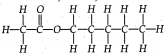
The structural formula of an ester is shown in the image. Write the structural formula of the acid and the alcohol from which it might be prepared. Name the process of formation of ester.
Solution
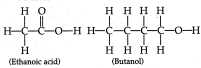
(N/A) The given ester is pentyl ethanoate. It is prepared from ethanoic acid $(CH_3COOH)$ and pentan$-1-$ol $(CH_3CH_2CH_2CH_2CH_2OH)$.
The structural formula of ethanoic acid is:
$H-C(H)(H)-C(=O)-O-H$
The structural formula of pentan$-1-$ol is:
$H-C(H)(H)-C(H)(H)-C(H)(H)-C(H)(H)-C(H)(H)-O-H$
The process of formation of an ester from a carboxylic acid and an alcohol in the presence of an acid catalyst is called esterification.
The structural formula of ethanoic acid is:
$H-C(H)(H)-C(=O)-O-H$
The structural formula of pentan$-1-$ol is:
$H-C(H)(H)-C(H)(H)-C(H)(H)-C(H)(H)-C(H)(H)-O-H$
The process of formation of an ester from a carboxylic acid and an alcohol in the presence of an acid catalyst is called esterification.
0 likes
View Solution25
Medium
An organic compound burns with a sooty flame. Is it a saturated or an unsaturated compound?
Solution
(B) It is an unsaturated compound.
Reason: Unsaturated compounds have a higher percentage of carbon compared to saturated compounds.
Thus,unsaturated compounds undergo incomplete combustion in the presence of air,producing a yellow flame with a significant amount of black smoke (soot).
Reason: Unsaturated compounds have a higher percentage of carbon compared to saturated compounds.
Thus,unsaturated compounds undergo incomplete combustion in the presence of air,producing a yellow flame with a significant amount of black smoke (soot).
0 likes
View Solution26
EasyMCQ
While cooking,if the bottom of the vessel is getting blackened on the outside,it means that:
A
The food is not cooked completely
B
The fuel is not burning completely
C
The fuel is wet
D
The fuel is burning completely.
Solution
(B) When a fuel burns,it releases energy. If the supply of oxygen is insufficient,the combustion is incomplete. Incomplete combustion of hydrocarbons produces carbon particles (soot),which deposit on the bottom of the cooking vessel,causing it to turn black. Therefore,the blackening of the vessel indicates that the fuel is not burning completely.
0 likes
View Solution27
EasyMCQ
The class of organic compounds which gives effervescence with $NaHCO_3$ solution is:
A
Aldehydes
B
Carboxylic acids
C
Esters
D
Alkanes
Solution
(B) Carboxylic acids react with sodium bicarbonate $(NaHCO_3)$ to produce carbon dioxide $(CO_2)$ gas.
This reaction is characterized by the evolution of gas bubbles,known as effervescence.
The chemical equation for this reaction is: $RCOOH + NaHCO_3 \rightarrow RCOONa + H_2O + CO_2 \uparrow$.
This test is commonly used to distinguish carboxylic acids from other organic compounds like alcohols or aldehydes,which do not react with $NaHCO_3$ to release $CO_2$.
0 likes
View Solution28
MediumMCQ
Chlorine reacts with saturated hydrocarbons at room temperature in the :
A
absence of sunlight
B
presence of water
C
presence of sunlight
D
presence of hydrochloric acid
Solution
(C) Saturated hydrocarbons (alkanes) are generally unreactive towards many reagents.
However, they undergo a substitution reaction with chlorine in the presence of sunlight (ultraviolet light).
This reaction is known as a free-radical substitution reaction.
For example, methane reacts with chlorine in the presence of sunlight to form chloromethane and hydrogen chloride: $CH_4 + Cl_2 \xrightarrow{\text{sunlight}} CH_3Cl + HCl$.
0 likes
View Solution29
Easy
Write true or false for the following statement:
Esters are most commonly formed by the reaction of an aldehyde with ketones.
Esters are most commonly formed by the reaction of an aldehyde with ketones.
Solution
(B) The statement is False.
Esters are typically formed by the process of esterification,which involves the reaction between a carboxylic acid and an alcohol in the presence of an acid catalyst (such as concentrated $H_2SO_4$).
Aldehydes and ketones do not react with each other to form esters.
Esters are typically formed by the process of esterification,which involves the reaction between a carboxylic acid and an alcohol in the presence of an acid catalyst (such as concentrated $H_2SO_4$).
Aldehydes and ketones do not react with each other to form esters.
0 likes
View Solution30
Easy
Write true or false for the following statement:
Esters react in the presence of an acid or a base to give back the alcohol and carboxylic acid.
Esters react in the presence of an acid or a base to give back the alcohol and carboxylic acid.
Solution
(TRUE) The statement is True.
This reaction is known as saponification (when using a base) or acid-catalyzed hydrolysis.
$1$. In the presence of an acid,the reaction is a reversible hydrolysis where the ester reacts with water to form the corresponding carboxylic acid and alcohol.
$2$. In the presence of a base (like $NaOH$),the reaction is known as saponification,which is irreversible. The ester reacts with the base to form a carboxylate salt (soap) and alcohol. The carboxylic acid can then be obtained by acidifying the salt.
0 likes
View Solution31
Easy
State whether the following statement is true or false:
Carbon, in its all allotropic forms, burns in oxygen to give nitrogen dioxide along with the release of heat and light.
Carbon, in its all allotropic forms, burns in oxygen to give nitrogen dioxide along with the release of heat and light.
Solution
(B) The statement is False.
Carbon, in its various allotropic forms (such as diamond, graphite, or charcoal), burns in oxygen to produce carbon dioxide $(CO_2)$, not nitrogen dioxide $(NO_2)$.
The chemical reaction is: $C(s) + O_2(g) \rightarrow CO_2(g) + \text{Heat} + \text{Light}$.
Carbon, in its various allotropic forms (such as diamond, graphite, or charcoal), burns in oxygen to produce carbon dioxide $(CO_2)$, not nitrogen dioxide $(NO_2)$.
The chemical reaction is: $C(s) + O_2(g) \rightarrow CO_2(g) + \text{Heat} + \text{Light}$.
0 likes
View Solution32
Medium
Write true or false for the following statement:
Saturated hydrocarbons will generally give a clean flame,while unsaturated carbon compounds will give a yellow flame with lots of black smoke.
Saturated hydrocarbons will generally give a clean flame,while unsaturated carbon compounds will give a yellow flame with lots of black smoke.
Solution
(TRUE) The statement is $True$.
$1$. Saturated hydrocarbons (alkanes) contain a higher proportion of hydrogen relative to carbon,which allows for complete combustion in the presence of sufficient oxygen,resulting in a clean,blue flame.
$2$. Unsaturated hydrocarbons (alkenes and alkynes) have a higher percentage of carbon. Due to the incomplete combustion of these compounds,unburnt carbon particles are produced,which glow yellow and produce black smoke.
0 likes
View Solution33
Easy
State whether the following statement is true or false:
Animal fats generally contain saturated fatty acids,which are said to be good for health.
Animal fats generally contain saturated fatty acids,which are said to be good for health.
Solution
(FALSE) The statement is False.
Animal fats generally contain saturated fatty acids,which are associated with an increased risk of cardiovascular diseases and are considered less healthy compared to unsaturated fatty acids. Unsaturated fatty acids,typically found in vegetable oils,are generally considered better for heart health.
Animal fats generally contain saturated fatty acids,which are associated with an increased risk of cardiovascular diseases and are considered less healthy compared to unsaturated fatty acids. Unsaturated fatty acids,typically found in vegetable oils,are generally considered better for heart health.
0 likes
View Solution34
EasyMCQ
With which of the following does the element carbon not give reaction?
A
Dichlorine gas
B
Dioxygen gas
C
Dihydrogen gas
D
Dilute hydrochloric acid
Solution
(D) Carbon is a non-metal.
$1$. Carbon reacts with $O_2$ (dioxygen) to form $CO_2$ or $CO$.
$2$. Carbon reacts with $H_2$ (dihydrogen) at high temperatures to form hydrocarbons like methane $(CH_4)$.
$3$. Carbon reacts with $Cl_2$ (dichlorine) to form carbon tetrachloride $(CCl_4)$.
$4$. Carbon does not react with dilute hydrochloric acid $(HCl)$ because it is a non-metal and cannot displace hydrogen from the acid.
0 likes
View Solution35
EasyMCQ
In the presence of which catalyst is vegetable ghee prepared from vegetable oil?
A
Iron
B
Platinum
C
Nickel
D
Vanadium pentoxide
Solution
(C) The process of converting vegetable oil into vegetable ghee (solid fat) is known as hydrogenation.
In this chemical reaction,hydrogen gas is added to unsaturated vegetable oils in the presence of a catalyst,typically $Nickel$ $(Ni)$,at a specific temperature.
The $Nickel$ catalyst facilitates the addition of hydrogen across the double bonds of the unsaturated fatty acids present in the oil,converting them into saturated fats,which are solid at room temperature.
0 likes
View Solution36
EasyMCQ
Which process is used to convert vegetable oil into vegetable ghee?
A
Oxidation
B
Neutralization
C
Hydrogenation
D
Displacement
Solution
(C) The process of converting vegetable oils (which contain unsaturated fatty acids) into vegetable ghee (which contains saturated fatty acids) is known as $Hydrogenation$.
In this process,vegetable oil is reacted with hydrogen gas in the presence of a catalyst,such as nickel $(Ni)$,at a specific temperature.
This addition of hydrogen across the double bonds of the unsaturated fats converts them into saturated fats,resulting in a solid or semi-solid state known as vegetable ghee.
0 likes
View Solution37
EasyMCQ
Which gas is used in the process of converting vegetable oils into vegetable ghee?
A
Chlorine
B
Dihydrogen
C
Dinitrogen
D
Ammonia
Solution
(B) The process of converting vegetable oils into vegetable ghee (vanaspati ghee) is known as hydrogenation. In this process,unsaturated vegetable oils are reacted with $H_2$ (dihydrogen) gas in the presence of a catalyst,such as nickel $(Ni)$,at a specific temperature and pressure. This reaction converts the unsaturated fats into saturated fats,resulting in a solid or semi-solid state known as vegetable ghee.
0 likes
View Solution38
EasyMCQ
Which medicine is prepared using ammonia?
A
Ammonium nitrate
B
Diammonium Phosphate
C
Ammonium Sulphate
D
Para aminobenzoic acid
Solution
(D) Para aminobenzoic acid $(PABA)$ is a chemical compound that can be synthesized using ammonia as a precursor in certain industrial chemical processes.
$PABA$ is used in the pharmaceutical industry for the production of various medicines,including local anesthetics like benzocaine and procaine.
While ammonium nitrate,diammonium phosphate,and ammonium sulphate are nitrogenous compounds,they are primarily used as fertilizers rather than as medicinal ingredients.
0 likes
View Solution39
EasyMCQ
Which substance is obtained by the reduction of methanal?
A
Ethanol
B
$CO_{2}$ and $O_{2}$
C
Methanol
D
Methanoic acid
Solution
(C) The reduction of an aldehyde results in the formation of a primary alcohol.
Methanal $(HCHO)$ is the simplest aldehyde with one carbon atom.
When methanal undergoes reduction (addition of hydrogen),it is converted into methanol $(CH_{3}OH)$.
The chemical reaction is: $HCHO + 2[H] \rightarrow CH_{3}OH$.
Methanal $(HCHO)$ is the simplest aldehyde with one carbon atom.
When methanal undergoes reduction (addition of hydrogen),it is converted into methanol $(CH_{3}OH)$.
The chemical reaction is: $HCHO + 2[H] \rightarrow CH_{3}OH$.
0 likes
View Solution40
EasyMCQ
Which of the following is the use of propanone?
A
To remove nail polish
B
Antiseptic
C
Antibiotic
D
As a preservative
Solution
(A) Propanone,commonly known as acetone,is a widely used organic solvent.
It is primarily used as a nail polish remover because it can dissolve various organic substances,including the polymers found in nail polish.
It is not used as an antiseptic,antibiotic,or preservative in common applications.
It is primarily used as a nail polish remover because it can dissolve various organic substances,including the polymers found in nail polish.
It is not used as an antiseptic,antibiotic,or preservative in common applications.
0 likes
View Solution41
EasyMCQ
Which of the following monomers is used in the synthesis of polythene?
A
$CH_{3}-CH_{3}$
B
$CH_{3}-CH=CH-CH_{3}$
C
$CH_{2}=CH_{2}$
D
$CH \equiv CH$
Solution
(C) Polythene is a polymer formed by the addition polymerization of ethene monomers.
In this process,many molecules of ethene $(CH_{2}=CH_{2})$ undergo a chemical reaction under high pressure and temperature in the presence of a catalyst to form a long-chain polymer known as polythene (polyethylene).
The chemical equation is: $n(CH_{2}=CH_{2}) \rightarrow -[CH_{2}-CH_{2}]_{n}-$.
Therefore,the correct monomer is ethene $(CH_{2}=CH_{2})$.
0 likes
View Solution42
EasyMCQ
In the presence of which enzyme does the fermentation of an aqueous solution of sugar or molasses produce glucose and fructose?
A
Lactase
B
Zymase
C
Invertase
D
Lipase
Solution
(C) The hydrolysis of sucrose (sugar or molasses) into glucose and fructose is catalyzed by the enzyme $Invertase$.
The chemical reaction is as follows:
$C_{12}H_{22}O_{11} (sucrose) + H_2O \xrightarrow{Invertase} C_6H_{12}O_6 (glucose) + C_6H_{12}O_6 (fructose)$.
$Zymase$ is the enzyme responsible for the further conversion of glucose and fructose into ethanol and carbon dioxide.
The chemical reaction is as follows:
$C_{12}H_{22}O_{11} (sucrose) + H_2O \xrightarrow{Invertase} C_6H_{12}O_6 (glucose) + C_6H_{12}O_6 (fructose)$.
$Zymase$ is the enzyme responsible for the further conversion of glucose and fructose into ethanol and carbon dioxide.
0 likes
View Solution43
EasyMCQ
What is the molecular formula of ethyl acetate?
A
$C_{2}H_{5}COCH_{3}$
B
$CH_{3}COOC_{2}H_{5}$
C
$CH_{3}COOH$
D
$C_{2}H_{5}COOH$
Solution
(B) Ethyl acetate is an ester formed by the reaction between acetic acid $(CH_{3}COOH)$ and ethanol $(C_{2}H_{5}OH)$.
In the esterification reaction,the hydroxyl group $(-OH)$ of the acid and the hydrogen atom of the alcohol's hydroxyl group are removed as water $(H_{2}O)$.
The remaining parts combine to form the ester: $CH_{3}COOH + C_{2}H_{5}OH \rightarrow CH_{3}COOC_{2}H_{5} + H_{2}O$.
Therefore,the molecular formula of ethyl acetate is $CH_{3}COOC_{2}H_{5}$.
0 likes
View Solution44
EasyMCQ
What is formed when methanol is oxidized in the presence of $Ag_{2}O$ at an appropriate temperature?
A
Ethanol
B
Methane
C
Methanal
D
Acetic acid
Solution
(C) The oxidation of primary alcohols like methanol $(CH_{3}OH)$ in the presence of a mild oxidizing agent like $Ag_{2}O$ (silver oxide) at an appropriate temperature leads to the formation of an aldehyde.
Specifically, methanol is oxidized to form methanal $(HCHO)$, which is also known as formaldehyde.
The reaction can be represented as: $CH_{3}OH + [O] \xrightarrow{Ag_{2}O} HCHO + H_{2}O$.
Specifically, methanol is oxidized to form methanal $(HCHO)$, which is also known as formaldehyde.
The reaction can be represented as: $CH_{3}OH + [O] \xrightarrow{Ag_{2}O} HCHO + H_{2}O$.
0 likes
View Solution45
EasyMCQ
Which substance is produced by the oxidation of methanal in the presence of an oxidising agent?
A
Ethanal
B
Methane
C
Methanoic acid
D
Acetic acid
Solution
(C) The oxidation of an aldehyde in the presence of an oxidising agent (like alkaline $KMnO_4$ or acidified $K_2Cr_2O_7$) results in the formation of a carboxylic acid with the same number of carbon atoms.
Methanal $(HCHO)$ is an aldehyde with one carbon atom.
Upon oxidation,it gets converted into methanoic acid $(HCOOH)$,which also contains one carbon atom.
The reaction is: $HCHO + [O] \xrightarrow{\text{oxidising agent}} HCOOH$.
Methanal $(HCHO)$ is an aldehyde with one carbon atom.
Upon oxidation,it gets converted into methanoic acid $(HCOOH)$,which also contains one carbon atom.
The reaction is: $HCHO + [O] \xrightarrow{\text{oxidising agent}} HCOOH$.
0 likes
View Solution46
EasyMCQ
Which functional group is identified by the Tollen's test (silver mirror test)?
A
$-OH$
B
$-COOH$
C
$>C=O$
D
$-CHO$
Solution
(D) The Tollen's test,also known as the silver mirror test,is a chemical test used to distinguish between aldehydes and ketones.
Aldehydes contain the $-CHO$ functional group,which acts as a reducing agent.
When an aldehyde is treated with Tollen's reagent (ammoniacal silver nitrate),it reduces the silver ions $(Ag^+)$ to metallic silver $(Ag)$,which deposits on the inner walls of the test tube,forming a 'silver mirror'.
Ketones do not have the $-CHO$ group and therefore do not give a positive Tollen's test.
0 likes
View Solution47
EasyMCQ
Which substance is produced by the reduction of methanal in the presence of a palladium catalyst?
A
Methanol
B
Methane
C
Formic acid
D
Ethanal
Solution
(A) The reduction of an aldehyde in the presence of a catalyst like palladium $(Pd)$ or nickel $(Ni)$ leads to the formation of a primary alcohol.
Methanal $(HCHO)$ is the simplest aldehyde.
When methanal undergoes catalytic hydrogenation (reduction),it reacts with hydrogen $(H_2)$ to form methanol $(CH_3OH)$.
The chemical equation is: $HCHO + H_2 \xrightarrow{Pd} CH_3OH$.
Methanal $(HCHO)$ is the simplest aldehyde.
When methanal undergoes catalytic hydrogenation (reduction),it reacts with hydrogen $(H_2)$ to form methanol $(CH_3OH)$.
The chemical equation is: $HCHO + H_2 \xrightarrow{Pd} CH_3OH$.
0 likes
View Solution48
EasyMCQ
Which is the simplest compound of the ketone group?
A
Methanal
B
Ethanal
C
Propanone
D
Propenal
Solution
(C) The general formula for a ketone group is $R-CO-R'$,where $R$ and $R'$ are alkyl groups.
For the simplest ketone,the smallest possible alkyl groups are methyl groups $(-CH_3)$.
Therefore,the simplest ketone is $CH_3-CO-CH_3$,which is known as Propanone (also called Acetone).
Methanal and Ethanal are aldehydes,and Propenal is an unsaturated aldehyde.
For the simplest ketone,the smallest possible alkyl groups are methyl groups $(-CH_3)$.
Therefore,the simplest ketone is $CH_3-CO-CH_3$,which is known as Propanone (also called Acetone).
Methanal and Ethanal are aldehydes,and Propenal is an unsaturated aldehyde.
0 likes
View Solution49
EasyMCQ
What is the molecular formula of propanone (acetone)?
A
$CH_{3}COCH_{3}$
B
$CH_{3}COOCH_{3}$
C
$CH_{3}CH_{2}CH_{2}CHO$
D
$C_{3}H_{7}OH$
Solution
(A) Propanone,commonly known as acetone,is a ketone with the chemical formula $C_{3}H_{6}O$.
Its structural formula is $CH_{3}-CO-CH_{3}$,which indicates a central carbonyl group $(C=O)$ bonded to two methyl groups $(CH_{3})$.
Therefore,the correct molecular formula is $CH_{3}COCH_{3}$.
Its structural formula is $CH_{3}-CO-CH_{3}$,which indicates a central carbonyl group $(C=O)$ bonded to two methyl groups $(CH_{3})$.
Therefore,the correct molecular formula is $CH_{3}COCH_{3}$.
0 likes
View Solution50
EasyMCQ
Which substance is used in the liquid used to remove nail polish from nails?
A
Acetic acid
B
Formalin
C
Formic acid
D
Acetone
Solution
(D) The liquid used to remove nail polish is commonly known as a nail polish remover. The primary active ingredient in most nail polish removers is $Acetone$ $(CH_3COCH_3)$. $Acetone$ is a simple ketone that acts as a powerful solvent,effectively dissolving the polymers and resins present in the nail polish,allowing it to be wiped away easily.
0 likes
View SolutionCarbon and its Compounds — Chemical Properties of Carbon Compounds · Frequently Asked Questions
1Are these Carbon and its Compounds questions useful for JEE and NEET?
Yes. All questions in this section are mapped to JEE Main and NEET exam patterns. Previous year questions from JEE Main, NEET, GUJCET and state-level exams are included with full solutions.
2Can I switch to Hindi or Gujarati for these questions?
Yes. Use the language tabs in the hero section or the sidebar to view the same questions and solutions in English, Hindi or Gujarati.
3How do I generate a question paper from this subtopic?
Use the Vedclass Exam Paper Generator — select the chapter and subtopic, set difficulty, and generate Sets A, B, C, D automatically. First 3 chapters of every subject are free.
Vedclass Products
For Students
Vedclass Test Series
Mock tests in real JEE/NEET style with performance analysis. 5-day free trial.
Start Free TrialFor Teachers
Exam Paper Generator
Generate Set A/B/C/D papers from this chapter in 2 minutes. 3 chapters free.
Try FreeFor Institutes
Online Exam Module
Live online exams with unlimited students, 360° analytics & white-label branding.
See DemoFor Teachers & Institutes
Generate a Carbon and its Compounds Exam Paper in 2 Minutes
Select subtopic & difficulty — Sets A, B, C, D auto-generated with No Repeat logic.
First 3 chapters of every subject are free — no payment required.