
A English
Heating Effect of Electric Current and Electric Power Questions in English
Class 10 Science · Electricity · Heating Effect of Electric Current and Electric Power
137+
Questions
English
Language
100%
With Solutions
Showing 50 of 137 questions in English
51
Easy
Name a few practical applications of the heating effect of current.
Solution
(N/A) The heating effect of electric current is utilized in various electrical appliances to produce heat for specific purposes.
Some common practical applications include:
$1$. Electric Iron: Used for pressing clothes.
$2$. Electric Toaster: Used for browning bread.
$3$. Electric Oven: Used for baking and cooking.
$4$. Electric Kettle: Used for boiling water.
$5$. Electric Geyser: Used for heating water.
$6$. Electric Fuse: $A$ safety device that melts and breaks the circuit when excessive current flows,protecting appliances from damage.
$7$. Electric Bulb: Uses the heating effect to produce light through a tungsten filament.
0 likes
View Solution52
Easy
Define electric power. Give its $SI$ units and write its mathematical equation.
Solution
(N/A) Electric power is defined as the rate at which electrical energy is consumed or dissipated in an electric circuit.
Mathematically,it is expressed as:
$P = \frac{W}{t} = VI = I^2R = \frac{V^2}{R}$
Where:
$P$ = Electric power
$W$ = Work done or energy consumed
$t$ = Time taken
$V$ = Potential difference
$I$ = Current
$R$ = Resistance
The $SI$ unit of electric power is the watt $(W)$,which is equivalent to $1 \text{ joule/second}$ $(1 \text{ J/s})$.
0 likes
View Solution53
Medium
Name the commercial unit of electrical energy. Convert it into joule. What is the other name of the commercial unit?
Solution
(N/A) The commercial unit of electrical energy is kilowatt-hour $(kWh)$.
$1 kWh = 1 kW \times 1 \text{ hour}$
$= 1000 W \times 3600 s$
$= 1000 J/s \times 3600 s$
$= 3.6 \times 10^6 J$
It is also known as the Board of Trade Unit $(BOTU)$.
$1 kWh = 1 kW \times 1 \text{ hour}$
$= 1000 W \times 3600 s$
$= 1000 J/s \times 3600 s$
$= 3.6 \times 10^6 J$
It is also known as the Board of Trade Unit $(BOTU)$.
0 likes
View Solution54
Medium
State Joule's law of heating and write its mathematical form.
Solution
(N/A) Joule's law of heating states that the heat produced $(H)$ in a conductor is:
$(i)$ Directly proportional to the square of the current $(I)$ flowing through it, i.e., $H \propto I^2$.
$(ii)$ Directly proportional to the resistance $(R)$ of the conductor, i.e., $H \propto R$.
$(iii)$ Directly proportional to the time $(t)$ for which the current flows through the conductor, i.e., $H \propto t$.
Combining these three factors, we get the mathematical expression:
$H = I^2Rt$
Where $H$ is the heat energy in Joules, $I$ is the current in Amperes, $R$ is the resistance in Ohms, and $t$ is the time in seconds.
0 likes
View Solution55
MediumMCQ
$A$ bulb is rated at $5.0 \text{ V}, 100 \text{ mA}$. Calculate its
$(i)$ power and $(ii)$ resistance.
$(i)$ power and $(ii)$ resistance.
A
$0.5 \text{ W}, 50 \, \Omega$
B
$0.5 \text{ W}, 5 \, \Omega$
C
$5.0 \text{ W}, 50 \, \Omega$
D
$0.05 \text{ W}, 500 \, \Omega$
Solution
(A) Given:
Voltage $(V) = 5.0 \text{ V}$
Current $(I) = 100 \text{ mA} = 100 \times 10^{-3} \text{ A} = 0.1 \text{ A}$
$(i)$ Power $(P)$ is calculated as:
$P = V \times I = 5.0 \text{ V} \times 0.1 \text{ A} = 0.5 \text{ W}$
$(ii)$ Resistance $(R)$ is calculated using Ohm's Law:
$R = \frac{V}{I} = \frac{5.0 \text{ V}}{0.1 \text{ A}} = 50 \, \Omega$
0 likes
View Solution56
EasyMCQ
Find the minimum rating of fuse that can be safely used on a line on which two $1.1 \, kW$ electric geysers are to run simultaneously. The supply voltage is $220 \, V$. (in $A$)
A
$5$
B
$10$
C
$15$
D
$20$
Solution
(C) The total power $P$ consumed by two geysers is $P = 2 \times 1.1 \, kW = 2.2 \, kW = 2200 \, W$.
Given supply voltage $V = 220 \, V$.
The current $I$ flowing through the circuit is calculated using the formula $I = P / V$.
$I = 2200 \, W / 220 \, V = 10 \, A$.
To safely operate the appliances,the fuse rating must be slightly higher than the current drawn by the circuit to prevent nuisance tripping while protecting against overcurrent.
Therefore,the minimum rating of the fuse should be greater than $10 \, A$.
0 likes
View Solution57
Easy
You have just paid the electricity bill for your house.
$(i)$ What was it that your family consumed,for which you had to pay?
$(ii)$ In what unit was it measured?
$(i)$ What was it that your family consumed,for which you had to pay?
$(ii)$ In what unit was it measured?
Solution
(N/A) $(i)$ The family consumed electrical energy.
$(ii)$ The energy consumed was measured in kilowatt-hour $(kWh)$.
$(ii)$ The energy consumed was measured in kilowatt-hour $(kWh)$.
0 likes
View Solution58
Easy
Make a table with names of three electrical appliances used in your home in one column, their power, voltage rating, and approximate time for which each is used in one day in the other columns.
Solution
(N/A)
| Name of appliance | Power rating, Voltage rating, and Daily use |
|---|---|
| Fluorescent tube | $40 \, W, 220 \, V, 5 \, \text{hours}$ |
| Fan | $60 \, W, 220 \, V, 15 \, \text{hours}$ |
| Geyser | $2000 \, W, 220 \, V, 1.5 \, \text{hours}$ |
0 likes
View Solution59
Easy
State whether the following statement is true or false:
Black surfaces are poor absorbers of heat.
Black surfaces are poor absorbers of heat.
Solution
(FALSE) The statement is False.
Black surfaces are actually excellent absorbers of heat because they absorb most of the radiation that falls on them,rather than reflecting it. This is why dark-colored objects heat up faster than light-colored ones when exposed to sunlight.
Black surfaces are actually excellent absorbers of heat because they absorb most of the radiation that falls on them,rather than reflecting it. This is why dark-colored objects heat up faster than light-colored ones when exposed to sunlight.
0 likes
View Solution60
Easy
State the factors on which the heat produced in a current-carrying conductor depends. Give one practical application of this effect.
Solution
(N/A) The heat produced $(H)$ in a current-carrying conductor is given by Joule's Law of Heating: $H = I^2Rt$.
$(i)$ The factors on which the heat produced depends are:
$(a)$ The square of the current flowing through the conductor $(I^2)$.
$(b)$ The resistance of the conductor $(R)$.
$(c)$ The time for which the current flows through the conductor $(t)$.
$(ii)$ $A$ practical application of this heating effect is the electric iron,which converts electrical energy into heat energy to press clothes.
0 likes
View Solution61
Easy
$(a)$ What material is used in making the filament of an electric bulb?
$(b)$ Name the characteristics which make it suitable for this.
$(b)$ Name the characteristics which make it suitable for this.
Solution
(N/A) The filament of an electric bulb is made of $Tungsten$.
$(b)$ The characteristics that make $Tungsten$ suitable for this purpose are:
$1$. It has a very high melting point (approximately $3380^{\circ}C$),which prevents it from melting even when it becomes white-hot during the emission of light.
$2$. It has high resistivity,which allows it to produce a large amount of heat when an electric current passes through it,enabling it to glow brightly.
0 likes
View Solution62
Easy
The following table provides the resistivity of three samples:
Which of them is suitable for heating elements of electrical appliances and why?
| Sample | $A$ | $B$ | $C$ |
| Resistivity | $1.6 \times 10^{-8} \Omega \cdot m$ | $5.2 \times 10^{-8} \Omega \cdot m$ | $100 \times 10^{-6} \Omega \cdot m$ |
Which of them is suitable for heating elements of electrical appliances and why?
Solution
(C) Sample $C$ is suitable for heating elements of electrical appliances.
Reason: Heating elements require materials with high resistivity so that they can produce a significant amount of heat when an electric current passes through them, according to Joule's Law of heating $(H = I^2Rt)$. Among the given samples, Sample $C$ has the highest resistivity $(100 \times 10^{-6} \Omega \cdot m)$, making it the most efficient choice for generating heat.
Reason: Heating elements require materials with high resistivity so that they can produce a significant amount of heat when an electric current passes through them, according to Joule's Law of heating $(H = I^2Rt)$. Among the given samples, Sample $C$ has the highest resistivity $(100 \times 10^{-6} \Omega \cdot m)$, making it the most efficient choice for generating heat.
0 likes
View Solution63
Medium
$(a)$ Give reasons why tungsten is used for making the filament of electric lamps.
$(b)$ Why are the heating elements of electrical appliances made up of an alloy rather than a pure metal?
$(b)$ Why are the heating elements of electrical appliances made up of an alloy rather than a pure metal?
Solution
(N/A) Tungsten is used for making the filament of electric lamps because:
$(i)$ It has a very high melting point (approximately $3380^{\circ}C$),which allows it to glow at high temperatures without melting.
$(ii)$ It has high resistivity,which allows it to produce a large amount of heat when current passes through it.
$(b)$ Heating elements are made of alloys because:
$(i)$ Alloys have higher resistivity than pure metals,which generates more heat.
$(ii)$ Alloys do not oxidize (burn) easily even at high temperatures,which increases the longevity of the appliance.
0 likes
View Solution64
MediumMCQ
Why do the wires connecting an electric heater to the mains not glow while its heating element does?
A
The connecting wires have high resistance.
B
The heating element has low resistance.
C
The heating element has high resistance,while the connecting wires have negligible resistance.
D
The current flowing through the heating element is higher than the current in the connecting wires.
Solution
(C) The wires of the connecting cord of an electric heater are typically made of copper $(Cu)$,which has extremely low electrical resistance. According to Joule's law of heating,$H = I^2Rt$,the heat produced is directly proportional to the resistance $(R)$. Since the resistance of copper wires is negligible,very little heat is produced,and they do not glow.
Conversely,the heating element is made of an alloy like nichrome,which has a very high electrical resistance. Due to this high resistance,a large amount of heat is generated when current flows through it,causing it to glow red-hot.
Conversely,the heating element is made of an alloy like nichrome,which has a very high electrical resistance. Due to this high resistance,a large amount of heat is generated when current flows through it,causing it to glow red-hot.
0 likes
View Solution65
Easy
Tungsten is used almost exclusively for filaments of electric bulbs. List two reasons.
Solution
(N/A) $1$. Tungsten has a very high melting point (approximately $3380 ^\circ C$), which allows it to glow at high temperatures without melting.
$2$. It has a high resistance, which allows it to produce a large amount of heat and light when an electric current passes through it.
$2$. It has a high resistance, which allows it to produce a large amount of heat and light when an electric current passes through it.
0 likes
View Solution66
Easy
$(a)$ Name the effect of electric current which is utilised in the working of an electrical fuse.
$(b)$ How is a fuse connected in a domestic circuit?
$(b)$ How is a fuse connected in a domestic circuit?
Solution
(N/A) The electrical fuse works on the heating effect of electric current. When the current exceeds the safe limit,the heat generated melts the fuse wire,breaking the circuit.
$(b)$ An electrical fuse is always connected in series with the live wire of the domestic circuit to protect appliances from high current surges.
$(b)$ An electrical fuse is always connected in series with the live wire of the domestic circuit to protect appliances from high current surges.
0 likes
View Solution67
MediumMCQ
What is meant by "electrical resistance" of a conductor? State how the resistance of a conductor is affected when $(i)$ a low current passes through it for a short duration; $(ii)$ a heavy current passes through it for about $30$ seconds.
A
$N/A$
B
$N/A$
C
$N/A$
D
$N/A$
Solution
(N/A) Electrical resistance is the property of a conductor to oppose the flow of electric current through it.
$(i)$ When a low current passes through a conductor for a short duration, the heat generated $(H = I^2Rt)$ is negligible. Therefore, there is no significant rise in temperature, and the resistance remains effectively unchanged.
$(ii)$ When a heavy current passes through a conductor for about $30$ seconds, a significant amount of heat is produced. This leads to a considerable rise in the temperature of the conductor. Since the resistance of most metallic conductors increases with an increase in temperature, the resistance of the conductor will increase.
0 likes
View Solution68
Difficult
Two lamps,one rated $100 \, W$ at $220 \, V$ and the other $60 \, W$ at $220 \, V$,are connected in parallel to a $220 \, V$ supply. Find the current drawn from the supply line.
Solution
(D) The power $P$ and voltage $V$ are given for both lamps. The current $I$ drawn by each lamp can be calculated using the formula $P = VI$,or $I = P/V$.
For the first lamp,$I_1 = P_1 / V = 100 \, W / 220 \, V = 10/22 \, A = 5/11 \, A$.
For the second lamp,$I_2 = P_2 / V = 60 \, W / 220 \, V = 6/22 \, A = 3/11 \, A$.
Since the lamps are connected in parallel,the total current $I$ drawn from the supply is the sum of the individual currents:
$I = I_1 + I_2 = 5/11 \, A + 3/11 \, A = 8/11 \, A$.
$I \approx 0.727 \, A$.
0 likes
View Solution69
Medium
An electric kettle of $2 kW$ works for $2 h$ daily. Calculate the $(a)$ energy consumed in $SI$ and commercial units, and $(b)$ cost of running it in the month of June at the rate of ₹ $3.00$ per unit.
Solution
(N/A) Given: Power, $P = 2 kW = 2000 W$, Time, $t = 2 h$ daily.
Energy consumed per day, $E = P \times t = 2 kW \times 2 h = 4 kWh$.
In $SI$ units (Joules): $4 kWh = 4 \times 3.6 \times 10^6 J = 14.4 \times 10^6 J$.
In commercial units: $4 kWh$ (or $4$ units).
$(b)$ Total energy consumed in June ($30$ days):
Total Energy $= 4 kWh/day \times 30 days = 120 kWh$.
Cost of electricity $= 120 \text{ units} \times ₹ 3.00/unit = ₹ 360$.
0 likes
View Solution70
Medium
Two bulbs $A$ and $B$ are rated as $90 \, W - 120 \, V$ and $60 \, W - 120 \, V$ respectively. They are connected in parallel across a $120 \, V$ source. Find the current in each bulb. Which bulb will consume more energy?
Solution
(A) $(i)$ For bulb $A$:
Resistance,$R_{A} = \frac{V^{2}}{P_{A}} = \frac{(120)^{2}}{90} = 160 \, \Omega$.
Therefore,current $I_{A} = \frac{V}{R_{A}} = \frac{120}{160} = 0.75 \, A$.
For bulb $B$:
Resistance,$R_{B} = \frac{V^{2}}{P_{B}} = \frac{(120)^{2}}{60} = 240 \, \Omega$.
Therefore,current $I_{B} = \frac{V}{R_{B}} = \frac{120}{240} = 0.5 \, A$.
$(ii)$ Since the bulbs are connected in parallel to a $120 \, V$ source,each bulb operates at its rated voltage. Bulb $A$ has a higher power rating $(90 \, W)$ compared to bulb $B$ $(60 \, W)$,therefore bulb $A$ will consume more energy.
0 likes
View Solution71
MediumMCQ
$A$ wire connected to a bulb does not glow,whereas the filament of the bulb glows when the same current is passed through them. Why?
A
The wire has high resistance.
B
The filament has high resistance compared to the connecting wire.
C
The current in the wire is less than in the filament.
D
The wire is made of a different material.
Solution
(B) The filament of the bulb and the connecting wires are connected in series,so the same current flows through both.
According to Joule's law of heating,the heat produced is given by $H = I^2Rt$.
Since the resistance $(R)$ of the connecting wires is negligibly small compared to the resistance of the filament,the heat produced in the wires is negligible.
Conversely,the filament has a high resistance,which leads to a significant amount of heat production,causing it to glow.
Therefore,the bulb glows while the connecting wires remain cool.
0 likes
View Solution72
MediumMCQ
Two conducting wires of the same material,equal length,and equal diameter are connected in series. How does the heat produced by the combination of resistance change?
A
It becomes double the heat produced by a single wire.
B
It becomes half the heat produced by a single wire.
C
It remains the same.
D
It becomes four times the heat produced by a single wire.
Solution
(B) Let the resistance of each wire be $R$.
When connected in series,the total resistance is $R_{S} = R + R = 2R$.
The heat produced by the series combination is given by $H = \frac{V^{2}}{R_{S}} t = \frac{V^{2}}{2R} t$.
The heat produced by an individual resistor (if connected alone to the same voltage source) is $H' = \frac{V^{2}}{R} t$.
Comparing the two,we find $H = \frac{1}{2} \left( \frac{V^{2}}{R} t \right) = \frac{H'}{2}$.
Thus,the heat produced by the series combination is half the heat produced by a single wire.
0 likes
View Solution73
Medium
State reasons for the following:
$(a)$ Tungsten is used for making bulb filaments.
$(b)$ Copper and aluminium are generally used for electricity transmission.
$(c)$ Alloys are commonly used in electrical heating devices such as electric iron and toaster.
$(a)$ Tungsten is used for making bulb filaments.
$(b)$ Copper and aluminium are generally used for electricity transmission.
$(c)$ Alloys are commonly used in electrical heating devices such as electric iron and toaster.
Solution
(N/A) Tungsten is a metal that has a very high melting point and high resistivity,which allows it to glow at high temperatures without melting,making it ideal for bulb filaments.
$(b)$ Copper and aluminium are excellent conductors of electricity because they possess very low resistivity,which minimizes energy loss during the transmission of electric current.
$(c)$ Alloys are used in electrical heating devices because their resistivity is significantly higher than that of their constituent pure metals,and they do not oxidize (burn) readily at high temperatures.
0 likes
View Solution74
Medium
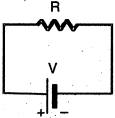
$(a)$ Derive the formula for the calculation of work done when current flows through a resistor.
$(b)$ One electric bulb is rated $40 \ W$ and $240 \ V$ and another is $25 \ W$ and $240 \ V$. Which bulb has higher resistance and how many times?
$(b)$ One electric bulb is rated $40 \ W$ and $240 \ V$ and another is $25 \ W$ and $240 \ V$. Which bulb has higher resistance and how many times?
Solution
(N/A) Suppose a current $I$ flows through a conductor of resistance $R$ for time $t$ under a potential difference of $V$ volts.
The charge flowing through the conductor is $Q = I \times t$.
The work done $(W)$ in moving a charge $Q$ across a potential difference $V$ is given by:
$W = V \times Q$
Substituting $Q = I \times t$ into the equation:
$W = V \times I \times t$
$(b)$ Given:
For bulb $1$: $P_1 = 40 \ W$,$V_1 = 240 \ V$
For bulb $2$: $P_2 = 25 \ W$,$V_2 = 240 \ V$
We know that $P = \frac{V^2}{R}$,so $R = \frac{V^2}{P}$.
$R_1 = \frac{240^2}{40} = \frac{57600}{40} = 1440 \ \Omega$
$R_2 = \frac{240^2}{25} = \frac{57600}{25} = 2304 \ \Omega$
Comparing $R_1$ and $R_2$,$R_2 > R_1$.
Ratio: $\frac{R_2}{R_1} = \frac{2304}{1440} = 1.6$
Thus,the $25 \ W$ bulb has higher resistance,and it is $1.6$ times the resistance of the $40 \ W$ bulb.
0 likes
View Solution75
Medium
What do you mean by the heating effect of electric current? Explain the production of heat in a resistor by the flow of electric current through it. Name two devices based on the heating effect of current.
Solution
(N/A) The heating effect of electric current is the phenomenon where heat is generated in a conductor when an electric current passes through it.
When an electric current flows through a resistor,the electrons move through the conductor and collide with the atoms or ions of the resistor. During these collisions,the kinetic energy of the electrons is transferred to the atoms of the resistor,causing them to vibrate more vigorously. This increase in the vibrational energy of the atoms manifests as an increase in the temperature of the resistor,resulting in the production of heat.
Two devices based on the heating effect of electric current are:
$(i)$ Electric iron
$(ii)$ Electric geyser
0 likes
View Solution76
Medium
$(a)$ State the commercial unit of electric energy and find its relation with its $SI$ unit.
$(b)$ The current through a resistor is made three times its initial value. Calculate how it will affect the heat produced in the resistor.
$(c)$ Find the increase in the amount of heat generated in a conductor if another conductor of double resistance is connected in the circuit,keeping all other factors unchanged.
Solution
(N/A) The commercial unit of electric energy is kilowatt-hour $(kWh)$.
The $SI$ unit of electrical energy is Joule $(J)$.
$1 \, kWh = 1000 \, W \times 3600 \, s = 3.6 \times 10^6 \, J$.
$(b)$ According to Joule's law of heating,$H = I^2Rt$.
If the current $I$ becomes $3I$,the new heat $H' = (3I)^2Rt = 9I^2Rt = 9H$.
Thus,the heat produced will become nine times the initial value.
$(c)$ Initial heat $H = I^2Rt$.
If the resistance $R$ is replaced by a conductor of double resistance $(2R)$,the new heat $H' = I^2(2R)t = 2I^2Rt = 2H$.
Thus,the heat produced will become twice the initial value.
0 likes
View Solution77
Medium
$(a)$ Why is the series arrangement not used for domestic circuits?
$(b)$ Why is tungsten used almost exclusively for the filament of electric lamps?
$(c)$ Why are the conductors of electric heating devices,such as bread toasters and electric irons,made of an alloy rather than a pure metal?
$(d)$ Why are copper and aluminium wires usually employed for electricity transmission?
$(e)$ Why does the cord of an electric heater not glow while the heating element does?
Solution
(N/A) In a series arrangement,if any one component stops working,the circuit breaks,and none of the other devices will function.
$(b)$ Tungsten is used because it has a very high melting point $(3380 ^\circ C)$ and high resistivity,allowing it to emit light without melting.
$(c)$ Alloys have higher resistivity than pure metals and do not oxidize (burn) easily at high temperatures,making them ideal for heating elements.
$(d)$ Copper and aluminium have very low resistivity,which minimizes energy loss during the transmission of electricity.
$(e)$ The cord has very low resistance,so it produces negligible heat,whereas the heating element has high resistance,causing it to glow due to the heating effect of current.
0 likes
View Solution78
Medium
Define power. State the difference between $1$ watt and $1$ watt hour. Establish the relationship between the commercial unit of electric energy and the $SI$ unit of energy. An electric heater rated $1000 \ W / 220 \ V$ operates for $2$ hours daily. Calculate the cost of energy to operate it for $30$ days at the rate of ₹ $5.00$ per $kWh$.
Solution
(N/A) Power is defined as the rate at which electric energy is dissipated or consumed in an electric circuit.
$1$ watt is the power consumed by a device that carries a current of $1 \ A$ when operated at a potential difference of $1 \ V$, whereas $1$ watt hour is the amount of energy consumed when $1$ watt of power is used for $1$ hour.
The commercial unit of electric energy is $kWh$.
$1 \ kWh = 1000 \ W \times 3600 \ s = 3.6 \times 10^6 \ J$.
Total energy consumed by the heater in $30$ days:
$E = \text{Power} \times \text{Time} \times \text{Days} = 1000 \ W \times 2 \ h \times 30 = 60000 \ Wh = 60 \ kWh$.
Cost of energy = $60 \ kWh \times ₹ 5.00/kWh = ₹ 300$.
0 likes
View Solution79
Medium
An electric iron has a rating of $750\, W; 200\, V$. Calculate:
$(i)$ The current required.
$(ii)$ The resistance of its heating element.
$(iii)$ Energy consumed by the iron in $2$ hours.
$(i)$ The current required.
$(ii)$ The resistance of its heating element.
$(iii)$ Energy consumed by the iron in $2$ hours.
Solution
(N/A) $(i)$ Current $(I)$ is calculated using the formula $P = V \times I$,so $I = P / V = 750\, W / 200\, V = 3.75\, A$.
$(ii)$ Resistance $(R)$ is calculated using Ohm's Law $V = I \times R$,so $R = V / I = 200\, V / 3.75\, A \approx 53.33\, \Omega$.
$(iii)$ Energy consumed $(E)$ is calculated as $E = P \times t = 750\, W \times 2\, h = 1500\, Wh = 1.5\, kWh$.
$(ii)$ Resistance $(R)$ is calculated using Ohm's Law $V = I \times R$,so $R = V / I = 200\, V / 3.75\, A \approx 53.33\, \Omega$.
$(iii)$ Energy consumed $(E)$ is calculated as $E = P \times t = 750\, W \times 2\, h = 1500\, Wh = 1.5\, kWh$.
0 likes
View Solution80
Medium
An electric iron consumes energy at a rate of $840\, W$ when heating is at the maximum rate and $360\, W$ when the heating is at the minimum. The voltage is $220\, V$. What are the current and the resistance in each case?
Solution
(N/A) We know that the power input is $P = V \times I$.
Thus,the current is $I = P / V$.
$(a)$ When heating is at the maximum rate $(P = 840\, W)$:
$I = 840 / 220 = 3.82\, A$.
The resistance is $R = V / I = 220 / 3.82 = 57.60\, \Omega$.
$(b)$ When heating is at the minimum rate $(P = 360\, W)$:
$I = 360 / 220 = 1.64\, A$.
The resistance is $R = V / I = 220 / 1.64 = 134.15\, \Omega$.
0 likes
View Solution81
EasyMCQ
$100 \, J$ of heat is produced each second in a $4 \, \Omega$ resistance. Find the potential difference across the resistor. (in $, V$)
A
$10$
B
$20$
C
$30$
D
$40$
Solution
(B) Given: Heat produced $H = 100 \, J$,Resistance $R = 4 \, \Omega$,Time $t = 1 \, s$.
We know that the formula for heat produced is $H = I^2 R t$.
Rearranging to find current $I$:
$I = \sqrt{\frac{H}{R t}} = \sqrt{\frac{100}{4 \times 1}} = \sqrt{25} = 5 \, A$.
Now,using Ohm's Law to find the potential difference $V$:
$V = I \times R$
$V = 5 \, A \times 4 \, \Omega = 20 \, V$.
Therefore,the potential difference across the resistor is $20 \, V$.
0 likes
View Solution82
EasyMCQ
An electric bulb is connected to a $220 \ V$ generator. The current is $0.50 \ A$. What is the power of the bulb?
A
$110 \ W$
B
$440 \ W$
C
$110 \ J$
D
$220 \ W$
Solution
(A) Given: Potential difference $V = 220 \ V$ and current $I = 0.50 \ A$.
The formula for electric power is $P = V \times I$.
Substituting the given values: $P = 220 \ V \times 0.50 \ A$.
Therefore,the power of the bulb is $P = 110 \ W$.
The formula for electric power is $P = V \times I$.
Substituting the given values: $P = 220 \ V \times 0.50 \ A$.
Therefore,the power of the bulb is $P = 110 \ W$.
0 likes
View Solution83
MediumMCQ
An electric refrigerator rated $400 \ W$ operates $8 \ h$ per day. What is the cost of the energy to operate it for $30$ days at ₹ $3.00$ per $kWh$?
A
₹ $288.00$
B
₹ $300.00$
C
₹ $250.00$
D
₹ $320.00$
Solution
(A) Given: Power $P = 400 \ W$,Time $t = 8 \ h$ per day for $30$ days,Rate $= ₹ 3.00$ per $kWh$.
Total time in hours $= 8 \times 30 = 240 \ h$.
Total energy consumed in $kWh = \frac{P \times t}{1000} = \frac{400 \times 240}{1000} = 96 \ kWh$.
Cost of energy $= \text{Total energy} \times \text{Rate} = 96 \times 3 = ₹ 288.00$.
Therefore,the cost to operate the refrigerator for $30$ days is ₹ $288.00$.
0 likes
View Solution84
EasyMCQ
An electric bulb of resistance $480 \Omega$ is connected to a $220 \text{ V}$ main. Find the amount of electrical energy consumed in $10 \text{ seconds}$. (in $J$)
A
$1008.3$
B
$1000$
C
$1050$
D
$950$
Solution
(A) Given:
Resistance $R = 480 \Omega$
Voltage $V = 220 \text{ V}$
Time $t = 10 \text{ s}$
The formula for electrical energy consumed is $E = \frac{V^2 t}{R}$.
Substituting the given values:
$E = \frac{(220)^2 \times 10}{480}$
$E = \frac{48400 \times 10}{480}$
$E = \frac{484000}{480}$
$E \approx 1008.33 \text{ J}$.
0 likes
View Solution85
Medium
$A$ $100 \text{ W}$ electric bulb is lighted for $2 \text{ hours}$ daily,and four $40 \text{ W}$ bulbs are lighted for $4 \text{ hours}$ everyday. Calculate the energy consumed (in $\text{kWh}$) in $30 \text{ days}$.
Solution
(25.2 KWH) Energy consumed by one $100 \text{ W}$ bulb working for $2 \text{ hours}$ daily:
$= \frac{100 \text{ W}}{1000} \times 2 \text{ h} = 0.2 \text{ kWh}$
Energy consumed by four $40 \text{ W}$ bulbs working for $4 \text{ hours}$ daily:
$= \frac{4 \times 40 \text{ W}}{1000} \times 4 \text{ h} = 0.64 \text{ kWh}$
Total energy consumed everyday:
$= 0.2 \text{ kWh} + 0.64 \text{ kWh} = 0.84 \text{ kWh}$
Total energy consumed in $30 \text{ days}$:
$= 0.84 \text{ kWh} \times 30 = 25.2 \text{ kWh}$
0 likes
View Solution86
Medium
An electric bulb is rated at $200 \ V - 100 \ W$. What is its resistance? If five such bulbs burn for $4 \ hours$, what is the total electrical energy consumed? Calculate the cost, if the rate is $50$ paise per unit.
Solution
(N/A) Given: Voltage $V = 200 \ V$, Power $P = 100 \ W$, Number of bulbs $n = 5$, Time $t = 4 \ hours$.
$(a)$ We know that $P = \frac{V^2}{R}$, therefore, the resistance of each bulb is:
$R = \frac{V^2}{P} = \frac{(200)^2}{100} = \frac{40000}{100} = 400 \ \Omega$.
$(b)$ Electrical energy consumed by one bulb in $4 \ hours$ is:
$E_1 = P \times t = 100 \ W \times 4 \ h = 400 \ Wh$.
Total energy consumed by $5$ bulbs in $4 \ hours$ is:
$E_{total} = 5 \times 400 \ Wh = 2000 \ Wh = 2 \ kWh$.
$(c)$ Cost of consumed electricity:
Since $1 \ unit = 1 \ kWh$ and the rate is $50 \ paise = ₹ 0.50$ per unit:
$Cost = 2 \ units \times ₹ 0.50/unit = ₹ 1.00$.
0 likes
View Solution87
Medium
In a household,$5$ tube lights of $40 \text{ W}$ each are used for $5 \text{ hours}$ and an electric press of $500 \text{ W}$ for $4 \text{ hours}$ everyday. Calculate the total energy consumed by the tube lights and press in a month of $30 \text{ days}$.
Solution
$1$. Energy consumed by $5$ tube lights of $40 \text{ W}$ each for $5 \text{ hours}$ per day:
$E_1 = 5 \times 40 \text{ W} \times 5 \text{ h} = 1000 \text{ Wh} = 1 \text{ kWh}$.
$2$. Energy consumed by an electric press of $500 \text{ W}$ for $4 \text{ hours}$ per day:
$E_2 = 500 \text{ W} \times 4 \text{ h} = 2000 \text{ Wh} = 2 \text{ kWh}$.
$3$. Total energy consumed per day:
$E_{\text{total/day}} = 1 \text{ kWh} + 2 \text{ kWh} = 3 \text{ kWh}$.
$4$. Total energy consumed in a month of $30 \text{ days}$:
$E_{\text{month}} = 3 \text{ kWh/day} \times 30 \text{ days} = 90 \text{ kWh}$.
0 likes
View Solution88
Medium
An electric lamp is marked $100 \, W, 220 \, V$. It is used for $5$ hours daily. Calculate: $(i)$ its resistance while glowing. $(ii)$ energy consumed in $kWh$ per day.
Solution
(N/A) $(i)$ The resistance $R$ of the lamp is calculated using the formula $R = \frac{V^2}{P}$. Substituting the given values: $R = \frac{(220)^2}{100} = \frac{48400}{100} = 484 \, \Omega$.
$(ii)$ The energy consumed $E$ is calculated using the formula $E = P \times t$. Given $P = 100 \, W$ and $t = 5 \, h$,we get $E = 100 \, W \times 5 \, h = 500 \, Wh$. Converting to $kWh$,$E = \frac{500}{1000} \, kWh = 0.5 \, kWh$.
$(ii)$ The energy consumed $E$ is calculated using the formula $E = P \times t$. Given $P = 100 \, W$ and $t = 5 \, h$,we get $E = 100 \, W \times 5 \, h = 500 \, Wh$. Converting to $kWh$,$E = \frac{500}{1000} \, kWh = 0.5 \, kWh$.
0 likes
View Solution89
Medium
The rating of an electric heater is $1100 \ W, 220 \ V$. Calculate its resistance when it operates at $220 \ V$. Also,calculate the energy consumed in $kWh$ in the month of November,if the heater is used daily for four hours at the rated voltage.
Solution
(N/A) Given: Power $P = 1100 \ W$,Voltage $V = 220 \ V$.
$1$. Calculation of Resistance:
Using the formula $R = \frac{V^2}{P}$,we have:
$R = \frac{(220)^2}{1100} = \frac{48400}{1100} = 44 \ \Omega$.
$2$. Calculation of Energy Consumed:
The month of November has $30$ days.
Total time $t = 4 \ \text{hours/day} \times 30 \ \text{days} = 120 \ \text{hours}$.
Energy $E = P \times t = 1100 \ \text{W} \times 120 \ \text{h} = 132000 \ \text{Wh}$.
To convert into $kWh$,divide by $1000$:
$E = \frac{132000}{1000} = 132 \ kWh$.
0 likes
View Solution90
Medium
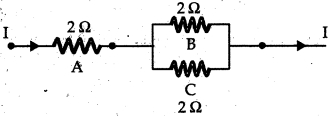
Three $2 \,\Omega$ resistors,$A, B$ and $C,$ are connected as shown in the figure. Each of them dissipates energy and can withstand a maximum power of $18 \,W$ without melting. Find the maximum current $I$ that can flow through the circuit.
Solution
(3 A) The power dissipated by a resistor is given by the formula $P = I^2 R$.
Given that the maximum power each resistor can withstand is $P_{max} = 18 \,W$ and the resistance is $R = 2 \,\Omega$.
First,calculate the maximum current $I_{max}$ that any single resistor can handle:
$I_{max}^2 = P_{max} / R = 18 / 2 = 9$
$I_{max} = \sqrt{9} = 3 \,A$.
In the given circuit,resistor $A$ is in series with the parallel combination of resistors $B$ and $C$.
The total current $I$ flows through resistor $A$. Therefore,the maximum current $I$ that can flow through the circuit is limited by the maximum current capacity of resistor $A$,which is $3 \,A$.
If $I = 3 \,A$ flows through the circuit,then at the parallel junction,the current splits equally between $B$ and $C$ (since $R_B = R_C = 2 \,\Omega$).
Thus,current through $B$ is $I_B = 1.5 \,A$ and current through $C$ is $I_C = 1.5 \,A$.
Since $1.5 \,A < 3 \,A$,both $B$ and $C$ are safe.
Therefore,the maximum current that can flow through the circuit is $3 \,A$.
0 likes
View Solution91
MediumMCQ
An electric heater rated $600 \ W$ operates $6$ hours per day. Find the cost to operate it for $30$ days at ₹ $3.00$ per unit.
A
₹ $300$
B
₹ $324$
C
₹ $350$
D
₹ $400$
Solution
(B) Given:
Power $(P)$ = $600 \ W = 0.6 \ kW$
Time $(t)$ = $6 \ hours/day \times 30 \ days = 180 \ hours$
Energy consumed $(E)$ = $P \times t = 0.6 \ kW \times 180 \ h = 108 \ kWh$
Since $1 \ unit = 1 \ kWh$, the total energy consumed is $108 \ units$.
Cost = Energy consumed $\times$ Rate per unit
Cost = $108 \times 3 = ₹ \ 324$.
0 likes
View Solution92
MediumMCQ
An electric heater rated $1200 \ W$ operates $2 \ h$ per day. Find the cost of the energy required to operate it for $30$ days at ₹ $5.00$ per unit.
A
₹ $300$
B
₹ $360$
C
₹ $400$
D
₹ $450$
Solution
(B) Power of the electric heater $= 1200 \ W = 1.2 \ kW$.
Time used per day $= 2 \ h$.
Energy consumed per day $= \text{Power} \times \text{Time} = 1.2 \ kW \times 2 \ h = 2.4 \ kWh$.
Total energy consumed in $30$ days $= 2.4 \ kWh/day \times 30 \ days = 72 \ kWh$.
Since $1 \ kWh = 1 \ \text{unit}$, total energy $= 72 \ \text{units}$.
Cost of energy $= \text{Total units} \times \text{Rate per unit} = 72 \times 5 = ₹ \ 360$.
0 likes
View Solution93
Medium
What is meant by "electrical resistance" of a conductor? State how the resistance of a conductor is affected when $(i)$ a low current passes through it for a short duration; $(ii)$ a heavy current passes through it for about $30$ seconds.
Solution
(N/A) Electrical resistance is the property of a conductor to oppose the flow of electric current through it.
$(i)$ When a low current passes through a conductor for a short duration, the temperature of the conductor does not change significantly. Therefore, the resistance remains constant.
$(ii)$ When a heavy current passes through a conductor for about $30$ seconds, the conductor heats up due to the heating effect of electric current $(H = I^2Rt)$. Since the resistance of a metallic conductor increases with an increase in temperature, the resistance of the conductor will increase.
0 likes
View Solution94
Difficult
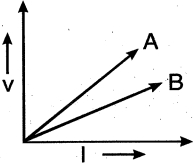
The $V-I$ graphs for two wires $A$ and $B$ are shown in the figure. If we connect both the wires one by one to the same battery, which of the two will produce more heat per unit time? Give justification for your answer.
Solution
(B) The heat produced per unit time is given by the power formula $P = \frac{V^2}{R}$, where $V$ is the potential difference and $R$ is the resistance.
Since both wires are connected to the same battery, $V$ is constant for both.
Therefore, $P \propto \frac{1}{R}$, meaning the wire with lower resistance will produce more heat.
In a $V-I$ graph, the slope represents the resistance $(R = \frac{V}{I})$. The slope of wire $A$ is greater than the slope of wire $B$, which means $R_A > R_B$.
Since $R_B < R_A$, wire $B$ will have a lower resistance and thus will produce more heat per unit time.
0 likes
View Solution95
EasyMCQ
The electrical resistivity of a few materials is given below in ohm-metre. Which of these materials can be used for making the element of a heating device?
| $A$. $6.84 \times 10^{-8} \, \Omega m$ |
| $B$. $1.60 \times 10^{-8} \, \Omega m$ |
| $C$. $1.00 \times 10^{-4} \, \Omega m$ |
| $D$. $2.50 \times 10^{12} \, \Omega m$ |
| $E$. $4.40 \times 10^{-5} \, \Omega m$ |
| $F$. $2.30 \times 10^{17} \, \Omega m$ |
A
$A$
B
$B$
C
$C$
D
$D$
Solution
(C) Heating elements in devices like toasters, heaters, and irons require materials with high electrical resistivity so that they can generate significant heat when current passes through them (Joule's heating effect, $H = I^2Rt$).
Comparing the given values:
$A$: $6.84 \times 10^{-8} \, \Omega m$ (Conductor)
$B$: $1.60 \times 10^{-8} \, \Omega m$ (Conductor)
$C$: $1.00 \times 10^{-4} \, \Omega m$ (Alloy/Resistive material)
$D$: $2.50 \times 10^{12} \, \Omega m$ (Insulator)
$E$: $4.40 \times 10^{-5} \, \Omega m$ (Alloy/Resistive material)
$F$: $2.30 \times 10^{17} \, \Omega m$ (Insulator)
Materials $C$ and $E$ have significantly higher resistivity compared to conductors like $A$ and $B$, making them suitable for heating elements. Among the options provided, $C$ is a standard choice for such applications.
0 likes
View Solution96
MediumMCQ
Two electric bulbs $A$ and $B$ are marked $220\, V, 60\, W$ and $220\, V, 100\, W$ respectively. Which one of the two has greater resistance?
A
$A$ has greater resistance
B
$B$ has greater resistance
C
Both have equal resistance
D
Resistance cannot be determined
Solution
(A) The resistance $R$ of an electric bulb is calculated using the formula $R = \frac{V^2}{P}$,where $V$ is the voltage and $P$ is the power.
For bulb $A$: $R_A = \frac{220^2}{60} \approx 806.67\, \Omega$.
For bulb $B$: $R_B = \frac{220^2}{100} = 484\, \Omega$.
Since the voltage $V$ is constant for both bulbs,the resistance is inversely proportional to the power $(R \propto \frac{1}{P})$.
Therefore,the bulb with the lower power rating $(60\, W)$ will have a higher resistance.
Thus,bulb $A$ has greater resistance.
0 likes
View Solution97
EasyMCQ
The applied potential difference across a given resistor is altered so that the heat produced per second increases by a factor of $16.$ By what factor does the applied potential difference change?
A
$2$
B
$4$
C
$8$
D
$16$
Solution
(B) The heat produced per second in a resistor is given by the power formula $P = \frac{V^2}{R}$,where $V$ is the potential difference and $R$ is the resistance.
Since the resistance $R$ remains constant,the heat produced per second is directly proportional to the square of the potential difference,i.e.,$P \propto V^2$.
If the heat produced per second increases by a factor of $16$,then $P' = 16P$.
Substituting this into the proportionality,we get $16P \propto (V')^2$.
Since $P \propto V^2$,we have $16V^2 = (V')^2$.
Taking the square root of both sides,we get $V' = 4V$.
Therefore,the applied potential difference changes by a factor of $4$.
0 likes
View Solution98
EasyMCQ
Two bulbs are marked $60\, W, 220\, V$ and $100\, W, 220\, V$. These are connected in parallel to a $220\, V$ mains. Which one out of the two will glow brighter?
A
$60\, W$ bulb
B
$100\, W$ bulb
C
Both will glow equally
D
None of these
Solution
(B) When bulbs are connected in parallel,the potential difference across each bulb remains the same,which is equal to the supply voltage $(220\, V)$.
The brightness of a bulb depends on the power consumed by it,which is given by the formula $P = V^2 / R$.
Since the voltage $V$ is constant for both bulbs,the power consumed is directly proportional to the rated power of the bulb.
The bulb with the higher wattage rating $(100\, W)$ will consume more power and therefore glow brighter than the $60\, W$ bulb.
0 likes
View Solution99
EasyMCQ
Two conductors,one having resistance $R$ and another $2R$ are connected in turn across a $dc$ source. If the rate of heat produced in the two conductors is $Q_{1}$ and $Q_{2}$ respectively,what is the value of $Q_{1} / Q_{2}$?
A
$1:2$
B
$2:1$
C
$1:4$
D
$4:1$
Solution
(B) The rate of heat produced in a conductor is given by the formula $P = \frac{V^2}{R}$,where $V$ is the potential difference and $R$ is the resistance.
Since both conductors are connected across the same $dc$ source,the potential difference $V$ remains constant for both.
Therefore,the rate of heat produced is inversely proportional to the resistance: $Q \propto \frac{1}{R}$.
For the first conductor with resistance $R_1 = R$,the rate of heat is $Q_1 = \frac{V^2}{R}$.
For the second conductor with resistance $R_2 = 2R$,the rate of heat is $Q_2 = \frac{V^2}{2R}$.
Calculating the ratio $Q_1 / Q_2$:
$\frac{Q_1}{Q_2} = \frac{V^2 / R}{V^2 / 2R} = \frac{V^2}{R} \times \frac{2R}{V^2} = 2$.
Thus,the value of $Q_1 / Q_2$ is $2$.
0 likes
View Solution100
EasyMCQ
If $R_{1}$ and $R_{2}$ are the resistances of filaments of a $400 \ W$ and a $200 \ W$ lamp,designed to operate on the same voltage,then
A
$R_{2} = 2R_{1}$
B
$R_{2} = 4R_{1}$
C
$R_{1} = 2R_{2}$
D
$R_{1} = R_{2}$
Solution
(A) The power $P$ of an electrical appliance is given by the formula $P = \frac{V^2}{R}$,where $V$ is the voltage and $R$ is the resistance.
Since both lamps are designed to operate on the same voltage $V$,we have $R = \frac{V^2}{P}$.
For the first lamp,$P_{1} = 400 \ W$,so $R_{1} = \frac{V^2}{400}$.
For the second lamp,$P_{2} = 200 \ W$,so $R_{2} = \frac{V^2}{200}$.
Dividing $R_{2}$ by $R_{1}$,we get $\frac{R_{2}}{R_{1}} = \frac{V^2 / 200}{V^2 / 400} = \frac{400}{200} = 2$.
Therefore,$R_{2} = 2R_{1}$.
0 likes
View SolutionElectricity — Heating Effect of Electric Current and Electric Power · Frequently Asked Questions
1Are these Electricity questions useful for JEE and NEET?
Yes. All questions in this section are mapped to JEE Main and NEET exam patterns. Previous year questions from JEE Main, NEET, GUJCET and state-level exams are included with full solutions.
2Can I switch to Hindi or Gujarati for these questions?
Yes. Use the language tabs in the hero section or the sidebar to view the same questions and solutions in English, Hindi or Gujarati.
3How do I generate a question paper from this subtopic?
Use the Vedclass Exam Paper Generator — select the chapter and subtopic, set difficulty, and generate Sets A, B, C, D automatically. First 3 chapters of every subject are free.
Vedclass Products
For Students
Vedclass Test Series
Mock tests in real JEE/NEET style with performance analysis. 5-day free trial.
Start Free TrialFor Teachers
Exam Paper Generator
Generate Set A/B/C/D papers from this chapter in 2 minutes. 3 chapters free.
Try FreeFor Institutes
Online Exam Module
Live online exams with unlimited students, 360° analytics & white-label branding.
See DemoFor Teachers & Institutes
Generate a Electricity Exam Paper in 2 Minutes
Select subtopic & difficulty — Sets A, B, C, D auto-generated with No Repeat logic.
First 3 chapters of every subject are free — no payment required.