
A English
Heating Effect of Electric Current and Electric Power Questions in English
Class 10 Science · Electricity · Heating Effect of Electric Current and Electric Power
137+
Questions
English
Language
100%
With Solutions
Showing 50 of 137 questions in English
1
Medium
Why are coils of electric toasters and electric irons made of an alloy rather than a pure metal?
Solution
(N/A) The resistivity of an alloy is generally much higher than that of its constituent pure metals.
Due to this high resistivity,alloys produce more heat when an electric current passes through them.
Furthermore,alloys do not oxidize (burn) or melt readily even at high temperatures.
Therefore,alloys are preferred for heating elements in appliances like electric toasters and electric irons.
Due to this high resistivity,alloys produce more heat when an electric current passes through them.
Furthermore,alloys do not oxidize (burn) or melt readily even at high temperatures.
Therefore,alloys are preferred for heating elements in appliances like electric toasters and electric irons.
0 likes
View Solution2
MediumMCQ
Why does the cord of an electric heater not glow while the heating element does?
A
The cord is made of a different material.
B
The heating element has high resistance,while the cord has low resistance.
C
The cord is insulated.
D
The current does not flow through the cord.
Solution
(B) The heating element of an electric heater is a resistor.
According to Joule's law of heating,the heat produced $(H)$ is given by $H = I^2Rt$,where $I$ is the current,$R$ is the resistance,and $t$ is the time.
The resistance of the heating element is very high,which causes it to produce a large amount of heat,making it glow red.
In contrast,the cord is made of good conductors like copper,which have very low resistance.
Therefore,the heat produced in the cord is negligible,and it does not glow.
0 likes
View Solution3
DifficultMCQ
Compute the heat generated while transferring $96000$ coulomb of charge in one hour through a potential difference of $50\, V$.
A
$9.6 \times 10^{6}\, J$
B
$1.2 \times 10^{6}\, J$
C
$4.8 \times 10^{6}\, J$
D
$2.4 \times 10^{6}\, J$
Solution
(C) The amount of heat $(H)$ produced is given by the formula $H = V \times Q$,where $V$ is the potential difference and $Q$ is the total charge transferred.
Given:
Potential difference,$V = 50\, V$
Charge,$Q = 96000\, C$
Using the formula:
$H = V \times Q$
$H = 50\, V \times 96000\, C$
$H = 4800000\, J$
$H = 4.8 \times 10^{6}\, J$
Therefore,the heat generated is $4.8 \times 10^{6}\, J$.
Given:
Potential difference,$V = 50\, V$
Charge,$Q = 96000\, C$
Using the formula:
$H = V \times Q$
$H = 50\, V \times 96000\, C$
$H = 4800000\, J$
$H = 4.8 \times 10^{6}\, J$
Therefore,the heat generated is $4.8 \times 10^{6}\, J$.
0 likes
View Solution4
MediumMCQ
An electric iron of resistance $20\, \Omega$ takes a current of $5\, A$. Calculate the heat developed in $30\, s$.
A
$6 \times 10^4\, J$
B
$3 \times 10^4\, J$
C
$4.5 \times 10^4\, J$
D
$1.5 \times 10^4\, J$
Solution
(D) The amount of heat $(H)$ produced is given by Joule's law of heating as $H = I^2Rt$.
Given:
Resistance,$R = 20\, \Omega$
Current,$I = 5\, A$
Time,$t = 30\, s$
Using the formula:
$H = (5)^2 \times 20 \times 30$
$H = 25 \times 20 \times 30$
$H = 500 \times 30$
$H = 15000\, J$
$H = 1.5 \times 10^4\, J$
Therefore,the amount of heat developed in the electric iron is $1.5 \times 10^4\, J$.
0 likes
View Solution5
EasyMCQ
What determines the rate at which energy is delivered by a current?
A
Electric potential
B
Electric power
C
Electric resistance
D
Electric charge
Solution
(B) The rate of consumption of electric energy in an electric appliance is defined as electric power.
Mathematically,$P = \frac{W}{t} = VI$.
Therefore,the rate at which energy is delivered by a current is known as electric power.
Mathematically,$P = \frac{W}{t} = VI$.
Therefore,the rate at which energy is delivered by a current is known as electric power.
0 likes
View Solution6
DifficultMCQ
An electric motor takes $5\, A$ from a $220\, V$ line. Determine the power of the motor and the energy consumed in $2\, h$.
A
$3.46 \times 10^6\, J$
B
$7.92 \times 10^6\, J$
C
$6.96 \times 10^5\, J$
D
$1.6 \times 10^5\, J$
Solution
(B) Power $(P)$ is given by the expression,
$P = V \times I$
Where,
Voltage,$V = 220\, V$
Current,$I = 5\, A$
$P = 220 \times 5 = 1100\, W$
Energy consumed $(E)$ by the motor is given by,
$E = P \times t$
Where,
Time,$t = 2\, h = 2 \times 60 \times 60 = 7200\, s$
$E = 1100 \times 7200 = 7,920,000\, J = 7.92 \times 10^6\, J$
Therefore,the power of the motor is $1100\, W$ and the energy consumed is $7.92 \times 10^6\, J$.
0 likes
View Solution7
MediumMCQ
Which of the following terms does not represent electrical power in a circuit?
A
$I^2R$
B
$VI$
C
$\frac{V^2}{R}$
D
$IR^2$
Solution
(D) Electrical power is given by the expression,$P = VI$ $(i)$.
According to Ohm's law,$V = IR$ $(ii)$.
Where,
$V =$ Potential difference
$I =$ Current
$R =$ Resistance
From equation $(i)$,substituting $V = IR$,we get:
$P = (IR) \times I = I^2R$.
From equation $(ii)$,substituting $I = \frac{V}{R}$,we get:
$P = V \times \frac{V}{R} = \frac{V^2}{R}$.
Therefore,the expressions for power are $P = VI = I^2R = \frac{V^2}{R}$.
The term $IR^2$ does not represent electrical power.
0 likes
View Solution8
MediumMCQ
An electric bulb is rated $220\, V$ and $100\, W$. When it is operated on $110\, V$,the power consumed will be ....... $W$.
A
$25$
B
$50$
C
$75$
D
$100$
Solution
(A) The power consumed by an electrical appliance is given by the formula $P = \frac{V^2}{R}$.
First,we calculate the resistance $R$ of the bulb using its rated values:
$R = \frac{V^2}{P} = \frac{(220)^2}{100} = \frac{48400}{100} = 484\, \Omega$.
The resistance of the bulb remains constant regardless of the operating voltage.
Now,when the bulb is operated at a new voltage $V' = 110\, V$,the new power consumed $P'$ is:
$P' = \frac{(V')^2}{R} = \frac{(110)^2}{484} = \frac{12100}{484} = 25\, W$.
Therefore,the power consumed will be $25\, W$.
0 likes
View Solution9
DifficultMCQ
Several electric bulbs designed to be used on a $220\, V$ electric supply line,are rated $10\, W$. How many lamps can be connected in parallel with each other across the two wires of a $220\, V$ line if the maximum allowable current is $5\, A$?
A
$90$
B
$110$
C
$140$
D
$150$
Solution
(B) The power rating of each bulb is $P_1 = 10\, W$ at a voltage of $V = 220\, V$.
The current drawn by each bulb is $I_1 = \frac{P_1}{V} = \frac{10}{220} = \frac{1}{22}\, A$.
The maximum allowable current in the circuit is $I_{total} = 5\, A$.
Since the bulbs are connected in parallel,the total current is the sum of the currents through each bulb.
If $n$ is the number of bulbs,then $I_{total} = n \times I_1$.
$5 = n \times \frac{1}{22}$.
$n = 5 \times 22 = 110$.
Therefore,$110$ electric bulbs can be connected in parallel.
0 likes
View Solution10
MediumMCQ
Two lamps,one rated $100\, W$ at $220\, V$,and the other $60\, W$ at $220\, V$,are connected in parallel to electric mains supply. What current (in $A$) is drawn from the line if the supply voltage is $220\, V$?
A
$0.73$
B
$1.46$
C
$0.33$
D
$1.67$
Solution
(A) Both the bulbs are connected in parallel. Therefore,the potential difference across each of them will be $220\, V$,because the voltage remains the same in a parallel circuit.
For the first bulb $(100\, W, 220\, V)$:
$I_1 = \frac{P_1}{V} = \frac{100}{220}\, A$
For the second bulb $(60\, W, 220\, V)$:
$I_2 = \frac{P_2}{V} = \frac{60}{220}\, A$
Total current drawn from the line $(I)$ is the sum of currents through both bulbs:
$I = I_1 + I_2 = \frac{100}{220} + \frac{60}{220} = \frac{160}{220}\, A$
$I \approx 0.727\, A$
Rounding to two decimal places,we get $0.73\, A$.
0 likes
View Solution11
MediumMCQ
If the current $I$ through a resistor is increased by $100\%$ (assume that temperature remains unchanged), the increase in power dissipated will be ........ $\%$
A
$100$
B
$200$
C
$400$
D
$300$
Solution
(D) The power dissipated in a resistor is given by the formula $P = I^2 R$, where $I$ is the current and $R$ is the resistance.
Initially, let the current be $I_1 = I$ and the power be $P_1 = I^2 R$.
When the current is increased by $100\%$, the new current $I_2$ becomes $I + 100\% \text{ of } I = I + I = 2I$.
The new power dissipated $P_2$ is $P_2 = (I_2)^2 R = (2I)^2 R = 4I^2 R = 4P_1$.
The increase in power is $P_2 - P_1 = 4P_1 - P_1 = 3P_1$.
The percentage increase in power is given by $\frac{P_2 - P_1}{P_1} \times 100\% = \frac{3P_1}{P_1} \times 100\% = 300\%$.
0 likes
View Solution12
MediumMCQ
In an electrical circuit,three incandescent bulbs $A, B$ and $C$ of rating $40 \, W, 60 \, W$ and $100 \, W$ respectively are connected in parallel to an electric source. Which of the following is likely to happen regarding their brightness?
A
Brightness of all the bulbs will be the same
B
Brightness of bulb $B$ will be more than that of $A$
C
Brightness of bulb $A$ will be the maximum
D
Brightness of bulb $C$ will be less than that of $B$
Solution
(B) When bulbs are connected in parallel,the potential difference $(V)$ across each bulb remains the same.
The power consumed by a bulb is given by the formula $P = V^2 / R$.
Since $V$ is constant,the power consumed is directly proportional to the brightness of the bulb.
Bulb $C$ has the highest power rating $(100 \, W)$,followed by bulb $B$ $(60 \, W)$,and bulb $A$ $(40 \, W)$.
Therefore,the brightness of bulb $C$ will be the maximum,and the brightness of bulb $A$ will be the minimum.
Comparing the options,the brightness of bulb $B$ $(60 \, W)$ is indeed more than that of bulb $A$ $(40 \, W)$.
0 likes
View Solution13
MediumMCQ
In an electrical circuit,two resistors of $2\,\Omega$ and $4\,\Omega$ respectively are connected in series to a $6\,V$ battery. The heat dissipated by the $4\,\Omega$ resistor in $5\,s$ will be ........ $J$.
A
$5$
B
$10$
C
$20$
D
$30$
Solution
(C) Given: Resistors $R_1 = 2\,\Omega$ and $R_2 = 4\,\Omega$ are connected in series.
Voltage $V = 6\,V$.
Time $t = 5\,s$.
Total resistance $R_{eq} = R_1 + R_2 = 2\,\Omega + 4\,\Omega = 6\,\Omega$.
The current $I$ flowing through the circuit is $I = V / R_{eq} = 6\,V / 6\,\Omega = 1\,A$.
Since the resistors are in series,the same current $I = 1\,A$ flows through the $4\,\Omega$ resistor.
The heat dissipated $H$ is given by the formula $H = I^2 R t$.
Substituting the values: $H = (1)^2 \times 4 \times 5 = 1 \times 4 \times 5 = 20\,J$.
0 likes
View Solution14
MediumMCQ
An electric kettle consumes $1\, kW$ of electric power when operated at $220\, V$. $A$ fuse wire of what rating (in $A$) must be used for it?
A
$1$
B
$2$
C
$4$
D
$5$
Solution
(D) The power consumed by the electric kettle is $P = 1\, kW = 1000\, W$.
The voltage at which it operates is $V = 220\, V$.
Using the formula for electric power,$P = V \times I$,we can find the current $I$ as:
$I = P / V$
$I = 1000 / 220 \approx 4.54\, A$.
Since the current drawn is approximately $4.54\, A$,a fuse wire with a rating slightly higher than this value is required to prevent the circuit from breaking during normal operation.
Therefore,a fuse of $5\, A$ rating is the most appropriate choice among the given options.
0 likes
View Solution15
EasyMCQ
The unit of electric power may also be expressed as:
A
kilowatt hour
B
volt ampere
C
watt second
D
joule second
Solution
(B) Electric power $(P)$ is defined as the rate at which electrical energy is consumed or dissipated in an electric circuit.
Mathematically,$P = V \times I$,where $V$ is the potential difference measured in volts $(V)$ and $I$ is the electric current measured in amperes $(A)$.
Therefore,the $SI$ unit of power,the watt $(W)$,can also be expressed as the product of volts and amperes $(V \cdot A)$.
- Kilowatt hour $(kWh)$ is a unit of electrical energy.
- Watt second $(Ws)$ is also a unit of energy (since $Power \times Time = Energy$).
- Joule second $(Js)$ is a unit of action.
Thus,the correct expression for electric power is volt ampere.
0 likes
View Solution16
DifficultMCQ
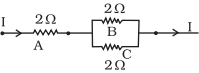
Three $2\,\Omega$ resistors,$A$,$B$,and $C$,are connected as shown in the figure. Each of them dissipates energy and can withstand a maximum power of $18\,W$ without melting. Find the maximum current (in $A$) that can flow through the circuit such that none of the resistors melt.
A
$3$
B
$4.5$
C
$1.5$
D
$6$
Solution
(A) The maximum power $P_{max}$ that each resistor can withstand is $18\,W$,and the resistance $R$ of each is $2\,\Omega$.
Using the formula $P = I^2R$,the maximum current $I_{max}$ that any individual resistor can withstand is:
$I_{max} = \sqrt{\frac{P_{max}}{R}} = \sqrt{\frac{18}{2}} = \sqrt{9} = 3\,A$.
In the given circuit,resistor $A$ is in series with the parallel combination of resistors $B$ and $C$.
The total current $I$ flows through resistor $A$. Therefore,the maximum current $I$ that can flow through the circuit is limited by the maximum current capacity of resistor $A$,which is $3\,A$.
If $I = 3\,A$,the current through $B$ and $C$ (which are equal) will be $I_B = I_C = \frac{I}{2} = 1.5\,A$.
Since $1.5\,A < 3\,A$,resistors $B$ and $C$ will not melt.
Thus,the maximum current that can flow through the circuit is $3\,A$.
0 likes
View Solution17
Easy
What is the commercial unit of electrical energy? Represent it in terms of joules.
Solution
(N/A) The commercial unit of electrical energy is the kilowatt-hour $(kWh)$.
To convert $1 \; kWh$ into joules $(J)$:
$1 \; kWh = 1 \; kW \times 1 \; h$
$1 \; kW = 1000 \; W = 1000 \; J/s$
$1 \; h = 60 \times 60 \; s = 3600 \; s$
Therefore,$1 \; kWh = 1000 \; J/s \times 3600 \; s = 3.6 \times 10^6 \; J$.
To convert $1 \; kWh$ into joules $(J)$:
$1 \; kWh = 1 \; kW \times 1 \; h$
$1 \; kW = 1000 \; W = 1000 \; J/s$
$1 \; h = 60 \times 60 \; s = 3600 \; s$
Therefore,$1 \; kWh = 1000 \; J/s \times 3600 \; s = 3.6 \times 10^6 \; J$.
0 likes
View Solution18
Medium
What is Joule's heating effect? How can it be demonstrated experimentally? List its four applications in daily life.
Solution
(N/A) Joule's heating effect states that when an electric current $I$ flows through a conductor of resistance $R$ for time $t$,the heat $H$ produced is given by the formula $H = I^2Rt$.
Experimental demonstration: Connect a resistor of known resistance $R$ in series with an ammeter,a battery,and a plug key. Connect a voltmeter in parallel across the resistor. Measure the current $I$ and potential difference $V$ across the resistor. The heat produced can be calculated by measuring the temperature rise in a known mass of water or by using the formula $H = VIt$.
Applications in daily life:
$1$. Electric iron
$2$. Electric toaster
$3$. Electric heater
$4$. Electric kettle
0 likes
View Solution19
Easy
Mention one reason why tungsten is used for making the filament of an electric lamp.
Solution
(N/A) Tungsten is used for making the filament of an electric lamp because it has a very high melting point (approximately $3380 ^\circ C$), which allows it to glow at high temperatures without melting. Additionally, it has a high resistivity, which helps in generating sufficient heat when an electric current passes through it.
0 likes
View Solution20
Easy
State a difference between the wire used in the element of an electric heater and in a fuse wire.
Solution
(N/A) The wire used in the element of an electric heater is made of an alloy (like Nichrome) which has a very high resistance and a high melting point,allowing it to produce heat without melting. In contrast,a fuse wire is made of a material with a low melting point and appropriate resistance,designed to melt and break the circuit when the current exceeds a safe limit.
0 likes
View Solution21
EasyMCQ
Power of a lamp is $60\, W$. Find the energy in joules consumed by it in $1\, s$. (in $, J$)
A
$60$
B
$30$
C
$120$
D
$1$
Solution
(A) The formula for energy consumed is given by $E = P \times t$,where $P$ is power and $t$ is time.
Given: Power $(P)$ = $60\, W$,Time $(t)$ = $1\, s$.
Substituting the values: $E = 60\, W \times 1\, s = 60\, J$.
Therefore,the energy consumed is $60\, J$.
Given: Power $(P)$ = $60\, W$,Time $(t)$ = $1\, s$.
Substituting the values: $E = 60\, W \times 1\, s = 60\, J$.
Therefore,the energy consumed is $60\, J$.
0 likes
View Solution22
MediumMCQ
Which uses more energy, a $250 \,W$ $TV$ set in $1 \,hr$ or a $1200 \,W$ toaster in $10$ minutes?
A
$250 \,W$ $TV$ set
B
$1200 \,W$ toaster
C
Both use the same energy
D
Cannot be determined
Solution
(A) Energy consumed by an electrical appliance is given by the formula, $H = P \times t$.
For the $TV$ set:
Power $(P)$ = $250 \,W$
Time $(t)$ = $1 \,hr = 3600 \,s$
Energy = $250 \,W \times 3600 \,s = 900,000 \,J = 9 \times 10^5 \,J$.
For the toaster:
Power $(P)$ = $1200 \,W$
Time $(t)$ = $10 \,minutes = 10 \times 60 \,s = 600 \,s$
Energy = $1200 \,W \times 600 \,s = 720,000 \,J = 7.2 \times 10^5 \,J$.
Comparing the two values, $9 \times 10^5 \,J > 7.2 \times 10^5 \,J$.
Therefore, the $250 \,W$ $TV$ set consumes more energy.
0 likes
View Solution23
MediumMCQ
An electric heater of resistance $8 \, \Omega$ draws $15 \, A$ from the service mains for $2$ hours. Calculate the rate at which heat is developed in the heater (in $W$).
A
$300$
B
$900$
C
$1800$
D
$1200$
Solution
(C) The rate at which heat is developed in an electric heater is defined as its electric power $(P)$.
The formula for electric power is given by:
$P = I^2 R$
Given:
Resistance $(R)$ = $8 \, \Omega$
Current $(I)$ = $15 \, A$
Substituting the values into the formula:
$P = (15)^2 \times 8$
$P = 225 \times 8$
$P = 1800 \, W$
Since $1 \, W = 1 \, J/s$,the rate at which heat is developed is $1800 \, J/s$ or $1800 \, W$.
0 likes
View Solution24
Medium
Explain the following.
$(a)$ Why is tungsten used almost exclusively for the filament of electric lamps?
$(b)$ Why are the conductors of electric heating devices,such as bread-toasters and electric irons,made of an alloy rather than a pure metal?
$(a)$ Why is tungsten used almost exclusively for the filament of electric lamps?
$(b)$ Why are the conductors of electric heating devices,such as bread-toasters and electric irons,made of an alloy rather than a pure metal?
Solution
(N/A) The melting point and resistivity of tungsten are very high. It does not oxidize or burn readily at high temperatures. Electric lamps glow at very high temperatures,and tungsten can withstand these temperatures without melting. Hence,tungsten is used as the filament of electric bulbs.
$(b)$ The conductors of electric heating devices,such as bread-toasters and electric irons,are made of an alloy because the resistivity of an alloy is significantly higher than that of pure metals. Furthermore,alloys do not oxidize (burn) readily at high temperatures even when they are red hot. This property allows them to produce a large amount of heat efficiently.
$(b)$ The conductors of electric heating devices,such as bread-toasters and electric irons,are made of an alloy because the resistivity of an alloy is significantly higher than that of pure metals. Furthermore,alloys do not oxidize (burn) readily at high temperatures even when they are red hot. This property allows them to produce a large amount of heat efficiently.
0 likes
View Solution25
EasyMCQ
How many joules are there in one kilowatt-hour?
A
$3.6 \times 10^{5} \text{ J}$
B
$3.6 \times 10^{6} \text{ J}$
C
$3.6 \times 10^{4} \text{ J}$
D
$3.6 \times 10^{7} \text{ J}$
Solution
(B) One kilowatt-hour $(kWh)$ is the amount of energy consumed by an electrical device of power $1 \text{ kW}$ in $1 \text{ hour}$.
$1 \text{ kW} = 1000 \text{ W} = 1000 \text{ J/s}$.
$1 \text{ hour} = 3600 \text{ seconds}$.
Therefore, $1 \text{ kWh} = 1000 \text{ J/s} \times 3600 \text{ s} = 3,600,000 \text{ J}$.
This can be expressed in scientific notation as $3.6 \times 10^{6} \text{ J}$.
$1 \text{ kW} = 1000 \text{ W} = 1000 \text{ J/s}$.
$1 \text{ hour} = 3600 \text{ seconds}$.
Therefore, $1 \text{ kWh} = 1000 \text{ J/s} \times 3600 \text{ s} = 3,600,000 \text{ J}$.
This can be expressed in scientific notation as $3.6 \times 10^{6} \text{ J}$.
0 likes
View Solution26
Easy
Define electric power. Give its $SI$ unit.
Solution
(N/A) Electric power is defined as the rate at which electrical energy is consumed or dissipated in an electric circuit. Mathematically,it is the rate of doing work,given by $P = \frac{W}{t} = VI = I^2R = \frac{V^2}{R}$. The $SI$ unit of electric power is the watt $(W)$,which is equivalent to $1 \text{ joule per second} (J/s).$
0 likes
View Solution27
EasyMCQ
What is the commercial unit of electric energy?
A
Joule
B
Watt
C
Kilowatt-hour (kWh)
D
Volt
Solution
(C) The commercial unit of electric energy is the kilowatt-hour $(kWh)$.
$1 \ kWh$ is equivalent to $3.6 \times 10^6 \ J$ of energy.
It is commonly known as a 'unit' of electricity used in billing domestic and industrial power consumption.
$1 \ kWh$ is equivalent to $3.6 \times 10^6 \ J$ of energy.
It is commonly known as a 'unit' of electricity used in billing domestic and industrial power consumption.
0 likes
View Solution28
EasyMCQ
What is the other name of the commercial unit of electrical energy?
A
Kilowatt-hour $(kWh)$
B
Joule $(J)$
C
Watt $(W)$
D
Ampere $(A)$
Solution
(A) The commercial unit of electrical energy is the kilowatt-hour $(kWh)$.
It is also commonly known as the Board of Trade Unit $(BOTU)$ or simply a 'unit' in electricity billing.
It is also commonly known as the Board of Trade Unit $(BOTU)$ or simply a 'unit' in electricity billing.
0 likes
View Solution29
EasyMCQ
Which has a greater resistance$-$a $100$ $W$ bulb or a $60$ $W$ bulb?
A
$100$ $W$ bulb
B
$60$ $W$ bulb
C
Both have equal resistance
D
Cannot be determined
Solution
(B) The power rating of a bulb is given by the formula $P = V^2 / R$,where $P$ is power,$V$ is voltage,and $R$ is resistance.
Assuming both bulbs are designed for the same voltage $V$,the resistance is inversely proportional to the power $(R = V^2 / P)$.
For a $100$ $W$ bulb,$R_1 = V^2 / 100$.
For a $60$ $W$ bulb,$R_2 = V^2 / 60$.
Since $60 < 100$,it follows that $V^2 / 60 > V^2 / 100$,which means $R_2 > R_1$.
Therefore,a $60$ $W$ bulb has a greater resistance.
0 likes
View Solution30
EasyMCQ
What are the factors on which heat dissipated by a conductor depends?
A
Current,resistance,and time
B
Voltage,current,and time
C
Resistance,voltage,and area
D
Current,voltage,and area
Solution
(A) According to Joule's law of heating,the heat $(H)$ dissipated by a conductor is given by the formula $H = I^2Rt$.
Therefore,the factors on which heat dissipated depends are:
$(i)$ The square of the current $(I^2)$ flowing through the conductor.
$(ii)$ The resistance $(R)$ of the conductor.
$(iii)$ The time $(t)$ for which the current is passed through the conductor.
Therefore,the factors on which heat dissipated depends are:
$(i)$ The square of the current $(I^2)$ flowing through the conductor.
$(ii)$ The resistance $(R)$ of the conductor.
$(iii)$ The time $(t)$ for which the current is passed through the conductor.
0 likes
View Solution31
Easy
Why is heat produced when a current is passed through a conductor?
Solution
(N/A) When an electric current flows through a conductor,the free electrons move in a specific direction. During their motion,these electrons frequently collide with the atoms and ions of the conductor's lattice. Due to these collisions,the electrons lose some of their kinetic energy. This lost kinetic energy is converted into thermal energy,which is dissipated as heat across the conductor.
0 likes
View Solution32
EasyMCQ
Give two practical applications of the heating effect of current.
A
Electric Iron
B
Electric Toaster
C
Electric Fuse
D
All of the above
Solution
(D) The heating effect of current is utilized in various electrical appliances where electrical energy is converted into heat energy.
Two common practical applications are:
$1$. Electric Iron: It uses a heating element to heat the base plate for ironing clothes.
$2$. Electric Fuse: It uses a wire with a low melting point that melts and breaks the circuit when excessive current flows,protecting the appliance.
Two common practical applications are:
$1$. Electric Iron: It uses a heating element to heat the base plate for ironing clothes.
$2$. Electric Fuse: It uses a wire with a low melting point that melts and breaks the circuit when excessive current flows,protecting the appliance.
0 likes
View Solution33
Easy
Define one watt.
Solution
(N/A) The power expended by a source is said to be $1$ watt,if $1$ ampere of current flows through it under a potential difference of $1$ volt. Mathematically,$P = V \times I$,where $P$ is power in watts,$V$ is potential difference in volts,and $I$ is current in amperes. Thus,$1 \text{ watt} = 1 \text{ volt} \times 1 \text{ ampere}$.
0 likes
View Solution34
Easy
Why should the melting point of a fuse wire be low?
Solution
(N/A) fuse wire is designed to protect electrical appliances from damage caused by excessive current. When the current flowing through the circuit exceeds the safe limit,the heat generated $(H = I^2Rt)$ increases significantly. Because the fuse wire has a low melting point,it melts quickly when this excess heat is produced,thereby breaking the circuit and preventing further flow of current. This action protects the connected devices from potential damage or fire hazards.
0 likes
View Solution35
Easy
State Joule's law of heating.
Solution
(N/A) Joule's law of heating states that the heat produced $(H)$ in a conductor is directly proportional to the square of the current $(I)$ flowing through it, the resistance $(R)$ of the conductor, and the time $(t)$ for which the current flows.
Mathematically, it is expressed as: $H = I^{2}Rt$
Where:
$H$ = Heat produced in Joules $(J)$
$I$ = Current in Amperes $(A)$
$R$ = Resistance in Ohms $(\Omega)$
$t$ = Time in seconds $(s)$
Mathematically, it is expressed as: $H = I^{2}Rt$
Where:
$H$ = Heat produced in Joules $(J)$
$I$ = Current in Amperes $(A)$
$R$ = Resistance in Ohms $(\Omega)$
$t$ = Time in seconds $(s)$
0 likes
View Solution36
Easy
The filament of an electric bulb is made of tungsten. Why?
Solution
(N/A) The filament of an electric bulb is made of tungsten because it has a very high melting point (approximately $3380 ^\circ C$).
This high melting point allows the filament to become white-hot and emit light without melting when a large amount of heat is produced due to the flow of electric current.
Additionally, tungsten does not easily oxidize or react with air at high temperatures, which ensures the longevity of the bulb.
This high melting point allows the filament to become white-hot and emit light without melting when a large amount of heat is produced due to the flow of electric current.
Additionally, tungsten does not easily oxidize or react with air at high temperatures, which ensures the longevity of the bulb.
0 likes
View Solution37
Easy
Define one watt hour.
Solution
One watt hour is defined as the amount of electrical energy consumed by an electrical appliance of power $1$ watt when it operates for a duration of $1$ hour.
Mathematically:
$1 \text{ watt hour} = 1 \text{ watt} \times 1 \text{ hour}$
Since $1 \text{ watt} = 1 \text{ J s}^{-1}$ and $1 \text{ hour} = 3600 \text{ s}$,
$1 \text{ watt hour} = (1 \text{ J s}^{-1}) \times (3600 \text{ s}) = 3600 \text{ J}$.
Mathematically:
$1 \text{ watt hour} = 1 \text{ watt} \times 1 \text{ hour}$
Since $1 \text{ watt} = 1 \text{ J s}^{-1}$ and $1 \text{ hour} = 3600 \text{ s}$,
$1 \text{ watt hour} = (1 \text{ J s}^{-1}) \times (3600 \text{ s}) = 3600 \text{ J}$.
0 likes
View Solution38
Easy
Why is tungsten metal selected for making filaments of incandescent lamps?
Solution
(N/A) Tungsten is selected for making the filaments of incandescent lamps because it has a very high melting point (approximately $3380 \, ^\circ C$).
This high melting point allows the filament to become white-hot and emit light without melting away when a large amount of electric current passes through it.
This high melting point allows the filament to become white-hot and emit light without melting away when a large amount of electric current passes through it.
0 likes
View Solution39
EasyMCQ
Why is much less heat generated in long electric cables than in filaments of electric bulbs?
A
Cables have higher resistance than filaments.
B
Cables are made of copper,which is a poor conductor.
C
Cables have low resistance,while filaments have high resistance.
D
Filaments are made of copper.
Solution
(C) According to Joule's law of heating,the heat generated $(H)$ in a conductor is given by $H = I^2Rt$,where $I$ is the current,$R$ is the resistance,and $t$ is the time.
Electric cables are typically made of thick copper wires,which have a very low resistance $(R)$.
In contrast,the filaments of electric bulbs are made of thin tungsten wire,which has a very high resistance $(R)$.
Since the heat generated is directly proportional to the resistance $(H \propto R)$,the low resistance of the cables results in significantly less heat generation compared to the high resistance of the bulb filaments.
0 likes
View Solution40
EasyMCQ
State which has a higher resistance,a $50 \, W$ or a $25 \, W$ lamp bulb,and by how many times?
A
$50 \, W$ bulb,$2$ times
B
$25 \, W$ bulb,$2$ times
C
$50 \, W$ bulb,$4$ times
D
$25 \, W$ bulb,$4$ times
Solution
(B) The resistance $R$ of an electrical appliance is given by the formula $R = \frac{V^2}{P}$,where $V$ is the voltage and $P$ is the power rating.
Assuming the voltage $V$ remains constant for both bulbs,the relationship between resistance and power is inversely proportional,i.e.,$R \propto \frac{1}{P}$.
For a $50 \, W$ bulb: $R_1 = \frac{V^2}{50}$.
For a $25 \, W$ bulb: $R_2 = \frac{V^2}{25}$.
Comparing the two: $\frac{R_2}{R_1} = \frac{V^2/25}{V^2/50} = \frac{50}{25} = 2$.
Therefore,the $25 \, W$ lamp has double ($2$ times) the resistance of the $50 \, W$ lamp.
0 likes
View Solution41
EasyMCQ
What is the power of a bulb rated at $2.5 \, V$ and $500 \, mA$ (in $, W$)?
A
$1.25$
B
$2.50$
C
$0.50$
D
$5.00$
Solution
(A) Given:
Voltage $(V)$ = $2.5 \, V$
Current $(I)$ = $500 \, mA = 500 \times 10^{-3} \, A = 0.5 \, A$
Formula for power $(P)$:
$P = V \times I$
Calculation:
$P = 2.5 \, V \times 0.5 \, A = 1.25 \, W$
Therefore,the power of the bulb is $1.25 \, W$.
Voltage $(V)$ = $2.5 \, V$
Current $(I)$ = $500 \, mA = 500 \times 10^{-3} \, A = 0.5 \, A$
Formula for power $(P)$:
$P = V \times I$
Calculation:
$P = 2.5 \, V \times 0.5 \, A = 1.25 \, W$
Therefore,the power of the bulb is $1.25 \, W$.
0 likes
View Solution42
EasyMCQ
Out of the two,a toaster of $1\, kW$ and an electric heater of $2\, kW$,which has a greater resistance?
A
Toaster
B
Electric heater
C
Both have equal resistance
D
Cannot be determined
Solution
(A) We know that the formula for resistance is $R = \frac{V^2}{P}$,where $V$ is the voltage and $P$ is the power.
Assuming the voltage $V$ is constant for both appliances,the resistance $R$ is inversely proportional to the power $P$,i.e.,$R \propto \frac{1}{P}$.
For the toaster,$P_1 = 1\, kW$.
For the electric heater,$P_2 = 2\, kW$.
Since $P_1 < P_2$,it follows that $R_1 > R_2$.
Therefore,the $1\, kW$ toaster has a greater resistance than the $2\, kW$ electric heater.
0 likes
View Solution43
Easy
Why are alloys commonly used in electrical heating devices?
Solution
(N/A) Alloys are commonly used in electrical heating devices because of the following reasons:
$1$. They have high resistivity,which allows them to produce more heat when an electric current passes through them.
$2$. They do not oxidize (burn) readily even at high temperatures,which increases the durability and lifespan of the heating element.
$1$. They have high resistivity,which allows them to produce more heat when an electric current passes through them.
$2$. They do not oxidize (burn) readily even at high temperatures,which increases the durability and lifespan of the heating element.
0 likes
View Solution44
EasyMCQ
$A$ bulb gets dimmer for a moment when a geyser,connected across the same source,is switched on. Why?
A
The geyser consumes all the energy.
B
The geyser draws a heavy current,causing a voltage drop in the supply line.
C
The resistance of the bulb increases.
D
The total resistance of the circuit decreases.
Solution
(B) When a high-power appliance like a geyser is switched on,it draws a large amount of current from the source.
Due to the internal resistance of the supply lines and the source,this high current causes a significant potential drop (voltage drop) across the supply lines.
As a result,the voltage available to the bulb decreases momentarily.
Since the power consumed by the bulb is given by $P = V^2 / R$,a decrease in voltage $(V)$ leads to a decrease in the power output of the bulb,making it appear dimmer.
0 likes
View Solution45
Easy
Why is very less heat generated in long electric cables than in filaments of electric bulbs?
Solution
(N/A) The heat generated in a conductor is given by Joule's law of heating,$H = I^2Rt$,where $I$ is the current,$R$ is the resistance,and $t$ is the time.
Since the electric cables are made of good conductors like copper or aluminum,they have very low electrical resistance $(R)$.
In contrast,the filament of an electric bulb is made of tungsten,which has a very high melting point and high electrical resistance $(R)$ to produce light through incandescence.
Because the heat generated $(H)$ is directly proportional to the resistance $(R)$,the high resistance of the filament results in significant heat production,whereas the low resistance of the cables results in minimal heat generation.
0 likes
View Solution46
Easy
Nichrome is used to make the element of an electric heater. Why?
Solution
(N/A) Nichrome is an alloy that possesses high electrical resistivity,which allows it to generate a significant amount of heat when an electric current passes through it.
Additionally,it has a very high melting point,which prevents it from melting or burning out even when it becomes extremely hot during operation.
Additionally,it has a very high melting point,which prevents it from melting or burning out even when it becomes extremely hot during operation.
0 likes
View Solution47
Medium
Elements of electric toasters and electric irons are made of an alloy rather than a pure metal. Give two reasons to justify the statement.
Solution
(N/A) Alloys do not oxidise readily at high temperatures,which makes them more resistant to corrosion.
$(b)$ Alloys have higher electrical resistivity (lower electrical conductivity) than pure metals,which allows them to generate more heat when current passes through them.
$(b)$ Alloys have higher electrical resistivity (lower electrical conductivity) than pure metals,which allows them to generate more heat when current passes through them.
0 likes
View Solution48
Medium
Mention two special features of the material to be used as an element of an electric iron.
Solution
(N/A) The material used for the heating element of an electric iron must possess the following two special features:
$(a)$ High resistivity: This ensures that the material produces a large amount of heat when an electric current passes through it,according to Joule's law of heating $(H = I^2Rt)$.
$(b)$ High melting point: This prevents the element from melting or breaking down even when it becomes extremely hot during continuous operation.
0 likes
View Solution49
Medium
Give reasons for the following:
$(i)$ Tungsten is used almost exclusively for the filament of electric lamps.
$(ii)$ Why do we use copper and aluminium wires for the transmission of electric current?
$(i)$ Tungsten is used almost exclusively for the filament of electric lamps.
$(ii)$ Why do we use copper and aluminium wires for the transmission of electric current?
Solution
(N/A) $(i)$ Tungsten is used in making the filament of an electric bulb because:
$(a)$ Tungsten has a very high melting point $(3380 \ ^\circ C)$,which allows it to glow at high temperatures without melting.
$(b)$ It has high resistivity,which allows it to produce a large amount of heat when current passes through it.
$(ii)$ Copper and aluminium are used for the transmission of electric current because:
$(a)$ They have very low electrical resistivity,which minimizes energy loss during transmission.
$(b)$ They are excellent conductors of electricity,allowing current to flow efficiently over long distances.
0 likes
View Solution50
EasyMCQ
Find the resistance of a bulb rated as $100 \, W - 250 \, V$.
A
$625 \, \Omega$
B
$250 \, \Omega$
C
$100 \, \Omega$
D
$2.5 \, \Omega$
Solution
(A) The power $P$ and voltage $V$ are given as $P = 100 \, W$ and $V = 250 \, V$.
Using the formula for electrical power,$P = \frac{V^2}{R}$,we can rearrange it to solve for resistance $R$:
$R = \frac{V^2}{P}$.
Substituting the given values:
$R = \frac{250 \times 250}{100} = \frac{62500}{100} = 625 \, \Omega$.
Therefore,the resistance of the bulb is $625 \, \Omega$.
Using the formula for electrical power,$P = \frac{V^2}{R}$,we can rearrange it to solve for resistance $R$:
$R = \frac{V^2}{P}$.
Substituting the given values:
$R = \frac{250 \times 250}{100} = \frac{62500}{100} = 625 \, \Omega$.
Therefore,the resistance of the bulb is $625 \, \Omega$.
0 likes
View SolutionElectricity — Heating Effect of Electric Current and Electric Power · Frequently Asked Questions
1Are these Electricity questions useful for JEE and NEET?
Yes. All questions in this section are mapped to JEE Main and NEET exam patterns. Previous year questions from JEE Main, NEET, GUJCET and state-level exams are included with full solutions.
2Can I switch to Hindi or Gujarati for these questions?
Yes. Use the language tabs in the hero section or the sidebar to view the same questions and solutions in English, Hindi or Gujarati.
3How do I generate a question paper from this subtopic?
Use the Vedclass Exam Paper Generator — select the chapter and subtopic, set difficulty, and generate Sets A, B, C, D automatically. First 3 chapters of every subject are free.
Vedclass Products
For Students
Vedclass Test Series
Mock tests in real JEE/NEET style with performance analysis. 5-day free trial.
Start Free TrialFor Teachers
Exam Paper Generator
Generate Set A/B/C/D papers from this chapter in 2 minutes. 3 chapters free.
Try FreeFor Institutes
Online Exam Module
Live online exams with unlimited students, 360° analytics & white-label branding.
See DemoFor Teachers & Institutes
Generate a Electricity Exam Paper in 2 Minutes
Select subtopic & difficulty — Sets A, B, C, D auto-generated with No Repeat logic.
First 3 chapters of every subject are free — no payment required.