
A English
Ohm's Law and Resistance Questions in English
Class 10 Science · Electricity · Ohm's Law and Resistance
116+
Questions
English
Language
100%
With Solutions
Showing 50 of 116 questions in English
1
Medium
On what factors does the resistance of a conductor depend?
Solution
(N/A) The resistance of a conductor depends upon the following factors:
$(a)$ Length of the conductor: Resistance is directly proportional to the length $(R \propto l)$.
$(b)$ Cross-sectional area of the conductor: Resistance is inversely proportional to the cross-sectional area $(R \propto 1/A)$.
$(c)$ Material of the conductor: Resistance depends on the nature of the material, represented by its resistivity $(\rho)$.
$(d)$ Temperature of the conductor: For most conductors, resistance increases with an increase in temperature.
0 likes
View Solution2
Medium
Will current flow more easily through a thick wire or a thin wire of the same material,when connected to the same source? Why?
Solution
(A) The resistance of a wire is given by the formula $R = \rho \frac{l}{A}$.
Where:
$\rho$ = Resistivity of the material of the wire.
$l$ = Length of the wire.
$A$ = Area of cross-section of the wire.
From the formula,it is clear that resistance is inversely proportional to the area of cross-section $(R \propto \frac{1}{A})$.
$A$ thicker wire has a larger area of cross-section,which results in lower resistance. Conversely,a thinner wire has a smaller area of cross-section,resulting in higher resistance.
Since current flows more easily through a path of lower resistance,current will flow more easily through a thick wire compared to a thin wire when connected to the same source.
0 likes
View Solution3
DifficultMCQ
Let the resistance of an electrical component remain constant while the potential difference across the two ends of the component decreases to half of its former value. What change will occur in the current through it?
A
The current remains the same.
B
The current becomes double.
C
The current becomes half.
D
The current becomes one-fourth.
Solution
(C) According to Ohm's law, the relationship between potential difference $(V)$, current $(I)$, and resistance $(R)$ is given by:
$V = IR$ or $I = \frac{V}{R}$
Given that the resistance $(R)$ remains constant, the current is directly proportional to the potential difference $(I \propto V)$.
If the potential difference is reduced to half of its former value, let the new potential difference be $V' = \frac{V}{2}$.
Substituting this into the formula for the new current $(I')$:
$I' = \frac{V'}{R} = \frac{\frac{V}{2}}{R} = \frac{1}{2} \left( \frac{V}{R} \right) = \frac{I}{2}$
Therefore, the current flowing through the electrical component is reduced to half of its original value.
0 likes
View Solution4
Easy
Use the data in the table to answer the following: Which among iron and mercury is a better conductor?
< p style="text-align:center"> < span style="font-size:14px"> Electrical resistivity of some substances at $20\,^oC$
< p style="text-align:center"> < span style="font-size:14px"> Electrical resistivity of some substances at $20\,^oC$
| Material | Resistivity $(\Omega \,m)$ |
| Iron | $10.0 \times 10^{-8}$ |
| Mercury | $94.0 \times 10^{-8}$ |
Solution
(A) The electrical resistivity of iron is $10.0 \times 10^{-8} \,\Omega \,m$.
The electrical resistivity of mercury is $94.0 \times 10^{-8} \,\Omega \,m$.
Since the resistivity of mercury is higher than that of iron, mercury offers more resistance to the flow of electric current.
Therefore, iron is a better conductor than mercury.
The electrical resistivity of mercury is $94.0 \times 10^{-8} \,\Omega \,m$.
Since the resistivity of mercury is higher than that of iron, mercury offers more resistance to the flow of electric current.
Therefore, iron is a better conductor than mercury.
0 likes
View Solution5
EasyMCQ
Use the data in the table to answer the following: Which material is the best conductor?
| Material | Resistivity $(\Omega \,m)$ |
|---|---|
| Silver | $1.6 \times 10^{-8}$ |
| Copper | $1.62 \times 10^{-8}$ |
| Aluminium | $2.63 \times 10^{-8}$ |
| Tungsten | $5.20 \times 10^{-8}$ |
| Nickel | $6.84 \times 10^{-8}$ |
| Iron | $10.0 \times 10^{-8}$ |
| Chromium | $12.9 \times 10^{-8}$ |
A
Silver
B
Copper
C
Aluminium
D
Iron
Solution
(A) The electrical conductivity of a material is inversely proportional to its electrical resistivity.
Materials with lower resistivity are better conductors of electricity.
Comparing the values in the table,silver has the lowest resistivity of $1.6 \times 10^{-8} \, \Omega \, m$.
Therefore,silver is the best conductor among the given materials.
Materials with lower resistivity are better conductors of electricity.
Comparing the values in the table,silver has the lowest resistivity of $1.6 \times 10^{-8} \, \Omega \, m$.
Therefore,silver is the best conductor among the given materials.
0 likes
View Solution6
Difficult
$A$ copper wire has a diameter of $0.5\, mm$ and a resistivity of $1.6 \times 10^{-8}\, \Omega \, m$. What will be the length of this wire to make its resistance $10\, \Omega$? How much does the resistance change if the diameter is doubled?
Solution
(A) The resistance $(R)$ of a copper wire of length $l$ and cross-sectional area $A$ is given by the formula:
$R = \rho \frac{l}{A}$
Given:
Resistivity of copper,$\rho = 1.6 \times 10^{-8}\, \Omega \, m$
Diameter,$d = 0.5\, mm = 5 \times 10^{-4}\, m$
Resistance,$R = 10\, \Omega$
Area of cross-section,$A = \pi r^2 = \pi \left(\frac{d}{2}\right)^2 = \pi \left(\frac{5 \times 10^{-4}}{2}\right)^2 = \pi \times 6.25 \times 10^{-8}\, m^2$
Calculating length $(l)$:
$l = \frac{R \times A}{\rho} = \frac{10 \times 3.14 \times 6.25 \times 10^{-8}}{1.6 \times 10^{-8}} = \frac{196.25}{1.6} \approx 122.7\, m$
If the diameter is doubled,the new diameter $d' = 2d = 1.0\, mm = 10^{-3}\, m$.
Since $R \propto \frac{1}{d^2}$,if the diameter is doubled,the area $A$ becomes $4$ times larger.
Therefore,the new resistance $R' = \frac{R}{4} = \frac{10}{4} = 2.5\, \Omega$.
0 likes
View Solution7
Medium
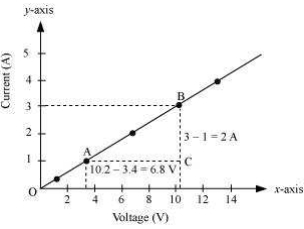
The values of current $I$ flowing in a given resistor for the corresponding values of potential difference $V$ across the resistor are given below -
Plot a graph between $V$ and $I$ and calculate the resistance of that resistor.
| $I$ (amperes) | $0.5$ | $1.0$ | $2.0$ | $3.0$ | $4.0$ |
| $V$ (volts) | $1.6$ | $3.4$ | $6.7$ | $10.2$ | $13.2$ |
Plot a graph between $V$ and $I$ and calculate the resistance of that resistor.
Solution
(N/A) The plot between voltage and current is called $IV$ characteristic. The voltage is plotted on the $x-$axis and current is plotted on the $y-$axis.
The $IV$ characteristic of the given resistor is plotted in the figure.
The slope of the line gives the value of $\frac{1}{R}$ as,
Slope $= \frac{1}{R} = \frac{\Delta I}{\Delta V} = \frac{BC}{AC} = \frac{3.0 - 1.0}{10.2 - 3.4} = \frac{2.0}{6.8}$
Therefore,the resistance $R$ is,
$R = \frac{6.8}{2.0} = 3.4\, \Omega$
Thus,the resistance of the resistor is $3.4\, \Omega$.
0 likes
View Solution8
MediumMCQ
When a $12\, V$ battery is connected across an unknown resistor,there is a current of $2.5\, mA$ in the circuit. Find the value of the resistance of the resistor.
A
$4.8 \,\Omega$
B
$4.8 \,k\Omega$
C
$2.4 \,k\Omega$
D
$1.2 \,\Omega$
Solution
(B) Resistance $(R)$ of a resistor is given by Ohm's law as:
$V = IR$
$R = \frac{V}{I}$
Given:
Potential difference,$V = 12\, V$
Current in the circuit,$I = 2.5\, mA = 2.5 \times 10^{-3}\, A$
Substituting the values in the formula:
$R = \frac{12}{2.5 \times 10^{-3}} = \frac{12}{0.0025} = 4800\, \Omega$
$R = 4.8 \times 10^3\, \Omega = 4.8\, k\Omega$
Therefore,the resistance of the resistor is $4.8\, k\Omega$.
0 likes
View Solution9
EasyMCQ
Electrical resistivity of a given metallic wire depends upon
A
its length
B
its thickness
C
nature of the material
D
its shape
Solution
(C) The electrical resistivity $(\rho)$ of a material is an intrinsic property that depends only on the nature of the material and the temperature of the conductor.
It does not depend on the physical dimensions of the wire, such as its length, thickness (cross-sectional area), or shape.
While resistance $(R)$ depends on length and area $(R = \rho \frac{l}{A})$, resistivity $(\rho)$ remains constant for a given material at a specific temperature.
It does not depend on the physical dimensions of the wire, such as its length, thickness (cross-sectional area), or shape.
While resistance $(R)$ depends on length and area $(R = \rho \frac{l}{A})$, resistivity $(\rho)$ remains constant for a given material at a specific temperature.
0 likes
View Solution10
MediumMCQ
$A$ cylindrical conductor of length $l$ and uniform area of cross-section $A$ has resistance $R$. Another conductor of length $2l$ and resistance $R$ of the same material has area of cross-section:
A
$A/2$
B
$2A$
C
$3A/2$
D
$3A$
Solution
(B) The resistance $R$ of a conductor is given by the formula $R = \rho \frac{l}{A}$,where $\rho$ is the resistivity of the material,$l$ is the length,and $A$ is the area of cross-section.
For the first conductor: $R = \rho \frac{l}{A}$.
For the second conductor,the length is $2l$,the resistance is $R$,and the material is the same (so $\rho$ remains constant). Let the new area be $A'$.
Then,$R = \rho \frac{2l}{A'}$.
Equating the two expressions for $R$: $\rho \frac{l}{A} = \rho \frac{2l}{A'}$.
Canceling $\rho$ and $l$ from both sides: $\frac{1}{A} = \frac{2}{A'}$.
Solving for $A'$,we get $A' = 2A$.
0 likes
View Solution11
MediumMCQ
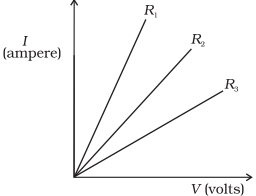
$A$ student carries out an experiment and plots the $V-I$ graph of three samples of nichrome wire with resistances $R_1, R_2$ and $R_3$ respectively (Figure). Which of the following is true?
A
$R_1 = R_2 = R_3$
B
$R_1 > R_2 > R_3$
C
$R_1 < R_2 < R_3$
D
$R_2 > R_3 > R_1$
Solution
(C) According to Ohm's law, $V = IR$, which implies $I = V/R$ or $R = V/I$.
In the given $I-V$ graph, the slope of the line represents $I/V$, which is equal to $1/R$.
Therefore, the slope of the graph is inversely proportional to the resistance $(Slope \propto 1/R)$.
From the figure, the slope of the line for $R_1$ is the greatest, followed by $R_2$, and then $R_3$ (i.e., $Slope_1 > Slope_2 > Slope_3$).
Since the slope is inversely proportional to resistance, a higher slope indicates a lower resistance.
Thus, $R_1 < R_2 < R_3$.
0 likes
View Solution12
EasyMCQ
The resistivity of a material does not change if:
A
the shape of the resistor is changed
B
the material is changed
C
the temperature is changed
D
both material and temperature are changed
Solution
(A) Resistivity $(\rho)$ is an intrinsic property of a material.
It depends only on the nature of the material and the temperature.
It does not depend on the physical dimensions (length, area of cross-section) or the shape of the resistor.
Therefore, if the shape of the resistor is changed, the resistance $(R)$ will change, but the resistivity $(\rho)$ remains constant.
0 likes
View Solution13
Medium
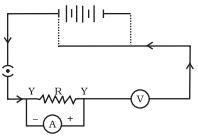
$A$ child has drawn the electric circuit to study Ohm's law as shown in the figure. His teacher told him that the circuit diagram needs correction. Study the circuit diagram and identify the errors,then describe the correct circuit configuration.
Solution
(N/A) The errors in the given circuit diagram are as follows:
$1$. The ammeter $(A)$ is connected in parallel with the resistor $(R)$,whereas it should be connected in series with the resistor.
$2$. The voltmeter $(V)$ is connected in series with the circuit,whereas it should be connected in parallel across the resistor $(R)$.
$3$. The polarity of the ammeter and voltmeter is incorrect in the diagram.
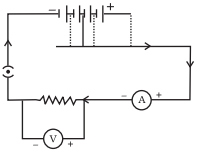
Correct circuit configuration:
$1$. Connect the ammeter $(A)$ in series with the resistor $(R)$.
$2$. Connect the voltmeter $(V)$ in parallel across the resistor $(R)$.
$3$. Ensure the positive terminal of the ammeter and voltmeter is connected towards the positive terminal of the battery,and the negative terminal is connected towards the negative terminal of the battery.
0 likes
View Solution14
Medium
Should the resistance of an ammeter be low or high? Give reason.
Solution
(A) The resistance of an ammeter should be as low as possible,ideally $0 \ \Omega$.
An ammeter is connected in series with the circuit to measure the current flowing through it.
If the resistance of the ammeter is high,it will significantly reduce the total current in the circuit due to the increased total resistance $(R_{total} = R_{circuit} + R_{ammeter})$.
Therefore,to ensure the ammeter measures the true current without altering the circuit's behavior,its resistance must be negligible.
0 likes
View Solution15
MediumMCQ
What is electrical resistivity? In a series electrical circuit comprising a resistor made up of a metallic wire, the ammeter reads $5\, A$. The reading of the ammeter decreases to half when the length of the wire is doubled. Why?
A
Due to change in cross-sectional area
B
Due to change in resistance
C
Due to change in voltage
D
Due to change in resistivity
Solution
(B) Electrical resistivity is the resistance offered by a unit length and unit cross-sectional area of a material. It is a characteristic property of the material.
According to the formula $R = \rho \frac{l}{A}$, where $R$ is resistance, $\rho$ is resistivity, $l$ is length, and $A$ is the cross-sectional area.
When the length of the wire is doubled $(l' = 2l)$, the resistance becomes $R' = \rho \frac{2l}{A} = 2R$.
Since the voltage $V$ remains constant in the circuit, according to Ohm's Law $(V = IR)$, the current $I$ is inversely proportional to resistance $(I = \frac{V}{R})$.
Therefore, when the resistance is doubled, the current becomes half of its original value, i.e., $I' = \frac{V}{2R} = \frac{I}{2} = \frac{5}{2} = 2.5\, A$.
0 likes
View Solution16
Medium
State Ohm's law. How can it be verified experimentally? Does it hold good under all conditions? Comment.
Solution
(N/A) Ohm's law states that the current $I$ flowing through a conductor is directly proportional to the potential difference $V$ across its ends,provided the temperature and other physical conditions remain constant. Mathematically,$V \propto I$ or $V = IR$,where $R$ is the resistance of the conductor.
Experimental Verification:
$1$. Set up a circuit consisting of a resistor,an ammeter in series,a voltmeter in parallel across the resistor,a battery,and a rheostat.
$2$. Adjust the rheostat to change the current in the circuit and record the corresponding readings of the ammeter $(I)$ and voltmeter $(V)$.
$3$. Plot a graph of $V$ (y-axis) versus $I$ (x-axis). $A$ straight line passing through the origin confirms Ohm's law.
Limitations:
Ohm's law does not hold under all conditions. It is not applicable to non-ohmic devices like diodes,transistors,and vacuum tubes,where the $V-I$ relationship is non-linear. Additionally,for ohmic conductors,if the temperature changes significantly due to heating,the resistance $R$ changes,and the law may not hold strictly.
0 likes
View Solution17
Medium
What is the electrical resistivity of a material? What is its $SI$ unit? Describe an experiment to study the factors on which the resistance of a conducting wire depends.
Solution
(N/A) Electrical resistivity is defined as the resistance offered by a material of unit length and unit cross-sectional area. Mathematically,$R = \rho (l/A)$,where $\rho$ is the resistivity. Its $SI$ unit is ohm-metre $(\Omega \, m)$. To study the factors affecting resistance: $1$. Take a battery,an ammeter,a plug key,and nichrome wires of different lengths but same thickness. $2$. Connect the wire in the circuit and measure the current using the ammeter. $3$. Observe that resistance increases with the length of the wire $(R \propto l)$. $4$. Repeat the experiment using wires of the same length but different cross-sectional areas. $5$. Observe that resistance decreases as the area of cross-section increases $(R \propto 1/A)$.
0 likes
View Solution18
Easy
List any two factors on which the resistance of a conductor depends.
Solution
(N/A) The resistance $(R)$ of a conductor depends on the following factors:
$1$. Length of the conductor $(l)$: Resistance is directly proportional to the length of the conductor $(R \propto l)$.
$2$. Area of cross-section $(A)$: Resistance is inversely proportional to the area of cross-section of the conductor $(R \propto 1/A)$.
$3$. Nature of the material: Resistance depends on the resistivity $(\rho)$ of the material.
$4$. Temperature: Resistance of a conductor changes with a change in temperature.
0 likes
View Solution19
EasyMCQ
How does the resistivity of alloys compare with those of pure metals from which they may have been formed?
A
Alloys have lower resistivity.
B
Alloys have higher resistivity.
C
Alloys have the same resistivity.
D
Resistivity is independent of the composition.
Solution
(B) The resistivity of an alloy is generally much higher than that of its constituent pure metals.
This occurs because the crystal lattice of an alloy is distorted by the presence of different types of atoms,which increases the scattering of electrons,thereby increasing the electrical resistance.
This occurs because the crystal lattice of an alloy is distorted by the presence of different types of atoms,which increases the scattering of electrons,thereby increasing the electrical resistance.
0 likes
View Solution20
Easy
Write the $SI$ unit of resistivity.
Solution
(A) The $SI$ unit of resistivity is the ohm-metre, denoted as $\Omega \cdot m$.
Resistivity $(\rho)$ is defined by the formula $R = \rho \frac{l}{A}$, where $R$ is resistance, $l$ is length, and $A$ is the cross-sectional area.
Rearranging for resistivity gives $\rho = \frac{R \cdot A}{l}$.
Substituting the $SI$ units: $\Omega \cdot \frac{m^2}{m} = \Omega \cdot m$.
Resistivity $(\rho)$ is defined by the formula $R = \rho \frac{l}{A}$, where $R$ is resistance, $l$ is length, and $A$ is the cross-sectional area.
Rearranging for resistivity gives $\rho = \frac{R \cdot A}{l}$.
Substituting the $SI$ units: $\Omega \cdot \frac{m^2}{m} = \Omega \cdot m$.
0 likes
View Solution21
EasyMCQ
How does the resistance of a wire vary with its cross-sectional area?
A
It is directly proportional to the cross-sectional area.
B
It is inversely proportional to the cross-sectional area.
C
It is independent of the cross-sectional area.
D
It is proportional to the square of the cross-sectional area.
Solution
(B) The resistance $R$ of a conductor is given by the formula $R = \rho \frac{L}{A}$,where $\rho$ is the resistivity,$L$ is the length,and $A$ is the cross-sectional area of the wire.
From this relation,it is clear that the resistance $R$ is inversely proportional to the cross-sectional area $A$ $(R \propto \frac{1}{A})$.
Therefore,as the cross-sectional area increases,the resistance of the wire decreases.
From this relation,it is clear that the resistance $R$ is inversely proportional to the cross-sectional area $A$ $(R \propto \frac{1}{A})$.
Therefore,as the cross-sectional area increases,the resistance of the wire decreases.
0 likes
View Solution22
Easy
State Ohm's law.
Solution
(N/A) Ohm's law states that the electric current flowing through a metallic conductor is directly proportional to the potential difference $(V)$ applied across its ends,provided that its physical conditions,such as temperature,remain constant.
Mathematically,this is expressed as $V \propto I$ or $V = IR$,where $R$ is the constant of proportionality known as resistance.
Mathematically,this is expressed as $V \propto I$ or $V = IR$,where $R$ is the constant of proportionality known as resistance.
0 likes
View Solution23
Easy
What is meant by resistance?
Solution
(N/A) Resistance is the property of a conductor to oppose the flow of current (electrons) through it. It is defined as the ratio of the potential difference $(V)$ applied across the conductor to the current $(I)$ flowing through it, expressed by the formula $R = V/I$. The $SI$ unit of resistance is the ohm $(\Omega)$.
0 likes
View Solution24
MediumMCQ
What are the units of resistance?
A
Ampere
B
Volt
C
Ohm
D
Watt
Solution
(C) The $SI$ unit of electrical resistance is the ohm,denoted by the Greek letter omega $(\Omega)$.
Resistance is defined as the opposition to the flow of electric current in a conductor.
According to Ohm's Law,$R = V / I$,where $R$ is resistance in ohms,$V$ is potential difference in volts,and $I$ is current in amperes.
Resistance is defined as the opposition to the flow of electric current in a conductor.
According to Ohm's Law,$R = V / I$,where $R$ is resistance in ohms,$V$ is potential difference in volts,and $I$ is current in amperes.
0 likes
View Solution25
Easy
What is meant by $1$ ohm resistance?
Solution
(N/A) The resistance of a conductor is said to be $1$ ohm if a current of $1$ ampere flows through it when a potential difference of $1$ volt is applied across its ends. This is based on Ohm's Law, which states $R = V / I$. Therefore, $1 \Omega = 1 \ V / 1 \ A$.
0 likes
View Solution26
EasyMCQ
What will happen to the current flowing through a conductor,if the potential difference is doubled?
A
It will remain the same.
B
It will be doubled.
C
It will be halved.
D
It will become four times.
Solution
(B) According to Ohm's Law,$V = IR$,where $V$ is the potential difference,$I$ is the current,and $R$ is the resistance of the conductor.
If the resistance $R$ remains constant,then $I = V/R$.
If the potential difference $V$ is doubled $(V' = 2V)$,the new current $I'$ becomes $I' = V'/R = (2V)/R = 2(V/R) = 2I$.
Therefore,the current flowing through the conductor is also doubled.
If the resistance $R$ remains constant,then $I = V/R$.
If the potential difference $V$ is doubled $(V' = 2V)$,the new current $I'$ becomes $I' = V'/R = (2V)/R = 2(V/R) = 2I$.
Therefore,the current flowing through the conductor is also doubled.
0 likes
View Solution27
EasyMCQ
What are the factors on which the resistance of a conductor depends?
A
Length of the conductor
B
Area of cross-section of the conductor
C
Nature of the material
D
All of the above
Solution
(D) The resistance $(R)$ of a conductor depends on the following factors:
$(i)$ Length of the conductor $(l)$: Resistance is directly proportional to the length of the conductor $(R \propto l)$.
$(ii)$ Area of cross-section $(A)$: Resistance is inversely proportional to the area of cross-section $(R \propto 1/A)$.
$(iii)$ Nature of the material: Resistance depends on the resistivity $(\rho)$ of the material.
$(iv)$ Temperature: Resistance of a conductor generally increases with an increase in temperature.
0 likes
View Solution28
EasyMCQ
What are the factors on which the resistivity of a material depends?
A
Length of the conductor
B
Area of cross-section of the conductor
C
Nature of the material and temperature
D
Shape of the conductor
Solution
(C) The resistivity $(\rho)$ of a material is an intrinsic property that depends on the following factors:
$1$. Nature of the material: Different materials have different atomic structures, which affect the mobility of charge carriers.
$2$. Temperature: For most conductors, resistivity increases with an increase in temperature due to increased lattice vibrations, which hinder the flow of electrons.
$1$. Nature of the material: Different materials have different atomic structures, which affect the mobility of charge carriers.
$2$. Temperature: For most conductors, resistivity increases with an increase in temperature due to increased lattice vibrations, which hinder the flow of electrons.
0 likes
View Solution29
EasyMCQ
What will happen to the current in a circuit,if its resistance is doubled?
A
It becomes double.
B
It becomes half.
C
It remains the same.
D
It becomes four times.
Solution
(B) According to Ohm's Law,$V = IR$,which can be rearranged as $I = V/R$.
If the resistance $R$ is doubled $(R' = 2R)$ while the voltage $V$ remains constant,the new current $I'$ will be $I' = V / (2R) = 1/2 * (V/R) = I/2$.
Therefore,the current becomes half of its original value.
If the resistance $R$ is doubled $(R' = 2R)$ while the voltage $V$ remains constant,the new current $I'$ will be $I' = V / (2R) = 1/2 * (V/R) = I/2$.
Therefore,the current becomes half of its original value.
0 likes
View Solution30
EasyMCQ
What will happen to the resistance of the circuit,if the current through it is doubled?
A
It will be doubled.
B
It will be halved.
C
It will remain the same.
D
It will become four times.
Solution
(C) According to Ohm's Law,$V = IR$,which implies $R = V/I$.
Resistance $(R)$ is a property of the conductor that depends on its material,length,cross-sectional area,and temperature.
It does not depend on the current $(I)$ flowing through the circuit or the potential difference $(V)$ applied across it.
Therefore,if the current through the circuit is doubled,the resistance will remain unchanged.
0 likes
View Solution31
EasyMCQ
What is the cause of resistance?
A
Collision of electrons with ions and other electrons
B
High temperature of the conductor
C
Presence of impurities in the conductor
D
Length of the conductor
Solution
(A) During their motion through a conductor,electrons collide with other electrons and the positive ions of the conductor lattice.
These collisions hinder the flow of electrons,creating an opposition to the electric current.
This opposition to the flow of charge is defined as electrical resistance.
These collisions hinder the flow of electrons,creating an opposition to the electric current.
This opposition to the flow of charge is defined as electrical resistance.
0 likes
View Solution32
Easy
Define resistivity of a material.
Solution
(N/A) The resistivity of a material is defined as the resistance offered by a conductor of that material having a unit length $(1 \ m)$ and a unit cross-sectional area $(1 \ m^2)$.
Mathematically,it is expressed as $\rho = \frac{RA}{l}$,where $R$ is the resistance,$A$ is the cross-sectional area,and $l$ is the length of the conductor.
Its $SI$ unit is $\Omega \cdot m$ (ohm-meter).
Mathematically,it is expressed as $\rho = \frac{RA}{l}$,where $R$ is the resistance,$A$ is the cross-sectional area,and $l$ is the length of the conductor.
Its $SI$ unit is $\Omega \cdot m$ (ohm-meter).
0 likes
View Solution33
Easy
$A$ cylinder of a material is $10\, cm$ long and has a cross-section of $2\, cm^{2}$. If its resistance along the length is $20\, \Omega$,what will be its resistivity in number and units?
Solution
(A) The formula for resistivity is $\rho = \frac{R \cdot A}{L}$.
Given:
Resistance $(R)$ = $20\, \Omega$
Area of cross-section $(A)$ = $2\, cm^{2}$
Length $(L)$ = $10\, cm$
Substituting the values into the formula:
$\rho = \frac{20 \times 2}{10} = \frac{40}{10} = 4\, \Omega \cdot cm$.
Thus,the resistivity is $4\, \Omega \cdot cm$.
Given:
Resistance $(R)$ = $20\, \Omega$
Area of cross-section $(A)$ = $2\, cm^{2}$
Length $(L)$ = $10\, cm$
Substituting the values into the formula:
$\rho = \frac{20 \times 2}{10} = \frac{40}{10} = 4\, \Omega \cdot cm$.
Thus,the resistivity is $4\, \Omega \cdot cm$.
0 likes
View Solution34
EasyMCQ
There are two electric bulbs,$(i)$ marked $60\, W, 220\, V$ and $(ii)$ marked $100\, W, 220\, V$. Which one of them has higher resistance?
A
$60\, W$ bulb
B
$100\, W$ bulb
C
Both have equal resistance
D
Resistance cannot be determined
Solution
(A) We know that the formula for resistance is $R = \frac{V^2}{P}$,where $V$ is the voltage and $P$ is the power.
Since both bulbs are rated for the same voltage $(V = 220\, V)$,the resistance $R$ is inversely proportional to the power $P$ $(R \propto \frac{1}{P})$.
Therefore,the bulb with the lower power rating will have a higher resistance.
Comparing the two bulbs,the $60\, W$ bulb has a lower power rating than the $100\, W$ bulb.
Thus,the $60\, W$ bulb has higher resistance.
0 likes
View Solution35
EasyMCQ
What is the resistance of an electric arc lamp,if the lamp uses $20\, A$ when connected to a $220\, V$ line?
A
$11\, \Omega$
B
$22\, \Omega$
C
$44\, \Omega$
D
$5\, \Omega$
Solution
(A) According to Ohm's Law,the relationship between voltage $(V)$,current $(I)$,and resistance $(R)$ is given by the formula: $V = I \times R$.
To find the resistance,we rearrange the formula as: $R = \frac{V}{I}$.
Given values are: Voltage $(V)$ = $220\, V$ and Current $(I)$ = $20\, A$.
Substituting these values into the formula: $R = \frac{220}{20} = 11\, \Omega$.
Therefore,the resistance of the electric arc lamp is $11\, \Omega$.
To find the resistance,we rearrange the formula as: $R = \frac{V}{I}$.
Given values are: Voltage $(V)$ = $220\, V$ and Current $(I)$ = $20\, A$.
Substituting these values into the formula: $R = \frac{220}{20} = 11\, \Omega$.
Therefore,the resistance of the electric arc lamp is $11\, \Omega$.
0 likes
View Solution36
Easy
Why is an ammeter likely to be burnt if you connect it in parallel?
Solution
(N/A) An ammeter is designed to have a very low resistance so that it can measure current without significantly altering the circuit. When connected in parallel,the potential difference across the ammeter is the same as the potential difference across the circuit components. Due to its extremely low resistance,a very large amount of current flows through the ammeter according to Ohm's Law $(I = V/R)$. This excessive current generates significant heat $(H = I^2Rt)$,which causes the internal components of the ammeter to overheat and burn out.
0 likes
View Solution37
EasyMCQ
What is the resistance of an ideal ammeter?
A
Infinite
B
Zero
C
Very high
D
Very low
Solution
(B) An ideal ammeter is designed to measure the current in a circuit without affecting the current flow.
To ensure that the current remains unchanged,an ideal ammeter must have zero resistance.
If the resistance were not zero,it would cause a voltage drop across the ammeter,thereby altering the total current in the circuit.
To ensure that the current remains unchanged,an ideal ammeter must have zero resistance.
If the resistance were not zero,it would cause a voltage drop across the ammeter,thereby altering the total current in the circuit.
0 likes
View Solution38
EasyMCQ
What is the resistance of an ideal voltmeter?
A
Zero
B
Low
C
High
D
Infinite
Solution
(D) An ideal voltmeter is designed to measure the potential difference between two points in a circuit without drawing any current from the circuit.
To ensure that no current flows through the voltmeter,it must have an extremely high resistance.
Therefore,the resistance of an ideal voltmeter is considered to be infinite.
To ensure that no current flows through the voltmeter,it must have an extremely high resistance.
Therefore,the resistance of an ideal voltmeter is considered to be infinite.
0 likes
View Solution39
EasyMCQ
What can be the difference between the specific resistance for a thin and thick wire made of the same material?
A
The thin wire has higher specific resistance.
B
The thick wire has higher specific resistance.
C
The specific resistance is the same for both wires.
D
The specific resistance depends on the length of the wire.
Solution
(C) Specific resistance, also known as resistivity $(\rho)$, is an intrinsic property of a material.
It depends only on the nature of the material and the temperature of the conductor.
It does not depend on the physical dimensions of the conductor, such as its length or cross-sectional area.
Therefore, since both wires are made of the same material, their specific resistance will be identical regardless of their thickness.
0 likes
View Solution40
EasyMCQ
What happens to the resistance of a conductor when the length of the conductor is reduced to half?
A
It becomes double
B
It becomes half
C
It remains the same
D
It becomes four times
Solution
(B) The resistance $R$ of a conductor is directly proportional to its length $l$,given by the formula $R = \rho \frac{l}{A}$,where $\rho$ is the resistivity and $A$ is the cross-sectional area.
Since $R \propto l$,if the length $l$ is reduced to half $(l' = l/2)$,the new resistance $R'$ will be $R' = \rho \frac{l/2}{A} = \frac{1}{2} R$.
Therefore,the resistance reduces to half of its original value.
Since $R \propto l$,if the length $l$ is reduced to half $(l' = l/2)$,the new resistance $R'$ will be $R' = \rho \frac{l/2}{A} = \frac{1}{2} R$.
Therefore,the resistance reduces to half of its original value.
0 likes
View Solution41
EasyMCQ
What happens to the resistance of a conductor when its temperature is increased?
A
It increases
B
It decreases
C
It remains constant
D
It becomes zero
Solution
(A) When the temperature of a metallic conductor is increased,the atoms or ions in the metal lattice vibrate with greater amplitude. This leads to more frequent collisions between the free electrons and the vibrating atoms,which increases the opposition to the flow of current. Therefore,the resistance of a conductor increases with an increase in temperature.
0 likes
View Solution42
EasyMCQ
Why do we use copper and aluminium wire for the transmission of electric current?
A
They are cheap and easily available.
B
They have low resistivity and are good conductors of electricity.
C
They have high melting points.
D
They are ductile and can be drawn into thin wires.
Solution
(B) Copper and aluminium are used for the transmission of electric current because they possess very low electrical resistivity.
Due to this low resistivity,they act as excellent conductors of electricity,allowing current to flow with minimal energy loss in the form of heat.
Additionally,they are relatively inexpensive and possess good mechanical properties,making them suitable for long-distance power transmission.
Due to this low resistivity,they act as excellent conductors of electricity,allowing current to flow with minimal energy loss in the form of heat.
Additionally,they are relatively inexpensive and possess good mechanical properties,making them suitable for long-distance power transmission.
0 likes
View Solution43
MediumMCQ
What is the resistance of an ideal voltmeter?
A
Zero
B
Low
C
High
D
Infinite
Solution
(D) voltmeter is used to measure the potential difference between two points in a circuit. To ensure that it does not draw any current from the circuit (which would alter the potential difference being measured),it must have a very high resistance. For an ideal voltmeter,the resistance is considered to be infinite.
0 likes
View Solution44
Medium
$(a)$ Resistivity of iron is $10 \times 10^{-8} \; \Omega m$ and of mercury is $94 \times 10^{-8} \; \Omega m$. Which among iron and mercury is a better conductor? Give reason.
$(b)$ Resistivity of a material $A$ is in the range of $10^{10}-10^{14} \; \Omega m$ while that of $B$ is in the range of $10^{-6}-10^{-8} \; \Omega m$. Which of the two will behave as an insulator and why?
$(b)$ Resistivity of a material $A$ is in the range of $10^{10}-10^{14} \; \Omega m$ while that of $B$ is in the range of $10^{-6}-10^{-8} \; \Omega m$. Which of the two will behave as an insulator and why?
Solution
(A) Iron is a better conductor. The reason is that electrical conductivity is inversely proportional to resistivity. Since the resistivity of iron $(10 \times 10^{-8} \; \Omega m)$ is significantly lower than that of mercury $(94 \times 10^{-8} \; \Omega m)$,iron allows electric current to flow more easily.
$(b)$ Material $A$ will behave as an insulator. Insulators are materials that offer very high resistance to the flow of electric current,which corresponds to a very high resistivity. Since the resistivity of material $A$ $(10^{10}-10^{14} \; \Omega m)$ is extremely high compared to material $B$,it acts as an insulator.
$(b)$ Material $A$ will behave as an insulator. Insulators are materials that offer very high resistance to the flow of electric current,which corresponds to a very high resistivity. Since the resistivity of material $A$ $(10^{10}-10^{14} \; \Omega m)$ is extremely high compared to material $B$,it acts as an insulator.
0 likes
View Solution45
Easy
$A$ thick wire and a thin wire of the same material are successively connected to the same circuit to find their respective resistance. Which one will have lower resistance? Give reason.
Solution
(A) The thick wire will have lower resistance.
According to the formula for resistance,$R = \rho \frac{L}{A}$,where $R$ is resistance,$\rho$ is resistivity,$L$ is length,and $A$ is the area of cross-section.
Since both wires are made of the same material,their resistivity $(\rho)$ is the same.
For a given length,resistance is inversely proportional to the area of cross-section $(R \propto \frac{1}{A})$.
$A$ thick wire has a larger area of cross-section compared to a thin wire.
Therefore,the thick wire offers less opposition to the flow of current,resulting in lower resistance.
0 likes
View Solution46
Medium
What are the conditions under which $Ohm's$ law is not obeyed?
Solution
(N/A) $Ohm's$ law is not obeyed under the following conditions:
$(i)$ The relationship between potential difference $(V)$ and current $(I)$ is non-linear.
$(ii)$ For a given value of $V$,there is more than one value of $I$ (i.e.,the relation is non-unique).
$(iii)$ The relationship between $V$ and $I$ depends on the sign of $V$ (i.e.,if the direction of current is reversed,the magnitude of current for the same potential difference changes).
0 likes
View Solution47
Easy
Why are alloys used to make standard resistors?
Solution
(N/A) Alloys like Manganin or Constantan are used to make standard resistors because they have a very low temperature coefficient of resistance. This means that there is a negligible change in the resistance of an alloy with a change in temperature,ensuring that the resistance value remains stable even if the operating temperature fluctuates.
0 likes
View Solution48
Medium
Explain the term resistance. Give its $SI$ unit of measurement.
Solution
(N/A) Resistance is the property of a conductor to oppose the flow of electric charges through it.
When a potential difference is applied across a conductor,free electrons begin to move,constituting an electric current.
During their motion,these electrons collide with other electrons and atoms of the conductor.
These collisions hinder the flow of electrons,thereby opposing the current.
This opposition to the flow of current is known as resistance.
The $SI$ unit of resistance is the $\text{ohm}$ $(\Omega)$.
0 likes
View Solution49
Medium
Explain how do we classify materials as conductors and insulators on the basis of their resistance.
Solution
(N/A) Conductors are materials that possess a large number of free electrons $(\simeq 10^{28} \text{ m}^{-3})$ and exhibit very low resistivity $(\simeq 10^{-8} \Omega \text{ m})$. The resistivity of an ideal conductor is zero,and it increases with a rise in temperature in metals.
Insulators are substances that have practically no free electrons and possess very high resistivity $(\simeq 10^{16} \Omega \text{ m})$. The resistivity of an ideal insulator is infinity and decreases with a rise in temperature. Mica,rubber,glass,and porcelain are some examples of insulators.
Insulators are substances that have practically no free electrons and possess very high resistivity $(\simeq 10^{16} \Omega \text{ m})$. The resistivity of an ideal insulator is infinity and decreases with a rise in temperature. Mica,rubber,glass,and porcelain are some examples of insulators.
0 likes
View Solution50
Easy
How much current will an electric bulb of resistance $1100 \ \Omega$ draw from a $220 \ V$ source? If a heater of resistance $100 \ \Omega$ is connected to the same source instead of the bulb,calculate the current drawn by the heater.
Solution
(0.2 A, 2.2 A) According to Ohm's law,the current $I$ is given by the formula $I = \frac{V}{R}$.
For the electric bulb:
Given,$V = 220 \ V$ and $R = 1100 \ \Omega$.
$I = \frac{220}{1100} = 0.2 \ A$.
For the electric heater:
Given,$V = 220 \ V$ and $R = 100 \ \Omega$.
$I = \frac{220}{100} = 2.2 \ A$.
For the electric bulb:
Given,$V = 220 \ V$ and $R = 1100 \ \Omega$.
$I = \frac{220}{1100} = 0.2 \ A$.
For the electric heater:
Given,$V = 220 \ V$ and $R = 100 \ \Omega$.
$I = \frac{220}{100} = 2.2 \ A$.
0 likes
View SolutionElectricity — Ohm's Law and Resistance · Frequently Asked Questions
1Are these Electricity questions useful for JEE and NEET?
Yes. All questions in this section are mapped to JEE Main and NEET exam patterns. Previous year questions from JEE Main, NEET, GUJCET and state-level exams are included with full solutions.
2Can I switch to Hindi or Gujarati for these questions?
Yes. Use the language tabs in the hero section or the sidebar to view the same questions and solutions in English, Hindi or Gujarati.
3How do I generate a question paper from this subtopic?
Use the Vedclass Exam Paper Generator — select the chapter and subtopic, set difficulty, and generate Sets A, B, C, D automatically. First 3 chapters of every subject are free.
Vedclass Products
For Students
Vedclass Test Series
Mock tests in real JEE/NEET style with performance analysis. 5-day free trial.
Start Free TrialFor Teachers
Exam Paper Generator
Generate Set A/B/C/D papers from this chapter in 2 minutes. 3 chapters free.
Try FreeFor Institutes
Online Exam Module
Live online exams with unlimited students, 360° analytics & white-label branding.
See DemoFor Teachers & Institutes
Generate a Electricity Exam Paper in 2 Minutes
Select subtopic & difficulty — Sets A, B, C, D auto-generated with No Repeat logic.
First 3 chapters of every subject are free — no payment required.