
A English
Mix Examples - IS MATTER AROUND US PURE? Questions in English
Class 9 Science · IS MATTER AROUND US PURE? · Mix Examples - IS MATTER AROUND US PURE?
22+
Questions
English
Language
100%
With Solutions
Showing 22 of 22 questions in English
1
Easy
Try segregating the things around you as pure substances or mixtures.
Solution
(N/A) pure substance consists of only one type of particles,whereas a mixture consists of two or more different types of particles.
$(a)$ Wood: Mixture (It contains cellulose,lignin,water,and other organic compounds).
$(b)$ Coal: Mixture (It is a complex mixture of carbon,hydrogen,nitrogen,oxygen,and sulfur).
$(c)$ Milk: Mixture (It is a colloid containing water,fats,proteins,lactose,and minerals).
$(d)$ Sugar: Pure substance (It consists only of sucrose molecules,$C_{12}H_{22}O_{11}$).
0 likes
View Solution2
Medium
Explain the following giving examples:
$(a)$ Saturated solution
$(b)$ Pure substance
$(a)$ Saturated solution
$(b)$ Pure substance
Solution
(N/A) Saturated solution: $A$ solution in which no more amount of solute can be dissolved at a particular temperature is called a saturated solution.
Example: When sugar is dissolved repeatedly in a given amount of water,a condition is reached at which further dissolution of sugar is not possible in that amount of water at room temperature.
$(b)$ Pure substance: $A$ substance made up of a single type of particles (atoms and/or molecules) is called a pure substance.
All elements and compounds are considered pure substances.
Example: Water $(H_2O)$,Gold $(Au)$,etc.
0 likes
View Solution3
Easy
$A$ sample of water under study was found to boil at $102\,^{\circ}C$ at normal temperature and pressure. Is the water pure? Will this water freeze at $0\,^{\circ}C$? Comment.
Solution
(N/A) The boiling point of pure water is $100\,^{\circ}C$ at $1 \text{ atm}$ pressure.
Since the given sample boils at $102\,^{\circ}C$,it indicates the presence of impurities (solutes) in the water.
Therefore,the water is not pure.
Due to the presence of impurities,the freezing point of the water will be depressed,meaning it will freeze at a temperature below $0\,^{\circ}C$.
Since the given sample boils at $102\,^{\circ}C$,it indicates the presence of impurities (solutes) in the water.
Therefore,the water is not pure.
Due to the presence of impurities,the freezing point of the water will be depressed,meaning it will freeze at a temperature below $0\,^{\circ}C$.
0 likes
View Solution4
MediumMCQ
Which of the following statements are true for pure substances?
$(i)$ Pure substances contain only one kind of particles.
$(ii)$ Pure substances may be compounds or mixtures.
$(iii)$ Pure substances have the same composition throughout.
$(iv)$ Pure substances can be exemplified by all elements other than nickel.
$(i)$ Pure substances contain only one kind of particles.
$(ii)$ Pure substances may be compounds or mixtures.
$(iii)$ Pure substances have the same composition throughout.
$(iv)$ Pure substances can be exemplified by all elements other than nickel.
A
$(i)$ and $(iii)$
B
$(i)$ and $(ii)$
C
$(iii)$ and $(iv)$
D
$(ii)$ and $(iii)$
Solution
(A) pure substance consists of particles of only one kind,which have the same chemical nature. Therefore,statement $(i)$ is true.
Pure substances are either elements or compounds,not mixtures. Therefore,statement $(ii)$ is false.
Pure substances have a fixed composition and properties throughout,meaning they are homogeneous. Therefore,statement $(iii)$ is true.
Elements like nickel are pure substances. Statement $(iv)$ claims that all elements except nickel are pure substances,which is incorrect because nickel is also a pure substance. Therefore,statement $(iv)$ is false.
Thus,statements $(i)$ and $(iii)$ are correct.
0 likes
View Solution5
Medium
The 'sea-water' can be classified as a homogeneous as well as heterogeneous mixture. Comment.
Solution
(N/A) Homogeneous mixture: When we consider sea-water as a solution of various salts dissolved in water,it appears uniform throughout,making it a homogeneous mixture.
Heterogeneous mixture: In its natural state,sea-water contains not only dissolved salts but also suspended particles like mud,sand,decayed plant matter,and microorganisms. Because these components are not uniformly distributed and can be physically separated,it is classified as a heterogeneous mixture.
Heterogeneous mixture: In its natural state,sea-water contains not only dissolved salts but also suspended particles like mud,sand,decayed plant matter,and microorganisms. Because these components are not uniformly distributed and can be physically separated,it is classified as a heterogeneous mixture.
0 likes
View Solution6
Medium
What would you observe when
$(a)$ a saturated solution of potassium chloride prepared at $60\,^{\circ}\text{C}$ is allowed to cool to room temperature.
$(b)$ an aqueous sugar solution is heated to dryness.
$(c)$ a mixture of iron filings and sulphur powder is heated strongly.
$(a)$ a saturated solution of potassium chloride prepared at $60\,^{\circ}\text{C}$ is allowed to cool to room temperature.
$(b)$ an aqueous sugar solution is heated to dryness.
$(c)$ a mixture of iron filings and sulphur powder is heated strongly.
Solution
(N/A) As the solubility of potassium chloride decreases with a decrease in temperature,solid potassium chloride crystals will separate out from the solution.
$(b)$ Initially,the water will evaporate,leaving behind sugar. Upon further heating,the sugar will undergo thermal decomposition and get charred (turn black).
$(c)$ Iron and sulphur react chemically to form a new compound,iron$(II)$ sulphide $(FeS)$,which is a black solid.
$(b)$ Initially,the water will evaporate,leaving behind sugar. Upon further heating,the sugar will undergo thermal decomposition and get charred (turn black).
$(c)$ Iron and sulphur react chemically to form a new compound,iron$(II)$ sulphide $(FeS)$,which is a black solid.
0 likes
View Solution7
Medium
Name the process associated with the following:
$(a)$ Dry ice is kept at room temperature and at one atmospheric pressure.
$(b)$ $A$ drop of ink placed on the surface of water contained in a glass spreads throughout the water.
$(c)$ $A$ potassium permanganate crystal is in a beaker and water is poured into the beaker with stirring.
$(d)$ An acetone bottle is left open and the bottle becomes empty.
$(e)$ Milk is churned to separate cream from it.
$(f)$ Settling of sand when a mixture of sand and water is left undisturbed for some time.
$(g)$ $A$ fine beam of light entering through a small hole in a dark room illuminates the particles in its path.
Solution
(N/A) Sublimation: Dry ice ($CO_2$ in solid state) directly converts into gas at room temperature.
$(b)$ Diffusion: The intermixing of particles of ink with water particles.
$(c)$ Dissolution/Diffusion: The solute (potassium permanganate) dissolves and spreads throughout the solvent.
$(d)$ Evaporation: Acetone has a low boiling point and turns into vapor at room temperature.
$(e)$ Centrifugation: The process of separating denser particles from lighter particles by spinning.
$(f)$ Sedimentation: The process where heavier insoluble particles settle down at the bottom due to gravity.
$(g)$ Scattering of light (Tyndall effect): The phenomenon where light is scattered by colloidal particles.
0 likes
View Solution8
Medium
Fill in the blanks:
$(a)$ $A$ colloid is a .......... mixture and its components can be separated by the technique known as .........
$(b)$ Ice,water,and water vapour look different and display different ......... properties but they are ......... the same.
$(c)$ $A$ mixture of chloroform and water taken in a separating funnel is mixed and left undisturbed for some time. The upper layer in the separating funnel will be of ......... and the lower layer will be that of .........
$(d)$ $A$ mixture of two or more miscible liquids,for which the difference in the boiling points is less than $25 \, K$,can be separated by the process called .........
$(e)$ When light is passed through water containing a few drops of milk,it shows a bluish tinge. This is due to the ......... of light by milk and the phenomenon is called ......... . This indicates that milk is a ......... solution.
Solution
(N/A) colloid is a heterogeneous mixture and its components can be separated by the technique known as centrifugation.
$(b)$ Ice,water,and water vapour look different and display different physical properties but they are chemically the same.
$(c)$ The upper layer in the separating funnel will be of water and the lower layer will be that of chloroform (hint: density of water is less than that of chloroform).
$(d)$ $A$ mixture of two or more miscible liquids,for which the difference in the boiling points is less than $25 \, K$,can be separated by the process called fractional distillation.
$(e)$ When light is passed through water containing a few drops of milk,it shows a bluish tinge. This is due to the scattering of light by milk and the phenomenon is called Tyndall effect. This indicates that milk is a colloidal solution.
0 likes
View Solution9
Medium
Iron filings and sulphur were mixed together and divided into two parts,$A$ and $B$. Part $A$ was heated strongly while Part $B$ was not heated. Dilute hydrochloric acid was added to both the parts and evolution of gas was seen in both the cases. How will you identify the gases evolved?
Solution
(N/A) When part $A$ is heated,iron and sulphur react to form iron sulphide $(FeS)$:
$Fe + S \rightarrow FeS$
When dilute hydrochloric acid $(HCl)$ is added to the iron sulphide $(FeS)$,hydrogen sulphide $(H_2S)$ gas is evolved:
$FeS + 2HCl \rightarrow FeCl_2 + H_2S$
Hydrogen sulphide gas has a characteristic foul smell,similar to that of rotten eggs.
When dilute hydrochloric acid is added to the unheated mixture of iron and sulphur (part $B$),iron reacts with the acid to release hydrogen $(H_2)$ gas,while sulphur remains unreacted:
$Fe + S + 2HCl \rightarrow FeCl_2 + H_2 + S$
Hydrogen gas is identified by bringing a burning matchstick near it,which causes the gas to burn with a characteristic 'pop' sound.
0 likes
View Solution10
MediumMCQ
You are provided with a fine white-coloured powder which is either sugar or salt. How would you identify it without tasting?
A
By heating the powder
B
By checking electrical conductivity in aqueous solution
C
Both $A$ and $B$
D
None of the above
Solution
(C) $1$. Heating: Sugar is an organic compound $(C_{12}H_{22}O_{11})$ that chars (turns black) upon heating due to dehydration. Salt $(NaCl)$ is an inorganic ionic compound that does not char upon heating.
$2$. Electrical Conductivity: Salt is an ionic compound that dissociates into ions ($Na^+$ and $Cl^-$) in water,making the solution a good conductor of electricity. Sugar is a covalent compound that does not dissociate into ions in water,making the solution a non-conductor of electricity.
$2$. Electrical Conductivity: Salt is an ionic compound that dissociates into ions ($Na^+$ and $Cl^-$) in water,making the solution a good conductor of electricity. Sugar is a covalent compound that does not dissociate into ions in water,making the solution a non-conductor of electricity.
0 likes
View Solution11
Easy
Classify each of the following as an element,compound,or mixture:
Gold,Air,Marble,Milk,Sugar.
Gold,Air,Marble,Milk,Sugar.
Solution
(N/A) $1$. Element: Gold $(Au)$ is a pure substance consisting of only one type of atom.
$2$. Compound: Marble $(CaCO_3)$ and Sugar $(C_{12}H_{22}O_{11})$ are compounds because they consist of two or more elements chemically combined in a fixed ratio.
$3$. Mixture: Air and Milk are mixtures. Air is a homogeneous mixture of various gases,while milk is a heterogeneous mixture (colloid) of water,fats,proteins,and minerals.
0 likes
View Solution12
Medium
What would you observe when:
$(a)$ a saturated solution of potassium chloride prepared at $60^{\circ} C$ is allowed to cool at room temperature?
$(b)$ an aqueous sugar solution is heated to dryness?
$(c)$ a mixture of iron filings and sulphur powder is heated strongly?
$(a)$ a saturated solution of potassium chloride prepared at $60^{\circ} C$ is allowed to cool at room temperature?
$(b)$ an aqueous sugar solution is heated to dryness?
$(c)$ a mixture of iron filings and sulphur powder is heated strongly?
Solution
(N/A) Solid potassium chloride will separate out as crystals because the solubility of the salt decreases with a decrease in temperature.
$(b)$ Initially,the water will evaporate,leaving behind sugar crystals. Upon further heating,the sugar will get charred (decomposed into carbon).
$(c)$ $A$ chemical reaction occurs,and iron sulphide $(FeS)$ will be formed,which is a new substance with different properties.
$(b)$ Initially,the water will evaporate,leaving behind sugar crystals. Upon further heating,the sugar will get charred (decomposed into carbon).
$(c)$ $A$ chemical reaction occurs,and iron sulphide $(FeS)$ will be formed,which is a new substance with different properties.
0 likes
View Solution13
Medium
$(a)$ What is the effect of temperature on the solubility of a solid in a liquid?
$(b)$ Why is it possible to distinguish the particles of solute from those of solvent in a suspension?
$(b)$ Why is it possible to distinguish the particles of solute from those of solvent in a suspension?
Solution
(N/A) For most solid solutes,solubility increases as the temperature increases,and solubility decreases as the temperature decreases.
$(b)$ It is possible to distinguish the particles of solute from those of solvent in a suspension because the particle size in a suspension is relatively large (greater than $100 \ nm$),making them visible to the naked eye.
$(b)$ It is possible to distinguish the particles of solute from those of solvent in a suspension because the particle size in a suspension is relatively large (greater than $100 \ nm$),making them visible to the naked eye.
0 likes
View Solution14
Medium
$(a)$ State the difference between a pure substance and a mixture. Give one example of each.
$(b)$ Identify homogeneous mixtures from the following:
$(i)$ Smoke
$(ii)$ Brass
$(iii)$ Tincture of iodine
$(iv)$ Milk
$(b)$ Identify homogeneous mixtures from the following:
$(i)$ Smoke
$(ii)$ Brass
$(iii)$ Tincture of iodine
$(iv)$ Milk
Solution
$(II, III)$ Pure substance consists of particles of only one kind of matter. These can be elements or compounds; for example, $Gold$ or $Water$. $A$ mixture is obtained by mixing two or more different elements or compounds which do not react chemically; for example, $Salt$ solution in water.
$(b)$ The homogeneous mixtures are:
$(ii)$ $Brass$ (an alloy of copper and zinc).
$(iii)$ $Tincture$ of iodine (a solution of iodine in alcohol).
$(b)$ The homogeneous mixtures are:
$(ii)$ $Brass$ (an alloy of copper and zinc).
$(iii)$ $Tincture$ of iodine (a solution of iodine in alcohol).
0 likes
View Solution15
Difficult
$(a)$ $7\, g$ of iron filings and $4\, g$ of sulphur powder is treated with dilute sulphuric acid at room temperature. Name the gas produced.
$(b)$ The same mixture is heated strongly,cooled and then treated with dilute sulphuric acid. Which gas would be produced?
$(c)$ What is the cause of this difference in results of chemical reaction in different conditions?
$(b)$ The same mixture is heated strongly,cooled and then treated with dilute sulphuric acid. Which gas would be produced?
$(c)$ What is the cause of this difference in results of chemical reaction in different conditions?
Solution
(A) At room temperature,the iron filings and sulphur powder exist as a mixture. When treated with dilute sulphuric acid,the iron reacts to produce hydrogen gas $(H_2)$.
$(b)$ When the mixture is heated strongly,iron and sulphur react to form a chemical compound,iron sulphide $(FeS)$. When this compound is treated with dilute sulphuric acid,it produces hydrogen sulphide gas $(H_2S)$,which has a characteristic rotten egg smell.
$(c)$ The difference in results occurs because in the first case,the substances exist as a mixture,retaining their individual properties. In the second case,heating causes a chemical reaction that forms a new compound with entirely different chemical properties compared to its constituent elements.
0 likes
View Solution16
Difficult
$(a)$ Differentiate between a mixture and a compound.
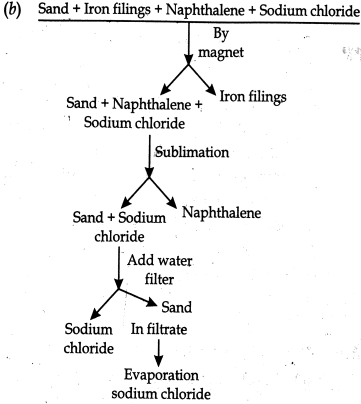
$(b)$ You are provided with a mixture containing sand,iron filings,naphthalene,and sodium chloride. Describe the procedures you would use to separate these constituents from the mixture.
$(b)$ You are provided with a mixture containing sand,iron filings,naphthalene,and sodium chloride. Describe the procedures you would use to separate these constituents from the mixture.
Solution
(N/A) Differences between a mixture and a compound:
$(b)$ Procedure to separate the mixture of sand,iron filings,naphthalene,and sodium chloride:
$(1)$ Use a magnet to move it over the mixture. The iron filings will be attracted to the magnet and can be separated.
$(2)$ The remaining mixture (sand,naphthalene,and sodium chloride) is heated. Naphthalene undergoes sublimation (changes directly from solid to gas) and can be collected separately.
$(3)$ Add water to the remaining mixture of sand and sodium chloride. Sodium chloride dissolves in water,while sand does not.
$(4)$ Filter the mixture. Sand remains as the residue on the filter paper,while sodium chloride solution passes through as the filtrate.
$(5)$ Finally,evaporate the filtrate (sodium chloride solution) to obtain solid sodium chloride.
| Mixtures | Compounds |
|---|---|
| $(1)$ Elements or compounds just mix together to form a mixture. | $(1)$ Elements react to form a new substance called a compound. |
| $(2)$ Variable composition. | $(2)$ Composition is fixed. |
| $(3)$ Show the properties of its constituents. | $(3)$ Show the properties of the compound and not the constituent elements. |
| $(4)$ Constituents can be separated easily by physical methods. | $(4)$ Cannot be separated by physical methods. |
$(b)$ Procedure to separate the mixture of sand,iron filings,naphthalene,and sodium chloride:
$(1)$ Use a magnet to move it over the mixture. The iron filings will be attracted to the magnet and can be separated.
$(2)$ The remaining mixture (sand,naphthalene,and sodium chloride) is heated. Naphthalene undergoes sublimation (changes directly from solid to gas) and can be collected separately.
$(3)$ Add water to the remaining mixture of sand and sodium chloride. Sodium chloride dissolves in water,while sand does not.
$(4)$ Filter the mixture. Sand remains as the residue on the filter paper,while sodium chloride solution passes through as the filtrate.
$(5)$ Finally,evaporate the filtrate (sodium chloride solution) to obtain solid sodium chloride.
0 likes
View Solution17
Medium
Write your observations when the following processes take place:
$(a)$ An aqueous solution of sugar is heated to dryness.
$(b)$ $A$ saturated solution of potassium chloride prepared at $60^\circ C$ is allowed to cool at room temperature.
$(c)$ $A$ mixture of iron filings and sulphur powder is heated strongly.
$(d)$ $A$ beam of light is passed through a colloidal solution.
$(e)$ $Dil. HCl$ is added to the mixture of iron and sulphur.
Solution
$(a)$ The water evaporates, and sugar remains as a solid residue.
$(b)$ The solubility of potassium chloride decreases with temperature, causing crystals of potassium chloride to form.
$(c)$ Iron reacts with sulphur to form a new compound, iron$(II)$ sulphide $(FeS)$, which is a black-coloured solid.
$(d)$ The path of the light becomes visible due to the scattering of light by colloidal particles, known as the Tyndall effect.
$(e)$ $A$ colourless gas, hydrogen sulphide $(H_2S)$, is evolved, which has a characteristic smell of rotten eggs.
0 likes
View Solution18
Medium
$(a)$ Write any three points of differences between homogeneous and heterogeneous mixtures.
$(b)$ Give two reasons for supporting that water is a compound and not a mixture.
$(b)$ Give two reasons for supporting that water is a compound and not a mixture.
Solution
(N/A) Differences between homogeneous and heterogeneous mixtures:
$(b)$ Reasons to support that water is a compound and not a mixture:
$(i)$ Water has a fixed chemical composition $(H_2O)$ and its components can be separated only by chemical methods like electrolysis,not by physical means.
$(ii)$ The properties of water are entirely different from the properties of its constituent elements,hydrogen (a combustible gas) and oxygen (a supporter of combustion).
| Homogeneous mixture | Heterogeneous mixture |
|---|---|
| $(i)$ Composition is uniform throughout. | $(i)$ Composition is not uniform throughout. |
| $(ii)$ No visible boundaries of separation. | $(ii)$ Distinct boundaries of separation are visible. |
| $(iii)$ Components are not easily separated (e.g.,sugar in water). | $(iii)$ Components can be easily separated (e.g.,oil and water). |
$(b)$ Reasons to support that water is a compound and not a mixture:
$(i)$ Water has a fixed chemical composition $(H_2O)$ and its components can be separated only by chemical methods like electrolysis,not by physical means.
$(ii)$ The properties of water are entirely different from the properties of its constituent elements,hydrogen (a combustible gas) and oxygen (a supporter of combustion).
0 likes
View Solution19
Medium
$(a)$ Name the separation techniques which you will apply for the separation of the following mixtures:
$(i)$ Small pieces of metal in the engine oil of a car.
$(ii)$ Fine mud particles suspended in water.
$(iii)$ Oil from water.
$(iv)$ Sodium chloride from its solution in water.
$(v)$ Camphor from salt.
$(vi)$ Wheat grains from husk.
$(b)$ Classify the following as a chemical or physical change:
$(i)$ Water boils to form steam.
$(ii)$ Burning of paper.
$(iii)$ An almirah gets rusted.
$(iv)$ Making a fruit salad with raw fruits.
Solution
(N/A) The separation techniques are:
$(i)$ Filtration: Used to separate solid particles from a liquid.
$(ii)$ Centrifugation: Used to separate fine suspended particles.
$(iii)$ Separating funnel: Used to separate immiscible liquids like oil and water.
$(iv)$ Evaporation: Used to separate a dissolved solid from its solvent.
$(v)$ Sublimation: Used to separate a sublimable solid (camphor) from a non-sublimable one (salt).
$(vi)$ Winnowing: Used to separate lighter husk from heavier grains.
$(b)$ Classification of changes:
Chemical change: $(ii)$ Burning of paper and $(iii)$ Rusting of an almirah (new substances are formed).
Physical change: $(i)$ Boiling of water and $(iv)$ Making a fruit salad (no new substances are formed,only physical state or appearance changes).
0 likes
View Solution20
Difficult
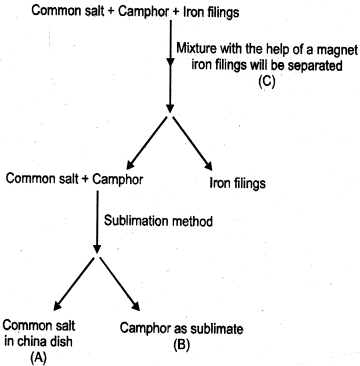
How will you separate a mixture of common salt $(A)$,camphor $(B)$ and iron filings $(C)$? Describe the process.
Solution
(N/A) To separate the mixture of common salt,camphor,and iron filings,follow these steps:
$1$. Magnetic Separation: Move a magnet over the mixture. Since iron filings $(C)$ are magnetic,they will be attracted to the magnet and can be separated from the mixture.
$2$. Sublimation: The remaining mixture contains common salt and camphor. Heat the mixture in a china dish. Camphor $(B)$ is a sublimable substance,meaning it changes directly from a solid to a gas upon heating. Place an inverted funnel over the dish to collect the camphor vapors,which will solidify on the cool inner walls of the funnel.
$3$. Residue: The common salt $(A)$ does not sublime and will remain as a residue in the china dish.
0 likes
View Solution21
Medium
Three students $A, B$ and $C$ prepared mixtures using chalk powder,common salt and milk respectively in water. Whose mixture
$(i)$ would not leave residue on filter paper after filtration?
$(ii)$ would show Tyndall effect?
$(iii)$ would give transparent/clear solution?
$(iv)$ would settle down at the bottom when left undisturbed?
$(v)$ could be filtered by filter paper?
$(i)$ would not leave residue on filter paper after filtration?
$(ii)$ would show Tyndall effect?
$(iii)$ would give transparent/clear solution?
$(iv)$ would settle down at the bottom when left undisturbed?
$(v)$ could be filtered by filter paper?
Solution
(N/A) $(i)$ Mixture of common salt and water (True solution).
$(ii)$ Mixtures of chalk powder with water (Suspension) and milk with water (Colloid).
$(iii)$ Mixture of common salt and water (True solution).
$(iv)$ Mixture of chalk powder and water (Suspension).
$(v)$ Mixture of chalk powder and water (Suspension).
$(ii)$ Mixtures of chalk powder with water (Suspension) and milk with water (Colloid).
$(iii)$ Mixture of common salt and water (True solution).
$(iv)$ Mixture of chalk powder and water (Suspension).
$(v)$ Mixture of chalk powder and water (Suspension).
0 likes
View Solution22
MediumMCQ
Which of the following statements are true for pure substances?
$(i)$ Pure substances contain only one kind of particles.
$(ii)$ Pure substances may be compounds or mixtures.
$(iii)$ Pure substances have the same composition throughout.
$(iv)$ Pure substances can be exemplified by all elements other than nickel.
$(i)$ Pure substances contain only one kind of particles.
$(ii)$ Pure substances may be compounds or mixtures.
$(iii)$ Pure substances have the same composition throughout.
$(iv)$ Pure substances can be exemplified by all elements other than nickel.
A
$(i)$ and $(ii)$
B
$(i)$ and $(iii)$
C
$(iii)$ and $(iv)$
D
$(ii)$ and $(iii)$
Solution
(B) pure substance consists of only one type of particles (atoms or molecules). Therefore,statement $(i)$ is true.
Pure substances are either elements or compounds,not mixtures. Therefore,statement $(ii)$ is false.
Pure substances have a fixed chemical composition and uniform properties throughout. Therefore,statement $(iii)$ is true.
Elements like nickel are pure substances; the claim that all elements except nickel are pure substances is incorrect. Therefore,statement $(iv)$ is false.
Thus,statements $(i)$ and $(iii)$ are correct.
0 likes
View SolutionIS MATTER AROUND US PURE? — Mix Examples - IS MATTER AROUND US PURE? · Frequently Asked Questions
1Are these IS MATTER AROUND US PURE? questions useful for JEE and NEET?
Yes. All questions in this section are mapped to JEE Main and NEET exam patterns. Previous year questions from JEE Main, NEET, GUJCET and state-level exams are included with full solutions.
2Can I switch to Hindi or Gujarati for these questions?
Yes. Use the language tabs in the hero section or the sidebar to view the same questions and solutions in English, Hindi or Gujarati.
3How do I generate a question paper from this subtopic?
Use the Vedclass Exam Paper Generator — select the chapter and subtopic, set difficulty, and generate Sets A, B, C, D automatically. First 3 chapters of every subject are free.
Vedclass Products
For Students
Vedclass Test Series
Mock tests in real JEE/NEET style with performance analysis. 5-day free trial.
Start Free TrialFor Teachers
Exam Paper Generator
Generate Set A/B/C/D papers from this chapter in 2 minutes. 3 chapters free.
Try FreeFor Institutes
Online Exam Module
Live online exams with unlimited students, 360° analytics & white-label branding.
See DemoFor Teachers & Institutes
Generate a IS MATTER AROUND US PURE? Exam Paper in 2 Minutes
Select subtopic & difficulty — Sets A, B, C, D auto-generated with No Repeat logic.
First 3 chapters of every subject are free — no payment required.