
A English
Separating the Components of a Mixture Questions in English
Class 9 Science · IS MATTER AROUND US PURE? · Separating the Components of a Mixture
46+
Questions
English
Language
100%
With Solutions
Showing 46 of 46 questions in English
1
MediumMCQ
How will you separate a mixture containing kerosene and petrol (difference in their boiling points is more than $25\,^{\circ}C$),which are miscible with each other?
A
Sublimation
B
Simple distillation
C
Fractional distillation
D
Centrifugation
Solution
(B) Simple distillation is the method used to separate a mixture of two miscible liquids when the difference in their boiling points is greater than $25\,^{\circ}C$.
Method:
$1$. The mixture of kerosene and petrol is placed in a distillation flask.
$2$. The mixture is heated slowly,and the temperature is monitored using a thermometer.
$3$. Since petrol has a lower boiling point than kerosene,it vaporizes first.
$4$. The petrol vapours are passed through a condenser,where they cool down to form liquid petrol,which is then collected in a separate container.
$5$. The kerosene remains in the distillation flask as it has a higher boiling point.
$6$. Once the temperature begins to rise again,the heating is stopped,ensuring both components are separated.
0 likes
View Solution2
MediumMCQ
Name the technique used to separate:
$(i)$ Butter from curd,
$(ii)$ Salt from sea-water,
$(iii)$ Camphor from salt.
$(i)$ Butter from curd,
$(ii)$ Salt from sea-water,
$(iii)$ Camphor from salt.
A
Centrifugation,Evaporation,Sublimation
B
Filtration,Distillation,Chromatography
C
Sedimentation,Crystallization,Filtration
D
Decantation,Sublimation,Evaporation
Solution
(A) $(i)$ Butter can be separated from curd by using the centrifugation method. In this process,the mixture is rotated at high speed,causing the denser particles to settle at the bottom and lighter particles (butter) to rise to the top.
$(ii)$ Salt can be separated from sea-water by using the evaporation method. When the mixture is heated,water vaporizes,leaving behind the solid salt crystals.
$(iii)$ Camphor can be separated from salt by using the sublimation method. Camphor is a sublimable substance that turns directly into vapor upon heating,while salt remains as a solid residue.
0 likes
View Solution3
MediumMCQ
What type of mixtures are separated by the technique of crystallisation?
A
Mixtures containing only insoluble impurities.
B
Mixtures containing soluble impurities that cannot be removed by simple filtration.
C
Mixtures of two liquids with different boiling points.
D
Mixtures of two immiscible liquids.
Solution
(B) Crystallisation is a process that separates a pure solid in the form of its crystals from a solution.
It is primarily used for the purification of solids.
This technique is specifically used for mixtures containing soluble impurities that cannot be removed by simple filtration,as the impurities remain dissolved in the solvent while the pure substance forms crystals upon cooling or evaporation.
It is primarily used for the purification of solids.
This technique is specifically used for mixtures containing soluble impurities that cannot be removed by simple filtration,as the impurities remain dissolved in the solvent while the pure substance forms crystals upon cooling or evaporation.
0 likes
View Solution4
Medium
Which separation techniques will you apply for the separation of the following?
$(a)$ Sodium chloride from its solution in water.
$(b)$ Ammonium chloride from a mixture containing sodium chloride and ammonium chloride.
$(c)$ Small pieces of metal in the engine oil of a car.
$(d)$ Different pigments from an extract of flower petals.
$(e)$ Butter from curd.
$(a)$ Sodium chloride from its solution in water.
$(b)$ Ammonium chloride from a mixture containing sodium chloride and ammonium chloride.
$(c)$ Small pieces of metal in the engine oil of a car.
$(d)$ Different pigments from an extract of flower petals.
$(e)$ Butter from curd.
Solution
(N/A) Evaporation: The solution is heated until the water evaporates,leaving behind solid sodium chloride.
$(b)$ Sublimation: Ammonium chloride sublimes on heating,while sodium chloride does not,allowing for separation.
$(c)$ Filtration: Metal pieces are solid particles that can be separated from the liquid oil using a filter.
$(d)$ Chromatography: This technique is used to separate different pigments based on their differential solubility in a solvent.
$(e)$ Centrifugation: Butter is separated from curd by spinning it at high speeds,which forces the denser components to the bottom and lighter butter to the top.
0 likes
View Solution5
Medium
Which separation techniques will you apply for the separation of the following?
$(a)$ Oil from water.
$(b)$ Tea leaves from tea.
$(c)$ Iron pins from sand.
$(d)$ Wheat grains from husk.
$(e)$ Fine mud particles suspended in water.
$(a)$ Oil from water.
$(b)$ Tea leaves from tea.
$(c)$ Iron pins from sand.
$(d)$ Wheat grains from husk.
$(e)$ Fine mud particles suspended in water.
Solution
(N/A) Decantation using a separating funnel.
$(b)$ Filtration.
$(c)$ Magnetic separation.
$(d)$ Winnowing.
$(e)$ Coagulation (using alum) followed by decantation or filtration.
$(b)$ Filtration.
$(c)$ Magnetic separation.
$(d)$ Winnowing.
$(e)$ Coagulation (using alum) followed by decantation or filtration.
0 likes
View Solution6
Medium
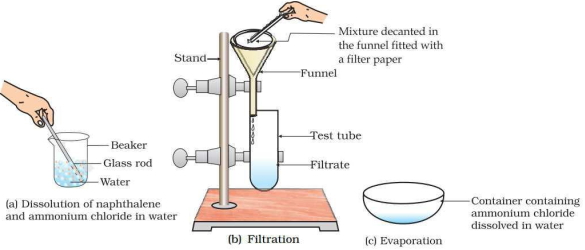
You are provided with a mixture of naphthalene and ammonium chloride by your teacher. Suggest an activity to separate them with a well-labelled diagram.
Solution
(N/A) To separate a mixture of naphthalene and ammonium chloride,we can use the property of solubility in water.
$1$. Take the mixture in a beaker and add water to it. Stir the mixture using a glass rod.
$2$. Ammonium chloride is soluble in water,whereas naphthalene is insoluble in water.
$3$. Filter the mixture using a funnel and filter paper. Naphthalene will remain as a residue on the filter paper,while the ammonium chloride solution will pass through as the filtrate.
$4$. Collect the filtrate in a china dish and heat it. The water will evaporate,leaving behind solid ammonium chloride crystals.
0 likes
View Solution7
Medium
Suggest separation technique$(s)$ one would need to employ to separate the following mixtures:
$(a)$ Mercury and water
$(b)$ Potassium chloride and ammonium chloride
$(c)$ Common salt,water and sand
$(d)$ Kerosene oil,water and salt
$(a)$ Mercury and water
$(b)$ Potassium chloride and ammonium chloride
$(c)$ Common salt,water and sand
$(d)$ Kerosene oil,water and salt
Solution
(N/A) Separation by using a separating funnel,as they are immiscible liquids with different densities.
$(b)$ Sublimation,as ammonium chloride sublimes upon heating while potassium chloride does not.
$(c)$ Filtration to remove sand,followed by evaporation to separate common salt from water.
$(d)$ Separation by using a separating funnel to remove kerosene oil,followed by evaporation or distillation to separate salt from water.
0 likes
View Solution8
Easy
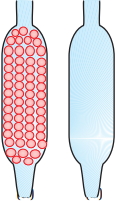
Which of the tubes in Fig. $(a)$ and $(b)$ will be more effective as a condenser in the distillation apparatus?
Solution
(A) The tube $(a)$ will be more effective as a condenser.
The presence of marbles increases the surface area available for cooling.
This allows more time for the vapours to condense,and hence it would be more effective than the column without marbles.
The presence of marbles increases the surface area available for cooling.
This allows more time for the vapours to condense,and hence it would be more effective than the column without marbles.
0 likes
View Solution9
EasyMCQ
Salt can be recovered from its solution by evaporation. Suggest some other technique for the same?
A
Distillation
B
Crystallization
C
Sublimation
D
Centrifugation
Solution
(B) Crystallization is a process that separates a pure solid in the form of its crystals from a saturated solution. It is a better technique than evaporation because evaporation can cause decomposition of some solids or contamination due to impurities,whereas crystallization provides a purer form of the substance.
0 likes
View Solution10
Easy
While diluting a solution of salt in water,a student by mistake added acetone (boiling point $56\,^oC$). What technique can be employed to get back the acetone? Justify your choice.
Solution
(DISTILLATION) Acetone can be separated from the mixture using the technique of distillation.
Distillation is used for the separation of components of a mixture containing two miscible liquids that boil without decomposition and have sufficient difference in their boiling points.
Since the boiling point of acetone $(56\,^oC)$ is significantly lower than that of water $(100\,^oC)$,acetone will vaporize first upon heating.
The vapors can then be passed through a condenser to be collected as a liquid,effectively separating it from the salt-water solution.
0 likes
View Solution11
Medium
Give an example each for the mixture having the following characteristics. Suggest a suitable method to separate the components of these mixtures:
$(a)$ $A$ volatile and a non-volatile component.
$(b)$ Two volatile components with appreciable difference in boiling points.
$(c)$ Two immiscible liquids.
$(d)$ One of the components changes directly from solid to gaseous state.
$(e)$ Two or more coloured constituents soluble in some solvent.
$(a)$ $A$ volatile and a non-volatile component.
$(b)$ Two volatile components with appreciable difference in boiling points.
$(c)$ Two immiscible liquids.
$(d)$ One of the components changes directly from solid to gaseous state.
$(e)$ Two or more coloured constituents soluble in some solvent.
Solution
(A-D) Example: Salt and water. Method: Evaporation or distillation.
$(b)$ Example: Acetone and water. Method: Distillation.
$(c)$ Example: Oil and water. Method: Separation by using a separating funnel.
$(d)$ Example: Ammonium chloride and salt. Method: Sublimation.
$(e)$ Example: Components of ink. Method: Chromatography.
$(b)$ Example: Acetone and water. Method: Distillation.
$(c)$ Example: Oil and water. Method: Separation by using a separating funnel.
$(d)$ Example: Ammonium chloride and salt. Method: Sublimation.
$(e)$ Example: Components of ink. Method: Chromatography.
0 likes
View Solution12
Easy
Can we separate alcohol dissolved in water by using a separating funnel? If yes,then describe the procedure. If not,explain.
Solution
(N/A) No,we cannot separate alcohol dissolved in water using a separating funnel.
This is because alcohol and water are miscible liquids,meaning they mix completely to form a single homogeneous phase.
$A$ separating funnel is only used to separate immiscible liquids (liquids that do not mix and form distinct layers,such as oil and water).
Since alcohol and water form a homogeneous mixture,they must be separated using other methods like fractional distillation,which relies on the difference in their boiling points.
0 likes
View Solution13
Medium
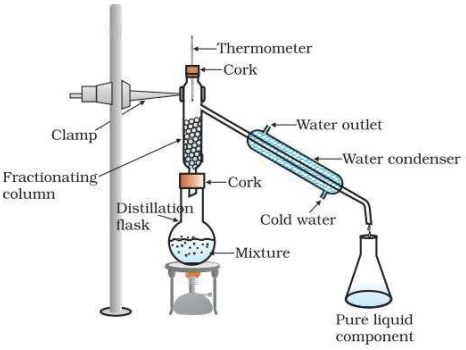
Fractional distillation is suitable for the separation of miscible liquids with a boiling point difference of about $25\, K$ or less. What part of the fractional distillation apparatus makes it efficient and provides an advantage over a simple distillation process? Explain using a diagram.
Solution
(N/A) The key component that makes fractional distillation efficient is the fractionating column. This column is typically packed with glass beads or other inert materials.
$1$. The glass beads provide a large surface area for the vapours to collide,lose energy,and undergo repeated condensation and evaporation cycles as they rise through the column.
$2$. This process ensures that the component with the higher boiling point condenses more easily and returns to the flask,while the component with the lower boiling point reaches the top of the column as a vapour.
$3$. The length of the column further increases the efficiency of this separation process,allowing for the effective separation of liquids with small boiling point differences.
(Refer to the provided diagram for the setup of the fractional distillation apparatus.)
0 likes
View Solution14
Medium
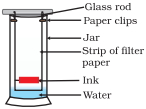
$A$ child wanted to separate the mixture of dyes constituting a sample of ink. He marked a line by the ink on the filter paper and placed the filter paper in a glass containing water as shown in the figure. The filter paper was removed when the water moved near the top of the filter paper.
$(i)$ What would you expect to see,if the ink contains three different coloured components?
$(ii)$ Name the technique used by the child.
$(iii)$ Suggest one more application of this technique.
$(i)$ What would you expect to see,if the ink contains three different coloured components?
$(ii)$ Name the technique used by the child.
$(iii)$ Suggest one more application of this technique.
Solution
(N/A) $(i)$ If the ink contains three different coloured components,we would expect to see three different coloured bands on the filter paper at different heights,as each component travels at a different speed depending on its solubility in the solvent.
$(ii)$ The technique used is Chromatography.
$(iii)$ One more application of this technique is to separate pigments present in natural colours (e.g.,chlorophyll) or to separate drugs from blood.
$(ii)$ The technique used is Chromatography.
$(iii)$ One more application of this technique is to separate pigments present in natural colours (e.g.,chlorophyll) or to separate drugs from blood.
0 likes
View Solution15
Medium
You are provided with a mixture containing sand, iron filings, ammonium chloride, and sodium chloride. Describe the procedures you would use to separate these constituents from the mixture.
Solution
(N/A) The components of the given mixture can be separated by the following methods:
$(i)$ $Using$ $a$ $magnet$: Hovering a magnet over the mixture will result in iron filings getting stuck to the magnet. Thus, iron will be separated.
$(ii)$ $Sublimation$: The remaining mixture is heated in a china dish. Ammonium chloride is a sublime substance and hence it will evaporate without undergoing the liquid phase. The crust of ammonium chloride can be collected by placing an inverted funnel on top of the china dish.
$(iii)$ $Sedimentation,$ $decantation,$ $and$ $filtration$: The remaining mixture is dissolved in water. The mixture is allowed to settle for some time. Sand, being insoluble in water, settles at the bottom. The liquid is decanted into another beaker. Then, the liquid is filtered to remove any trace of sand in it.
$(iv)$ $Evaporation$: The liquid is now a solution of sodium chloride in water. This is heated in a beaker so that the water evaporates. Once all the water evaporates, we get sodium chloride in the beaker.
0 likes
View Solution16
Easy
State the principle involved in separating a mixture containing kerosene and water.
Solution
(N/A) The principle involved in separating a mixture of kerosene and water is based on the difference in the densities of the two liquids. Kerosene and water are immiscible liquids,meaning they do not mix with each other. When left undisturbed,they form separate layers. Since water is denser than kerosene,it settles at the bottom,while kerosene,being lighter,forms the upper layer. This mixture can be separated using a separating funnel.
0 likes
View Solution17
Easy
Colloids are quite stable. Name the process by which you can separate the components of a colloidal solution.
Solution
(CENTRIFUGATION) The components of a colloidal solution cannot be separated by ordinary filtration. However,they can be separated by a process known as $Centrifugation$. In this process,the colloidal solution is spun at a very high speed,causing the dispersed phase particles to settle down at the bottom due to their density,allowing the separation of the components.
0 likes
View Solution18
Easy
How can we obtain a coloured component (dye) from blue/black ink?
Solution
(N/A) The coloured component (dye) can be obtained from blue or black ink using the process of evaporation.
$1$. Take a small amount of ink in a watch glass.
$2$. Place the watch glass on a beaker containing water and heat the beaker.
$3$. As the water boils,the steam heats the ink.
$4$. The solvent (water) evaporates,leaving behind the solid coloured component (dye) in the watch glass.
Note: Chromatography is used to separate different pigments present within the dye itself,but evaporation is the primary method to separate the dye from the solvent.
0 likes
View Solution19
Easy
How can we separate a mixture of two immiscible liquids?
Solution
(N/A) mixture of two immiscible liquids can be separated by using a separating funnel.
In this process,the mixture is poured into the separating funnel and left undisturbed for some time.
The two liquids form separate layers based on their densities.
The heavier liquid settles at the bottom,while the lighter liquid floats on top.
By opening the stopcock of the separating funnel,the heavier liquid is collected in a beaker,and the stopcock is closed before the lighter liquid enters the outlet.
0 likes
View Solution20
Easy
How can we obtain different gases from air?
Solution
(N/A) Air is a homogeneous mixture of various gases. To separate these gases,the air is first compressed by increasing pressure and then cooled by decreasing temperature to get liquid air. This liquid air is then allowed to warm up slowly in a fractional distillation column. Since different gases have different boiling points,they get separated at different heights in the column.
0 likes
View Solution21
EasyMCQ
How can we obtain pure copper sulphate from an impure sample?
A
Evaporation
B
Crystallisation
C
Sublimation
D
Distillation
Solution
(B) Crystallisation is the process used to purify solids. It is a separation technique that separates a pure solid in the form of its crystals from a solution.
To obtain pure copper sulphate from an impure sample,the sample is dissolved in a minimum amount of water.
The solution is filtered to remove insoluble impurities.
The solution is then heated to evaporate the solvent until a saturated solution is obtained.
Finally,the solution is allowed to cool slowly without disturbance,which results in the formation of pure copper sulphate crystals.
0 likes
View Solution22
Easy
Define distillation.
Solution
(N/A) Distillation is a process used to separate components of a mixture based on differences in their boiling points. It involves heating a liquid to form vapours and then cooling these vapours to condense them back into a liquid state.
0 likes
View Solution23
Easy
Define chromatography.
Solution
(N/A) Chromatography is a laboratory technique used for the separation of a mixture into its individual components. It works on the principle that different components of a mixture move at different rates through a stationary phase when carried by a mobile phase,allowing them to be separated based on their differential affinities.
0 likes
View Solution24
Easy
Salt can be recovered from its solution by evaporation. Can you suggest any other technique also?
Solution
(CRYSTALLISATION) Crystallisation is another effective technique used to recover salt from its solution. Crystallisation is a process that separates a pure solid in the form of its crystals from a solution. It is often preferred over evaporation because it avoids the decomposition of substances that might occur at high temperatures and removes impurities more effectively.
0 likes
View Solution25
Easy
Can we separate alcohol dissolved in water by using a separating funnel? If yes,then describe the procedure. If not,explain.
Solution
(N/A) No,we cannot separate alcohol dissolved in water using a separating funnel. $A$ separating funnel is used to separate two immiscible liquids (liquids that do not mix,like oil and water) based on their density differences. Alcohol and water are miscible liquids,meaning they form a homogeneous mixture and dissolve completely in each other. Therefore,they cannot be separated by a separating funnel; instead,they are typically separated by fractional distillation based on their different boiling points.
0 likes
View Solution26
Easy
Crystallisation is a better technique than simple evaporation. Give one reason to justify the statement.
Solution
(N/A) Crystallisation is preferred because:
$1$. Some solids decompose or get charred (e.g.,sugar) upon heating to dryness during evaporation.
$2$. Some impurities may remain dissolved in the solution even after evaporation,which contaminates the solid product. Crystallisation helps in obtaining a purer form of the solid.
$1$. Some solids decompose or get charred (e.g.,sugar) upon heating to dryness during evaporation.
$2$. Some impurities may remain dissolved in the solution even after evaporation,which contaminates the solid product. Crystallisation helps in obtaining a purer form of the solid.
0 likes
View Solution27
MediumMCQ
Name the appropriate methods to separate the following:
$(i)$ Nitrogen from air
$(ii)$ Dye from blue ink
$(iii)$ Butter cream from milk
$(iv)$ Ammonium chloride from common salt
$(i)$ Nitrogen from air
$(ii)$ Dye from blue ink
$(iii)$ Butter cream from milk
$(iv)$ Ammonium chloride from common salt
A
Fractional distillation,Chromatography,Centrifugation,Sublimation
B
Distillation,Evaporation,Filtration,Sublimation
C
Fractional distillation,Evaporation,Centrifugation,Crystallization
D
Distillation,Chromatography,Filtration,Sublimation
Solution
(A) $(i)$ Nitrogen from air is separated by Fractional distillation because it involves separating components based on their different boiling points.
$(ii)$ Dye from blue ink is separated by Chromatography,which is used to separate solutes that dissolve in the same solvent.
$(iii)$ Butter cream from milk is separated by Centrifugation,where denser particles are forced to the bottom and lighter particles stay at the top.
$(iv)$ Ammonium chloride from common salt is separated by Sublimation,as ammonium chloride sublimes upon heating while common salt does not.
0 likes
View Solution28
Easy
What is distillation? List the two conditions essential for using this as a method of separation of components of a mixture.
Solution
(N/A) Distillation is the process of heating a liquid to form vapour and then cooling the vapour to get back the liquid.
Conditions:
$(i)$ The components of the mixture should boil without decomposition.
$(ii)$ There should be a sufficient difference in the boiling points of the components.
Conditions:
$(i)$ The components of the mixture should boil without decomposition.
$(ii)$ There should be a sufficient difference in the boiling points of the components.
0 likes
View Solution29
Medium
How will you separate a mixture of naphthalene powder and common salt? Draw a neat and labelled diagram to show the process.
Solution
(N/A) To separate a mixture of naphthalene powder and common salt,we use the process of sublimation.
$1$. Place the mixture in a china dish.
$2$. Invert a glass funnel over the china dish.
$3$. Plug the stem of the funnel with a cotton plug to prevent the vapours from escaping.
$4$. Place the china dish on a tripod stand and heat it using a burner.
$5$. Naphthalene,being a sublimable substance,directly converts into vapours upon heating,while common salt remains in the china dish.
$6$. The naphthalene vapours condense on the cooler inner walls of the funnel and can be scraped off,leaving pure common salt in the china dish.
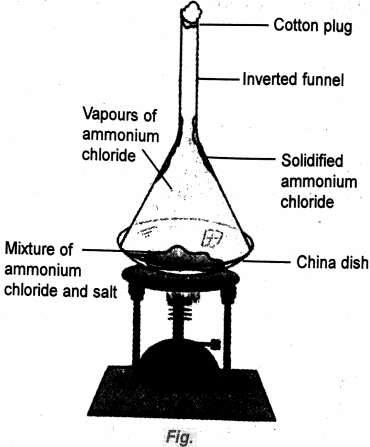
0 likes
View Solution30
Medium
Distinguish between miscible and immiscible liquids. Name the techniques used to separate these liquids.
Solution
(N/A) Miscible liquids: These liquids mix with each other completely to form a single phase.
Immiscible liquids: These liquids do not mix with each other and form separate layers.
Techniques for separation:
$1$. For miscible liquids: Distillation or fractional distillation is used based on the difference in their boiling points.
$2$. For immiscible liquids: $A$ separating funnel is used to separate them based on the difference in their densities.
0 likes
View Solution31
Medium
What is distillation? List two conditions essential for using this as a method of separation of components of a mixture.
Solution
(N/A) Distillation: This is a process of separating components of a mixture by heating a liquid to form vapours and then cooling the vapours to get back the liquid.
$(b)$ Two essential conditions for distillation are:
$(i)$ The components of the mixture must be miscible liquids.
$(ii)$ There should be a significant difference in the boiling points of the components (usually greater than $25 \ K$ for simple distillation,though the question implies general conditions for separation).
0 likes
View Solution32
Medium
What is chromatography? Mention its applications.
Solution
(N/A) Chromatography is a laboratory technique used for the separation of a mixture into its individual components. It works on the principle that different components of a mixture move at different rates through a stationary phase when carried by a mobile phase.
Applications:
$(a)$ Separation of colours in a dye.
$(b)$ Separation of pigments from natural colours (e.g.,chlorophyll from plant extracts).
$(c)$ Separation of drugs from blood.
Applications:
$(a)$ Separation of colours in a dye.
$(b)$ Separation of pigments from natural colours (e.g.,chlorophyll from plant extracts).
$(c)$ Separation of drugs from blood.
0 likes
View Solution33
Medium
Enumerate any two differences between simple distillation and fractional distillation.
Solution
(N/A)
| Simple distillation | Fractional distillation |
| $(i)$ Used to separate a mixture of two or more miscible liquids for which the difference in boiling point $(b.p.)$ is more than $25^{\circ} C$. | $(i)$ Used to separate two or more miscible liquids for which the difference in boiling point $(b.p.)$ is less than $25^{\circ} C$. |
| $(ii)$ $A$ fractionating column is not used. | $(ii)$ $A$ fractionating column is used to provide more surface area for cooling and condensation. |
0 likes
View Solution34
Medium
$A$ mixture containing two liquids visibly separated,is placed in a separating funnel. Answer the following:
$(i)$ What type of liquids form the mixture?
$(ii)$ Which of the liquids will form the lower layer?
$(iii)$ What is the principle behind this method of separation?
$(i)$ What type of liquids form the mixture?
$(ii)$ Which of the liquids will form the lower layer?
$(iii)$ What is the principle behind this method of separation?
Solution
(N/A) $(i)$ Immiscible liquids.
$(ii)$ The liquid with higher density will form the lower layer.
$(iii)$ The principle behind this method is that immiscible liquids separate out into distinct layers based on their differences in densities.
$(ii)$ The liquid with higher density will form the lower layer.
$(iii)$ The principle behind this method is that immiscible liquids separate out into distinct layers based on their differences in densities.
0 likes
View Solution35
Medium
$(i)$ Name a technique to separate a mixture of two or more miscible liquids for which the difference in boiling points is less than $25\, K$.
$(ii)$ Describe the structure of the column used in the above technique. Why is it used?
$(ii)$ Describe the structure of the column used in the above technique. Why is it used?
Solution
(N/A) $(i)$ The technique used is fractional distillation.
$(ii)$ The fractionating column is a glass tube packed with glass beads or other materials that provide a large surface area. It is fitted between the distillation flask and the condenser.
It is used because it provides a large surface area for the vapours to cool and condense repeatedly,allowing for better separation of liquids with boiling points close to each other.
0 likes
View Solution36
Medium
$(a)$ What separation technique will you apply for the separation of the following?
$(i)$ Ammonium chloride from sodium chloride.
$(ii)$ Different pigments from the extract of flower petals.
$(b)$ What is crystallisation? List two ways in which the crystallisation technique is better than the simple evaporation technique.
$(i)$ Ammonium chloride from sodium chloride.
$(ii)$ Different pigments from the extract of flower petals.
$(b)$ What is crystallisation? List two ways in which the crystallisation technique is better than the simple evaporation technique.
Solution
(A-D) $(i)$ Sublimation.
$(ii)$ Paper chromatography.
$(b)$ Crystallisation is a process that separates a pure solid in the form of its crystals from a solution.
The crystallisation technique is better than the simple evaporation technique because:
$1$. Some solids decompose or may get charred (e.g.,sugar) upon heating to dryness.
$2$. Some impurities may remain dissolved in the solution even after filtration; evaporation would cause these impurities to contaminate the solid,whereas crystallisation leaves them in the mother liquor.
0 likes
View Solution37
Medium
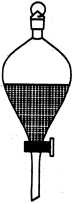
Observe the apparatus shown and answer the following questions:
$(a)$ Name the apparatus.
$(b)$ State one use of the apparatus.
$(c)$ State the principle involved in this process.
$(a)$ Name the apparatus.
$(b)$ State one use of the apparatus.
$(c)$ State the principle involved in this process.
Solution
(N/A) Separating funnel.
$(b)$ It is used to separate a mixture of two immiscible liquids.
$(c)$ The principle involved is that immiscible liquids separate out into distinct layers based on their densities.
$(b)$ It is used to separate a mixture of two immiscible liquids.
$(c)$ The principle involved is that immiscible liquids separate out into distinct layers based on their densities.
0 likes
View Solution38
Medium
$(i)$ Name the process or the separation technique you would follow to separate:
$(a)$ Dyes in black ink
$(b)$ Butter from cream
$(c)$ Ammonium chloride and common salt
$(d)$ Iron filings and sand
$(ii)$ State the principle used in separation by centrifugation.
$(a)$ Dyes in black ink
$(b)$ Butter from cream
$(c)$ Ammonium chloride and common salt
$(d)$ Iron filings and sand
$(ii)$ State the principle used in separation by centrifugation.
Solution
(A-D) $(i)$ $(a)$ Chromatography: This technique is used to separate solutes that dissolve in the same solvent.
$(b)$ Centrifugation: This method is used to separate suspended particles from a liquid based on density.
$(c)$ Sublimation: This process is used to separate a sublimable volatile component from a non-sublimable impurity.
$(d)$ Magnetic separation: This method is used to separate magnetic substances from non-magnetic substances.
$(ii)$ The principle of centrifugation is that when a mixture is rotated at high speed,the denser particles are forced to the bottom and the lighter particles stay at the top.
0 likes
View Solution39
Medium
State the separation technique you would apply for the separation of the following:
$(a)$ Sodium chloride from its solution in water
$(b)$ Tea leaves from tea
$(c)$ Iron pins from sand
$(d)$ Different pigments from an extract of leaves
$(e)$ Butter from curd
$(f)$ Fine mud particles suspended in water.
$(a)$ Sodium chloride from its solution in water
$(b)$ Tea leaves from tea
$(c)$ Iron pins from sand
$(d)$ Different pigments from an extract of leaves
$(e)$ Butter from curd
$(f)$ Fine mud particles suspended in water.
Solution
(N/A) Evaporation: Sodium chloride is a non-volatile solute,so it can be recovered from its aqueous solution by evaporating the water.
$(b)$ Filtration: Tea leaves are insoluble solids that can be separated from the liquid tea using a filter or sieve.
$(c)$ Magnetic separation: Iron pins are magnetic,while sand is not; therefore,a magnet can be used to attract and separate the pins.
$(d)$ Chromatography: This technique is used to separate different pigments based on their differential solubility in a solvent.
$(e)$ Centrifugation: Butter particles are lighter than the liquid in curd; spinning the mixture at high speed forces the denser components outward,separating the butter.
$(f)$ Decantation and filtration: Fine mud particles can be allowed to settle (sedimentation) followed by decantation,or removed directly using filtration.
0 likes
View Solution40
Easy
What is meant by crystallisation? How is impure copper sulphate purified by the process?
Solution
(N/A) Crystallisation is a process that separates a pure solid in the form of its crystals from a solution.
$AIM$: To obtain crystals of pure copper sulphate from an impure sample.
Procedure:
$(i)$ Take some impure sample of copper sulphate in a china dish (approximately $5 \ g$).
$(ii)$ Dissolve the contents in a minimum amount of water and filter the impurities out.
$(iii)$ Evaporate water from the solution to get a saturated solution of copper sulphate.
$(iv)$ Cover the solution with a filter paper and leave it undisturbed at room temperature to cool slowly for a day.
Observation: The crystals of copper sulphate can be seen in the china dish.
Conclusion: The process of formation of crystals of a pure solid from a solution is called crystallisation.
0 likes
View Solution41
Difficult
How will you separate a mixture of common salt,camphor,and iron filings? Describe the process.
Solution
(N/A) $(i)$ Magnetic separation: Pass a magnet over the mixture. The iron filings will be attracted to the magnet and can be separated from the mixture.
$(ii)$ Sublimation: Heat the remaining mixture. Camphor,being a sublimable substance,will change directly from a solid to a gas and can be collected by cooling it on a cold surface (like an inverted funnel),leaving behind the common salt.
$(iii)$ Dissolution and Filtration/Evaporation: Add water to the remaining residue (common salt). The salt will dissolve in the water. Filter the solution to remove any impurities if necessary,then evaporate the water to obtain the common salt.
0 likes
View Solution42
Medium
Suggest a suitable separation technique for the following:
$(i)$ Mercury and water.
$(ii)$ Coloured components from blue ink.
$(iii)$ Ammonium chloride and potassium chloride.
$(iv)$ Mixture of alcohol and water.
$(i)$ Mercury and water.
$(ii)$ Coloured components from blue ink.
$(iii)$ Ammonium chloride and potassium chloride.
$(iv)$ Mixture of alcohol and water.
Solution
(N/A) $(i)$ Mercury and water: Since they are immiscible liquids with different densities,a separating funnel is used.
$(ii)$ Coloured components from blue ink: Chromatography is used as it separates components based on their different solubilities in a solvent.
$(iii)$ Ammonium chloride and potassium chloride: Sublimation is used because ammonium chloride sublimes upon heating,while potassium chloride does not.
$(iv)$ Mixture of alcohol and water: Fractional distillation is used because they are miscible liquids with different boiling points.
0 likes
View Solution43
Easy
Give an example each of a mixture that shows the following characteristics:
$(i)$ $A$ mixture of two coloured components.
$(ii)$ $A$ mixture of two volatile components with a boiling point difference of less than $25\ K$.
$(iii)$ $A$ mixture of a volatile and a non-volatile solid component.
$(i)$ $A$ mixture of two coloured components.
$(ii)$ $A$ mixture of two volatile components with a boiling point difference of less than $25\ K$.
$(iii)$ $A$ mixture of a volatile and a non-volatile solid component.
Solution
(N/A) $(i)$ $A$ mixture of two coloured components: Ink (which contains various dyes).
$(ii)$ $A$ mixture of two volatile components with a boiling point difference of less than $25\ K$: Air (which is a mixture of gases like nitrogen,oxygen,and argon).
$(iii)$ $A$ mixture of a volatile and a non-volatile solid component: Salt and water (or camphor and sand).
$(ii)$ $A$ mixture of two volatile components with a boiling point difference of less than $25\ K$: Air (which is a mixture of gases like nitrogen,oxygen,and argon).
$(iii)$ $A$ mixture of a volatile and a non-volatile solid component: Salt and water (or camphor and sand).
0 likes
View Solution44
MediumMCQ
Chromatography is the technique which is used for separation of those solutes that
A
Dissolve in the same solvent
B
Get adsorbed to different extremes
C
Get absorbed at the same speed
D
Are soluble in aqueous medium
Solution
(B) Chromatography is a laboratory technique used for the separation of a mixture into its individual components.
It works on the principle that different components of a mixture have different affinities for the stationary phase and the mobile phase.
As the mixture moves through the stationary phase,the components are adsorbed to different extents based on their chemical properties.
This difference in the extent of adsorption causes the components to travel at different speeds,leading to their separation.
0 likes
View Solution45
Medium
Jessica saw her mother rotating a milk churner in a container of milk. She was surprised and asked her mother why she was doing that. Her mother smiled and explained that she was separating cream from milk,which would be used in various dishes.
$(a)$ What kind of qualities are shown by Jessica's mother?
$(b)$ How is cream easily separated from milk by a milk churner?
$(a)$ What kind of qualities are shown by Jessica's mother?
$(b)$ How is cream easily separated from milk by a milk churner?
Solution
(N/A) The qualities shown by Jessica's mother are:
$(i)$ In-depth knowledge of household tasks.
$(ii)$ Caring nature towards her family.
$(iii)$ Awareness of her duties and responsibilities.
$(b)$ When milk is rotated at a high speed using a churner,the principle of centrifugation is applied. The denser components of milk are pushed towards the sides of the container,while the lighter particles (cream) collect in the center. Since cream is lighter than the skimmed milk,it floats on the surface and can be easily separated.
0 likes
View Solution46
Medium
Ravjot's mother always squeezes water from wet clothes in the spinner of a washing machine and then uses it to clean the floor:
$(a)$ Write the principle of the technique used in the above-mentioned process.
$(b)$ Write one more application of this technique.
$(c)$ What do you learn from Ravjot's mother?
$(a)$ Write the principle of the technique used in the above-mentioned process.
$(b)$ Write one more application of this technique.
$(c)$ What do you learn from Ravjot's mother?
Solution
(N/A) The principle used is Centrifugation,where denser particles are forced to the bottom and lighter particles stay at the top when spun rapidly.
$(b)$ $(i)$ Used in diagnostic laboratories for blood and urine tests.
$(ii)$ Used in dairies and at home to separate butter from cream.
$(c)$ Ravjot's mother is concerned about water conservation. It shows that she cares about the environment and natural resources. By reusing wastewater,she is effectively conserving precious environmental resources.
0 likes
View SolutionIS MATTER AROUND US PURE? — Separating the Components of a Mixture · Frequently Asked Questions
1Are these IS MATTER AROUND US PURE? questions useful for JEE and NEET?
Yes. All questions in this section are mapped to JEE Main and NEET exam patterns. Previous year questions from JEE Main, NEET, GUJCET and state-level exams are included with full solutions.
2Can I switch to Hindi or Gujarati for these questions?
Yes. Use the language tabs in the hero section or the sidebar to view the same questions and solutions in English, Hindi or Gujarati.
3How do I generate a question paper from this subtopic?
Use the Vedclass Exam Paper Generator — select the chapter and subtopic, set difficulty, and generate Sets A, B, C, D automatically. First 3 chapters of every subject are free.
Vedclass Products
For Students
Vedclass Test Series
Mock tests in real JEE/NEET style with performance analysis. 5-day free trial.
Start Free TrialFor Teachers
Exam Paper Generator
Generate Set A/B/C/D papers from this chapter in 2 minutes. 3 chapters free.
Try FreeFor Institutes
Online Exam Module
Live online exams with unlimited students, 360° analytics & white-label branding.
See DemoFor Teachers & Institutes
Generate a IS MATTER AROUND US PURE? Exam Paper in 2 Minutes
Select subtopic & difficulty — Sets A, B, C, D auto-generated with No Repeat logic.
First 3 chapters of every subject are free — no payment required.