
A English
Physical and Chemical Changes, Elements and Compounds Questions in English
Class 9 Science · IS MATTER AROUND US PURE? · Physical and Chemical Changes, Elements and Compounds
46+
Questions
English
Language
100%
With Solutions
Showing 46 of 46 questions in English
1
Medium
What is meant by a pure substance?
Solution
(N/A) pure substance is defined as a substance that consists of only one type of particles (atoms or molecules).
For example: $Hydrogen$,$Water$,$Gold$,etc.,are considered pure substances.
Note: All elements and compounds are classified as pure substances because they have a fixed chemical composition and uniform properties throughout.
For example: $Hydrogen$,$Water$,$Gold$,etc.,are considered pure substances.
Note: All elements and compounds are classified as pure substances because they have a fixed chemical composition and uniform properties throughout.
0 likes
View Solution2
Medium
Classify the following as chemical or physical changes:
$1$. Cutting of trees
$2$. Melting of butter in a pan
$3$. Rusting of almirah
$4$. Boiling of water to form steam
$5$. Passing of electric current through water and the water breaking down into hydrogen and oxygen gases
$6$. Dissolving common salt in water
$7$. Making a fruit salad with raw fruits
$8$. Burning of paper and wood
Solution
(N/A) Physical Change: These are changes where no new substance is formed and the chemical composition remains the same.
- Cutting of trees
- Melting of butter in a pan
- Boiling of water to form steam
- Dissolving common salt in water
- Making a fruit salad with raw fruits
Chemical Change: These are changes where new substances with different chemical properties are formed.
- Rusting of almirah (Iron reacts with oxygen and moisture to form iron oxide)
- Passing of electric current through water and the water breaking down into hydrogen and oxygen gases (Electrolysis)
- Burning of paper and wood (Combustion reaction)
4 likes
View Solution3
EasyMCQ
How would you confirm that a colorless liquid given to you is pure water?
A
By checking its color
B
By checking its boiling point
C
By checking its taste
D
By checking its smell
Solution
(B) To confirm if a colorless liquid is pure water,we can determine its boiling point.
Pure water has a fixed boiling point of $100\,^{\circ}\text{C}$ at standard atmospheric pressure.
If the liquid boils exactly at $100\,^{\circ}\text{C}$,it is pure water.
If the boiling point is different,it indicates the presence of impurities.
Pure water has a fixed boiling point of $100\,^{\circ}\text{C}$ at standard atmospheric pressure.
If the liquid boils exactly at $100\,^{\circ}\text{C}$,it is pure water.
If the boiling point is different,it indicates the presence of impurities.
0 likes
View Solution4
EasyMCQ
Which of the following materials fall in the category of a 'pure substance'?
$(a)$ Ice $(b)$ Milk $(c)$ Iron $(d)$ Hydrochloric acid $(e)$ Calcium oxide
$(f)$ Mercury $(g)$ Brick $(h)$ Wood $(i)$ Air.
$(a)$ Ice $(b)$ Milk $(c)$ Iron $(d)$ Hydrochloric acid $(e)$ Calcium oxide
$(f)$ Mercury $(g)$ Brick $(h)$ Wood $(i)$ Air.
A
$(a), (c), (e), (f)$
B
$(a), (b), (c), (d)$
C
$(c), (d), (e), (f)$
D
$(b), (g), (h), (i)$
Solution
(A) pure substance consists of particles of only one type of chemical nature. Its composition remains the same throughout.
$(a)$ Ice is solid water $(H_2O)$,which is a pure compound.
$(b)$ Milk is a mixture (colloid) of water,fats,and proteins.
$(c)$ Iron $(Fe)$ is an element,which is a pure substance.
$(d)$ Hydrochloric acid is typically an aqueous solution of hydrogen chloride gas $(HCl)$ in water,making it a mixture.
$(e)$ Calcium oxide $(CaO)$ is a pure compound.
$(f)$ Mercury $(Hg)$ is an element,which is a pure substance.
$(g)$ Brick is a mixture of various minerals and soil components.
$(h)$ Wood is a complex mixture of cellulose,lignin,and other organic compounds.
$(i)$ Air is a mixture of various gases like nitrogen,oxygen,argon,and carbon dioxide.
Therefore,the pure substances are $(a), (c), (e),$ and $(f)$.
0 likes
View Solution5
EasyMCQ
Rusting of an article made up of iron is called
A
corrosion and it is a physical as well as chemical change
B
corrosion and it is a chemical change
C
dissolution and it is a physical change
D
dissolution and it is a chemical change
Solution
(B) Rusting of iron is a process where iron reacts with oxygen and moisture to form hydrated iron$(III)$ oxide.
This process is known as corrosion.
Since a new substance is formed and the process is irreversible,it is classified as a chemical change.
This process is known as corrosion.
Since a new substance is formed and the process is irreversible,it is classified as a chemical change.
0 likes
View Solution6
MediumMCQ
Which of the following are physical changes?
$(i)$ Melting of iron metal
$(ii)$ Rusting of iron
$(iii)$ Bending of an iron rod
$(iv)$ Drawing a wire of iron metal
$(i)$ Melting of iron metal
$(ii)$ Rusting of iron
$(iii)$ Bending of an iron rod
$(iv)$ Drawing a wire of iron metal
A
$(i), (ii)$ and $(iii)$
B
$(i), (iii)$ and $(iv)$
C
$(i), (ii)$ and $(iv)$
D
$(ii), (iii)$ and $(iv)$
Solution
(B) physical change is a change in which no new substance is formed and the chemical composition of the substance remains the same.
$(i)$ Melting of iron metal is a physical change because it only involves a change in the state of matter.
$(ii)$ Rusting of iron is a chemical change because iron reacts with oxygen and moisture to form iron oxide,which is a new substance.
$(iii)$ Bending of an iron rod is a physical change because it only involves a change in the shape of the metal.
$(iv)$ Drawing a wire of iron metal is a physical change because it involves a change in the shape/form of the metal without changing its chemical identity.
Therefore,$(i), (iii),$ and $(iv)$ are physical changes.
0 likes
View Solution7
MediumMCQ
Which of the following are chemical changes?
$(i)$ Decaying of wood
$(ii)$ Burning of wood
$(iii)$ Sawing of wood
$(iv)$ Hammering of a nail into a piece of wood
$(i)$ Decaying of wood
$(ii)$ Burning of wood
$(iii)$ Sawing of wood
$(iv)$ Hammering of a nail into a piece of wood
A
$(iii)$ and $(iv)$
B
$(ii)$ and $(iii)$
C
$(i)$ and $(ii)$
D
$(i)$ and $(iv)$
Solution
(C) chemical change is a process where one or more substances are altered into one or more new and different substances.
$(i)$ Decaying of wood: This is a chemical change because microorganisms break down the wood into new substances.
$(ii)$ Burning of wood: This is a chemical change because wood reacts with oxygen to form carbon dioxide,water vapor,and ash,which are new substances.
$(iii)$ Sawing of wood: This is a physical change because only the shape and size of the wood change,not its chemical composition.
$(iv)$ Hammering of a nail into a piece of wood: This is a physical change as it involves a mechanical action without altering the chemical identity of the wood or the nail.
Therefore,$(i)$ and $(ii)$ are chemical changes.
0 likes
View Solution8
MediumMCQ
Two substances,$A$ and $B$,were made to react to form a third substance,$A_2B$,according to the following reaction: $2A + B \to A_2B$. Which of the following statements concerning this reaction are incorrect?
$(i)$ The product $A_2B$ shows the properties of substances $A$ and $B$.
$(ii)$ The product will always have a fixed composition.
$(iii)$ The product so formed cannot be classified as a compound.
$(iv)$ The product so formed is an element.
$(i)$ The product $A_2B$ shows the properties of substances $A$ and $B$.
$(ii)$ The product will always have a fixed composition.
$(iii)$ The product so formed cannot be classified as a compound.
$(iv)$ The product so formed is an element.
A
$(i), (ii)$ and $(iii)$
B
$(i), (iii)$ and $(iv)$
C
$(ii), (iii)$ and $(iv)$
D
$(ii), (iv)$ and $(i)$
Solution
(B) The reaction $2A + B \to A_2B$ represents the formation of a chemical compound.
$(i)$ Incorrect: $A$ chemical compound $(A_2B)$ has properties entirely different from the constituent elements ($A$ and $B$).
$(ii)$ Correct: $A$ compound always has a fixed composition by mass.
$(iii)$ Incorrect: Since $A_2B$ is formed by the chemical combination of two substances in a fixed ratio,it is classified as a compound.
$(iv)$ Incorrect: $A_2B$ is a compound,not an element,as it consists of two different types of atoms chemically bonded together.
Therefore,statements $(i), (iii),$ and $(iv)$ are incorrect.
0 likes
View Solution9
MediumMCQ
Two chemical species $X$ and $Y$ combine together to form a product $P$ which contains both $X$ and $Y$.
$X + Y \to P$
$X$ and $Y$ cannot be broken down into simpler substances by simple chemical reactions. Which of the following concerning the species $X$,$Y$ and $P$ are correct?
$(i)$ $P$ is a compound
$(ii)$ $X$ and $Y$ are compounds
$(iii)$ $X$ and $Y$ are elements
$(iv)$ $P$ has a fixed composition
A
$(i), (iii)$ and $(iv)$
B
$(i), (ii)$ and $(iv)$
C
$(ii), (iii)$ and $(iv)$
D
$(i), (iii)$ and $(iii)$
Solution
(A) $1$. According to the definition of elements,they are substances that cannot be broken down into simpler substances by simple chemical reactions. Since $X$ and $Y$ cannot be broken down,they are elements.
$2$. When two or more elements combine chemically in a fixed proportion,they form a compound. Here,$X$ and $Y$ combine to form $P$,so $P$ is a compound.
$3$. Compounds always have a fixed composition by mass.
$4$. Therefore,statements $(i)$,$(iii)$,and $(iv)$ are correct.
$2$. When two or more elements combine chemically in a fixed proportion,they form a compound. Here,$X$ and $Y$ combine to form $P$,so $P$ is a compound.
$3$. Compounds always have a fixed composition by mass.
$4$. Therefore,statements $(i)$,$(iii)$,and $(iv)$ are correct.
0 likes
View Solution10
Medium
Classify the following as physical or chemical properties:
$(a)$ The composition of a sample of steel is: $98\%$ iron,$1.5\%$ carbon,and $0.5\%$ other elements.
$(b)$ Zinc dissolves in hydrochloric acid with the evolution of hydrogen gas.
$(c)$ Metallic sodium is soft enough to be cut with a knife.
$(d)$ Most metal oxides form alkalis on interacting with water.
Solution
(N/A) Physical properties: $(a)$ and $(c)$. These describe the inherent characteristics or composition of the substance without changing its chemical identity.
Chemical properties: $(b)$ and $(d)$. These describe the ability of a substance to undergo a specific chemical change or reaction,resulting in the formation of new substances.
Chemical properties: $(b)$ and $(d)$. These describe the ability of a substance to undergo a specific chemical change or reaction,resulting in the formation of new substances.
0 likes
View Solution11
MediumMCQ
What are the favourable qualities given to gold when it is alloyed with copper or silver for the purpose of making ornaments?
A
It increases the melting point of gold.
B
It provides hardness and strength to the gold.
C
It changes the chemical composition of gold.
D
It makes gold more malleable.
Solution
(B) Pure gold ($24$ carat) is extremely soft and ductile,making it unsuitable for making jewelry as it would easily deform. By alloying gold with small amounts of copper or silver,the metal gains significant hardness and structural strength. This allows the ornaments to maintain their shape and durability over time.
0 likes
View Solution12
Easy
An element is sonorous and highly ductile. Under which category would you classify this element? What other characteristics do you expect the element to possess?
Solution
(N/A) The element is classified as a $Metal$.
Metals are elements that typically exhibit properties such as being sonorous (producing a ringing sound when struck) and ductile (can be drawn into thin wires).
Other characteristics expected to be possessed by this element include:
$1$. Lustre: They have a shiny appearance.
$2$. Malleability: They can be beaten into thin sheets.
$3$. Conductivity: They are good conductors of heat and electricity.
$4$. High melting and boiling points.
0 likes
View Solution13
Easy
Sucrose (sugar) crystals obtained from sugarcane and beetroot are mixed together. Will it be a pure substance or a mixture? Give reasons for the same.
Solution
(A) It is a pure substance.
Even though the sucrose crystals are obtained from different sources (sugarcane and beetroot),their chemical composition is identical.
$A$ pure substance consists of particles of only one type of substance.
Since the chemical formula for sucrose is $C_{12}H_{22}O_{11}$ regardless of its origin,the mixture of these crystals remains a pure substance.
0 likes
View Solution14
Medium
On heating,calcium carbonate gets converted into calcium oxide and carbon dioxide.
$(a)$ Is this a physical or a chemical change?
$(b)$ Can you prepare one acidic and one basic solution by using the products formed in the above process? If so,write the chemical equations involved.
$(a)$ Is this a physical or a chemical change?
$(b)$ Can you prepare one acidic and one basic solution by using the products formed in the above process? If so,write the chemical equations involved.
Solution
(N/A) This is a chemical change because a new substance is formed and the process is irreversible under normal conditions.
$(b)$ Yes,acidic and basic solutions can be prepared by dissolving the products in water:
$1.$ Basic solution: Calcium oxide $(CaO)$ reacts with water to form calcium hydroxide $(Ca(OH)_2)$,which is basic in nature.
$CaO + H_2O \rightarrow Ca(OH)_2$
$2.$ Acidic solution: Carbon dioxide $(CO_2)$ reacts with water to form carbonic acid $(H_2CO_3)$,which is acidic in nature.
$CO_2 + H_2O \rightarrow H_2CO_3$
0 likes
View Solution15
Medium
Non-metals are usually poor conductors of heat and electricity. They are non-lustrous,non-sonorous,non-malleable,and are coloured.
$(a)$ Name a lustrous non-metal.
$(b)$ Name a non-metal which exists as a liquid at room temperature.
$(c)$ The allotropic form of a non-metal is a good conductor of electricity. Name the allotrope.
$(d)$ Name a non-metal which is known to form the largest number of compounds.
$(e)$ Name a non-metal other than carbon which shows allotropy.
$(f)$ Name a non-metal which is required for combustion.
Solution
(N/A) Iodine is a lustrous non-metal.
$(b)$ Bromine is the only non-metal that exists as a liquid at room temperature.
$(c)$ Graphite is an allotrope of carbon and is a good conductor of electricity due to the presence of free electrons.
$(d)$ Carbon is known to form the largest number of compounds due to its unique property of catenation.
$(e)$ Sulphur and phosphorus are non-metals other than carbon that exhibit allotropy.
$(f)$ Oxygen is a non-metal essential for the process of combustion.
0 likes
View Solution16
Easy
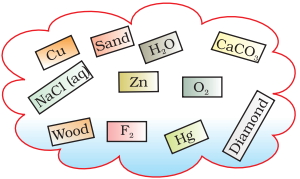
Classify the substances given in the figure into elements and compounds.
Solution
(N/A) Based on the chemical composition,the substances are classified as follows:
Elements: These are pure substances consisting of only one type of atom. From the figure,the elements are: $Cu$ (Copper),$Zn$ (Zinc),$O_2$ (Oxygen),$F_2$ (Fluorine),$Hg$ (Mercury),and Diamond (an allotrope of Carbon).
Compounds: These are substances formed by the chemical combination of two or more elements in a fixed proportion. From the figure,the compounds are: $H_2O$ (Water) and $CaCO_3$ (Calcium carbonate).
Note: Substances like Sand,$NaCl(aq)$,and Wood are mixtures,not pure elements or compounds.
0 likes
View Solution17
Medium
Which of the following are not compounds?
$(a)$ Chlorine gas
$(b)$ Potassium chloride
$(c)$ Iron
$(d)$ Iron sulphide
$(e)$ Aluminium
$(f)$ Iodine
$(g)$ Carbon
$(h)$ Carbon monoxide
$(i)$ Sulphur powder
$(a)$ Chlorine gas
$(b)$ Potassium chloride
$(c)$ Iron
$(d)$ Iron sulphide
$(e)$ Aluminium
$(f)$ Iodine
$(g)$ Carbon
$(h)$ Carbon monoxide
$(i)$ Sulphur powder
Solution
(A, C, E, F, G, I) compound is a substance formed when two or more chemical elements are chemically bonded together. Elements are pure substances consisting of only one type of atom.
$1$. Chlorine gas $(Cl_2)$ is an element.
$2$. Potassium chloride $(KCl)$ is a compound.
$3$. Iron $(Fe)$ is an element.
$4$. Iron sulphide $(FeS)$ is a compound.
$5$. Aluminium $(Al)$ is an element.
$6$. Iodine $(I_2)$ is an element.
$7$. Carbon $(C)$ is an element.
$8$. Carbon monoxide $(CO)$ is a compound.
$9$. Sulphur powder $(S)$ is an element.
Therefore,the substances that are not compounds are: Chlorine gas,Iron,Aluminium,Iodine,Carbon,and Sulphur powder.
0 likes
View Solution18
Medium
Classify each of the following as a physical or a chemical change. Give reasons.
$(a)$ Drying of a shirt in the sun.
$(b)$ Rising of hot air over a radiator.
$(c)$ Burning of kerosene in a lantern.
$(d)$ Change in the colour of black tea on adding lemon juice to it.
$(e)$ Churning of milk cream to get butter.
$(a)$ Drying of a shirt in the sun.
$(b)$ Rising of hot air over a radiator.
$(c)$ Burning of kerosene in a lantern.
$(d)$ Change in the colour of black tea on adding lemon juice to it.
$(e)$ Churning of milk cream to get butter.
Solution
(A) Physical changes: $(a), (b), (e)$. These are physical changes because no new substance is formed,and the chemical composition remains the same.
Chemical changes: $(c), (d)$. These are chemical changes because new substances are formed with different chemical properties. Burning of kerosene involves a combustion reaction,and adding lemon juice to tea causes a chemical reaction between the acid in the lemon and the pigments in the tea.
Chemical changes: $(c), (d)$. These are chemical changes because new substances are formed with different chemical properties. Burning of kerosene involves a combustion reaction,and adding lemon juice to tea causes a chemical reaction between the acid in the lemon and the pigments in the tea.
0 likes
View Solution19
Medium
Classify the following into elements,compounds,and mixtures:
$(a)$ Sodium $(b)$ Soil $(c)$ Sugar solution $(d)$ Silver $(e)$ Calcium carbonate $(f)$ Tin
$(g)$ Silicon $(h)$ Coal $(i)$ Air $(j)$ Soap $(k)$ Methane $(l)$ Carbon dioxide $(m)$ Blood
$(a)$ Sodium $(b)$ Soil $(c)$ Sugar solution $(d)$ Silver $(e)$ Calcium carbonate $(f)$ Tin
$(g)$ Silicon $(h)$ Coal $(i)$ Air $(j)$ Soap $(k)$ Methane $(l)$ Carbon dioxide $(m)$ Blood
Solution
(N/A) Elements: These are pure substances consisting of only one type of atom. Examples: Sodium,silver,tin,and silicon.
Compounds: These are pure substances formed by the chemical combination of two or more elements in a fixed proportion. Examples: Calcium carbonate,methane,and carbon dioxide.
Mixtures: These are substances formed by the physical mixing of two or more components in any proportion. Examples: Soil,sugar solution,coal,air,soap,and blood.
0 likes
View Solution20
Easy
Which of the following are chemical changes?
$(a)$ Growth of a plant
$(b)$ Rusting of iron
$(c)$ Mixing of iron filings and sand
$(d)$ Cooking of food
$(e)$ Digestion of food
$(f)$ Freezing of water
$(g)$ Burning of a candle
$(a)$ Growth of a plant
$(b)$ Rusting of iron
$(c)$ Mixing of iron filings and sand
$(d)$ Cooking of food
$(e)$ Digestion of food
$(f)$ Freezing of water
$(g)$ Burning of a candle
Solution
(A, B, D, E, G) Chemical changes involve a change in the chemical composition of a substance,resulting in the formation of new substances.
$(a)$ Growth of a plant: Involves complex biochemical reactions.
$(b)$ Rusting of iron: Iron reacts with oxygen and moisture to form iron oxide.
$(d)$ Cooking of food: Involves chemical breakdown of nutrients.
$(e)$ Digestion of food: Enzymes break down complex molecules into simpler ones.
$(g)$ Burning of a candle: Combustion is a chemical reaction.
Mixing of iron filings and sand $(c)$ and freezing of water $(f)$ are physical changes because no new chemical substances are formed.
0 likes
View Solution21
EasyMCQ
Identify which of the following are elements,mixtures,or compounds:
$(i)$ Brass $(ii)$ Diamond $(iii)$ Sand.
$(i)$ Brass $(ii)$ Diamond $(iii)$ Sand.
A
Brass: Mixture,Diamond: Element,Sand: Compound
B
Brass: Compound,Diamond: Element,Sand: Mixture
C
Brass: Element,Diamond: Mixture,Sand: Compound
D
Brass: Mixture,Diamond: Compound,Sand: Element
Solution
(A) $(i)$ Brass is a mixture (it is an alloy of copper and zinc).
$(ii)$ Diamond is an element (it is an allotrope of carbon,consisting only of carbon atoms).
$(iii)$ Sand is a compound (it is primarily silicon dioxide,$SiO_2$).
$(ii)$ Diamond is an element (it is an allotrope of carbon,consisting only of carbon atoms).
$(iii)$ Sand is a compound (it is primarily silicon dioxide,$SiO_2$).
0 likes
View Solution22
Medium
Compare physical and chemical changes.
Solution
(N/A)
| Physical Change | Chemical Change |
|---|---|
| $1$. No new substances are formed during a physical change. | $1$. New substances having different properties are formed. |
| $2$. The substance can easily be brought back to its original state,i.e.,it is a reversible process. | $2$. It is mostly an irreversible process. |
0 likes
View Solution23
Medium
$(a)$ Define an element.
$(b)$ Identify non-metals from the following elements: Carbon,Potassium,Silicon,Chlorine,Mercury.
$(b)$ Identify non-metals from the following elements: Carbon,Potassium,Silicon,Chlorine,Mercury.
Solution
(B) An element is a basic form of matter that cannot be broken down into simpler substances by chemical reactions.
$(b)$ Carbon,Silicon,and Chlorine are non-metals.
$(b)$ Carbon,Silicon,and Chlorine are non-metals.
0 likes
View Solution24
Medium
Why is blood a mixture and graphite an element? Mention any one reason for each.
Solution
(N/A) Blood is considered a mixture because its components (such as plasma,red blood cells,white blood cells,and platelets) can be separated by physical methods like centrifugation,and their composition varies from person to person.
Graphite is considered an element because it is composed of only one kind of atom (carbon atoms) and it cannot be broken down into simpler substances by chemical or physical means.
Graphite is considered an element because it is composed of only one kind of atom (carbon atoms) and it cannot be broken down into simpler substances by chemical or physical means.
0 likes
View Solution25
Medium
When a bar magnet is brought closer to a mixture of iron filings and sulphur powder,iron particles stick to the magnet,whereas in the case of iron sulphide,no change is observed. When a mixture of iron and sulphur is added to carbon disulphide,sulphur dissolves,whereas in the case of iron sulphide,no change is observed. Justify the statement that the properties of a compound are different from its constituents,while a mixture shows the properties of its constituent elements using the example of iron and sulphur.
Solution
(N/A) $1$. $A$ mixture of iron filings and sulphur powder retains the individual properties of its constituents. Iron particles are attracted by a magnet,and sulphur is soluble in carbon disulphide $(CS_2)$. This demonstrates that the components in a mixture do not lose their identity.
$2$. Iron sulphide $(FeS)$ is a compound formed by the chemical reaction between iron and sulphur. In a compound,the constituent elements lose their original properties. Therefore,iron sulphide is not attracted by a magnet,and sulphur does not dissolve in carbon disulphide.
$3$. Thus,it is justified that a mixture exhibits the properties of its constituents,whereas a compound possesses entirely new properties different from its constituent elements.
0 likes
View Solution26
Medium
How are mixtures different from compounds?
Solution
(N/A)
| Parameters | Compounds vs Mixtures |
|---|---|
| Composition | Compounds have a fixed composition,whereas mixtures have a variable composition. |
| Melting and Boiling point | Compounds have sharp melting and boiling points,while mixtures do not. |
| Properties of constituents | In compounds,constituents lose their individual properties. In mixtures,constituents retain their original properties. |
| Separation | Compounds can only be separated by chemical methods,while mixtures can be separated by physical methods. |
0 likes
View Solution27
Medium
Differentiate between an element and a compound (any two points). Give one example each.
Solution
(N/A)
Example of an element: $Copper (Cu)$.
Example of a compound: $Water (H_{2}O)$.
| Element | Compound |
| $(1)$ It is the simplest form of matter that cannot be broken down into simpler substances by chemical reactions. | $(1)$ It is a substance composed of two or more elements chemically combined in a fixed proportion. |
| $(2)$ It consists of only one type of atom. | $(2)$ It can be separated into its constituent elements by chemical reactions. |
Example of an element: $Copper (Cu)$.
Example of a compound: $Water (H_{2}O)$.
0 likes
View Solution28
Medium
Priya's mother uses iodised salt at home. One day while cooking,Priya asked her mother about iodised salt. She said people who do not use iodised salt suffer from deficiency of iodine which leads to goitre and hypothyroidism.
$(a)$ What are the physical symptoms of goitre and hypothyroidism?
$(b)$ How will you inform others about the importance of iodised salt?
$(c)$ Is iodine a metal or a non-metal?
$(d)$ What are the physical properties of iodine?
$(e)$ What is the difference between iodised salt and normal salt?
$(a)$ What are the physical symptoms of goitre and hypothyroidism?
$(b)$ How will you inform others about the importance of iodised salt?
$(c)$ Is iodine a metal or a non-metal?
$(d)$ What are the physical properties of iodine?
$(e)$ What is the difference between iodised salt and normal salt?
Solution
(N/A) The physical symptoms of goitre and hypothyroidism are as follows:
$(i)$ During hypothyroidism,the metabolic rate of the body decreases.
$(ii)$ Increased sleep and lethargy are observed along with increased body weight.
$(iii)$ Swelling of the neck (goitre) and sometimes swelling of the legs is observed.
$(iv)$ During goitre,the thyroid gland enlarges significantly.
$(b)$ Others can be informed about the importance of iodised salt through posters,banners,or by organizing small awareness programs in the locality.
$(c)$ Iodine is a non-metal with the symbol $I$.
$(d)$ Iodine is a non-metal that appears as a metallic grey solid and turns into a violet gas upon heating. It has a boiling point of about $457.4 \ K$ and a density of about $4.933 \ g/cm^3$. Iodine undergoes sublimation when heated.
$(e)$ There is no significant difference in the chemical structure of the base salt. The main difference is that normal salt is primarily $NaCl$,whereas iodised salt has a small amount of iodine compounds (like potassium iodide) added to $NaCl$,which is an essential micronutrient. This is necessary because iodine levels are low in many soils worldwide,leading to a deficiency in crops and subsequently in humans,causing goitre.
0 likes
View Solution29
Medium
$(a)$ Illustrate with an example that physical and chemical changes can take place together.
$(b)$ Which of the following are chemical changes?
$(i)$ Mixing of iron filings and sand
$(ii)$ Growth of plant
$(iii)$ Rusting of iron
$(iv)$ Freezing of water
$(b)$ Which of the following are chemical changes?
$(i)$ Mixing of iron filings and sand
$(ii)$ Growth of plant
$(iii)$ Rusting of iron
$(iv)$ Freezing of water
Solution
(II, III) Burning of a candle: When a candle burns,the wax melts,which is a physical change. Simultaneously,the wax reacts with oxygen to produce $CO_2$ and $H_2O$ vapor,which is a chemical change. Thus,both changes occur together.
$(b)$ The chemical changes are:
$(ii)$ Growth of plant: This involves complex metabolic processes and permanent changes in the organism's structure.
$(iii)$ Rusting of iron: This is a chemical reaction where iron reacts with oxygen and moisture to form hydrated iron$(III)$ oxide.
$(b)$ The chemical changes are:
$(ii)$ Growth of plant: This involves complex metabolic processes and permanent changes in the organism's structure.
$(iii)$ Rusting of iron: This is a chemical reaction where iron reacts with oxygen and moisture to form hydrated iron$(III)$ oxide.
0 likes
View Solution30
Medium
Elements are classified as metals,non-metals,and metalloids. Give any one property of each. Also,give one example of each.
Solution
(N/A) $1$. Metals: Property: They are lustrous (shiny). Example: Iron $(Fe)$.
$2$. Non-metals: Property: They are poor conductors of heat and electricity. Example: Oxygen $(O_2)$.
$3$. Metalloids: Property: They exhibit properties intermediate between those of metals and non-metals. Example: Germanium $(Ge)$.
$2$. Non-metals: Property: They are poor conductors of heat and electricity. Example: Oxygen $(O_2)$.
$3$. Metalloids: Property: They exhibit properties intermediate between those of metals and non-metals. Example: Germanium $(Ge)$.
0 likes
View Solution31
Medium
$(a)$ Compare metals and non-metals based on their physical properties. (any four points)
$(b)$ What are metalloids? Give two examples.
$(c)$ Identify metals from the following: Boron,sodium,mercury,carbon.
$(b)$ What are metalloids? Give two examples.
$(c)$ Identify metals from the following: Boron,sodium,mercury,carbon.
Solution
(C) Comparison between metals and non-metals:
$(b)$ Elements that exhibit properties intermediate between those of metals and non-metals are called metalloids. Examples: Boron $(B)$ and Silicon $(Si)$.
$(c)$ Among the given elements,sodium $(Na)$ and mercury $(Hg)$ are metals.
| Metals | Non-metals |
|---|---|
| $(1)$ Metals are malleable and ductile. | $(1)$ Non-metals are brittle. |
| $(2)$ Metals are sonorous,i.e.,they produce a ringing sound when struck. | $(2)$ Non-metals are not sonorous. |
| $(3)$ Metals are good conductors of heat and electricity. | $(3)$ Non-metals are poor conductors of heat and electricity (except diamond and graphite). |
| $(4)$ Metals are generally solids at room temperature (except mercury). | $(4)$ Non-metals can be solids,liquids,or gases at room temperature. |
$(b)$ Elements that exhibit properties intermediate between those of metals and non-metals are called metalloids. Examples: Boron $(B)$ and Silicon $(Si)$.
$(c)$ Among the given elements,sodium $(Na)$ and mercury $(Hg)$ are metals.
0 likes
View Solution32
Easy
How is heating of sugar and heating of ammonium chloride different from each other? Explain your answer.
Solution
(N/A) Heating of $NH_4Cl$ (ammonium chloride) and sugar are different processes because they involve different physical and chemical changes.
$1$. $NH_4Cl$ is a sublime substance. When heated,it undergoes sublimation,meaning it changes directly from a solid state to a gaseous state without passing through the liquid phase.
$2$. Sugar $(C_{12}H_{22}O_{11})$ is not a sublime substance. When heated,it undergoes a chemical change called dehydration and thermal decomposition,which results in charring (turning into black carbon residue) rather than sublimation.
0 likes
View Solution33
Medium
$(i)$ Name the compound formed on heating a mixture of iron filings and sulphur.
$(ii)$ If dilute $HCl$ is added to the above compound,name the gas evolved and write down its two properties.
$(ii)$ If dilute $HCl$ is added to the above compound,name the gas evolved and write down its two properties.
Solution
(N/A) $(i)$ When iron filings and sulphur are heated together,they undergo a chemical reaction to form iron$(II)$ sulphide,represented by the formula $FeS$.
$(ii)$ When dilute hydrochloric acid $(HCl)$ is added to iron$(II)$ sulphide $(FeS)$,a chemical reaction occurs to produce hydrogen sulphide gas $(H_2S)$.
The chemical equation is: $FeS(s) + 2HCl(aq) \rightarrow FeCl_2(aq) + H_2S(g)$.
Two properties of hydrogen sulphide $(H_2S)$ gas are:
$(a)$ It is a colourless gas.
$(b)$ It has a characteristic smell of rotten eggs.
0 likes
View Solution34
Medium
Differentiate between an element and a compound. Categorize the following substances into elements and compounds: Sodium chloride,Iodine,Water,$24$ carat gold,Oxygen gas,Carbon.
Solution
(N/A)
Classification:
Elements: Iodine,$24$ carat gold,Oxygen gas,Carbon.
Compounds: Sodium chloride,Water.
| Elements | Compounds |
|---|---|
| $(i)$ Made up of only one type of atoms. | $(i)$ Made up of two or more types of atoms chemically combined in a fixed ratio. |
| $(ii)$ Cannot be broken down into simpler substances by chemical reactions. | $(ii)$ Can be broken down into simpler substances (elements) by chemical reactions. |
Classification:
Elements: Iodine,$24$ carat gold,Oxygen gas,Carbon.
Compounds: Sodium chloride,Water.
0 likes
View Solution35
EasyMCQ
What is meant by a pure substance?
A
$A$ substance containing only one type of atom or molecule.
B
$A$ substance containing a mixture of different elements.
C
$A$ substance that can be separated by physical methods.
D
$A$ substance that has variable composition.
Solution
(A) pure substance is defined as a substance that consists of only one type of particles. These particles can be atoms (in the case of an element) or molecules (in the case of a compound). All constituent particles in a pure substance have the same chemical properties.
0 likes
View Solution36
Easy
What are metalloids? Give examples.
Solution
(N/A) The elements which exhibit properties intermediate between those of metals and non-metals are called metalloids or semimetals.
Examples include Silicon $(Si)$,Germanium $(Ge)$,Arsenic $(As)$,Antimony $(Sb)$,and Tellurium $(Te)$.
Examples include Silicon $(Si)$,Germanium $(Ge)$,Arsenic $(As)$,Antimony $(Sb)$,and Tellurium $(Te)$.
0 likes
View Solution37
EasyMCQ
When is a compound said to be pure?
A
When it has a fixed melting point.
B
When it has a fixed boiling point.
C
When it has a fixed melting and boiling point.
D
When it is found in nature.
Solution
(C) substance or compound is considered pure if it consists of only one type of particles and exhibits a fixed melting point and a fixed boiling point under standard atmospheric pressure.
If a substance is impure,it will typically show a range of temperatures for melting or boiling rather than a sharp,fixed value.
If a substance is impure,it will typically show a range of temperatures for melting or boiling rather than a sharp,fixed value.
0 likes
View Solution38
EasyMCQ
Which of the following is a compound?
A
Air
B
Water
C
Soda water
D
Pond water
Solution
(B) compound is a substance formed when two or more chemical elements are chemically bonded together in a fixed proportion by mass.
Water $(H_2O)$ is a compound because it consists of hydrogen and oxygen atoms chemically combined in a fixed ratio of $2:1$ by volume or $1:8$ by mass.
Air is a mixture of various gases like nitrogen,oxygen,argon,and carbon dioxide.
Soda water is a mixture of carbon dioxide gas dissolved in water.
Pond water is a mixture containing water,dissolved minerals,organic matter,and microorganisms.
Therefore,water is the correct answer.
0 likes
View Solution39
EasyMCQ
Which of the following is an element?
A
Carbon dioxide gas
B
Sulphur dioxide gas
C
Oxygen gas
D
Nitrogen dioxide gas
Solution
(C) An element is a pure substance consisting only of atoms that all have the same number of protons in their atomic nuclei.
$A$. Carbon dioxide $(CO_2)$ is a compound made of carbon and oxygen atoms.
$B$. Sulphur dioxide $(SO_2)$ is a compound made of sulphur and oxygen atoms.
$C$. Oxygen gas $(O_2)$ consists only of oxygen atoms,making it an element.
$D$. Nitrogen dioxide $(NO_2)$ is a compound made of nitrogen and oxygen atoms.
Therefore,the correct option is $C$.
0 likes
View Solution40
EasyMCQ
Which of the following materials fall in the category of a "pure substance"?
A
$CaO, CO_2$ and $NaCl$
B
Brick, mercury and wood
C
Iron, $CaO$ and air
D
Ice, milk and iron
Solution
(A) pure substance consists of particles of only one type of chemical nature. Elements and compounds are considered pure substances.
$CaO$ (Calcium oxide), $CO_2$ (Carbon dioxide), and $NaCl$ (Sodium chloride) are all chemical compounds with fixed compositions.
Brick is a mixture of various materials, mercury is an element (pure), but wood is a complex mixture.
Iron is an element (pure), $CaO$ is a compound (pure), but air is a mixture of gases.
Ice is pure water $(H_2O)$, but milk is a colloid (mixture of water, fats, proteins, etc.).
Therefore, the group containing only pure substances is $CaO, CO_2$ and $NaCl$.
0 likes
View Solution41
MediumMCQ
Rusting of an article made of iron is called:
A
Corrosion and it is a physical as well as chemical change
B
Dissolution and it is a physical change
C
Corrosion and it is a chemical change
D
Dissolution and it is a chemical change
Solution
(C) Rusting of iron is a process where iron reacts with oxygen and moisture in the air to form hydrated iron $(III)$ oxide $(Fe_2O_3 \cdot xH_2O)$.
This process is known as corrosion.
Since a new substance with different chemical properties is formed, it is a chemical change.
Therefore, rusting is corrosion and it is a chemical change.
This process is known as corrosion.
Since a new substance with different chemical properties is formed, it is a chemical change.
Therefore, rusting is corrosion and it is a chemical change.
0 likes
View Solution42
Easy
State whether the following statement is true or false:
During the burning of a candle,only a chemical change takes place.
During the burning of a candle,only a chemical change takes place.
Solution
(B) The statement is False.
When a candle burns,both physical and chemical changes occur simultaneously.
$1$. Physical Change: The wax near the flame melts due to heat,changing from a solid state to a liquid state. This is a physical change because the chemical composition of the wax remains the same.
$2$. Chemical Change: The melted wax (vaporized) reacts with oxygen in the air to produce carbon dioxide,water vapor,heat,and light. This is a chemical change because new substances are formed.
0 likes
View Solution43
Easy
State whether the following statement is true or false:
Non-metals are lustrous and good conductors of heat and electricity.
Non-metals are lustrous and good conductors of heat and electricity.
Solution
(FALSE) The statement is False.
Non-metals are generally non-lustrous (dull) and are poor conductors of heat and electricity (insulators). Exceptions exist,such as graphite,which is a good conductor of electricity,but as a general rule,the statement is incorrect.
Non-metals are generally non-lustrous (dull) and are poor conductors of heat and electricity (insulators). Exceptions exist,such as graphite,which is a good conductor of electricity,but as a general rule,the statement is incorrect.
0 likes
View Solution44
EasyMCQ
State whether the following statement is true or false:
Metals are malleable,ductile,sonorous,and lustrous.
Metals are malleable,ductile,sonorous,and lustrous.
A
True
B
False
Solution
(A) The statement is True.
$1$. Malleability: Metals can be beaten into thin sheets.
$2$. Ductility: Metals can be drawn into thin wires.
$3$. Sonorous: Metals produce a ringing sound when struck.
$4$. Lustrous: Metals have a shiny appearance.
$1$. Malleability: Metals can be beaten into thin sheets.
$2$. Ductility: Metals can be drawn into thin wires.
$3$. Sonorous: Metals produce a ringing sound when struck.
$4$. Lustrous: Metals have a shiny appearance.
0 likes
View Solution45
Medium
State whether the following statement is true or false:
$A$ compound is a substance composed of two or more elements,chemically combined with one another in a fixed proportion.
$A$ compound is a substance composed of two or more elements,chemically combined with one another in a fixed proportion.
Solution
(TRUE) The statement is True.
$A$ compound is defined as a pure substance formed by the chemical combination of two or more elements in a fixed ratio by mass. The properties of a compound are entirely different from the properties of its constituent elements.
$A$ compound is defined as a pure substance formed by the chemical combination of two or more elements in a fixed ratio by mass. The properties of a compound are entirely different from the properties of its constituent elements.
0 likes
View Solution46
EasyMCQ
In nature,carbon is found in elemental forms as:
A
Carbon dioxide and carbonates
B
Diamond and graphite
C
Hydrogen carbonates and graphite
D
Carbon dioxide and graphite
Solution
(B) Carbon exists in nature in two primary states: combined forms and elemental forms.
In combined forms,it is found as carbon dioxide,carbonates,and hydrogen carbonates.
In elemental forms,carbon exists as allotropes,which include diamond and graphite.
Therefore,the correct option is $B$.
In combined forms,it is found as carbon dioxide,carbonates,and hydrogen carbonates.
In elemental forms,carbon exists as allotropes,which include diamond and graphite.
Therefore,the correct option is $B$.
0 likes
View SolutionIS MATTER AROUND US PURE? — Physical and Chemical Changes, Elements and Compounds · Frequently Asked Questions
1Are these IS MATTER AROUND US PURE? questions useful for JEE and NEET?
Yes. All questions in this section are mapped to JEE Main and NEET exam patterns. Previous year questions from JEE Main, NEET, GUJCET and state-level exams are included with full solutions.
2Can I switch to Hindi or Gujarati for these questions?
Yes. Use the language tabs in the hero section or the sidebar to view the same questions and solutions in English, Hindi or Gujarati.
3How do I generate a question paper from this subtopic?
Use the Vedclass Exam Paper Generator — select the chapter and subtopic, set difficulty, and generate Sets A, B, C, D automatically. First 3 chapters of every subject are free.
Vedclass Products
For Students
Vedclass Test Series
Mock tests in real JEE/NEET style with performance analysis. 5-day free trial.
Start Free TrialFor Teachers
Exam Paper Generator
Generate Set A/B/C/D papers from this chapter in 2 minutes. 3 chapters free.
Try FreeFor Institutes
Online Exam Module
Live online exams with unlimited students, 360° analytics & white-label branding.
See DemoFor Teachers & Institutes
Generate a IS MATTER AROUND US PURE? Exam Paper in 2 Minutes
Select subtopic & difficulty — Sets A, B, C, D auto-generated with No Repeat logic.
First 3 chapters of every subject are free — no payment required.