
A English
Equations of Motion Questions in English
Class 9 Science · MOTION · Equations of Motion
36+
Questions
English
Language
100%
With Solutions
Showing 36 of 36 questions in English
1
MediumMCQ
$A$ bus starting from rest moves with a uniform acceleration of $0.1\, m s^{-2}$ for $2\, min$. Find $(a)$ the speed acquired,$(b)$ the distance travelled.
A
$v = 6\, m s^{-1}; s = 360\, m$
B
$v = 12\, m s^{-1}; s = 360\, m$
C
$v = 24\, m s^{-1}; s = 720\, m$
D
$v = 12\, m s^{-1}; s = 720\, m$
Solution
(D) Given:
Initial velocity,$u = 0\, m s^{-1}$
Acceleration,$a = 0.1\, m s^{-2}$
Time,$t = 2\, min = 120\, s$
$(a)$ To find the speed acquired $(v)$:
Using the first equation of motion,$v = u + at$
$v = 0 + (0.1\, m s^{-2} \times 120\, s)$
$v = 12\, m s^{-1}$
$(b)$ To find the distance travelled $(s)$:
Using the second equation of motion,$s = ut + \frac{1}{2}at^2$
$s = (0 \times 120) + \frac{1}{2} \times 0.1 \times (120)^2$
$s = 0 + 0.05 \times 14400$
$s = 720\, m$
Thus,the speed acquired is $12\, m s^{-1}$ and the distance travelled is $720\, m$.
0 likes
View Solution2
MediumMCQ
$A$ train is travelling at a speed of $90\, km \,h^{-1}$. Brakes are applied so as to produce a uniform acceleration of $-0.5\, m s^{-2}$. Find how far (in $m$) the train will go before it is brought to rest.
A
$625$
B
$225$
C
$500$
D
$750$
Solution
(A) Initial speed of the train,$u = 90\, km/h = 90 \times \frac{5}{18} = 25\, m/s$.
Final speed of the train,$v = 0\, m/s$ (as the train comes to rest).
Acceleration,$a = -0.5\, m/s^2$.
Using the third equation of motion,$v^2 = u^2 + 2as$.
Substituting the values: $(0)^2 = (25)^2 + 2(-0.5)s$.
$0 = 625 - 1s$.
$s = 625\, m$.
The train will cover a distance of $625\, m$ before it comes to rest.
1 likes
View Solution3
MediumMCQ
$A$ trolley,while going down an inclined plane,has an acceleration of $2 \,m \,s^{-2}$. What will be its velocity (in $cm \,s^{-1}$) $3 \,s$ after the start?
A
$600$
B
$60$
C
$6$
D
$6000$
Solution
(A) Initial velocity of the trolley,$u = 0 \,m \,s^{-1} = 0 \,cm \,s^{-1}$.
Acceleration,$a = 2 \,m \,s^{-2} = 200 \,cm \,s^{-2}$.
Time,$t = 3 \,s$.
Using the first equation of motion,$v = u + at$.
Substituting the values: $v = 0 + (200 \,cm \,s^{-2} \times 3 \,s)$.
$v = 600 \,cm \,s^{-1}$.
Therefore,the velocity of the trolley after $3 \,s$ is $600 \,cm \,s^{-1}$.
Acceleration,$a = 2 \,m \,s^{-2} = 200 \,cm \,s^{-2}$.
Time,$t = 3 \,s$.
Using the first equation of motion,$v = u + at$.
Substituting the values: $v = 0 + (200 \,cm \,s^{-2} \times 3 \,s)$.
$v = 600 \,cm \,s^{-1}$.
Therefore,the velocity of the trolley after $3 \,s$ is $600 \,cm \,s^{-1}$.
0 likes
View Solution4
MediumMCQ
$A$ racing car has a uniform acceleration of $4 \,m s^{-2}$. What distance (in $m$) will it cover in $10 \,s$ after start?
A
$100$
B
$50$
C
$200$
D
$400$
Solution
(C) Initial velocity of the car,$u = 0 \,m s^{-1}$.
Acceleration,$a = 4 \,m s^{-2}$.
Time,$t = 10 \,s$.
We use the second equation of motion: $s = ut + \frac{1}{2}at^2$.
Substituting the values: $s = (0 \times 10) + \frac{1}{2} \times 4 \times (10)^2$.
$s = 0 + \frac{1}{2} \times 4 \times 100$.
$s = 2 \times 100 = 200 \,m$.
Therefore,the distance covered by the car in $10 \,s$ is $200 \,m$.
0 likes
View Solution5
DifficultMCQ
$A$ stone is thrown in a vertically upward direction with a velocity of $5 \, m s^{-1}$. If the acceleration of the stone during its motion is $10 \, m s^{-2}$ in the downward direction,what will be the height attained by the stone and how much time will it take to reach there?
A
$t=1 \, s; s=1.25 \, m$
B
$t=0.5 \, s; s=2.25 \, m$
C
$t=1 \, s; s=2.5 \, m$
D
$t=0.5 \, s; s=1.25 \, m$
Solution
(D) Given: Initial velocity $u = 5 \, m s^{-1}$.
Final velocity at maximum height $v = 0 \, m s^{-1}$.
Acceleration $a = -10 \, m s^{-2}$ (since it acts downwards).
Using the equation of motion $v^2 - u^2 = 2as$:
$0^2 - (5)^2 = 2 \times (-10) \times s$
$-25 = -20s$
$s = \frac{-25}{-20} = 1.25 \, m$.
Using the equation of motion $v = u + at$:
$0 = 5 + (-10)t$
$10t = 5$
$t = 0.5 \, s$.
Thus,the height attained is $1.25 \, m$ and the time taken is $0.5 \, s$.
0 likes
View Solution6
MediumMCQ
$A$ motorboat starting from rest on a lake accelerates in a straight line at a constant rate of $3.0 \, m s^{-2}$ for $8.0 \, s$. How far does the boat travel (in $m$) during this time?
A
$70$
B
$60$
C
$90$
D
$96$
Solution
(D) Given: Initial velocity of the motorboat,$u = 0 \, m s^{-1}$.
Acceleration of the motorboat,$a = 3.0 \, m s^{-2}$.
Time interval,$t = 8.0 \, s$.
We use the second equation of motion: $s = ut + \frac{1}{2}at^2$.
Substituting the given values:
$s = (0 \times 8.0) + \frac{1}{2} \times 3.0 \times (8.0)^2$.
$s = 0 + \frac{1}{2} \times 3.0 \times 64$.
$s = 3.0 \times 32$.
$s = 96 \, m$.
Therefore,the boat travels $96 \, m$ during this time.
0 likes
View Solution7
MediumMCQ
$A$ ball is gently dropped from a height of $20 \, m$. If its velocity increases uniformly at the rate of $10 \, m s^{-2}$,with what velocity will it strike the ground? After what time will it strike the ground?
A
$v=10 \, m s^{-1}; t=1 \, s$
B
$v=20 \, m s^{-1}; t=1 \, s$
C
$v=20 \, m s^{-1}; t=2 \, s$
D
$v=10 \, m s^{-1}; t=2 \, s$
Solution
(C) Let the final velocity with which the ball strikes the ground be $v$ and the time taken be $t$.
Initial velocity of the ball,$u = 0 \, m s^{-1}$.
Distance or height of fall,$s = 20 \, m$.
Downward acceleration,$a = 10 \, m s^{-2}$.
Using the third equation of motion: $v^2 - u^2 = 2as$.
$v^2 = 2as + u^2$.
$v^2 = 2 \times 10 \times 20 + 0^2 = 400$.
Therefore,final velocity $v = \sqrt{400} = 20 \, m s^{-1}$.
Using the first equation of motion: $v = u + at$.
$20 = 0 + 10 \times t$.
Therefore,time $t = 20 / 10 = 2 \, s$.
0 likes
View Solution8
MediumMCQ
How much momentum will a dumbbell of mass $10\, kg$ transfer to the floor if it falls from a height of $80\, cm$? Take its downward acceleration to be $10\, m \,s^{-2}$.
A
$25\, kg\, m \,s^{-1}$
B
$49\, kg\, m \,s^{-1}$
C
$40\, kg\, m \,s^{-1}$
D
$45\, kg\, m \,s^{-1}$
Solution
(C) Given: Mass of the dumbbell,$m = 10\, kg$.
Distance covered,$s = 80\, cm = 0.8\, m$.
Acceleration,$a = 10\, m \,s^{-2}$.
Initial velocity,$u = 0\, m \,s^{-1}$.
Using the third equation of motion,$v^2 = u^2 + 2as$:
$v^2 = 0^2 + 2 \times 10 \times 0.8$
$v^2 = 16$
$v = 4\, m \,s^{-1}$.
Momentum $(p)$ is given by the product of mass and velocity: $p = m \times v$.
$p = 10\, kg \times 4\, m \,s^{-1} = 40\, kg\, m \,s^{-1}$.
Therefore,the dumbbell will transfer $40\, kg\, m \,s^{-1}$ of momentum to the floor.
0 likes
View Solution9
MediumMCQ
$A$ ball thrown up vertically returns to the thrower after $6\, s$. Find
$(a)$ the velocity with which it was thrown up,
$(b)$ the maximum height it reaches,and
$(c)$ its position after $4\, s$.
$(a)$ the velocity with which it was thrown up,
$(b)$ the maximum height it reaches,and
$(c)$ its position after $4\, s$.
A
$29.4\, m/s$,$44.1\, m$,$39.2\, m$
B
$25.4\, m/s$,$40.1\, m$,$35.2\, m$
C
$32.5\, m/s$,$48.2\, m$,$36.3\, m$
D
$54.6\, m/s$,$25.4\, m$,$12.2\, m$
Solution
(A) Time of ascent is equal to the time of descent. The ball takes a total of $6\, s$ for its upward and downward journey.
Hence,it has taken $3\, s$ to attain the maximum height.
Final velocity of the ball at the maximum height,$v = 0\, m/s$.
Acceleration due to gravity,$g = -9.8\, m/s^2$.
Using the equation of motion,$v = u + at$,we have:
$0 = u + (-9.8 \times 3)$
$u = 9.8 \times 3 = 29.4\, m/s$.
Hence,the ball was thrown upwards with a velocity of $29.4\, m/s$.
$(b)$ Let the maximum height attained by the ball be $h$.
Initial velocity during the upward journey,$u = 29.4\, m/s$.
Final velocity,$v = 0\, m/s$.
Acceleration due to gravity,$g = -9.8\, m/s^2$.
Using the equation of motion,$s = ut + \frac{1}{2}at^2$:
$h = 29.4 \times 3 - \frac{1}{2} \times 9.8 \times 3^2 = 88.2 - 44.1 = 44.1\, m$.
Hence,the maximum height is $44.1\, m$.
$(c)$ The ball attains the maximum height after $3\, s$. After attaining this height,it starts falling downwards.
In this case,initial velocity,$u = 0\, m/s$.
The position of the ball after $4\, s$ of the throw is given by the distance traveled by it during its downward journey in $4\, s - 3\, s = 1\, s$.
Using the equation of motion,$s = ut + \frac{1}{2}at^2$:
$s = 0 \times 1 + \frac{1}{2} \times 9.8 \times 1^2 = 4.9\, m$.
Now,the total height is $44.1\, m$.
This means the ball is $39.2\, m$ $(44.1\, m - 4.9\, m)$ above the ground after $4\, s$.
0 likes
View Solution10
MediumMCQ
$A$ body is thrown vertically upward with velocity $u$,the greatest height $h$ to which it will rise is,
A
$u/g$
B
$u^2/2g$
C
$u^2/g$
D
$u/2g$
Solution
(B) When a body is thrown vertically upward with an initial velocity $u$,it reaches its maximum height $h$ where its final velocity $v$ becomes $0$.
According to the third equation of motion: $v^2 = u^2 + 2as$.
Here,$v = 0$,$a = -g$ (acceleration due to gravity acting downwards),and $s = h$.
Substituting these values: $0^2 = u^2 + 2(-g)h$.
$0 = u^2 - 2gh$.
$2gh = u^2$.
Therefore,the maximum height reached is $h = u^2 / (2g)$.
According to the third equation of motion: $v^2 = u^2 + 2as$.
Here,$v = 0$,$a = -g$ (acceleration due to gravity acting downwards),and $s = h$.
Substituting these values: $0^2 = u^2 + 2(-g)h$.
$0 = u^2 - 2gh$.
$2gh = u^2$.
Therefore,the maximum height reached is $h = u^2 / (2g)$.
0 likes
View Solution11
Medium
How will the equations of motion for an object moving with a uniform velocity change?
Solution
(N/A) When an object moves with a uniform velocity,the acceleration $(a)$ is $0$ and the final velocity $(v)$ is equal to the initial velocity $(u)$,i.e.,$v = u$.
$1$. The first equation of motion,$v = u + at$,becomes $v = u + (0)t$,which simplifies to $v = u$.
$2$. The second equation of motion,$s = ut + (1/2)at^2$,becomes $s = ut + (1/2)(0)t^2$,which simplifies to $s = ut$.
$3$. The third equation of motion,$v^2 - u^2 = 2as$,becomes $v^2 - u^2 = 2(0)s$,which simplifies to $v^2 - u^2 = 0$ or $v^2 = u^2$.
0 likes
View Solution12
DifficultMCQ
An object starting from rest travels $20 \, m$ in the first $2 \, s$ and $160 \, m$ in the next $4 \, s$. What will be the velocity after $7 \, s$ from the start (in $, m/s$)?
A
$0.07$
B
$700$
C
$0.7$
D
$70$
Solution
(D) Given that the object starts from rest,initial velocity $u = 0 \, m/s$.
For the first $2 \, s$,distance $s_1 = 20 \, m$ and time $t_1 = 2 \, s$.
Using the equation of motion $s = ut + \frac{1}{2}at^2$:
$20 = 0(2) + \frac{1}{2} a(2)^2 \Rightarrow 20 = 2a \Rightarrow a = 10 \, m/s^2$.
Since the acceleration is constant,we can calculate the velocity at any time $t$ using $v = u + at$.
For $t = 7 \, s$:
$v = 0 + (10 \times 7) = 70 \, m/s$.
0 likes
View Solution13
MediumMCQ
An electron moving with a velocity of $5 \times 10^{4} \, ms^{-1}$ enters into a uniform electric field and acquires a uniform acceleration of $10^{4} \, ms^{-2}$ in the direction of its initial motion.
$(i)$ Calculate the time in which the electron would acquire a velocity double of its initial velocity.
$(ii)$ How much distance the electron would cover in this time?
$(i)$ Calculate the time in which the electron would acquire a velocity double of its initial velocity.
$(ii)$ How much distance the electron would cover in this time?
A
$20 \, s$ and $7.5 \times 10^{4} \, m$
B
$5 \, s$ and $37.5 \times 10^{4} \, m$
C
$0.5 \, s$ and $75.3 \times 10^{4} \, m$
D
$15 \, s$ and $35.7 \times 10^{4} \, m$
Solution
(B) Given initial velocity,$u = 5 \times 10^{4} \, ms^{-1}$.
Acceleration,$a = 10^{4} \, ms^{-2}$.
$(i)$ Final velocity $v = 2u = 2 \times 5 \times 10^{4} = 10 \times 10^{4} \, ms^{-1}$.
Using the first equation of motion,$v = u + at$,we get $t = \frac{v - u}{a}$.
$t = \frac{10 \times 10^{4} - 5 \times 10^{4}}{10^{4}} = \frac{5 \times 10^{4}}{10^{4}} = 5 \, s$.
$(ii)$ Using the second equation of motion,$s = ut + \frac{1}{2}at^{2}$.
$s = (5 \times 10^{4}) \times 5 + \frac{1}{2} \times (10^{4}) \times (5)^{2}$.
$s = 25 \times 10^{4} + 12.5 \times 10^{4} = 37.5 \times 10^{4} \, m$.
0 likes
View Solution14
DifficultMCQ
Obtain a relation for the distance travelled by an object moving with a uniform acceleration in the interval between the $4^{th}$ and $5^{th}$ seconds.
A
$(u+5a) \, m$
B
$(u+\frac{3}{2}a) \, m$
C
$(u+\frac{9}{2}a) \, m$
D
$(u+4a) \, m$
Solution
(C) The distance travelled by an object in time $t$ with uniform acceleration $a$ and initial velocity $u$ is given by the equation of motion: $s = ut + \frac{1}{2}at^2$.
First,calculate the total distance travelled in $5 \, s$:
$s_5 = u(5) + \frac{1}{2}a(5)^2 = 5u + \frac{25}{2}a$ ........... $(i)$
Next,calculate the total distance travelled in $4 \, s$:
$s_4 = u(4) + \frac{1}{2}a(4)^2 = 4u + \frac{16}{2}a = 4u + 8a$ ........... $(ii)$
The distance travelled in the interval between the $4^{th}$ and $5^{th}$ second is the difference between the distance at $5 \, s$ and $4 \, s$:
Distance $= s_5 - s_4 = (5u + \frac{25}{2}a) - (4u + 8a)$
Distance $= (5u - 4u) + (12.5a - 8a) = u + 4.5a$
Distance $= (u + \frac{9}{2}a) \, m$.
0 likes
View Solution15
Difficult
Two stones are thrown vertically upwards simultaneously with their initial velocities $u_{1}$ and $u_{2}$ respectively. Prove that the heights reached by them would be in the ratio of $u_{1}^{2}: u_{2}^{2}$ (Assume upward acceleration is $-g$ and downward acceleration is $+g$).
Solution
For an object moving vertically upwards,the third equation of motion is given by $v^{2} = u^{2} + 2as$.
At the maximum height,the final velocity $v$ becomes $0$.
Substituting $v = 0$,$a = -g$,and $s = h$ into the equation: $0 = u^{2} - 2gh$.
Rearranging for height,we get $h = \frac{u^{2}}{2g}$.
For the first stone with initial velocity $u_{1}$,the maximum height reached is $h_{1} = \frac{u_{1}^{2}}{2g}$.
For the second stone with initial velocity $u_{2}$,the maximum height reached is $h_{2} = \frac{u_{2}^{2}}{2g}$.
Taking the ratio of the two heights: $\frac{h_{1}}{h_{2}} = \frac{u_{1}^{2} / 2g}{u_{2}^{2} / 2g} = \frac{u_{1}^{2}}{u_{2}^{2}}$.
Therefore,the ratio of the heights reached is $h_{1}: h_{2} = u_{1}^{2}: u_{2}^{2}$.
0 likes
View Solution16
Easy
Write any two equations of motion for a body having uniform acceleration.
Solution
(N/A) The three equations of motion for a body moving with uniform acceleration are:
$(i)$ $v = u + at$
$(ii)$ $S = ut + \frac{1}{2}at^2$
$(iii)$ $v^2 = u^2 + 2aS$
Where:
$u$ = initial velocity
$v$ = final velocity
$a$ = uniform acceleration
$t$ = time taken
$S$ = displacement covered
Any two of these equations can be provided as the answer.
$(i)$ $v = u + at$
$(ii)$ $S = ut + \frac{1}{2}at^2$
$(iii)$ $v^2 = u^2 + 2aS$
Where:
$u$ = initial velocity
$v$ = final velocity
$a$ = uniform acceleration
$t$ = time taken
$S$ = displacement covered
Any two of these equations can be provided as the answer.
0 likes
View Solution17
Difficult
$A$ piece of stone is thrown vertically upwards. It reaches its maximum height in $3 \ s$. If the acceleration of the stone is $9.8 \ m s^{-2}$ directed towards the ground,calculate the initial velocity of the stone with which it is thrown upwards. Find the maximum height attained by it.
Solution
(A) Given: Time $t = 3 \ s$,Final velocity $v = 0 \ m s^{-1}$ (at maximum height),Acceleration $a = g = -9.8 \ m s^{-2}$ (acting downwards).
To find initial velocity $u$:
Using the first equation of motion: $v = u + at$
$0 = u + (-9.8) \times 3$
$u = 29.4 \ m s^{-1}$.
To find maximum height $h$:
Using the second equation of motion: $h = ut + \frac{1}{2}at^2$
$h = (29.4 \times 3) + \frac{1}{2} \times (-9.8) \times (3)^2$
$h = 88.2 - 44.1$
$h = 44.1 \ m$.
0 likes
View Solution18
Difficult
Derive the equation $v^{2}-u^{2}=2 a S$ graphically.
Solution
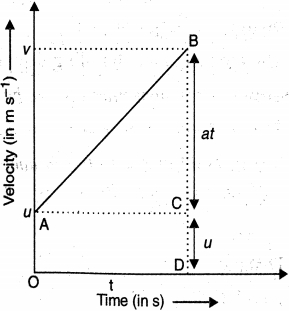
(N/A) Consider the velocity-time graph shown in the figure.
The distance $S$ covered by an object moving with uniform acceleration $a$ is equal to the area under the velocity-time graph,which is the area of the trapezium $OABD$.
Area of trapezium $OABD = \frac{(OA + BD) \times OD}{2}$
From the graph,we have:
$OA = u$ (initial velocity)
$BD = v$ (final velocity)
$OD = t$ (time taken)
Substituting these values,we get:
$S = \frac{(u + v) t}{2}$ --- (Equation $1$)
We know that for uniform acceleration,$v = u + at$,which can be rearranged to find time $t$:
$at = v - u$
$t = \frac{v - u}{a}$ --- (Equation $2$)
Substituting the value of $t$ from Equation $2$ into Equation $1$:
$S = \frac{(u + v)(v - u)}{2a}$
Using the algebraic identity $(a+b)(a-b) = a^2 - b^2$,we get:
$S = \frac{v^2 - u^2}{2a}$
Rearranging the terms,we get the final equation:
$v^2 - u^2 = 2aS$
0 likes
View Solution19
Difficult
Draw a velocity-time graph for a body which starts to move with initial velocity $u$ under a constant acceleration $a$ for time $t$. Using this graph,derive an expression for the distance covered $S$ in time $t$.
Solution
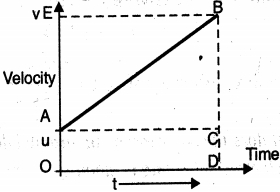
(N/A) The velocity-time graph for a body moving with constant acceleration $a$ and initial velocity $u$ is shown in the figure.
The distance covered $S$ by the object in time $t$ is equal to the area under the velocity-time graph.
The area under the graph is the sum of the area of the rectangle $OACD$ and the area of the triangle $ABC$ on top of it.
The area of the rectangle $OACD$ is given by: $\text{Area} = \text{length} \times \text{breadth} = t \times u = ut$.
The area of the triangle $ABC$ is given by: $\text{Area} = \frac{1}{2} \times \text{base} \times \text{height} = \frac{1}{2} \times t \times (v - u)$.
Since the total distance $S$ is the sum of these areas,we have:
$S = ut + \frac{1}{2} \times t \times (v - u)$ $....(1)$
From the first equation of motion,we know that $v = u + at$,which implies $v - u = at$.
Substituting $(v - u) = at$ into equation $(1)$,we get:
$S = ut + \frac{1}{2} \times t \times (at)$
$S = ut + \frac{1}{2}at^{2}$
0 likes
View Solution20
Difficult
Derive the following equations for a uniformly accelerated motion:
$(i)$ $v = u + at$
$(ii)$ $S = ut + \frac{1}{2}at^2$
$(iii)$ $v^2 - u^2 = 2aS$, where the symbols have their usual meanings.
$(i)$ $v = u + at$
$(ii)$ $S = ut + \frac{1}{2}at^2$
$(iii)$ $v^2 - u^2 = 2aS$, where the symbols have their usual meanings.
Solution
(N/A) Suppose the initial velocity of a body is $u$ and it is moving with uniform acceleration $a$ for time $t$. Let the final velocity be $v$ and the distance covered be $S$.
$(i)$ Acceleration is defined as the rate of change of velocity:
$a = \frac{v - u}{t}$
$at = v - u$
$v = u + at$
$(ii)$ The average velocity for uniform acceleration is given by:
$\bar{v} = \frac{u + v}{2} \quad \dots(1)$
Also, average velocity is total displacement divided by time:
$\bar{v} = \frac{S}{t} \quad \dots(2)$
Equating $(1)$ and $(2)$:
$\frac{u + v}{2} = \frac{S}{t} \implies S = \left( \frac{u + v}{2} \right) t \quad \dots(3)$
Substituting $v = u + at$ into equation $(3)$:
$S = \left( \frac{u + (u + at)}{2} \right) t$
$S = \left( \frac{2u + at}{2} \right) t$
$S = ut + \frac{1}{2}at^2$
$(iii)$ From equation $(3)$, $S = \left( \frac{u + v}{2} \right) t$. From $v = u + at$, we get $t = \frac{v - u}{a}$.
Substituting $t$ in equation $(3)$:
$S = \left( \frac{u + v}{2} \right) \left( \frac{v - u}{a} \right)$
$S = \frac{v^2 - u^2}{2a}$
$v^2 - u^2 = 2aS$
0 likes
View Solution21
Difficult
$(a)$ Derive the second equation of motion $S = ut + \frac{1}{2}at^2$ graphically,where the symbols have their usual meanings.
$(b)$ $A$ car accelerates uniformly from $18 \text{ km h}^{-1}$ to $36 \text{ km h}^{-1}$ in $5 \text{ s}$. Calculate the acceleration and the distance covered by the car in that time.
$(b)$ $A$ car accelerates uniformly from $18 \text{ km h}^{-1}$ to $36 \text{ km h}^{-1}$ in $5 \text{ s}$. Calculate the acceleration and the distance covered by the car in that time.
Solution
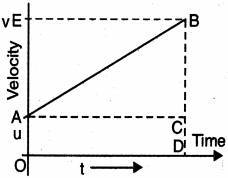
(A) The area under the velocity-time graph represents the distance travelled by the object. As shown in the figure,the area is the sum of the area of the rectangle $OACD$ and the area of the triangle $ABC$.
The area of the rectangle $OACD = \text{length} \times \text{breadth} = OC \times OA = t \times u = ut$.
The area of the triangle $ABC = \frac{1}{2} \times \text{base} \times \text{height} = \frac{1}{2} \times AC \times BC = \frac{1}{2} \times t \times (v - u)$.
Since $v = u + at$,we have $(v - u) = at$. Substituting this into the area of the triangle,we get:
Area of triangle $ABC = \frac{1}{2} \times t \times (at) = \frac{1}{2}at^2$.
Therefore,the total distance $S = \text{Area of rectangle } OACD + \text{Area of triangle } ABC = ut + \frac{1}{2}at^2$.
$(b)$ Given:
Initial velocity $u = 18 \text{ km h}^{-1} = 18 \times \frac{5}{18} \text{ m s}^{-1} = 5 \text{ m s}^{-1}$.
Final velocity $v = 36 \text{ km h}^{-1} = 36 \times \frac{5}{18} \text{ m s}^{-1} = 10 \text{ m s}^{-1}$.
Time $t = 5 \text{ s}$.
Acceleration $a = \frac{v - u}{t} = \frac{10 - 5}{5} = \frac{5}{5} = 1 \text{ m s}^{-2}$.
Distance $S = ut + \frac{1}{2}at^2 = (5 \times 5) + \frac{1}{2} \times 1 \times (5)^2 = 25 + 12.5 = 37.5 \text{ m}$.
0 likes
View Solution22
EasyMCQ
$A$ racing car has an acceleration of $4\, m s^{-2}$. What distance will it cover in $20\, s$ after the start (in $, m$)?
A
$400$
B
$800$
C
$1600$
D
$200$
Solution
(B) Given: Initial velocity $u = 0\, m s^{-1}$,acceleration $a = 4\, m s^{-2}$,and time $t = 20\, s$.
To find the distance $S$ covered,we use the second equation of motion:
$S = ut + \frac{1}{2}at^2$
Substituting the given values:
$S = (0 \times 20) + \frac{1}{2} \times 4 \times (20)^2$
$S = 0 + 2 \times 400$
$S = 800\, m$
Therefore,the car will cover a distance of $800\, m$ in $20\, s$.
To find the distance $S$ covered,we use the second equation of motion:
$S = ut + \frac{1}{2}at^2$
Substituting the given values:
$S = (0 \times 20) + \frac{1}{2} \times 4 \times (20)^2$
$S = 0 + 2 \times 400$
$S = 800\, m$
Therefore,the car will cover a distance of $800\, m$ in $20\, s$.
0 likes
View Solution23
DifficultMCQ
$A$ train is travelling at a speed of $90\, km\, h^{-1}$. Brakes are applied so as to produce a uniform acceleration of $-0.5\, m\, s^{-2}$. Find how far the train will go before it is brought to rest. (in $, m$)
A
$625$
B
$500$
C
$750$
D
$1000$
Solution
(A) Given:
Initial velocity $u = 90\, km\, h^{-1} = 90 \times \frac{5}{18} = 25\, m\, s^{-1}$.
Final velocity $v = 0\, m\, s^{-1}$ (since the train comes to rest).
Acceleration $a = -0.5\, m\, s^{-2}$ (negative sign indicates retardation).
We need to find the distance $S$.
Using the third equation of motion: $v^{2} - u^{2} = 2aS$.
Substituting the values: $0^{2} - (25)^{2} = 2 \times (-0.5) \times S$.
$-625 = -1 \times S$.
$S = 625\, m$.
Therefore,the train will travel $625\, m$ before coming to rest.
0 likes
View Solution24
EasyMCQ
$A$ driver of a train travelling at $40 \, m s^{-1}$ applies the brakes as the train enters a station. The train slows down at a rate of $2 \, m s^{-2}$. The platform is $400 \, m$ long. Will the train stop in time?
A
Yes,it stops exactly at the end of the platform.
B
No,it overshoots the platform.
C
Yes,it stops well before the platform ends.
D
The train does not stop.
Solution
(A) Given: Initial velocity $u = 40 \, m s^{-1}$,Final velocity $v = 0 \, m s^{-1}$,Acceleration $a = -2 \, m s^{-2}$.
Using the third equation of motion: $v^{2} = u^{2} + 2aS$.
Substituting the values: $0^{2} = (40)^{2} + 2(-2)S$.
$0 = 1600 - 4S$.
$4S = 1600$.
$S = 400 \, m$.
Since the calculated stopping distance is $400 \, m$ and the platform length is $400 \, m$,the train will stop exactly at the end of the platform.
0 likes
View Solution25
EasyMCQ
$A$ girl running a race accelerates at $2.5 \, m s^{-2}$ for the first $4 \, s$ of the race. How far does she travel in this time (in $, m$)?
A
$10$
B
$20$
C
$40$
D
$50$
Solution
(B) Given: Initial velocity $u = 0 \, m/s$,acceleration $a = 2.5 \, m s^{-2}$,and time $t = 4 \, s$.
To find the distance traveled $(S)$,we use the second equation of motion:
$S = ut + \frac{1}{2}at^2$
Substituting the given values into the equation:
$S = (0 \times 4) + \frac{1}{2} \times 2.5 \times (4)^2$
$S = 0 + 0.5 \times 2.5 \times 16$
$S = 1.25 \times 16 = 20 \, m$
Therefore,the girl travels $20 \, m$ in this time.
0 likes
View Solution26
Medium
$A$ cyclist driving at $5\, m s^{-1}$ picks up a velocity of $10\, m s^{-1}$ over a distance of $50\, m$. Calculate $(i)$ acceleration $(ii)$ time in which the cyclist picks up the above velocity.
Solution
(N/A) Given: Initial velocity $u = 5\, m s^{-1}$,Final velocity $v = 10\, m s^{-1}$,Distance $S = 50\, m$.
$(i)$ To calculate acceleration $(a)$,we use the third equation of motion: $v^{2} - u^{2} = 2aS$.
Substituting the values: $(10)^{2} - (5)^{2} = 2 \times a \times 50$.
$100 - 25 = 100a$.
$75 = 100a$.
$a = \frac{75}{100} = 0.75\, m s^{-2}$.
$(ii)$ To calculate time $(t)$,we use the first equation of motion: $v = u + at$.
Substituting the values: $10 = 5 + 0.75 \times t$.
$10 - 5 = 0.75t$.
$5 = 0.75t$.
$t = \frac{5}{0.75} = 6.67\, s$.
0 likes
View Solution27
MediumMCQ
$A$ truck running at $90 \text{ km h}^{-1}$ is brought to rest over a distance of $25 \text{ m}$. Calculate the retardation and time for which brakes are applied.
A
Retardation = $12.5 \text{ m s}^{-2}$,Time = $2 \text{ s}$
B
Retardation = $10 \text{ m s}^{-2}$,Time = $2.5 \text{ s}$
C
Retardation = $12.5 \text{ m s}^{-2}$,Time = $4 \text{ s}$
D
Retardation = $25 \text{ m s}^{-2}$,Time = $1 \text{ s}$
Solution
(A) Given: Initial velocity $u = 90 \text{ km h}^{-1} = 90 \times \frac{5}{18} \text{ m s}^{-1} = 25 \text{ m s}^{-1}$.
Final velocity $v = 0 \text{ m s}^{-1}$ (as the truck comes to rest).
Distance $S = 25 \text{ m}$.
$(i)$ To find retardation $(a)$: Using the third equation of motion,$v^{2} - u^{2} = 2aS$.
$(0)^{2} - (25)^{2} = 2 \times a \times 25$.
$-625 = 50a$.
$a = -\frac{625}{50} = -12.5 \text{ m s}^{-2}$.
Retardation is the magnitude of negative acceleration,so retardation = $12.5 \text{ m s}^{-2}$.
(ii) To find time $(t)$: Using the first equation of motion,$v = u + at$.
$0 = 25 + (-12.5) \times t$.
$12.5t = 25$.
$t = \frac{25}{12.5} = 2 \text{ s}$.
0 likes
View Solution28
MediumMCQ
The brakes applied to a car produce an acceleration of $6 \, m s^{-2}$ in the opposite direction of motion. If the car takes $2 \, s$ to stop after the application of the brakes,calculate the distance it travels during this time. (in $, m$)
A
$12$
B
$24$
C
$6$
D
$36$
Solution
(A) Given: Acceleration $a = -6 \, m s^{-2}$ (negative because it is in the opposite direction of motion),time $t = 2 \, s$,and final velocity $v = 0 \, m s^{-1}$ (since the car stops).
$(i)$ First,find the initial velocity $u$ using the first equation of motion: $v = u + at$.
$0 = u + (-6) \times 2$
$u = 12 \, m s^{-1}$.
$(ii)$ Now,calculate the distance $S$ using the second equation of motion: $S = ut + \frac{1}{2}at^2$.
$S = (12 \times 2) + \frac{1}{2} \times (-6) \times (2)^2$
$S = 24 - 12 = 12 \, m$.
Therefore,the car travels $12 \, m$ before stopping.
0 likes
View Solution29
MediumMCQ
$A$ cyclist driving at $36 \, km \, h^{-1}$ stops his cycle in $2 \, s$ by the application of brakes. Calculate $(i)$ retardation $(ii)$ distance covered during the application of brakes.
A
$5 \, m \, s^{-2}, 10 \, m$
B
$10 \, m \, s^{-2}, 5 \, m$
C
$5 \, m \, s^{-2}, 20 \, m$
D
$2 \, m \, s^{-2}, 10 \, m$
Solution
(A) Given: Initial velocity $u = 36 \, km \, h^{-1} = 36 \times \frac{5}{18} = 10 \, m \, s^{-1}$.
Final velocity $v = 0 \, m \, s^{-1}$ (since the cycle stops).
Time $t = 2 \, s$.
$(i)$ To calculate retardation:
Using the first equation of motion,$v = u + at$:
$0 = 10 + a \times 2$
$2a = -10$
$a = -5 \, m \, s^{-2}$.
Retardation is the negative of acceleration,so retardation $= -(-5 \, m \, s^{-2}) = 5 \, m \, s^{-2}$.
$(ii)$ To calculate distance covered $(S)$:
Using the third equation of motion,$v^2 - u^2 = 2aS$:
$0^2 - (10)^2 = 2 \times (-5) \times S$
$-100 = -10 \times S$
$S = \frac{-100}{-10} = 10 \, m$.
0 likes
View Solution30
Medium
$A$ scooter starts from rest and moves in a straight line with a constant acceleration,covering a distance of $64 \, m$ in $4 \, s$.
$(i)$ Calculate its acceleration and its final velocity.
$(ii)$ At what time had the scooter covered half the total distance?
$(i)$ Calculate its acceleration and its final velocity.
$(ii)$ At what time had the scooter covered half the total distance?
Solution
(N/A) $(i)$ Given: Initial velocity $u = 0 \, m/s$,Distance $S = 64 \, m$,Time $t = 4 \, s$.
Using the equation of motion $S = ut + \frac{1}{2}at^2$:
$64 = 0(4) + \frac{1}{2} \times a \times (4)^2$
$64 = 8a$
$a = 8 \, m/s^2$.
Using the equation $v = u + at$:
$v = 0 + 8 \times 4 = 32 \, m/s$.
$(ii)$ Half the total distance is $S' = \frac{64}{2} = 32 \, m$.
Using $S' = ut + \frac{1}{2}at^2$:
$32 = 0(t) + \frac{1}{2} \times 8 \times t^2$
$32 = 4t^2$
$t^2 = 8$
$t = \sqrt{8} \approx 2.83 \, s$.
0 likes
View Solution31
DifficultMCQ
Starting from rest at the top of an inclined plane, a body reaches the bottom of the inclined plane in $4$ seconds. In what time does the body cover one-fourth of the distance starting from rest at the top?
A
$1$ second
B
$3$ seconds
C
$2$ seconds
D
$4$ seconds
Solution
(C) For a body starting from rest $(u = 0)$ and moving with constant acceleration $(a)$ along an inclined plane, the distance $(s)$ covered in time $(t)$ is given by the equation of motion: $s = ut + \frac{1}{2}at^2$.
Since $u = 0$, the equation simplifies to $s = \frac{1}{2}at^2$, which implies $s \propto t^2$.
Let the total distance be $S$ and the total time taken be $T = 4$ seconds.
We are asked to find the time $(t')$ taken to cover one-fourth of the distance, i.e., $s' = \frac{S}{4}$.
Using the proportionality $s \propto t^2$, we have the ratio: $\frac{s'}{S} = \frac{(t')^2}{T^2}$.
Substituting the values: $\frac{S/4}{S} = \frac{(t')^2}{4^2}$.
$\frac{1}{4} = \frac{(t')^2}{16}$.
$(t')^2 = \frac{16}{4} = 4$.
$t' = \sqrt{4} = 2$ seconds.
Therefore, the body covers one-fourth of the distance in $2$ seconds.
0 likes
View Solution32
DifficultMCQ
$A$ body moving with uniform acceleration has velocities $20 \, m/s$ and $30 \, m/s$ when passing two points $A$ and $B$. Then the velocity midway between $A$ and $B$ is:
A
$25.5 \, m/s$
B
$25 \, m/s$
C
$24 \, m/s$
D
$10 \sqrt{6} \, m/s$
Solution
(A) Let the velocity at point $A$ be $v_A = 20 \, m/s$ and at point $B$ be $v_B = 30 \, m/s$.
Let the distance between $A$ and $B$ be $s$. The velocity $v$ at the midpoint $M$ can be found using the third equation of motion: $v^2 = u^2 + 2as$.
For the segment $AM$,$v_M^2 = v_A^2 + 2a(s/2) = v_A^2 + as$.
For the segment $MB$,$v_B^2 = v_M^2 + 2a(s/2) = v_M^2 + as$.
From the first equation,$as = v_M^2 - v_A^2$. Substituting this into the second equation:
$v_B^2 = v_M^2 + (v_M^2 - v_A^2) = 2v_M^2 - v_A^2$.
Rearranging for $v_M$:
$2v_M^2 = v_A^2 + v_B^2 \implies v_M = \sqrt{\frac{v_A^2 + v_B^2}{2}}$.
Substituting the values: $v_M = \sqrt{\frac{20^2 + 30^2}{2}} = \sqrt{\frac{400 + 900}{2}} = \sqrt{\frac{1300}{2}} = \sqrt{650} = \sqrt{25 \times 26} = 5 \sqrt{26} \approx 25.49 \, m/s$.
Wait,calculating $\sqrt{650} \approx 25.495$. Let's re-check the options. $10\sqrt{6} = \sqrt{600} \approx 24.49$. Actually,the formula for velocity at the midpoint is $v_M = \sqrt{\frac{v_A^2 + v_B^2}{2}}$. Calculation: $\sqrt{650} \approx 25.5 \, m/s$.
0 likes
View Solution33
Medium
Prove that if a body is thrown vertically upwards,then the time of ascent is equal to the time of descent.
Solution
(N/A) For a body thrown vertically upwards with initial velocity $u$,the final velocity at the maximum height is $v = 0$.
Let $t_{1}$ be the time of ascent. Using the first equation of motion $v = u + at$,where $a = -g$:
$0 = u - gt_{1}$
$\Rightarrow t_{1} = \frac{u}{g} ......(1)$
For the return journey (descent),the body starts from rest at the maximum height,so initial velocity $u' = 0$. The final velocity when it reaches the ground is $v' = u$. Let $t_{2}$ be the time of descent. Using $v' = u' + gt_{2}$:
$u = 0 + gt_{2}$
$\Rightarrow t_{2} = \frac{u}{g} ......(2)$
Comparing equation $(1)$ and $(2)$,we get $t_{1} = t_{2}$.
Thus,the time of ascent is equal to the time of descent.
0 likes
View Solution34
Medium
$A$ ball is dropped from a height of $20\, m$. $A$ second ball is thrown downwards from the same height after one second with initial velocity $u$. If both the balls reach the ground at the same time, calculate the initial velocity of the second ball. (Take $g = 10\, m s^{-2}$).
Solution
$(15 M S^{-1})$ For the first ball:
$u = 0, h = 20\, m, g = 10\, m s^{-2}, t = ?$
Using the equation of motion $S = ut + \frac{1}{2}at^2$, we have:
$20 = 0 + \frac{1}{2} \times 10 \times t^2$
$20 = 5t^2$
$t^2 = 4$
$t = 2\, s$
For the second ball:
Since the second ball is thrown $1\, s$ later and reaches the ground at the same time, its time of travel is $t' = 2 - 1 = 1\, s$.
$u = ?, h = 20\, m, g = 10\, m s^{-2}, t' = 1\, s$
Using $S = ut' + \frac{1}{2}at'^2$, we have:
$20 = u(1) + \frac{1}{2} \times 10 \times (1)^2$
$20 = u + 5$
$u = 20 - 5 = 15\, m s^{-1}$
0 likes
View Solution35
MediumMCQ
$A$ stone is dropped from the top of a tower. Its speed after it has fallen $20 \, m$ is (Take $g = 10 \, m s^{-2}$): (in $, m s^{-1}$)
A
$20$
B
$10$
C
$-20$
D
$-10$
Solution
(A) Given:
Initial velocity $(u)$ = $0 \, m s^{-1}$ (as the stone is dropped).
Distance fallen $(s)$ = $20 \, m$.
Acceleration due to gravity $(g)$ = $10 \, m s^{-2}$.
Using the third equation of motion: $v^2 - u^2 = 2as$.
Substituting the values: $v^2 - 0^2 = 2 \times 10 \times 20$.
$v^2 = 400$.
$v = \sqrt{400} = 20 \, m s^{-1}$.
Thus,the speed of the stone after falling $20 \, m$ is $20 \, m s^{-1}$.
0 likes
View Solution36
MediumMCQ
$A$ ball is thrown up and attains a maximum height of $100 \, m$. It is thrown upwards with a speed of: (in $, m/s$)
A
$9.8$
B
$44.2$
C
$19.69$
D
$98$
Solution
(B) To find the initial velocity $(u)$ of the ball,we use the third equation of motion: $v^2 = u^2 + 2as$.
At maximum height,the final velocity $(v)$ is $0 \, m/s$.
The acceleration due to gravity $(a)$ is $-g = -9.8 \, m/s^2$.
The displacement $(s)$ is $100 \, m$.
Substituting these values into the equation: $0^2 = u^2 + 2(-9.8)(100)$.
$0 = u^2 - 1960$.
$u^2 = 1960$.
$u = \sqrt{1960} \approx 44.27 \, m/s$.
Rounding to the nearest option,the speed is $44.2 \, m/s$.
0 likes
View SolutionMOTION — Equations of Motion · Frequently Asked Questions
1Are these MOTION questions useful for JEE and NEET?
Yes. All questions in this section are mapped to JEE Main and NEET exam patterns. Previous year questions from JEE Main, NEET, GUJCET and state-level exams are included with full solutions.
2Can I switch to Hindi or Gujarati for these questions?
Yes. Use the language tabs in the hero section or the sidebar to view the same questions and solutions in English, Hindi or Gujarati.
3How do I generate a question paper from this subtopic?
Use the Vedclass Exam Paper Generator — select the chapter and subtopic, set difficulty, and generate Sets A, B, C, D automatically. First 3 chapters of every subject are free.
Vedclass Products
For Students
Vedclass Test Series
Mock tests in real JEE/NEET style with performance analysis. 5-day free trial.
Start Free TrialFor Teachers
Exam Paper Generator
Generate Set A/B/C/D papers from this chapter in 2 minutes. 3 chapters free.
Try FreeFor Institutes
Online Exam Module
Live online exams with unlimited students, 360° analytics & white-label branding.
See DemoFor Teachers & Institutes
Generate a MOTION Exam Paper in 2 Minutes
Select subtopic & difficulty — Sets A, B, C, D auto-generated with No Repeat logic.
First 3 chapters of every subject are free — no payment required.