
A English
Uniform Circular Motion Questions in English
Class 9 Science · MOTION · Uniform Circular Motion
31+
Questions
English
Language
100%
With Solutions
Showing 31 of 31 questions in English
1
DifficultMCQ
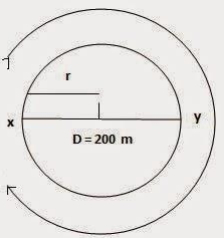
An athlete completes one round of a circular track of diameter $200\, m$ in $40\, s$. What will be the distance covered and the displacement at the end of $2\, min$ $20\, s$?
A
$Distance\, covered=2200\,m;\, Displacement=200\,m$
B
$Distance\, covered=\frac{4400}{7}\,m;\, Displacement=200\,m$
C
$Distance\, covered=\frac{4400}{7}\,m;\, Displacement=100\,m$
D
$Distance\, covered=2200\,m;\, Displacement=100\,m$
Solution
(A) Diameter of circular track $(D) = 200\, m$.
Radius of circular track $(r) = D / 2 = 100\, m$.
Time taken for one round $(t) = 40\, s$.
Total time given $= 2\, min\, 20\, s = 140\, s$.
Number of rounds $= 140 / 40 = 3.5\, rounds$.
Distance covered $= 3.5 \times (2 \pi r) = 3.5 \times 2 \times (22/7) \times 100 = 7 \times (22/7) \times 100 = 2200\, m$.
After $3.5\, rounds$, the athlete will be at the diametrically opposite point of the starting position.
Displacement $= \text{Diameter of the circular track} = 200\, m$.
0 likes
View Solution2
MediumMCQ
An artificial satellite is moving in a circular orbit of radius $42250 \, km$. Calculate its speed (in $m s^{-1}$) if it takes $24 \, h$ to revolve around the Earth.
A
$1026$
B
$3074$
C
$2096$
D
$4064$
Solution
(B) The radius of the circular orbit is $r = 42250 \, km = 42250000 \, m$.
The time taken to complete one revolution is $t = 24 \, h = 24 \times 60 \times 60 \, s = 86400 \, s$.
The speed $v$ of an object moving in a circular path is given by the formula $v = \frac{2 \pi r}{t}$.
Substituting the values: $v = \frac{2 \times (22/7) \times 42250000}{86400}$.
$v = \frac{2 \times 22 \times 42250000}{7 \times 86400} \approx 3073.74 \, m s^{-1}$.
Rounding to the nearest whole number,the speed is approximately $3074 \, m s^{-1}$.
0 likes
View Solution3
EasyMCQ
$A$ particle is moving in a circular path of radius $r$. The displacement after half a circle would be:
A
$2r$
B
$\pi r$
C
Zero
D
$2\pi r$
Solution
(A) Displacement is defined as the shortest distance between the initial and final positions of an object.
In a circular path of radius $r$,after completing half a circle,the particle moves from one end of the diameter to the other end.
The initial position and final position are diametrically opposite.
The shortest distance between these two points is the diameter of the circle.
Therefore,displacement = $2r$.
0 likes
View Solution4
EasyMCQ
Suppose a boy is enjoying a ride on a merry-go-round which is moving with a constant speed of $10 \, ms^{-1}$. It implies that the boy is
A
at rest
B
in accelerated motion
C
moving with no acceleration
D
moving with uniform velocity
Solution
(B) boy on a merry-go-round is performing circular motion.
In circular motion,even if the speed remains constant,the direction of motion changes at every point.
Since velocity is a vector quantity (having both magnitude and direction),a change in direction results in a change in velocity.
Therefore,the boy is in accelerated motion.
In circular motion,even if the speed remains constant,the direction of motion changes at every point.
Since velocity is a vector quantity (having both magnitude and direction),a change in direction results in a change in velocity.
Therefore,the boy is in accelerated motion.
0 likes
View Solution5
MediumMCQ
$A$ body is moving along a circular path of radius $R$. Find the displacement of the body when it completes half a revolution.
A
$R$
B
$2\,R$
C
$\pi\,R$
D
$0$
Solution
(B) Displacement is defined as the shortest distance between the initial and final positions of an object.
When a body completes half a revolution on a circular path of radius $R$,it moves from one end of the diameter to the other end.
The initial position is at one end of the diameter,and the final position is at the diametrically opposite end.
The shortest distance between these two points is the diameter of the circle.
Therefore,the displacement is equal to the diameter,which is $2 \times R = 2\,R$.
0 likes
View Solution6
EasyMCQ
Give an expression for the speed of an athlete if he takes time $t$ to complete one round of a circular track of radius $r$.
A
v = $2$πr / t
B
v = πr / t
C
v = $2$π / rt
D
v = r / $2$πt
Solution
(A) The speed of an object moving in a circular path is defined as the distance traveled per unit time.
For one complete round of a circular track with radius $r$,the distance traveled is equal to the circumference of the circle,which is $2 \pi r$.
Given that the time taken to complete this round is $t$,the speed $v$ is calculated as:
$v = \frac{\text{Distance}}{\text{Time}} = \frac{2 \pi r}{t}$.
For one complete round of a circular track with radius $r$,the distance traveled is equal to the circumference of the circle,which is $2 \pi r$.
Given that the time taken to complete this round is $t$,the speed $v$ is calculated as:
$v = \frac{\text{Distance}}{\text{Time}} = \frac{2 \pi r}{t}$.
0 likes
View Solution7
EasyMCQ
Can a body have constant speed and still be accelerating?
A
Yes
B
No
C
Only at rest
D
Only in linear motion
Solution
(A) Yes. When a body moves along a circular path with a constant speed,its direction of motion changes at every point. Since velocity is a vector quantity (having both magnitude and direction),a change in direction results in a change in velocity. This change in velocity constitutes acceleration,known as centripetal acceleration.
0 likes
View Solution8
Easy
Give an example of a force that merely changes the direction of motion of a body.
Solution
(N/A) force acting towards the centre of a circular path,known as centripetal force,in which a body moves with constant speed,merely changes the direction of motion of the body without changing its speed.
0 likes
View Solution9
EasyMCQ
$A$ boy is whirling a stone tied with a string in a horizontal circular path. If the string breaks,the stone
A
will continue to move in the circular path
B
will move along a straight line towards the centre of the circular path
C
will move along a straight line perpendicular to the circular path away from the boy
D
will move along a straight line tangential to the circular path
Solution
(D) When an object is in circular motion,it experiences a centripetal force directed towards the center,which keeps it on the circular path.
At any given instant,the velocity of the object is directed along the tangent to the circular path.
When the string breaks,the centripetal force is no longer acting on the stone.
According to Newton's first law of motion,the object will continue to move in the direction of its velocity at that instant.
Therefore,the stone will move along a straight line tangential to the circular path at the point where the string broke.
0 likes
View Solution10
MediumMCQ
Is it possible that an object is in a state of accelerated motion due to an external force acting on it,but no work is being done by the force? Explain with an example.
A
Yes,it is possible.
B
No,it is not possible.
C
Only if the force is zero.
D
Only if the velocity is constant.
Solution
(A) Yes,it is possible for an object to be in a state of accelerated motion while the work done by the force is zero.
Work done $(W)$ is defined as $W = F \cdot s \cdot \cos(\theta)$,where $F$ is the force,$s$ is the displacement,and $\theta$ is the angle between the force and the displacement.
In uniform circular motion,a centripetal force acts on the object directed towards the center of the circle,which causes centripetal acceleration.
Since the displacement of the object at any instant is along the tangent to the circular path and the centripetal force is directed towards the center,the angle $\theta$ between the force and the displacement is $90^{\circ}$.
Since $\cos(90^{\circ}) = 0$,the work done $W = F \cdot s \cdot 0 = 0$. Thus,despite the presence of an external force causing acceleration,the work done is zero.
0 likes
View Solution11
EasyMCQ
If the acceleration of a particle is constant in magnitude but not in direction,what type of path is followed by the particle?
A
Straight line
B
Circular path
C
Parabolic path
D
Elliptical path
Solution
(B) When the magnitude of acceleration is constant but its direction is always perpendicular to the velocity of the particle,the particle undergoes uniform circular motion.
In this case,the acceleration acts as a centripetal acceleration,which changes the direction of the velocity vector continuously while keeping its magnitude constant.
Therefore,the path followed by the particle is a circular path.
In this case,the acceleration acts as a centripetal acceleration,which changes the direction of the velocity vector continuously while keeping its magnitude constant.
Therefore,the path followed by the particle is a circular path.
0 likes
View Solution12
Easy
Give an example of an accelerated body,moving with a uniform speed.
Solution
(N/A) An object moving in a circular path with a constant speed is an example of an accelerated body. This is because the direction of motion changes at every point along the circular path,which results in a change in velocity. Since acceleration is defined as the rate of change of velocity,the body is considered to be accelerated. $A$ common example is a dust particle on the circumference of a revolving bicycle wheel moving at a constant speed.
0 likes
View Solution13
EasyMCQ
Why is the motion of an athlete moving along a circular path considered an accelerated motion?
A
Because the speed of the athlete changes.
B
Because the direction of motion changes continuously.
C
Because the athlete is running on a track.
D
Because the athlete is moving at a constant speed.
Solution
(B) An athlete moving along a circular path is considered to be in accelerated motion because the direction of the athlete's velocity changes at every point along the path.
Even if the speed (magnitude of velocity) remains constant,the change in direction implies a change in velocity.
Since acceleration is defined as the rate of change of velocity,a continuous change in the direction of motion results in continuous acceleration.
Even if the speed (magnitude of velocity) remains constant,the change in direction implies a change in velocity.
Since acceleration is defined as the rate of change of velocity,a continuous change in the direction of motion results in continuous acceleration.
0 likes
View Solution14
EasyMCQ
If the acceleration of the particle is constant in magnitude but not in direction,what type of path does the particle follow?
A
Straight line path
B
Circular path
C
Parabolic path
D
Elliptical path
Solution
(B) When the acceleration of a particle is constant in magnitude but its direction is always perpendicular to the velocity of the particle,the particle follows a circular path. This is the characteristic condition for uniform circular motion,where the centripetal acceleration changes the direction of velocity continuously while keeping the speed constant.
0 likes
View Solution15
Easy
State the meaning of uniform circular motion.
Solution
(N/A) Uniform circular motion is defined as the motion of an object traveling along a circular path at a constant speed. In this type of motion,although the speed remains constant,the direction of velocity changes continuously at every point along the path,which means the object is constantly accelerating.
0 likes
View Solution16
Medium
$A$ person is running along a circular path in a park.
$(a)$ At what point does he change his direction while running?
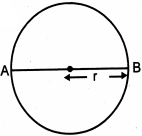
$(b)$ If he covers half of the circular path,what will be his displacement? Draw a diagram showing it.
$(a)$ At what point does he change his direction while running?
$(b)$ If he covers half of the circular path,what will be his displacement? Draw a diagram showing it.
Solution
(N/A) In circular motion,the direction of motion changes at each and every point along the path because the velocity vector is always tangent to the circle at any given point.
$(b)$ Displacement is the shortest distance between the initial and final positions. If a person starts at point $A$ and covers half of the circular path to reach point $B$,the displacement is the straight-line distance between $A$ and $B$,which is equal to the diameter of the circle $(2r)$.
Diagram: The image shows a circle with points $A$ and $B$ at opposite ends of a diameter,with the radius $r$ indicated from the center to point $B$. The displacement is the straight line $AB = 2r$.
0 likes
View Solution17
Medium
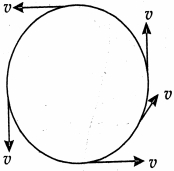
Draw a diagram to show the motion of a body whose speed remains constant but velocity continuously changes.
Solution
(N/A) Uniform circular motion is an example of motion where the speed of the body remains constant,but its velocity changes continuously due to the change in the direction of motion at every point along the circular path.
The diagram below illustrates this motion,where $v$ represents the velocity vector at different points on the circular path. Since the direction of the tangent changes at every point,the velocity vector also changes,even though the magnitude of velocity (speed) remains constant.
The diagram below illustrates this motion,where $v$ represents the velocity vector at different points on the circular path. Since the direction of the tangent changes at every point,the velocity vector also changes,even though the magnitude of velocity (speed) remains constant.
0 likes
View Solution18
Easy
$(a)$ Define acceleration.
$(b)$ $A$ stone describes a circular path with a constant speed. State the type of motion of the stone.
$(b)$ $A$ stone describes a circular path with a constant speed. State the type of motion of the stone.
Solution
(N/A) Acceleration is defined as the rate of change of velocity of an object with respect to time. Mathematically, it is the ratio of the change in velocity to the time taken for that change: $a = \frac{v - u}{t}$.
$(b)$ When a stone moves in a circular path with a constant speed, its direction of motion changes at every point. Since velocity is a vector quantity (speed with direction), the change in direction implies a change in velocity. This type of motion is known as $\text{Uniform circular motion}$.
$(b)$ When a stone moves in a circular path with a constant speed, its direction of motion changes at every point. Since velocity is a vector quantity (speed with direction), the change in direction implies a change in velocity. This type of motion is known as $\text{Uniform circular motion}$.
0 likes
View Solution19
Medium
$(a)$ Name the force that keeps the object moving in a circular path with constant acceleration.
$(b)$ What would happen if this force is absent?
$(b)$ What would happen if this force is absent?
Solution
(N/A) The force that keeps an object moving in a circular path with constant acceleration is known as the centripetal force.
$(b)$ If this force is absent,the object will no longer move in a circular path. Instead,it will move in a straight line along the direction of the tangent to the circular path at the point where the force ceased to act,in accordance with Newton's first law of motion.
$(b)$ If this force is absent,the object will no longer move in a circular path. Instead,it will move in a straight line along the direction of the tangent to the circular path at the point where the force ceased to act,in accordance with Newton's first law of motion.
0 likes
View Solution20
MediumMCQ
What is the amount of work done by a force when a body moves in a circular path?
A
Positive
B
Negative
C
Zero
D
Maximum
Solution
(C) Work done is defined by the formula $W = F S \cos \theta$,where $F$ is the force,$S$ is the displacement,and $\theta$ is the angle between the force and displacement vectors.
When a body completes one full revolution in a circular path,the final position coincides with the initial position,making the net displacement $S = 0$.
Since the centripetal force acts perpendicular to the direction of motion (tangential velocity) at every point,the work done by the centripetal force is zero.
Therefore,the total work done by the force when a body moves in a circular path is $W = F \times 0 = 0$.
0 likes
View Solution21
Medium
$(a)$ Define uniform circular motion.
$(b)$ Is the uniform circular motion an accelerated motion? Give reasons for your answer.
$(b)$ Is the uniform circular motion an accelerated motion? Give reasons for your answer.
Solution
(N/A) Uniform circular motion is defined as the motion of an object traveling along a circular path at a constant speed.
$(b)$ Yes,uniform circular motion is an accelerated motion. Even though the speed of the object remains constant,the direction of its velocity changes continuously at every point along the circular path. Since acceleration is defined as the rate of change of velocity,and velocity is a vector quantity (having both magnitude and direction),the continuous change in direction results in a continuous change in velocity,thereby causing acceleration.
$(b)$ Yes,uniform circular motion is an accelerated motion. Even though the speed of the object remains constant,the direction of its velocity changes continuously at every point along the circular path. Since acceleration is defined as the rate of change of velocity,and velocity is a vector quantity (having both magnitude and direction),the continuous change in direction results in a continuous change in velocity,thereby causing acceleration.
0 likes
View Solution22
EasyMCQ
An object is moving with uniform speed in a circle of radius $7 \, m$. Calculate the distance and displacement when it completes half the circle. What type of motion does the object possess?
A
Distance = $22 \, m$, Displacement = $14 \, m$
B
Distance = $44 \, m$, Displacement = $7 \, m$
C
Distance = $11 \, m$, Displacement = $14 \, m$
D
Distance = $22 \, m$, Displacement = $7 \, m$
Solution
(A) When an object completes half of a circular path, the distance covered is equal to half of the circumference of the circle.
Distance $= \pi R = \frac{22}{7} \times 7 = 22 \, m$.
The displacement is the shortest distance between the initial and final positions, which is the diameter of the circle.
Displacement $= 2R = 2 \times 7 = 14 \, m$.
The object possesses uniform circular motion because it moves with a constant speed along a circular path.
0 likes
View Solution23
Medium
Define distance and displacement. $A$ body covers one complete revolution around a circular park of circumference $176 \, m$ in $4$ minutes. Find the displacement of the body after $6$ minutes.
Solution
(N/A) Distance: It is defined as the total path length covered by a body.
Displacement: It is defined as the shortest distance between the initial and final positions of a body.
Given that the circumference of the circular park is $176 \, m$. The body completes one revolution in $4$ minutes.
After $6$ minutes,the number of revolutions completed $= \frac{6}{4} = 1.5$ revolutions.
Since $1$ revolution brings the body back to the starting point,after $1.5$ revolutions,the body will be at a position diametrically opposite to the starting point.
Given $2 \pi r = 176 \, m$,where $r$ is the radius.
$r = \frac{176}{2 \pi} = \frac{176 \times 7}{2 \times 22} = 28 \, m$.
The displacement after $1.5$ revolutions is the diameter of the circular path.
Displacement $= 2r = 2 \times 28 = 56 \, m$.
0 likes
View Solution24
Medium
$(a)$ Define circular motion.
$(b)$ "Uniform circular motion is an accelerated motion". Justify this statement with reason.
$(c)$ An artificial satellite is moving in a circular orbit of radius $42250 \, km$. Calculate its speed if it takes $24 \, h$ to revolve once around the Earth.
$(b)$ "Uniform circular motion is an accelerated motion". Justify this statement with reason.
$(c)$ An artificial satellite is moving in a circular orbit of radius $42250 \, km$. Calculate its speed if it takes $24 \, h$ to revolve once around the Earth.
Solution
$(a)$ When a body moves along a circular path, it is said to be in circular motion.
$(b)$ Uniform circular motion is considered an accelerated motion because the direction of the velocity vector changes at every point along the path, even though the magnitude (speed) remains constant. Since acceleration is defined as the rate of change of velocity, a change in direction constitutes acceleration.
$(c)$ The distance covered in one revolution is the circumference of the circular orbit, given by $2 \pi r$.
Distance $= 2 \times 3.14 \times 42250 \, km = 265330 \, km$.
Time taken $(t) = 24 \, h$.
Speed $= \frac{\text{Distance}}{\text{Time}} = \frac{265330 \, km}{24 \, h} \approx 11055.42 \, km/h$.
0 likes
View Solution25
Medium
$(a)$ Differentiate between uniform linear motion and uniform circular motion.
$(b)$ Write any four examples of uniform circular motion.
$(c)$ Is uniform circular motion an accelerated motion?
$(b)$ Write any four examples of uniform circular motion.
$(c)$ Is uniform circular motion an accelerated motion?
Solution
(N/A) In uniform linear motion,a body moves along a straight line with constant speed. In uniform circular motion,a body moves along a circular path with constant speed.
$(b)$ $(i)$ Motion of a point on the rim of a rotating wheel.
$(ii)$ Motion of a satellite around a planet.
$(iii)$ Motion of the Moon around the Earth.
$(iv)$ Motion of the tip of the second hand of a clock.
$(c)$ Yes,uniform circular motion is an accelerated motion. Although the speed remains constant,the direction of motion changes continuously at every point along the circular path. Since velocity is a vector quantity (speed with direction),a change in direction implies a change in velocity,which constitutes acceleration.
0 likes
View Solution26
MediumMCQ
$A$ cyclist goes once around a circular track of diameter $105 \, m$ in $5 \, minutes$. Calculate his speed. (in $m/s$)
A
$1.1$
B
$2.2$
C
$0.55$
D
$3.3$
Solution
(A) The diameter of the circular track is $D = 105 \, m$. Therefore, the radius $R = \frac{105}{2} = 52.5 \, m$.
The time taken to complete one round is $t = 5 \, minutes = 5 \times 60 \, s = 300 \, s$.
The distance covered in one round is equal to the circumference of the circle, which is $2 \pi R$.
Distance $= 2 \times 3.14 \times 52.5 = 329.7 \, m$.
Speed $= \frac{\text{Distance}}{\text{Time}} = \frac{329.7}{300} = 1.099 \, m/s \approx 1.1 \, m/s$.
0 likes
View Solution27
EasyMCQ
$A$ satellite while revolving around the earth completes one revolution in $1$ hour and $30$ minutes. What is the angular speed of the satellite?
A
$1.16 \times 10^{-3} \text{ rad/s}$
B
$2.16 \times 10^{-3} \text{ rad/s}$
C
$3.16 \times 10^{-3} \text{ rad/s}$
D
$4.16 \times 10^{-3} \text{ rad/s}$
Solution
(A) The time taken for one revolution is $t = 1 \text{ hour } 30 \text{ minutes} = 90 \text{ minutes}$.
Converting this into seconds: $t = 90 \times 60 = 5400 \text{ s}$.
The angle covered in one complete revolution is $\theta = 2\pi \text{ radians}$.
The formula for angular speed is $\omega = \frac{\theta}{t}$.
Substituting the values: $\omega = \frac{2\pi}{5400} = \frac{\pi}{2700} \text{ rad/s}$.
Calculating the numerical value: $\omega \approx \frac{3.14159}{2700} \approx 1.1635 \times 10^{-3} \text{ rad/s}$.
Thus,the angular speed is approximately $1.16 \times 10^{-3} \text{ rad/s}$.
0 likes
View Solution28
MediumMCQ
An artificial satellite is moving in a circular orbit of radius nearly $42,250 \, km$. Calculate its linear velocity, if it takes $24 \, \text{hours}$ to revolve around the Earth. (in $ km/s$)
A
$3.07$
B
$3.17$
C
$2.97$
D
$3.27$
Solution
(A) Given:
Radius $r = 42,250 \, km = 42,250,000 \, m$
Time period $T = 24 \, \text{hours} = 24 \times 60 \times 60 \, s = 86,400 \, s$
The linear velocity $v$ of an object moving in a circular path is given by the formula:
$v = \frac{2 \pi r}{T}$
Substituting the values:
$v = \frac{2 \times 3.14159 \times 42,250 \, km}{86,400 \, s}$
$v \approx \frac{265,464}{86,400} \, km/s$
$v \approx 3.07 \, km/s$
Thus, the linear velocity of the satellite is approximately $3.07 \, km/s$.
0 likes
View Solution29
Medium
An athlete completes one round of a circular track of diameter $49 \,m$ in $20 \,s$. Calculate the distance covered and displacement at the end of $30 \,s$.
Solution
(DISTANCE = 231 M, DISPLACEMENT = 49 M) Given: Diameter $d = 49 \,m$,Time for one round $T = 20 \,s$,Total time $t = 30 \,s$.
First,calculate the number of rounds completed in $30 \,s$:
$n = \frac{t}{T} = \frac{30}{20} = 1.5 \, \text{rounds}$.
Distance covered is the total path length:
$S = n \times (2 \pi r) = n \times (\pi d) = 1.5 \times \frac{22}{7} \times 49 = 1.5 \times 22 \times 7 = 231 \,m$.
Displacement is the shortest distance between the initial and final positions:
After $1.5$ rounds,the athlete is at the point diametrically opposite to the starting point.
Therefore,the displacement is equal to the diameter of the circular track,which is $49 \,m$.
0 likes
View Solution30
MediumMCQ
The direction of acceleration of an object moving in a circular path is
A
directed away from the centre of the circle
B
directed upward in the plane of the circle
C
none of these
D
directed towards the centre of the circle
Solution
(D) When an object moves in a circular path at a constant speed,its velocity changes continuously due to the change in direction at every point.
This change in velocity gives rise to an acceleration known as centripetal acceleration.
By definition,centripetal acceleration is always directed towards the centre of the circular path.
Therefore,the correct option is $D$.
This change in velocity gives rise to an acceleration known as centripetal acceleration.
By definition,centripetal acceleration is always directed towards the centre of the circular path.
Therefore,the correct option is $D$.
0 likes
View Solution31
EasyMCQ
State whether the following statement is true or false:
Work done by centripetal force is zero.
Work done by centripetal force is zero.
A
True
B
False
Solution
(A) The statement is $True$.
Work done $(W)$ is defined by the formula $W = F \cdot s \cdot \cos(\theta)$,where $F$ is the force,$s$ is the displacement,and $\theta$ is the angle between the force and the displacement.
In circular motion,the centripetal force acts towards the center of the circle,while the displacement (tangential velocity) is always perpendicular to the radius.
Since the angle $\theta$ between the centripetal force and the displacement is $90^{\circ}$,the work done is $W = F \cdot s \cdot \cos(90^{\circ})$.
Because $\cos(90^{\circ}) = 0$,the work done by the centripetal force is $0$.
0 likes
View SolutionMOTION — Uniform Circular Motion · Frequently Asked Questions
1Are these MOTION questions useful for JEE and NEET?
Yes. All questions in this section are mapped to JEE Main and NEET exam patterns. Previous year questions from JEE Main, NEET, GUJCET and state-level exams are included with full solutions.
2Can I switch to Hindi or Gujarati for these questions?
Yes. Use the language tabs in the hero section or the sidebar to view the same questions and solutions in English, Hindi or Gujarati.
3How do I generate a question paper from this subtopic?
Use the Vedclass Exam Paper Generator — select the chapter and subtopic, set difficulty, and generate Sets A, B, C, D automatically. First 3 chapters of every subject are free.
Vedclass Products
For Students
Vedclass Test Series
Mock tests in real JEE/NEET style with performance analysis. 5-day free trial.
Start Free TrialFor Teachers
Exam Paper Generator
Generate Set A/B/C/D papers from this chapter in 2 minutes. 3 chapters free.
Try FreeFor Institutes
Online Exam Module
Live online exams with unlimited students, 360° analytics & white-label branding.
See DemoFor Teachers & Institutes
Generate a MOTION Exam Paper in 2 Minutes
Select subtopic & difficulty — Sets A, B, C, D auto-generated with No Repeat logic.
First 3 chapters of every subject are free — no payment required.