
A English
Arithmetic Progressions Questions in English
Class 10 Mathematics · Arithmetic Progressions · Arithmetic Progressions
98+
Questions
English
Language
100%
With Solutions
Showing 50 of 98 questions in English
1
Easy
For the $AP: \frac{3}{2}, \frac{1}{2}, -\frac{1}{2}, -\frac{3}{2}, \ldots,$ write the first term $a$ and the common difference $d$.
Solution
(N/A) The given arithmetic progression $(AP)$ is $\frac{3}{2}, \frac{1}{2}, -\frac{1}{2}, -\frac{3}{2}, \ldots$
The first term $a$ is the first number in the sequence,so $a = \frac{3}{2}$.
The common difference $d$ is calculated by subtracting any term from the term that follows it,i.e.,$d = a_2 - a_1$.
Substituting the values,$d = \frac{1}{2} - \frac{3}{2} = \frac{1 - 3}{2} = \frac{-2}{2} = -1$.
Thus,the first term $a = \frac{3}{2}$ and the common difference $d = -1$.
0 likes
View Solution2
Easy
Do $4, 10, 16, 22, \ldots$ form an $AP$? If they form an $AP,$ write the next two terms.
Solution
(A) We have $a_{2}-a_{1} = 10-4 = 6$.
$a_{3}-a_{2} = 16-10 = 6$.
$a_{4}-a_{3} = 22-16 = 6$.
Since the difference $a_{k+1}-a_{k}$ is constant for all $k$,the given list of numbers forms an $AP$ with the common difference $d = 6$.
The next two terms are:
$22 + 6 = 28$
$28 + 6 = 34$.
$a_{3}-a_{2} = 16-10 = 6$.
$a_{4}-a_{3} = 22-16 = 6$.
Since the difference $a_{k+1}-a_{k}$ is constant for all $k$,the given list of numbers forms an $AP$ with the common difference $d = 6$.
The next two terms are:
$22 + 6 = 28$
$28 + 6 = 34$.
0 likes
View Solution3
Medium
Do $1, -1, -3, -5, \ldots$ form an $AP$? If they form an $AP$,write the next two terms.
Solution
(A) To check if the sequence forms an $AP$,we calculate the common difference $d = a_{k+1} - a_k$ for consecutive terms:
$a_2 - a_1 = -1 - 1 = -2$
$a_3 - a_2 = -3 - (-1) = -3 + 1 = -2$
$a_4 - a_3 = -5 - (-3) = -5 + 3 = -2$
Since the difference $d = -2$ is constant,the given sequence forms an $AP$.
The next two terms are calculated by adding the common difference $d = -2$ to the last term:
Next term $1 = -5 + (-2) = -7$
Next term $2 = -7 + (-2) = -9$
Thus,the next two terms are $-7$ and $-9$.
0 likes
View Solution4
Easy
Does the sequence $-2, 2, -2, 2, -2, \ldots$ form an $AP$? If it forms an $AP$,write the next two terms.
Solution
(N/A) To check if the sequence forms an $AP$,we calculate the common difference $d$ between consecutive terms.
First,calculate the difference between the second and first term:
$a_{2} - a_{1} = 2 - (-2) = 2 + 2 = 4$
Next,calculate the difference between the third and second term:
$a_{3} - a_{2} = -2 - 2 = -4$
Since $a_{2} - a_{1} \neq a_{3} - a_{2}$ (i.e.,$4 \neq -4$),the common difference is not constant.
Therefore,the given list of numbers does not form an $AP$.
0 likes
View Solution5
Easy
Do $1, 1, 1, 2, 2, 2, 3, 3, 3, \ldots$ form an $AP$? If they form an $AP$,write the next two terms.
Solution
(NO) An arithmetic progression $(AP)$ is a sequence of numbers such that the difference between any two consecutive terms is constant.
Let the sequence be $a_1, a_2, a_3, a_4, \ldots = 1, 1, 1, 2, 2, 2, 3, 3, 3, \ldots$
Calculate the common difference $d$ between consecutive terms:
$d_1 = a_2 - a_1 = 1 - 1 = 0$
$d_2 = a_3 - a_2 = 1 - 1 = 0$
$d_3 = a_4 - a_3 = 2 - 1 = 1$
Since $d_1 = d_2 \neq d_3$,the difference between consecutive terms is not constant.
Therefore,the given sequence does not form an $AP$.
0 likes
View Solution6
MediumMCQ
The taxi fare after each $km$ when the fare is ₹ $15$ for the first $km$ and ₹ $8$ for each additional $km$. Does the list of numbers involved form an arithmetic progression,and why?
A
Yes,because the difference between consecutive terms is constant.
B
No,because the difference between consecutive terms is not constant.
C
Yes,because the taxi fare increases exponentially.
D
No,because the initial fare is too high.
Solution
(A) It can be observed that:
Taxi fare for $1^{\text{st}} \ km = 15$
Taxi fare for first $2 \ km = 15 + 8 = 23$
Taxi fare for first $3 \ km = 23 + 8 = 31$
Taxi fare for first $4 \ km = 31 + 8 = 39$
Clearly,the sequence $15, 23, 31, 39, \dots$ forms an $A.P.$ because the difference between any two consecutive terms is constant,i.e.,$d = 8$.
0 likes
View Solution7
DifficultMCQ
In which of the following situations,does the list of numbers involved make an arithmetic progression,and why? The amount of air present in a cylinder when a vacuum pump removes $\frac{1}{4}$ of the air remaining in the cylinder at a time.
A
Yes,it forms an arithmetic progression because the difference is constant.
B
No,it does not form an arithmetic progression because the difference between consecutive terms is not constant.
C
Yes,it forms an arithmetic progression because it is a geometric sequence.
D
No,it does not form an arithmetic progression because the amount of air becomes zero.
Solution
(B) Let the initial volume of air in a cylinder be $V$ liters.
In each stroke,the vacuum pump removes $\frac{1}{4}$ of the air remaining in the cylinder.
This means that after every stroke,the remaining air is $1 - \frac{1}{4} = \frac{3}{4}$ of the previous amount.
Therefore,the sequence of volumes after each stroke is $V, \frac{3}{4}V, \left(\frac{3}{4}\right)^2 V, \left(\frac{3}{4}\right)^3 V, \dots$.
To check if this is an arithmetic progression $(A.P.)$,we calculate the difference between consecutive terms:
$d_1 = \frac{3}{4}V - V = -\frac{1}{4}V$
$d_2 = \left(\frac{3}{4}\right)^2 V - \frac{3}{4}V = \frac{9}{16}V - \frac{12}{16}V = -\frac{3}{16}V$.
Since $d_1 \neq d_2$,the difference between consecutive terms is not constant.
Thus,this list of numbers does not form an $A.P.$
0 likes
View Solution8
Easy
The cost of digging a well after every metre of digging, when it costs ₹ $150$ for the first metre and rises by ₹ $50$ for each subsequent metre, does the list of numbers involved make an arithmetic progression, and why?
Solution
(A) Cost of digging for the first metre $= ₹ 150$.
Cost of digging for the first $2$ metres $= 150 + 50 = ₹ 200$.
Cost of digging for the first $3$ metres $= 200 + 50 = ₹ 250$.
Cost of digging for the first $4$ metres $= 250 + 50 = ₹ 300$.
Clearly, the sequence $150, 200, 250, 300, \dots$ forms an Arithmetic Progression $(A.P.)$ because the difference between any two consecutive terms is constant, i.e., $d = 50$.
0 likes
View Solution9
DifficultMCQ
In which of the following situations,does the list of numbers involved make an arithmetic progression,and why? The amount of money in the account every year,when ₹ $10000$ is deposited at compound interest at $8 \%$ per annum.
A
Yes,it forms an $A$.$P$. because the interest is constant.
B
No,it does not form an $A$.$P$. because the difference between consecutive terms is not constant.
C
Yes,it forms an $A$.$P$. because the amount increases every year.
D
No,it does not form an $A$.$P$. because the amount decreases every year.
Solution
(B) We know that if a principal amount $P$ is deposited at $r \%$ compound interest per annum for $n$ years,the amount after $n$ years is given by $A = P(1 + \frac{r}{100})^n$.
For the given problem,$P = 10000$ and $r = 8$.
The amount in the account after each year is:
Year $1$: $10000(1 + \frac{8}{100})^1 = 10800$
Year $2$: $10000(1 + \frac{8}{100})^2 = 11664$
Year $3$: $10000(1 + \frac{8}{100})^3 = 12597.12$
The sequence of amounts is $10800, 11664, 12597.12, \dots$
To check if this is an Arithmetic Progression $(A.P.)$,we calculate the common difference:
$d_1 = 11664 - 10800 = 864$
$d_2 = 12597.12 - 11664 = 933.12$
Since $d_1 \neq d_2$,the difference between consecutive terms is not constant. Therefore,this list of numbers does not form an $A.P.$
1 likes
View Solution10
Medium
Write the first four terms of the $AP,$ when the first term $a$ and the common difference $d$ are given as follows: $a = -2, d = 0.$
Solution
(A) Given: First term $a = -2$ and common difference $d = 0.$
The general form of an $AP$ is $a, a+d, a+2d, a+3d, \dots$
First term $a_1 = a = -2.$
Second term $a_2 = a + d = -2 + 0 = -2.$
Third term $a_3 = a + 2d = -2 + 2(0) = -2.$
Fourth term $a_4 = a + 3d = -2 + 3(0) = -2.$
Therefore,the first four terms of the $AP$ are $-2, -2, -2, -2.$
The general form of an $AP$ is $a, a+d, a+2d, a+3d, \dots$
First term $a_1 = a = -2.$
Second term $a_2 = a + d = -2 + 0 = -2.$
Third term $a_3 = a + 2d = -2 + 2(0) = -2.$
Fourth term $a_4 = a + 3d = -2 + 3(0) = -2.$
Therefore,the first four terms of the $AP$ are $-2, -2, -2, -2.$
0 likes
View Solution11
Medium
Write the first four terms of the $AP,$ when the first term $a$ and the common difference $d$ are given as follows: $a=4, d=-3.$
Solution
(A) Given: First term $a = 4$ and common difference $d = -3.$
The general form of an $AP$ is $a, a+d, a+2d, a+3d, \dots$
First term $a_1 = a = 4.$
Second term $a_2 = a + d = 4 + (-3) = 4 - 3 = 1.$
Third term $a_3 = a + 2d = 4 + 2(-3) = 4 - 6 = -2.$
Fourth term $a_4 = a + 3d = 4 + 3(-3) = 4 - 9 = -5.$
Therefore,the first four terms of the $AP$ are $4, 1, -2, -5.$
0 likes
View Solution12
DifficultMCQ
Write the first four terms of the $AP,$ when the first term $a$ and the common difference $d$ are given as follows: $a = -1, d = \frac{1}{2}$
A
-$1$,-$1$/$2$,$0$,$1$/$2$
B
-$1$,-$1$/$2$,$1$/$2$,$1$
C
-$1$,$0$,$1$/$2$,$1$
D
-$1$,-$1$/$2$,$0$,$1$
Solution
(A) Given: $a = -1$ and $d = \frac{1}{2}$.
The general form of an $AP$ is $a_1, a_2, a_3, a_4, \dots$ where $a_n = a + (n-1)d$.
$a_1 = a = -1$
$a_2 = a + d = -1 + \frac{1}{2} = -\frac{1}{2}$
$a_3 = a + 2d = -1 + 2(\frac{1}{2}) = -1 + 1 = 0$
$a_4 = a + 3d = -1 + 3(\frac{1}{2}) = -1 + \frac{3}{2} = \frac{1}{2}$
Thus,the first four terms of the $AP$ are $-1, -\frac{1}{2}, 0, \frac{1}{2}$.
0 likes
View Solution13
MediumMCQ
Write the first four terms of the $AP,$ when the first term $a$ and the common difference $d$ are given as follows: $a = -1.25, d = -0.25.$
A
$-1.25, -1.50, -1.75, -2.00$
B
$-1.25, -1.00, -0.75, -0.50$
C
$-1.25, -1.50, -2.00, -2.25$
D
$-1.25, -0.75, -0.25, 0.25$
Solution
(A) Given: First term $a = -1.25$ and common difference $d = -0.25.$
The terms of an $AP$ are given by $a_n = a + (n-1)d.$
First term: $a_1 = a = -1.25$
Second term: $a_2 = a + d = -1.25 + (-0.25) = -1.50$
Third term: $a_3 = a + 2d = -1.25 + 2(-0.25) = -1.25 - 0.50 = -1.75$
Fourth term: $a_4 = a + 3d = -1.25 + 3(-0.25) = -1.25 - 0.75 = -2.00$
Thus,the first four terms of the $AP$ are $-1.25, -1.50, -1.75,$ and $-2.00.$
0 likes
View Solution14
EasyMCQ
For the following $APs,$ $3, 1, -1, -3, \ldots$ write the first term and the common difference.
A
$a = 3, d = 0$
B
$a = 3, d = -1$
C
$a = 3, d = -2$
D
$a = 1, d = -2$
Solution
(C) The given arithmetic progression is $3, 1, -1, -3, \ldots$
The first term $(a)$ is the first number in the sequence,so $a = 3$.
The common difference $(d)$ is calculated by subtracting the first term from the second term:
$d = a_2 - a_1$
$d = 1 - 3$
$d = -2$
Thus,the first term is $3$ and the common difference is $-2$.
The first term $(a)$ is the first number in the sequence,so $a = 3$.
The common difference $(d)$ is calculated by subtracting the first term from the second term:
$d = a_2 - a_1$
$d = 1 - 3$
$d = -2$
Thus,the first term is $3$ and the common difference is $-2$.
0 likes
View Solution15
EasyMCQ
For the following $APs$,$-5, -1, 3, 7, \ldots$,write the first term and the common difference.
A
$a = -5, d = 4$
B
$a = -5, d = 2$
C
$a = 5, d = 4$
D
$a = -5, d = -4$
Solution
(A) The given arithmetic progression is $-5, -1, 3, 7, \ldots$.
The first term $(a)$ is the first number in the sequence,so $a = -5$.
The common difference $(d)$ is calculated by subtracting the first term from the second term:
$d = a_2 - a_1$
$d = (-1) - (-5)$
$d = -1 + 5$
$d = 4$.
Thus,the first term is $-5$ and the common difference is $4$.
The first term $(a)$ is the first number in the sequence,so $a = -5$.
The common difference $(d)$ is calculated by subtracting the first term from the second term:
$d = a_2 - a_1$
$d = (-1) - (-5)$
$d = -1 + 5$
$d = 4$.
Thus,the first term is $-5$ and the common difference is $4$.
0 likes
View Solution16
Medium
For the following $APs$,write the first term and the common difference: $\frac{1}{3}, \frac{5}{3}, \frac{9}{3}, \frac{13}{3}, \ldots$
Solution
(N/A) The given arithmetic progression is $\frac{1}{3}, \frac{5}{3}, \frac{9}{3}, \frac{13}{3}, \ldots$
The first term $(a)$ is the first number in the sequence,so $a = \frac{1}{3}$.
The common difference $(d)$ is calculated by subtracting the first term from the second term:
$d = \frac{5}{3} - \frac{1}{3} = \frac{4}{3}$.
Thus,the first term is $\frac{1}{3}$ and the common difference is $\frac{4}{3}$.
1 likes
View Solution17
MediumMCQ
For the following $APs,$ write the first term and the common difference: $0.6, 1.7, 2.8, 3.9, \ldots$
A
First term $a = 0.6$,Common difference $d = 1.1$
B
First term $a = 0.6$,Common difference $d = 1.2$
C
First term $a = 1.7$,Common difference $d = 1.1$
D
First term $a = 0.6$,Common difference $d = 0.1$
Solution
(A) The given arithmetic progression is $0.6, 1.7, 2.8, 3.9, \ldots$
The first term $(a)$ is the first number in the sequence,so $a = 0.6$.
The common difference $(d)$ is calculated by subtracting the first term from the second term:
$d = a_2 - a_1$
$d = 1.7 - 0.6$
$d = 1.1$
Thus,the first term is $0.6$ and the common difference is $1.1$.
The first term $(a)$ is the first number in the sequence,so $a = 0.6$.
The common difference $(d)$ is calculated by subtracting the first term from the second term:
$d = a_2 - a_1$
$d = 1.7 - 0.6$
$d = 1.1$
Thus,the first term is $0.6$ and the common difference is $1.1$.
0 likes
View Solution18
Difficult
Are $2, 4, 8, 16, \ldots$ in an $AP$? If they form an $AP$,find the common difference $d$ and write three more terms.
Solution
(N/A) Given sequence: $2, 4, 8, 16, \ldots$
To check if the sequence is an $AP$,we calculate the difference between consecutive terms:
$a_2 - a_1 = 4 - 2 = 2$
$a_3 - a_2 = 8 - 4 = 4$
$a_4 - a_3 = 16 - 8 = 8$
Since the difference between consecutive terms $(a_{k+1} - a_k)$ is not constant,the given sequence does not form an $AP$.
To check if the sequence is an $AP$,we calculate the difference between consecutive terms:
$a_2 - a_1 = 4 - 2 = 2$
$a_3 - a_2 = 8 - 4 = 4$
$a_4 - a_3 = 16 - 8 = 8$
Since the difference between consecutive terms $(a_{k+1} - a_k)$ is not constant,the given sequence does not form an $AP$.
0 likes
View Solution19
Difficult
$2, \frac{5}{2}, 3, \frac{7}{2}, \ldots$ are $APs$? If they form an $AP$,find the common difference $d$ and write three more terms.
Solution
(A) Given sequence: $2, \frac{5}{2}, 3, \frac{7}{2}, \ldots$
To check if it is an $AP$,we calculate the difference between consecutive terms:
$a_{2} - a_{1} = \frac{5}{2} - 2 = \frac{1}{2}$
$a_{3} - a_{2} = 3 - \frac{5}{2} = \frac{1}{2}$
$a_{4} - a_{3} = \frac{7}{2} - 3 = \frac{1}{2}$
Since the difference $a_{k+1} - a_{k}$ is constant,the sequence is an $AP$ with common difference $d = \frac{1}{2}$.
The next three terms are:
$a_{5} = \frac{7}{2} + \frac{1}{2} = 4$
$a_{6} = 4 + \frac{1}{2} = \frac{9}{2}$
$a_{7} = \frac{9}{2} + \frac{1}{2} = 5$
0 likes
View Solution20
Medium
$-10, -6, -2, 2, \ldots$ are $APs$? If they form an $AP$,find the common difference $d$ and write three more terms.
Solution
(D) Given sequence: $-10, -6, -2, 2, \ldots$
To check if it is an $AP$,we calculate the difference between consecutive terms:
$a_{2} - a_{1} = (-6) - (-10) = -6 + 10 = 4$
$a_{3} - a_{2} = (-2) - (-6) = -2 + 6 = 4$
$a_{4} - a_{3} = 2 - (-2) = 2 + 2 = 4$
Since the difference $a_{k+1} - a_{k}$ is constant $(d = 4)$,the sequence forms an $AP$.
The next three terms are:
$a_{5} = a_{4} + d = 2 + 4 = 6$
$a_{6} = a_{5} + d = 6 + 4 = 10$
$a_{7} = a_{6} + d = 10 + 4 = 14$
Thus,the common difference is $d = 4$ and the next three terms are $6, 10, 14$.
0 likes
View Solution21
Difficult
Are $3, 3+\sqrt{2}, 3+2\sqrt{2}, 3+3\sqrt{2}, \ldots$ in $AP$? If they form an $AP$,find the common difference $d$ and write the next three terms.
Solution
(A) The given sequence is $3, 3+\sqrt{2}, 3+2\sqrt{2}, 3+3\sqrt{2}, \ldots$
To check if the sequence is in $AP$,we calculate the difference between consecutive terms:
$a_2 - a_1 = (3 + \sqrt{2}) - 3 = \sqrt{2}$
$a_3 - a_2 = (3 + 2\sqrt{2}) - (3 + \sqrt{2}) = \sqrt{2}$
$a_4 - a_3 = (3 + 3\sqrt{2}) - (3 + 2\sqrt{2}) = \sqrt{2}$
Since the difference $a_{k+1} - a_k$ is constant,the sequence is an $AP$ with common difference $d = \sqrt{2}$.
The next three terms are:
$a_5 = a_4 + d = (3 + 3\sqrt{2}) + \sqrt{2} = 3 + 4\sqrt{2}$
$a_6 = a_5 + d = (3 + 4\sqrt{2}) + \sqrt{2} = 3 + 5\sqrt{2}$
$a_7 = a_6 + d = (3 + 5\sqrt{2}) + \sqrt{2} = 3 + 6\sqrt{2}$
0 likes
View Solution22
MediumMCQ
Are $0.2, 0.22, 0.222, 0.2222, \ldots$ in $AP$? If they form an $AP$,find the common difference $d$ and write three more terms.
A
Yes,$d = 0.02$,next terms are $0.22222, 0.222222, 0.2222222$
B
No,they do not form an $AP$.
C
Yes,$d = 0.2$,next terms are $0.4, 0.6, 0.8$
D
Yes,$d = 0.002$,next terms are $0.22222, 0.222222, 0.2222222$
Solution
(B) Given sequence: $0.2, 0.22, 0.222, 0.2222, \ldots$
To check if the sequence is an $AP$,we calculate the difference between consecutive terms:
$a_{2} - a_{1} = 0.22 - 0.2 = 0.02$
$a_{3} - a_{2} = 0.222 - 0.22 = 0.002$
$a_{4} - a_{3} = 0.2222 - 0.222 = 0.0002$
Since the difference $a_{k+1} - a_{k}$ is not constant,the given sequence does not form an $AP$.
0 likes
View Solution23
Medium
$0, -4, -8, -12, \ldots$ are $APs$? If they form an $AP$,find the common difference $d$ and write three more terms.
Solution
(A) Given sequence: $0, -4, -8, -12, \ldots$
To check if the sequence is an $AP$,we calculate the difference between consecutive terms:
$a_{2} - a_{1} = (-4) - 0 = -4$
$a_{3} - a_{2} = (-8) - (-4) = -4$
$a_{4} - a_{3} = (-12) - (-8) = -4$
Since the difference $a_{k+1} - a_{k}$ is constant,the sequence is an $AP$ with common difference $d = -4$.
The next three terms are:
$a_{5} = a_{4} + d = -12 + (-4) = -16$
$a_{6} = a_{5} + d = -16 + (-4) = -20$
$a_{7} = a_{6} + d = -20 + (-4) = -24$
Thus,the common difference is $-4$ and the next three terms are $-16, -20, -24$.
0 likes
View Solution24
DifficultMCQ
Are $-\frac{1}{2}, -\frac{1}{2}, -\frac{1}{2}, -\frac{1}{2}, \ldots$ in an $AP$? If they form an $AP$,find the common difference $d$ and write three more terms.
A
Yes,$d = 0$; next three terms are $-\frac{1}{2}, -\frac{1}{2}, -\frac{1}{2}$
B
Yes,$d = -\frac{1}{2}$; next three terms are $-1, -\frac{3}{2}, -2$
C
No,it is not an $AP$
D
Yes,$d = 1$; next three terms are $\frac{1}{2}, 1, \frac{3}{2}$
Solution
(A) Given sequence: $-\frac{1}{2}, -\frac{1}{2}, -\frac{1}{2}, -\frac{1}{2}, \ldots$
To check if it is an $AP$,we calculate the difference between consecutive terms:
$a_2 - a_1 = (-\frac{1}{2}) - (-\frac{1}{2}) = 0$
$a_3 - a_2 = (-\frac{1}{2}) - (-\frac{1}{2}) = 0$
$a_4 - a_3 = (-\frac{1}{2}) - (-\frac{1}{2}) = 0$
Since the difference $a_{k+1} - a_k$ is constant $(0)$ for all $k$,the sequence is an $AP$ with common difference $d = 0$.
The next three terms are:
$a_5 = a_4 + d = -\frac{1}{2} + 0 = -\frac{1}{2}$
$a_6 = a_5 + d = -\frac{1}{2} + 0 = -\frac{1}{2}$
$a_7 = a_6 + d = -\frac{1}{2} + 0 = -\frac{1}{2}$
0 likes
View Solution25
Easy
Are $1, 3, 9, 27, \ldots$ in $AP$? If they form an $AP$,find the common difference $d$ and write three more terms.
Solution
(NONE) Given sequence: $1, 3, 9, 27, \ldots$
To check if the sequence is an $AP$,we calculate the difference between consecutive terms:
$a_{2} - a_{1} = 3 - 1 = 2$
$a_{3} - a_{2} = 9 - 3 = 6$
$a_{4} - a_{3} = 27 - 9 = 18$
Since the common difference $(a_{k+1} - a_{k})$ is not constant (i.e.,$2 \neq 6 \neq 18$),the given sequence does not form an $AP$.
0 likes
View Solution26
Medium
$a, 2a, 3a, 4a, \dots$ are $APs$? If they form an $AP,$ find the common difference $d$ and write three more terms.
Solution
(A) The given sequence is $a, 2a, 3a, 4a, \dots$
To check if it is an $AP,$ we calculate the difference between consecutive terms:
$a_2 - a_1 = 2a - a = a$
$a_3 - a_2 = 3a - 2a = a$
$a_4 - a_3 = 4a - 3a = a$
Since the difference $a_{k+1} - a_k$ is constant $(d = a)$,the sequence forms an $AP.$
The next three terms are:
$a_5 = 4a + a = 5a$
$a_6 = 5a + a = 6a$
$a_7 = 6a + a = 7a$
0 likes
View Solution27
Medium
Are $a, a^{2}, a^{3}, a^{4}, \ldots$ in an $AP$? If they form an $AP$,find the common difference $d$ and write three more terms.
Solution
(NONE) The given sequence is $a, a^{2}, a^{3}, a^{4}, \ldots$
To check if the sequence is in an $AP$,we calculate the difference between consecutive terms:
$a_{2} - a_{1} = a^{2} - a = a(a - 1)$
$a_{3} - a_{2} = a^{3} - a^{2} = a^{2}(a - 1)$
$a_{4} - a_{3} = a^{4} - a^{3} = a^{3}(a - 1)$
Since the difference $a_{k+1} - a_{k}$ is not constant (i.e.,$a(a-1) \neq a^{2}(a-1)$ for $a \neq 0, 1$),the given sequence does not form an $AP$.
0 likes
View Solution28
Difficult
Are $\sqrt{2}, \sqrt{8}, \sqrt{18}, \sqrt{32}, \ldots$ in an $AP$? If they form an $AP$,find the common difference $d$ and write the next three terms.
Solution
(A) The given sequence is $\sqrt{2}, \sqrt{8}, \sqrt{18}, \sqrt{32}, \ldots$
We can simplify the terms as:
$a_1 = \sqrt{2} = 1\sqrt{2}$
$a_2 = \sqrt{8} = 2\sqrt{2}$
$a_3 = \sqrt{18} = 3\sqrt{2}$
$a_4 = \sqrt{32} = 4\sqrt{2}$
To check if it is an $AP$,we find the common difference $d = a_{k+1} - a_k$:
$a_2 - a_1 = 2\sqrt{2} - 1\sqrt{2} = \sqrt{2}$
$a_3 - a_2 = 3\sqrt{2} - 2\sqrt{2} = \sqrt{2}$
$a_4 - a_3 = 4\sqrt{2} - 3\sqrt{2} = \sqrt{2}$
Since the difference $d = \sqrt{2}$ is constant,the sequence is an $AP$.
The next three terms are:
$a_5 = a_4 + d = 4\sqrt{2} + \sqrt{2} = 5\sqrt{2} = \sqrt{50}$
$a_6 = a_5 + d = 5\sqrt{2} + \sqrt{2} = 6\sqrt{2} = \sqrt{72}$
$a_7 = a_6 + d = 6\sqrt{2} + \sqrt{2} = 7\sqrt{2} = \sqrt{98}$
0 likes
View Solution29
Medium
Are $\sqrt{3}, \sqrt{6}, \sqrt{9}, \sqrt{12}, \ldots$ in an $AP$? If they form an $AP$,find the common difference $d$ and write three more terms.
Solution
(N/A) The given sequence is $\sqrt{3}, \sqrt{6}, \sqrt{9}, \sqrt{12}, \ldots$
To check if the sequence is an $AP$,we calculate the difference between consecutive terms:
$a_{2} - a_{1} = \sqrt{6} - \sqrt{3} = \sqrt{3}(\sqrt{2} - 1)$
$a_{3} - a_{2} = \sqrt{9} - \sqrt{6} = 3 - \sqrt{6} = \sqrt{3}(\sqrt{3} - \sqrt{2})$
$a_{4} - a_{3} = \sqrt{12} - \sqrt{9} = 2\sqrt{3} - 3 = \sqrt{3}(2 - \sqrt{3})$
Since the difference $a_{k+1} - a_{k}$ is not constant for all $k$,the given sequence does not form an $AP$.
0 likes
View Solution30
Medium
$1^{2}, 3^{2}, 5^{2}, 7^{2}, \ldots$ are $APs$? If they form an $AP,$ find the common difference $d$ and write three more terms.
Solution
(N/A) The given sequence is $1^{2}, 3^{2}, 5^{2}, 7^{2}, \ldots$
This can be written as $1, 9, 25, 49, \ldots$
To check if the sequence forms an $AP$,we calculate the difference between consecutive terms:
$a_{2} - a_{1} = 9 - 1 = 8$
$a_{3} - a_{2} = 25 - 9 = 16$
$a_{4} - a_{3} = 49 - 25 = 24$
Since the difference $a_{k+1} - a_{k}$ is not constant (i.e.,$8 \neq 16 \neq 24$),the given sequence does not form an $AP$.
0 likes
View Solution31
Medium
$1^{2}, 5^{2}, 7^{2}, 73, \ldots$ are $APs$? If they form an $AP,$ find the common difference $d$ and write three more terms.
Solution
(A) The given sequence is $1^{2}, 5^{2}, 7^{2}, 73, \ldots$
Calculating the values,we get $1, 25, 49, 73, \ldots$
To check if it is an $AP$,we find the difference between consecutive terms:
$a_{2} - a_{1} = 25 - 1 = 24$
$a_{3} - a_{2} = 49 - 25 = 24$
$a_{4} - a_{3} = 73 - 49 = 24$
Since the difference $a_{k+1} - a_{k}$ is constant $(d = 24)$,the given sequence forms an $AP$.
The common difference is $d = 24$.
The next three terms are:
$a_{5} = 73 + 24 = 97$
$a_{6} = 97 + 24 = 121$
$a_{7} = 121 + 24 = 145$
0 likes
View Solution32
MediumMCQ
The list of numbers $-10, -6, -2, 2, \ldots$ is
A
an $AP$ with $d = 4$
B
an $AP$ with $d = -16$
C
an $AP$ with $d = -4$
D
not an $AP$
Solution
(A) The given sequence is $-10, -6, -2, 2, \ldots$
Here,the first term $a_1 = -10$,the second term $a_2 = -6$,the third term $a_3 = -2$,and the fourth term $a_4 = 2$.
To check if the sequence is an $AP$,we calculate the common difference $d$ between consecutive terms:
$d_1 = a_2 - a_1 = -6 - (-10) = -6 + 10 = 4$
$d_2 = a_3 - a_2 = -2 - (-6) = -2 + 6 = 4$
$d_3 = a_4 - a_3 = 2 - (-2) = 2 + 2 = 4$
Since the difference between consecutive terms is constant $(d = 4)$,the given list of numbers forms an $AP$ with a common difference $d = 4$.
0 likes
View Solution33
MediumMCQ
The first four terms of an $AP,$ whose first term is $-2$ and the common difference is $-2,$ are
A
$-2, 0, 2, 4$
B
$-2, 4, -8, 16$
C
$-2, -4, -6, -8$
D
$-2, -4, -8, -16$
Solution
(C) The general form of an $AP$ is given by $a, a + d, a + 2d, a + 3d, \dots$
Given that the first term $a = -2$ and the common difference $d = -2$.
Substituting these values into the general form:
First term: $a = -2$
Second term: $a + d = -2 + (-2) = -4$
Third term: $a + 2d = -2 + 2(-2) = -2 - 4 = -6$
Fourth term: $a + 3d = -2 + 3(-2) = -2 - 6 = -8$
Thus,the first four terms are $-2, -4, -6, -8$.
0 likes
View Solution34
Easy
In the $AP: 10, 5, 0, -5, \ldots$,the common difference $d$ is equal to $5$. Justify whether the above statement is true or false.
Solution
(B) The common difference $d$ of an $AP$ is calculated as $d = a_{n} - a_{n-1}$.
For the given $AP: 10, 5, 0, -5, \ldots$:
$a_{2} - a_{1} = 5 - 10 = -5$
$a_{3} - a_{2} = 0 - 5 = -5$
$a_{4} - a_{3} = -5 - 0 = -5$
Since the difference between consecutive terms is constant,the given list of numbers forms an $AP$ with a common difference $d = -5$.
Therefore,the statement that the common difference $d$ is equal to $5$ is false.
0 likes
View Solution35
MediumMCQ
Divya deposited $Rs. 1000$ at compound interest at the rate of $10\%$ per annum. The amounts at the end of the first year,second year,third year,$\ldots,$ form an $AP$. Justify your answer.
A
Yes,it forms an $AP$.
B
No,it does not form an $AP$.
C
It forms a $GP$.
D
None of these.
Solution
(B) The formula for the amount $A$ under compound interest is $A = P(1 + r/100)^n$,where $P = 1000$,$r = 10$,and $n$ is the number of years.
Amount at the end of the $1^{st}$ year: $A_1 = 1000(1 + 10/100)^1 = 1000(1.1) = 1100$.
Amount at the end of the $2^{nd}$ year: $A_2 = 1000(1 + 10/100)^2 = 1000(1.21) = 1210$.
Amount at the end of the $3^{rd}$ year: $A_3 = 1000(1 + 10/100)^3 = 1000(1.331) = 1331$.
The sequence of amounts is $1100, 1210, 1331, \ldots$.
To check if it is an $AP$,we calculate the common difference:
$A_2 - A_1 = 1210 - 1100 = 110$.
$A_3 - A_2 = 1331 - 1210 = 121$.
Since $A_2 - A_1 \neq A_3 - A_2$,the difference between consecutive terms is not constant.
Therefore,the sequence does not form an $AP$.
0 likes
View Solution36
Medium
Which of the following form an $AP$? Justify your answer.
$(i)$ $-1, -1, -1, -1, \ldots$
$(ii)$ $0, 2, 0, 2, \ldots$
$(iii)$ $1, 1, 2, 2, 3, 3, \ldots$
$(i)$ $-1, -1, -1, -1, \ldots$
$(ii)$ $0, 2, 0, 2, \ldots$
$(iii)$ $1, 1, 2, 2, 3, 3, \ldots$
Solution
(A) $(i)$ Here,$t_{1} = -1, t_{2} = -1, t_{3} = -1$ and $t_{4} = -1$.
$t_{2} - t_{1} = -1 - (-1) = 0$
$t_{3} - t_{2} = -1 - (-1) = 0$
$t_{4} - t_{3} = -1 - (-1) = 0$
Since the common difference $d = 0$ is constant,the given list of numbers forms an $AP$.
$(ii)$ Here,$t_{1} = 0, t_{2} = 2, t_{3} = 0$ and $t_{4} = 2$.
$t_{2} - t_{1} = 2 - 0 = 2$
$t_{3} - t_{2} = 0 - 2 = -2$
Since $t_{2} - t_{1} \neq t_{3} - t_{2}$,the given list of numbers does not form an $AP$.
$(iii)$ Here,$t_{1} = 1, t_{2} = 1, t_{3} = 2$ and $t_{4} = 2$.
$t_{2} - t_{1} = 1 - 1 = 0$
$t_{3} - t_{2} = 2 - 1 = 1$
Since $t_{2} - t_{1} \neq t_{3} - t_{2}$,the given list of numbers does not form an $AP$.
0 likes
View Solution37
Medium
Which of the following form an $AP$? Justify your answer.
$(i)$ $11, 22, 33, \ldots$
$(ii)$ $\frac{1}{2}, \frac{1}{3}, \frac{1}{4}, \ldots$
$(iii)$ $2, 2^2, 2^3, 2^4, \ldots$
$(iv)$ $\sqrt{3}, \sqrt{12}, \sqrt{27}, \sqrt{48}, \ldots$
$(i)$ $11, 22, 33, \ldots$
$(ii)$ $\frac{1}{2}, \frac{1}{3}, \frac{1}{4}, \ldots$
$(iii)$ $2, 2^2, 2^3, 2^4, \ldots$
$(iv)$ $\sqrt{3}, \sqrt{12}, \sqrt{27}, \sqrt{48}, \ldots$
Solution
(I, IV) $(i)$ Here,$t_1 = 11, t_2 = 22, t_3 = 33$.
$t_2 - t_1 = 22 - 11 = 11$.
$t_3 - t_2 = 33 - 22 = 11$.
Since the common difference $d = 11$ is constant,this forms an $AP$.
$(ii)$ Here,$t_1 = \frac{1}{2}, t_2 = \frac{1}{3}, t_3 = \frac{1}{4}$.
$t_2 - t_1 = \frac{1}{3} - \frac{1}{2} = -\frac{1}{6}$.
$t_3 - t_2 = \frac{1}{4} - \frac{1}{3} = -\frac{1}{12}$.
Since the differences are not equal,this does not form an $AP$.
$(iii)$ The sequence is $2, 4, 8, 16, \ldots$.
$t_2 - t_1 = 4 - 2 = 2$.
$t_3 - t_2 = 8 - 4 = 4$.
Since the differences are not equal,this does not form an $AP$.
$(iv)$ The sequence is $\sqrt{3}, 2\sqrt{3}, 3\sqrt{3}, 4\sqrt{3}, \ldots$.
$t_2 - t_1 = 2\sqrt{3} - \sqrt{3} = \sqrt{3}$.
$t_3 - t_2 = 3\sqrt{3} - 2\sqrt{3} = \sqrt{3}$.
$t_4 - t_3 = 4\sqrt{3} - 3\sqrt{3} = \sqrt{3}$.
Since the common difference $d = \sqrt{3}$ is constant,this forms an $AP$.
0 likes
View Solution38
MediumMCQ
Justify whether it is true to say that $-1, -\frac{3}{2}, -2, \frac{5}{2}, \ldots$ forms an $AP$ as $a_{2}-a_{1} = a_{3}-a_{2}$.
A
True
B
False
C
Cannot be determined
D
None of these
Solution
(B) False.
Here,$a_{1} = -1, a_{2} = -\frac{3}{2}, a_{3} = -2$ and $a_{4} = \frac{5}{2}$.
Calculate the common differences:
$a_{2} - a_{1} = -\frac{3}{2} - (-1) = -\frac{3}{2} + 1 = -\frac{1}{2}$.
$a_{3} - a_{2} = -2 - (-\frac{3}{2}) = -2 + \frac{3}{2} = -\frac{1}{2}$.
$a_{4} - a_{3} = \frac{5}{2} - (-2) = \frac{5}{2} + 2 = \frac{9}{2}$.
For a sequence to be an $AP$,the difference between any two consecutive terms must be constant.
Although $a_{2} - a_{1} = a_{3} - a_{2} = -\frac{1}{2}$,the difference $a_{4} - a_{3} = \frac{9}{2}$.
Since the common difference is not constant throughout the sequence,it does not form an $AP$.
0 likes
View Solution39
Difficult
Two APs have the same common difference. The first term of one $AP$ is $2$ and that of the other is $7$. The difference between their $10^{\text{th}}$ terms is the same as the difference between their $21^{\text{st}}$ terms,which is the same as the difference between any two corresponding terms. Why?
Solution
(N/A) Let the common difference of both $APs$ be $d$.
Given that the first term of the first $AP$ is $a_1 = 2$ and the first term of the second $AP$ is $b_1 = 7$.
The $n^{\text{th}}$ term of an $AP$ is given by $a_n = a + (n-1)d$.
For the first $AP$,the $n^{\text{th}}$ term is $a_n = 2 + (n-1)d$.
For the second $AP$,the $n^{\text{th}}$ term is $b_n = 7 + (n-1)d$.
The difference between the $n^{\text{th}}$ terms is $b_n - a_n = [7 + (n-1)d] - [2 + (n-1)d] = 7 - 2 = 5$.
Since the difference is independent of $n$,the difference between any two corresponding terms is always $5$.
Thus,the difference between the $10^{\text{th}}$ terms is $5$,and the difference between the $21^{\text{st}}$ terms is also $5$.
0 likes
View Solution40
Medium
The taxi fare after each $km$,when the fare is $Rs. 15$ for the first $km$ and $Rs. 8$ for each additional $km$,does not form an $AP$ as the total fare (in $Rs.$) after each $km$ is $15, 8, 8, 8, \ldots$. Is the statement true? Give reasons.
Solution
(B) No,the statement is false. The total fare (in $Rs.$) after each $km$ is calculated as follows:
For $1$ $km$: $15$
For $2$ $km$: $15 + 8 = 23$
For $3$ $km$: $15 + 2 \times 8 = 31$
For $4$ $km$: $15 + 3 \times 8 = 39$
Thus,the sequence of total fares is $15, 23, 31, 39, \ldots$.
Let $t_1 = 15, t_2 = 23, t_3 = 31, t_4 = 39$.
Now,calculating the common difference:
$t_2 - t_1 = 23 - 15 = 8$
$t_3 - t_2 = 31 - 23 = 8$
$t_4 - t_3 = 39 - 31 = 8$
Since the difference between consecutive terms is constant (common difference $d = 8$),the sequence forms an Arithmetic Progression $(AP)$.
0 likes
View Solution41
Difficult
In which of the following situations,do the lists of numbers involved form an $AP$? Give reasons for your answers.
$(i)$ The fee charged from a student every month by a school for the whole session,when the monthly fee is $Rs. 400$.
$(ii)$ The fee charged every month by a school from Classes $I$ to $XII$,when the monthly fee for Class $I$ is $Rs. 250$,and it increases by $Rs. 50$ for the next higher class.
$(iii)$ The amount of money in the account of Varun at the end of every year when $Rs. 1000$ is deposited at simple interest of $10\%$ per annum.
$(iv)$ The number of bacteria in a certain food item after each second,when they double in every second.
Solution
(A) $(i)$ The fee charged from a student every month is $400, 400, 400, 400, \ldots$. This forms an $AP$ because the common difference $(d) = 400 - 400 = 0$ is constant.
$(ii)$ The fee charged for Classes $I$ to $XII$ is $250, (250+50), (250+2 \times 50), (250+3 \times 50), \ldots$,i.e.,$250, 300, 350, 400, \ldots$. This forms an $AP$ because the common difference $(d) = 300 - 250 = 50$ is constant.
$(iii)$ Simple interest for one year is $\frac{1000 \times 10 \times 1}{100} = 100$. The amount at the end of every year is $1000, (1000+100), (1000+200), (1000+300), \ldots$,i.e.,$1000, 1100, 1200, 1300, \ldots$. This forms an $AP$ because the common difference $(d) = 1100 - 1000 = 100$ is constant.
$(iv)$ Let the initial number of bacteria be $x$. Since they double every second,the sequence is $x, 2x, 4x, 8x, \ldots$. Here,$t_2 - t_1 = x$ and $t_3 - t_2 = 2x$. Since the difference is not constant,it does not form an $AP$.
0 likes
View Solution42
Medium
Justify whether it is true to say that the following are the $n^{\text{th}}$ terms of an $AP.$
$(i)$ $2n-3$
$(ii)$ $3n^{2}+5$
$(iii)$ $1+n+n^{2}$
$(i)$ $2n-3$
$(ii)$ $3n^{2}+5$
$(iii)$ $1+n+n^{2}$
Solution
(N/A) $(i)$ Yes,here $a_{n}=2n-3$.
Put $n=1, a_{1}=2(1)-3=-1$.
Put $n=2, a_{2}=2(2)-3=1$.
Put $n=3, a_{3}=2(3)-3=3$.
Put $n=4, a_{4}=2(4)-3=5$.
The list of numbers is $-1, 1, 3, 5, \ldots$.
Here,$a_{2}-a_{1}=1-(-1)=2$,$a_{3}-a_{2}=3-1=2$,and $a_{4}-a_{3}=5-3=2$.
Since the common difference $d=2$ is constant,$2n-3$ is the $n^{\text{th}}$ term of an $AP$.
$(ii)$ No,here $a_{n}=3n^{2}+5$.
Put $n=1, a_{1}=3(1)^{2}+5=8$.
Put $n=2, a_{2}=3(2)^{2}+5=17$.
Put $n=3, a_{3}=3(3)^{2}+5=32$.
The list of numbers is $8, 17, 32, \ldots$.
Here,$a_{2}-a_{1}=17-8=9$ and $a_{3}-a_{2}=32-17=15$.
Since $a_{2}-a_{1} \neq a_{3}-a_{2}$,it does not form an $AP$.
$(iii)$ No,here $a_{n}=1+n+n^{2}$.
Put $n=1, a_{1}=1+1+(1)^{2}=3$.
Put $n=2, a_{2}=1+2+(2)^{2}=7$.
Put $n=3, a_{3}=1+3+(3)^{2}=13$.
The list of numbers is $3, 7, 13, \ldots$.
Here,$a_{2}-a_{1}=7-3=4$ and $a_{3}-a_{2}=13-7=6$.
Since $a_{2}-a_{1} \neq a_{3}-a_{2}$,it does not form an $AP$.
0 likes
View Solution43
MediumMCQ
If the numbers $n-2, 4n-1$ and $5n+2$ are in $AP$,find the value of $n$.
A
$-1$
B
$0$
C
$-2$
D
$1$
Solution
(D) If three terms $a, b, c$ are in $AP$,then $b - a = c - b$,which implies $2b = a + c$.
Given terms are $n-2, 4n-1, 5n+2$.
Applying the condition $2(4n-1) = (n-2) + (5n+2)$.
$8n - 2 = 6n$.
$8n - 6n = 2$.
$2n = 2$.
Therefore,$n = 1$.
Given terms are $n-2, 4n-1, 5n+2$.
Applying the condition $2(4n-1) = (n-2) + (5n+2)$.
$8n - 2 = 6n$.
$8n - 6n = 2$.
$2n = 2$.
Therefore,$n = 1$.
0 likes
View Solution44
Medium
Verify that each of the following is an $AP$,and then write its next three terms.
$0, \frac{1}{4}, \frac{1}{2}, \frac{3}{4}, \ldots$
$0, \frac{1}{4}, \frac{1}{2}, \frac{3}{4}, \ldots$
Solution
(N/A) Here,$a_{1}=0, a_{2}=\frac{1}{4}, a_{3}=\frac{1}{2}$ and $a_{4}=\frac{3}{4}$.
Calculate the common difference $d$:
$a_{2}-a_{1} = \frac{1}{4} - 0 = \frac{1}{4}$
$a_{3}-a_{2} = \frac{1}{2} - \frac{1}{4} = \frac{1}{4}$
$a_{4}-a_{3} = \frac{3}{4} - \frac{1}{2} = \frac{1}{4}$
Since the difference between consecutive terms is constant $(d = \frac{1}{4})$,the given sequence forms an $AP$.
The next three terms are:
$a_{5} = a_{4} + d = \frac{3}{4} + \frac{1}{4} = 1$
$a_{6} = a_{5} + d = 1 + \frac{1}{4} = \frac{5}{4}$
$a_{7} = a_{6} + d = \frac{5}{4} + \frac{1}{4} = \frac{6}{4} = \frac{3}{2}$
0 likes
View Solution45
Medium
Verify that each of the following is an $AP$,and then write its next three terms.
$5, \frac{14}{3}, \frac{13}{3}, 4, \ldots$
$5, \frac{14}{3}, \frac{13}{3}, 4, \ldots$
Solution
(A) Given sequence: $5, \frac{14}{3}, \frac{13}{3}, 4, \ldots$
Here,$a_{1}=5, a_{2}=\frac{14}{3}, a_{3}=\frac{13}{3}$ and $a_{4}=4$.
Calculate the common differences:
$a_{2}-a_{1} = \frac{14}{3} - 5 = \frac{14-15}{3} = -\frac{1}{3}$
$a_{3}-a_{2} = \frac{13}{3} - \frac{14}{3} = -\frac{1}{3}$
$a_{4}-a_{3} = 4 - \frac{13}{3} = \frac{12-13}{3} = -\frac{1}{3}$
Since the difference between consecutive terms is constant $(d = -\frac{1}{3})$,the given sequence is an $AP$.
The next three terms are:
$a_{5} = a_{4} + d = 4 + (-\frac{1}{3}) = \frac{12-1}{3} = \frac{11}{3}$
$a_{6} = a_{5} + d = \frac{11}{3} + (-\frac{1}{3}) = \frac{10}{3}$
$a_{7} = a_{6} + d = \frac{10}{3} + (-\frac{1}{3}) = \frac{9}{3} = 3$
Thus,the next three terms are $\frac{11}{3}, \frac{10}{3}, 3$.
0 likes
View Solution46
Medium
Verify that each of the following is an $AP$,and then write its next three terms.
$\sqrt{3}, 2 \sqrt{3}, 3 \sqrt{3}, \ldots$
$\sqrt{3}, 2 \sqrt{3}, 3 \sqrt{3}, \ldots$
Solution
(N/A) Here,$a_{1}=\sqrt{3}, a_{2}=2 \sqrt{3}$ and $a_{3}=3 \sqrt{3}$.
Calculate the common difference:
$a_{2}-a_{1}=2 \sqrt{3}-\sqrt{3}=\sqrt{3}$
$a_{3}-a_{2}=3 \sqrt{3}-2 \sqrt{3}=\sqrt{3}$
Since $a_{2}-a_{1}=a_{3}-a_{2}=\sqrt{3}$,which is the common difference $(d)$,the given sequence forms an $AP$.
The next three terms are:
$a_{4}=a_{3}+d=3 \sqrt{3}+\sqrt{3}=4 \sqrt{3}$
$a_{5}=a_{4}+d=4 \sqrt{3}+\sqrt{3}=5 \sqrt{3}$
$a_{6}=a_{5}+d=5 \sqrt{3}+\sqrt{3}=6 \sqrt{3}$
0 likes
View Solution47
Medium
Verify that each of the following is an $AP$,and then write its next three terms.
$a+b, (a+1)+b, (a+1)+(b+1), \ldots$
$a+b, (a+1)+b, (a+1)+(b+1), \ldots$
Solution
(N/A) Given sequence: $a_1 = a+b, a_2 = a+1+b, a_3 = a+1+b+1$.
Calculate the common difference $d$:
$d_1 = a_2 - a_1 = (a+1+b) - (a+b) = 1$.
$d_2 = a_3 - a_2 = (a+1+b+1) - (a+1+b) = 1$.
Since $d_1 = d_2 = 1$,the common difference is constant,so the sequence is an $AP$.
The next three terms are:
$a_4 = a_3 + d = (a+1+b+1) + 1 = a+b+3 = (a+2)+(b+1)$.
$a_5 = a_4 + d = (a+b+3) + 1 = a+b+4 = (a+2)+(b+2)$.
$a_6 = a_5 + d = (a+b+4) + 1 = a+b+5 = (a+3)+(b+2)$.
0 likes
View Solution48
Medium
Verify that each of the following is an $AP$,and then write its next three terms.
$a, 2a+1, 3a+2, 4a+3, \ldots$
$a, 2a+1, 3a+2, 4a+3, \ldots$
Solution
(A) Given sequence: $a_1 = a, a_2 = 2a+1, a_3 = 3a+2, a_4 = 4a+3$.
Calculate the common difference $d$:
$d_1 = a_2 - a_1 = (2a+1) - a = a+1$
$d_2 = a_3 - a_2 = (3a+2) - (2a+1) = a+1$
$d_3 = a_4 - a_3 = (4a+3) - (3a+2) = a+1$
Since $d_1 = d_2 = d_3 = a+1$,the common difference is constant. Therefore,the sequence is an $AP$.
The next three terms are:
$a_5 = a_4 + d = (4a+3) + (a+1) = 5a+4$
$a_6 = a_5 + d = (5a+4) + (a+1) = 6a+5$
$a_7 = a_6 + d = (6a+5) + (a+1) = 7a+6$
0 likes
View Solution49
DifficultMCQ
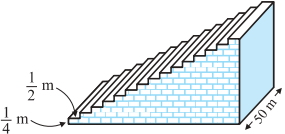
$A$ small terrace at a football ground comprises of $15$ steps each of which is $50 \, m$ long and built of solid concrete. Each step has a rise of $\frac{1}{4} \, m$ and a tread of $\frac{1}{2} \, m$. Calculate the total volume of concrete required to build the terrace (in $m^3$).
A
$700$
B
$750$
C
$725$
D
$744$
Solution
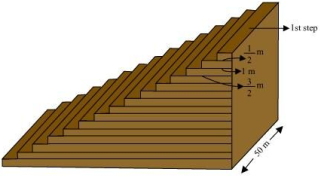
(B) From the figure,it can be observed that:
$1^{\text{st}}$ step is $\frac{1}{2} \, m$ wide,
$2^{\text{nd}}$ step is $1 \, m$ wide,
$3^{\text{rd}}$ step is $\frac{3}{2} \, m$ wide.
Therefore,the width of each step is increasing by $\frac{1}{2} \, m$ each time,whereas their height $\frac{1}{4} \, m$ and length $50 \, m$ remain the same.
Thus,the widths of these steps form an arithmetic progression: $\frac{1}{2}, 1, \frac{3}{2}, 2, \dots$
Volume of concrete in $1^{\text{st}}$ step $= \text{length} \times \text{width} \times \text{height} = 50 \times \frac{1}{2} \times \frac{1}{4} = \frac{25}{4} \, m^3$.
Volume of concrete in $2^{\text{nd}}$ step $= 50 \times 1 \times \frac{1}{4} = \frac{25}{2} \, m^3$.
Volume of concrete in $3^{\text{rd}}$ step $= 50 \times \frac{3}{2} \times \frac{1}{4} = \frac{75}{4} \, m^3$.
The volumes of concrete in these steps form an $A.P.$ with first term $a = \frac{25}{4}$ and common difference $d = \frac{25}{2} - \frac{25}{4} = \frac{25}{4}$.
The total volume for $n = 15$ steps is given by the sum $S_n = \frac{n}{2} [2a + (n - 1)d]$.
$S_{15} = \frac{15}{2} \left[ 2 \left( \frac{25}{4} \right) + (15 - 1) \left( \frac{25}{4} \right) \right]$
$S_{15} = \frac{15}{2} \left[ \frac{25}{2} + 14 \times \frac{25}{4} \right] = \frac{15}{2} \left[ \frac{25}{2} + \frac{175}{2} \right]$
$S_{15} = \frac{15}{2} \left[ \frac{200}{2} \right] = \frac{15}{2} \times 100 = 750$.
Thus,the total volume of concrete required is $750 \, m^3$.
0 likes
View Solution50
Medium
Write the first three terms of the $APs$ when $a$ and $d$ are as given below:
$a = \frac{1}{2}, d = -\frac{1}{6}$
$a = \frac{1}{2}, d = -\frac{1}{6}$
Solution
Given that,the first term $(a) = \frac{1}{2}$ and the common difference $(d) = -\frac{1}{6}$.
The general form of an $AP$ is $a, a+d, a+2d, \dots$
First term $(T_1) = a = \frac{1}{2}$.
Second term $(T_2) = a + d = \frac{1}{2} + (-\frac{1}{6}) = \frac{3}{6} - \frac{1}{6} = \frac{2}{6} = \frac{1}{3}$.
Third term $(T_3) = a + 2d = \frac{1}{2} + 2(-\frac{1}{6}) = \frac{1}{2} - \frac{1}{3} = \frac{3}{6} - \frac{2}{6} = \frac{1}{6}$.
Hence,the required three terms are $\frac{1}{2}, \frac{1}{3}, \frac{1}{6}$.
0 likes
View SolutionArithmetic Progressions — Arithmetic Progressions · Frequently Asked Questions
1Are these Arithmetic Progressions questions useful for JEE and NEET?
Yes. All questions in this section are mapped to JEE Main and NEET exam patterns. Previous year questions from JEE Main, NEET, GUJCET and state-level exams are included with full solutions.
2Can I switch to Hindi or Gujarati for these questions?
Yes. Use the language tabs in the hero section or the sidebar to view the same questions and solutions in English, Hindi or Gujarati.
3How do I generate a question paper from this subtopic?
Use the Vedclass Exam Paper Generator — select the chapter and subtopic, set difficulty, and generate Sets A, B, C, D automatically. First 3 chapters of every subject are free.
Vedclass Products
For Students
Vedclass Test Series
Mock tests in real JEE/NEET style with performance analysis. 5-day free trial.
Start Free TrialFor Teachers
Exam Paper Generator
Generate Set A/B/C/D papers from this chapter in 2 minutes. 3 chapters free.
Try FreeFor Institutes
Online Exam Module
Live online exams with unlimited students, 360° analytics & white-label branding.
See DemoFor Teachers & Institutes
Generate a Arithmetic Progressions Exam Paper in 2 Minutes
Select subtopic & difficulty — Sets A, B, C, D auto-generated with No Repeat logic.
First 3 chapters of every subject are free — no payment required.