
A English
Chemical Properties of Acids and Bases Questions in English
Class 10 Science · Acids, Bases and Salts · Chemical Properties of Acids and Bases
108+
Questions
English
Language
100%
With Solutions
Showing 50 of 108 questions in English
1
EasyMCQ
Why should curd and sour substances not be kept in brass and copper vessels?
A
They react with the metal to form toxic salts.
B
They neutralize the metal surface.
C
They cause the vessels to melt.
D
They increase the nutritional value of the food.
Solution
(A) Curd and other sour substances contain acids. When these substances are kept in brass and copper vessels,the acids react with the metal to form metallic salts and release hydrogen gas. These metallic salts are toxic and can cause food poisoning,thereby spoiling the food.
0 likes
View Solution2
Medium
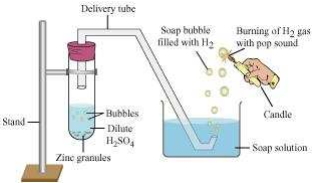
Which gas is usually liberated when an acid reacts with a metal? Illustrate with an example. How will you test for the presence of this gas?
Solution
(N/A) Hydrogen gas $(H_2)$ is usually liberated when an acid reacts with a metal.
Example: When zinc granules react with dilute sulfuric acid $(H_2SO_4)$,zinc sulfate $(ZnSO_4)$ and hydrogen gas are produced.
The chemical equation is:
$Zn(s) + H_2SO_4(aq) \to ZnSO_4(aq) + H_2(g) \uparrow$
Test for Hydrogen gas:
To test for the presence of hydrogen gas,pass the gas produced through a soap solution. Bubbles are formed in the soap solution,which contain hydrogen gas. When a burning candle is brought near these soap bubbles,the gas burns with a 'pop' sound,which confirms the presence of hydrogen gas.
0 likes
View Solution3
Medium
Why do $HCl$,$HNO_3$,etc.,show acidic characters in aqueous solutions while solutions of compounds like alcohol and glucose do not show acidic character?
Solution
(N/A) The dissociation of $HCl$ or $HNO_3$ to form hydrogen ions occurs only in the presence of water.
Hydrogen ions $(H^+)$ combine with $H_2O$ to form hydronium ions $(H_3O^+)$,which are responsible for acidic properties.
The reactions are as follows:
$HCl_{(aq)} \rightarrow H^+_{(aq)} + Cl^-_{(aq)}$
$H^+_{(aq)} + H_2O_{(l)} \rightarrow H_3O^+_{(aq)}$
Although aqueous solutions of glucose and alcohol contain hydrogen atoms in their molecular structure,these hydrogen atoms do not dissociate into $H^+$ ions in water.
Since they do not release hydrogen ions in solution,they do not exhibit acidic character.
0 likes
View Solution4
EasyMCQ
Why does an aqueous solution of an acid conduct electricity?
A
Due to the presence of free electrons.
B
Due to the presence of free ions.
C
Due to the presence of molecules.
D
Due to the presence of covalent bonds.
Solution
(B) Acids are substances that dissociate in an aqueous solution to produce hydrogen ions $(H^+)$ and corresponding anions.
These free ions act as charge carriers in the solution.
Since electricity is the flow of charge,the movement of these ions allows the aqueous solution of an acid to conduct electricity.
These free ions act as charge carriers in the solution.
Since electricity is the flow of charge,the movement of these ions allows the aqueous solution of an acid to conduct electricity.
1 likes
View Solution5
EasyMCQ
Why does dry $HCl$ gas not change the colour of the dry litmus paper?
A
It is not acidic in nature.
B
It does not contain $H^+$ ions in the gaseous state.
C
It is a covalent compound.
D
It requires a catalyst to react.
Solution
(B) The colour of litmus paper is changed by the presence of hydrogen ions $(H^+)$.
Dry $HCl$ gas does not contain free $H^+$ ions.
An acid only dissociates to release $H^+$ ions when it is in an aqueous solution.
Since the $HCl$ gas is dry and the litmus paper is also dry,no dissociation occurs,and therefore,the colour of the litmus paper does not change.
Dry $HCl$ gas does not contain free $H^+$ ions.
An acid only dissociates to release $H^+$ ions when it is in an aqueous solution.
Since the $HCl$ gas is dry and the litmus paper is also dry,no dissociation occurs,and therefore,the colour of the litmus paper does not change.
0 likes
View Solution6
MediumMCQ
While diluting an acid,why is it recommended that the acid should be added to water and not water to the acid?
A
To prevent the acid from becoming too concentrated.
B
To ensure the acid does not evaporate.
C
To prevent the mixture from splashing out due to the highly exothermic nature of the reaction.
D
To maintain the chemical properties of the acid.
Solution
(C) The process of dissolving a concentrated acid in water is a highly exothermic reaction,meaning it releases a large amount of heat.
If water is added to a concentrated acid,the heat generated may cause the mixture to splash out and cause severe acid burns.
Additionally,the glass container may break due to excessive local heating.
Therefore,it is always recommended to add acid slowly to water with constant stirring.
If water is added to a concentrated acid,the heat generated may cause the mixture to splash out and cause severe acid burns.
Additionally,the glass container may break due to excessive local heating.
Therefore,it is always recommended to add acid slowly to water with constant stirring.
0 likes
View Solution7
EasyMCQ
How is the concentration of hydronium ions $(H_3O^+)$ affected when a solution of an acid is diluted?
A
It increases.
B
It decreases.
C
It remains unchanged.
D
It becomes zero.
Solution
(B) When an acid is diluted by adding water,the number of hydronium ions $(H_3O^+)$ per unit volume decreases.
This process is known as dilution.
As the volume of the solution increases due to the addition of water,the concentration of the acid decreases,resulting in a lower concentration of $(H_3O^+)$ ions.
This process is known as dilution.
As the volume of the solution increases due to the addition of water,the concentration of the acid decreases,resulting in a lower concentration of $(H_3O^+)$ ions.
0 likes
View Solution8
EasyMCQ
How is the concentration of hydroxide ions $(OH^-)$ affected when excess base is dissolved in a solution of sodium hydroxide?
A
It increases
B
It decreases
C
It remains the same
D
It becomes zero
Solution
(A) When an excess base is dissolved in a solution of sodium hydroxide $(NaOH)$,it releases more hydroxide ions $(OH^-)$ into the solution.
Since sodium hydroxide is a strong base that dissociates completely,adding more base increases the total number of $(OH^-)$ ions per unit volume.
Therefore,the concentration of hydroxide ions $(OH^-)$ increases.
Since sodium hydroxide is a strong base that dissociates completely,adding more base increases the total number of $(OH^-)$ ions per unit volume.
Therefore,the concentration of hydroxide ions $(OH^-)$ increases.
0 likes
View Solution9
Easy
Do basic solutions also have $H^+_{(aq)}$ ions? If yes,then why are these basic?
Solution
(N/A) Yes,basic solutions also contain $H^+_{(aq)}$ ions. However,their concentration is significantly lower than the concentration of $OH^-$ ions. Because the concentration of $OH^-$ ions is higher than that of $H^+_{(aq)}$ ions,the solution exhibits basic properties.
0 likes
View Solution10
MediumMCQ
Under what soil condition do you think a farmer would treat the soil of his fields with quick lime $(CaO)$,slaked lime $(Ca(OH)_2)$,or chalk $(CaCO_3)$?
A
When the soil is too basic.
B
When the soil is too acidic.
C
When the soil is neutral.
D
When the soil is waterlogged.
Solution
(B) The substances mentioned,such as quick lime $(CaO)$,slaked lime $(Ca(OH)_2)$,and chalk $(CaCO_3)$,are basic in nature.
If the soil is too acidic,it becomes unsuitable for the growth of many crops.
To neutralize the excess acidity and improve the soil quality for cultivation,a farmer adds these basic substances to the field.
Therefore,the farmer treats the soil with these substances when the soil is too acidic.
If the soil is too acidic,it becomes unsuitable for the growth of many crops.
To neutralize the excess acidity and improve the soil quality for cultivation,a farmer adds these basic substances to the field.
Therefore,the farmer treats the soil with these substances when the soil is too acidic.
0 likes
View Solution11
EasyMCQ
$A$ solution reacts with crushed egg-shells to give a gas that turns lime water milky. The solution contains:
A
$NaCl$
B
$LiCl$
C
$KCl$
D
$HCl$
Solution
(D) Crushed egg-shells consist mainly of calcium carbonate $(CaCO_3)$.
When an acid,such as hydrochloric acid $(HCl)$,reacts with calcium carbonate,it produces carbon dioxide gas $(CO_2)$.
The reaction is: $CaCO_3 + 2HCl \rightarrow CaCl_2 + H_2O + CO_2 \uparrow$.
Carbon dioxide gas turns lime water $(Ca(OH)_2)$ milky due to the formation of insoluble calcium carbonate $(CaCO_3)$.
Therefore,the solution must contain $HCl$.
0 likes
View Solution12
EasyMCQ
Which one of the following types of medicines is used for treating indigestion?
A
Antibiotic
B
Antacid
C
Analgesic
D
Antiseptic
Solution
(B) Indigestion is caused by the production of excess acid in the stomach. Antacids are mild bases that neutralize this excess acid,thereby providing relief from pain and irritation. Therefore,antacids are used for treating indigestion.
0 likes
View Solution13
Compounds such as alcohols and glucose also contain hydrogen but are not categorized as acids. Describe an activity to prove that they do not show acidic character.

Solution
(N/A) $1$. Take two iron nails and fix them on a rubber cork. Place the cork in a $100\,mL$ beaker.
$2$. Connect the nails to the two terminals of a $6\,V$ battery through a bulb and a switch.
$3$. Pour some dilute $HCl$ into the beaker and switch on the current. The bulb will glow,indicating that $HCl$ conducts electricity due to the presence of $H^+$ ions.
$4$. Repeat the same experiment using glucose solution and alcohol solution separately.
$5$. Observation: The bulb does not glow in the case of glucose and alcohol solutions.
$6$. Conclusion: Glucose and alcohol do not dissociate into ions in aqueous solution. Since they do not produce $H^+$ ions,they do not show acidic properties,even though they contain hydrogen.
0 likes
View Solution14
EasyMCQ
Why do acids not show acidic behaviour in the absence of water?
A
They do not dissociate into ions.
B
They are not soluble in water.
C
They react with water to form bases.
D
They become neutral in the absence of water.
Solution
(A) Acids do not show acidic behaviour in the absence of water because the dissociation of hydrogen ions $(H^+)$ from an acid occurs only in the presence of water.
It is the presence of these hydrogen ions $(H^+)$ that is responsible for the acidic behaviour of the substance.
In the absence of water,the acid molecules do not release $H^+$ ions,and therefore,they do not exhibit acidic properties.
It is the presence of these hydrogen ions $(H^+)$ that is responsible for the acidic behaviour of the substance.
In the absence of water,the acid molecules do not release $H^+$ ions,and therefore,they do not exhibit acidic properties.
0 likes
View Solution15
Medium
Equal lengths of magnesium ribbons are taken in test tubes $A$ and $B$. Hydrochloric acid $(HCl)$ is added to test tube $A$,while acetic acid $(CH_3COOH)$ is added to test tube $B$. The amount and concentration taken for both the acids are the same. In which test tube will the fizzing occur more vigorously and why?
Solution
(A) The fizzing will occur more vigorously in test tube $A$,to which hydrochloric acid $(HCl)$ is added.
This is because $HCl$ is a strong acid,whereas $CH_3COOH$ is a weak acid.
Strong acids dissociate completely in water to produce a higher concentration of hydrogen ions $(H^+)$ compared to weak acids.
Since the reaction between magnesium and acid depends on the concentration of $H^+$ ions,the reaction in test tube $A$ proceeds at a faster rate,resulting in more vigorous evolution of hydrogen gas.
1 likes
View Solution16
MediumMCQ
What is a neutralization reaction? Give two examples.
A
$A$ reaction between an acid and a base to form salt and water.
B
$A$ reaction between a metal and an acid.
C
$A$ reaction between a non-metal and a base.
D
$A$ reaction between two salts.
Solution
(A) reaction in which an acid and a base react with each other to produce salt and water is termed as a neutralization reaction. In this reaction,energy is evolved in the form of heat.
Example $(i)$: The reaction between sodium hydroxide $(NaOH)$ and hydrochloric acid $(HCl)$:
$NaOH + HCl \rightarrow NaCl + H_2O$
Example $(ii)$: During indigestion,caused by the production of excess hydrochloric acid in the stomach,we take an antacid like milk of magnesia $(Mg(OH)_2)$. The antacid neutralizes the excess acid and provides relief.
$Mg(OH)_2 + 2HCl \rightarrow MgCl_2 + 2H_2O$
2 likes
View Solution17
Difficult
Pratyush took sulphur powder on a spatula and heated it. He collected the gas evolved by inverting a test tube over it,as shown in the figure below.
$(a)$ What will be the action of the gas on
$(i)$ dry litmus paper?
$(ii)$ moist litmus paper?
$(b)$ Write a balanced chemical equation for the reaction taking place.
$(a)$ What will be the action of the gas on
$(i)$ dry litmus paper?
$(ii)$ moist litmus paper?
$(b)$ Write a balanced chemical equation for the reaction taking place.
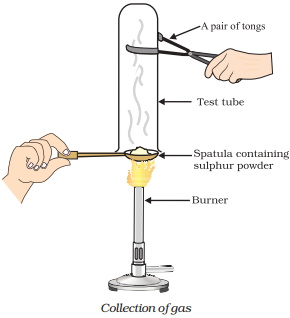
Solution
(N/A) $(i)$ There will be no action on dry litmus paper.
$(ii)$ Since the gas is sulphur dioxide $(SO_2)$,it turns moist blue litmus paper to red because sulphur dioxide reacts with moisture to form sulphurous acid.
$(b)$ $S_{(s)} + O_{2(g)} \to SO_{2(g)}$
$SO_{2(g)} + H_2O_{(l)} \to H_2SO_{3(aq)}$
$(ii)$ Since the gas is sulphur dioxide $(SO_2)$,it turns moist blue litmus paper to red because sulphur dioxide reacts with moisture to form sulphurous acid.
$(b)$ $S_{(s)} + O_{2(g)} \to SO_{2(g)}$
$SO_{2(g)} + H_2O_{(l)} \to H_2SO_{3(aq)}$
0 likes
View Solution18
Medium
You must have seen tarnished copper vessels being cleaned with lemon or tamarind juice. Explain why these sour substances are effective in cleaning the vessels.
Solution
(N/A) Copper reacts with moist carbon dioxide in the air to form copper carbonate,which results in the copper vessel losing its shiny brown surface and forming a green layer of copper carbonate.
The citric acid present in lemon or tamarind juice neutralizes the basic copper carbonate and dissolves the layer.
This is why tarnished copper vessels are cleaned with lemon or tamarind juice to restore the characteristic lustre of the copper surface.
The citric acid present in lemon or tamarind juice neutralizes the basic copper carbonate and dissolves the layer.
This is why tarnished copper vessels are cleaned with lemon or tamarind juice to restore the characteristic lustre of the copper surface.
0 likes
View Solution19
MediumMCQ
$A$ substance $X$, which is an oxide of a group $2$ element, is used intensively in the cement industry. This element is present in bones also. On treatment with water, it forms a solution which turns red litmus blue. Identify $X$ and write the chemical reactions involved.
A
Calcium oxide $(CaO)$
B
Calcium carbonate $(CaCO_3)$
C
Calcium hydroxide $(Ca(OH)_2)$
D
Calcium chloride $(CaCl_2)$
Solution
(A) The substance $X$ is Calcium oxide $(CaO)$, commonly known as quicklime.
$1$. It is an oxide of Calcium, which is a group $2$ element.
$2$. Calcium is a major component of bones in the form of calcium phosphate.
$3$. It is used extensively in the cement industry.
$4$. When $CaO$ reacts with water, it forms Calcium hydroxide $(Ca(OH)_2)$, which is a strong base and turns red litmus blue.
The chemical reaction is:
$CaO(s) + H_2O(l) \longrightarrow Ca(OH)_2(aq) + \text{Heat}$
0 likes
View Solution20
MediumMCQ
During the preparation of hydrogen chloride gas on a humid day,the gas is usually passed through the guard tube containing calcium chloride. The role of calcium chloride taken in the guard tube is to
A
absorb the evolved gas
B
moisten the gas
C
absorb moisture from the gas
D
absorb $Cl^-$ ions from the evolved gas
Solution
(C) Calcium chloride $(CaCl_2)$ is a well-known dehydrating agent or desiccant.
When hydrogen chloride $(HCl)$ gas is prepared,it may contain water vapor,especially on a humid day.
To obtain dry $HCl$ gas,it is passed through a guard tube containing anhydrous calcium chloride.
This substance absorbs the moisture (water vapor) present in the gas,ensuring that the resulting $HCl$ gas is dry.
0 likes
View Solution21
EasyMCQ
To protect against tooth decay,we are advised to brush our teeth regularly. The nature of the toothpaste commonly used is:
A
basic
B
neutral
C
acidic
D
corrosive
Solution
(A) Tooth decay is caused by the production of acids in the mouth by bacteria,which break down leftover food particles. These acids lower the $pH$ of the mouth,causing the tooth enamel to corrode.
To neutralize these acids and prevent decay,we use toothpaste. Toothpaste is generally basic (alkaline) in nature. When it reacts with the acids in the mouth,it neutralizes them,thereby protecting the teeth from decay.
To neutralize these acids and prevent decay,we use toothpaste. Toothpaste is generally basic (alkaline) in nature. When it reacts with the acids in the mouth,it neutralizes them,thereby protecting the teeth from decay.
0 likes
View Solution22
EasyMCQ
Which one of the following can be used as an acid-base indicator by a visually impaired student?
A
Vanilla essence
B
Turmeric
C
Litmus
D
Petunia leaves
Solution
(A) An acid-base indicator that can be used by a visually impaired student is known as an olfactory indicator.
Olfactory indicators are substances whose smell changes in acidic or basic media.
Vanilla essence is an olfactory indicator.
In an acidic medium,the characteristic smell of vanilla essence is retained,whereas in a basic medium,the smell is destroyed.
Turmeric,litmus,and petunia leaves are visual indicators that require sight to observe color changes.
0 likes
View Solution23
DifficultMCQ
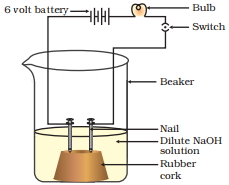
In an attempt to demonstrate electrical conductivity through an electrolyte,the following apparatus was set up. Which among the following statement$(s)$ is(are) correct?
$(i)$ Bulb will not glow because electrolyte is not acidic.
$(ii)$ Bulb will glow because $NaOH$ is a strong base and furnishes ions for conduction.
$(iii)$ Bulb will not glow because circuit is incomplete.
$(iv)$ Bulb will not glow because it depends upon the type of electrolytic solution.
Solution: The apparatus shows a beaker containing a dilute $NaOH$ solution with two nails fixed on a rubber cork. $NaOH$ is a strong base that dissociates completely in water to provide $Na^+$ and $OH^-$ ions. These free ions act as charge carriers,allowing the electric current to flow through the solution and complete the circuit. Therefore,the bulb will glow. Statement $(ii)$ is correct.
A
$(i)$ and $(iii)$
B
$(ii)$ and $(iv)$
C
$(iv)$ only
D
$(ii)$ only
1 likes
View Solution24
EasyMCQ
Which of the following is not a mineral acid?
A
Hydrochloric acid
B
Citric acid
C
Sulphuric acid
D
Nitric acid
Solution
(B) Mineral acids are acids derived from inorganic compounds,typically through chemical processes. Examples include $HCl$,$H_2SO_4$,and $HNO_3$.
Organic acids are acids that occur naturally in plants and animals. Citric acid is an organic acid found in citrus fruits like lemons and oranges.
Therefore,citric acid is not a mineral acid.
Organic acids are acids that occur naturally in plants and animals. Citric acid is an organic acid found in citrus fruits like lemons and oranges.
Therefore,citric acid is not a mineral acid.
0 likes
View Solution25
MediumMCQ
Which among the following is not a base?
A
$NaOH$
B
$KOH$
C
$C_2H_5OH$
D
$NH_4OH$
Solution
(C) $C_2H_5OH$ is not a base.
$C_2H_5OH$ (ethyl alcohol) contains an $-OH$ group,but it does not dissociate to release $OH^-$ ions in an aqueous solution.
Bases are substances that release $OH^-$ ions in water.
Since $C_2H_5OH$ does not act as a proton acceptor or $OH^-$ donor,it is classified as an alcohol,not a base.
$C_2H_5OH$ (ethyl alcohol) contains an $-OH$ group,but it does not dissociate to release $OH^-$ ions in an aqueous solution.
Bases are substances that release $OH^-$ ions in water.
Since $C_2H_5OH$ does not act as a proton acceptor or $OH^-$ donor,it is classified as an alcohol,not a base.
0 likes
View Solution26
MediumMCQ
Which of the following is(are) true when $HCl(g)$ is passed through water?
$(i)$ It does not ionise in the solution as it is a covalent compound.
$(ii)$ It ionises in the solution.
$(iii)$ It gives both hydrogen and hydroxyl ion in the solution.
$(iv)$ It forms hydronium ion in the solution due to the combination of hydrogen ion with water molecule.
$(i)$ It does not ionise in the solution as it is a covalent compound.
$(ii)$ It ionises in the solution.
$(iii)$ It gives both hydrogen and hydroxyl ion in the solution.
$(iv)$ It forms hydronium ion in the solution due to the combination of hydrogen ion with water molecule.
A
$(i)$ only
B
$(iii)$ only
C
$(ii)$ and $(iv)$
D
$(iii)$ and $(iv)$
Solution
(C) When $HCl(g)$ is passed through water,it undergoes ionization because water acts as a polar solvent.
$HCl + H_2O \rightarrow H_3O^+ + Cl^-$.
Statement $(ii)$ is true because $HCl$ ionizes in water.
Statement $(iv)$ is true because the $H^+$ ion produced combines with $H_2O$ to form the hydronium ion $(H_3O^+)$.
Statement $(i)$ is false because it does ionize.
Statement $(iii)$ is false because it does not produce hydroxyl ions $(OH^-)$ in the solution.
0 likes
View Solution27
EasyMCQ
Which of the following statements is true for acids?
A
Bitter and change red litmus to blue
B
Sour and change red litmus to blue
C
Bitter and change blue litmus to red
D
Sour and change blue litmus to red
Solution
(D) Acids are chemical substances that have a sour taste.
They turn blue litmus paper into red.
Bases,on the other hand,are bitter in taste and turn red litmus paper into blue.
Therefore,the correct statement for acids is that they are sour and change blue litmus to red.
They turn blue litmus paper into red.
Bases,on the other hand,are bitter in taste and turn red litmus paper into blue.
Therefore,the correct statement for acids is that they are sour and change blue litmus to red.
0 likes
View Solution28
EasyMCQ
Which of the following are present in a dilute aqueous solution of hydrochloric acid?
A
$H_{3}O^{+} + Cl^{-}$
B
$H_{3}O^{+} + OH^{-}$
C
$Cl^{-} + OH^{-}$
D
Unionised $HCl$
Solution
(A) Hydrochloric acid $(HCl)$ is a strong acid that undergoes complete dissociation in an aqueous solution.
When $HCl$ is dissolved in water,it reacts with water molecules to form hydronium ions $(H_{3}O^{+})$ and chloride ions $(Cl^{-})$.
The dissociation reaction is represented as: $HCl(aq) + H_{2}O(l) \rightarrow H_{3}O^{+}(aq) + Cl^{-}(aq)$.
Since it is a strong acid,almost all $HCl$ molecules dissociate into ions,leaving negligible amounts of unionised $HCl$ in a dilute solution.
Therefore,the primary species present in the solution are $H_{3}O^{+}$ and $Cl^{-}$.
0 likes
View Solution29
MediumMCQ
Match the acids given in Column $(A)$ with their correct source given in Column $(B)$.
| Column $(A)$ | Column $(B)$ |
| $(a)$ Lactic acid | $(i)$ Tomato |
| $(b)$ Acetic acid | $(ii)$ Lemon |
| $(c)$ Citric acid | $(iii)$ Vinegar |
| $(d)$ Oxalic acid | $(iv)$ Curd |
A
$(a)-(iv), (b)-(iii), (c)-(i), (d)-(ii)$
B
$(a)-(iii), (b)-(ii), (c)-(i), (d)-(iv)$
C
$(a)-(iv), (b)-(iii), (c)-(ii), (d)-(i)$
D
$(a)-(ii), (b)-(i), (c)-(iii), (d)-(iv)$
Solution
(C) The correct matches are as follows:
$(a)$ Lactic acid is found in $(iv)$ Curd.
$(b)$ Acetic acid is found in $(iii)$ Vinegar.
$(c)$ Citric acid is found in $(ii)$ Lemon.
$(d)$ Oxalic acid is found in $(i)$ Tomato.
Therefore, the correct sequence is $(a)-(iv), (b)-(iii), (c)-(ii), (d)-(i)$.
$(a)$ Lactic acid is found in $(iv)$ Curd.
$(b)$ Acetic acid is found in $(iii)$ Vinegar.
$(c)$ Citric acid is found in $(ii)$ Lemon.
$(d)$ Oxalic acid is found in $(i)$ Tomato.
Therefore, the correct sequence is $(a)-(iv), (b)-(iii), (c)-(ii), (d)-(i)$.
0 likes
View Solution30
Medium
Name the acid present in ant sting and give its chemical formula. Also,suggest a common method to get relief from the discomfort caused by the ant sting.
Solution
(N/A) The acid present in an ant sting is methanoic acid,also known as formic acid.
The chemical formula for methanoic acid is $HCOOH$.
To get relief from the irritation caused by the ant sting,one should apply a mild base,such as baking soda $(NaHCO_3)$,to the affected area. The base neutralizes the acidic effect of the sting,providing relief.
The chemical formula for methanoic acid is $HCOOH$.
To get relief from the irritation caused by the ant sting,one should apply a mild base,such as baking soda $(NaHCO_3)$,to the affected area. The base neutralizes the acidic effect of the sting,providing relief.
1 likes
View Solution31
MediumMCQ
Mineral acids are stronger acids than carboxylic acids because:
$(i)$ Mineral acids are completely ionised.
$(ii)$ Carboxylic acids are completely ionised.
$(iii)$ Mineral acids are partially ionised.
$(iv)$ Carboxylic acids are partially ionised.
$(i)$ Mineral acids are completely ionised.
$(ii)$ Carboxylic acids are completely ionised.
$(iii)$ Mineral acids are partially ionised.
$(iv)$ Carboxylic acids are partially ionised.
A
$(iii)$ and $(iv)$
B
$(ii)$ and $(iii)$
C
$(i)$ and $(ii)$
D
$(i)$ and $(iv)$
Solution
(D) Mineral acids (such as $HCl$,$H_2SO_4$,$HNO_3$) are strong acids because they dissociate completely into ions in an aqueous solution.
Carboxylic acids (such as $CH_3COOH$) are weak acids because they dissociate only partially into ions in an aqueous solution.
Therefore,statement $(i)$ (mineral acids are completely ionised) and statement $(iv)$ (carboxylic acids are partially ionised) correctly explain why mineral acids are stronger than carboxylic acids.
Thus,the correct option is $(i)$ and $(iv)$.
0 likes
View Solution32
MediumMCQ
On adding dilute hydrochloric acid to copper oxide powder,the solution formed is blue-green. Predict the new compound formed which imparts a blue-green colour to the solution.
A
Copper $(I)$ chloride
B
Copper $(II)$ chloride
C
Copper hydroxide
D
Copper carbonate
Solution
(B) When copper oxide $(CuO)$ reacts with dilute hydrochloric acid $(HCl)$,a neutralization reaction occurs.
The chemical equation is: $CuO(s) + 2HCl(aq) \rightarrow CuCl_2(aq) + H_2O(l)$.
The new compound formed is copper $(II)$ chloride $(CuCl_2)$,which imparts a blue-green colour to the solution.
The chemical equation is: $CuO(s) + 2HCl(aq) \rightarrow CuCl_2(aq) + H_2O(l)$.
The new compound formed is copper $(II)$ chloride $(CuCl_2)$,which imparts a blue-green colour to the solution.
0 likes
View Solution33
Easy
What are antacids? Explain their role in providing relief from stomach ache.
Solution
(N/A) $(i)$ Antacids are mild bases.
$(ii)$ During indigestion,the stomach produces excess hydrochloric acid,which causes pain and irritation. Antacids are chemical substances that neutralize this excess acid,thereby providing relief from stomach ache.
$(ii)$ During indigestion,the stomach produces excess hydrochloric acid,which causes pain and irritation. Antacids are chemical substances that neutralize this excess acid,thereby providing relief from stomach ache.
0 likes
View Solution34
Easy
Define alkalies and give an example.
Solution
(N/A) Bases that are soluble in water are known as alkalies.
All alkalies are bases,but not all bases are alkalies.
Examples include sodium hydroxide $(NaOH)$ and potassium hydroxide $(KOH)$.
All alkalies are bases,but not all bases are alkalies.
Examples include sodium hydroxide $(NaOH)$ and potassium hydroxide $(KOH)$.
0 likes
View Solution35
EasyMCQ
What are olfactory indicators?
A
Substances that change color in acidic or basic media.
B
Substances whose odour changes in acidic or basic media.
C
Substances that indicate the presence of salts.
D
Substances that are used to measure the $pH$ of a solution.
Solution
(B) Olfactory indicators are substances whose smell or odour changes in acidic or basic media.
These indicators are useful for visually impaired students as they can detect the change in the nature of a substance through their sense of smell.
Examples include onion,vanilla extract,and clove oil.
These indicators are useful for visually impaired students as they can detect the change in the nature of a substance through their sense of smell.
Examples include onion,vanilla extract,and clove oil.
0 likes
View Solution36
MediumMCQ
Why does $1 \, M \, HCl$ solution have a higher concentration of $H^{+}$ ions than $1 \, M \, CH_{3}COOH$ solution?
A
$HCl$ is a strong acid and ionizes completely.
B
$CH_{3}COOH$ is a strong acid and ionizes completely.
C
$HCl$ is a weak acid and ionizes partially.
D
Both are equally strong acids.
Solution
(A) $HCl$ is a strong acid,which means it undergoes complete dissociation in an aqueous solution to produce a high concentration of $H^{+}$ ions.
In contrast,$CH_{3}COOH$ (acetic acid) is a weak acid,which undergoes only partial dissociation in an aqueous solution.
Therefore,for the same molar concentration,the $HCl$ solution will have a significantly higher concentration of $H^{+}$ ions compared to the $CH_{3}COOH$ solution.
In contrast,$CH_{3}COOH$ (acetic acid) is a weak acid,which undergoes only partial dissociation in an aqueous solution.
Therefore,for the same molar concentration,the $HCl$ solution will have a significantly higher concentration of $H^{+}$ ions compared to the $CH_{3}COOH$ solution.
0 likes
View Solution37
EasyMCQ
In which form do $H^{+}$ (hydrogen) ions exist in water?
A
As free $H^{+}$ ions
B
As $H_{3}O^{+}$ (hydronium) ions
C
As $H_{2}O_{2}$ molecules
D
As $OH^{-}$ ions
Solution
(B) Hydrogen ions $(H^{+})$ cannot exist independently in an aqueous solution because they are highly reactive.
They immediately combine with water $(H_{2}O)$ molecules to form hydronium ions $(H_{3}O^{+})$.
Therefore,hydrogen ions are always represented as $H^{+}(aq)$ or as hydronium ions $(H_{3}O^{+})$.
They immediately combine with water $(H_{2}O)$ molecules to form hydronium ions $(H_{3}O^{+})$.
Therefore,hydrogen ions are always represented as $H^{+}(aq)$ or as hydronium ions $(H_{3}O^{+})$.
0 likes
View Solution38
Easy
Dry $HCl$ gas does not change the colour of dry blue litmus. Give reason.
Solution
(N/A) The acidic character of $HCl$ is due to the presence of $H^+$ ions.
In the absence of water,$HCl$ molecules do not dissociate to produce $H^+$ ions.
Since the litmus paper is dry and the $HCl$ gas is also dry,there is no medium for the dissociation of $HCl$ into ions.
Therefore,the litmus paper does not change its colour.
In the absence of water,$HCl$ molecules do not dissociate to produce $H^+$ ions.
Since the litmus paper is dry and the $HCl$ gas is also dry,there is no medium for the dissociation of $HCl$ into ions.
Therefore,the litmus paper does not change its colour.
0 likes
View Solution39
Medium
Give reasons for the following:
$(a)$ Dry $HCl$ gas does not change the colour of dry litmus paper.
$(a)$ Dry $HCl$ gas does not change the colour of dry litmus paper.
Solution
(N/A) The acidic character of a substance is due to the presence of $H^{+}$ ions.
In the case of dry $HCl$ gas,there is no water present to facilitate the dissociation of $HCl$ molecules into $H^{+}$ and $Cl^{-}$ ions.
Since $H^{+}$ ions are responsible for the acidic property of changing the colour of litmus paper,the absence of these ions in dry $HCl$ means the litmus paper will not change colour.
0 likes
View Solution40
Easy
Give reasons for the following:
$(a)$ Aqueous solution of an acid conducts electricity.
$(a)$ Aqueous solution of an acid conducts electricity.
Solution
(N/A) When an acid is dissolved in water,it dissociates to produce $H^{+}$ ions (hydrogen ions).
These $H^{+}$ ions act as charge carriers in the solution.
Since the movement of ions is responsible for the flow of electric current,the aqueous solution of an acid conducts electricity.
These $H^{+}$ ions act as charge carriers in the solution.
Since the movement of ions is responsible for the flow of electric current,the aqueous solution of an acid conducts electricity.
0 likes
View Solution41
Easy
$(i)$ Give an example of a strong base and a weak base.
Solution
(N/A) strong base is a base that completely dissociates into its ions in an aqueous solution. An example of a strong base is $NaOH$ (Sodium hydroxide).
$A$ weak base is a base that partially dissociates into its ions in an aqueous solution. An example of a weak base is $Mg(OH)_2$ (Magnesium hydroxide or Milk of magnesia).
$A$ weak base is a base that partially dissociates into its ions in an aqueous solution. An example of a weak base is $Mg(OH)_2$ (Magnesium hydroxide or Milk of magnesia).
0 likes
View Solution42
Medium
Acids do not show acidic behaviour in the absence of water but do so in water. Justify this statement with the help of a chemical equation.
Solution
(N/A) Acids ionize in an aqueous medium to produce hydrogen ions $(H^+)$. These hydrogen ions cannot exist independently; they combine with water molecules to form hydronium ions $(H_3O^+)$. Since the presence of these ions is essential for exhibiting acidic properties,acids only show acidic behavior in the presence of water.
Chemical equation:
$H^+ + H_2O \to H_3O^+$
These hydrogen ions are represented as $H^+(aq)$ or hydronium ions $(H_3O^+)$.
Chemical equation:
$H^+ + H_2O \to H_3O^+$
These hydrogen ions are represented as $H^+(aq)$ or hydronium ions $(H_3O^+)$.
0 likes
View Solution43
Medium
What happens when $CO_2$ is passed through lime water in limited amount?
Solution
(N/A) When $CO_2$ is passed through lime water in limited amount,the lime water turns milky due to the formation of insoluble white precipitates of calcium carbonate.
The chemical reaction is as follows:
$Ca(OH)_2(aq) + CO_2(g) \to CaCO_3(s) \downarrow + H_2O(l)$
The chemical reaction is as follows:
$Ca(OH)_2(aq) + CO_2(g) \to CaCO_3(s) \downarrow + H_2O(l)$
0 likes
View Solution44
Medium
What happens when $CO_{2}$ is passed through lime water in excess?
Solution
(N/A) When $CO_{2}$ is passed through lime water in excess,the initially formed white precipitate of calcium carbonate $(CaCO_{3})$ reacts further with $CO_{2}$ and water to form calcium hydrogen carbonate,which is soluble in water.
The chemical reaction is as follows:
$Ca(OH)_{2}(aq) + 2CO_{2}(g) \to Ca(HCO_{3})_{2}(aq)$
In this reaction,the insoluble $CaCO_{3}$ (formed when $CO_{2}$ is passed in limited amounts) dissolves due to the formation of soluble calcium hydrogen carbonate.
The chemical reaction is as follows:
$Ca(OH)_{2}(aq) + 2CO_{2}(g) \to Ca(HCO_{3})_{2}(aq)$
In this reaction,the insoluble $CaCO_{3}$ (formed when $CO_{2}$ is passed in limited amounts) dissolves due to the formation of soluble calcium hydrogen carbonate.
0 likes
View Solution45
MediumMCQ
What precaution must be taken while diluting a concentrated acid?
A
Always add water to the acid.
B
Always add acid to water slowly with constant stirring.
C
Mix both rapidly in a closed container.
D
Use a plastic container for dilution.
Solution
(B) Dilution should always be performed by adding concentrated acid to water,never by adding water to concentrated acid.
This is because the process of dissolving a concentrated acid in water is highly exothermic.
If water is added to concentrated acid,the large amount of heat generated can cause the mixture to splash out,potentially causing severe acid burns.
Therefore,one should always add acid to water slowly while stirring the solution constantly to dissipate the heat.
0 likes
View Solution46
Medium
$15 \, mL$ of water and $10 \, mL$ of sulphuric acid are to be mixed in a beaker.
$(i)$ State the method that should be followed with reason.
$(ii)$ What is this process called?
$(i)$ State the method that should be followed with reason.
$(ii)$ What is this process called?
Solution
(N/A) $(i)$ The acid should be added slowly to the water with constant stirring. This is because the process of dissolving a concentrated acid in water is highly exothermic. If water is added to a concentrated acid,the heat generated may cause the mixture to splash out and cause burns. Adding acid to water allows the large volume of water to absorb the heat generated.
$(ii)$ This process is called dilution.
$(ii)$ This process is called dilution.
0 likes
View Solution47
Medium
$(a)$ Give the chemical names of acids present in:
$(i)$ ants
$(ii)$ lemon
$(iii)$ milk
$(iv)$ tomato
$(i)$ ants
$(ii)$ lemon
$(iii)$ milk
$(iv)$ tomato
Solution
(N/A) $(i)$ Ants contain formic acid (also known as methanoic acid).
$(ii)$ Lemon contains citric acid.
$(iii)$ Milk contains lactic acid.
$(iv)$ Tomato contains oxalic acid.
$(ii)$ Lemon contains citric acid.
$(iii)$ Milk contains lactic acid.
$(iv)$ Tomato contains oxalic acid.
0 likes
View Solution48
Easy
$(a)$ Why should curd and sour substances not be kept in brass and copper vessels?
Solution
(N/A) Curd and other sour substances contain acids.
These acids react with the metal (copper) present in brass and copper vessels.
This chemical reaction leads to the formation of metallic salts (compounds) which are toxic or poisonous in nature.
Consuming food stored in such vessels can cause food poisoning.
These acids react with the metal (copper) present in brass and copper vessels.
This chemical reaction leads to the formation of metallic salts (compounds) which are toxic or poisonous in nature.
Consuming food stored in such vessels can cause food poisoning.
0 likes
View Solution49
Medium
How do metal carbonates and metal hydrogen carbonates react with acids? Give their chemical equations. Name the gas evolved during the reaction. What will happen when this gas is passed through lime water?
Solution
(N/A) Metal carbonates and metal hydrogen carbonates react with acids to produce the corresponding salt,carbon dioxide,and water.
$(b)$ Chemical equations:
$(i)$ Metal carbonate: $Na_{2}CO_{3}(s) + 2HCl(aq) \rightarrow 2NaCl(aq) + H_{2}O(l) + CO_{2}(g)$
$(ii)$ Metal hydrogen carbonate: $NaHCO_{3}(s) + HCl(aq) \rightarrow NaCl(aq) + H_{2}O(l) + CO_{2}(g)$
$(c)$ The gas evolved during the reaction is carbon dioxide $(CO_{2})$.
$(d)$ When carbon dioxide gas is passed through lime water $(Ca(OH)_{2})$,it turns milky due to the formation of white precipitate of calcium carbonate $(CaCO_{3})$.
0 likes
View Solution50
EasyMCQ
When soap is scrubbed on a stain of curry on a white cloth,why does it become reddish-brown,and why does it turn yellow again when the cloth is washed with plenty of water?
A
Soap reacts with turmeric to form a new compound.
B
Turmeric acts as a natural acid-base indicator.
C
The soap is acidic in nature.
D
The water neutralizes the soap.
Solution
(B) Curry contains turmeric,which acts as a natural acid-base indicator.
Soap is basic in nature.
When soap is applied to the turmeric stain,the basic medium causes the turmeric to turn reddish-brown.
When the cloth is washed with plenty of water,the soap is rinsed away,removing the basic medium.
As the medium is no longer basic,the turmeric returns to its original yellow color.
0 likes
View SolutionAcids, Bases and Salts — Chemical Properties of Acids and Bases · Frequently Asked Questions
1Are these Acids, Bases and Salts questions useful for JEE and NEET?
Yes. All questions in this section are mapped to JEE Main and NEET exam patterns. Previous year questions from JEE Main, NEET, GUJCET and state-level exams are included with full solutions.
2Can I switch to Hindi or Gujarati for these questions?
Yes. Use the language tabs in the hero section or the sidebar to view the same questions and solutions in English, Hindi or Gujarati.
3How do I generate a question paper from this subtopic?
Use the Vedclass Exam Paper Generator — select the chapter and subtopic, set difficulty, and generate Sets A, B, C, D automatically. First 3 chapters of every subject are free.
Vedclass Products
For Students
Vedclass Test Series
Mock tests in real JEE/NEET style with performance analysis. 5-day free trial.
Start Free TrialFor Teachers
Exam Paper Generator
Generate Set A/B/C/D papers from this chapter in 2 minutes. 3 chapters free.
Try FreeFor Institutes
Online Exam Module
Live online exams with unlimited students, 360° analytics & white-label branding.
See DemoFor Teachers & Institutes
Generate a Acids, Bases and Salts Exam Paper in 2 Minutes
Select subtopic & difficulty — Sets A, B, C, D auto-generated with No Repeat logic.
First 3 chapters of every subject are free — no payment required.