
A English
Mix Examples - Acids, Bases and Salts Questions in English
Class 10 Science · Acids, Bases and Salts · Mix Examples - Acids, Bases and Salts
68+
Questions
English
Language
100%
With Solutions
Showing 50 of 68 questions in English
1
Medium
Metal compound $A$ reacts with dilute hydrochloric acid to produce effervescence. The gas evolved extinguishes a burning candle. Write a balanced chemical equation for the reaction if one of the compounds formed is calcium chloride.
Solution
(N/A) The gas that extinguishes a burning candle is carbon dioxide $(CO_2)$. Since the reaction produces $CO_2$ and calcium chloride $(CaCl_2)$ from a metal compound $A$ and hydrochloric acid $(HCl)$,the metal compound $A$ must be calcium carbonate $(CaCO_3)$.
The balanced chemical equation is:
$CaCO_{3(s)} + 2HCl_{(aq)} \rightarrow CaCl_{2(aq)} + CO_{2(g)} + H_2O_{(l)}$
The balanced chemical equation is:
$CaCO_{3(s)} + 2HCl_{(aq)} \rightarrow CaCl_{2(aq)} + CO_{2(g)} + H_2O_{(l)}$
0 likes
View Solution2
MediumMCQ
$10 \,mL$ of a solution of $NaOH$ is found to be completely neutralized by $8 \,mL$ of a given solution of $HCl$. If we take $20 \,mL$ of the same solution of $NaOH$,the amount of $HCl$ solution (the same solution as before) required to neutralize it will be ...... $mL$.
A
$16$
B
$4$
C
$8$
D
$12$
Solution
(A) According to the law of stoichiometry,the neutralization reaction between $NaOH$ and $HCl$ occurs in a fixed ratio.
Given that $10 \,mL$ of $NaOH$ requires $8 \,mL$ of $HCl$ for complete neutralization.
If the volume of $NaOH$ is doubled to $20 \,mL$,the amount of $HCl$ required will also be doubled proportionally.
Calculation: $(20 \,mL \,NaOH / 10 \,mL \,NaOH) \times 8 \,mL \,HCl = 2 \times 8 \,mL = 16 \,mL$.
Therefore,$16 \,mL$ of $HCl$ solution is required.
0 likes
View Solution3
MediumMCQ
Why does distilled water not conduct electricity, whereas rain water does?
A
Distilled water contains ions.
B
Rain water is acidic.
C
Distilled water is free of dissolved salts/ions, while rain water contains dissolved impurities that form ions.
D
Rain water is pure.
Solution
(C) Step $1$: Distilled water is a pure form of water and is devoid of any dissolved ionic species. Since electrical conduction requires the movement of free ions, distilled water does not conduct electricity.
Step $2$: Rain water, while falling through the atmosphere, dissolves atmospheric gases like $CO_2$ and $SO_2$ to form acids such as carbonic acid and sulfuric acid.
Step $3$: These acids dissociate into ions in the water. The presence of these free ions allows rain water to conduct electricity.
Step $2$: Rain water, while falling through the atmosphere, dissolves atmospheric gases like $CO_2$ and $SO_2$ to form acids such as carbonic acid and sulfuric acid.
Step $3$: These acids dissociate into ions in the water. The presence of these free ions allows rain water to conduct electricity.
0 likes
View Solution4
Medium
$A$ milkman adds a very small amount of baking soda to fresh milk.
$(a)$ Why does he shift the $pH$ of the fresh milk from $6$ to slightly alkaline?
$(b)$ Why does this milk take a long time to set as curd?
$(a)$ Why does he shift the $pH$ of the fresh milk from $6$ to slightly alkaline?
$(b)$ Why does this milk take a long time to set as curd?
Solution
(N/A) The milkman shifts the $pH$ of the fresh milk from $6$ to slightly alkaline to prevent the milk from turning sour quickly. In an alkaline condition,the growth of lactic acid-producing bacteria is inhibited,which prevents the milk from spoiling.
$(b)$ Since this milk is slightly basic,the lactic acid produced by bacteria during the fermentation process is neutralized by the added baking soda. Therefore,it takes a longer time for the milk to reach the required acidity level to set as curd.
$(b)$ Since this milk is slightly basic,the lactic acid produced by bacteria during the fermentation process is neutralized by the added baking soda. Therefore,it takes a longer time for the milk to reach the required acidity level to set as curd.
2 likes
View Solution5
Difficult
You have been provided with three test tubes. One of them contains distilled water,and the other two contain an acidic solution and a basic solution,respectively. If you are given only red litmus paper,how will you identify the contents of each test tube?
Solution
(N/A) $1$. Place a drop of each solution on the red litmus paper. The solution that turns the red litmus paper blue is the basic solution.
$2$. Now,we have two test tubes left: one containing distilled water (neutral) and the other containing an acidic solution.
$3$. Take the identified basic solution and mix a drop of it with a drop of each of the two remaining unknown solutions separately.
$4$. Test these mixtures with the red litmus paper. The mixture that turns the red litmus paper blue indicates that the added solution was neutral (distilled water),as the basic property remains dominant.
$5$. The mixture that does not change the colour of the red litmus paper indicates that the added solution was acidic,as the acid neutralized the base.
0 likes
View Solution6
DifficultMCQ
Three beakers labelled as $A$,$B$ and $C$ each containing $25 \, mL$ of water were taken. $A$ small amount of $NaOH$,anhydrous $CuSO_4$ and $NaCl$ were added to the beakers $A$,$B$ and $C$ respectively. It was observed that there was an increase in the temperature of the solutions contained in beakers $A$ and $B$,whereas in case of beaker $C$,the temperature of the solution falls. Which one of the following statement$(s)$ is(are) correct?
$(i)$ In beakers $A$ and $B$,exothermic process has occurred.
$(ii)$ In beakers $A$ and $B$,endothermic process has occurred.
$(iii)$ In beaker $C$ exothermic process has occurred.
$(iv)$ In beaker $C$ endothermic process has occurred.
$(i)$ In beakers $A$ and $B$,exothermic process has occurred.
$(ii)$ In beakers $A$ and $B$,endothermic process has occurred.
$(iii)$ In beaker $C$ exothermic process has occurred.
$(iv)$ In beaker $C$ endothermic process has occurred.
A
$(i)$ and $(iv)$
B
$(ii)$ only
C
$(i)$ only
D
$(ii)$ and $(iii)$
Solution
(A) $1$. When $NaOH$ and anhydrous $CuSO_4$ are dissolved in water,the temperature of the solution increases. This indicates that heat is released during the dissolution process,which is characteristic of an exothermic process.
$2$. When $NaCl$ is dissolved in water,the temperature of the solution decreases. This indicates that heat is absorbed from the surroundings,which is characteristic of an endothermic process.
$3$. Therefore,statement $(i)$ is correct because beakers $A$ and $B$ involve exothermic processes.
$4$. Statement $(iv)$ is correct because beaker $C$ involves an endothermic process.
$5$. Thus,the correct combination is $(i)$ and $(iv)$.
0 likes
View Solution7
MediumMCQ
What happens when a solution of an acid is mixed with a solution of a base in a test tube?
$(i)$ The temperature of the solution increases
$(ii)$ The temperature of the solution decreases
$(iii)$ The temperature of the solution remains the same
$(iv)$ Salt formation takes place
$(i)$ The temperature of the solution increases
$(ii)$ The temperature of the solution decreases
$(iii)$ The temperature of the solution remains the same
$(iv)$ Salt formation takes place
A
$(i)$ and $(iv)$
B
$(i)$ and $(iii)$
C
$(ii)$ and $(iii)$
D
$(i)$ only
Solution
(A) When an acid reacts with a base,a neutralization reaction occurs.
This reaction is exothermic in nature,meaning it releases heat energy into the surroundings,which causes the temperature of the solution to increase.
As a result of the neutralization reaction,salt and water are produced $(Acid + Base \rightarrow Salt + Water)$.
Therefore,both statement $(i)$ (temperature increases) and statement $(iv)$ (salt formation takes place) are correct.
0 likes
View Solution8
MediumMCQ
An aqueous solution turns red litmus solution blue. Excess addition of which of the following solution would reverse the change?
A
Baking powder
B
Hydrochloric acid
C
Ammonium hydroxide solution
D
Lime
Solution
(B) solution that turns red litmus blue is basic in nature.
To reverse this change, we need to neutralize the base by adding an acid.
Among the given options, $Hydrochloric acid$ $(HCl)$ is a strong acid.
Adding an excess of $HCl$ will neutralize the basic solution and turn the blue litmus back to red.
To reverse this change, we need to neutralize the base by adding an acid.
Among the given options, $Hydrochloric acid$ $(HCl)$ is a strong acid.
Adding an excess of $HCl$ will neutralize the basic solution and turn the blue litmus back to red.
0 likes
View Solution9
MediumMCQ
$A$ sample of soil is mixed with water and allowed to settle. The clear supernatant solution turns the pH paper yellowish-orange. Which of the following would change the colour of this pH paper to greenish-blue?
A
Lemon juice
B
Vinegar
C
An antacid
D
Common salt
Solution
(C) The pH paper turning yellowish-orange indicates that the soil solution is acidic (pH < $7$).
To change the colour of the pH paper to greenish-blue,we need to add a substance that is basic (alkaline) in nature (pH > $7$).
$A$. Lemon juice is acidic.
$B$. Vinegar is acidic.
$C$. An antacid is basic (alkaline) and neutralizes the acid,shifting the pH towards the basic range (greenish-blue).
$D$. Common salt is neutral.
0 likes
View Solution10
MediumMCQ
If a few drops of a concentrated acid accidentally spill over the hand of a student,what should be done?
A
Wash the hand immediately with plenty of water and apply a paste of sodium hydrogencarbonate.
B
Wash the hand with saline solution.
C
After washing with plenty of water,apply a solution of sodium hydroxide on the hand.
D
Neutralize the acid with a strong alkali.
Solution
(A) When a concentrated acid spills on the skin,the immediate priority is to dilute and remove the acid to prevent further tissue damage.
$1$. Wash the affected area immediately with plenty of running water to dilute the acid.
$2$. After washing,apply a mild base like sodium hydrogencarbonate $(NaHCO_3)$ paste. This helps to neutralize any remaining traces of acid on the skin.
$3$. Using a strong alkali (like $NaOH$) is dangerous because it can cause severe chemical burns itself.
Therefore,the correct action is to wash with water and apply a mild base like sodium hydrogencarbonate.
0 likes
View Solution11
DifficultMCQ
Sodium hydrogencarbonate when added to acetic acid evolves a gas. Which of the following statements are true about the gas evolved?
$(i)$ It turns lime water milky
$(ii)$ It extinguishes a burning splinter
$(iii)$ It dissolves in a solution of sodium hydroxide
$(iv)$ It has a pungent odour
$(i)$ It turns lime water milky
$(ii)$ It extinguishes a burning splinter
$(iii)$ It dissolves in a solution of sodium hydroxide
$(iv)$ It has a pungent odour
A
$(i)$ and $(ii)$
B
$(i)$,$(ii)$ and $(iii)$
C
$(ii)$,$(iii)$ and $(iv)$
D
$(i)$ and $(iv)$
Solution
(B) When sodium hydrogencarbonate $(NaHCO_3)$ reacts with acetic acid $(CH_3COOH)$,it produces sodium acetate,water,and carbon dioxide $(CO_2)$ gas.
The chemical reaction is: $CH_3COOH + NaHCO_3 \rightarrow CH_3COONa + H_2O + CO_2$.
Properties of $CO_2$ gas:
$(i)$ It turns lime water milky due to the formation of calcium carbonate $(CaCO_3)$. This is a true statement.
$(ii)$ It does not support combustion,so it extinguishes a burning splinter. This is a true statement.
$(iii)$ It is an acidic oxide and reacts with sodium hydroxide $(NaOH)$ to form sodium carbonate and water. This is a true statement.
$(iv)$ $CO_2$ is an odourless gas,so it does not have a pungent odour. This is a false statement.
Therefore,statements $(i)$,$(ii)$,and $(iii)$ are correct.
0 likes
View Solution12
MediumMCQ
Which of the following phenomena occur when a small amount of acid is added to water?
$(i)$ Ionisation
(ii) Neutralisation
(iii) Dilution
(iv) Salt formation
$(i)$ Ionisation
(ii) Neutralisation
(iii) Dilution
(iv) Salt formation
A
$(i)$ and $(ii)$
B
$(ii)$ and $(iv)$
C
$(ii)$ and $(iii)$
D
$(i)$ and $(iii)$
Solution
(D) When a small amount of acid is added to water, the following processes occur:
$1$. Ionisation: The acid molecules dissociate into their respective ions (e.g., $HCl + H_2O \rightarrow H_3O^+ + Cl^-$). This is the process of ionisation.
$2$. Dilution: Adding a small amount of acid to a large volume of water decreases the concentration of $H_3O^+$ ions per unit volume, which is known as dilution.
Therefore, both ionisation and dilution occur. The correct option is $(D)$.
0 likes
View Solution13
EasyMCQ
Which of the following substances will not give carbon dioxide on treatment with dilute acid?
A
Marble
B
Lime
C
Baking soda
D
Limestone
Solution
(B) Marble $(CaCO_3)$,Baking soda $(NaHCO_3)$,and Limestone $(CaCO_3)$ are carbonates or bicarbonates. When these react with dilute acids,they release carbon dioxide $(CO_2)$ gas.
For example: $CaCO_3 + 2HCl \rightarrow CaCl_2 + H_2O + CO_2 \uparrow$.
Lime $(CaO)$,also known as quicklime,is a metal oxide. When it reacts with dilute acid,it undergoes a neutralization reaction to form salt and water,but it does not release carbon dioxide gas.
Reaction: $CaO + 2HCl \rightarrow CaCl_2 + H_2O$.
0 likes
View Solution14
MediumMCQ
Which of the following statements is not correct?
A
All metal carbonates react with acid to give a salt,water and carbon dioxide.
B
Some non-metal oxides react with water to form an acid.
C
Some metals react with acids to give salt and hydrogen.
D
All metal oxides react with water to give salt and acid.
Solution
(D) $1$. Metal carbonates react with acids to produce salt,water,and $CO_2$ gas. This is a correct statement.
$2$. Non-metal oxides (like $SO_2$,$CO_2$) are acidic in nature and react with water to form acids (like $H_2SO_3$,$H_2CO_3$). This is a correct statement.
$3$. Many reactive metals (like $Zn$,$Fe$) react with dilute acids to produce salt and hydrogen gas. This is a correct statement.
$4$. Metal oxides are generally basic in nature. While some (like alkali metal oxides) react with water to form bases (alkalis),they do not react with water to form salt and acid. Therefore,this statement is incorrect.
0 likes
View Solution15
MediumMCQ
Match the chemical substances given in Column $(A)$ with their appropriate application given in Column $(B)$.
| Column $(A)$ | Column $(B)$ |
| $(A)$ Bleaching powder | $(i)$ Preparation of glass |
| $(B)$ Baking soda | $(ii)$ Production of $H_2$ and $Cl_2$ |
| $(C)$ Washing soda | $(iii)$ Decolourisation |
| $(D)$ Sodium chloride | $(iv)$ Antacid |
A
$A-(iii), B-(iv), C-(i), D-(ii)$
B
$A-(iii), B-(ii), C-(iv), D-(i)$
C
$A-(ii), B-(i), C-(iv), D-(iii)$
D
$A-(ii), B-(iv), C-(i), D-(iii)$
Solution
$(A)$ The correct matches are as follows:
$1$. Bleaching powder $(CaOCl_2)$ is used for decolourisation (bleaching action) in the textile and paper industries. Thus, $(A)-(iii)$.
$2$. Baking soda $(NaHCO_3)$ is used as an antacid to neutralize excess stomach acid. Thus, $(B)-(iv)$.
$3$. Washing soda $(Na_2CO_3 \cdot 10H_2O)$ is used in the glass, soap, and paper industries. Thus, $(C)-(i)$.
$4$. Sodium chloride $(NaCl)$ is used in the chlor-alkali process for the production of $H_2$ and $Cl_2$ gases. Thus, $(D)-(ii)$.
Therefore, the correct sequence is $A-(iii), B-(iv), C-(i), D-(ii)$.
0 likes
View Solution16
Medium
What will be the action of the following substances on litmus paper? Dry $HCl$ gas,Moistened $NH_3$ gas,Lemon juice,Carbonated soft drink,Curd,Soap solution.
Solution
(N/A) The action of these substances on litmus paper depends on their acidic or basic nature. Acids turn blue litmus red,while bases turn red litmus blue. Dry $HCl$ gas does not show acidic properties because it lacks $H^+$ ions in the absence of water. Moistened $NH_3$ gas acts as a base $(NH_4OH)$. Lemon juice,carbonated soft drinks,and curd are acidic. Soap solution is basic.
| Substance | Action on Litmus paper |
| Dry $HCl$ gas | No change |
| Moistened $NH_3$ gas | Turns red to blue |
| Lemon juice | Turns blue to red |
| Carbonated soft drink | Turns blue to red |
| Curd | Turns blue to red |
| Soap solution | Turns red to blue |
0 likes
View Solution17
EasyMCQ
What happens when nitric acid is added to an egg shell?
A
No reaction occurs.
B
Carbon dioxide gas is evolved.
C
Hydrogen gas is evolved.
D
The egg shell becomes harder.
Solution
(B) Egg shells are primarily composed of calcium carbonate $(CaCO_3)$.
When nitric acid $(HNO_3)$ is added to the egg shell,a chemical reaction occurs between the acid and the carbonate.
This reaction results in the evolution of carbon dioxide $(CO_2)$ gas,along with the formation of calcium nitrate and water.
The balanced chemical equation for this reaction is:
$CaCO_3 + 2HNO_3 \rightarrow Ca(NO_3)_2 + H_2O + CO_2 \uparrow$
0 likes
View Solution18
MediumMCQ
$A$ student prepared solutions of $(i)$ an acid and $(ii)$ a base in two separate beakers. She forgot to label the solutions and litmus paper is not available in the laboratory. Since both the solutions are colourless,how will she distinguish between the two?
A
By tasting the solutions.
B
By using a chemical indicator like phenolphthalein or natural indicators like turmeric or china rose.
C
By checking the smell of the solutions.
D
By observing the colour of the solutions.
Solution
(B) Since both solutions are colourless and litmus paper is unavailable,the student can use other indicators.
$1$. Phenolphthalein: It turns pink in a basic solution and remains colourless in an acidic solution.
$2$. Natural indicators: Turmeric turns reddish-brown in a base and remains yellow in an acid. China rose (Hibiscus) solution turns dark pink (magenta) in an acid and green in a base.
$1$. Phenolphthalein: It turns pink in a basic solution and remains colourless in an acidic solution.
$2$. Natural indicators: Turmeric turns reddish-brown in a base and remains yellow in an acid. China rose (Hibiscus) solution turns dark pink (magenta) in an acid and green in a base.
0 likes
View Solution19
Difficult
How would you distinguish between baking powder and washing soda by heating?
Solution
(N/A) The chemical formula of baking powder is sodium hydrogencarbonate $(NaHCO_3)$,while the chemical formula of washing soda is sodium carbonate decahydrate $(Na_2CO_3 \cdot 10H_2O)$.
When baking powder $(NaHCO_3)$ is heated,it undergoes thermal decomposition to release carbon dioxide $(CO_2)$ gas. This gas turns lime water milky.
$2NaHCO_3 \xrightarrow{\text{Heat}} Na_2CO_3 + H_2O + CO_2 \uparrow$
In contrast,washing soda $(Na_2CO_3 \cdot 10H_2O)$ loses its water of crystallization upon heating but does not release $CO_2$ gas. Therefore,it does not turn lime water milky.
$Na_2CO_3 \cdot 10H_2O \xrightarrow{\text{Heat}} Na_2CO_3 + 10H_2O$
0 likes
View Solution20
Difficult
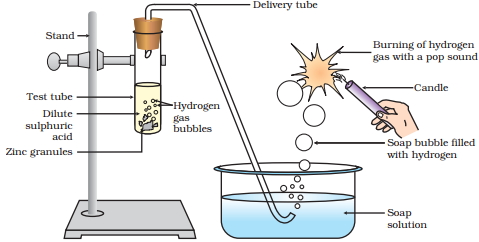
In the following schematic diagram for the preparation of hydrogen gas as shown in the Figure,what would happen if the following changes are made?
$(a)$ In place of zinc granules,the same amount of zinc dust is taken in the test tube.
$(b)$ Instead of dilute sulphuric acid,dilute hydrochloric acid is taken.
$(c)$ In place of zinc,copper turnings are taken.
$(d)$ Sodium hydroxide is taken in place of dilute sulphuric acid and the tube is heated.
Solution
(N/A) Hydrogen gas will evolve with greater speed because zinc dust has a larger surface area compared to zinc granules,which increases the rate of reaction.
$(b)$ Almost the same amount of hydrogen gas will be evolved as both are strong mineral acids.
$(c)$ Hydrogen gas will not be evolved because copper is less reactive than hydrogen and cannot displace it from the acid.
$(d)$ If sodium hydroxide is taken,hydrogen gas will be evolved upon heating:
$Zn + 2NaOH \to Na_2ZnO_2 + H_2$ (Sodium zincate is formed along with hydrogen gas).
0 likes
View Solution21
Medium
$A$ metal carbonate $X$ on reacting with an acid gives a gas which when passed through a solution $Y$ gives the carbonate back. On the other hand,a gas $G$ that is obtained at anode during electrolysis of brine is passed on dry $Y$,it gives a compound $Z$,used for disinfecting drinking water. Identify $X$,$Y$,$G$ and $Z$.
Solution
(X=CACO3, Y=CA(OH)2, G=CL2, Z=CAOCL2) $1$. The gas evolved at the anode during the electrolysis of brine ($NaCl$ solution) is chlorine gas $(G = Cl_2)$.
$2$. When chlorine gas is passed over dry slaked lime $(Y = Ca(OH)_2)$,it produces bleaching powder $(Z = CaOCl_2)$,which is used for disinfecting drinking water.
$3$. The reaction is: $Ca(OH)_2 + Cl_2 \rightarrow CaOCl_2 + H_2O$.
$4$. Since $Y$ is calcium hydroxide,the metal carbonate $X$ is calcium carbonate $(CaCO_3)$.
$5$. When $CaCO_3$ reacts with an acid (e.g.,$HCl$),it releases $CO_2$ gas: $CaCO_3 + 2HCl \rightarrow CaCl_2 + H_2O + CO_2$.
$6$. When this $CO_2$ is passed through lime water $(Ca(OH)_2)$,it turns milky due to the formation of $CaCO_3$: $Ca(OH)_2 + CO_2 \rightarrow CaCO_3 + H_2O$.
0 likes
View Solution22
Medium
$A$ dry pellet of a common base $B$,when kept in open,absorbs moisture and turns sticky. The compound is also a by-product of the chlor-alkali process. Identify $B$. What type of reaction occurs when $B$ is treated with an acidic oxide? Write a balanced chemical equation for one such reaction.
Solution
(N/A) The common base $B$ is Sodium hydroxide $(NaOH)$. It is a deliquescent substance,meaning it absorbs moisture from the atmosphere and becomes sticky.
The reaction between a base and an acidic oxide is a neutralization reaction,which produces salt and water.
When $NaOH$ reacts with carbon dioxide $(CO_2)$,which is an acidic oxide,the balanced chemical equation is:
$2NaOH + CO_2 \rightarrow Na_2CO_3 + H_2O$
The reaction between a base and an acidic oxide is a neutralization reaction,which produces salt and water.
When $NaOH$ reacts with carbon dioxide $(CO_2)$,which is an acidic oxide,the balanced chemical equation is:
$2NaOH + CO_2 \rightarrow Na_2CO_3 + H_2O$
0 likes
View Solution23
Medium
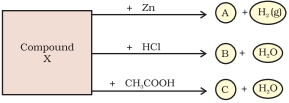
Identify the compound $X$ on the basis of the reactions given below. Also,write the name and chemical formulae of $A$,$B$ and $C$.
Solution
(N/A) Based on the given reactions:
$1$. $X + Zn \rightarrow A + H_2(g)$: $A$ base reacts with zinc to produce hydrogen gas. Thus,$X$ is a base,$NaOH$.
$2$. $X + HCl \rightarrow B + H_2O$: $A$ base reacts with an acid to form salt and water (neutralization). Thus,$B$ is $NaCl$.
$3$. $X + CH_3COOH \rightarrow C + H_2O$: $A$ base reacts with acetic acid to form salt and water. Thus,$C$ is $CH_3COONa$.
Final identifications:
$X = NaOH$ (Sodium hydroxide)
$A = Na_2ZnO_2$ (Sodium zincate)
$B = NaCl$ (Sodium chloride)
$C = CH_3COONa$ (Sodium acetate)
0 likes
View Solution24
EasyMCQ
What are the causes of acid rain?
A
Excessive use of fertilizers
B
Dissolution of acidic oxides of carbon,nitrogen,and sulphur in rainwater
C
Deforestation
D
Ozone layer depletion
Solution
(B) Acid rain is primarily caused by the emission of acidic oxides such as sulphur dioxide $(SO_2)$,nitrogen oxides $(NO_x)$,and carbon dioxide $(CO_2)$ into the atmosphere.
These gases are released mainly through the burning of fossil fuels,industrial processes,and vehicular emissions.
When these gases react with water vapor in the atmosphere,they form acids like sulphuric acid $(H_2SO_4)$,nitric acid $(HNO_3)$,and carbonic acid $(H_2CO_3)$.
These acids then dissolve in rainwater,lowering its $pH$ and resulting in acid rain.
0 likes
View Solution25
Easy
Name the gas evolved when dilute $HCl$ reacts with sodium hydrogen carbonate. How is it recognized?
Solution
(N/A) When dilute $HCl$ reacts with sodium hydrogen carbonate $(NaHCO_3)$,the gas evolved is carbon dioxide $(CO_2)$.
The chemical reaction is: $NaHCO_3 + HCl \rightarrow NaCl + H_2O + CO_2 \uparrow$.
This gas is recognized by passing it through lime water $(Ca(OH)_2)$. It turns the lime water milky due to the formation of insoluble calcium carbonate $(CaCO_3)$.
The chemical reaction is: $NaHCO_3 + HCl \rightarrow NaCl + H_2O + CO_2 \uparrow$.
This gas is recognized by passing it through lime water $(Ca(OH)_2)$. It turns the lime water milky due to the formation of insoluble calcium carbonate $(CaCO_3)$.
0 likes
View Solution26
EasyMCQ
Why is $HCl$ a stronger acid than acetic acid?
A
$HCl$ is a strong electrolyte while acetic acid is a weak electrolyte.
B
$HCl$ is a mineral acid while acetic acid is an organic acid.
C
$HCl$ dissociates completely in water,whereas acetic acid dissociates only partially.
D
All of the above.
Solution
(D) $HCl$ is a strong acid because it undergoes complete dissociation in an aqueous solution,releasing a high concentration of $H^+$ ions.
In contrast,acetic acid is a weak acid that undergoes only partial dissociation in water,resulting in a lower concentration of $H^+$ ions for the same molar concentration.
Therefore,due to the higher degree of ionization,$HCl$ exhibits stronger acidic properties.
In contrast,acetic acid is a weak acid that undergoes only partial dissociation in water,resulting in a lower concentration of $H^+$ ions for the same molar concentration.
Therefore,due to the higher degree of ionization,$HCl$ exhibits stronger acidic properties.
0 likes
View Solution27
Medium
Write balanced chemical equations for the following:
$(a)$ Calcium carbonate reacts with hydrochloric acid.
$(b)$ Calcium oxychloride reacts with hydrochloric acid.
$(c)$ Sodium hydroxide reacts with zinc.
$(a)$ Calcium carbonate reacts with hydrochloric acid.
$(b)$ Calcium oxychloride reacts with hydrochloric acid.
$(c)$ Sodium hydroxide reacts with zinc.
Solution
(N/A) Calcium carbonate reacts with hydrochloric acid to form calcium chloride,water,and carbon dioxide:
$CaCO_{3} + 2HCl \rightarrow CaCl_{2} + H_{2}O + CO_{2}$
$(b)$ Calcium oxychloride (bleaching powder) reacts with hydrochloric acid to form calcium chloride,water,and chlorine gas:
$CaOCl_{2} + 2HCl \rightarrow CaCl_{2} + H_{2}O + Cl_{2}$
$(c)$ Sodium hydroxide reacts with zinc to form sodium zincate and hydrogen gas:
$2NaOH + Zn \rightarrow Na_{2}ZnO_{2} + H_{2}$
0 likes
View Solution28
Medium
Identify $A, B$ and $C$ in the following reactions and write the chemical name of $A, B$ and $C$.
$(i)$ $HNO_{3} + NaOH \rightarrow \underline{A} + H_{2}O$
$(ii)$ $\underline{B} + Ca(OH)_{2} \rightarrow CaSO_{4} + 2H_{2}O$
$(iii)$ $HCl + \underline{C} \rightarrow KCl + H_{2}O$
$(i)$ $HNO_{3} + NaOH \rightarrow \underline{A} + H_{2}O$
$(ii)$ $\underline{B} + Ca(OH)_{2} \rightarrow CaSO_{4} + 2H_{2}O$
$(iii)$ $HCl + \underline{C} \rightarrow KCl + H_{2}O$
Solution
(N/A) The given reactions are neutralization reactions where an acid reacts with a base to form salt and water.
$(i)$ $HNO_{3} + NaOH \rightarrow NaNO_{3} + H_{2}O$. Here,$A$ is $NaNO_{3}$ (Sodium nitrate).
$(ii)$ $H_{2}SO_{4} + Ca(OH)_{2} \rightarrow CaSO_{4} + 2H_{2}O$. Here,$B$ is $H_{2}SO_{4}$ (Sulphuric acid).
$(iii)$ $HCl + KOH \rightarrow KCl + H_{2}O$. Here,$C$ is $KOH$ (Potassium hydroxide).
$(i)$ $HNO_{3} + NaOH \rightarrow NaNO_{3} + H_{2}O$. Here,$A$ is $NaNO_{3}$ (Sodium nitrate).
$(ii)$ $H_{2}SO_{4} + Ca(OH)_{2} \rightarrow CaSO_{4} + 2H_{2}O$. Here,$B$ is $H_{2}SO_{4}$ (Sulphuric acid).
$(iii)$ $HCl + KOH \rightarrow KCl + H_{2}O$. Here,$C$ is $KOH$ (Potassium hydroxide).
0 likes
View Solution29
Difficult
$(a)$ If we take hydrochloric acid and acetic acid of the same concentration,which one will produce a lower $H^{+}$ ion concentration? Out of the two,which one is a weak acid?
$(b)$ If someone is suffering from acidity,which of the following would you suggest to cure it: vinegar,orange juice,or baking soda solution? Give a reason for your answer.
$(b)$ If someone is suffering from acidity,which of the following would you suggest to cure it: vinegar,orange juice,or baking soda solution? Give a reason for your answer.
Solution
(D) $(i)$ Between hydrochloric acid and acetic acid of the same concentration,acetic acid will produce a lower concentration of $H^{+}$ ions because it is a weak acid that does not ionize completely in water.
$(ii)$ Acetic acid is the weak acid.
$(b)$ If someone is suffering from acidity,$I$ would suggest a baking soda solution to cure it. Baking soda is a mild base (sodium bicarbonate) that neutralizes the excess hydrochloric acid produced in the stomach,thereby providing relief.
$(ii)$ Acetic acid is the weak acid.
$(b)$ If someone is suffering from acidity,$I$ would suggest a baking soda solution to cure it. Baking soda is a mild base (sodium bicarbonate) that neutralizes the excess hydrochloric acid produced in the stomach,thereby providing relief.
0 likes
View Solution30
Medium
Give three practical applications of neutralisation reaction.
Solution
(N/A) $(i)$ Antacids are formulated based on the principle of neutralisation reaction to treat acidity.
$(ii)$ Toothpastes are basic in nature,which help in neutralising the excess acid produced in the mouth,thereby preventing tooth decay.
$(iii)$ Milkmen add a small amount of baking soda to milk to neutralise the lactic acid produced,which helps in preventing the milk from souring quickly.
$(ii)$ Toothpastes are basic in nature,which help in neutralising the excess acid produced in the mouth,thereby preventing tooth decay.
$(iii)$ Milkmen add a small amount of baking soda to milk to neutralise the lactic acid produced,which helps in preventing the milk from souring quickly.
0 likes
View Solution31
Easy
Write the chemical name and formula of the following:
$(a)$ Salt formed by the combination of a weak acid like carbonic acid and a strong base like sodium hydroxide.
$(b)$ Basic substance formed by the chlor-alkali process.
$(c)$ Substance added to cakes to make them fluffy.
$(a)$ Salt formed by the combination of a weak acid like carbonic acid and a strong base like sodium hydroxide.
$(b)$ Basic substance formed by the chlor-alkali process.
$(c)$ Substance added to cakes to make them fluffy.
Solution
(N/A) The salt formed by the reaction of carbonic acid $(H_{2}CO_{3})$ and sodium hydroxide $(NaOH)$ is sodium carbonate,with the formula $Na_{2}CO_{3}$.
$(b)$ The chlor-alkali process involves the electrolysis of brine $(NaCl$ solution$)$,which produces sodium hydroxide $(NaOH)$,chlorine gas,and hydrogen gas. The basic substance formed is sodium hydroxide $(NaOH)$.
$(c)$ Sodium hydrogen carbonate $(NaHCO_{3})$,also known as baking soda,is added to cakes. Upon heating,it releases carbon dioxide gas,which makes the cakes fluffy.
0 likes
View Solution32
Medium
Write balanced chemical equations for the reaction of dilute $HCl$ with:
$(i)$ $Zn$ metal.
$(ii)$ $Na_{2}CO_{3}$.
$(iii)$ $NaOH$.
$(i)$ $Zn$ metal.
$(ii)$ $Na_{2}CO_{3}$.
$(iii)$ $NaOH$.
Solution
(N/A) $(i)$ The reaction of zinc metal with dilute hydrochloric acid produces zinc chloride and hydrogen gas: $Zn(s) + 2HCl(aq) \rightarrow ZnCl_{2}(aq) + H_{2}(g)$.
$(ii)$ The reaction of sodium carbonate with dilute hydrochloric acid produces sodium chloride,water,and carbon dioxide gas: $Na_{2}CO_{3}(s) + 2HCl(aq) \rightarrow 2NaCl(aq) + H_{2}O(l) + CO_{2}(g)$.
$(iii)$ The reaction of sodium hydroxide (a base) with dilute hydrochloric acid (an acid) is a neutralization reaction producing sodium chloride and water: $NaOH(aq) + HCl(aq) \rightarrow NaCl(aq) + H_{2}O(l)$.
0 likes
View Solution33
Medium
Complete and balance the following chemical equations:
$(a)$ $Ca(OH)_{2} + Cl_{2} \longrightarrow$
$(b)$ $CaSO_{4} \cdot 1/2 H_{2}O + H_{2}O \longrightarrow$
$(c)$ $Na_{2}CO_{3} \cdot 10H_{2}O \xrightarrow{\text{air}} \dots$
$(a)$ $Ca(OH)_{2} + Cl_{2} \longrightarrow$
$(b)$ $CaSO_{4} \cdot 1/2 H_{2}O + H_{2}O \longrightarrow$
$(c)$ $Na_{2}CO_{3} \cdot 10H_{2}O \xrightarrow{\text{air}} \dots$
Solution
(N/A) $Ca(OH)_{2} + Cl_{2} \longrightarrow CaOCl_{2} + H_{2}O$ (Bleaching powder is formed).
$(b)$ $CaSO_{4} \cdot 1/2 H_{2}O + 1 \frac{1}{2} H_{2}O \longrightarrow CaSO_{4} \cdot 2H_{2}O$ (Gypsum is formed).
$(c)$ $Na_{2}CO_{3} \cdot 10H_{2}O \xrightarrow{\text{air}} Na_{2}CO_{3} \cdot H_{2}O + 9H_{2}O$ (Efflorescence occurs,forming sodium carbonate monohydrate).
$(b)$ $CaSO_{4} \cdot 1/2 H_{2}O + 1 \frac{1}{2} H_{2}O \longrightarrow CaSO_{4} \cdot 2H_{2}O$ (Gypsum is formed).
$(c)$ $Na_{2}CO_{3} \cdot 10H_{2}O \xrightarrow{\text{air}} Na_{2}CO_{3} \cdot H_{2}O + 9H_{2}O$ (Efflorescence occurs,forming sodium carbonate monohydrate).
0 likes
View Solution34
Medium
Explain why:
$(a)$ the colour of copper sulphate crystals changes on heating?
$(b)$ baking soda acts as an antacid?
$(c)$ an acid should be added to water while diluting?
$(a)$ the colour of copper sulphate crystals changes on heating?
$(b)$ baking soda acts as an antacid?
$(c)$ an acid should be added to water while diluting?
Solution
(N/A) Copper sulphate pentahydrate $(CuSO_4 \cdot 5H_2O)$ crystals are blue due to the presence of $5$ molecules of water of crystallisation. On heating, they lose these water molecules and become anhydrous copper sulphate $(CuSO_4)$, which is white in colour.
$(b)$ Baking soda $(NaHCO_3)$ is mildly alkaline in nature. When taken, it reacts with the excess hydrochloric acid $(HCl)$ produced in the stomach, neutralising it and providing relief from acidity.
$(c)$ The process of diluting a concentrated acid is highly exothermic. If water is added to a concentrated acid, the large amount of heat generated can cause the mixture to splash out, potentially causing severe acid burns. Therefore, acid is always added to water slowly with constant stirring.
0 likes
View Solution35
Medium
$(a)$ What will you observe when dilute hydrochloric acid is added to a small amount of copper oxide in a beaker?
$(b)$ Aqueous solution of $HCl$ shows acidic character. But the aqueous solution of glucose fails to do so. Why?
$(b)$ Aqueous solution of $HCl$ shows acidic character. But the aqueous solution of glucose fails to do so. Why?
Solution
(N/A) The colour of the solution becomes blue-green and the copper oxide dissolves. The chemical reaction is: $CuO + 2HCl \rightarrow CuCl_2 + H_2O$.
$(b)$ Aqueous solution of $HCl$ dissociates to produce $H^+$ ions,which are responsible for its acidic character. However,glucose $(C_6H_{12}O_6)$ is a covalent compound that does not dissociate into ions in water; therefore,it does not produce $H^+$ ions and fails to show acidic character.
$(b)$ Aqueous solution of $HCl$ dissociates to produce $H^+$ ions,which are responsible for its acidic character. However,glucose $(C_6H_{12}O_6)$ is a covalent compound that does not dissociate into ions in water; therefore,it does not produce $H^+$ ions and fails to show acidic character.
0 likes
View Solution36
Medium
Write the balanced chemical equations for the following reactions:
$(a)$ Chlorine is passed over dry slaked lime.
$(b)$ Sodium bicarbonate reacts with dilute hydrochloric acid.
$(c)$ Sodium bicarbonate is heated.
$(a)$ Chlorine is passed over dry slaked lime.
$(b)$ Sodium bicarbonate reacts with dilute hydrochloric acid.
$(c)$ Sodium bicarbonate is heated.
Solution
(N/A) When chlorine is passed over dry slaked lime $(Ca(OH)_2)$,it forms bleaching powder $(CaOCl_2)$ and water $(H_2O)$. The balanced equation is: $Ca(OH)_2 + Cl_2 \rightarrow CaOCl_2 + H_2O$
$(b)$ When sodium bicarbonate $(NaHCO_3)$ reacts with dilute hydrochloric acid $(HCl)$,it produces sodium chloride $(NaCl)$,water $(H_2O)$,and carbon dioxide $(CO_2)$. The balanced equation is: $NaHCO_3 + HCl \rightarrow NaCl + H_2O + CO_2$
$(c)$ When sodium bicarbonate $(NaHCO_3)$ is heated,it undergoes thermal decomposition to form sodium carbonate $(Na_2CO_3)$,water $(H_2O)$,and carbon dioxide $(CO_2)$. The balanced equation is: $2NaHCO_3 \xrightarrow{\Delta} Na_2CO_3 + H_2O + CO_2$
0 likes
View Solution37
Medium
$(a)$ What is a universal indicator?
$(b)$ Write the chemical equation involved in the preparation of sodium hydroxide. Name the process.
$(b)$ Write the chemical equation involved in the preparation of sodium hydroxide. Name the process.
Solution
(N/A) universal indicator is a mixture of several indicators that exhibits different colours at different concentrations of hydrogen ions in a solution,allowing for the determination of the $pH$ value.
$(b)$ The process is known as the Chlor-alkali process. The chemical equation is: $2NaCl(aq) + 2H_2O(l) \rightarrow 2NaOH(aq) + Cl_2(g) + H_2(g)$.
$(b)$ The process is known as the Chlor-alkali process. The chemical equation is: $2NaCl(aq) + 2H_2O(l) \rightarrow 2NaOH(aq) + Cl_2(g) + H_2(g)$.
0 likes
View Solution38
Difficult
Equal lengths of magnesium ribbon are taken in two test tubes $A$ and $B$. $H_{2}SO_{4}$ is added to test tube $A$ and $H_{2}CO_{3}$ in test tube $B$ in equal amounts.
$(a)$ Identify the test tube showing vigorous reaction.
$(b)$ Give reason to support your answer.
$(c)$ Name the gas liberated in both the test tubes. How will you prove its liberation?
$(a)$ Identify the test tube showing vigorous reaction.
$(b)$ Give reason to support your answer.
$(c)$ Name the gas liberated in both the test tubes. How will you prove its liberation?
Solution
(A) Vigorous reaction will be seen in test tube $A$.
$(b)$ This is because $H_{2}SO_{4}$ is a strong acid,whereas $H_{2}CO_{3}$ is a weak acid.
$(c)$ $(i)$ Hydrogen gas $(H_{2})$ is liberated in both test tubes.
$(ii)$ When a burning candle is brought near the evolving gas,it burns with a 'pop' sound. This confirms the presence of hydrogen gas.
$(b)$ This is because $H_{2}SO_{4}$ is a strong acid,whereas $H_{2}CO_{3}$ is a weak acid.
$(c)$ $(i)$ Hydrogen gas $(H_{2})$ is liberated in both test tubes.
$(ii)$ When a burning candle is brought near the evolving gas,it burns with a 'pop' sound. This confirms the presence of hydrogen gas.
0 likes
View Solution39
Difficult
Equal lengths of magnesium ribbon are taken in two test tubes $A$ and $B$. $H_{2}SO_{4}$ is added to test tube $A$ and $H_{2}CO_{3}$ is added to test tube $B$ in equal amounts.
$(a)$ Write chemical equations for both the reactions.
$(b)$ Out of the two acids taken above,which one will have a lower $pH$ value and lower $H^{+}$ concentration,respectively?
$(a)$ Write chemical equations for both the reactions.
$(b)$ Out of the two acids taken above,which one will have a lower $pH$ value and lower $H^{+}$ concentration,respectively?
Solution
(B) The chemical equations for the reactions are:
$Mg(s) + H_{2}SO_{4}(aq) \rightarrow MgSO_{4}(aq) + H_{2}(g)$
$Mg(s) + H_{2}CO_{3}(aq) \rightarrow MgCO_{3}(s) + H_{2}(g)$
$(b)$ $H_{2}SO_{4}$ is a strong acid,while $H_{2}CO_{3}$ is a weak acid.
Therefore,$H_{2}SO_{4}$ will have a lower $pH$ value because it dissociates completely to provide a higher concentration of $H^{+}$ ions.
Conversely,$H_{2}CO_{3}$ will have a lower $H^{+}$ concentration because it is a weak acid and dissociates only partially.
0 likes
View Solution40
Medium
$(a)$ Identify the acid and the base whose combination forms the common salt that you use in your food. Write its formula and chemical name of this salt. Name the source from where it is obtained.
$(b)$ What is rock salt? Mention its colour and the reason due to which it has this colour.
$(c)$ What happens when electricity is passed through brine? Write the chemical equation for it.
$(b)$ What is rock salt? Mention its colour and the reason due to which it has this colour.
$(c)$ What happens when electricity is passed through brine? Write the chemical equation for it.
Solution
(N/A) The common salt used in food is sodium chloride $(NaCl)$. It is formed by the combination of hydrochloric acid $(HCl)$ and sodium hydroxide $(NaOH)$. The primary source of common salt is seawater (ocean water).
$(b)$ Rock salt refers to large deposits of solid salt found in several parts of the world. It is often brown in colour due to the presence of impurities.
$(c)$ When electricity is passed through an aqueous solution of sodium chloride (brine),it decomposes to form sodium hydroxide,chlorine gas,and hydrogen gas. This process is known as the chlor-alkali process. The chemical equation is: $2NaCl(aq) + 2H_2O(l) \xrightarrow{\text{Electricity}} 2NaOH(aq) + Cl_2(g) + H_2(g)$.
0 likes
View Solution41
Medium
$(a)$ Tooth enamel is one of the hardest substances in our body. Explain the changes in $pH$ of the mouth that indicate tooth decay. How does toothpaste help in preventing it?
$(b)$ What is the nature of the salt if the $pH$ of its solution is greater than $7$? Name the acid and base that would be used to prepare the following salts:
$(i)$ Potassium sulphate.
$(ii)$ Ammonium chloride.
$(b)$ What is the nature of the salt if the $pH$ of its solution is greater than $7$? Name the acid and base that would be used to prepare the following salts:
$(i)$ Potassium sulphate.
$(ii)$ Ammonium chloride.
Solution
(N/A) Tooth decay starts when the $pH$ of the mouth falls below $5.5$. This occurs when bacteria present in the mouth produce acids by degrading sugar and food particles remaining in the mouth after eating. Using toothpaste,which is generally basic,helps neutralize the excess acid and prevents tooth decay.
$(b)$ If the $pH$ of a salt solution is greater than $7$,the nature of the salt is basic.
$(i)$ For Potassium sulphate $(K_2SO_4)$: Base is $KOH$ (Potassium hydroxide) and Acid is $H_2SO_4$ (Sulphuric acid).
$(ii)$ For Ammonium chloride $(NH_4Cl)$: Base is $NH_4OH$ (Ammonium hydroxide) and Acid is $HCl$ (Hydrochloric acid).
0 likes
View Solution42
Medium
Give suitable reasons for the following statements: An aqueous solution of sodium chloride is neutral,but an aqueous solution of sodium is basic.
Solution
(N/A) An aqueous solution of sodium chloride $(NaCl)$ is neutral because it is a salt formed from the neutralization reaction between a strong acid $(HCl)$ and a strong base $(NaOH)$. Since both components are strong,the resulting salt solution does not undergo hydrolysis to change the $pH$ of the water,remaining at $pH = 7$.
An aqueous solution of sodium $(Na)$ is basic because sodium is a highly reactive alkali metal. When it reacts with water,it produces sodium hydroxide $(NaOH)$,which is a strong base,and hydrogen gas $(H_2)$. The presence of $NaOH$ in the solution increases the concentration of hydroxide ions $(OH^-)$,making the solution basic.
The chemical reaction is: $2Na(s) + 2H_2O(l) \longrightarrow 2NaOH(aq) + H_2(g)$
0 likes
View Solution43
Medium
Differentiate between strong electrolytes and weak electrolytes. Mention two examples each.
Solution
(N/A) Strong electrolytes are substances that dissociate completely into ions when dissolved in an aqueous solution. They conduct electricity very well due to the high concentration of ions. Examples: $NaCl$ (Sodium chloride) and $HCl$ (Hydrochloric acid).
Weak electrolytes are substances that dissociate only partially into ions in an aqueous solution. They conduct electricity poorly because only a small fraction of the molecules exist as ions. Examples: $CH_{3}COOH$ (Acetic acid) and $NH_{4}OH$ (Ammonium hydroxide).
Weak electrolytes are substances that dissociate only partially into ions in an aqueous solution. They conduct electricity poorly because only a small fraction of the molecules exist as ions. Examples: $CH_{3}COOH$ (Acetic acid) and $NH_{4}OH$ (Ammonium hydroxide).
0 likes
View Solution44
Medium
Explain the action of dilute hydrochloric acid on the following with chemical equations:
$(a)$ Magnesium ribbon
$(b)$ Sodium hydroxide
$(c)$ Crushed egg shells
$(a)$ Magnesium ribbon
$(b)$ Sodium hydroxide
$(c)$ Crushed egg shells
Solution
(N/A) Dilute hydrochloric acid reacts with magnesium to form magnesium chloride and hydrogen gas is liberated.
$Mg(s) + 2HCl(aq) \longrightarrow MgCl_2(aq) + H_2(g)$
$(b)$ The reaction between dilute hydrochloric acid and sodium hydroxide is a neutralization reaction,forming sodium chloride salt and water.
$NaOH(aq) + HCl(aq) \longrightarrow NaCl(aq) + H_2O(l)$
$(c)$ Egg shells are primarily composed of calcium carbonate $(CaCO_3)$. Dilute hydrochloric acid reacts with calcium carbonate to produce calcium chloride,carbon dioxide gas,and water.
$CaCO_3(s) + 2HCl(aq) \longrightarrow CaCl_2(aq) + CO_2(g) + H_2O(l)$
0 likes
View Solution45
Medium
Give reasons for the following:
$(i)$ Why is it recommended that acid should be added to water and not water to acid?
$(ii)$ Why do compounds like alcohol and glucose not show acidic behavior even though they contain hydrogen?
$(i)$ Why is it recommended that acid should be added to water and not water to acid?
$(ii)$ Why do compounds like alcohol and glucose not show acidic behavior even though they contain hydrogen?
Solution
(N/A) $(i)$ The process of diluting a concentrated acid is a highly exothermic reaction. If water is added to a concentrated acid,the large amount of heat generated can cause the mixture to splash out,potentially leading to severe acid burns.
$(ii)$ Compounds like alcohol and glucose contain hydrogen,but they do not dissociate to release hydrogen ions $(H^+)$ when dissolved in water. Since acidic behavior is defined by the presence of $H^+$ ions in an aqueous solution,these compounds do not exhibit acidic properties.
$(ii)$ Compounds like alcohol and glucose contain hydrogen,but they do not dissociate to release hydrogen ions $(H^+)$ when dissolved in water. Since acidic behavior is defined by the presence of $H^+$ ions in an aqueous solution,these compounds do not exhibit acidic properties.
0 likes
View Solution46
Medium
Answer the following:
$(i)$ Why is Plaster of Paris written as $CaSO_{4} \cdot 1/2 H_{2}O$? How is it possible to have half a water molecule attached to $CaSO_{4}$?
$(ii)$ Why is sodium hydrogen carbonate an essential ingredient in antacids?
$(iii)$ When electricity is passed through an aqueous solution of sodium chloride,three products are obtained. Why is the process called chlor-alkali?
Solution
(N/A) $(i)$ Plaster of Paris is written as $CaSO_{4} \cdot 1/2 H_{2}O$ because two formula units of $CaSO_{4}$ share one molecule of water of crystallization. This means that one water molecule is associated with two $CaSO_{4}$ units,effectively resulting in $1/2 H_{2}O$ per unit.
$(ii)$ Sodium hydrogen carbonate $(NaHCO_{3})$ is a mild,non-corrosive basic salt. It acts as an antacid by neutralizing the excess hydrochloric acid $(HCl)$ produced in the stomach,thereby providing relief from acidity.
$(iii)$ The electrolysis of an aqueous solution of sodium chloride (brine) produces chlorine gas $(Cl_{2})$ at the anode and sodium hydroxide $(NaOH)$,which is an alkali,at the cathode. Due to the formation of these two specific products,the process is termed the chlor-alkali process.
0 likes
View Solution47
MediumMCQ
What happens when a solution of an acid is mixed with a solution of a base in a test tube?
$(i)$ The temperature of the solution increases
$(ii)$ The temperature of the solution decreases
$(iii)$ The temperature of the solution remains the same
$(iv)$ Salt formation takes place
$(i)$ The temperature of the solution increases
$(ii)$ The temperature of the solution decreases
$(iii)$ The temperature of the solution remains the same
$(iv)$ Salt formation takes place
A
$(i)$ and $(iv)$
B
$(i)$ and $(iii)$
C
$(ii)$ and $(iii)$
D
$(i)$ only
Solution
(A) When an acid reacts with a base,a neutralization reaction occurs.
This reaction is exothermic in nature,meaning heat is released,which causes the temperature of the solution to increase.
The products formed in this reaction are salt and water.
Therefore,both statement $(i)$ (temperature increases) and statement $(iv)$ (salt formation takes place) are correct.
This reaction is exothermic in nature,meaning heat is released,which causes the temperature of the solution to increase.
The products formed in this reaction are salt and water.
Therefore,both statement $(i)$ (temperature increases) and statement $(iv)$ (salt formation takes place) are correct.
0 likes
View Solution48
DifficultMCQ
The $pH$ of a water sample collected from a river was found to be acidic in the range of $3.5-4.5$. On the banks of the river were several factories that were discharging effluents into the river. The effluents of which one of the following factories is the most likely cause for lowering the $pH$ of river water?
A
Soap and detergent factory
B
Lead battery manufacturing factory
C
Plastic cup manufacturing factory
D
Alcohol distillery
Solution
(B) The $pH$ range of $3.5-4.5$ indicates that the river water is highly acidic.
Lead battery manufacturing factories typically use sulfuric acid $(H_2SO_4)$ in their production processes.
If the effluents from these factories are discharged into the river without proper treatment,the sulfuric acid significantly lowers the $pH$ of the water,making it acidic.
Soap and detergent factories often release alkaline substances,while plastic and alcohol industries do not typically release strong mineral acids as their primary effluent that would cause such a drastic drop in $pH$.
0 likes
View Solution49
EasyMCQ
What makes the electric current flow through an electrolyte?
A
Only free electrons
B
Only positive ions
C
Only negative ions
D
Positive and negative ions
Solution
(D) An electrolyte is a substance that produces an electrically conducting solution when dissolved in a polar solvent,such as water.
When an electric potential is applied across an electrolyte,the dissolved solute dissociates into charged particles called ions.
The positive ions (cations) move towards the cathode (negative electrode),and the negative ions (anions) move towards the anode (positive electrode).
Therefore,the flow of electric current through an electrolyte is due to the movement of both positive and negative ions.
0 likes
View Solution50
EasyMCQ
$500 \ ml$ aqueous solution is prepared by dissolving $2$ moles of $HCl$ in water. What will be the molarity of this solution (in $M$)?
A
$1$
B
$2$
C
$3$
D
$4$
Solution
(D) Molarity $(M)$ is defined as the number of moles of solute dissolved per liter of solution.
Formula: $M = \frac{\text{moles of solute}}{\text{volume of solution in liters}}$
Given:
Moles of solute $(HCl)$ = $2 \ mol$
Volume of solution = $500 \ ml = 0.5 \ L$
Calculation:
$M = \frac{2 \ mol}{0.5 \ L} = 4 \ M$
Therefore,the molarity of the solution is $4 \ M$.
Formula: $M = \frac{\text{moles of solute}}{\text{volume of solution in liters}}$
Given:
Moles of solute $(HCl)$ = $2 \ mol$
Volume of solution = $500 \ ml = 0.5 \ L$
Calculation:
$M = \frac{2 \ mol}{0.5 \ L} = 4 \ M$
Therefore,the molarity of the solution is $4 \ M$.
0 likes
View SolutionAcids, Bases and Salts — Mix Examples - Acids, Bases and Salts · Frequently Asked Questions
1Are these Acids, Bases and Salts questions useful for JEE and NEET?
Yes. All questions in this section are mapped to JEE Main and NEET exam patterns. Previous year questions from JEE Main, NEET, GUJCET and state-level exams are included with full solutions.
2Can I switch to Hindi or Gujarati for these questions?
Yes. Use the language tabs in the hero section or the sidebar to view the same questions and solutions in English, Hindi or Gujarati.
3How do I generate a question paper from this subtopic?
Use the Vedclass Exam Paper Generator — select the chapter and subtopic, set difficulty, and generate Sets A, B, C, D automatically. First 3 chapters of every subject are free.
Vedclass Products
For Students
Vedclass Test Series
Mock tests in real JEE/NEET style with performance analysis. 5-day free trial.
Start Free TrialFor Teachers
Exam Paper Generator
Generate Set A/B/C/D papers from this chapter in 2 minutes. 3 chapters free.
Try FreeFor Institutes
Online Exam Module
Live online exams with unlimited students, 360° analytics & white-label branding.
See DemoFor Teachers & Institutes
Generate a Acids, Bases and Salts Exam Paper in 2 Minutes
Select subtopic & difficulty — Sets A, B, C, D auto-generated with No Repeat logic.
First 3 chapters of every subject are free — no payment required.