
A English
Ethanol and Ethanoic Acid Questions in English
Class 10 Science · Carbon and its Compounds · Ethanol and Ethanoic Acid
80+
Questions
English
Language
100%
With Solutions
Showing 50 of 80 questions in English
1
Difficult
Draw the structures for the following compounds:
$(i)$ Ethanoic acid
$(ii)$ Bromopentane
Are structural isomers possible for bromopentane?
$(i)$ Ethanoic acid
$(ii)$ Bromopentane
Are structural isomers possible for bromopentane?
Solution
(N/A) $(i)$ Ethanoic acid $(CH_{3}COOH)$:
$H-C(H)(H)-C(=O)-OH$
$(ii)$ Yes,structural isomers are possible for bromopentane $(C_{5}H_{11}Br)$. Three common isomers are:
$1$. $1$-Bromopentane: $CH_{3}-CH_{2}-CH_{2}-CH_{2}-CH_{2}-Br$
$2$. $2$-Bromopentane: $CH_{3}-CH_{2}-CH_{2}-CH(Br)-CH_{3}$
$3$. $3$-Bromopentane: $CH_{3}-CH_{2}-CH(Br)-CH_{2}-CH_{3}$
0 likes
View Solution2
Medium
Why is the conversion of ethanol to ethanoic acid an oxidation reaction?
Solution
(N/A) The chemical reaction is represented as: $\text{CH}_3\text{CH}_2\text{OH} \xrightarrow{[O]} \text{CH}_3\text{COOH}$.
An oxidation reaction is defined as the addition of oxygen or the removal of hydrogen from a substance.
In the conversion of ethanol $(\text{CH}_3\text{CH}_2\text{OH})$ to ethanoic acid $(\text{CH}_3\text{COOH})$, an oxygen atom is added to the molecule.
Since oxygen is added to ethanol to form ethanoic acid, this process is classified as an oxidation reaction.
0 likes
View Solution3
Medium
$A$ mixture of oxygen and ethyne is burnt for welding. Can you tell why a mixture of ethyne and air is not used?
Solution
(N/A) The chemical reaction for the combustion of ethyne is: $2HC \equiv CH + 5O_2 \to 4CO_2 + 2H_2O + \text{Heat}$.
When ethyne is burnt in air,it produces a sooty flame due to incomplete combustion caused by the limited supply of oxygen in the air.
However,when ethyne is burnt with pure oxygen,it undergoes complete combustion,producing a clean,high-temperature flame reaching approximately $3000 \, ^\circ C$.
This oxy-acetylene flame provides the necessary heat for welding metals.
It is not possible to attain such a high temperature using only air,which is why a mixture of ethyne and air is not used for welding.
0 likes
View Solution4
MediumMCQ
How would you distinguish experimentally between an alcohol and a carboxylic acid?
A
By adding sodium carbonate solution.
B
By adding sodium hydroxide solution.
C
By adding water.
D
By adding sodium chloride solution.
Solution
(A) We can distinguish between an alcohol and a carboxylic acid based on their reaction with carbonates and hydrogen carbonates.
Carboxylic acids react with metal carbonates and metal hydrogen carbonates to evolve $CO_2$ gas,which turns lime water milky.
Reaction: $\text{Metal Carbonate} / \text{Metal Hydrogen carbonate} + \text{Carboxylic acid} \rightarrow \text{Salt} + \text{Water} + \text{Carbon dioxide}$.
Alcohols,on the other hand,do not react with carbonates or hydrogen carbonates,so no gas is evolved.
0 likes
View Solution5
Difficult
How can ethanol and ethanoic acid be differentiated on the basis of their physical and chemical properties?
Solution
(N/A) Physical Properties:
$1$. Odour: Ethanol has a pleasant,characteristic alcoholic odour,whereas ethanoic acid has a pungent,vinegar-like smell.
$2$. Melting Point: The melting point of ethanoic acid is $17\,^{\circ}C$,which is below room temperature,causing it to freeze in winter. Ethanol has a much lower melting point $(-114\,^{\circ}C)$ and remains liquid at room temperature.
Chemical Properties:
$1$. Reaction with Carbonates/Hydrogencarbonates: Ethanoic acid reacts with metal carbonates and metal hydrogencarbonates to evolve $CO_{2}$ gas,which turns lime water milky. Ethanol does not react with these compounds.
Reaction:
$2CH_{3}COOH + Na_{2}CO_{3} \longrightarrow 2CH_{3}COONa + H_{2}O + CO_{2} \uparrow$
$CH_{3}CH_{2}OH + Na_{2}CO_{3} \longrightarrow \text{No reaction}$
0 likes
View Solution6
EasyMCQ
Ethanol reacts with sodium and forms two products. These are
A
sodium ethoxide and hydrogen
B
sodium ethanoate and oxygen
C
sodium ethanoate and hydrogen
D
sodium ethoxide and oxygen
Solution
(A) When ethanol $(C_2H_5OH)$ reacts with sodium metal $(Na)$,it undergoes a substitution reaction where the hydrogen atom of the hydroxyl group is replaced by sodium.
The chemical equation for this reaction is:
$2C_2H_5OH + 2Na \rightarrow 2C_2H_5ONa + H_2 \uparrow$
In this reaction,$C_2H_5ONa$ (sodium ethoxide) and $H_2$ (hydrogen gas) are formed.
Therefore,the correct products are sodium ethoxide and hydrogen.
The chemical equation for this reaction is:
$2C_2H_5OH + 2Na \rightarrow 2C_2H_5ONa + H_2 \uparrow$
In this reaction,$C_2H_5ONa$ (sodium ethoxide) and $H_2$ (hydrogen gas) are formed.
Therefore,the correct products are sodium ethoxide and hydrogen.
0 likes
View Solution7
MediumMCQ
The correct structural formula of butanoic acid is
A
$CH_2=CH-CH_2-COOH$
B
$CH_3-CH_2-CH_2-COOH$
C
$CH_3-CH_2-CH_2-CH_2-OH$
D
$CH_3-CH_2-CH_2-CH_2-CH_2-COOH$
Solution
(B) Butanoic acid is a carboxylic acid with a four-carbon chain. The general formula for a carboxylic acid is $R-COOH$. For butanoic acid,the chain length is $n=4$. The structure is $CH_3-CH_2-CH_2-COOH$. Option $B$ correctly represents this structure,where the carbon atoms are bonded in a linear chain and the terminal carbon is part of the carboxyl group $(-COOH)$.
0 likes
View Solution8
EasyMCQ
Vinegar is a solution of
A
$50 \%-60 \%$ acetic acid in alcohol
B
$5 \%-8 \%$ acetic acid in alcohol
C
$5 \%-8 \%$ acetic acid in water
D
$50 \%-60 \%$ acetic acid in water
Solution
(C) Vinegar is a common household substance used for cooking and preservation.
It is chemically defined as a dilute solution of acetic acid $(CH_3COOH)$.
The standard concentration of acetic acid in vinegar typically ranges from $5 \%$ to $8 \%$ by volume.
The solvent used in this solution is water.
Therefore,vinegar is a $5 \%-8 \%$ solution of acetic acid in water.
It is chemically defined as a dilute solution of acetic acid $(CH_3COOH)$.
The standard concentration of acetic acid in vinegar typically ranges from $5 \%$ to $8 \%$ by volume.
The solvent used in this solution is water.
Therefore,vinegar is a $5 \%-8 \%$ solution of acetic acid in water.
0 likes
View Solution9
Easy
Draw the electron dot structure of ethyne and also draw its structural formula.
Solution
(N/A) The chemical formula of ethyne is $C_2H_2$.
In ethyne, there is a triple bond between the two carbon atoms and a single bond between each carbon atom and a hydrogen atom.
Electron dot structure: $H : C \vdots \vdots C : H$
Structural formula: $H - C \equiv C - H$
In ethyne, there is a triple bond between the two carbon atoms and a single bond between each carbon atom and a hydrogen atom.
Electron dot structure: $H : C \vdots \vdots C : H$
Structural formula: $H - C \equiv C - H$
0 likes
View Solution10
Difficult
$A$ compound $X$ is formed by the reaction of a carboxylic acid $C_{2}H_{4}O_{2}$ and an alcohol in the presence of a few drops of $H_{2}SO_{4}$. The alcohol,upon oxidation with alkaline $KMnO_{4}$ followed by acidification,gives the same carboxylic acid as used in this reaction. Give the names and structures of $(a)$ carboxylic acid,$(b)$ alcohol,and $(c)$ the compound $X$. Also,write the chemical reaction.
Solution
(A) The carboxylic acid is ethanoic acid $(CH_{3}COOH)$.
$(b)$ The alcohol is ethanol $(C_{2}H_{5}OH)$.
$(c)$ The compound $X$ is ethyl ethanoate $(CH_{3}COOC_{2}H_{5})$.
The reaction is an esterification reaction:
$CH_{3}COOH + C_{2}H_{5}OH \xrightarrow{H_{2}SO_{4}} CH_{3}COOC_{2}H_{5} + H_{2}O$
$(b)$ The alcohol is ethanol $(C_{2}H_{5}OH)$.
$(c)$ The compound $X$ is ethyl ethanoate $(CH_{3}COOC_{2}H_{5})$.
The reaction is an esterification reaction:
$CH_{3}COOH + C_{2}H_{5}OH \xrightarrow{H_{2}SO_{4}} CH_{3}COOC_{2}H_{5} + H_{2}O$
0 likes
View Solution11
Medium
How is ethene prepared from ethanol? Give the reaction involved in it.
Solution
(N/A) Ethanol,when heated with excess concentrated sulphuric acid $(H_{2}SO_{4})$ at $443\, K$,undergoes dehydration to produce ethene.
The chemical reaction is as follows:
$CH_{3}CH_{2}OH \xrightarrow[443\, K]{\text{Hot conc. } H_{2}SO_{4}} CH_{2}=CH_{2} + H_{2}O$
The chemical reaction is as follows:
$CH_{3}CH_{2}OH \xrightarrow[443\, K]{\text{Hot conc. } H_{2}SO_{4}} CH_{2}=CH_{2} + H_{2}O$
0 likes
View Solution12
Easy
Intake of small quantity of methanol can be lethal. Comment.
Solution
(N/A) Methanol is oxidized to methanal in the liver.
Methanal reacts rapidly with the components of cells.
It causes the protoplasm to coagulate.
It also affects the optic nerve,causing blindness.
Methanal reacts rapidly with the components of cells.
It causes the protoplasm to coagulate.
It also affects the optic nerve,causing blindness.
0 likes
View Solution13
Medium
$A$ gas is evolved when ethanol reacts with sodium. Name the gas evolved and also write the balanced chemical equation of the reaction involved.
Solution
(N/A) When ethanol $(CH_{3}CH_{2}OH)$ reacts with sodium metal $(Na)$,it forms sodium ethoxide $(CH_{3}CH_{2}ONa)$ and releases hydrogen gas $(H_{2})$.
The balanced chemical equation for this reaction is:
$2CH_{3}CH_{2}OH + 2Na \rightarrow 2CH_{3}CH_{2}ONa + H_{2}$
The balanced chemical equation for this reaction is:
$2CH_{3}CH_{2}OH + 2Na \rightarrow 2CH_{3}CH_{2}ONa + H_{2}$
0 likes
View Solution14
Medium
Ethene is formed when ethanol at $443\, K$ is heated with excess of concentrated sulphuric acid. What is the role of sulphuric acid in this reaction? Write the balanced chemical equation of this reaction.
Solution
(N/A) In this reaction,concentrated sulphuric acid acts as a dehydrating agent,which removes a water molecule from the ethanol molecule.
The balanced chemical equation is:
$CH_3CH_2OH \xrightarrow[443\, K]{\text{Hot conc. } H_2SO_4} CH_2=CH_2 + H_2O$
The balanced chemical equation is:
$CH_3CH_2OH \xrightarrow[443\, K]{\text{Hot conc. } H_2SO_4} CH_2=CH_2 + H_2O$
0 likes
View Solution15
Medium
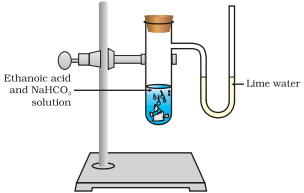
$A$ salt $X$ is formed and a gas is evolved when ethanoic acid reacts with sodium hydrogencarbonate. Name the salt $X$ and the gas evolved. Describe an activity and draw the diagram of the apparatus to prove that the evolved gas is the one which you have named. Also,write the chemical equation of the reaction involved.
Solution
(N/A) The chemical equation for the reaction is:
$CH_{3}COOH + NaHCO_{3} \rightarrow CH_{3}COONa + H_{2}O + CO_{2}$
$X$ is sodium ethanoate $(CH_{3}COONa)$.
The gas evolved is carbon dioxide $(CO_{2})$.
Activity:
$1$. Take a test tube and add a small amount of sodium hydrogencarbonate $(NaHCO_{3})$ to it.
$2$. Add a few drops of ethanoic acid $(CH_{3}COOH)$ to the test tube.
$3$. You will observe effervescence due to the evolution of a gas.
$4$. Pass this gas through a delivery tube into another test tube containing lime water $(Ca(OH)_{2})$.
$5$. The lime water will turn milky,which confirms that the evolved gas is carbon dioxide $(CO_{2})$.
Chemical reaction with lime water:
$Ca(OH)_{2} + CO_{2} \rightarrow CaCO_{3} + H_{2}O$
0 likes
View Solution16
Medium
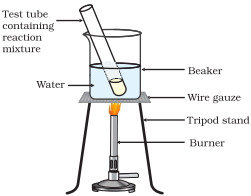
Esters are sweet-smelling substances and are used in making perfumes. Suggest an activity and the reaction involved for the preparation of an ester with a well-labeled diagram.
Solution
(N/A) Activity:
$1$. Take $1 \, mL$ of ethanol (absolute alcohol) and $1 \, mL$ of glacial acetic acid in a test tube.
$2$. Add a few drops of concentrated sulphuric acid to the mixture.
$3$. Warm the mixture in a water-bath at about $60 \, ^\circ C$ for at least $15 \, \text{min}$ as shown in the diagram. (Note: It should not be heated directly on a flame because ethanol is highly flammable).
$4$. Pour the contents into a beaker containing $20-50 \, mL$ of water and smell the resulting mixture. $A$ sweet,fruity smell indicates the formation of an ester.
Reaction:
$CH_3COOH + CH_3CH_2OH \xrightarrow{Conc. H_2SO_4} CH_3COOCH_2CH_3 + H_2O$
(Ethanoic acid + Ethanol $\rightarrow$ Ethyl ethanoate + Water)
0 likes
View Solution17
Difficult
$A$ compound $C$ (molecular formula $C_2H_4O_2$) reacts with $Na$ metal to form a compound $R$ and evolves a gas which burns with a pop sound. Compound $C$ on treatment with an alcohol $A$ in the presence of an acid forms a sweet-smelling compound $S$ (molecular formula $C_3H_6O_2$). On addition of $NaOH$ to $C$,it also gives $R$ and water. $S$ on treatment with $NaOH$ solution gives back $R$ and $A$. Identify $C$,$R$,$A$,$S$ and write down the reactions involved.
Solution
(A) is Ethanoic acid $(CH_3COOH)$.
$R$ is Sodium acetate $(CH_3COONa)$ and the gas evolved is Hydrogen $(H_2)$.
$A$ is Methanol $(CH_3OH)$.
$S$ is Methyl acetate $(CH_3COOCH_3)$.
$(a)$ Reaction with $Na$ metal:
$2CH_3COOH + 2Na \to 2CH_3COONa + H_2 \uparrow$
$(b)$ Esterification reaction:
$CH_3COOH + CH_3OH \xrightarrow{Conc. H_2SO_4} CH_3COOCH_3 + H_2O$
$(c)$ Reaction with $NaOH$ (Neutralization):
$CH_3COOH + NaOH \to CH_3COONa + H_2O$
$(d)$ Saponification reaction:
$CH_3COOCH_3 + NaOH \to CH_3COONa + CH_3OH$
0 likes
View Solution18
Medium
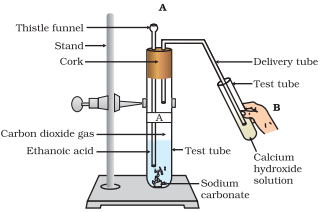
Look at the figure and answer the following questions:
$(a)$ What change would you observe in the calcium hydroxide solution taken in tube $B$?
$(b)$ Write the chemical reactions involved in test tubes $A$ and $B$ respectively.
$(a)$ What change would you observe in the calcium hydroxide solution taken in tube $B$?
$(b)$ Write the chemical reactions involved in test tubes $A$ and $B$ respectively.
Solution
(N/A) The calcium hydroxide solution will turn milky due to the formation of calcium carbonate.
$(b)$ The chemical reactions are as follows:
In test tube $A$: Ethanoic acid reacts with sodium carbonate to produce carbon dioxide gas.
$2CH_{3}COOH + Na_{2}CO_{3} \rightarrow 2CH_{3}COONa + H_{2}O + CO_{2}$
In test tube $B$: Carbon dioxide gas reacts with calcium hydroxide (lime water) to form calcium carbonate,which makes the solution milky.
$Ca(OH)_{2} + CO_{2} \rightarrow CaCO_{3} + H_{2}O$
Note: If excess $CO_{2}$ is passed through the solution,the milkiness disappears due to the formation of soluble calcium bicarbonate.
$CaCO_{3} + H_{2}O + CO_{2} \rightarrow Ca(HCO_{3})_{2}$
0 likes
View Solution19
Difficult
An organic compound $A$ on heating with concentrated $H_2SO_4$ forms a compound $B$, which on addition of one mole of hydrogen in the presence of $Ni$ forms a compound $C$. One mole of compound $C$ on combustion forms two moles of $CO_2$ and $3$ moles of $H_2O$. Identify the compounds $A$, $B$, and $C$ and write the chemical equations of the reactions involved.
Solution
(A) Since one mole of compound $C$ gives $2$ moles of $CO_2$ and $3$ moles of $H_2O$, its molecular formula is $C_2H_6$ (Ethane).
Compound $C$ is obtained by the hydrogenation of compound $B$, so $B$ must be $C_2H_4$ (Ethene).
Compound $B$ is formed by the dehydration of compound $A$ using concentrated $H_2SO_4$, which indicates $A$ is an alcohol, specifically $C_2H_5OH$ (Ethanol).
Reaction $1$: $C_2H_5OH \xrightarrow{\text{Hot conc. } H_2SO_4} C_2H_4 + H_2O$
Reaction $2$: $C_2H_4 + H_2 \xrightarrow{Ni} C_2H_6$
Reaction $3$: $2C_2H_6 + 7O_2 \to 4CO_2 + 6H_2O + \text{Heat and light}$
0 likes
View Solution20
Easy
Write the molecular formula of an alcohol that can be derived from butane.
Solution
(N/A) Butane has the chemical formula $C_{4}H_{10}$.
When one hydrogen atom is replaced by a hydroxyl group $(-OH)$,it forms an alcohol.
The molecular formula for butanol is $C_{4}H_{9}OH$ or $CH_{3}CH_{2}CH_{2}CH_{2}OH$.
When one hydrogen atom is replaced by a hydroxyl group $(-OH)$,it forms an alcohol.
The molecular formula for butanol is $C_{4}H_{9}OH$ or $CH_{3}CH_{2}CH_{2}CH_{2}OH$.
0 likes
View Solution21
EasyMCQ
What happens when a small piece of sodium is dropped into ethanol?
A
It reacts vigorously to form sodium ethoxide and hydrogen gas.
B
It forms sodium hydroxide and ethane.
C
It does not react with ethanol.
D
It forms sodium carbonate and water.
Solution
(A) When a small piece of sodium metal is added to ethanol,it reacts to produce sodium ethoxide and hydrogen gas. The hydrogen gas is released as bubbles.
$2Na + 2C_{2}H_{5}OH \to 2C_{2}H_{5}ONa + H_{2} \uparrow$
$2Na + 2C_{2}H_{5}OH \to 2C_{2}H_{5}ONa + H_{2} \uparrow$
0 likes
View Solution22
Medium
What will you observe on adding a $5\%$ alkaline potassium permanganate solution drop by drop to some warm ethanol taken in a test tube? Write the name of the compound formed during the above chemical reaction.
Solution
(N/A) When $5\%$ alkaline $KMnO_4$ solution is added drop by drop to warm ethanol,the initial pink colour of the potassium permanganate solution disappears. This happens because the alkaline $KMnO_4$ acts as an oxidising agent and oxidises ethanol to ethanoic acid. The chemical reaction is: $CH_3CH_2OH + [O] \xrightarrow{\text{alkaline } KMnO_4} CH_3COOH + H_2O$. The name of the compound formed is Ethanoic acid.
0 likes
View Solution23
EasyMCQ
How did ethanoic acid get its name as glacial acetic acid?
A
It has a high boiling point.
B
It freezes in cold climates to form ice-like crystals.
C
It is found in glaciers.
D
It reacts with ice.
Solution
(B) The melting point of pure ethanoic acid is $290 \,K$ $(17 \,^{\circ}C)$.
Because this temperature is close to room temperature in cold climates,it often freezes during winter.
When it freezes,it forms solid,ice-like flakes or crystals,which is why it is commonly referred to as glacial acetic acid.
Because this temperature is close to room temperature in cold climates,it often freezes during winter.
When it freezes,it forms solid,ice-like flakes or crystals,which is why it is commonly referred to as glacial acetic acid.
0 likes
View Solution24
Medium
What happens when: $(i)$ ethanol is burnt in air and $(ii)$ it is oxidized? Write the corresponding reaction equations.
Solution
(N/A) $(i)$ When ethanol is burnt in air,it undergoes combustion to produce carbon dioxide,water,and energy.
$CH_{3}CH_{2}OH + 3O_{2} \longrightarrow 2CO_{2} + 3H_{2}O + \text{Energy}$
$(ii)$ When ethanol is oxidized using oxidizing agents like alkaline $KMnO_{4}$ or acidified $K_{2}Cr_{2}O_{7}$,it is converted into ethanoic acid.
$CH_{3}CH_{2}OH \xrightarrow[\text{Acidified } K_{2}Cr_{2}O_{7}]{\text{Alkaline } KMnO_{4}} CH_{3}COOH$
0 likes
View Solution25
MediumMCQ
What happens when ethyl alcohol and acetic acid react with each other in the presence of conc. $H_{2}SO_{4}$?
A
It forms an aldehyde.
B
It forms a sweet-smelling ester.
C
It forms a ketone.
D
It forms an ether.
Solution
(B) When $C_{2}H_{5}OH$ reacts with $CH_{3}COOH$,i.e.,ethanol with ethanoic acid,in the presence of concentrated $H_{2}SO_{4}$,a sweet-smelling ester is formed. This reaction is known as esterification.
The chemical equation is:
$CH_{3}COOH + C_{2}H_{5}OH \xrightarrow{Conc. H_{2}SO_{4}} CH_{3}COOC_{2}H_{5} + H_{2}O$
In this reaction,$CH_{3}COOC_{2}H_{5}$ is ethyl ethanoate,which is an ester.
The chemical equation is:
$CH_{3}COOH + C_{2}H_{5}OH \xrightarrow{Conc. H_{2}SO_{4}} CH_{3}COOC_{2}H_{5} + H_{2}O$
In this reaction,$CH_{3}COOC_{2}H_{5}$ is ethyl ethanoate,which is an ester.
0 likes
View Solution26
Medium
Write three different chemical reactions showing the conversion of ethanoic acid to sodium ethanoate. Write balanced chemical equations in each case. Write the name of the reactants and the products other than ethanoic acid and sodium ethanoate in each case.
Solution
(N/A) The three chemical reactions for the conversion of ethanoic acid $(CH_{3}COOH)$ to sodium ethanoate $(CH_{3}COONa)$ are as follows:
$1$. Reaction with Sodium Hydroxide (Neutralization):
$CH_{3}COOH + NaOH \rightarrow CH_{3}COONa + H_{2}O$
Reactant: Sodium hydroxide $(NaOH)$; Product: Water $(H_{2}O)$.
$2$. Reaction with Sodium Carbonate:
$2CH_{3}COOH + Na_{2}CO_{3} \rightarrow 2CH_{3}COONa + H_{2}O + CO_{2}$
Reactant: Sodium carbonate $(Na_{2}CO_{3})$; Products: Water $(H_{2}O)$ and Carbon dioxide $(CO_{2})$.
$3$. Reaction with Sodium Bicarbonate:
$CH_{3}COOH + NaHCO_{3} \rightarrow CH_{3}COONa + H_{2}O + CO_{2}$
Reactant: Sodium bicarbonate $(NaHCO_{3})$; Products: Water $(H_{2}O)$ and Carbon dioxide $(CO_{2})$.
0 likes
View Solution27
Medium
Write any three physical properties and three uses of ethanol.
Solution
(N/A) Three physical properties of ethanol:
$(i)$ Ethanol is a liquid at room temperature.
$(ii)$ It is a good solvent.
$(iii)$ It is a colourless liquid with a pleasant smell.
Three uses of ethanol:
$(i)$ It is used as an active ingredient in all alcoholic drinks.
$(ii)$ It is used in medicines such as tincture of iodine,cough syrups,and tonics.
$(iii)$ It is used as a solvent in the manufacturing of perfumes and paints.
0 likes
View Solution28
Difficult
On dropping a small piece of sodium in a test tube containing carbon compound $X$ with molecular formula $C_{2}H_{6}O$,a brisk effervescence is observed and a gas $Y$ is produced. On bringing a burning splinter at the mouth of the test tube,the gas evolved burns with a pop sound. Identify $X$ and $Y$. Also,write the chemical equation for the reaction. Write the name and structure of the product formed when you heat $X$ with excess concentrated sulphuric acid.
Solution
(A) $X$ is Ethanol $(C_{2}H_{5}OH)$ and $Y$ is Hydrogen gas $(H_{2})$.
The chemical equation for the reaction is:
$2C_{2}H_{5}OH + 2Na \longrightarrow 2C_{2}H_{5}ONa + H_{2} \uparrow$
When $X$ (ethanol) is heated with excess concentrated sulphuric acid $(H_{2}SO_{4})$ at $443 \ K$,it undergoes dehydration to form Ethene $(C_{2}H_{4})$.
The name of the product is Ethene.
The structure of Ethene is $CH_{2}=CH_{2}$.
0 likes
View Solution29
Medium
Give a name to the reaction which takes place between ethanoic acid and ethanol in the presence of concentrated sulphuric acid. Write the chemical reaction and the name of the product obtained.
Solution
(N/A) The reaction is known as $Esterification$.
The chemical reaction is:
$CH_3COOH + C_2H_5OH \xrightarrow{Conc. H_2SO_4} CH_3COOC_2H_5 + H_2O$
The product obtained is $Ethyl \ ethanoate$ (an ester).
The chemical reaction is:
$CH_3COOH + C_2H_5OH \xrightarrow{Conc. H_2SO_4} CH_3COOC_2H_5 + H_2O$
The product obtained is $Ethyl \ ethanoate$ (an ester).
0 likes
View Solution30
Difficult
$A$ carboxylic acid (molecular formula $C_{2}H_{4}O_{2}$) reacts with an alcohol in the presence of an acid catalyst to form a compound $'X'$. The alcohol on oxidation with alkaline $KMnO_{4}$ followed by acidification gives the same carboxylic acid $C_{2}H_{4}O_{2}$. Write the name and structure of $(i)$ carboxylic acid,$(ii)$ alcohol,and $(iii)$ the compound $'X'$.
Solution
(N/A) $(i)$ Carboxylic acid: Ethanoic acid $(CH_{3}COOH)$. Structure: $CH_{3}-C(=O)OH$.
$(ii)$ Alcohol: Ethanol $(CH_{3}CH_{2}OH)$. Structure: $CH_{3}-CH_{2}-OH$.
$(iii)$ Compound $'X'$: Ethyl ethanoate $(CH_{3}COOC_{2}H_{5})$. Structure: $CH_{3}-C(=O)-O-CH_{2}-CH_{3}$.
Explanation: The reaction between ethanoic acid and ethanol in the presence of an acid catalyst is an esterification reaction,producing the ester ethyl ethanoate $('X')$.
0 likes
View Solution31
Medium
State the meaning of functional group in a carbon compound. Write the functional group present in $(i)$ ethanol and $(ii)$ ethanoic acid and also draw their structures.
Solution
(N/A) An atom or a group of atoms that determines the chemical properties of organic compounds is called a functional group. They confer specific properties to the compound,regardless of the length and nature of the carbon chain.
| Organic compound | Functional group and Structure |
|---|---|
| $(i)$ Ethanol | Alcohol group $(-OH)$: $CH_{3}-CH_{2}-OH$ |
| $(ii)$ Ethanoic acid | Carboxylic acid group $(-COOH)$: $CH_{3}-C(=O)OH$ |
0 likes
View Solution32
Medium
Define oxidising agents. Explain its role in the oxidation of alcohols to acids. Write the oxidation reaction of ethanol.
Solution
(N/A) $(i)$ Substances that are capable of adding oxygen to other substances are known as oxidising agents.
$(ii)$ Alkaline potassium permanganate $(KMnO_4)$ or acidified potassium dichromate $(K_2Cr_2O_7)$ act as oxidising agents because they provide oxygen to oxidise alcohols into carboxylic acids.
$(iii)$ The oxidation reaction of ethanol is:
$CH_3CH_2OH \xrightarrow[\text{Acidified } K_2Cr_2O_7]{\text{Alkaline } KMnO_4} CH_3COOH$
0 likes
View Solution33
Medium
$(i)$ What is vinegar? State its one use.
$(ii)$ Which gas is produced when dilute ethanoic acid is added to sodium bicarbonate? How will you test the presence of this gas?
$(ii)$ Which gas is produced when dilute ethanoic acid is added to sodium bicarbonate? How will you test the presence of this gas?
Solution
(N/A) $(i)$ $A$ $5-8 \%$ solution of acetic acid in water is known as vinegar. Its use: It is commonly used as a preservative in pickles and various food items.
$(ii)$ When dilute ethanoic acid is added to sodium bicarbonate,carbon dioxide $(CO_2)$ gas is produced. Test: This gas turns lime water milky and extinguishes a burning splinter.
$(ii)$ When dilute ethanoic acid is added to sodium bicarbonate,carbon dioxide $(CO_2)$ gas is produced. Test: This gas turns lime water milky and extinguishes a burning splinter.
0 likes
View Solution34
MediumMCQ
$(a)$ Write chemical equations for the reactions of ethanoic acid with:
$(i)$ Sodium
$(ii)$ Sodium carbonate
$(iii)$ Ethanol in the presence of conc. $H_{2}SO_{4}$.
$(b)$ State the role of concentrated sulphuric acid in the esterification reaction.
$(c)$ Write one use of ethanoic acid.
$(i)$ Sodium
$(ii)$ Sodium carbonate
$(iii)$ Ethanol in the presence of conc. $H_{2}SO_{4}$.
$(b)$ State the role of concentrated sulphuric acid in the esterification reaction.
$(c)$ Write one use of ethanoic acid.
A
$N$/$A$
B
$N$/$A$
C
$N$/$A$
D
$N$/$A$
Solution
(N/A) $(a) (i)$ $2CH_{3}COOH + 2Na \rightarrow 2CH_{3}COONa + H_{2} \uparrow$
$(ii)$ $2CH_{3}COOH + Na_{2}CO_{3} \rightarrow 2CH_{3}COONa + H_{2}O + CO_{2} \uparrow$
$(iii)$ $CH_{3}COOH + C_{2}H_{5}OH \xrightarrow{\text{conc. } H_{2}SO_{4}} CH_{3}COOC_{2}H_{5} + H_{2}O$
$(b)$ Concentrated sulphuric acid acts as a dehydrating agent. It removes the water molecule formed during the reaction,which shifts the equilibrium forward,thereby increasing the yield of the ester.
$(c)$ Ethanoic acid is used as a preservative in pickles and for making vinegar.
0 likes
View Solution35
Medium
$(a)$ How is vinegar made?
$(b)$ What is glacial acetic acid? What is its melting point?
$(c)$ Why are carboxylic acids called weak acids?
$(d)$ Write the name and the formula of the two compounds formed when the ester $CH_{3}COOC_{2}H_{5}$ undergoes saponification.
$(b)$ What is glacial acetic acid? What is its melting point?
$(c)$ Why are carboxylic acids called weak acids?
$(d)$ Write the name and the formula of the two compounds formed when the ester $CH_{3}COOC_{2}H_{5}$ undergoes saponification.
Solution
(D) Vinegar is made by the fermentation of ethanol using bacteria like $Acetobacter$ $aceti$,which produces a $5-8\%$ aqueous solution of acetic acid.
$(b)$ Pure ethanoic acid (acetic acid) is known as glacial acetic acid because it freezes into an ice-like solid at temperatures below $290 \ K$.
$(c)$ Carboxylic acids are called weak acids because they do not ionize completely in an aqueous solution; they only partially dissociate into ions.
$(d)$ When the ester $CH_{3}COOC_{2}H_{5}$ (ethyl ethanoate) undergoes saponification,it reacts with a base (like $NaOH$) to form:
$1.$ Sodium ethanoate $(CH_{3}COONa)$
$2.$ Ethanol $(C_{2}H_{5}OH)$
0 likes
View Solution36
Easy
Describe a chemical test to distinguish between ethanol and ethanoic acid.
Solution
(N/A) To distinguish between ethanol and ethanoic acid,the Sodium Hydrogen Carbonate $(NaHCO_3)$ test is used.
Procedure: Take a small amount of both substances in separate test tubes and add a pinch of solid $NaHCO_3$ to each.
Observation: Ethanoic acid reacts with $NaHCO_3$ to produce brisk effervescence due to the evolution of $CO_2$ gas.
Conclusion: Ethanol does not react with $NaHCO_3$ and shows no effervescence,thus allowing us to distinguish between the two.
0 likes
View Solution37
Medium
$(i)$ How will you bring about the following reactions? Write the concerned chemical equations:
$(a)$ Ethanol to Ethene.
$(b)$ Ethanol to Ethanoic acid.
$(a)$ Ethanol to Ethene.
$(b)$ Ethanol to Ethanoic acid.
Solution
(N/A) Ethanol undergoes dehydration in the presence of hot concentrated sulfuric acid $(H_2SO_4)$ at $443 \ K$ to form ethene:
$CH_3CH_2OH \xrightarrow[Conc. H_2SO_4]{443 \ K} CH_2=CH_2 + H_2O$
$(b)$ Ethanol undergoes oxidation in the presence of alkaline potassium permanganate $(KMnO_4)$ or acidified potassium dichromate $(K_2Cr_2O_7)$ to form ethanoic acid:
$CH_3CH_2OH \xrightarrow[alk. KMnO_4]{Oxidation} CH_3COOH$
$CH_3CH_2OH \xrightarrow[Conc. H_2SO_4]{443 \ K} CH_2=CH_2 + H_2O$
$(b)$ Ethanol undergoes oxidation in the presence of alkaline potassium permanganate $(KMnO_4)$ or acidified potassium dichromate $(K_2Cr_2O_7)$ to form ethanoic acid:
$CH_3CH_2OH \xrightarrow[alk. KMnO_4]{Oxidation} CH_3COOH$
0 likes
View Solution38
Medium
Write the name and structure of an alcohol with three carbon atoms in its molecule.
Solution
(N/A) The alcohol with three carbon atoms is $Propanol$ (specifically $Propan-1-ol$).
The chemical formula is $C_{3}H_{7}OH$.
The structural formula is:
$CH_{3}-CH_{2}-CH_{2}-OH$
The chemical formula is $C_{3}H_{7}OH$.
The structural formula is:
$CH_{3}-CH_{2}-CH_{2}-OH$
0 likes
View Solution39
Medium
Write the chemical equations for the reactions of ethanoic acid with the following:
$(a)$ Sodium
$(b)$ Sodium hydroxide
$(c)$ Ethanol
Also,write the name of one main product for each reaction.
$(a)$ Sodium
$(b)$ Sodium hydroxide
$(c)$ Ethanol
Also,write the name of one main product for each reaction.
Solution
(N/A) $(i)$ Reaction with Sodium:
$2CH_{3}COOH + 2Na \longrightarrow 2CH_{3}COONa + H_{2}$
Main product: Sodium ethanoate.
$(ii)$ Reaction with Sodium hydroxide:
$CH_{3}COOH + NaOH \longrightarrow CH_{3}COONa + H_{2}O$
Main product: Sodium ethanoate.
$(iii)$ Reaction with Ethanol:
$CH_{3}COOH + C_{2}H_{5}OH \xrightarrow{acid} CH_{3}COOC_{2}H_{5} + H_{2}O$
Main product: Ethyl ethanoate (ester).
0 likes
View Solution40
Medium
An organic compound $'A'$ has a molecular formula $C_{2}H_{6}O$. $'A'$ on oxidation gives compound $'B'$,which produces effervescence with baking soda.
$(i)$ Identify $'A'$ and $'B'$.
$(ii)$ Write the chemical reaction of $'B'$ with baking soda.
$(i)$ Identify $'A'$ and $'B'$.
$(ii)$ Write the chemical reaction of $'B'$ with baking soda.
Solution
(A) $(i)$ $'A'$ is Ethanol $(CH_{3}CH_{2}OH)$ and $'B'$ is Ethanoic acid $(CH_{3}COOH)$.
$(ii)$ The reaction of Ethanoic acid with baking soda $(NaHCO_{3})$ is:
$CH_{3}COOH + NaHCO_{3} \longrightarrow CH_{3}COONa + CO_{2} \uparrow + H_{2}O$
This reaction releases carbon dioxide gas,which causes the observed effervescence.
$(ii)$ The reaction of Ethanoic acid with baking soda $(NaHCO_{3})$ is:
$CH_{3}COOH + NaHCO_{3} \longrightarrow CH_{3}COONa + CO_{2} \uparrow + H_{2}O$
This reaction releases carbon dioxide gas,which causes the observed effervescence.
0 likes
View Solution41
Medium
$(a)$ Give chemical tests to detect the presence of:
$(i)$ Ethanol
$(ii)$ Ethanoic acid
$(b)$ Why is ethanoic acid called glacial acetic acid?
$(i)$ Ethanol
$(ii)$ Ethanoic acid
$(b)$ Why is ethanoic acid called glacial acetic acid?
Solution
(N/A) $(i)$ Ethanol test (Reaction with Sodium metal):
Ethanol reacts with sodium metal to evolve hydrogen gas,which can be tested by bringing a burning splinter near the gas,producing a 'pop' sound.
$2 CH_3CH_2OH + 2 Na \rightarrow 2 CH_3CH_2ONa + H_2 \uparrow$
$(ii)$ Ethanoic acid test (Esterification reaction):
Ethanoic acid reacts with ethanol in the presence of an acid catalyst to form an ester,which has a sweet,fruity smell.
$CH_3COOH + CH_3CH_2OH \xrightarrow{H^+} CH_3COOCH_2CH_3 + H_2O$
$(b)$ Pure ethanoic acid has a melting point of $290 \, K$. In cold climates,it often freezes into an ice-like solid during winter,which is why it is known as glacial acetic acid.
0 likes
View Solution42
EasyMCQ
Ethanoic acid can be obtained from ethanol by the process of:
A
Reduction
B
Hydrogenation
C
Hydrolysis
D
Oxidation
Solution
(D) The conversion of ethanol $(CH_3CH_2OH)$ to ethanoic acid $(CH_3COOH)$ involves the addition of oxygen or the removal of hydrogen.
This chemical process is known as oxidation.
In the presence of oxidizing agents like alkaline potassium permanganate $(KMnO_4)$ or acidified potassium dichromate $(K_2Cr_2O_7)$, ethanol is oxidized to ethanoic acid.
The reaction is: $CH_3CH_2OH + 2[O] \xrightarrow{alkaline KMnO_4/heat} CH_3COOH + H_2O$.
0 likes
View Solution43
EasyMCQ
The oxidising agent which can oxidise ethanol to ethanoic acid is:
A
Alkaline $K_{2}Cr_{2}O_{7}$
B
Alkaline $KClO_{3}$
C
Alkaline $KMnO_{4}$
D
Alkaline $CrO_{3}$
Solution
(C) Ethanol $(CH_{3}CH_{2}OH)$ can be oxidised to ethanoic acid $(CH_{3}COOH)$ using strong oxidising agents.
Alkaline potassium permanganate $(KMnO_{4})$ is a common oxidising agent used in laboratory settings to convert alcohols into carboxylic acids.
While acidic potassium dichromate $(K_{2}Cr_{2}O_{7})$ is also a strong oxidising agent,the question specifically asks for an alkaline agent,making alkaline $KMnO_{4}$ the correct choice.
0 likes
View Solution44
EasyMCQ
Ethanol reacts with sodium and forms two products. These are:
A
sodium ethoxide and hydrogen
B
sodium ethanoate and oxygen
C
sodium ethanoate and hydrogen
D
sodium ethoxide and oxygen
Solution
(A) When ethanol $(C_2H_5OH)$ reacts with sodium metal $(Na)$,it undergoes a substitution reaction where the hydrogen atom of the hydroxyl group is replaced by sodium.
This reaction produces sodium ethoxide $(C_2H_5ONa)$ and releases hydrogen gas $(H_2)$.
The balanced chemical equation is: $2C_2H_5OH + 2Na \rightarrow 2C_2H_5ONa + H_2 \uparrow$.
This reaction produces sodium ethoxide $(C_2H_5ONa)$ and releases hydrogen gas $(H_2)$.
The balanced chemical equation is: $2C_2H_5OH + 2Na \rightarrow 2C_2H_5ONa + H_2 \uparrow$.
0 likes
View Solution45
EasyMCQ
Vinegar is a solution of :
A
$5 \%-8 \%$ acetic acid in alcohol
B
$5 \%-8 \%$ acetic acid in water
C
$50 \%-60 \%$ acetic acid in alcohol
D
$50 \%-60 \%$ acetic acid in water
Solution
(B) Vinegar is a common household substance used as a preservative and flavoring agent.
It is chemically defined as a dilute solution of acetic acid $(CH_3COOH)$.
Specifically,vinegar typically contains $5 \%-8 \%$ acetic acid dissolved in water.
Therefore,the correct option is $B$.
It is chemically defined as a dilute solution of acetic acid $(CH_3COOH)$.
Specifically,vinegar typically contains $5 \%-8 \%$ acetic acid dissolved in water.
Therefore,the correct option is $B$.
0 likes
View Solution46
Easy
State whether the following statement is true or false:
Alcohols react with sodium to evolve carbon dioxide.
Alcohols react with sodium to evolve carbon dioxide.
Solution
(FALSE) The statement is False.
When alcohols (such as ethanol) react with sodium metal,they produce sodium alkoxide and hydrogen gas $(H_2)$,not carbon dioxide $(CO_2)$.
The chemical equation for the reaction is:
$2CH_3CH_2OH + 2Na \rightarrow 2CH_3CH_2ONa + H_2 \uparrow$
When alcohols (such as ethanol) react with sodium metal,they produce sodium alkoxide and hydrogen gas $(H_2)$,not carbon dioxide $(CO_2)$.
The chemical equation for the reaction is:
$2CH_3CH_2OH + 2Na \rightarrow 2CH_3CH_2ONa + H_2 \uparrow$
0 likes
View Solution47
EasyMCQ
State whether the following statement is true or false:
Heating ethanol at $443 \,K$ with excess concentrated sulphuric acid results in the dehydration of ethanol to give ethene.
Heating ethanol at $443 \,K$ with excess concentrated sulphuric acid results in the dehydration of ethanol to give ethene.
A
True
B
False
Solution
(A) The statement is True.
When ethanol $(CH_3CH_2OH)$ is heated with excess concentrated sulphuric acid $(H_2SO_4)$ at $443 \,K$,it undergoes dehydration.
The concentrated sulphuric acid acts as a dehydrating agent,removing a water molecule from the ethanol.
The chemical reaction is: $CH_3CH_2OH \xrightarrow[443 \,K]{Conc. H_2SO_4} CH_2=CH_2 + H_2O$ (ethene).
0 likes
View Solution48
Easy
Write true or false for the following statement:
Like mineral acids,ethanoic acid reacts with a base such as sodium hydroxide to give salt (sodium ethanoate or sodium acetate) and water.
Like mineral acids,ethanoic acid reacts with a base such as sodium hydroxide to give salt (sodium ethanoate or sodium acetate) and water.
Solution
(TRUE) True. Ethanoic acid $(CH_3COOH)$ is a weak organic acid. When it reacts with a strong base like sodium hydroxide $(NaOH)$,it undergoes a neutralization reaction to form sodium ethanoate $(CH_3COONa)$ and water $(H_2O)$. The chemical equation is: $CH_3COOH + NaOH \rightarrow CH_3COONa + H_2O$.
0 likes
View Solution49
EasyMCQ
Which of the following compounds is obtained by the fermentation reaction of molasses?
A
Chloromethane
B
Ethanol
C
Acetone
D
All of these
Solution
(B) Molasses is a dark,viscous byproduct of the sugar refining process,which is rich in sucrose $(C_{12}H_{22}O_{11})$.
In the process of fermentation,enzymes like invertase and zymase (produced by yeast) act on the sugars present in molasses.
First,invertase converts sucrose into glucose and fructose $(C_6H_{12}O_6)$.
Then,zymase converts these simple sugars into ethanol $(C_2H_5OH)$ and carbon dioxide $(CO_2)$.
Therefore,ethanol is the primary compound obtained through the fermentation of molasses.
0 likes
View Solution50
EasyMCQ
What is the solution of ethanol containing $5\%$ water called?
A
Beer
B
Varnish
C
Rectified spirit
D
Perfume
Solution
(C) The solution of ethanol containing approximately $5\%$ water is known as Rectified spirit.
It is produced by the fractional distillation of fermented molasses or other sugar-containing substances.
Rectified spirit typically contains about $95\%$ ethanol and $5\%$ water by volume.
It is widely used as a solvent in industries and as a starting material for the preparation of absolute alcohol.
0 likes
View SolutionCarbon and its Compounds — Ethanol and Ethanoic Acid · Frequently Asked Questions
1Are these Carbon and its Compounds questions useful for JEE and NEET?
Yes. All questions in this section are mapped to JEE Main and NEET exam patterns. Previous year questions from JEE Main, NEET, GUJCET and state-level exams are included with full solutions.
2Can I switch to Hindi or Gujarati for these questions?
Yes. Use the language tabs in the hero section or the sidebar to view the same questions and solutions in English, Hindi or Gujarati.
3How do I generate a question paper from this subtopic?
Use the Vedclass Exam Paper Generator — select the chapter and subtopic, set difficulty, and generate Sets A, B, C, D automatically. First 3 chapters of every subject are free.
Vedclass Products
For Students
Vedclass Test Series
Mock tests in real JEE/NEET style with performance analysis. 5-day free trial.
Start Free TrialFor Teachers
Exam Paper Generator
Generate Set A/B/C/D papers from this chapter in 2 minutes. 3 chapters free.
Try FreeFor Institutes
Online Exam Module
Live online exams with unlimited students, 360° analytics & white-label branding.
See DemoFor Teachers & Institutes
Generate a Carbon and its Compounds Exam Paper in 2 Minutes
Select subtopic & difficulty — Sets A, B, C, D auto-generated with No Repeat logic.
First 3 chapters of every subject are free — no payment required.