
A English
The Human Eye and Defects of Vision Questions in English
Class 10 Science · The Human Eye and the Colourful World · The Human Eye and Defects of Vision
176+
Questions
English
Language
100%
With Solutions
Showing 50 of 176 questions in English
51
EasyMCQ
How is near-sightedness corrected?
A
By using a convex lens
B
By using a concave lens
C
By using a bifocal lens
D
By using a cylindrical lens
Solution
(B) Near-sightedness, also known as $Myopia$, is a defect of vision in which a person can see nearby objects clearly but cannot see distant objects distinctly.
In this condition, the image of a distant object is formed in front of the retina.
To correct this defect, a $concave$ lens (also known as a $divergent$ lens) of a suitable focal length is used.
This lens diverges the incoming light rays before they enter the eye, allowing the image to be focused exactly on the retina.
0 likes
View Solution52
EasyMCQ
Where is the image formed in an eye suffering from near-sightedness?
A
On the retina
B
Behind the retina
C
In front of the retina
D
At the blind spot
Solution
(C) In an eye suffering from near-sightedness (myopia),the light rays from a distant object converge at a point in front of the retina instead of on the retina itself. This occurs because the eyeball becomes too long or the lens becomes too curved,causing the image to form in front of the retina.
0 likes
View Solution53
EasyMCQ
What is long-sightedness (hypermetropia)?
A
Inability to see distant objects clearly.
B
Inability to see nearby objects clearly.
C
Inability to see both nearby and distant objects.
D
Inability to focus on moving objects.
Solution
(B) Long-sightedness,also known as $Hypermetropia$,is a vision defect where a person can see distant objects clearly but cannot see nearby objects distinctly.
This occurs because the light rays from a nearby object are focused at a point behind the retina instead of on the retina itself.
It can be corrected by using a convex lens of appropriate power.
This occurs because the light rays from a nearby object are focused at a point behind the retina instead of on the retina itself.
It can be corrected by using a convex lens of appropriate power.
0 likes
View Solution54
EasyMCQ
What is the other name of long-sightedness?
A
Myopia
B
Hypermetropia
C
Presbyopia
D
Astigmatism
Solution
(B) Long-sightedness is also known as $Hypermetropia$. In this condition,a person can see distant objects clearly but cannot see nearby objects distinctly.
0 likes
View Solution55
Easy
Give one cause of long-sightedness (hypermetropia).
Solution
(N/A) The primary cause of long-sightedness,also known as hypermetropia,is the increase in the focal length of the eye lens. This occurs because the eyeball becomes too short,causing light rays from nearby objects to focus behind the retina instead of directly on it.
0 likes
View Solution56
EasyMCQ
Where is the image formed in an eye suffering from long-sightedness?
A
On the retina
B
In front of the retina
C
Behind the retina
D
At the blind spot
Solution
(C) Long-sightedness,also known as $Hypermetropia$,is a defect of vision where a person can see distant objects clearly but cannot see nearby objects distinctly. In this condition,the light rays from a nearby object are focused at a point behind the retina instead of on the retina itself. This occurs because the eyeball becomes too short or the focal length of the eye lens becomes too large.
0 likes
View Solution57
EasyMCQ
How is long-sightedness corrected?
A
By using a concave lens of suitable focal length.
B
By using a convex lens of suitable focal length.
C
By using a bifocal lens.
D
By using a cylindrical lens.
Solution
(B) Long-sightedness,also known as $Hypermetropia$,is a defect of vision where a person can see distant objects clearly but cannot see nearby objects distinctly.
This condition occurs because the light rays from a nearby object focus behind the retina.
To correct this defect,a convex lens (converging lens) of suitable focal length is used.
The convex lens converges the incoming light rays before they enter the eye,allowing the image to be formed exactly on the retina.
0 likes
View Solution58
EasyMCQ
What is astigmatism?
A
$A$ defect where the eye cannot focus on near objects.
B
$A$ defect where the eye cannot focus on distant objects.
C
$A$ defect in which the cornea or lens has an irregular curvature,causing blurred vision in all directions.
D
$A$ defect caused by the hardening of the ciliary muscles.
Solution
(C) Astigmatism is a common vision defect caused by an irregular curvature of the cornea or the lens of the eye.
Due to this irregularity,light rays entering the eye do not focus at a single point on the retina.
As a result,a person suffering from astigmatism cannot see objects clearly in all directions equally well,leading to blurred or distorted vision.
Due to this irregularity,light rays entering the eye do not focus at a single point on the retina.
As a result,a person suffering from astigmatism cannot see objects clearly in all directions equally well,leading to blurred or distorted vision.
0 likes
View Solution59
EasyMCQ
How is astigmatism corrected?
A
By using a convex lens
B
By using a concave lens
C
By using a cylindrical lens
D
By using a bifocal lens
Solution
(C) Astigmatism is a refractive error of the eye where the cornea or lens has an irregular curvature,causing blurred vision at all distances.
It is corrected by using a cylindrical lens,which compensates for the uneven curvature of the eye's refractive surfaces.
It is corrected by using a cylindrical lens,which compensates for the uneven curvature of the eye's refractive surfaces.
0 likes
View Solution60
EasyMCQ
$A$ person has to use a concave lens in his spectacles. Which defect of vision is he suffering from?
A
Myopia (Short-sightedness)
B
Hypermetropia (Long-sightedness)
C
Presbyopia
D
Astigmatism
Solution
(A) concave lens is used to correct myopia,also known as short-sightedness or near-sightedness.
In this defect,the image of a distant object is formed in front of the retina.
$A$ concave lens diverges the incoming light rays,allowing the image to be focused correctly on the retina.
In this defect,the image of a distant object is formed in front of the retina.
$A$ concave lens diverges the incoming light rays,allowing the image to be focused correctly on the retina.
0 likes
View Solution61
EasyMCQ
Why can you not see an object clearly if it is placed very close to your eye?
A
The eye lens cannot adjust its focal length to focus the image on the retina.
B
The light rays from the object do not enter the eye.
C
The object is too small to be seen.
D
The eye lens becomes opaque.
Solution
(A) The human eye has a limit to its accommodation power. The minimum distance at which an object can be seen clearly without strain is known as the least distance of distinct vision or the near point of the eye. For a normal adult eye,this distance is approximately $25 \ cm$. If an object is placed closer than this,the ciliary muscles cannot adjust the focal length of the eye lens sufficiently to form a sharp image on the retina,resulting in a blurred image.
0 likes
View Solution62
Easy
How does an eye manage to see objects in dim light and bright light?
Solution
(N/A) The human eye adapts to different light intensities using two types of photoreceptor cells located in the retina: rods and cones.
$1$. Rods: These cells are highly sensitive to dim light but do not perceive color. They allow us to see in low-light conditions (scotopic vision).
$2$. Cones: These cells are sensitive to bright light and are responsible for color vision and high-acuity detail. They function effectively in well-lit conditions (photopic vision).
Additionally,the iris regulates the amount of light entering the eye by adjusting the size of the pupil.
0 likes
View Solution63
EasyMCQ
When you enter from bright sunshine into a dark room,you are not able to see clearly for some time. Why?
A
The pupil is unable to dilate quickly.
B
The retina takes time to adjust to low light.
C
The iris takes time to contract.
D
The lens takes time to change its focal length.
Solution
(A) When in bright sunlight,the pupil of the eye contracts to allow less light to enter,protecting the retina. When you suddenly enter a dark room,the pupil remains small for a short period,allowing very little light to enter the eye. Consequently,you cannot see clearly until the iris muscles relax and the pupil dilates to allow more light to enter.
0 likes
View Solution64
EasyMCQ
Which part of the eye helps in changing the focal length of the eye lens to focus the image of objects lying at varying distances from the eye?
A
Iris
B
Pupil
C
Ciliary muscles
D
Cornea
Solution
(C) The ciliary muscles are responsible for changing the focal length of the eye lens. By contracting or relaxing,they alter the curvature of the lens,a process known as accommodation,which allows the eye to focus on objects at varying distances.
0 likes
View Solution65
Easy
How can you identify the type of vision defect a person is suffering from by physically touching their spectacles?
Solution
(N/A) By touching the lenses of the spectacles,one can determine their shape.
$1$. If the lens is thinner in the middle and thicker at the edges,it is a concave lens,which is used to correct myopia (nearsightedness).
$2$. If the lens is thicker in the middle and thinner at the edges,it is a convex lens,which is used to correct hypermetropia (farsightedness).
$1$. If the lens is thinner in the middle and thicker at the edges,it is a concave lens,which is used to correct myopia (nearsightedness).
$2$. If the lens is thicker in the middle and thinner at the edges,it is a convex lens,which is used to correct hypermetropia (farsightedness).
0 likes
View Solution66
Easy
Sometimes you see a person reading the newspaper by placing it very close to his eyes. Which defect is he suffering from? How can the defect be removed?
Solution
(N/A) The person is suffering from myopia,also known as short-sightedness or near-sightedness. In this condition,a person can see nearby objects clearly but cannot see distant objects distinctly. This defect occurs because the image of a distant object is formed in front of the retina rather than on it. This defect can be corrected by using a concave lens of appropriate focal length,which diverges the incoming light rays before they enter the eye,allowing the image to be focused correctly on the retina.
0 likes
View Solution67
Easy
Sometimes you see a person reading the newspaper by placing it far away from their eyes. Which defect is the person suffering from? How can this defect be corrected?
Solution
(N/A) The person is suffering from $Hypermetropia$ (also known as $Long-sightedness$ or $Farsightedness$).
In this defect,the person can see distant objects clearly but cannot see nearby objects distinctly.
This defect can be corrected by using a $Convex$ lens (converging lens) of appropriate focal length,which helps in converging the light rays onto the retina.
In this defect,the person can see distant objects clearly but cannot see nearby objects distinctly.
This defect can be corrected by using a $Convex$ lens (converging lens) of appropriate focal length,which helps in converging the light rays onto the retina.
0 likes
View Solution68
EasyMCQ
What is Presbyopia?
A
$A$ condition where the eye loses its ability to focus on distant objects.
B
$A$ condition where the eye loses its ability to focus on near objects due to aging.
C
$A$ condition where the eye develops a cloudy lens.
D
$A$ condition where the eye has an irregular curvature of the cornea.
Solution
(B) Presbyopia is a vision defect that occurs due to the gradual weakening of the ciliary muscles and the diminishing flexibility of the eye lens as a person ages.
This condition makes it difficult for an elderly person to focus on nearby objects,making reading and writing uncomfortable without the use of corrective lenses,typically bifocals or reading glasses.
This condition makes it difficult for an elderly person to focus on nearby objects,making reading and writing uncomfortable without the use of corrective lenses,typically bifocals or reading glasses.
0 likes
View Solution69
EasyMCQ
Name the delicate membrane in the eye having an enormous number of light-sensitive cells.
A
Cornea
B
Retina
C
Iris
D
Pupil
Solution
(B) The retina is a delicate membrane in the eye that contains a vast number of light-sensitive cells called rods and cones. When light enters the eye,it is focused onto the retina,where these cells convert light energy into electrical signals that are sent to the brain via the optic nerve.
0 likes
View Solution70
EasyMCQ
What kind of lens is used in the spectacles of a person suffering from myopia (near-sightedness)?
A
Concave lens
B
Convex lens
C
Bifocal lens
D
Cylindrical lens
Solution
(A) Myopia,also known as near-sightedness,is a defect of vision where a person can see nearby objects clearly but cannot see distant objects distinctly.
In this condition,the image of a distant object is formed in front of the retina rather than on the retina.
To correct this defect,a concave lens (diverging lens) is used in the spectacles.
The concave lens diverges the incoming light rays from distant objects,allowing the eye lens to focus the image correctly on the retina.
0 likes
View Solution71
EasyMCQ
What happens to the lens and the ciliary muscles when you are looking at nearby objects?
A
Ciliary muscles relax and the lens becomes thin.
B
Ciliary muscles contract and the lens becomes thick.
C
Ciliary muscles contract and the lens becomes thin.
D
Ciliary muscles relax and the lens becomes thick.
Solution
(B) When looking at nearby objects,the ciliary muscles contract.
This contraction reduces the tension on the suspensory ligaments,allowing the lens to become more convex (thicker).
As a result,the focal length of the lens decreases,which increases its converging power to focus the image of the nearby object clearly on the retina.
This contraction reduces the tension on the suspensory ligaments,allowing the lens to become more convex (thicker).
As a result,the focal length of the lens decreases,which increases its converging power to focus the image of the nearby object clearly on the retina.
0 likes
View Solution72
EasyMCQ
What happens to the lens and the ciliary muscles when you are looking at distant objects?
A
Ciliary muscles contract,lens becomes thick.
B
Ciliary muscles relax,lens becomes thin.
C
Ciliary muscles contract,lens becomes thin.
D
Ciliary muscles relax,lens becomes thick.
Solution
(B) When looking at distant objects,the ciliary muscles relax.
This relaxation increases the tension on the suspensory ligaments,which in turn pulls the lens,making it thinner.
As the lens becomes thinner,its radius of curvature increases,which decreases its converging power,allowing the image of distant objects to focus clearly on the retina.
This relaxation increases the tension on the suspensory ligaments,which in turn pulls the lens,making it thinner.
As the lens becomes thinner,its radius of curvature increases,which decreases its converging power,allowing the image of distant objects to focus clearly on the retina.
0 likes
View Solution73
EasyMCQ
Chickens can see only in bright light. What type of cells is present in their retina?
A
Only cone cells
B
Only rod cells
C
Both rod and cone cells
D
No cells
Solution
(A) The retina of a chicken contains primarily cone cells and very few or no rod cells.
Cone cells are responsible for color vision and function in bright light.
Since chickens lack sufficient rod cells,which are responsible for vision in dim light,they cannot see well in the dark.
Cone cells are responsible for color vision and function in bright light.
Since chickens lack sufficient rod cells,which are responsible for vision in dim light,they cannot see well in the dark.
0 likes
View Solution74
Easy
Name the outermost layer of the eye. What is its function?
Solution
(N/A) The outermost layer of the eye is the $Sclera$ (also known as the $Sclerotic$ layer).
Its primary function is to provide structural support,protect the delicate internal structures of the eye,and maintain the shape of the eyeball.
Its primary function is to provide structural support,protect the delicate internal structures of the eye,and maintain the shape of the eyeball.
0 likes
View Solution75
EasyMCQ
What is the function of the choroid?
A
It helps in focusing light on the retina.
B
It contains black pigments which prevent internal reflections within the eye.
C
It controls the amount of light entering the eye.
D
It provides nourishment to the retina.
Solution
(B) The choroid is the middle layer of the eye wall,located between the sclera and the retina.
It is rich in blood vessels and contains dark-colored pigments (melanin).
The primary function of these pigments is to absorb excess light and prevent internal reflections within the eyeball,which ensures that the image formed on the retina is sharp and clear.
It is rich in blood vessels and contains dark-colored pigments (melanin).
The primary function of these pigments is to absorb excess light and prevent internal reflections within the eyeball,which ensures that the image formed on the retina is sharp and clear.
0 likes
View Solution76
EasyMCQ
The colour of which part of the eye determines the colour of the eye of a person?
A
Cornea
B
Iris
C
Pupil
D
Retina
Solution
(B) The colour of a person's eye is determined by the colour of the iris. The iris is a thin,circular structure in the eye,responsible for controlling the diameter and size of the pupil and thus the amount of light reaching the retina. The pigmentation within the iris determines its colour,which in turn gives the eye its characteristic appearance.
0 likes
View Solution77
EasyMCQ
In myopia,what happens to the power of the eye lens?
A
It increases
B
It decreases
C
It remains the same
D
It becomes zero
Solution
(A) Myopia,also known as nearsightedness,is a condition where the eyeball becomes too long or the curvature of the cornea is too steep.
In this condition,the eye lens has an excessive converging power,which causes light rays from distant objects to focus in front of the retina rather than directly on it.
Therefore,the power of the eye lens effectively increases,necessitating the use of a concave lens to diverge the light rays before they enter the eye.
0 likes
View Solution78
EasyMCQ
$A$ man wearing glasses of focal length $+1\, m$ cannot see objects beyond $1\, m$. What is the defect in his eye?
A
Myopia
B
Hypermetropia
C
Presbyopia
D
Astigmatism
Solution
(B) The man is using glasses with a positive focal length $(+1\, m)$,which indicates a convex lens. $A$ convex lens is used to correct hypermetropia (farsightedness). Since he cannot see objects beyond $1\, m$,this confirms he suffers from hypermetropia,where the near point of the eye has shifted further away.
0 likes
View Solution79
EasyMCQ
Name the part of the human eye that helps in changing the focal length of the eye lens.
A
Iris
B
Ciliary muscles
C
Pupil
D
Retina
Solution
(B) The $Ciliary$ $muscles$ are responsible for changing the focal length of the eye lens.
They adjust the curvature of the lens,which in turn changes its focal length,allowing the eye to focus on objects at varying distances,a process known as accommodation.
They adjust the curvature of the lens,which in turn changes its focal length,allowing the eye to focus on objects at varying distances,a process known as accommodation.
0 likes
View Solution80
Easy
Write the value of the near point of distinct vision for a normal eye.
Solution
(N/A) The near point of distinct vision for a normal eye is the minimum distance at which an object can be seen clearly without strain. For a normal human eye,this distance is $25 \text{ cm}$.
0 likes
View Solution81
EasyMCQ
What is the role of the pupil in a human eye?
A
To focus light on the retina
B
To regulate and control the amount of light entering the eye
C
To change the shape of the lens
D
To protect the eye from dust
Solution
(B) The pupil is a variable aperture in the center of the iris. Its primary function is to regulate and control the amount of light entering the eye. In bright light,the pupil constricts to reduce the amount of light,and in dim light,it dilates to allow more light to enter.
0 likes
View Solution82
EasyMCQ
What is the range of vision for a normal human eye?
A
$25$ cm to $100$ cm
B
$25$ cm to infinity
C
$0$ cm to infinity
D
$10$ cm to $100$ cm
Solution
(B) The near point of a normal human eye is $25\, cm$,which is the minimum distance at which objects can be seen clearly without strain.
The far point of a normal human eye is infinity,which is the maximum distance at which objects can be seen clearly.
Therefore,the range of vision for a normal human eye is $25\, cm$ to infinity.
The far point of a normal human eye is infinity,which is the maximum distance at which objects can be seen clearly.
Therefore,the range of vision for a normal human eye is $25\, cm$ to infinity.
0 likes
View Solution83
MediumMCQ
$A$ person is advised to wear spectacles with concave lenses. What type of defect of vision is he suffering from?
A
Myopia
B
Hypermetropia
C
Presbyopia
D
Astigmatism
Solution
(A) concave lens is used to correct $Myopia$ (also known as near-sightedness or short-sightedness).
In $Myopia$,the image of a distant object is formed in front of the retina rather than on the retina itself.
$A$ concave lens diverges the incoming light rays before they enter the eye,allowing the image to be focused correctly on the retina.
In $Myopia$,the image of a distant object is formed in front of the retina rather than on the retina itself.
$A$ concave lens diverges the incoming light rays before they enter the eye,allowing the image to be focused correctly on the retina.
0 likes
View Solution84
EasyMCQ
Name the part responsible for the power of accommodation of the eye.
A
Iris
B
Ciliary muscles
C
Pupil
D
Retina
Solution
(B) The $Ciliary$ muscles are responsible for the power of accommodation of the eye. These muscles change the curvature and focal length of the eye lens, allowing the eye to focus on objects at varying distances.
0 likes
View Solution85
EasyMCQ
Name the condition resulting due to the eye lens becoming cloudy.
A
Myopia
B
Hypermetropia
C
Cataract
D
Presbyopia
Solution
(C) The condition in which the eye lens of a person becomes progressively cloudy,resulting in blurred vision,is known as $Cataract$. This condition often leads to a partial or complete loss of vision and can be corrected through surgical intervention.
0 likes
View Solution86
Easy
$A$ person suffering from an eye defect uses lenses of power $-1\, D$. Name the defect he is suffering from and the nature of lens used.
Solution
(N/A) The power of the lens is negative $(-1\, D)$,which indicates that the lens is a concave lens.
Concave lenses are used to correct myopia (nearsightedness).
Therefore,the person is suffering from myopia and is using a concave lens.
Concave lenses are used to correct myopia (nearsightedness).
Therefore,the person is suffering from myopia and is using a concave lens.
0 likes
View Solution87
Medium
How can a change in the size of the eyeball be a reason for $(a)$ Myopia and $(b)$ Hypermetropia? Compare the size of the eyeball with that of a normal eye in each case. How does this change in size affect the position of the image in each case?
Solution
(N/A) Myopia: The eyeball becomes longer than normal. Due to this,the image formed by the eye lens is focused in front of the retina.
$(b)$ Hypermetropia: The eyeball becomes shorter than normal. Due to this,the image formed by the eye lens is focused behind the retina.
$(b)$ Hypermetropia: The eyeball becomes shorter than normal. Due to this,the image formed by the eye lens is focused behind the retina.
0 likes
View Solution88
Medium
Sushil went to an eye specialist for a check-up. The doctor prescribed him to use spectacle lenses of $+0.5 \text{ D}$ power.
$(a)$ Name the defect of vision he is suffering from.
$(b)$ Find the focal length of the spectacle lens.
$(a)$ Name the defect of vision he is suffering from.
$(b)$ Find the focal length of the spectacle lens.
Solution
(N/A) The defect of vision is Hypermetropia (farsightedness).
$(b)$ The formula for focal length $f$ in meters is given by $f = \frac{1}{P}$,where $P$ is the power in Diopters $(D)$.
Given $P = +0.5 \text{ D}$.
$f = \frac{1}{0.5} = 2 \text{ m}$.
Therefore,the focal length of the convex lens is $2 \text{ m}$.
$(b)$ The formula for focal length $f$ in meters is given by $f = \frac{1}{P}$,where $P$ is the power in Diopters $(D)$.
Given $P = +0.5 \text{ D}$.
$f = \frac{1}{0.5} = 2 \text{ m}$.
Therefore,the focal length of the convex lens is $2 \text{ m}$.
0 likes
View Solution89
Easy
State the function of the pupil and ciliary muscles.
Solution
(N/A) The pupil regulates and controls the amount of light entering the eye by adjusting its size.
The ciliary muscles control the curvature of the eye lens,which helps in the process of accommodation,allowing the eye to focus on objects at varying distances.
The ciliary muscles control the curvature of the eye lens,which helps in the process of accommodation,allowing the eye to focus on objects at varying distances.
0 likes
View Solution90
Medium
$A$ child sitting in a classroom is not able to read clearly the writing on the blackboard.
$(a)$ Name the type of defect from which his eye is suffering.
$(b)$ With the help of a ray diagram show how this defect can be remedied.
$(a)$ Name the type of defect from which his eye is suffering.
$(b)$ With the help of a ray diagram show how this defect can be remedied.
Solution
(N/A) The child's eye is suffering from the defect of myopia (near-sightedness).
$(b)$ This defect can be corrected by using a concave lens of suitable focal length. The concave lens diverges the incoming parallel rays from a distant object,making them appear to originate from the child's far point,thus allowing the eye lens to focus the image on the retina. The ray diagram for the correction of myopia is shown below.
$(b)$ This defect can be corrected by using a concave lens of suitable focal length. The concave lens diverges the incoming parallel rays from a distant object,making them appear to originate from the child's far point,thus allowing the eye lens to focus the image on the retina. The ray diagram for the correction of myopia is shown below.
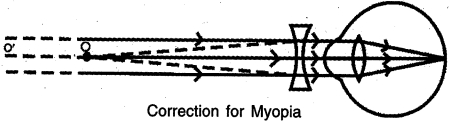
0 likes
View Solution91
Medium
What are hypermetropia and myopia? What are their causes? How are they rectified?
Solution
(N/A) These are common defects of vision.
Hypermetropia (Farsightedness): $A$ person suffering from this defect can see distant objects clearly but cannot see nearby objects clearly. In this defect,the near point of the eye shifts farther away than $25 \ cm$.
Causes:
$1.$ The eyeball becomes too short.
$2.$ The focal length of the eye lens becomes too large.
Correction: This condition is corrected using a converging or convex lens.
Myopia (Nearsightedness): $A$ person suffering from myopia can see nearby objects clearly but cannot see distant objects clearly. In this defect,the far point of the eye comes closer than infinity.
Causes:
$1.$ The eyeball becomes too long.
$2.$ The focal length of the eye lens becomes too small.
Correction: This condition is corrected using a diverging or concave lens.
0 likes
View Solution92
Medium
Explain the following terms connected with the eye:
$(i)$ Ciliary muscles
$(ii)$ Accommodation
$(iii)$ Blind spot.
$(i)$ Ciliary muscles
$(ii)$ Accommodation
$(iii)$ Blind spot.
Solution
(N/A) $(i)$ Ciliary muscles: These are the muscles that hold the eye lens in position and control its curvature.
$(ii)$ Accommodation: The ability of the eye lens to adjust its focal length to focus objects at varying distances is called accommodation.
$(iii)$ Blind spot: This is the point on the retina where the optic nerve leaves the eye. There are no photoreceptor cells at this point,so any image formed here is not transmitted to the brain.
0 likes
View Solution93
MediumMCQ
Why do we have two eyes for vision instead of just one?
A
To increase the intensity of light
B
To provide a wider field of view and depth perception
C
To have a backup in case one eye fails
D
To see colors more clearly
Solution
(B) We need two eyes because a human being has a horizontal field of view of about $150^{\circ}$ with one eye and about $180^{\circ}$ with two eyes. Thus,two eyes provide us with a wider horizontal field of view.
With one eye,the world looks flat,i.e.,two-dimensional. With two eyes,the view is three-dimensional,which adds the dimension of depth to our vision.
With one eye,the world looks flat,i.e.,two-dimensional. With two eyes,the view is three-dimensional,which adds the dimension of depth to our vision.
0 likes
View Solution94
Easy
What is meant by persistence of vision?
Solution
(N/A) The impression of an object seen by the eye persists on the retina for $1/16$ of a second,even after the object is removed from the field of view.
If another object is seen before this time interval,the impressions of the two objects merge in the brain to give us the sensation of continuity.
This property of the human eye is known as persistence of vision.
If another object is seen before this time interval,the impressions of the two objects merge in the brain to give us the sensation of continuity.
This property of the human eye is known as persistence of vision.
0 likes
View Solution95
Easy
List four common defects of vision that can be corrected with the use of spectacles.
Solution
(N/A) The four common defects of vision that can be corrected with the use of spectacles are:
$(i)$ Myopia (nearsightedness): Corrected using concave lenses.
$(ii)$ Hypermetropia (farsightedness): Corrected using convex lenses.
$(iii)$ Presbyopia: Corrected using bifocal or progressive lenses.
$(iv)$ Astigmatism: Corrected using cylindrical lenses.
$(i)$ Myopia (nearsightedness): Corrected using concave lenses.
$(ii)$ Hypermetropia (farsightedness): Corrected using convex lenses.
$(iii)$ Presbyopia: Corrected using bifocal or progressive lenses.
$(iv)$ Astigmatism: Corrected using cylindrical lenses.
0 likes
View Solution96
Medium
$(a)$ State two main causes of a person developing near-sightedness. How can this defect be corrected?
$(b)$ What is 'astigmatism' and how is this vision defect corrected?
$(b)$ What is 'astigmatism' and how is this vision defect corrected?
Solution
(N/A) When a person can see near objects but is unable to see distant objects clearly,the defect is known as near-sightedness (myopia). This defect is caused by either $(i)$ excessive curvature of the cornea or $(ii)$ elongation of the eyeball. As a result,the image of a distant object is formed in front of the retina instead of on the retina. It can be corrected by using a concave lens of appropriate power.
$(b)$ Astigmatism is a vision defect where a person is unable to focus equally on objects in all directions (horizontal and vertical) simultaneously. This occurs because the cornea or the eye lens has different curvatures along different planes. This defect is corrected by using cylindrical lenses.
$(b)$ Astigmatism is a vision defect where a person is unable to focus equally on objects in all directions (horizontal and vertical) simultaneously. This occurs because the cornea or the eye lens has different curvatures along different planes. This defect is corrected by using cylindrical lenses.
0 likes
View Solution97
Medium
$A$ $14$ year old student is not able to see clearly the questions written on the blackboard placed at a distance of $5\, m$ from him.
$(a)$ Name the defect of vision he is suffering from.
$(b)$ With the help of labelled ray diagrams show how this defect can be corrected.
$(c)$ Name the type of lens used to correct this defect.
$(a)$ Name the defect of vision he is suffering from.
$(b)$ With the help of labelled ray diagrams show how this defect can be corrected.
$(c)$ Name the type of lens used to correct this defect.
Solution
(N/A) The student is suffering from Myopia (near-sightedness).
$(b)$ The defect is corrected by using a concave lens of appropriate power. The concave lens diverges the incoming parallel rays from a distant object so that they appear to originate from the student's far point,allowing the eye lens to focus them on the retina.
$(c)$ $A$ concave lens is used to correct this defect.
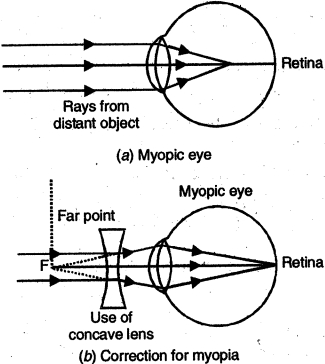
0 likes
View Solution98
Easy
Why does it take some time to see objects in a dim room when we enter the room from bright sunlight outside?
Solution
(N/A) In bright sunlight,the size of the pupil is small to restrict the amount of light entering the eye. When we enter a dim room,the pupil takes some time to dilate (expand) so that more light can enter the eye,which eventually allows us to see objects clearly.
0 likes
View Solution99
Easy
Why does it take some time to see objects in a cinema hall when we just enter the hall from bright sunlight? Explain in brief.
Solution
(N/A) The pupil of the eye regulates and controls the amount of light entering the eye.
In bright sunlight,the iris causes the pupil to contract,making its size small to limit light entry.
When we enter a dark cinema hall,the amount of light is significantly lower.
It takes some time for the iris to relax and the pupil to expand in size to allow more light to enter the eye so that we can see objects clearly in the dim light.
0 likes
View Solution100
Easy
$(a)$ What is "power of accommodation of the eye"?
$(b)$ What happens to the image distance when the object being viewed is moved away from the eye?
$(b)$ What happens to the image distance when the object being viewed is moved away from the eye?
Solution
(N/A) The "power of accommodation of the eye" is the ability of the eye lens to adjust its focal length to focus objects at varying distances clearly on the retina.
$(b)$ The image distance in the eye remains constant. It is equal to the distance between the eye lens and the retina, which does not change regardless of the object's distance.
$(b)$ The image distance in the eye remains constant. It is equal to the distance between the eye lens and the retina, which does not change regardless of the object's distance.
0 likes
View SolutionThe Human Eye and the Colourful World — The Human Eye and Defects of Vision · Frequently Asked Questions
1Are these The Human Eye and the Colourful World questions useful for JEE and NEET?
Yes. All questions in this section are mapped to JEE Main and NEET exam patterns. Previous year questions from JEE Main, NEET, GUJCET and state-level exams are included with full solutions.
2Can I switch to Hindi or Gujarati for these questions?
Yes. Use the language tabs in the hero section or the sidebar to view the same questions and solutions in English, Hindi or Gujarati.
3How do I generate a question paper from this subtopic?
Use the Vedclass Exam Paper Generator — select the chapter and subtopic, set difficulty, and generate Sets A, B, C, D automatically. First 3 chapters of every subject are free.
Vedclass Products
For Students
Vedclass Test Series
Mock tests in real JEE/NEET style with performance analysis. 5-day free trial.
Start Free TrialFor Teachers
Exam Paper Generator
Generate Set A/B/C/D papers from this chapter in 2 minutes. 3 chapters free.
Try FreeFor Institutes
Online Exam Module
Live online exams with unlimited students, 360° analytics & white-label branding.
See DemoFor Teachers & Institutes
Generate a The Human Eye and the Colourful World Exam Paper in 2 Minutes
Select subtopic & difficulty — Sets A, B, C, D auto-generated with No Repeat logic.
First 3 chapters of every subject are free — no payment required.