
A English
The Human Eye and Defects of Vision Questions in English
Class 10 Science · The Human Eye and the Colourful World · The Human Eye and Defects of Vision
176+
Questions
English
Language
100%
With Solutions
Showing 50 of 176 questions in English
101
Easy
$(a)$ What is meant by the least distance of distinct vision?
$(b)$ How does the thickness of the eye lens change when we shift our focus from a distant tree to reading a book?
$(b)$ How does the thickness of the eye lens change when we shift our focus from a distant tree to reading a book?
Solution
(N/A) The least distance of distinct vision is the minimum distance at which an object can be placed so that a normal eye can see it clearly without any strain. For a normal adult eye,this distance is approximately $25 \ cm$.
$(b)$ When we shift our focus from a distant tree to reading a book,the ciliary muscles contract. This contraction increases the curvature of the eye lens,making it thicker. This increase in thickness increases the converging power of the lens,allowing the image of the nearby object (the book) to be focused clearly on the retina.
$(b)$ When we shift our focus from a distant tree to reading a book,the ciliary muscles contract. This contraction increases the curvature of the eye lens,making it thicker. This increase in thickness increases the converging power of the lens,allowing the image of the nearby object (the book) to be focused clearly on the retina.
0 likes
View Solution102
Medium
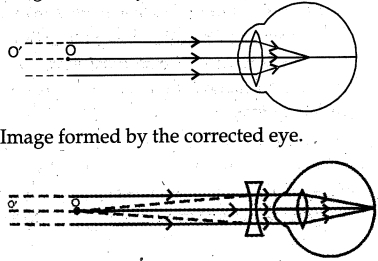
List two causes leading to myopia of the eye. Draw ray diagrams to show the image formation in case of a defective eye and a corrected eye.
Solution
(N/A) The two main causes of myopia are:
$(i)$ Excessive curvature of the eye lens (decrease in focal length).
$(ii)$ Elongation of the eyeball.
In myopia,the image of a distant object is formed in front of the retina instead of on the retina itself. This defect is corrected by using a concave lens of suitable power,which diverges the incoming light rays so that the image is formed on the retina.
0 likes
View Solution103
Medium
$(i)$ What is the least distance of distinct vision for a normal eye?
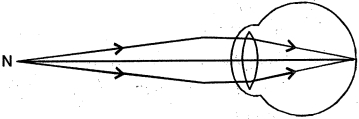
$(ii)$ Does the above distance increase or decrease for a long-sighted eye (hypermetropia)? Give a reason for your answer with a diagram.
$(ii)$ Does the above distance increase or decrease for a long-sighted eye (hypermetropia)? Give a reason for your answer with a diagram.
Solution
(N/A) $(i)$ The least distance of distinct vision for a normal eye is $25\, cm$.
$(ii)$ For a long-sighted eye (hypermetropia),the least distance of distinct vision increases. $A$ person with hypermetropia cannot see objects clearly at the normal near point $(25\, cm)$ because the image is formed behind the retina. The near point of such an eye shifts further away from the eye,meaning the minimum distance at which they can see clearly is greater than $25\, cm$. This is illustrated in the diagram where the near point $N$ is at a distance greater than $25\, cm$.
$(ii)$ For a long-sighted eye (hypermetropia),the least distance of distinct vision increases. $A$ person with hypermetropia cannot see objects clearly at the normal near point $(25\, cm)$ because the image is formed behind the retina. The near point of such an eye shifts further away from the eye,meaning the minimum distance at which they can see clearly is greater than $25\, cm$. This is illustrated in the diagram where the near point $N$ is at a distance greater than $25\, cm$.
0 likes
View Solution104
Medium
$A$ person needs a lens of power $-2.5 \ D$ for correcting his vision. Name the defect of vision he is suffering from. Which lens will he be using for the correction? Also,find the focal length of the lens.
Solution
(N/A) The power of the lens is negative $(P = -2.5 \ D)$,which indicates that the person is using a concave lens.
Since a concave lens is used to correct myopia (nearsightedness),the person is suffering from myopia.
The focal length $f$ is calculated using the formula $f = 1 / P$.
Substituting the value: $f = 1 / (-2.5) = -0.4 \ m$.
Converting to centimeters: $f = -0.4 \times 100 = -40 \ cm$.
The negative sign indicates that the lens is concave.
0 likes
View Solution105
Medium
Name the part of the eye where the image is formed by the eye lens. What is the nature of the image formed? How is this image sent to the brain?
Solution
(N/A) The image of the object formed by the eye lens is formed on the retina of the eye.
The nature of the image formed on the retina is real and inverted.
The image is converted into electrical signals by photoreceptors in the retina and is sent to the brain via the optic nerve.
The nature of the image formed on the retina is real and inverted.
The image is converted into electrical signals by photoreceptors in the retina and is sent to the brain via the optic nerve.
0 likes
View Solution106
Medium
Explain how a normal human eye is able to see distinctly objects placed at a distance as well as those placed at a nearer distance. What is the far point and near point of a normal human eye?
Solution
(N/A) normal human eye can adjust its focal length using the ciliary muscles, a process known as accommodation.
To see distant objects, the ciliary muscles relax, making the eye lens thin and increasing its focal length.
To see near objects, the ciliary muscles contract, making the eye lens thick and decreasing its focal length.
The far point of a normal human eye is at infinity $(\infty)$.
The near point of a normal human eye is at $25\, cm$ from the eye.
0 likes
View Solution107
Medium
An old person is unable to see clearly nearby objects as well as distant objects. $(i)$ What defect of vision is he suffering from? $(ii)$ What kind of lens will be required to see clearly the nearby as well as distant objects? Give reasons.
Solution
(N/A) $(i)$ The person is suffering from $Presbyopia$.
$(ii)$ The person will require $Bifocal$ lenses. $Bifocal$ lenses consist of both convex and concave lenses. The upper portion consists of a concave lens to correct myopia (nearsightedness) for distant vision,and the lower portion consists of a convex lens to correct hypermetropia (farsightedness) for near vision. This combination allows the person to see both distant and nearby objects clearly.
$(ii)$ The person will require $Bifocal$ lenses. $Bifocal$ lenses consist of both convex and concave lenses. The upper portion consists of a concave lens to correct myopia (nearsightedness) for distant vision,and the lower portion consists of a convex lens to correct hypermetropia (farsightedness) for near vision. This combination allows the person to see both distant and nearby objects clearly.
0 likes
View Solution108
Medium
$(a)$ Explain how a normal human eye is able to see distinctly objects placed at a distance as well as those placed at a nearer distance.
$(b)$ What are the far point and near point of a normal human eye?
$(b)$ What are the far point and near point of a normal human eye?
Solution
(N/A) The ciliary muscles change the curvature of the eye lens as per the requirement of the eye. This process changes the focal length of the eye lens,which is known as accommodation.
When the ciliary muscles are relaxed,the lens becomes thin,increasing its focal length,which allows the eye to see distant objects clearly.
When viewing closer objects,the ciliary muscles contract,which makes the eye lens thicker and decreases its focal length,allowing the eye to focus on near objects.
$(b)$ The far point of a normal human eye is at infinity,and the near point is at $25\, cm$ from the eye.
0 likes
View Solution109
Easy
What is meant by the least distance of distinct vision? How does this vary between the very young and old people?
Solution
(N/A) The least distance of distinct vision is defined as the minimum distance at which an object can be placed so that the eye lens can form a clear and sharp image on the retina without any strain. For a normal adult eye,this distance is approximately $25 \ cm$.
$(b)$ This distance varies with age because the flexibility of the ciliary muscles and the eye lens decreases over time. In very young people,the eye lens is highly flexible,allowing for a shorter least distance of distinct vision. In contrast,as people age,the lens becomes less flexible and the ciliary muscles weaken (a condition often associated with presbyopia),which increases the least distance of distinct vision.
$(b)$ This distance varies with age because the flexibility of the ciliary muscles and the eye lens decreases over time. In very young people,the eye lens is highly flexible,allowing for a shorter least distance of distinct vision. In contrast,as people age,the lens becomes less flexible and the ciliary muscles weaken (a condition often associated with presbyopia),which increases the least distance of distinct vision.
0 likes
View Solution110
Medium
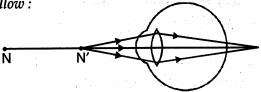
Study the diagram and answer the questions that follow:
$(i)$ Identify the defect of vision represented by this diagram.
$(ii)$ List the two possible causes of this defect.
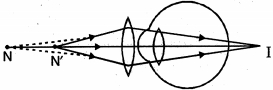
$(iii)$ With the help of a ray diagram,explain how this defect can be corrected.
$(i)$ Identify the defect of vision represented by this diagram.
$(ii)$ List the two possible causes of this defect.
$(iii)$ With the help of a ray diagram,explain how this defect can be corrected.
Solution
(N/A) $(i)$ The defect of vision represented is Hypermetropia (farsightedness).
$(ii)$ The two possible causes of this defect are:
$(a)$ The eyeball has become too short,so that light rays from a nearby object are focused at a point behind the retina.
$(b)$ The focal length of the eye lens is too long,meaning the ciliary muscles are unable to make the lens sufficiently convex to focus the image on the retina.
$(iii)$ This defect can be corrected by using a convex lens of appropriate power. The convex lens converges the incoming light rays before they enter the eye,allowing the eye lens to focus the image exactly on the retina,as shown in the diagram.
0 likes
View Solution111
Medium
$A$ person can see distant sign boards clearly but cannot read clearly a book which is at $25\, cm$ from his eye. Giving reason,identify the defect. Draw a labelled ray diagram to illustrate this defect and its correction.
Solution
(N/A) The person is suffering from Hypermetropia (farsightedness).
Reasons for this defect:
$(a)$ The eyeball has become too short,so that light rays from a nearby object are focused at a point behind the retina.
$(b)$ The focal length of the eye lens is too long because the ciliary muscles are unable to make the lens sufficiently convex.
This defect is corrected by using a convex lens of appropriate power,which converges the light rays before they enter the eye,allowing them to focus on the retina.
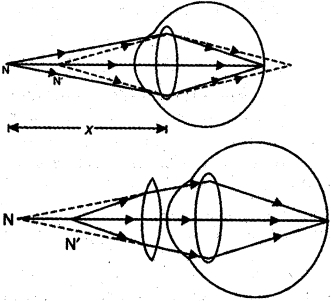
0 likes
View Solution112
Medium
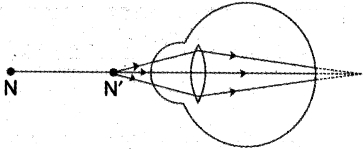
Study the diagram given below and answer the questions that follow it.
$(i)$ Identify the defect of vision represented in this case. Give a reason for your answer.
$(ii)$ Mention the two causes of this defect.
$(i)$ Identify the defect of vision represented in this case. Give a reason for your answer.
$(ii)$ Mention the two causes of this defect.
Solution
(N/A) $(i)$ Hypermetropia (far-sightedness). The reason is that the image of nearby objects is focused behind the retina instead of on the retina.
$(ii)$ This defect arises due to the following two causes:
$(a)$ The focal length of the eye lens is too long.
$(b)$ The eyeball has become too small.
$(ii)$ This defect arises due to the following two causes:
$(a)$ The focal length of the eye lens is too long.
$(b)$ The eyeball has become too small.
0 likes
View Solution113
Medium
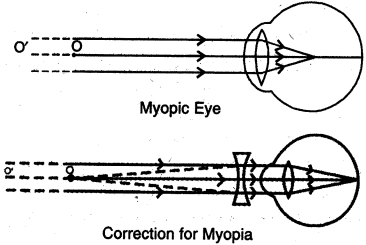
$A$ person cannot see objects farther than $12\, m$ from the eye clearly. Name the defect of vision he is suffering from and the lens that should be used for correction of this defect. Illustrate with the help of a diagram,how this lens will correct the defective vision?
Solution
(N/A) The person is suffering from Myopia (near-sightedness),as they cannot see distant objects clearly beyond a certain point ($12\, m$ in this case).
The corrective lens to be used is a Concave Lens (diverging lens).
$A$ concave lens diverges the incoming light rays from a distant object,making them appear to originate from the person's far point $(12\, m)$. This allows the eye lens to focus the image correctly on the retina.
The diagrams are as shown in the provided image.
0 likes
View Solution114
Medium
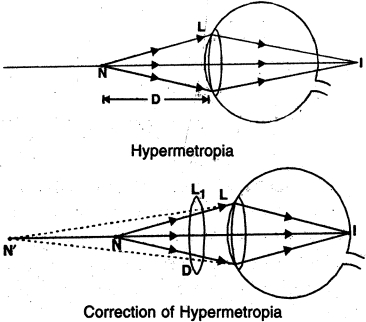
$A$ person cannot read a book at distances less than $50\, cm$. Name the defect of vision he is suffering from. How can it be corrected? Draw ray diagrams to show the image formation
$(i)$ by defective eye and
$(ii)$ after using corrective lens.
$(i)$ by defective eye and
$(ii)$ after using corrective lens.
Solution
(N/A) The defect of vision is Hypermetropia,also known as long-sightedness.
In this condition,the person can see distant objects clearly but cannot see nearby objects distinctly because the image of a nearby object is formed behind the retina.
It can be corrected by using a convex lens of suitable power,which converges the light rays before they enter the eye,allowing the image to be formed exactly on the retina.
0 likes
View Solution115
Medium
$A$ person is unable to read a book clearly when kept at a distance of $25 \,cm$ from his eye. Name the defect. How can it be corrected? Draw ray diagrams for $(i)$ defective eye $(ii)$ corrected eye and explain them.
Solution
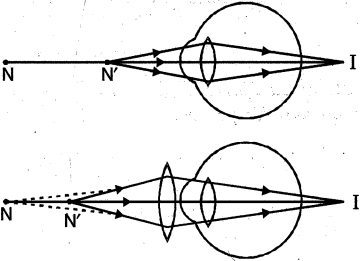
(N/A) The defect is Hypermetropia,also known as long-sightedness. In this condition,the near point of the eye shifts further away than the normal $25 \,cm$.
It can be corrected by using a convex lens of suitable focal length,which converges the light rays from the object at $25 \,cm$ to the eye's actual near point $(N')$,allowing the eye to focus the image on the retina.
$(i)$ Defective eye: Rays from an object placed at the normal near point $(N = 25 \,cm)$ are focused behind the retina because the eye's near point has shifted to $N'$.
$(ii)$ Corrected eye: $A$ convex lens is placed in front of the eye. It forms a virtual image of the object (placed at $N$) at the eye's actual near point $(N')$. The eye then focuses this image onto the retina.
0 likes
View Solution116
Medium
$A$ person suffering from an eye defect uses lenses of power $-1 \,D$. Identify the eye defect. Draw a suitable diagram to illustrate how this type of lens corrects the defect. Give the nature of the corrective lens to be used. Also,calculate the focal length of the corrective lens.
Solution
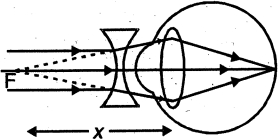
(N/A) The person is suffering from myopia (short-sightedness).
$A$ concave lens is used to correct this defect.
The nature of the corrective lens is a concave lens (diverging lens).
We know that the power of a lens $P = 1 / f$ (where $f$ is in meters).
Given $P = -1 \,D$.
Therefore,$f = 1 / P = 1 / (-1) = -1 \,m = -100 \,cm$.
The negative sign indicates that the lens is concave.
0 likes
View Solution117
Medium
$(i)$ Calculate the maximum power of accommodation of a person having normal vision.
$(ii)$ $A$ person needs to use glasses for reading a newspaper. Identify the defect in her vision and the type of lens she would need to correct it.
$(iii)$ Sometimes when we enter a dark room from bright sunlight,we are unable to see objects clearly. Why?
$(ii)$ $A$ person needs to use glasses for reading a newspaper. Identify the defect in her vision and the type of lens she would need to correct it.
$(iii)$ Sometimes when we enter a dark room from bright sunlight,we are unable to see objects clearly. Why?
Solution
(A) $(i)$ The near point of a normal eye is $D = 25 \text{ cm}$. The power of accommodation $P$ is given by $P = 1/f = 100/D$ (where $D$ is in cm).
$P = 100 / 25 = 4 \text{ D}$.
Thus,for a person with normal vision,the power of accommodation is about $4 \text{ Dioptre}$.
$(ii)$ The defect is Hypermetropia (long-sightedness),as the person has difficulty reading nearby objects. She would need a convex lens to correct this defect.
$(iii)$ The pupil regulates and controls the amount of light entering the eye. In bright sunlight,the pupil size is small. When we enter a dark room,it takes some time for the pupil to dilate (expand) to allow more light to enter,which is why we cannot see objects clearly immediately.
0 likes
View Solution118
Medium
State one function each of iris,pupil,and cornea.
Solution
(N/A) Iris: It regulates the amount of light entering the eye by dilating the pupil in low-intensity light and contracting the pupil in high-intensity light.
Pupil: It is the aperture that allows light to enter the eye.
Cornea: It is a transparent spherical membrane covering the front of the eyeball. It acts as the primary refractive surface where light is refracted the most upon entering the eye.
Pupil: It is the aperture that allows light to enter the eye.
Cornea: It is a transparent spherical membrane covering the front of the eyeball. It acts as the primary refractive surface where light is refracted the most upon entering the eye.
0 likes
View Solution119
Medium
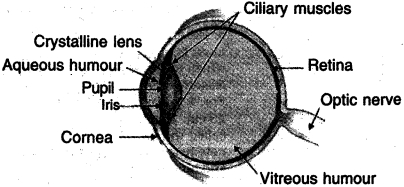
Draw a neat labelled diagram of the structure of the human eye and mention the functions of any four parts.
Solution
(N/A) Cornea: $A$ thin transparent membrane that allows light to enter and refracts it to focus on the crystalline lens.
$(b)$ Crystalline lens: $A$ double convex lens that changes its focal length with the help of ciliary muscles and suspensory ligaments,enabling light rays to focus on the retina.
$(c)$ Iris: The coloured portion of the eye that regulates the size of the pupil and controls the amount of light entering the eye.
$(d)$ Retina: Consists of light-sensitive cells,known as rod and cone cells,which enable us to see in dim and bright light.
0 likes
View Solution120
Medium
$(a)$ State two main causes of a person developing near-sightedness (myopia). With the help of a ray diagram, suggest how this disability can be corrected.
$(b)$ The far point of a myopic person is $150 \ cm$ in front of the eye. Calculate the focal length and power of the lens required to enable him to see distant objects clearly.
$(b)$ The far point of a myopic person is $150 \ cm$ in front of the eye. Calculate the focal length and power of the lens required to enable him to see distant objects clearly.
Solution
(N/A) The two main causes of myopia are:
$1$. Excessive curvature of the eye lens.
$2$. Elongation of the eyeball.
To correct this, a concave lens of suitable focal length is used. The lens diverges the incoming parallel rays from a distant object so that they appear to come from the far point of the myopic eye, allowing the image to be formed on the retina.
$(b)$ Given:
Far point of the myopic eye $(v)$ = $-150 \ cm = -1.5 \ m$.
For a distant object, the object distance $(u)$ = $\infty$.
Using the lens formula: $\frac{1}{f} = \frac{1}{v} - \frac{1}{u}$.
$\frac{1}{f} = \frac{1}{-150} - \frac{1}{\infty} = \frac{1}{-150} - 0 = -\frac{1}{150}$.
Thus, the focal length $(f)$ = $-150 \ cm = -1.5 \ m$.
Power $(P)$ = $\frac{1}{f(in \ meters)} = \frac{1}{-1.5} = -0.667 \ D \approx -0.67 \ D$.
0 likes
View Solution121
Medium
$(a)$ Explain the following terms used in relation to defects of vision and corrections provided for them:
$(i)$ Myopia $(ii)$ Astigmatism $(iii)$ Bifocal lenses $(iv)$ Far-sightedness (Hypermetropia).
$(b)$ Describe with a ray diagram how a person with myopia can be helped by spectacles.
$(i)$ Myopia $(ii)$ Astigmatism $(iii)$ Bifocal lenses $(iv)$ Far-sightedness (Hypermetropia).
$(b)$ Describe with a ray diagram how a person with myopia can be helped by spectacles.
Solution
(N/A) $(i)$ Myopia (Near-sightedness): $A$ defect where a person can see nearby objects clearly but cannot see distant objects distinctly. It is corrected using a concave lens.
$(ii)$ Astigmatism: $A$ defect where the cornea or lens has an irregular curvature,causing blurred vision at all distances. It is corrected using cylindrical lenses.
$(iii)$ Bifocal lenses: Lenses consisting of both concave and convex parts,used to correct Presbyopia,where a person has both Myopia and Hypermetropia.
$(iv)$ Far-sightedness (Hypermetropia): $A$ defect where a person can see distant objects clearly but cannot see nearby objects distinctly. It is corrected using a convex lens.
$(b)$ In Myopia,the image of a distant object forms in front of the retina. $A$ concave lens of suitable focal length is placed in front of the eye to diverge the incoming light rays,shifting the image back onto the retina.
0 likes
View Solution122
Medium
What is long-sightedness (hypermetropia)? List two causes for the development of long-sightedness. Describe with a ray diagram how this defect may be corrected by using spectacles.
Solution
(N/A) Long-sightedness,also known as $Hypermetropia$,is a vision defect in which a person can see distant objects clearly but cannot see nearby objects distinctly.
Two causes for the development of $Hypermetropia$ are:
$1$. The focal length of the eye lens is too long.
$2$. The eyeball has become too small.
Correction:
This defect is corrected by using a convex lens of appropriate power. The convex lens converges the light rays coming from a nearby object before they enter the eye,allowing the image to be formed on the retina.
[Ray Diagram Description: $A$ diagram showing the image forming behind the retina in a defective eye,and a second diagram showing a convex lens placed in front of the eye,which converges the rays so that the image is formed exactly on the retina.]
0 likes
View Solution123
Medium
$A$ person cannot see objects distinctly when placed at a distance less than $50\, cm$.
$(a)$ Identify the defect of vision.
$(b)$ Give two reasons for this defect.
$(c)$ Calculate the power and nature of the lens he should be using to see clearly the object placed at a distance of $25\, cm$ from his eyes.
$(d)$ Draw the ray diagrams for the defective and the corrected eye.
$(a)$ Identify the defect of vision.
$(b)$ Give two reasons for this defect.
$(c)$ Calculate the power and nature of the lens he should be using to see clearly the object placed at a distance of $25\, cm$ from his eyes.
$(d)$ Draw the ray diagrams for the defective and the corrected eye.
Solution
(A) The defect of vision is Hypermetropia (farsightedness).
$(b)$ Two reasons for this defect are:
$(i)$ The eyeball has become too short,so that light rays from a nearby object are focused at a point behind the retina.
$(ii)$ The focal length of the eye lens is too long because the ciliary muscles are unable to make the lens sufficiently convex.
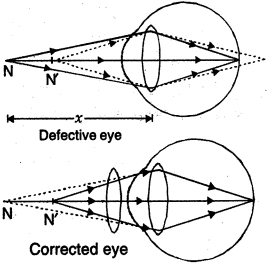
$(c)$ Given: Object distance $u = -25\, cm$,Image distance $v = -50\, cm$ (the near point of the defective eye).
Using the lens formula: $\frac{1}{f} = \frac{1}{v} - \frac{1}{u}$
$\frac{1}{f} = \frac{1}{-50} - \frac{1}{-25} = \frac{-1 + 2}{50} = \frac{1}{50}$
$f = +50\, cm = +0.5\, m$
Power $P = \frac{1}{f(m)} = \frac{1}{0.5} = +2.0\, D$.
The nature of the lens is a convex lens.
$(d)$ The ray diagrams are as shown in the image.
0 likes
View Solution124
Medium
$A$ person cannot see objects distinctly when placed beyond $2\, m$.
$(a)$ Identify the eye defect.
$(b)$ Give two reasons for this defect.
$(c)$ Calculate the power and nature of the lens he should be using to see the distant objects clearly.
$(d)$ Draw the ray diagrams for the defective and the corrected eye.
$(a)$ Identify the eye defect.
$(b)$ Give two reasons for this defect.
$(c)$ Calculate the power and nature of the lens he should be using to see the distant objects clearly.
$(d)$ Draw the ray diagrams for the defective and the corrected eye.
Solution
(N/A) The eye defect is Myopia (nearsightedness).
$(b)$ The two reasons for this defect are:
$(i)$ Excessive curvature of the eye lens.
$(ii)$ Elongation of the eyeball.
$(c)$ To see distant objects clearly,the person needs a lens that forms a virtual image of an object at infinity at his far point $(2\, m)$.
Given: Object distance $u = \infty$,Image distance $v = -2\, m$.
Using the lens formula: $\frac{1}{f} = \frac{1}{v} - \frac{1}{u} = \frac{1}{-2} - \frac{1}{\infty} = -0.5\, m^{-1}$.
Power $P = \frac{1}{f(m)} = -0.5\, D$.
The negative sign indicates that the lens is a concave lens (diverging lens).
$(d)$ The ray diagrams are as shown in the provided image.
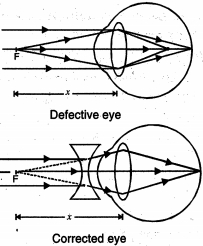
0 likes
View Solution125
MediumMCQ
$A$ person with defective vision is unable to see objects nearer than $1.5 \ m$. He wants to read books at a distance of $30 \ cm$. Find the nature, focal length, and power of the lens he needs in his spectacles.
A
Convex lens, $37.5 \ cm$, $+2.67 \ D$
B
Concave lens, $37.5 \ cm$, $-2.67 \ D$
C
Convex lens, $30 \ cm$, $+3.33 \ D$
D
Concave lens, $30 \ cm$, $-3.33 \ D$
Solution
(A) This person suffers from hypermetropia (farsightedness).
For the corrective lens, the object distance $u = -30 \ cm$ and the image must be formed at the person's near point $v = -150 \ cm$.
Using the lens formula: $\frac{1}{f} = \frac{1}{v} - \frac{1}{u}$.
$\frac{1}{f} = \frac{1}{-150} - \frac{1}{-30} = \frac{-1 + 5}{150} = \frac{4}{150}$.
$f = \frac{150}{4} = +37.5 \ cm = +0.375 \ m$.
The positive sign indicates a convex lens.
Power $P = \frac{1}{f(\text{in } m)} = \frac{1}{0.375} = +2.67 \ D$.
0 likes
View Solution126
MediumMCQ
The far point of a myopic person is $80 \, cm$ in front of the eyes. What is the nature and power of the lens required to enable him to see very distant objects distinctly?
A
Concave lens of power $-1.25 \, D$
B
Convex lens of power $+1.25 \, D$
C
Concave lens of power $+1.25 \, D$
D
Convex lens of power $-1.25 \, D$
Solution
(A) For a myopic eye, the correcting lens is a concave lens.
The far point of the myopic person is $x = 80 \, cm = 0.8 \, m$.
To see distant objects (at infinity) clearly, the lens must form a virtual image of an object at infinity at the person's far point $(80 \, cm)$.
Thus, the focal length $f$ of the corrective lens is equal to the negative of the far point distance:
$f = -x = -80 \, cm = -0.8 \, m$.
The power $P$ of the lens is given by the formula $P = \frac{1}{f(in \, meters)}$.
$P = \frac{1}{-0.8 \, m} = -1.25 \, D$.
Therefore, a concave lens of power $-1.25 \, D$ is required.
0 likes
View Solution127
MediumMCQ
The far point of a myopic person is $40 \, cm$. What type of lens should they wear to see distant objects clearly? Calculate the focal length and the power of the lens they should use.
A
Concave lens,$f = -40 \, cm, P = -2.5 \, D$
B
Convex lens,$f = 40 \, cm, P = 2.5 \, D$
C
Concave lens,$f = -20 \, cm, P = -5.0 \, D$
D
Convex lens,$f = -40 \, cm, P = -2.5 \, D$
Solution
(A) myopic person suffers from myopia (nearsightedness),which is corrected using a concave lens.
For a myopic person,the far point is at $40 \, cm$. To see distant objects (at infinity) clearly,the lens must form a virtual image of the object at the person's far point.
Given: Object distance $u = \infty$,Image distance $v = -40 \, cm = -0.4 \, m$.
Using the lens formula: $\frac{1}{f} = \frac{1}{v} - \frac{1}{u}$.
Substituting the values: $\frac{1}{f} = \frac{1}{-0.4} - \frac{1}{\infty} = -2.5 \, m^{-1}$.
Thus,the focal length $f = -0.4 \, m = -40 \, cm$.
The power of the lens $P = \frac{1}{f \text{ (in meters)}} = \frac{1}{-0.4} = -2.5 \, D$.
Therefore,a concave lens of focal length $40 \, cm$ and power $-2.5 \, D$ is required.
0 likes
View Solution128
MediumMCQ
$A$ myopic person has been using spectacles of power $-1.00\, D$ for clear vision. During old age,he also needs to use separate reading glasses of power $+2.00\, D$. Explain what may have happened to his eyesight?
A
He developed hypermetropia.
B
He developed presbyopia.
C
He developed astigmatism.
D
He developed cataract.
Solution
(B) Initially,the person suffered from myopia (nearsightedness),which was corrected by a concave lens of power $-1.00\, D$. This lens allowed him to see distant objects clearly.
As the person aged,he developed presbyopia,a condition where the eye loses its ability to focus on near objects due to the weakening of ciliary muscles and reduced flexibility of the eye lens.
To correct this,he requires a convex lens for reading. The power of $+2.00\, D$ indicates that his near point has shifted further away from the normal $25\, cm$.
Using the lens formula $\frac{1}{f} = \frac{1}{v} - \frac{1}{u}$,where $f = +0.5\, m$ $(+50\, cm)$ and $u = -25\, cm$ (the standard near point),we find the image distance $v$ that his eye can currently accommodate:
$\frac{1}{v} = \frac{1}{50} + \frac{1}{-25} = \frac{1-2}{50} = -\frac{1}{50}$.
Thus,$v = -50\, cm$. This means his new near point has shifted to $50\, cm$ from his eyes,necessitating the use of reading glasses.
0 likes
View Solution129
Medium
The far point of a myopic person is $150 \ cm$ in front of the eye. Calculate the focal length and the power of a lens required to enable him to see distant objects clearly.
Solution
(D) Given: The object distance $u = \infty$ (for distant objects) and the image distance $v = -150 \ cm = -1.5 \ m$ (since the image must be formed at the person's far point).
Using the lens formula, $\frac{1}{f} = \frac{1}{v} - \frac{1}{u}$.
Substituting the values: $\frac{1}{f} = \frac{1}{-1.5} - \frac{1}{\infty}$.
Since $\frac{1}{\infty} = 0$, we get $\frac{1}{f} = -\frac{1}{1.5}$.
Therefore, the focal length $f = -1.5 \ m$.
The power of the lens $P$ is given by $P = \frac{1}{f(\text{in meters})}$.
$P = \frac{1}{-1.5} = -0.67 \ D$.
Thus, the required focal length is $-1.5 \ m$ and the power is $-0.67 \ D$.
0 likes
View Solution130
EasyMCQ
$A$ person needs a lens of power $-0.5 \text{ D}$ for correcting his distant vision. For correcting his near vision,he needs a lens of power $+1.5 \text{ D}$. What is the focal length of the lens required for correcting his $(i)$ distant vision,$(ii)$ near vision?
A
$f_1 = -2 \text{ m}, f_2 = +0.67 \text{ m}$
B
$f_1 = -0.5 \text{ m}, f_2 = +1.5 \text{ m}$
C
$f_1 = +2 \text{ m}, f_2 = -0.67 \text{ m}$
D
$f_1 = -1 \text{ m}, f_2 = +0.5 \text{ m}$
Solution
(A) The focal length $f$ of a lens is given by the formula $f = 1 / P$,where $P$ is the power of the lens in dioptres $(D)$ and $f$ is in metres $(m)$.
$(i)$ For distant vision:
Given power $P = -0.5 \text{ D}$.
$f = 1 / (-0.5) = -2 \text{ m}$.
$(ii)$ For near vision:
Given power $P = +1.5 \text{ D}$.
$f = 1 / 1.5 = 0.67 \text{ m}$ (approximately).
$(i)$ For distant vision:
Given power $P = -0.5 \text{ D}$.
$f = 1 / (-0.5) = -2 \text{ m}$.
$(ii)$ For near vision:
Given power $P = +1.5 \text{ D}$.
$f = 1 / 1.5 = 0.67 \text{ m}$ (approximately).
0 likes
View Solution131
Easy
$A$ person is able to see objects clearly only when these are lying at distances between $50 \text{ cm}$ and $300 \text{ cm}$ from his eye. Identify the kind of defects of vision he is suffering from. Give reason for your answer.
Solution
(N/A) The person is suffering from both myopia (short-sightedness) and presbyopia.
$1$. The near point of a normal eye is $25 \text{ cm}$. Since the person's near point is $50 \text{ cm}$, he cannot see objects closer than $50 \text{ cm}$, which indicates presbyopia (or hypermetropia).
$2$. The far point of a normal eye is infinity $(\infty)$. Since the person's far point is limited to $300 \text{ cm}$, he cannot see distant objects clearly, which indicates myopia (short-sightedness).
0 likes
View Solution132
Medium
$(i)$ Write the range of distance for a person having normal vision.
$(ii)$ $A$ person needs to use glasses for reading a newspaper. Identify the defect in his vision and the type of lens he would need to correct it.
$(iii)$ Sometimes when we enter into a dark room from bright sunlight,we are unable to see objects clearly. Why?
$(ii)$ $A$ person needs to use glasses for reading a newspaper. Identify the defect in his vision and the type of lens he would need to correct it.
$(iii)$ Sometimes when we enter into a dark room from bright sunlight,we are unable to see objects clearly. Why?
Solution
(N/A) $(i)$ The near point for a person with normal vision is $25 \, cm$ and the far point is infinity.
$(ii)$ The defect is Hypermetropia (farsightedness). The person needs a convex lens to correct this defect.
$(iii)$ In bright sunlight,the pupil of the eye is small to allow less light to enter. When we enter a dark room,the pupil takes some time to dilate (expand) to allow more light to enter,which is why we cannot see objects clearly immediately.
0 likes
View Solution133
Medium
When one enters a dim-lit room from bright light,one is unable to see the objects in the room for some time. Explain why.
Solution
(N/A) In bright light,the iris contracts the pupil of the eye to allow less light to enter. When we enter a dim-lit room,the iris takes time to expand the pupil to allow more light to enter the eye. Thus,for a short duration,one is unable to see clearly in a dim-lit room.
0 likes
View Solution134
Medium
$A$ person is able to see objects clearly only when these are lying at distances between $50\, cm$ and $300\, cm$ from his eye.
$(a)$ What kind of defect of vision is he suffering from?
$(b)$ What kind of lenses will be required to increase his range of vision from $25\, cm$ to infinity? Explain.
$(a)$ What kind of defect of vision is he suffering from?
$(b)$ What kind of lenses will be required to increase his range of vision from $25\, cm$ to infinity? Explain.
Solution
(N/A) For a normal eye,the near point is at $25\, cm$ and the far point is at infinity. The given person cannot see objects clearly closer than $50\, cm$ (near point defect) or farther than $300\, cm$ (far point defect). Therefore,he is suffering from both myopia (nearsightedness) and hypermetropia (farsightedness),a condition often referred to as presbyopia.
$(b)$ To correct these defects,a bifocal lens is required. $A$ concave lens of suitable focal length is used in the upper part to correct myopia (to see distant objects up to infinity),and a convex lens of suitable focal length is used in the lower part to correct hypermetropia (to see near objects up to $25\, cm$).
$(b)$ To correct these defects,a bifocal lens is required. $A$ concave lens of suitable focal length is used in the upper part to correct myopia (to see distant objects up to infinity),and a convex lens of suitable focal length is used in the lower part to correct hypermetropia (to see near objects up to $25\, cm$).
0 likes
View Solution135
Medium
$A$ student cannot read properly from the blackboard while sitting on the front desk in a large classroom. However,he can read clearly while sitting on the last desk of the classroom.
$(a)$ Draw ray diagrams to illustrate the formation of the image of the blackboard writing by his eye lens when he is seated at the $(i)$ front desk,$(ii)$ last desk.
$(b)$ Name the defect of the eye from which the student is suffering.
$(c)$ Name the type of lens that would enable him to see the blackboard writing clearly when seated at the front desk. Draw a ray diagram to illustrate how this lens helps him to see clearly.
Solution
(N/A) $(i)$ When the student sits at the front desk,the object is too close. The light rays from the blackboard focus behind the retina,resulting in a blurred image on the retina.
$(ii)$ When the student sits at the last desk,the object is at a sufficient distance. The light rays from the blackboard focus exactly on the retina,resulting in a clear image.
$(b)$ The student is suffering from hypermetropia,also known as long-sightedness.
$(c)$ This defect can be corrected by using a convex lens of suitable focal length. The convex lens converges the light rays before they enter the eye,allowing the image to be formed on the retina.
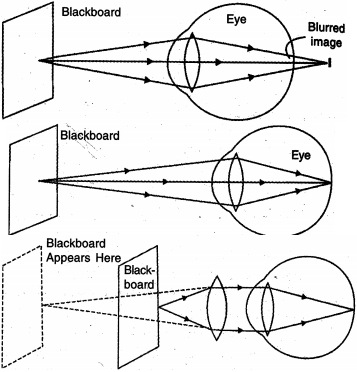
0 likes
View Solution136
Medium
$A$ student finds the writing on the blackboard blurred and unclear while sitting on the last desk in a classroom. He,however,sees it clearly while sitting on the front desk at about $2\, m$ from the blackboard.
$(a)$ Draw ray diagrams to illustrate the formation of image of the blackboard writing by his eye lens when he is seated at the $(i)$ last desk,$(ii)$ front desk.
$(b)$ Name the defect of the eye from which the student is suffering.
$(c)$ Name the kind of lens that would help him to see clearly even when he is seated at the last desk. Draw a ray diagram to illustrate how this lens helps him to see clearly.
Solution
(N/A) $(i)$ When the student is seated at the last desk,the image of the distant object forms in front of the retina because the eye lens is unable to focus light rays from distant objects onto the retina.
$(ii)$ When the student is seated at the front desk,the object is closer,and the eye lens can focus the light rays onto the retina,resulting in a clear image.
$(b)$ The student is suffering from myopia (near-sightedness).
$(c)$ The defect can be corrected by using a concave lens of suitable focal length. The concave lens diverges the incoming light rays from the distant object,making them appear to come from the student's far point,thus allowing the eye lens to focus them onto the retina.
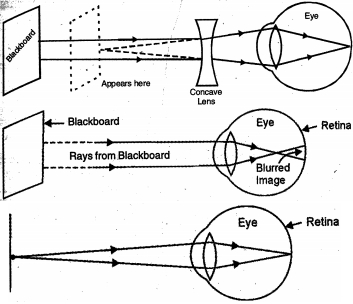
0 likes
View Solution137
EasyMCQ
$A$ human eye can focus objects at different distances by adjusting the focal length of the eye lens. This is due to
A
accommodation
B
near sightedness
C
persistence of vision
D
far sightedness
Solution
(A) The ability of the eye lens to adjust its focal length to focus objects at varying distances is known as $accommodation$.
This process is facilitated by the ciliary muscles,which change the curvature and thickness of the lens.
When the ciliary muscles relax,the lens becomes thin,increasing the focal length to see distant objects.
When the ciliary muscles contract,the lens becomes thick,decreasing the focal length to see nearby objects.
0 likes
View Solution138
EasyMCQ
Cinematography makes use of
A
accommodation
B
persistence of vision
C
least distance of distinct vision
D
bifocal lens system
Solution
(B) Cinematography relies on the phenomenon known as the $persistence \ of \ vision$.
This is the ability of the human eye to retain an image on the retina for approximately $1/16$ of a second after the object has been removed from the field of view.
In cinematography,a series of still images are projected in rapid succession (usually $24$ frames per second).
Because the brain perceives these images as continuous motion due to the $persistence \ of \ vision$,the viewer sees a smooth,moving picture rather than individual static frames.
0 likes
View Solution139
EasyMCQ
The human eye forms the image of an object at its
A
cornea
B
pupil
C
retina
D
iris
Solution
(C) The human eye functions like a camera. Light enters the eye through the cornea and pupil,passes through the crystalline lens,and is focused onto the light-sensitive screen located at the back of the eye,known as the retina. The retina contains photoreceptor cells (rods and cones) that convert light energy into electrical signals,which are then transmitted to the brain via the optic nerve. Therefore,the correct answer is the retina.
0 likes
View Solution140
EasyMCQ
The change in focal length of an eye lens to focus the image of objects at varying distances is done by the action of the
A
pupil
B
retina
C
blind spot
D
ciliary muscles
Solution
(D) The ability of the eye lens to adjust its focal length to focus objects at varying distances is known as accommodation.
This process is controlled by the ciliary muscles.
When the ciliary muscles contract,the curvature of the lens increases,making it thicker and decreasing its focal length,which allows the eye to focus on nearby objects.
When the ciliary muscles relax,the lens becomes thinner,increasing its focal length,which allows the eye to focus on distant objects.
0 likes
View Solution141
EasyMCQ
In the case of the human eye,when light rays enter the eye,most of the refraction occurs at the
A
outer surface of the cornea
B
iris
C
crystalline lens
D
pupil
Solution
(A) When light rays enter the human eye,they first encounter the cornea.
The cornea is the transparent,curved,outermost layer of the eye.
Because the cornea has a significant difference in refractive index compared to the air outside,it is responsible for the majority of the refraction of light entering the eye.
The crystalline lens provides the fine-tuning of the focus,but the primary bending of light occurs at the outer surface of the cornea.
0 likes
View Solution142
MediumMCQ
The focal length of the eye lens increases when eye muscles
A
contract and lens becomes thinner.
B
contract and lens becomes thicker.
C
are relaxed and lens becomes thicker.
D
are relaxed and lens becomes thinner.
Solution
(D) The focal length of the eye lens is controlled by the ciliary muscles.
When the ciliary muscles are relaxed,the suspensory ligaments become taut,which pulls the lens and makes it thinner.
$A$ thinner lens has a greater radius of curvature,which results in an increased focal length,allowing the eye to focus on distant objects.
Therefore,the focal length increases when the eye muscles are relaxed and the lens becomes thinner.
0 likes
View Solution143
MediumMCQ
$A$ person cannot see distinctly objects kept beyond $2\, m$. This defect can be corrected by using a lens of power:
A
$-0.2\, D$
B
$+0.5\, D$
C
$-0.5\, D$
D
$-0.25\, D$
Solution
(C) The person is suffering from myopia (near-sightedness) because they cannot see objects beyond $2\, m$.
To correct this defect, a concave lens is used to bring the image of an object at infinity to the person's far point $(2\, m)$.
Here, the object distance $u = \infty$ and the image distance $v = -2\, m$.
Using the lens formula: $\frac{1}{f} = \frac{1}{v} - \frac{1}{u}$.
Substituting the values: $\frac{1}{f} = \frac{1}{-2} - \frac{1}{\infty} = -0.5\, m^{-1}$.
Since power $P = \frac{1}{f(\text{in meters})}$, we get $P = -0.5\, D$.
0 likes
View Solution144
EasyMCQ
Accommodation means the adjustment of light going into the eye for image formation.
A
True
B
False
Solution
(B) The statement is False.
Accommodation is the ability of the eye to focus on objects at varying distances by changing the focal length of the eye lens with the help of ciliary muscles.
The adjustment of the amount of light entering the eye is controlled by the iris and the pupil,not by accommodation.
Accommodation is the ability of the eye to focus on objects at varying distances by changing the focal length of the eye lens with the help of ciliary muscles.
The adjustment of the amount of light entering the eye is controlled by the iris and the pupil,not by accommodation.
0 likes
View Solution145
EasyMCQ
$A$ near-sighted person can see only nearer objects.
A
True
B
False
Solution
(B) The statement is $False$.
Myopia,or near-sightedness,is a defect of vision in which a person can see nearby objects clearly but cannot see distant objects distinctly.
While the statement says they can see 'only' nearer objects,it is important to clarify that the primary characteristic of myopia is the inability to see distant objects clearly,rather than a limitation that prevents them from seeing anything else.
However,in the context of standard physics problems,this statement is often considered false because it implies an exclusive capability that ignores the definition of the defect as a failure to focus on distant objects.
0 likes
View Solution146
EasyMCQ
Presbyopia is a type of far-sightedness.
A
True
B
False
Solution
(B) Presbyopia is a defect of vision in which an old person cannot see the nearby objects clearly due to the loss of accommodation power of the eye. It is not a type of far-sightedness (hypermetropia),although it shares some similarities in terms of corrective lenses. Therefore,the statement is False.
0 likes
View Solution147
EasyMCQ
$A$ convex lens can be used to correct long-sightedness (hypermetropia).
A
True
B
False
Solution
(A) Long-sightedness,also known as $Hypermetropia$,is a defect of vision where a person can see distant objects clearly but cannot see nearby objects distinctly. This happens because the light rays from a nearby object focus behind the retina. $A$ convex lens is used to converge the light rays before they enter the eye,allowing the image to be focused correctly on the retina. Therefore,the statement is $True$.
0 likes
View Solution148
EasyMCQ
To correct astigmatism,we use a cylindrical lens.
A
True
B
False
Solution
(A) Astigmatism is a common vision condition caused by an irregularly shaped cornea or lens,which prevents light from focusing properly on the retina. This results in blurred or distorted vision at all distances. To correct this refractive error,a cylindrical lens is used,which compensates for the uneven curvature of the eye by providing different refractive powers in different meridians. Therefore,the statement is true.
0 likes
View Solution149
EasyMCQ
Short-sightedness (myopia) is caused due to the elongation of the eyeball.
A
True
B
False
Solution
(A) Short-sightedness,also known as myopia,is a defect of vision in which a person can see nearby objects clearly but cannot see distant objects distinctly.
This condition occurs because the eyeball becomes too long,causing the light rays from distant objects to focus in front of the retina instead of directly on it.
Therefore,the statement is True.
This condition occurs because the eyeball becomes too long,causing the light rays from distant objects to focus in front of the retina instead of directly on it.
Therefore,the statement is True.
0 likes
View Solution150
EasyMCQ
Abnormalities in the normal vision of the eye are called defects of vision.
A
True
B
False
Solution
(A) The statement is $True$.
Defects of vision occur when the eye loses its ability to accommodate or focus light properly on the retina.
Common examples include myopia (nearsightedness),hypermetropia (farsightedness),and presbyopia.
Defects of vision occur when the eye loses its ability to accommodate or focus light properly on the retina.
Common examples include myopia (nearsightedness),hypermetropia (farsightedness),and presbyopia.
0 likes
View SolutionThe Human Eye and the Colourful World — The Human Eye and Defects of Vision · Frequently Asked Questions
1Are these The Human Eye and the Colourful World questions useful for JEE and NEET?
Yes. All questions in this section are mapped to JEE Main and NEET exam patterns. Previous year questions from JEE Main, NEET, GUJCET and state-level exams are included with full solutions.
2Can I switch to Hindi or Gujarati for these questions?
Yes. Use the language tabs in the hero section or the sidebar to view the same questions and solutions in English, Hindi or Gujarati.
3How do I generate a question paper from this subtopic?
Use the Vedclass Exam Paper Generator — select the chapter and subtopic, set difficulty, and generate Sets A, B, C, D automatically. First 3 chapters of every subject are free.
Vedclass Products
For Students
Vedclass Test Series
Mock tests in real JEE/NEET style with performance analysis. 5-day free trial.
Start Free TrialFor Teachers
Exam Paper Generator
Generate Set A/B/C/D papers from this chapter in 2 minutes. 3 chapters free.
Try FreeFor Institutes
Online Exam Module
Live online exams with unlimited students, 360° analytics & white-label branding.
See DemoFor Teachers & Institutes
Generate a The Human Eye and the Colourful World Exam Paper in 2 Minutes
Select subtopic & difficulty — Sets A, B, C, D auto-generated with No Repeat logic.
First 3 chapters of every subject are free — no payment required.