
A English
Properties of a Parallelogram Questions in English
Class 9 Mathematics · Quadrilaterals · Properties of a Parallelogram
80+
Questions
English
Language
100%
With Solutions
Showing 30 of 80 questions in English
51
Medium
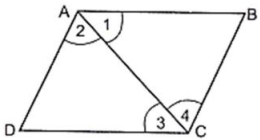
$A$ diagonal of a parallelogram bisects one of its angles. Show that it is a rhombus.
Solution
(N/A) $ABCD$ is a parallelogram and diagonal $AC$ bisects $\angle A$. We have to show that $ABCD$ is a rhombus.
$\angle 1 = \angle 2$ $\dots(1)$ [$\because AC$ bisects $\angle A$]
$\angle 2 = \angle 4$ $\dots(2)$ [Alternate interior angles,since $AB \parallel DC$]
From $(1)$ and $(2)$,we get:
$\angle 1 = \angle 4$
Now,in $\triangle ABC$,we have:
$\angle 1 = \angle 4$ [Proved above]
$BC = AB$ [$\because$ Sides opposite to equal angles are equal]
Also,$AB = DC$ and $AD = BC$ [$\because$ Opposite sides of a parallelogram are equal]
Therefore,$AB = BC = CD = AD$.
Since all sides of the parallelogram $ABCD$ are equal,it is a rhombus.
0 likes
View Solution52
EasyMCQ
$PQRS$ is a parallelogram. If the two diagonals are equal,find the measure of $\angle PQR$. (in $^{\circ}$)
A
$45$
B
$60$
C
$90$
D
$120$
Solution
(C) parallelogram with equal diagonals is a rectangle.
In a rectangle,all interior angles are equal to $90^{\circ}$.
Therefore,$\angle PQR = 90^{\circ}$.
In a rectangle,all interior angles are equal to $90^{\circ}$.
Therefore,$\angle PQR = 90^{\circ}$.
0 likes
View Solution53
Medium
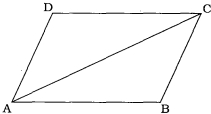
Prove that a diagonal of a parallelogram divides it into two congruent triangles.
Solution
(N/A) Given: $A$ parallelogram $ABCD$.
To Prove: $A$ diagonal,say $AC$,of parallelogram $ABCD$ divides it into congruent triangles $ABC$ and $CDA$. i.e.,$\Delta ABC \cong \Delta CDA$.
Construction: Join $AC$.
Proof:
Since $ABCD$ is a parallelogram,
$AB \parallel CD$ and $AD \parallel BC$.
Now,$AD \parallel BC$ and transversal $AC$ intersects them at $A$ and $C$ respectively.
Therefore,$\angle DAC = \angle BCA$ (Alternate interior angles)........$(1)$
Again,$AB \parallel DC$ and transversal $AC$ intersects them at $A$ and $C$ respectively.
Therefore,$\angle BAC = \angle DCA$ (Alternate interior angles)........$(2)$
Now,in $\Delta ABC$ and $\Delta CDA$,we have:
$\angle BCA = \angle DAC$ [From $(1)$]
$AC = CA$ (Common side)
$\angle BAC = \angle DCA$ [From $(2)$]
So,by $ASA$ congruence criterion,we obtain:
$\Delta ABC \cong \Delta CDA$.
0 likes
View Solution54
Medium
In a quadrilateral $ABCD$,$\angle A : \angle B : \angle C : \angle D = 4 : 5 : 4 : 5$. Find the measure of each angle of the quadrilateral and state the type of quadrilateral $ABCD$.
Solution
(A) In quadrilateral $ABCD$,the sum of the interior angles is $360^{\circ}$.
Given the ratio $\angle A : \angle B : \angle C : \angle D = 4 : 5 : 4 : 5$.
Let the angles be $4x, 5x, 4x$,and $5x$.
Sum of angles: $4x + 5x + 4x + 5x = 360^{\circ}$.
$18x = 360^{\circ}$,which gives $x = 20^{\circ}$.
Therefore,the angles are:
$\angle A = 4 \times 20^{\circ} = 80^{\circ}$
$\angle B = 5 \times 20^{\circ} = 100^{\circ}$
$\angle C = 4 \times 20^{\circ} = 80^{\circ}$
$\angle D = 5 \times 20^{\circ} = 100^{\circ}$
Since $\angle A = \angle C$ and $\angle B = \angle D$,both pairs of opposite angles are equal.
Therefore,$ABCD$ is a parallelogram.
0 likes
View Solution55
Medium
Prove that the diagonals of a square are equal and bisect each other at right angles.
Solution
(N/A) Let $ABCD$ be a square. We need to prove that $AC = BD$,$OA = OC$,$OB = OD$,and $\angle AOB = 90^{\circ}$.
$1$. To prove diagonals are equal: Consider $\triangle ABC$ and $\triangle BAD$. In these triangles,$AB = BA$ (common side),$BC = AD$ (sides of a square),and $\angle ABC = \angle BAD = 90^{\circ}$. By $SAS$ congruence,$\triangle ABC \cong \triangle BAD$. Thus,$AC = BD$ $(CPCT)$.
$2$. To prove diagonals bisect each other: Consider $\triangle OAB$ and $\triangle OCD$. Here,$\angle OAB = \angle OCD$ (alternate interior angles),$\angle OBA = \angle ODC$ (alternate interior angles),and $AB = CD$ (sides of a square). By $ASA$ congruence,$\triangle OAB \cong \triangle OCD$. Thus,$OA = OC$ and $OB = OD$ $(CPCT)$.
$3$. To prove diagonals intersect at right angles: Consider $\triangle OAB$ and $\triangle OCB$. Here,$OA = OC$ (proved above),$AB = CB$ (sides of a square),and $OB = OB$ (common side). By $SSS$ congruence,$\triangle OAB \cong \triangle OCB$. Thus,$\angle AOB = \angle COB$ $(CPCT)$. Since $\angle AOB + \angle COB = 180^{\circ}$ (linear pair),$2 \angle AOB = 180^{\circ}$,which implies $\angle AOB = 90^{\circ}$.
0 likes
View Solution56
Medium
In parallelogram $PQRS$,the bisector of $\angle P$ intersects $RS$ at $M$ and the bisector of $\angle R$ intersects $PQ$ at $N$. Prove that $PNRM$ is a parallelogram.
Solution
(N/A) $1$. In parallelogram $PQRS$,we have $\angle P = \angle R$ (opposite angles are equal) and $PQ \parallel RS$.
$2$. Let the bisector of $\angle P$ be $PM$ and the bisector of $\angle R$ be $RN$.
$3$. Since $PM$ bisects $\angle P$,$\angle SPM = \angle RPM = \frac{1}{2} \angle P$.
$4$. Since $RN$ bisects $\angle R$,$\angle QRN = \angle PRN = \frac{1}{2} \angle R$.
$5$. Since $\angle P = \angle R$,it follows that $\frac{1}{2} \angle P = \frac{1}{2} \angle R$,so $\angle RPM = \angle PRN$.
$6$. These are alternate interior angles for lines $PM$ and $RN$ with transversal $PR$. Therefore,$PM \parallel RN$.
$7$. Also,$PQ \parallel RS$ implies $PN \parallel RM$ (since $N$ lies on $PQ$ and $M$ lies on $RS$).
$8$. Since both pairs of opposite sides are parallel ($PM \parallel RN$ and $PN \parallel RM$),$PNRM$ is a parallelogram.
0 likes
View Solution57
Medium
In parallelogram $PQRS$,diagonal $PR$ bisects $\angle P$. Prove that diagonal $PR$ bisects $\angle R$ also and $PQRS$ is a rhombus.
Solution
(N/A) Given: $PQRS$ is a parallelogram where diagonal $PR$ bisects $\angle P$,i.e.,$\angle SPR = \angle QPR$.
Step $1$: Since $PQRS$ is a parallelogram,$PS \parallel QR$ and $PQ \parallel SR$.
Step $2$: Because $PS \parallel QR$ and $PR$ is a transversal,$\angle SPR = \angle PRQ$ (alternate interior angles).
Step $3$: Because $PQ \parallel SR$ and $PR$ is a transversal,$\angle QPR = \angle PRS$ (alternate interior angles).
Step $4$: Since $\angle SPR = \angle QPR$ (given),it follows that $\angle PRQ = \angle PRS$. Thus,$PR$ bisects $\angle R$.
Step $5$: In $\triangle PQR$ and $\triangle PSR$,we have $\angle QPR = \angle SPR$ and $\angle PRQ = \angle PRS$. Since $PR = PR$ (common side),the triangles are congruent by $ASA$ congruence.
Step $6$: By $CPCT$,$PQ = PS$. Since adjacent sides of a parallelogram are equal,$PQRS$ is a rhombus.
0 likes
View Solution58
MediumMCQ
In parallelogram $ABCD$,$\angle A = \angle B + 50^{\circ}$. Find the measure of each angle of the quadrilateral $ABCD$.
A
$\angle A = 115^{\circ}, \angle B = 65^{\circ}, \angle C = 115^{\circ}, \angle D = 65^{\circ}$
B
$\angle A = 105^{\circ}, \angle B = 75^{\circ}, \angle C = 105^{\circ}, \angle D = 75^{\circ}$
C
$\angle A = 125^{\circ}, \angle B = 55^{\circ}, \angle C = 125^{\circ}, \angle D = 55^{\circ}$
D
$\angle A = 110^{\circ}, \angle B = 70^{\circ}, \angle C = 110^{\circ}, \angle D = 70^{\circ}$
Solution
(A) In a parallelogram,adjacent angles are supplementary,so $\angle A + \angle B = 180^{\circ}$.
Given that $\angle A = \angle B + 50^{\circ}$.
Substituting the value of $\angle A$ in the first equation: $(\angle B + 50^{\circ}) + \angle B = 180^{\circ}$.
$2 \angle B + 50^{\circ} = 180^{\circ}$.
$2 \angle B = 130^{\circ}$,which gives $\angle B = 65^{\circ}$.
Then,$\angle A = 65^{\circ} + 50^{\circ} = 115^{\circ}$.
Since opposite angles of a parallelogram are equal,$\angle C = \angle A = 115^{\circ}$ and $\angle D = \angle B = 65^{\circ}$.
Thus,the angles are $\angle A = 115^{\circ}, \angle B = 65^{\circ}, \angle C = 115^{\circ}, \angle D = 65^{\circ}$.
0 likes
View Solution59
MediumMCQ
$ABCD$ is a trapezium such that $AB || CD$. If $\angle A = y + 60^{\circ}$,$\angle B = x + 60^{\circ}$,$\angle C = 3x - 40^{\circ}$ and $\angle D = 3y - 80^{\circ}$,then find the measure of each angle of $ABCD$.
A
$\angle A = 110^{\circ}, \angle B = 100^{\circ}, \angle C = 80^{\circ}, \angle D = 70^{\circ}$
B
$\angle A = 100^{\circ}, \angle B = 110^{\circ}, \angle C = 70^{\circ}, \angle D = 80^{\circ}$
C
$\angle A = 120^{\circ}, \angle B = 90^{\circ}, \angle C = 90^{\circ}, \angle D = 60^{\circ}$
D
$\angle A = 115^{\circ}, \angle B = 105^{\circ}, \angle C = 75^{\circ}, \angle D = 65^{\circ}$
Solution
(A) In a trapezium $ABCD$ with $AB || CD$,the sum of consecutive interior angles between parallel lines is $180^{\circ}$.
Therefore,$\angle A + \angle D = 180^{\circ}$ and $\angle B + \angle C = 180^{\circ}$.
Substituting the given values:
$(y + 60^{\circ}) + (3y - 80^{\circ}) = 180^{\circ} \implies 4y - 20^{\circ} = 180^{\circ} \implies 4y = 200^{\circ} \implies y = 50^{\circ}$.
$(x + 60^{\circ}) + (3x - 40^{\circ}) = 180^{\circ} \implies 4x + 20^{\circ} = 180^{\circ} \implies 4x = 160^{\circ} \implies x = 40^{\circ}$.
Now,calculating the angles:
$\angle A = 50^{\circ} + 60^{\circ} = 110^{\circ}$.
$\angle B = 40^{\circ} + 60^{\circ} = 100^{\circ}$.
$\angle C = 3(40^{\circ}) - 40^{\circ} = 120^{\circ} - 40^{\circ} = 80^{\circ}$.
$\angle D = 3(50^{\circ}) - 80^{\circ} = 150^{\circ} - 80^{\circ} = 70^{\circ}$.
0 likes
View Solution60
Medium
$ABCD$ is a parallelogram and $P$ and $Q$ are points on the diagonal $AC$ such that $AP = PQ = QC$. Prove that $BQ \parallel DP$ and $BD$ bisects $PQ$.
Solution
(N/A) $1$. In $\triangle ABP$ and $\triangle CDQ$:
$AB = CD$ (Opposite sides of parallelogram $ABCD$ are equal).
$\angle BAP = \angle DCQ$ (Alternate interior angles as $AB \parallel CD$ and $AC$ is a transversal).
$AP = CQ$ (Given).
By $SAS$ congruence criterion, $\triangle ABP \cong \triangle CDQ$.
Thus, $BP = DQ$ and $\angle ABP = \angle CDQ$.
$2$. In $\triangle ADP$ and $\triangle CBQ$:
$AD = CB$ (Opposite sides of parallelogram $ABCD$ are equal).
$\angle DAP = \angle BCQ$ (Alternate interior angles as $AD \parallel BC$ and $AC$ is a transversal).
$AP = CQ$ (Given).
By $SAS$ congruence criterion, $\triangle ADP \cong \triangle CBQ$.
Thus, $DP = BQ$ and $\angle ADP = \angle CBQ$.
$3$. Since $BP = DQ$ and $DP = BQ$, quadrilateral $PBQD$ is a parallelogram (opposite sides are equal).
Therefore, $BQ \parallel DP$.
$4$. In parallelogram $PBQD$, diagonals $BD$ and $PQ$ bisect each other. Hence, $BD$ bisects $PQ$.
0 likes
View Solution61
MediumMCQ
In parallelogram $ABCD$,$\angle A$ is an obtuse angle,$AM \perp BC$,and $AN \perp CD$. If $\angle MAN = 60^{\circ}$,find each of the angles of quadrilateral $ABCD$.
A
$120^{\circ}, 60^{\circ}, 120^{\circ}, 60^{\circ}$
B
$135^{\circ}, 45^{\circ}, 135^{\circ}, 45^{\circ}$
C
$150^{\circ}, 30^{\circ}, 150^{\circ}, 30^{\circ}$
D
$100^{\circ}, 80^{\circ}, 100^{\circ}, 80^{\circ}$
Solution
(A) In quadrilateral $AMCN$,the sum of angles is $360^{\circ}$.
Given $AM \perp BC$ and $AN \perp CD$,we have $\angle AMC = 90^{\circ}$ and $\angle ANC = 90^{\circ}$.
In quadrilateral $AMCN$,$\angle MCN + \angle AMC + \angle ANC + \angle MAN = 360^{\circ}$.
$\angle C + 90^{\circ} + 90^{\circ} + 60^{\circ} = 360^{\circ}$.
$\angle C + 240^{\circ} = 360^{\circ}$,so $\angle C = 120^{\circ}$.
In a parallelogram,opposite angles are equal,so $\angle A = \angle C = 120^{\circ}$.
Adjacent angles are supplementary,so $\angle B = 180^{\circ} - 120^{\circ} = 60^{\circ}$ and $\angle D = 180^{\circ} - 120^{\circ} = 60^{\circ}$.
Thus,the angles are $120^{\circ}, 60^{\circ}, 120^{\circ}, 60^{\circ}$.
0 likes
View Solution62
EasyMCQ
State whether the following statement is true or false:
The diagonals of a rhombus bisect each other at right angles.
The diagonals of a rhombus bisect each other at right angles.
A
True
B
False
Solution
(A) The statement is True.
By definition,a rhombus is a quadrilateral where all four sides are equal in length.
$A$ key property of a rhombus is that its diagonals are perpendicular bisectors of each other.
This means that the diagonals intersect at a $90^{\circ}$ angle and divide each other into two equal segments.
By definition,a rhombus is a quadrilateral where all four sides are equal in length.
$A$ key property of a rhombus is that its diagonals are perpendicular bisectors of each other.
This means that the diagonals intersect at a $90^{\circ}$ angle and divide each other into two equal segments.
0 likes
View Solution63
EasyMCQ
In a rhombus $ABCD$,$\angle B = 80^{\circ}$,then $\angle ADB = \ldots$ (in $^{\circ}$)
A
$30$
B
$80$
C
$50$
D
$40$
Solution
(D) In a rhombus $ABCD$,all sides are equal,so $AB = AD$.
Since $AB = AD$,$\triangle ABD$ is an isosceles triangle.
In a rhombus,adjacent angles are supplementary,so $\angle A + \angle B = 180^{\circ}$.
Given $\angle B = 80^{\circ}$,then $\angle A = 180^{\circ} - 80^{\circ} = 100^{\circ}$.
In $\triangle ABD$,the sum of angles is $180^{\circ}$,so $\angle A + \angle ADB + \angle ABD = 180^{\circ}$.
Since $AB = AD$,the base angles are equal: $\angle ADB = \angle ABD$.
Therefore,$100^{\circ} + 2(\angle ADB) = 180^{\circ}$.
$2(\angle ADB) = 80^{\circ}$.
$\angle ADB = 40^{\circ}$.
0 likes
View Solution64
MediumMCQ
In a parallelogram $ABCD$,$\angle A = 5x - 40^{\circ}$ and $\angle C = 3x + 10^{\circ}$,then $x = \ldots$
A
$30$
B
$52$
C
$25$
D
$50$
Solution
(C) In a parallelogram,opposite angles are equal.
Therefore,$\angle A = \angle C$.
Given that $\angle A = 5x - 40^{\circ}$ and $\angle C = 3x + 10^{\circ}$.
Equating the two expressions: $5x - 40 = 3x + 10$.
Subtract $3x$ from both sides: $2x - 40 = 10$.
Add $40$ to both sides: $2x = 50$.
Divide by $2$: $x = 25$.
Therefore,$\angle A = \angle C$.
Given that $\angle A = 5x - 40^{\circ}$ and $\angle C = 3x + 10^{\circ}$.
Equating the two expressions: $5x - 40 = 3x + 10$.
Subtract $3x$ from both sides: $2x - 40 = 10$.
Add $40$ to both sides: $2x = 50$.
Divide by $2$: $x = 25$.
0 likes
View Solution65
EasyMCQ
In a parallelogram $ABCD$,$\angle A = 5 \angle B$,then $\angle C = \ldots$ (in $^o$)
A
$150$
B
$75$
C
$50$
D
$160$
Solution
(A) In a parallelogram $ABCD$,the sum of adjacent angles is $180^o$. Therefore,$\angle A + \angle B = 180^o$.
Given that $\angle A = 5 \angle B$,we substitute this into the equation:
$5 \angle B + \angle B = 180^o$
$6 \angle B = 180^o$
$\angle B = 30^o$.
Since $\angle A = 5 \angle B$,then $\angle A = 5 \times 30^o = 150^o$.
In a parallelogram,opposite angles are equal,so $\angle C = \angle A$.
Therefore,$\angle C = 150^o$.
0 likes
View Solution66
MediumMCQ
$XYZW$ is a rhombus. If the diagonals $XZ$ and $YW$ intersect at $P$,then $\angle XPY = \ldots \ldots \ldots$ (in $^o$)
A
$50$
B
$190$
C
$90$
D
$160$
Solution
(C) rhombus is a quadrilateral where all sides are equal and diagonals bisect each other at right angles.
By the properties of a rhombus,the diagonals $XZ$ and $YW$ are perpendicular to each other.
Since the diagonals intersect at point $P$,the angle formed at the intersection,$\angle XPY$,must be $90^o$.
Therefore,$\angle XPY = 90^o$.
By the properties of a rhombus,the diagonals $XZ$ and $YW$ are perpendicular to each other.
Since the diagonals intersect at point $P$,the angle formed at the intersection,$\angle XPY$,must be $90^o$.
Therefore,$\angle XPY = 90^o$.
0 likes
View Solution67
EasyMCQ
In parallelogram $ABCD$,the diagonals intersect at $P$. If $PA = 3.8 \, cm$ and $PB = 5.2 \, cm$,then $BD = \dots \dots \dots cm$.
A
$2.3$
B
$3.0$
C
$7.5$
D
$10.4$
Solution
(D) In a parallelogram,the diagonals bisect each other.
This means that the point of intersection $P$ is the midpoint of both diagonals $AC$ and $BD$.
Therefore,$BD = 2 \times PB$.
Given that $PB = 5.2 \, cm$,we have:
$BD = 2 \times 5.2 \, cm = 10.4 \, cm$.
Thus,the length of diagonal $BD$ is $10.4 \, cm$.
This means that the point of intersection $P$ is the midpoint of both diagonals $AC$ and $BD$.
Therefore,$BD = 2 \times PB$.
Given that $PB = 5.2 \, cm$,we have:
$BD = 2 \times 5.2 \, cm = 10.4 \, cm$.
Thus,the length of diagonal $BD$ is $10.4 \, cm$.
0 likes
View Solution68
EasyMCQ
In rhombus $ABCD$,$\angle A = \angle B - 30^{\circ}$,then $\angle C = \ldots$ (in $^{\circ}$)
A
$75$
B
$60$
C
$120$
D
$105$
Solution
(A) In a rhombus $ABCD$,adjacent angles are supplementary,meaning $\angle A + \angle B = 180^{\circ}$.
Given that $\angle A = \angle B - 30^{\circ}$,we can substitute this into the equation:
$(\angle B - 30^{\circ}) + \angle B = 180^{\circ}$
$2\angle B = 210^{\circ}$
$\angle B = 105^{\circ}$.
Since $\angle A = \angle B - 30^{\circ}$,then $\angle A = 105^{\circ} - 30^{\circ} = 75^{\circ}$.
In a rhombus,opposite angles are equal,so $\angle C = \angle A$.
Therefore,$\angle C = 75^{\circ}$.
1 likes
View Solution69
MediumMCQ
In parallelogram $PQRS$,$PQ = 8 \, \text{cm}$ and $QR = 5 \, \text{cm}$,then the perimeter of $PQRS = \ldots \ldots \ldots$ (in $, \text{cm}$)
A
$16$
B
$10$
C
$26$
D
$13$
Solution
(C) In a parallelogram $PQRS$,the opposite sides are equal in length.
Therefore,$PQ = RS = 8 \, \text{cm}$ and $QR = PS = 5 \, \text{cm}$.
The perimeter of a parallelogram is the sum of all its sides.
Perimeter $= PQ + QR + RS + PS$
Perimeter $= 8 \, \text{cm} + 5 \, \text{cm} + 8 \, \text{cm} + 5 \, \text{cm} = 26 \, \text{cm}$.
Alternatively,the perimeter of a parallelogram is given by $2 \times (\text{sum of adjacent sides}) = 2 \times (PQ + QR) = 2 \times (8 + 5) = 2 \times 13 = 26 \, \text{cm}$.
0 likes
View Solution70
Easy
$(1)$ The diagonals of a rhombus are ....... to each other.
$(2)$ The diagonals of a parallelogram ...... each other.
$(2)$ The diagonals of a parallelogram ...... each other.
Solution
(N/A) $(1)$ The diagonals of a rhombus are perpendicular to each other.
$(2)$ The diagonals of a parallelogram bisect each other.
$(2)$ The diagonals of a parallelogram bisect each other.
0 likes
View Solution71
EasyMCQ
In parallelogram $ABCD$,$\angle A = \angle B - 30^{\circ}$,then find $\angle A$. (in $^{\circ}$)
A
$75$
B
$95$
C
$100$
D
$35$
Solution
(A) In a parallelogram $ABCD$,the adjacent angles are supplementary,meaning their sum is $180^{\circ}$.
Therefore,$\angle A + \angle B = 180^{\circ}$.
Given that $\angle A = \angle B - 30^{\circ}$,we can express $\angle B$ as $\angle B = \angle A + 30^{\circ}$.
Substituting this into the sum equation: $\angle A + (\angle A + 30^{\circ}) = 180^{\circ}$.
$2\angle A + 30^{\circ} = 180^{\circ}$.
$2\angle A = 180^{\circ} - 30^{\circ} = 150^{\circ}$.
$\angle A = 150^{\circ} / 2 = 75^{\circ}$.
0 likes
View Solution72
EasyMCQ
In parallelogram $ABCD$,$AB = 12.5 \, cm$ and $BC = 7 \, cm$,then find the perimeter of $ABCD$ in $cm$.
A
$12$
B
$24$
C
$39$
D
$43$
Solution
(C) The perimeter of a parallelogram is given by the formula $P = 2(a + b)$,where $a$ and $b$ are the lengths of adjacent sides.
Given,$AB = 12.5 \, cm$ and $BC = 7 \, cm$.
Here,$a = 12.5 \, cm$ and $b = 7 \, cm$.
Perimeter $P = 2(12.5 + 7) \, cm$.
$P = 2(19.5) \, cm$.
$P = 39 \, cm$.
Therefore,the perimeter of parallelogram $ABCD$ is $39 \, cm$.
Given,$AB = 12.5 \, cm$ and $BC = 7 \, cm$.
Here,$a = 12.5 \, cm$ and $b = 7 \, cm$.
Perimeter $P = 2(12.5 + 7) \, cm$.
$P = 2(19.5) \, cm$.
$P = 39 \, cm$.
Therefore,the perimeter of parallelogram $ABCD$ is $39 \, cm$.
0 likes
View Solution73
MediumMCQ
In trapezium $ABCD$,$AB \parallel CD$. If $\angle A = 80^{\circ}$ and $\angle B = 75^{\circ}$,then find $\angle D$. (in $^{\circ}$)
A
$100$
B
$80$
C
$60$
D
$40$
Solution
(A) In a trapezium $ABCD$,the sides $AB$ and $CD$ are parallel $(AB \parallel CD)$.
According to the properties of parallel lines,the consecutive interior angles (also known as co-interior angles) between parallel lines are supplementary.
Therefore,$\angle A + \angle D = 180^{\circ}$ and $\angle B + \angle C = 180^{\circ}$.
Given $\angle A = 80^{\circ}$,we can find $\angle D$ as follows:
$\angle A + \angle D = 180^{\circ}$
$80^{\circ} + \angle D = 180^{\circ}$
$\angle D = 180^{\circ} - 80^{\circ}$
$\angle D = 100^{\circ}$.
0 likes
View Solution74
MediumMCQ
In parallelogram $ABCD$,$AB = 12 \, cm$. Altitudes $DM$ and $DN$ correspond to bases $AB$ and $BC$ respectively. If $DM = 5 \, cm$ and $DN = 6 \, cm$,then find the length of $BC$ in $cm$.
A
$20$
B
$10$
C
$30$
D
$40$
Solution
(B) The area of a parallelogram is the product of its base and the altitude corresponding to that base.
In parallelogram $ABCD$,the area can be calculated using base $AB$ with altitude $DM$,or base $BC$ with altitude $DN$.
Therefore,$\text{Area}(ABCD) = AB \times DM = BC \times DN$.
Given $AB = 12 \, cm$,$DM = 5 \, cm$,and $DN = 6 \, cm$.
Substituting these values: $12 \times 5 = BC \times 6$.
$60 = BC \times 6$.
$BC = \frac{60}{6} = 10 \, cm$.
0 likes
View Solution75
Medium
In parallelogram $PQRS$,$PQ = 15 \, cm$. Altitudes $SM$ and $SN$ are corresponding to bases $PQ$ and $QR$ respectively. If $SM = 6 \, cm$ and $SN = 10 \, cm$,find $QR$ and the perimeter of $PQRS$.
Solution
(N/A) The area of a parallelogram is given by the formula: $\text{Area} = \text{base} \times \text{corresponding altitude}$.
For base $PQ = 15 \, cm$ and altitude $SM = 6 \, cm$,the area is: $\text{Area} = 15 \times 6 = 90 \, cm^2$.
Since the area of the parallelogram is constant,we can also write: $\text{Area} = QR \times SN$.
Substituting the known values: $90 = QR \times 10$.
Therefore,$QR = \frac{90}{10} = 9 \, cm$.
The perimeter of a parallelogram is given by $2 \times (\text{sum of adjacent sides}) = 2 \times (PQ + QR)$.
Perimeter $= 2 \times (15 + 9) = 2 \times 24 = 48 \, cm$.
0 likes
View Solution76
MediumMCQ
In parallelogram $ABCD$,$AB = 20 \, cm$. Altitudes $AY$ and $DX$ are corresponding to bases $BC$ and $AB$ respectively. If $DX = 12 \, cm$ and $AY = 15 \, cm$,then find $BC$ and the perimeter of $ABCD$.
A
$BC = 16 \, cm, \text{ Perimeter} = 72 \, cm$
B
$BC = 15 \, cm, \text{ Perimeter} = 70 \, cm$
C
$BC = 18 \, cm, \text{ Perimeter} = 76 \, cm$
D
$BC = 20 \, cm, \text{ Perimeter} = 80 \, cm$
Solution
(A) The area of a parallelogram is given by the formula $\text{Area} = \text{base} \times \text{corresponding altitude}$.
For base $AB = 20 \, cm$ and corresponding altitude $DX = 12 \, cm$,the area is:
$\text{Area} = AB \times DX = 20 \, cm \times 12 \, cm = 240 \, cm^2$.
Since the area is constant,for base $BC$ and corresponding altitude $AY = 15 \, cm$,we have:
$\text{Area} = BC \times AY = 240 \, cm^2$.
$BC \times 15 \, cm = 240 \, cm^2 \implies BC = \frac{240}{15} \, cm = 16 \, cm$.
The perimeter of a parallelogram is $2 \times (\text{sum of adjacent sides})$.
$\text{Perimeter} = 2 \times (AB + BC) = 2 \times (20 \, cm + 16 \, cm) = 2 \times 36 \, cm = 72 \, cm$.
0 likes
View Solution77
Medium
In parallelogram $XYZW$,$XY = 24 \, cm$. Altitudes $WP$ and $WQ$ are corresponding to bases $XY$ and $YZ$ respectively. If $WP = 6 \, cm$ and $WQ = 8 \, cm$,then find $YZ$ and the perimeter of parallelogram $XYZW$.
Solution
(N/A) The area of a parallelogram is given by the formula: $\text{Area} = \text{base} \times \text{corresponding altitude}$.
For base $XY = 24 \, cm$ and altitude $WP = 6 \, cm$,the area is: $\text{Area} = 24 \times 6 = 144 \, cm^2$.
Since the area of the parallelogram is constant,we can also write: $\text{Area} = YZ \times WQ$.
Given $WQ = 8 \, cm$,we have: $144 = YZ \times 8$.
Therefore,$YZ = 144 / 8 = 18 \, cm$.
The perimeter of a parallelogram is given by $2 \times (\text{sum of adjacent sides})$.
Perimeter $= 2 \times (XY + YZ) = 2 \times (24 + 18) = 2 \times 42 = 84 \, cm$.
0 likes
View Solution78
Medium
Prove that the line segment joining the midpoints of two opposite sides of a parallelogram divides the parallelogram into two parallelograms with equal area.
Solution
(N/A) Let $ABCD$ be a parallelogram where $E$ and $F$ are the midpoints of sides $AB$ and $CD$ respectively.
Since $AB \parallel CD$ and $AB = CD$,it follows that $AE = EB = \frac{1}{2} AB$ and $CF = FD = \frac{1}{2} CD$.
Thus,$AE = FC$ and $AE \parallel FC$,which implies that $AEFC$ is a parallelogram.
Similarly,$EBFD$ is a parallelogram because $EB = FD$ and $EB \parallel FD$.
Since $ABCD$ is a parallelogram,the height $h$ between sides $AB$ and $CD$ is constant.
The area of parallelogram $AEFC = AE \times h$ and the area of parallelogram $EBFD = EB \times h$.
Since $AE = EB$,it follows that $\text{Area}(AEFC) = \text{Area}(EBFD)$.
Thus,the line segment $EF$ divides the parallelogram $ABCD$ into two parallelograms of equal area.
0 likes
View Solution79
MediumMCQ
In parallelogram $ABCD$,$DM$ is an altitude corresponding to base $AB$. If $AB = 15 \text{ cm}$ and $\text{ar}(ABCD) = 360 \text{ cm}^2$,then $DM = \ldots \text{ cm}$.
A
$18$
B
$24$
C
$36$
D
$12$
Solution
(B) The area of a parallelogram is given by the formula: $\text{Area} = \text{base} \times \text{height}$.
Here,the base is $AB = 15 \text{ cm}$ and the corresponding altitude is $DM$.
Given,$\text{ar}(ABCD) = 360 \text{ cm}^2$.
Substituting the values into the formula: $360 = 15 \times DM$.
To find $DM$,divide $360$ by $15$: $DM = \frac{360}{15} = 24 \text{ cm}$.
Therefore,the length of the altitude $DM$ is $24 \text{ cm}$.
0 likes
View Solution80
MediumMCQ
$ABCD$ is a parallelogram. If $\operatorname{ar}(ABC) = 42 \, \text{cm}^2$,then find $\operatorname{ar}(ABCD)$ in $\text{cm}^2$.
A
$84$
B
$48$
C
$112$
D
$108$
Solution
(A) diagonal of a parallelogram divides it into two triangles of equal area.
In parallelogram $ABCD$,the diagonal $AC$ divides the parallelogram into two triangles,$\triangle ABC$ and $\triangle ADC$.
Therefore,$\operatorname{ar}(ABC) = \operatorname{ar}(ADC)$.
The area of the parallelogram is the sum of the areas of these two triangles:
$\operatorname{ar}(ABCD) = \operatorname{ar}(ABC) + \operatorname{ar}(ADC)$.
Since $\operatorname{ar}(ABC) = 42 \, \text{cm}^2$,then $\operatorname{ar}(ADC) = 42 \, \text{cm}^2$.
Thus,$\operatorname{ar}(ABCD) = 42 \, \text{cm}^2 + 42 \, \text{cm}^2 = 84 \, \text{cm}^2$.
0 likes
View SolutionQuadrilaterals — Properties of a Parallelogram · Frequently Asked Questions
1Are these Quadrilaterals questions useful for JEE and NEET?
Yes. All questions in this section are mapped to JEE Main and NEET exam patterns. Previous year questions from JEE Main, NEET, GUJCET and state-level exams are included with full solutions.
2Can I switch to Hindi or Gujarati for these questions?
Yes. Use the language tabs in the hero section or the sidebar to view the same questions and solutions in English, Hindi or Gujarati.
3How do I generate a question paper from this subtopic?
Use the Vedclass Exam Paper Generator — select the chapter and subtopic, set difficulty, and generate Sets A, B, C, D automatically. First 3 chapters of every subject are free.
Vedclass Products
For Students
Vedclass Test Series
Mock tests in real JEE/NEET style with performance analysis. 5-day free trial.
Start Free TrialFor Teachers
Exam Paper Generator
Generate Set A/B/C/D papers from this chapter in 2 minutes. 3 chapters free.
Try FreeFor Institutes
Online Exam Module
Live online exams with unlimited students, 360° analytics & white-label branding.
See DemoFor Teachers & Institutes
Generate a Quadrilaterals Exam Paper in 2 Minutes
Select subtopic & difficulty — Sets A, B, C, D auto-generated with No Repeat logic.
First 3 chapters of every subject are free — no payment required.