
A English
Solutions, Suspensions and Colloids Questions in English
Class 9 Science · IS MATTER AROUND US PURE? · Solutions, Suspensions and Colloids
74+
Questions
English
Language
100%
With Solutions
Showing 50 of 74 questions in English
1
Medium
How are sol,solution,and suspension different from each other?
Solution
(N/A) $Solution$ (true solution) is a homogeneous mixture. It does not show the $Tyndall$ effect. The solute particles are very small and cannot be filtered using filter paper. It is transparent. Examples: $Sea$ $water$,$alloys$,$lemon$ $juice$ in $water$.
$A$ $Sol$ (colloidal solution) is a heterogeneous mixture. It shows the $Tyndall$ effect. The particles cannot be separated by ordinary filter paper. It may be transparent or translucent. Examples: $Milk$ of $magnesia$,$cough$ $syrup$,$fog$,$smoke$.
$A$ $Suspension$ is a heterogeneous mixture. It shows the $Tyndall$ effect. The particles are large enough to be separated easily by filter paper. It is generally opaque. Examples: $Sand$ in $water$,$chalk$ in $water$.
1 likes
View Solution2
MediumMCQ
To make a saturated solution,$36 \,g$ of sodium chloride is dissolved in $100 \,g$ of water at $293 \,K$. Find its concentration at this temperature. (in $,\%$)
A
$26.47$
B
$27.50$
C
$28.74$
D
$25.00$
Solution
(A) Mass of sodium chloride (solute) $= 36 \,g$
Mass of water (solvent) $= 100 \,g$
We know that,mass of solution $=$ mass of solute $+$ mass of solvent
$= 36 \,g + 100 \,g = 136 \,g$
Concentration (mass percentage) of the solution $= \frac{\text{Mass of Solute}}{\text{Mass of Solution}} \times 100$
$= \frac{36 \,g}{136 \,g} \times 100 = 26.47\,\%$
3 likes
View Solution3
Medium
Write the steps you would use for making tea. Use the words solution,solvent,solute,dissolve,soluble,insoluble,filtrate and residue.
Solution
(N/A) Method of preparation of tea:
$(i)$ Take some water $(solvent)$ in a pan and heat it.
$(ii)$ Add some sugar $(solute)$ and boil to $dissolve$ the sugar completely; the obtained homogeneous mixture is called a $solution$.
$(iii)$ Add tea leaves (which are $insoluble$) to the $solution$ and boil the mixture.
$(iv)$ Add milk and boil again.
$(v)$ Filter the mixture through a tea strainer. The liquid collected in the cup is the $filtrate$ (containing $soluble$ substances),and the tea leaves left behind in the strainer are the $residue$.
4 likes
View Solution4
Medium
Pragya tested the solubility of four different substances at different temperatures and collected the data as given below (results are given in the following table,as grams of substance dissolved in $100 \,g$ of water to form a saturated solution).
$(a)$ What mass of potassium nitrate would be needed to produce a saturated solution of potassium nitrate in $50 \,g$ of water at $313 \,K$?
$(b)$ Pragya makes a saturated solution of potassium chloride in water at $353 \,K$ and leaves the solution to cool at room temperature. What would she observe as the solution cools? Explain.
| Substance Dissolved | $283 \,K$ | $293 \,K$ | $313 \,K$ | $333 \,K$ | $353 \,K$ |
| Potassium nitrate | $21$ | $32$ | $62$ | $106$ | $167$ |
| Sodium chloride | $36$ | $36$ | $36$ | $37$ | $37$ |
| Potassium chloride | $35$ | $35$ | $40$ | $46$ | $54$ |
| Ammonium chloride | $24$ | $37$ | $41$ | $55$ | $66$ |
$(a)$ What mass of potassium nitrate would be needed to produce a saturated solution of potassium nitrate in $50 \,g$ of water at $313 \,K$?
$(b)$ Pragya makes a saturated solution of potassium chloride in water at $353 \,K$ and leaves the solution to cool at room temperature. What would she observe as the solution cools? Explain.
Solution
(N/A) According to the table,the solubility of potassium nitrate at $313 \,K$ is $62 \,g$ per $100 \,g$ of water.
To find the mass needed for $50 \,g$ of water:
Mass $= (62 \,g / 100 \,g) \times 50 \,g = 31 \,g$.
Thus,$31 \,g$ of potassium nitrate is required.
$(b)$ As the solution cools,Pragya will observe the formation of crystals of potassium chloride. This occurs because the solubility of most solid solutes in water decreases as the temperature decreases. When the solution cools,it becomes supersaturated,and the excess solute crystallizes out of the solution.
0 likes
View Solution5
Medium
Pragya tested the solubility of four different substances at different temperatures and collected the data as given below (results are given in the following table,as grams of substance dissolved in $100 \,g$ of water to form a saturated solution).
$(a)$ Find the solubility of each salt at $293 \,K$. Which salt has the highest solubility at this temperature?
$(b)$ What is the effect of change of temperature on the solubility of a salt?
| Substance Dissolved | $283 \,K$ | $293 \,K$ | $313 \,K$ | $333 \,K$ | $353 \,K$ |
| Potassium nitrate | $21$ | $32$ | $62$ | $106$ | $167$ |
| Sodium chloride | $36$ | $36$ | $36$ | $37$ | $37$ |
| Potassium chloride | $35$ | $35$ | $40$ | $46$ | $54$ |
| Ammonium chloride | $24$ | $37$ | $41$ | $55$ | $66$ |
$(a)$ Find the solubility of each salt at $293 \,K$. Which salt has the highest solubility at this temperature?
$(b)$ What is the effect of change of temperature on the solubility of a salt?
Solution
(D) Solubility of each salt at $293 \,K$:
- Potassium nitrate: $32 \,g$ per $100 \,g$ of water.
- Sodium chloride: $36 \,g$ per $100 \,g$ of water.
- Potassium chloride: $35 \,g$ per $100 \,g$ of water.
- Ammonium chloride: $37 \,g$ per $100 \,g$ of water.
Ammonium chloride has the highest solubility ($37 \,g$ per $100 \,g$ of water) at $293 \,K$.
$(b)$ The solubility of most solid salts increases with an increase in temperature and decreases with a decrease in temperature.
0 likes
View Solution6
Medium
Explain the following giving examples.
$(a)$ Colloid
$(b)$ Suspension
$(a)$ Colloid
$(b)$ Suspension
Solution
(N/A) Colloid: $A$ heterogeneous mixture in which the solute particle size is too small to be seen with the naked eye,but is large enough to scatter light is known as a colloid. There are two phases in a colloidal solution:
$1.$ Dispersed phase: The solute-like particles are said to be the dispersed phase.
$2.$ Dispersion medium: The medium in which the solute particles are spread is called the dispersion medium.
Example: Milk,clouds,etc.,are examples of colloids.
$(b)$ Suspension: $A$ suspension is a heterogeneous mixture in which the solute particles do not dissolve but remain suspended throughout the bulk of the medium. Particles of a suspension are visible to the naked eye.
Example: $A$ mixture of sand and water,muddy water,etc.
0 likes
View Solution7
EasyMCQ
Identify the solutions among the following mixtures:
$(a)$ Soil
$(b)$ Sea water
$(c)$ Air
$(d)$ Coal
$(e)$ Soda water
$(a)$ Soil
$(b)$ Sea water
$(c)$ Air
$(d)$ Coal
$(e)$ Soda water
A
$(b), (c), (e)$
B
$(a), (b), (c)$
C
$(c), (d), (e)$
D
$(a), (d), (e)$
Solution
(A) solution is a homogeneous mixture of two or more substances.
$(1)$ Sea water is a homogeneous mixture of water and various dissolved salts.
$(2)$ Air is a homogeneous mixture of various gases like nitrogen,oxygen,argon,carbon dioxide,etc.
$(3)$ Soda water is a homogeneous mixture of carbon dioxide gas dissolved in water.
Soil and coal are heterogeneous mixtures because their composition is not uniform throughout.
Therefore,the solutions are $(b)$ Sea water,$(c)$ Air,and $(e)$ Soda water.
0 likes
View Solution8
MediumMCQ
$A$ mixture of sulphur and carbon disulphide is
A
heterogeneous and shows Tyndall effect
B
homogeneous and shows Tyndall effect
C
homogeneous and does not show Tyndall effect
D
heterogeneous and does not show Tyndall effect
Solution
(C) solution is a homogeneous mixture and does not show the Tyndall effect.
Colloids and suspensions are heterogeneous mixtures and exhibit the Tyndall effect.
The mixture of sulphur and carbon disulphide forms a true solution,as sulphur dissolves completely in carbon disulphide.
Colloids and suspensions are heterogeneous mixtures and exhibit the Tyndall effect.
The mixture of sulphur and carbon disulphide forms a true solution,as sulphur dissolves completely in carbon disulphide.
0 likes
View Solution9
MediumMCQ
Tincture of iodine has antiseptic properties. This solution is made by dissolving
A
iodine in potassium iodide
B
iodine in vaseline
C
iodine in water
D
iodine in alcohol
Solution
(D) Tincture of iodine is a well-known antiseptic solution.
It is prepared by dissolving a small amount of iodine $(I_2)$ in a mixture of alcohol and water.
Therefore,the correct composition is iodine dissolved in alcohol.
It is prepared by dissolving a small amount of iodine $(I_2)$ in a mixture of alcohol and water.
Therefore,the correct composition is iodine dissolved in alcohol.
0 likes
View Solution10
Easy
Explain why particles of a colloidal solution do not settle down when left undisturbed,while in the case of a suspension they do.
Solution
(N/A) The particles in a colloidal solution are very small (ranging from $1 \ nm$ to $1000 \ nm$) and remain in a state of continuous random motion known as Brownian motion. This motion,along with the electrostatic repulsion between charged colloidal particles,prevents them from settling down due to gravity. In contrast,particles in a suspension are much larger (greater than $1000 \ nm$). Because of their larger size,gravity acts more effectively on them,and the intermolecular forces are not sufficient to keep them suspended,causing them to settle down when left undisturbed.
0 likes
View Solution11
EasyMCQ
Smoke and fog both are aerosols. In what way are they different?
A
Fog has a solid dispersed phase,while smoke has a liquid dispersed phase.
B
Fog has a liquid dispersed phase,while smoke has a solid dispersed phase.
C
Fog has a gas dispersed phase,while smoke has a liquid dispersed phase.
D
Fog has a solid dispersed phase,while smoke has a gas dispersed phase.
Solution
(B) Both fog and smoke are types of aerosols where the dispersion medium is a gas.
In fog,the dispersed phase is liquid (tiny water droplets suspended in air).
In smoke,the dispersed phase is solid (fine carbon or soot particles suspended in air).
In fog,the dispersed phase is liquid (tiny water droplets suspended in air).
In smoke,the dispersed phase is solid (fine carbon or soot particles suspended in air).
0 likes
View Solution12
Medium
The teacher instructed three students $A$,$B$ and $C$ respectively to prepare a $50\%$ (mass by volume) solution of sodium hydroxide $(NaOH)$. $A$ dissolved $50\,g$ of $NaOH$ in $100\,mL$ of water,$B$ dissolved $50\,g$ of $NaOH$ in $100\,g$ of water while $C$ dissolved $50\,g$ of $NaOH$ in water to make $100\,mL$ of solution. Which one of them has made the desired solution and why?
Solution
(C) Student $C$ has made the desired solution.
The formula for mass by volume percentage is:
$\text{Mass by volume } \% = \frac{\text{Mass of solute (g)}}{\text{Volume of solution (mL)}} \times 100$
For student $C$:
$\text{Mass by volume } \% = \frac{50\,g}{100\,mL} \times 100 = 50\%$
Students $A$ and $B$ did not make the correct solution because they added $50\,g$ of $NaOH$ to $100\,mL$ or $100\,g$ of solvent,which results in a total solution volume greater than $100\,mL$.
0 likes
View Solution13
Medium
You are given two samples of water labelled as $A$ and $B$. Sample $A$ boils at $100\,^{\circ}C$ and sample $B$ boils at $102\,^{\circ}C$. Which sample of water will not freeze at $0\,^{\circ}C$? Comment.
Solution
(B) Sample $B$ will not freeze at $0\,^{\circ}C$ because it is not pure water.
At $1 \text{ atm}$ pressure,the boiling point of pure water is $100\,^{\circ}C$ and its freezing point is $0\,^{\circ}C$.
Since sample $B$ boils at $102\,^{\circ}C$,it indicates the presence of impurities (solutes) dissolved in the water.
The presence of impurities leads to the phenomenon of freezing point depression,meaning the freezing point of the solution will be lower than $0\,^{\circ}C$.
0 likes
View Solution14
MediumMCQ
Give some examples of the Tyndall effect observed in your surroundings.
A
Light passing through a small hole in a dark room.
B
Light passing through the canopy of a dense forest.
C
Light passing through fog or mist.
D
All of the above.
Solution
(D) The Tyndall effect is the scattering of light by particles in a colloid or a very fine suspension.
$(a)$ When a beam of light enters a dark room through a small hole,the dust particles present in the air scatter the light,making the path of the beam visible.
$(b)$ In a dense forest,the canopy of trees allows small beams of sunlight to pass through,which get scattered by tiny water droplets or mist particles in the air,creating a visible light path.
$(c)$ Similarly,light passing through fog or mist is scattered by water droplets,demonstrating the Tyndall effect.
0 likes
View Solution15
Medium
Answer the following:
$(a)$ Under which category of mixtures will you classify alloys and why?
$(b)$ $A$ solution is always a liquid. Comment.
$(c)$ Can a solution be heterogeneous?
$(a)$ Under which category of mixtures will you classify alloys and why?
$(b)$ $A$ solution is always a liquid. Comment.
$(c)$ Can a solution be heterogeneous?
Solution
(N/A) Alloys are classified as homogeneous mixtures because they have a uniform composition throughout their entire mass.
$(b)$ No,this statement is incorrect. Solutions can exist in different states of matter,including solid solutions (e.g.,brass,which is an alloy of copper and zinc) and gaseous solutions (e.g.,air,which is a mixture of various gases).
$(c)$ No,by definition,a solution is a homogeneous mixture of two or more substances. If a mixture is heterogeneous,it is not classified as a solution.
0 likes
View Solution16
Difficult
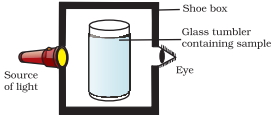
$A$ group of students took an old shoe box and covered it with black paper from all sides. They fixed a source of light (a torch) at one end of the box by making a hole in it and made another hole on the other side to view the light. They placed a milk sample contained in a beaker/tumbler in the box as shown in the figure. They were amazed to see that the milk taken in the tumbler was illuminated. They tried the same activity by taking a salt solution but found that light simply passed through it.
$(a)$ Explain why the milk sample was illuminated. Name the phenomenon involved.
$(b)$ Same results were not observed with a salt solution. Explain.
$(c)$ Can you suggest two more solutions which would show the same effect as shown by the milk solution?
$(a)$ Explain why the milk sample was illuminated. Name the phenomenon involved.
$(b)$ Same results were not observed with a salt solution. Explain.
$(c)$ Can you suggest two more solutions which would show the same effect as shown by the milk solution?
Solution
(N/A) Milk is a colloid. Colloidal particles are large enough to scatter a beam of light passing through them,which makes the path of light visible. This phenomenon is known as the Tyndall effect.
$(b)$ $A$ salt solution is a true solution. The particles in a true solution are extremely small (less than $1 \ nm$ in diameter) and are unable to scatter the beam of light passing through them. Therefore,the path of light is not visible in a salt solution.
$(c)$ Two other examples of colloidal solutions that show the Tyndall effect are starch solution and soap solution.
0 likes
View Solution17
Medium
During an experiment, students were asked to prepare a $10\%$ (mass/mass) solution of sugar in water. Ramesh dissolved $10\,g$ of sugar in $100\,g$ of water, while Sarika prepared it by dissolving $10\,g$ of sugar in water to make $100\,g$ of the solution.
$(a)$ Are the two solutions of the same concentration?
$(b)$ Compare the mass percentage of the two solutions.
$(a)$ Are the two solutions of the same concentration?
$(b)$ Compare the mass percentage of the two solutions.
Solution
$(a)$ No, the two solutions do not have the same concentration.
$(b)$ The formula for mass percentage is:
$\text{Mass } \% = \frac{\text{Mass of solute}}{\text{Mass of solute} + \text{Mass of solvent}} \times 100$
For Ramesh's solution:
$\text{Mass of solute} = 10\,g$, $\text{Mass of solvent} = 100\,g$
$\text{Mass } \% = \left( \frac{10}{10 + 100} \right) \times 100 = \frac{10}{110} \times 100 \approx 9.09\%$
For Sarika's solution:
$\text{Mass of solute} = 10\,g$, $\text{Total mass of solution} = 100\,g$
$\text{Mass } \% = \left( \frac{10}{100} \right) \times 100 = 10\%$
Conclusion: The solution prepared by Sarika $(10\%)$ has a higher mass percentage than the solution prepared by Ramesh $(\approx 9.09\%)$.
0 likes
View Solution18
Easy
Does the solubility of a substance change with temperature? Explain with the help of an example.
Solution
(N/A) Yes,the solubility of a substance is a temperature-dependent property.
Generally,the solubility of solids in liquids increases with an increase in temperature.
For example,you can dissolve a larger amount of sugar in hot water compared to the same volume of cold water because the kinetic energy of the solvent molecules increases,facilitating the breakdown of the solute.
0 likes
View Solution19
DifficultMCQ
Arun has prepared a $0.01\%$ (by mass) solution of sodium chloride in water. Which of the following correctly represents the composition of the solution?
A
$0.01 \, g$ of $NaCl + 99.99 \, g$ of water
B
$0.11 \, g$ of $NaCl + 100 \, g$ of water
C
$1.00 \, g$ of $NaCl + 100 \, g$ of water
D
$0.10 \, g$ of $NaCl + 99.90 \, g$ of water
Solution
(A) The mass percentage of a solution is calculated using the formula:
$\text{Mass } \% = \frac{\text{mass of solute}}{\text{mass of solute} + \text{mass of solvent}} \times 100$
Given that the concentration is $0.01\%$ by mass,we test option $(a)$:
$\text{Mass } \% = \frac{0.01 \, g}{0.01 \, g + 99.99 \, g} \times 100$
$= \frac{0.01}{100} \times 100 = 0.01\%$
Thus,option $(a)$ correctly represents the composition of the solution.
0 likes
View Solution20
DifficultMCQ
Calculate the mass of sodium sulphate required to prepare its $20\%$ (mass percent) solution in $100\,g$ of water. (in $,g$)
A
$15$
B
$25$
C
$30$
D
$35$
Solution
(B) Let the mass of sodium sulphate required be $x\,g$.
The mass of the solution is the sum of the mass of the solute and the mass of the solvent (water).
Mass of solution $= (x + 100)\,g$.
The formula for mass percentage is: $\text{Mass percentage} = \frac{\text{Mass of solute}}{\text{Mass of solution}} \times 100$.
Given that the mass percentage is $20\%$,we have:
$20 = \frac{x}{x + 100} \times 100$.
Dividing both sides by $20$:
$1 = \frac{x}{x + 100} \times 5$.
$x + 100 = 5x$.
$4x = 100$.
$x = 25\,g$.
Therefore,the mass of sodium sulphate required is $25\,g$.
0 likes
View Solution21
EasyMCQ
Why is the path of light not visible in a solution when a beam of light is passed through it?
A
The solute particles are too large.
B
The solute particles are very small and do not scatter light.
C
The solution is opaque.
D
The light is absorbed by the solvent.
Solution
(B) In a true solution,the size of the solute particles is extremely small (less than $1 \ nm$ in diameter).
Because of their tiny size,these particles are unable to scatter the beam of light passing through the solution.
Therefore,the path of the light beam remains invisible,and the Tyndall effect is not observed.
Because of their tiny size,these particles are unable to scatter the beam of light passing through the solution.
Therefore,the path of the light beam remains invisible,and the Tyndall effect is not observed.
0 likes
View Solution22
Easy
What are the two components of a solution?
Solution
(N/A) solution is a homogeneous mixture of two or more substances. The two main components of a solution are:
$(i)$ Solute: The component that is present in a smaller quantity and is dissolved in the solvent.
$(ii)$ Solvent: The component that is present in a larger quantity and in which the solute is dissolved.
$(i)$ Solute: The component that is present in a smaller quantity and is dissolved in the solvent.
$(ii)$ Solvent: The component that is present in a larger quantity and in which the solute is dissolved.
0 likes
View Solution23
Easy
What is meant by concentration of a solution?
Solution
(N/A) The concentration of a solution is defined as the amount of solute present in a given amount (mass or volume) of the solution or solvent.
It represents the relative proportion of solute and solvent in the mixture.
Mathematically, it can be expressed as: $\text{Concentration} = \frac{\text{Amount of solute}}{\text{Amount of solution}}$.
It represents the relative proportion of solute and solvent in the mixture.
Mathematically, it can be expressed as: $\text{Concentration} = \frac{\text{Amount of solute}}{\text{Amount of solution}}$.
0 likes
View Solution24
EasyMCQ
Based on which factor is a solution said to be dilute,concentrated,or saturated?
A
Temperature of the solution
B
Amount of solute present in the solution
C
Volume of the solvent
D
Pressure applied on the solution
Solution
(B) solution is classified as dilute,concentrated,or saturated based on the amount of solute dissolved in a given amount of solvent or solution.
$1$. $A$ dilute solution contains a relatively small amount of solute.
$2$. $A$ concentrated solution contains a relatively large amount of solute.
$3$. $A$ saturated solution is one in which no more solute can be dissolved at a given temperature.
$1$. $A$ dilute solution contains a relatively small amount of solute.
$2$. $A$ concentrated solution contains a relatively large amount of solute.
$3$. $A$ saturated solution is one in which no more solute can be dissolved at a given temperature.
0 likes
View Solution25
Easy
"Tyndall Effect can be observed when sunlight passes through the canopy of dense forest." Explain how this occurs.
Solution
(N/A) The Tyndall effect is the scattering of light by particles in a colloid or a very fine suspension. In a dense forest, the air contains mist, which consists of tiny water droplets suspended in the air. These water droplets act as colloidal particles. When sunlight enters the forest through the canopy, these tiny droplets scatter the light, making the path of the light beam visible. This phenomenon is known as the Tyndall effect.
0 likes
View Solution26
EasyMCQ
What happens when a saturated solution is heated?
A
It becomes unsaturated.
B
It becomes supersaturated.
C
The solute precipitates out.
D
The concentration remains the same.
Solution
(A) saturated solution is one in which no more solute can be dissolved at a given temperature.
When a saturated solution is heated,the solubility of the solute generally increases.
As a result,the solution can now dissolve more solute,making it unsaturated at the higher temperature.
When a saturated solution is heated,the solubility of the solute generally increases.
As a result,the solution can now dissolve more solute,making it unsaturated at the higher temperature.
0 likes
View Solution27
EasyMCQ
What happens when a hot saturated solution is cooled?
A
The solution becomes unsaturated.
B
Crystals are formed.
C
The solvent evaporates.
D
The solute dissolves further.
Solution
(B) saturated solution contains the maximum amount of solute that can be dissolved at a given temperature.
When this hot saturated solution is cooled,its solubility decreases.
As a result,the excess solute can no longer remain dissolved in the solvent and separates out in the form of solid crystals.
When this hot saturated solution is cooled,its solubility decreases.
As a result,the excess solute can no longer remain dissolved in the solvent and separates out in the form of solid crystals.
0 likes
View Solution28
EasyMCQ
Which of the two will scatter light: soap solution or salt solution?
A
Soap solution
B
Salt solution
C
Both
D
None
Solution
(A) soap solution is a colloidal solution,whereas a salt solution is a true solution.
Colloidal particles are large enough to scatter a beam of light passing through them,a phenomenon known as the Tyndall effect.
True solutions have particles that are too small to scatter light.
Therefore,the soap solution will scatter light.
Colloidal particles are large enough to scatter a beam of light passing through them,a phenomenon known as the Tyndall effect.
True solutions have particles that are too small to scatter light.
Therefore,the soap solution will scatter light.
0 likes
View Solution29
EasyMCQ
What is the effect of temperature on the solubility of solids in liquids?
A
Solubility increases with an increase in temperature.
B
Solubility decreases with an increase in temperature.
C
Solubility remains constant with an increase in temperature.
D
Solubility first increases then decreases.
Solution
(A) For most solid solutes,solubility in a liquid solvent increases as the temperature increases.
This happens because the dissolution process is generally endothermic,meaning it absorbs heat from the surroundings.
According to Le Chatelier's principle,increasing the temperature shifts the equilibrium in the direction that absorbs heat,thereby increasing the amount of solid that can be dissolved.
0 likes
View Solution30
EasyMCQ
Why does a copper sulphate solution in water not show the Tyndall effect,while a mixture of water and milk does?
A
Copper sulphate is a true solution.
B
Milk is a colloidal solution.
C
Particles in copper sulphate are too small to scatter light.
D
All of the above.
Solution
(D) copper sulphate solution is a true solution where the solute particles are extremely small,typically of the order of $10^{-9} \ m$ or less. These particles are too small to scatter a beam of light,hence they do not exhibit the Tyndall effect.
In contrast,milk is a colloidal solution containing suspended particles of fats and proteins. Although these particles are not visible to the naked eye,they are large enough to scatter a beam of light passing through the mixture,thereby demonstrating the Tyndall effect.
In contrast,milk is a colloidal solution containing suspended particles of fats and proteins. Although these particles are not visible to the naked eye,they are large enough to scatter a beam of light passing through the mixture,thereby demonstrating the Tyndall effect.
0 likes
View Solution31
Easy
Classify the following as sol,solution,or suspension:
$(i)$ Milk of magnesia
$(ii)$ Coloured gemstones
$(iii)$ Aerated drinks
$(iv)$ Emulsion paint
$(i)$ Milk of magnesia
$(ii)$ Coloured gemstones
$(iii)$ Aerated drinks
$(iv)$ Emulsion paint
Solution
(N/A) $(i)$ Milk of magnesia: Suspension (often categorized as a sol in specific colloidal contexts,but primarily a suspension of $Mg(OH)_2$ in water).
$(ii)$ Coloured gemstones: Solid sol (a type of colloid where solid particles are dispersed in a solid medium).
$(iii)$ Aerated drinks: Solution (a homogeneous mixture of gas in liquid).
$(iv)$ Emulsion paint: Emulsion (a type of colloid where liquid is dispersed in another liquid).
$(ii)$ Coloured gemstones: Solid sol (a type of colloid where solid particles are dispersed in a solid medium).
$(iii)$ Aerated drinks: Solution (a homogeneous mixture of gas in liquid).
$(iv)$ Emulsion paint: Emulsion (a type of colloid where liquid is dispersed in another liquid).
0 likes
View Solution32
EasyMCQ
How can you convert a saturated solution into an unsaturated solution?
A
By adding more solvent.
B
By adding more solute.
C
By cooling the solution.
D
By increasing the pressure.
Solution
(A) saturated solution is one in which no more solute can be dissolved at a given temperature.
To convert a saturated solution into an unsaturated solution,you can:
$1$. Add more solvent: Increasing the amount of solvent allows more solute to be dissolved in the solution.
$2$. Increase the temperature: Heating the solution increases the solubility of the solute,allowing more solute to be dissolved,thereby making the solution unsaturated at the higher temperature.
0 likes
View Solution33
Easy
When is a solution said to be saturated? How can you change an unsaturated solution to a saturated solution without adding any more solute to it?
Solution
(N/A) $(i)$ $A$ solution is said to be saturated when it cannot dissolve any more solute at a given temperature.
$(ii)$ An unsaturated solution can be converted into a saturated solution by heating it. Heating increases the solvent's ability to hold solute,but if we then allow the solvent to evaporate or cool it down,the concentration of the solute increases relative to the solvent,effectively reaching a saturation point.
$(ii)$ An unsaturated solution can be converted into a saturated solution by heating it. Heating increases the solvent's ability to hold solute,but if we then allow the solvent to evaporate or cool it down,the concentration of the solute increases relative to the solvent,effectively reaching a saturation point.
0 likes
View Solution34
Medium
$(a)$ Both smoke and fog are aerosols. In what way are they different?
$(b)$ How do sol and gel differ from each other? Give one example for each.
$(b)$ How do sol and gel differ from each other? Give one example for each.
Solution
(N/A) Smoke and fog differ in their dispersed phase. In smoke,the dispersed phase is solid,and in fog,the dispersed phase is liquid,while the dispersion medium is gas in both cases.
$(b)$ Sol: The dispersed phase is solid and the dispersion medium is liquid. Example: Mud.
Gel: The dispersed phase is liquid and the dispersion medium is solid. Example: Butter or cheese.
$(b)$ Sol: The dispersed phase is solid and the dispersion medium is liquid. Example: Mud.
Gel: The dispersed phase is liquid and the dispersion medium is solid. Example: Butter or cheese.
0 likes
View Solution35
Difficult
You are provided with a solution of substance $'X'$. How will you test whether it is saturated or unsaturated with respect to $'X'$ at a given temperature? What happens when a hot saturated solution is allowed to cool?
Solution
(N/A) To test if a solution is saturated or unsaturated,add more of the solute $'X'$ to the solution at the same temperature while stirring.
$1$. If the added solute $'X'$ dissolves completely,the solution is unsaturated.
$2$. If the added solute $'X'$ remains undissolved and settles at the bottom,the solution is saturated.
When a hot saturated solution is allowed to cool,the solubility of the solute decreases,causing the excess solute to crystallize and separate out from the solution.
0 likes
View Solution36
MediumMCQ
What volume of ethyl alcohol and water must be mixed together to prepare $250 \, mL$ of $60 \%$ by volume of alcohol in water?
A
$150 \, mL$ of ethyl alcohol and $100 \, mL$ of water
B
$100 \, mL$ of ethyl alcohol and $150 \, mL$ of water
C
$125 \, mL$ of ethyl alcohol and $125 \, mL$ of water
D
$140 \, mL$ of ethyl alcohol and $110 \, mL$ of water
Solution
(A) Let the volume of ethyl alcohol be $x \, mL$.
The formula for volume percentage is:
$\text{Concentration} = \frac{\text{Volume of solute (ethyl alcohol)}}{\text{Total volume of solution}} \times 100$
Given:
Total volume of solution = $250 \, mL$
Concentration = $60 \%$
Substituting the values:
$60 = \frac{x}{250} \times 100$
$x = \frac{60 \times 250}{100} = 150 \, mL$
Therefore,the volume of ethyl alcohol required is $150 \, mL$.
The volume of water required = Total volume - Volume of ethyl alcohol
$= 250 \, mL - 150 \, mL = 100 \, mL$.
Thus,$150 \, mL$ of ethyl alcohol and $100 \, mL$ of water must be mixed.
0 likes
View Solution37
MediumMCQ
The concentration of a salt solution in terms of mass by mass percentage is $20 \%$ and the mass of the solution is $550 \text{ g}$. Determine the mass of solute present in the solution. (in $\text{ g}$)
A
$100$
B
$110$
C
$120$
D
$130$
Solution
(B) The formula for mass by mass percentage of a solution is given by:
$\text{Mass by mass percentage} = \frac{\text{Mass of solute}}{\text{Mass of solution}} \times 100$
Given:
$\text{Mass by mass percentage} = 20 \%$
$\text{Mass of solution} = 550 \text{ g}$
Substituting the values into the formula:
$20 = \frac{\text{Mass of solute}}{550 \text{ g}} \times 100$
Rearranging to solve for the mass of solute:
$\text{Mass of solute} = \frac{20 \times 550}{100} \text{ g}$
$\text{Mass of solute} = 20 \times 5.5 \text{ g} = 110 \text{ g}$
Therefore,the mass of solute present in the solution is $110 \text{ g}$.
0 likes
View Solution38
EasyMCQ
Smoke and fog both are aerosols. In what way are they different?
A
Fog has a solid dispersed phase,while smoke has a liquid dispersed phase.
B
Fog has a liquid dispersed phase,while smoke has a solid dispersed phase.
C
Fog has a gas dispersed phase,while smoke has a liquid dispersed phase.
D
Fog has a solid dispersed phase,while smoke has a gas dispersed phase.
Solution
(B) Both fog and smoke are types of aerosols,which means they have gas as the dispersion medium.
In fog,the dispersed phase is liquid (tiny water droplets suspended in air).
In smoke,the dispersed phase is solid (fine carbon particles suspended in air).
In fog,the dispersed phase is liquid (tiny water droplets suspended in air).
In smoke,the dispersed phase is solid (fine carbon particles suspended in air).
0 likes
View Solution39
Easy
What is a solution? On which factors is a solution said to be diluted,concentrated,or saturated?
Solution
(N/A) solution is a homogeneous mixture of two or more substances.
$A$ solution is classified as diluted,concentrated,or saturated based on the amount of solute dissolved in a given amount of solvent at a specific temperature.
$1$. Diluted solution: $A$ solution containing a relatively small amount of solute in a given volume of solvent.
$2$. Concentrated solution: $A$ solution containing a relatively large amount of solute in a given volume of solvent.
$3$. Saturated solution: $A$ solution in which no more solute can be dissolved at a given temperature.
0 likes
View Solution40
MediumMCQ
What is tincture of iodine? Identify the solute and solvent in 'tincture of iodine.' Why is the Tyndall effect not seen in a true solution?
A
Tincture of iodine is a solution of iodine in water.
B
Solute is alcohol and solvent is iodine.
C
Tyndall effect is not seen because particles are large.
D
Tincture of iodine is a solution of iodine in alcohol; solute is iodine,solvent is alcohol; Tyndall effect is not seen because particle size is extremely small.
Solution
(D) solution of iodine in alcohol is known as 'tincture of iodine'.
Solute $-$ Iodine $(I_2)$
Solvent $-$ Alcohol (usually ethanol)
The Tyndall effect is not seen in a true solution because the particle size of the solute is extremely small (less than $1 \ nm$ in diameter). Due to this small size,the particles are unable to scatter the beam of light passing through the solution.
0 likes
View Solution41
MediumMCQ
How much water should be added to $15 \, g$ of salt to obtain a $15 \%$ salt solution (in $, g$)?
A
$85$
B
$100$
C
$15$
D
$75$
Solution
(A) The concentration of a solution is defined as the mass of the solute divided by the total mass of the solution,multiplied by $100$.
Given: Mass of solute (salt) $= 15 \, g$.
Let the mass of water (solvent) to be added be $X \, g$.
Total mass of the solution $= \text{Mass of solute} + \text{Mass of solvent} = 15 + X$.
Concentration of the solution $= 15 \%$.
Using the formula: $\text{Concentration} = (\text{Mass of solute} / \text{Total mass of solution}) \times 100$.
$15 = (15 / (15 + X)) \times 100$.
Dividing both sides by $15$: $1 = (1 / (15 + X)) \times 100$.
$15 + X = 100$.
$X = 100 - 15 = 85 \, g$.
Therefore,$85 \, g$ of water must be added.
0 likes
View Solution42
Medium
Define a solution. Give an example of $(i)$ gas in liquid solution $(ii)$ gas in gas solution.
Solution
(N/A) solution is a homogeneous mixture of two or more substances.
$(i)$ Gas in liquid solution: Aerated cold drinks (carbon dioxide gas dissolved in water).
$(ii)$ Gas in gas solution: Air (a mixture of various gases like nitrogen,oxygen,argon,etc.).
$(i)$ Gas in liquid solution: Aerated cold drinks (carbon dioxide gas dissolved in water).
$(ii)$ Gas in gas solution: Air (a mixture of various gases like nitrogen,oxygen,argon,etc.).
0 likes
View Solution43
Medium
Compare in tabular form the properties of true solution and colloids with respect to Tyndall effect and stability.
Solution
(N/A)
$1$. $\text{Tyndall effect}$: In a true solution,the particles are too small to scatter light,so it does not show the Tyndall effect. In colloids,the particles are large enough to scatter a beam of light passing through them,thus exhibiting the Tyndall effect.
$2$. $\text{Stability}$: True solutions are highly stable as the solute particles do not settle down. Colloids are also stable,but the dispersed phase particles can be separated from the dispersion medium using the process of centrifugation.
| Property | True Solution | Colloid |
|---|---|---|
| Tyndall effect | Does not show Tyndall effect | Shows Tyndall effect |
| Stability | Stable | Stable (can be separated by centrifugation) |
$1$. $\text{Tyndall effect}$: In a true solution,the particles are too small to scatter light,so it does not show the Tyndall effect. In colloids,the particles are large enough to scatter a beam of light passing through them,thus exhibiting the Tyndall effect.
$2$. $\text{Stability}$: True solutions are highly stable as the solute particles do not settle down. Colloids are also stable,but the dispersed phase particles can be separated from the dispersion medium using the process of centrifugation.
0 likes
View Solution44
Medium
Sidak took $50\, mL$ of water in two beakers at room temperature and added sodium chloride to one beaker while sugar to the other,until no more solute could be dissolved. Then she heated the contents of the beakers and added more solutes in them.
$(a)$ Will the amount of salt and sugar that can be dissolved in water at a given temperature be the same?
$(b)$ What would you expect to happen if she cools the contents of the beakers? Justify your answer.
$(a)$ Will the amount of salt and sugar that can be dissolved in water at a given temperature be the same?
$(b)$ What would you expect to happen if she cools the contents of the beakers? Justify your answer.
Solution
(N/A) No,the amount of salt and sugar that can be dissolved in water at a given temperature is not the same. Solubility is a characteristic property of a substance and varies depending on the nature of the solute.
$(b)$ If she cools the contents of the beakers,crystals of salt and sugar will appear. This happens because the solubility of a solid in a liquid generally decreases as the temperature decreases. As the solution cools,it becomes supersaturated,causing the excess solute to precipitate out in the form of crystals.
$(b)$ If she cools the contents of the beakers,crystals of salt and sugar will appear. This happens because the solubility of a solid in a liquid generally decreases as the temperature decreases. As the solution cools,it becomes supersaturated,causing the excess solute to precipitate out in the form of crystals.
0 likes
View Solution45
EasyMCQ
$A$ solution contains $50 \, g$ of sugar in $350 \, g$ of water. Calculate the concentration of the solution in terms of mass by mass percentage of the solution. (in $\%$)
A
$12.5$
B
$14.28$
C
$15.0$
D
$10.0$
Solution
(A) The concentration of a solution is calculated using the formula:
$\text{Concentration} = \frac{\text{Mass of solute}}{\text{Mass of solution}} \times 100$
Here,the mass of the solute (sugar) = $50 \, g$.
The mass of the solvent (water) = $350 \, g$.
The total mass of the solution = $\text{Mass of solute} + \text{Mass of solvent} = 50 \, g + 350 \, g = 400 \, g$.
Now,substituting the values into the formula:
$\text{Concentration} = \frac{50}{400} \times 100 = \frac{1}{8} \times 100 = 12.5 \%$.
Thus,the concentration of the solution is $12.5 \%$.
0 likes
View Solution46
Medium
Which of the following will show Tyndall effect? Why?
$(a)$ Salt solution
$(b)$ Milk
$(c)$ Copper sulphate solution
$(d)$ Starch solution.
$(a)$ Salt solution
$(b)$ Milk
$(c)$ Copper sulphate solution
$(d)$ Starch solution.
Solution
(B, D) Milk and starch solution will show the Tyndall effect.
This is because both milk and starch solution are colloidal solutions.
Colloidal particles are large enough to scatter a beam of light passing through them,which makes the path of light visible.
This phenomenon of scattering of light by colloidal particles is known as the Tyndall effect.
Salt solution and copper sulphate solution are true solutions,where particles are too small to scatter light.
0 likes
View Solution47
MediumMCQ
What volume of ethyl alcohol and water must be mixed together to prepare $250 \, mL$ of $50 \%$ by volume of alcohol in water?
A
$125 \, mL$ of ethyl alcohol and $125 \, mL$ of water
B
$100 \, mL$ of ethyl alcohol and $150 \, mL$ of water
C
$150 \, mL$ of ethyl alcohol and $100 \, mL$ of water
D
$50 \, mL$ of ethyl alcohol and $200 \, mL$ of water
Solution
(A) The concentration of a solution by volume is given by the formula:
Concentration $(\% v/v) = \frac{\text{Volume of solute}}{\text{Total volume of solution}} \times 100$
Given,total volume of solution = $250 \, mL$ and concentration = $50 \%$.
Let the volume of ethyl alcohol (solute) be $x \, mL$.
$50 = \frac{x}{250} \times 100$
$x = \frac{50 \times 250}{100} = 125 \, mL$.
Therefore,the volume of ethyl alcohol required is $125 \, mL$.
The volume of water (solvent) required = Total volume - Volume of ethyl alcohol = $250 \, mL - 125 \, mL = 125 \, mL$.
Thus,$125 \, mL$ of ethyl alcohol and $125 \, mL$ of water must be mixed.
0 likes
View Solution48
Medium
Compare solution,suspension,and colloids in terms of:
$(a)$ stability
$(b)$ filterability
$(c)$ Tyndall effect
$(a)$ stability
$(b)$ filterability
$(c)$ Tyndall effect
Solution
(N/A)
Detailed Explanation:
$1$. Stability: Solutions and colloids are stable as their particles do not settle down over time. Suspensions are unstable because the solute particles settle down when left undisturbed.
$2$. Filterability: Particles in solutions and colloids are too small to be separated by filtration. In suspensions,particles are large enough to be separated by filter paper.
$3$. Tyndall effect: Colloids exhibit the Tyndall effect due to the scattering of light by dispersed particles. Solutions do not show this effect because particles are too small. Suspensions generally do not show the Tyndall effect as particles are too large and may settle,though they can scatter light if particles are suspended.
| Property | Solution | Suspension | Colloid |
|---|---|---|---|
| $(a)$ Stability | Stable | Unstable | Stable |
| $(b)$ Filterability | Cannot be filtered | Can be filtered | Cannot be filtered |
| $(c)$ Tyndall effect | Does not show | Does not show | Shows |
Detailed Explanation:
$1$. Stability: Solutions and colloids are stable as their particles do not settle down over time. Suspensions are unstable because the solute particles settle down when left undisturbed.
$2$. Filterability: Particles in solutions and colloids are too small to be separated by filtration. In suspensions,particles are large enough to be separated by filter paper.
$3$. Tyndall effect: Colloids exhibit the Tyndall effect due to the scattering of light by dispersed particles. Solutions do not show this effect because particles are too small. Suspensions generally do not show the Tyndall effect as particles are too large and may settle,though they can scatter light if particles are suspended.
0 likes
View Solution49
EasyMCQ
State whether the following statement is true or false:
The movement of tiny particles in a gas or liquid is called the Tyndall effect.
The movement of tiny particles in a gas or liquid is called the Tyndall effect.
A
True
B
False
Solution
(B) The statement is False.
The random,zigzag movement of tiny particles suspended in a fluid (a liquid or a gas) is known as Brownian motion,not the Tyndall effect.
The Tyndall effect refers to the scattering of a beam of light by particles in a colloid or a very fine suspension.
The random,zigzag movement of tiny particles suspended in a fluid (a liquid or a gas) is known as Brownian motion,not the Tyndall effect.
The Tyndall effect refers to the scattering of a beam of light by particles in a colloid or a very fine suspension.
0 likes
View Solution50
DifficultMCQ
Calculate the mass of water and mass of glucose required to make $250 \, g$ of $40 \%$ solution of glucose.
A
$100 \, g$ glucose,$150 \, g$ water
B
$150 \, g$ glucose,$100 \, g$ water
C
$40 \, g$ glucose,$210 \, g$ water
D
$250 \, g$ glucose,$40 \, g$ water
Solution
(A) Mass by percentage formula is given by: $\text{Mass percentage} = \frac{\text{Mass of solute}}{\text{Mass of solution}} \times 100$
Given:
Mass of solution $= 250 \, g$
Mass percentage of glucose $= 40 \%$
Substituting the values:
$40 = \frac{\text{Mass of glucose}}{250} \times 100$
Mass of glucose $= \frac{40 \times 250}{100} = 100 \, g$
Now,calculate the mass of water:
Mass of water $= \text{Mass of solution} - \text{Mass of glucose}$
Mass of water $= 250 \, g - 100 \, g = 150 \, g$
Therefore,the mass of glucose is $100 \, g$ and the mass of water is $150 \, g$.
0 likes
View SolutionIS MATTER AROUND US PURE? — Solutions, Suspensions and Colloids · Frequently Asked Questions
1Are these IS MATTER AROUND US PURE? questions useful for JEE and NEET?
Yes. All questions in this section are mapped to JEE Main and NEET exam patterns. Previous year questions from JEE Main, NEET, GUJCET and state-level exams are included with full solutions.
2Can I switch to Hindi or Gujarati for these questions?
Yes. Use the language tabs in the hero section or the sidebar to view the same questions and solutions in English, Hindi or Gujarati.
3How do I generate a question paper from this subtopic?
Use the Vedclass Exam Paper Generator — select the chapter and subtopic, set difficulty, and generate Sets A, B, C, D automatically. First 3 chapters of every subject are free.
Vedclass Products
For Students
Vedclass Test Series
Mock tests in real JEE/NEET style with performance analysis. 5-day free trial.
Start Free TrialFor Teachers
Exam Paper Generator
Generate Set A/B/C/D papers from this chapter in 2 minutes. 3 chapters free.
Try FreeFor Institutes
Online Exam Module
Live online exams with unlimited students, 360° analytics & white-label branding.
See DemoFor Teachers & Institutes
Generate a IS MATTER AROUND US PURE? Exam Paper in 2 Minutes
Select subtopic & difficulty — Sets A, B, C, D auto-generated with No Repeat logic.
First 3 chapters of every subject are free — no payment required.