
A English
Mix Examples - MOTION Questions in English
Class 9 Science · MOTION · Mix Examples - MOTION
62+
Questions
English
Language
100%
With Solutions
Showing 12 of 62 questions in English
51
Medium
$A$ motor car slows down from $72 \ km \ h^{-1}$ to $36 \ km \ h^{-1}$ over a distance of $25 \ m$. If the brakes are applied with the same force,calculate $(i)$ total time in which the car comes to rest,and $(ii)$ total distance travelled by it until it comes to rest.
Solution
(N/A) Case $1$: Initial velocity $u = 72 \ km \ h^{-1} = 20 \ m \ s^{-1}$; Final velocity $v = 36 \ km \ h^{-1} = 10 \ m \ s^{-1}$; Distance $S = 25 \ m$.
Using the equation of motion $v^{2} - u^{2} = 2aS$:
$(10)^{2} - (20)^{2} = 2 \times a \times 25$
$100 - 400 = 50a$
$-300 = 50a$
$a = -6 \ m \ s^{-2}$.
Case $2$: The car starts from $u = 72 \ km \ h^{-1} = 20 \ m \ s^{-1}$ and comes to rest $(v = 0)$ with the same retardation $a = -6 \ m \ s^{-2}$.
$(i)$ To find total time $t$,use $v = u + at$:
$0 = 20 + (-6)t$
$6t = 20$
$t = 3.33 \ s$.
$(ii)$ To find total distance $S$,use $v^{2} - u^{2} = 2aS$:
$0^{2} - (20)^{2} = 2 \times (-6) \times S$
$-400 = -12S$
$S = 400 / 12 = 33.33 \ m$.
0 likes
View Solution52
Medium
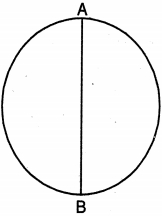
$A$ circular cycle track has a circumference of $314 \ m$ with $AB$ as one of its diameters. $A$ cyclist travels from $A$ to $B$ along the circular path with a velocity of constant magnitude $15.7 \ m s^{-1}$. Find the:
$(a)$ distance moved by the cyclist.
$(b)$ displacement of the cyclist,if $AB$ represents the north-south direction.
$(c)$ the average velocity of the cyclist.
$(a)$ distance moved by the cyclist.
$(b)$ displacement of the cyclist,if $AB$ represents the north-south direction.
$(c)$ the average velocity of the cyclist.
Solution
(N/A) Distance travelled by the cyclist $=$ length of the path $AB$ (semicircle) $=$ half the circumference of the circle.
$S = \frac{314}{2} = 157 \ m$.
$(b)$ The displacement of the cyclist is equal to the diameter $AB$ of the circle.
Since circumference $= 2 \pi r = 314 \ m$,therefore,
$r = \frac{\text{circumference}}{2 \pi} = \frac{314}{2 \times 3.14} = 50 \ m$.
Therefore,displacement of the cyclist $= 2 \times r = 2 \times 50 = 100 \ m$ towards south.
$(c)$ Average velocity is defined as the total displacement divided by the total time taken.
First,find the time taken: $\text{Time} = \frac{\text{Distance}}{\text{Speed}} = \frac{157 \ m}{15.7 \ m s^{-1}} = 10 \ s$.
Average velocity $= \frac{\text{Total Displacement}}{\text{Total Time}} = \frac{100 \ m}{10 \ s} = 10 \ m s^{-1}$ towards south.
0 likes
View Solution53
Medium
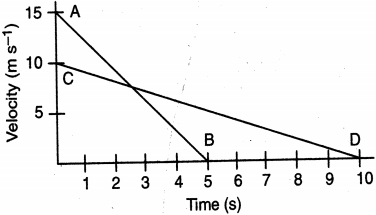
The driver of a train $A$ travelling at a speed of $54\, km\, h^{-1}$ applies brakes and retards the train uniformly. The train stops in $5\, s$. Another train $B$ is travelling on the parallel track with a speed of $36\, km\, h^{-1}$. This driver also applies the brakes and the train retards uniformly. The train $B$ stops in $10\, s$. Plot the speed-time graph for both the trains on the same paper. Also,calculate the distance travelled by each train after the brakes were applied.
Solution
(N/A) For train $A$:
Initial velocity $u_A = 54\, km\, h^{-1} = 54 \times \frac{5}{18} = 15\, m\, s^{-1}$.
Final velocity $v_A = 0\, m\, s^{-1}$.
Time taken $t_A = 5\, s$.
Distance travelled by train $A$ is the area under the velocity-time graph $AB$:
Distance $= \frac{1}{2} \times \text{base} \times \text{height} = \frac{1}{2} \times 5\, s \times 15\, m\, s^{-1} = 37.5\, m$.
For train $B$:
Initial velocity $u_B = 36\, km\, h^{-1} = 36 \times \frac{5}{18} = 10\, m\, s^{-1}$.
Final velocity $v_B = 0\, m\, s^{-1}$.
Time taken $t_B = 10\, s$.
Distance travelled by train $B$ is the area under the velocity-time graph $CD$:
Distance $= \frac{1}{2} \times \text{base} \times \text{height} = \frac{1}{2} \times 10\, s \times 10\, m\, s^{-1} = 50\, m$.
0 likes
View Solution54
Medium
$A$ motor bike running at $5\, m s^{-1}$,picks up a velocity of $30\, m s^{-1}$ in $5\, s$. Calculate $(i)$ acceleration $(ii)$ distance covered during acceleration.
Solution
(N/A) Given: Initial velocity $u = 5\, m s^{-1}$,Final velocity $v = 30\, m s^{-1}$,Time $t = 5\, s$.
$(i)$ To calculate acceleration $(a)$: Using the first equation of motion,$v = u + at$.
$30 = 5 + a \times 5$
$30 - 5 = 5a$
$25 = 5a$
$a = 5\, m s^{-2}$.
$(ii)$ To calculate distance covered $(S)$: Using the third equation of motion,$v^2 - u^2 = 2aS$.
$(30)^2 - (5)^2 = 2 \times 5 \times S$
$900 - 25 = 10S$
$875 = 10S$
$S = 87.5\, m$.
0 likes
View Solution55
MediumMCQ
There is an argument about uniform acceleration between $Mr. X$ and $Mr. Y$. $Mr. X$ says,"acceleration means that the farther you go, the faster you go". $Mr. Y$ says,"acceleration means that the longer you go, the faster you go". Whose statement is correct?
A
$Mr. Y$
B
$Mr. X$
C
Both
D
None
Solution
(C) Uniform acceleration is defined as the constant rate of change of velocity with respect to time $(a = \frac{dv}{dt} = \text{constant})$.
$Mr. Y$'s statement,"the longer you go, the faster you go," refers to the time duration $(t)$. Since $v = u + at$, as time $(t)$ increases, velocity $(v)$ increases linearly, which correctly describes uniform acceleration.
$Mr. X$'s statement,"the farther you go, the faster you go," refers to the displacement $(s)$. Using the equation $v^2 = u^2 + 2as$, we can see that as displacement $(s)$ increases, velocity $(v)$ also increases. Therefore, both statements are physically correct descriptions of uniform acceleration.
0 likes
View Solution56
MediumMCQ
$A$ car travels $100\, km$ east and then $100\, km$ south. Finally,it comes back to the starting point by the south-east route. Throughout the journey the speed is constant at $60\, km\, h^{-1}$. The average velocity for the whole journey if the time taken is $3.3\, h$ is
A
$60\, km\, h^{-1}$
B
$90\, km\, h^{-1}$
C
$180\, km\, h^{-1}$
D
$0\, km\, h^{-1}$
Solution
(D) Average velocity is defined as the total displacement divided by the total time taken.
Displacement is a vector quantity representing the shortest distance between the initial and final positions.
In this problem,the car starts at a point,travels $100\, km$ east,$100\, km$ south,and then returns to the exact same starting point.
Since the final position is the same as the initial position,the total displacement is $0\, km$.
Therefore,the average velocity = $\frac{\text{Total Displacement}}{\text{Total Time}} = \frac{0\, km}{3.3\, h} = 0\, km\, h^{-1}$.
0 likes
View Solution57
EasyMCQ
For the motion on a straight line path with constant acceleration,the ratio of the magnitude of the displacement to the distance covered is
A
$\geq 1$
B
$\leq 1$
C
$< 1$
D
$= 1$
Solution
(B) For any motion,the distance covered is always greater than or equal to the magnitude of the displacement.
Mathematically,$\text{Distance} \geq |\text{Displacement}|$.
Therefore,the ratio of the magnitude of the displacement to the distance covered is $\frac{|\text{Displacement}|}{\text{Distance}} \leq 1$.
In a straight-line path,if the motion is unidirectional (no turning back),the distance is equal to the magnitude of the displacement,so the ratio is $1$.
If the motion involves a change in direction,the distance will be greater than the magnitude of the displacement,making the ratio less than $1$.
Thus,the ratio is always less than or equal to $1$.
0 likes
View Solution58
Easy
State whether the following statements are true or false:
$1$. The motion in animals is called locomotion.
$2$. Mechanics deals with the motion of non-living objects.
$1$. The motion in animals is called locomotion.
$2$. Mechanics deals with the motion of non-living objects.
Solution
(B) The first statement is $False$. Locomotion is specifically defined as the ability of an organism to move from one place to another,whereas motion is a general term for any change in position. Not all motion in animals is locomotion (e.g.,movement of internal organs).
The second statement is $False$. Mechanics is a branch of physics that deals with the motion of both living and non-living objects under the action of forces. Therefore,the overall answer is $False$.
The second statement is $False$. Mechanics is a branch of physics that deals with the motion of both living and non-living objects under the action of forces. Therefore,the overall answer is $False$.
0 likes
View Solution59
Easy
State whether the following statement is true or false:
$A$ quantity which can be represented completely by magnitude alone is called a vector quantity.
$A$ quantity which can be represented completely by magnitude alone is called a vector quantity.
Solution
(B) The statement is False.
Explanation:
$1$. $A$ quantity that is described completely by its magnitude alone is known as a scalar quantity (e.g.,distance,speed,mass).
$2$. $A$ vector quantity requires both magnitude and direction to be completely specified (e.g.,displacement,velocity,force).
$3$. Since the statement defines a scalar quantity as a vector quantity,it is incorrect.
0 likes
View Solution60
Easy
State whether the following statement is true or false:
$A$ motion is said to be uniform if $x \propto t^{2}$.
$A$ motion is said to be uniform if $x \propto t^{2}$.
Solution
(B) The statement is $False$.
In uniform motion,an object covers equal distances in equal intervals of time,which implies a constant velocity.
For uniform motion,the position $x$ is related to time $t$ by the linear equation $x = vt + x_0$,meaning $x \propto t$.
If $x \propto t^{2}$,the motion represents constant acceleration (non-uniform motion),as the velocity $v = dx/dt$ would be proportional to $t$ $(v \propto t)$.
0 likes
View Solution61
Medium
$A$ stone is thrown vertically upwards with a velocity of $40 \, m s^{-1}$ and is caught back. (Taking $g = 10 \, m s^{-2}$) Calculate the maximum height reached by the stone. What is the net displacement and total distance covered by the stone?
Solution
(N/A) Given initial velocity $u = 40 \, m s^{-1}$,acceleration due to gravity $g = -10 \, m s^{-2}$ (acting downwards),and final velocity $v = 0 \, m s^{-1}$ at the maximum height.
Using the equation of motion $v^2 - u^2 = 2as$:
$0^2 - (40)^2 = 2 \times (-10) \times h$
$-1600 = -20 \times h$
$h = 80 \, m$.
Therefore,the maximum height reached is $80 \, m$.
The total distance covered is the sum of the upward and downward journey: $80 \, m + 80 \, m = 160 \, m$.
The net displacement is the difference between the final and initial position. Since the stone returns to the starting point,the net displacement is $0 \, m$.
0 likes
View Solution62
MediumMCQ
$A$ bomb is released from an aircraft. Its trajectory is:
A
a straight line
B
an arc of a circle
C
parabola
D
a zigzag path
Solution
(C) When a bomb is released from an aircraft moving with a constant horizontal velocity, it possesses the same horizontal velocity as the aircraft at the moment of release.
Due to gravity, it experiences a constant downward acceleration $(g)$.
The combination of uniform horizontal motion and uniformly accelerated vertical motion results in a curved path known as a $parabola$.
Therefore, the trajectory of the bomb is a parabola.
Due to gravity, it experiences a constant downward acceleration $(g)$.
The combination of uniform horizontal motion and uniformly accelerated vertical motion results in a curved path known as a $parabola$.
Therefore, the trajectory of the bomb is a parabola.
0 likes
View SolutionMOTION — Mix Examples - MOTION · Frequently Asked Questions
1Are these MOTION questions useful for JEE and NEET?
Yes. All questions in this section are mapped to JEE Main and NEET exam patterns. Previous year questions from JEE Main, NEET, GUJCET and state-level exams are included with full solutions.
2Can I switch to Hindi or Gujarati for these questions?
Yes. Use the language tabs in the hero section or the sidebar to view the same questions and solutions in English, Hindi or Gujarati.
3How do I generate a question paper from this subtopic?
Use the Vedclass Exam Paper Generator — select the chapter and subtopic, set difficulty, and generate Sets A, B, C, D automatically. First 3 chapters of every subject are free.
Vedclass Products
For Students
Vedclass Test Series
Mock tests in real JEE/NEET style with performance analysis. 5-day free trial.
Start Free TrialFor Teachers
Exam Paper Generator
Generate Set A/B/C/D papers from this chapter in 2 minutes. 3 chapters free.
Try FreeFor Institutes
Online Exam Module
Live online exams with unlimited students, 360° analytics & white-label branding.
See DemoFor Teachers & Institutes
Generate a MOTION Exam Paper in 2 Minutes
Select subtopic & difficulty — Sets A, B, C, D auto-generated with No Repeat logic.
First 3 chapters of every subject are free — no payment required.