
A English
Mix Examples - MOTION Questions in English
Class 9 Science · MOTION · Mix Examples - MOTION
62+
Questions
English
Language
100%
With Solutions
Showing 50 of 62 questions in English
1
Medium
State which of the following situations are possible and give an example for each of these:
$(a)$ An object with a constant acceleration but with zero velocity.
$(b)$ An object moving with an acceleration but with uniform speed.
$(c)$ An object moving in a certain direction with an acceleration in the perpendicular direction.
$(a)$ An object with a constant acceleration but with zero velocity.
$(b)$ An object moving with an acceleration but with uniform speed.
$(c)$ An object moving in a certain direction with an acceleration in the perpendicular direction.
Solution
(N/A) Possible.
When a ball is thrown vertically upwards,at its maximum height,its velocity is zero,but it still experiences a constant acceleration due to gravity $(g = 9.8\,m/s^2)$ acting downwards.
$(b)$ Possible.
When an object moves in a circular path with a uniform speed,its velocity changes continuously due to the change in direction. This change in velocity results in a centripetal acceleration directed towards the center of the circle.
$(c)$ Possible.
An object moving in a circular path is a classic example. The velocity of the object is tangential to the path,while the centripetal acceleration acts towards the center of the circle,which is perpendicular to the direction of motion.
0 likes
View Solution2
MediumMCQ
$A$ stone is thrown vertically upward with an initial velocity of $40 \, m/s$. Taking $g = 10 \, m/s^2$,find the maximum height reached by the stone. What is the net displacement and the total distance covered by the stone?
A
$50 \, m, 140 \, m$ and $5$
B
$80 \, m, 160 \, m$ and $0$
C
$30 \, m, 150 \, m$ and $3$
D
$20 \, m, 170 \, m$ and $2$
Solution
(B) Using the equation of motion $v^2 - u^2 = 2as$,where $a = -g$ for upward motion.
Given:
Initial velocity $u = 40 \, m/s$
Final velocity at maximum height $v = 0 \, m/s$
Acceleration $g = 10 \, m/s^2$
Using $v^2 = u^2 - 2gh$:
$0^2 = (40)^2 - 2(10)h$
$20h = 1600$
$h = 80 \, m$ (Maximum height).
Total distance covered = distance upward + distance downward = $80 \, m + 80 \, m = 160 \, m$.
Net displacement = final position - initial position = $0 \, m$ (since the stone returns to the starting point).
0 likes
View Solution3
EasyMCQ
Which of the following figures (Fig.) represents uniform motion of a moving object correctly?
A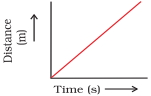
B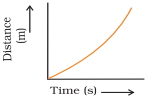
C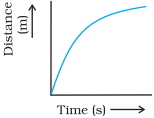
D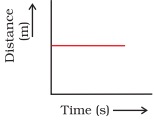
Solution
(A) Uniform motion is defined as the motion of an object in which it travels equal distances in equal intervals of time.
In a distance-time graph,this is represented by a straight line with a constant slope passing through the origin.
Figure $(A)$ shows a straight line starting from the origin,which indicates that the distance increases at a constant rate with respect to time,thus representing uniform motion.
In a distance-time graph,this is represented by a straight line with a constant slope passing through the origin.
Figure $(A)$ shows a straight line starting from the origin,which indicates that the distance increases at a constant rate with respect to time,thus representing uniform motion.
0 likes
View Solution4
MediumMCQ
$A$ car starts from rest and moves along the $x-$ axis with constant acceleration $5\, ms^{-2}$ for $8\, s$. If it then continues with constant velocity,what distance will the car cover in $12\, s$ since it started from the rest (in $m$)?
A
$320$
B
$160$
C
$400$
D
$240$
Solution
(A) The distance travelled in the first $8 \, s$ is calculated using the equation $s = ut + \frac{1}{2}at^2$. Since the car starts from rest,$u = 0$.
$x_1 = 0 + \frac{1}{2} \times 5 \times (8)^2 = 160 \, m$.
At $t = 8 \, s$,the velocity $v$ is calculated as $v = u + at = 0 + (5 \times 8) = 40 \, m/s$.
For the remaining time,which is $12 \, s - 8 \, s = 4 \, s$,the car moves with a constant velocity of $40 \, m/s$.
The distance covered in the last $4 \, s$ is $x_2 = v \times t = 40 \times 4 = 160 \, m$.
Therefore,the total distance covered in $12 \, s$ is $x = x_1 + x_2 = 160 \, m + 160 \, m = 320 \, m$.
0 likes
View Solution5
EasyMCQ
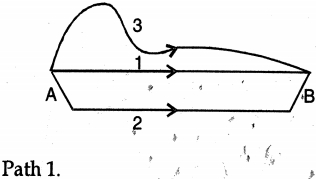
$A$ person standing at $A$ goes to $B$ by following any of the paths $1, 2$ or $3$. Which path can we measure to find the average velocity?
A
Path $1$
B
Path $2$
C
Path $3$
D
All of the above
Solution
(D) Average velocity is defined as the total displacement divided by the total time taken.
Displacement is the shortest distance between the initial point $A$ and the final point $B$.
Since the displacement is the same regardless of the path taken,the average velocity depends only on the total time taken to travel from $A$ to $B$.
Therefore,we can use any of the paths $1, 2$ or $3$ to calculate the average velocity,provided we know the total time taken for that specific path.
Thus,the correct answer is all of the above.
0 likes
View Solution6
Easy
Can a particle be accelerated
$(i)$ if its speed is constant?
$(ii)$ if its velocity is constant?
$(i)$ if its speed is constant?
$(ii)$ if its velocity is constant?
Solution
(A) $(i)$ Yes. $A$ particle moving with constant speed can be accelerated if its direction of motion changes,such as in uniform circular motion.
$(ii)$ No. Acceleration is defined as the rate of change of velocity. If velocity is constant,the rate of change of velocity is zero,meaning acceleration is zero.
$(ii)$ No. Acceleration is defined as the rate of change of velocity. If velocity is constant,the rate of change of velocity is zero,meaning acceleration is zero.
0 likes
View Solution7
EasyMCQ
Which of the following statements is not correct for an object moving along a straight path in an accelerated motion?
A
It always goes away from the earth
B
Its velocity always changes
C
Its speed keeps changing
D
$A$ force is always acting on it
Solution
(A) An object moving in an accelerated motion along a straight path must have a changing velocity,which implies that its speed may change or its direction of motion might change (though in a straight line,only speed changes). According to Newton's $Second$ $Law$ of $Motion$,an acceleration requires a net external force to act on the object. Therefore,options $B$,$C$,and $D$ are correct characteristics of accelerated motion. Option $A$ is incorrect because an object moving in an accelerated motion along a straight path does not necessarily move away from the earth; it could be moving towards the earth or horizontally.
0 likes
View Solution8
EasyMCQ
$A$ ball is thrown vertically upwards. What is its momentum at the highest point?
A
$0$
B
$m \times g$
C
$m \times v$
D
Cannot be determined
Solution
(A) Momentum $(p)$ is defined as the product of mass $(m)$ and velocity $(v)$,expressed as $p = m \times v$.
At the highest point of its trajectory,the ball momentarily comes to rest before falling back down,meaning its velocity $(v)$ is $0 \ m/s$.
Therefore,the momentum at the highest point is $p = m \times 0 = 0$.
At the highest point of its trajectory,the ball momentarily comes to rest before falling back down,meaning its velocity $(v)$ is $0 \ m/s$.
Therefore,the momentum at the highest point is $p = m \times 0 = 0$.
0 likes
View Solution9
Easy
Give an example of a body which covers a certain distance,but its displacement is zero.
Solution
(N/A) An object moving in a circular path and returning to its starting point covers a distance equal to the circumference of the circle $(2 \pi r)$,but its displacement is zero because the initial and final positions are the same.
Another example is the Earth,which covers a very large distance in its rotation about its own axis in $24$ hours,but its displacement is zero because it returns to its original position.
Another example is the Earth,which covers a very large distance in its rotation about its own axis in $24$ hours,but its displacement is zero because it returns to its original position.
0 likes
View Solution10
EasyMCQ
What is the difference between uniform motion in a straight line and uniform circular motion?
A
Uniform linear motion has constant velocity,while uniform circular motion has changing velocity.
B
Uniform linear motion has zero acceleration,while uniform circular motion has non-zero acceleration.
C
Both have constant speed,but only uniform linear motion has constant direction.
D
All of the above.
Solution
(D)
| Uniform linear motion | Uniform circular motion |
|---|---|
| $(i)$ The body moves along a straight line. | $(i)$ The body moves along a circular path. |
| $(ii)$ Acceleration is zero,as velocity remains constant. | $(ii)$ It is an accelerated motion,due to the continuous change in velocity caused by the change in direction. |
0 likes
View Solution11
Medium
$A$ cheetah can accelerate from rest at the rate of $4 \, m \, s^{-2}$.
$(i)$ What will be the velocity attained by it in $10 \, s$?
$(ii)$ How far will it travel in this duration?
$(i)$ What will be the velocity attained by it in $10 \, s$?
$(ii)$ How far will it travel in this duration?
Solution
(N/A) Initial velocity,$u = 0 \, m \, s^{-1}$.
Acceleration,$a = 4 \, m \, s^{-2}$.
Time,$t = 10 \, s$.
$(i)$ Using the first equation of motion,$v = u + at$:
$v = 0 + (4 \times 10) = 40 \, m \, s^{-1}$.
Thus,the velocity attained is $40 \, m \, s^{-1}$.
$(ii)$ Using the second equation of motion,$s = ut + \frac{1}{2}at^2$:
$s = (0 \times 10) + \frac{1}{2} \times 4 \times (10)^2$
$s = 0 + 2 \times 100 = 200 \, m$.
Thus,the distance traveled is $200 \, m$.
0 likes
View Solution12
Medium
Give examples to distinguish:
$(i)$ Distance and displacement.
$(ii)$ Speed and velocity.
$(iii)$ Acceleration and retardation.
$(i)$ Distance and displacement.
$(ii)$ Speed and velocity.
$(iii)$ Acceleration and retardation.
Solution
(N/A) $(i)$ Distance is the total path length covered by an object,while displacement is the shortest distance between the initial and final positions. For example,if a car travels $100 \, m$ along a winding road,the distance is $100 \, m$. However,if the straight-line distance from the start to the end point is $60 \, m$ towards the north,the displacement is $60 \, m$ north.
$(ii)$ Speed is the rate of change of distance,while velocity is the rate of change of displacement. For example,if a body moves in a circular path and returns to its starting point,its displacement is $0$,making its average velocity $0$. However,the total distance covered is not $0$,so the average speed is not $0$.
$(iii)$ Acceleration is the rate of increase of velocity with time,whereas retardation (or deceleration) is the rate of decrease of velocity with time. For example,when a car speeds up to overtake another vehicle,it is accelerating. When the driver applies brakes to stop the car at a traffic signal,the car is undergoing retardation.
0 likes
View Solution13
Medium
In a long distance race,the athletes were expected to take four rounds of the track such that the finish line was the same as the start line. Suppose the length of the track was $200 \ m$.
$(a)$ What is the total distance to be covered by the athletes?
$(b)$ What is the displacement of the athletes when they touch the finish line?
$(c)$ Is the motion of the athletes uniform or nonuniform?
$(d)$ Is the displacement of an athlete and the distance moved by him at the end of the race equal?
Solution
(D) The total distance is $200 \ m \times 4 = 800 \ m$.
$(b)$ Since the athletes return to the starting point,their displacement is $0 \ m$.
$(c)$ Since the velocity of the athletes changes throughout the race,their motion is nonuniform.
$(d)$ No,the displacement $(0 \ m)$ and the distance travelled $(800 \ m)$ are not equal.
$(b)$ Since the athletes return to the starting point,their displacement is $0 \ m$.
$(c)$ Since the velocity of the athletes changes throughout the race,their motion is nonuniform.
$(d)$ No,the displacement $(0 \ m)$ and the distance travelled $(800 \ m)$ are not equal.
0 likes
View Solution14
Medium
State which of the following situations are possible and give an example of each of these:
$(a)$ $A$ body moving with constant acceleration but with zero velocity.
$(b)$ $A$ body moving horizontally with an acceleration in the vertical direction.
$(c)$ $A$ body moving with a constant speed in an accelerated motion.
$(a)$ $A$ body moving with constant acceleration but with zero velocity.
$(b)$ $A$ body moving horizontally with an acceleration in the vertical direction.
$(c)$ $A$ body moving with a constant speed in an accelerated motion.
Solution
(A-D) Yes,this is possible at the highest point of a body thrown vertically upwards. At the highest point,the body's velocity is $0 \ m/s$,but it experiences a constant acceleration due to gravity of $9.8 \ m/s^2$ in the downward direction.
$(b)$ Yes,this is possible for a projectile. $A$ projectile fired at an angle has a constant horizontal velocity,but its motion along the vertical direction is subject to a constant downward acceleration due to gravity.
$(c)$ Yes,this is possible when a body moves along a circular path with constant speed. In this situation,the speed is constant,but because the direction of motion changes continuously,the body possesses centripetal acceleration.
0 likes
View Solution15
Medium
In the following cases,identify the direction of the net force acting on the objects:
$(a)$ $A$ car drives around a circular race track at a constant speed.
$(b)$ Earth moving around the sun.
$(c)$ $A$ ball,rolling across a grassy field,slowly comes to a stop.
$(a)$ $A$ car drives around a circular race track at a constant speed.
$(b)$ Earth moving around the sun.
$(c)$ $A$ ball,rolling across a grassy field,slowly comes to a stop.
Solution
(N/A) The car is performing uniform circular motion. The net force acting on it is the centripetal force,which is directed towards the centre of the circular track.
$(b)$ The Earth is revolving around the sun in a nearly circular orbit. The net force acting on the Earth is the gravitational force exerted by the sun,which is directed towards the sun.
$(c)$ The ball is moving on a grassy field. The net force acting on it is the frictional force,which acts in the direction opposite to the direction of motion,causing the ball to decelerate and eventually come to a stop.
0 likes
View Solution16
EasyMCQ
At what point in its trajectory does a projectile have its $(i)$ maximum speed and $(ii)$ minimum speed?
A
At the point of projection and at the highest point respectively.
B
At the highest point and at the point of projection respectively.
C
At the point of projection and at the landing point respectively.
D
At the landing point and at the point of projection respectively.
Solution
(A) In projectile motion,the horizontal component of velocity $(u_x = u \cos \theta)$ remains constant throughout the flight.
However,the vertical component of velocity $(u_y)$ changes due to gravity.
$(i)$ The speed is maximum at the point of projection because the vertical component is at its maximum value here.
$(ii)$ The speed is minimum at the highest point of the trajectory because the vertical component of velocity becomes zero,leaving only the constant horizontal component $(u \cos \theta)$.
0 likes
View Solution17
EasyMCQ
What is the shape of the path followed by a projectile?
A
Straight line
B
Circle
C
Parabola
D
Hyperbola
Solution
(C) projectile is an object projected into the air,subject only to the acceleration of gravity.
When an object is thrown at an angle with the horizontal,it moves under the influence of gravity in a vertical plane.
The horizontal velocity remains constant (ignoring air resistance),while the vertical velocity changes due to gravity.
The combination of these two motions results in a curved path known as a $Parabola$.
0 likes
View Solution18
Medium
Four speed-time graphs are shown below. Which graph represents the following cases?
$(i)$ $A$ ball thrown vertically upwards and returning to the hand of the thrower.
$(ii)$ $A$ body decelerating to a constant speed and then accelerating.
$(i)$ $A$ ball thrown vertically upwards and returning to the hand of the thrower.
$(ii)$ $A$ body decelerating to a constant speed and then accelerating.
Solution
(A) $(i)$ Graph $(a)$ represents this case. The ball starts with an initial velocity,experiences constant retardation due to gravity,and its velocity decreases to become zero at the highest point. Thereafter,the ball falls down,and its velocity increases in the opposite direction until it returns to the hand.
$(ii)$ Graph $(d)$ represents the case of a body decelerating (decreasing speed) to a constant speed and then accelerating (increasing speed).
$(ii)$ Graph $(d)$ represents the case of a body decelerating (decreasing speed) to a constant speed and then accelerating (increasing speed).
0 likes
View Solution19
Medium
$A$ body can have zero average velocity but not zero average speed. Justify.
Solution
(N/A) Average velocity is defined as the ratio of total displacement to total time taken,whereas average speed is defined as the ratio of total distance travelled to total time taken.
Displacement is a vector quantity and can be zero if the initial and final positions of an object are the same (e.g.,in circular motion). Since average velocity depends on displacement,it can be zero.
Distance is a scalar quantity representing the total path length covered and is always positive for a moving body. Since average speed depends on total distance,it cannot be zero for a moving body.
0 likes
View Solution20
Easy
$(a)$ Write differences between speed and velocity.
$(b)$ The speed of a moving object is $x \ m \ s^{-1}$. Its velocity is $y \ m \ s^{-1}$. What is the similarity observed?
$(b)$ The speed of a moving object is $x \ m \ s^{-1}$. Its velocity is $y \ m \ s^{-1}$. What is the similarity observed?
Solution
(N/A) Speed is the distance travelled per unit time,whereas velocity is the displacement per unit time.
Speed is a scalar quantity,while velocity is a vector quantity.
Speed can never be zero for a moving object,whereas velocity can be zero if the displacement is zero.
$(b)$ Both speed and velocity have the same $SI$ units,which is $m \ s^{-1}$.
Speed is a scalar quantity,while velocity is a vector quantity.
Speed can never be zero for a moving object,whereas velocity can be zero if the displacement is zero.
$(b)$ Both speed and velocity have the same $SI$ units,which is $m \ s^{-1}$.
0 likes
View Solution21
Medium
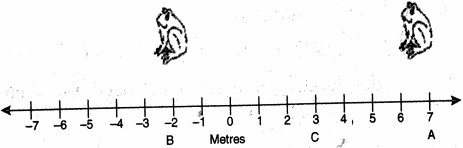
$A$ frog hops along a straight line path from point $A$ to point $B$ in $10 \, s$ and then turns and hops to point $C$ in another $5 \, s$. Based on the provided number line,calculate the average speed and average velocity of the frog for the motion between: $(a)$ $A$ to $B$ $(b)$ $A$ to $C$ (through $B$).
Solution
(N/A) From the number line,the positions are: $A = 7 \, m$,$B = -2 \, m$,$C = 3 \, m$.
$(a)$ For motion from $A$ to $B$:
Total distance $= |(-2) - 7| = 9 \, m$.
Total displacement $= -2 - 7 = -9 \, m$.
Time taken $= 10 \, s$.
Average speed $= \frac{\text{Total distance}}{\text{Total time}} = \frac{9}{10} = 0.9 \, m/s$.
Average velocity $= \frac{\text{Total displacement}}{\text{Total time}} = \frac{-9}{10} = -0.9 \, m/s$.
$(b)$ For motion from $A$ to $C$ through $B$:
Total distance $= |(-2) - 7| + |3 - (-2)| = 9 + 5 = 14 \, m$.
Total displacement $= 3 - 7 = -4 \, m$.
Total time $= 10 + 5 = 15 \, s$.
Average speed $= \frac{14}{15} \approx 0.933 \, m/s$.
Average velocity $= \frac{-4}{15} \approx -0.267 \, m/s$.
0 likes
View Solution22
Easy
Answer the following questions:
$(i)$ State the type of motion shown by a freely falling stone.
$(ii)$ When a stone is thrown vertically upwards,its velocity is continuously decreased. Why?
$(iii)$ Give an example of a motion in which average velocity is zero,but the average speed is not zero.
$(i)$ State the type of motion shown by a freely falling stone.
$(ii)$ When a stone is thrown vertically upwards,its velocity is continuously decreased. Why?
$(iii)$ Give an example of a motion in which average velocity is zero,but the average speed is not zero.
Solution
(N/A) $(i)$ $A$ freely falling stone exhibits uniformly accelerated motion because it is under the influence of constant gravitational acceleration $(g \approx 9.8 \ m/s^2)$.
$(ii)$ When a stone is thrown vertically upwards,the earth exerts a gravitational force on it in the downward direction. This force acts against the direction of motion,causing retardation (negative acceleration),which leads to a continuous decrease in velocity.
$(iii)$ An example of such motion is an object moving in a circular path and returning to its starting point. Since the displacement is zero,the average velocity is zero,but the total distance covered is the circumference of the circle,so the average speed is not zero.
0 likes
View Solution23
Medium
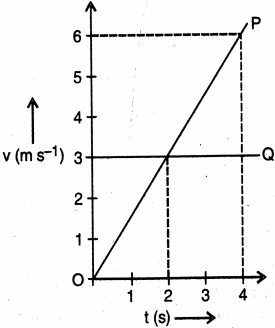
The speed-time graphs of two cars are represented by $P$ and $Q$ as shown below.
$(a)$ Find the difference in the distance travelled by the two cars (in $m$) after $4\, s$.
$(b)$ Do they ever move with the same speed? If so,when?
$(c)$ What type of motion are car $P$ and car $Q$ undergoing?
$(a)$ Find the difference in the distance travelled by the two cars (in $m$) after $4\, s$.
$(b)$ Do they ever move with the same speed? If so,when?
$(c)$ What type of motion are car $P$ and car $Q$ undergoing?
Solution
(N/A) The distance covered by an object is equal to the area under the speed-time graph.
For car $P$,the area is a triangle with base $= 4\, s$ and height $= 6\, m/s$.
Distance $= \frac{1}{2} \times \text{base} \times \text{height} = \frac{1}{2} \times 4\, s \times 6\, m/s = 12\, m$.
For car $Q$,the area is a rectangle with length $= 4\, s$ and width $= 3\, m/s$.
Distance $= \text{length} \times \text{width} = 4\, s \times 3\, m/s = 12\, m$.
The difference in the distance travelled by the two cars is $12\, m - 12\, m = 0\, m$.
$(b)$ Yes,they move with the same speed at the point where the two graphs intersect. This occurs at $t = 2\, s$,where both cars have a speed of $3\, m/s$.
$(c)$ Car $P$ is undergoing uniform acceleration because its speed-time graph is a straight line passing through the origin,indicating a constant rate of change of speed. Car $Q$ is undergoing uniform motion (constant speed) because its speed-time graph is a horizontal line,indicating that its speed does not change with time.
0 likes
View Solution24
MediumMCQ
Starting from rest,a scooter acquires a velocity of $36 \, km/h$ in $10 \, s$ and then brakes are applied,taking $20 \, s$ to stop. Calculate the acceleration and the total distance travelled.
A
Acceleration = $1 \, m/s^2$,Deceleration = $-0.5 \, m/s^2$,Distance = $150 \, m$
B
Acceleration = $1 \, m/s^2$,Deceleration = $-0.5 \, m/s^2$,Distance = $200 \, m$
C
Acceleration = $1 \, m/s^2$,Deceleration = $-0.5 \, m/s^2$,Distance = $250 \, m$
D
Acceleration = $1 \, m/s^2$,Deceleration = $-0.5 \, m/s^2$,Distance = $300 \, m$
Solution
(A) Part $1$: Acceleration phase
Initial velocity $u = 0 \, m/s$,Final velocity $v = 36 \, km/h = 36 \times (5/18) = 10 \, m/s$,Time $t_1 = 10 \, s$.
Acceleration $a_1 = (v - u) / t_1 = (10 - 0) / 10 = 1 \, m/s^2$.
Distance $s_1 = ut_1 + 0.5 a_1 t_1^2 = 0 + 0.5 \times 1 \times 10^2 = 50 \, m$.
Part $2$: Deceleration phase
Initial velocity $u = 10 \, m/s$,Final velocity $v = 0 \, m/s$,Time $t_2 = 20 \, s$.
Acceleration $a_2 = (v - u) / t_2 = (0 - 10) / 20 = -0.5 \, m/s^2$.
Distance $s_2 = ut_2 + 0.5 a_2 t_2^2 = 10 \times 20 + 0.5 \times (-0.5) \times 20^2 = 200 - 100 = 100 \, m$.
Total distance = $s_1 + s_2 = 50 + 100 = 150 \, m$.
0 likes
View Solution25
Medium
The following table shows the position of three persons between $8.00\, am$ to $8.20\, am$.
$(i)$ Who is moving with constant speed?
$(ii)$ Who has travelled the maximum distance between $8.00\, am$ to $8.05\, am$?
$(iii)$ Calculate the average speed of person $A$ in $km\, h^{-1}$.
| Time | Position of Person $A$ $(km)$ | Position of Person $B$ $(km)$ | Position of Person $C$ $(km)$ |
| $8.00\, am$ | $0$ | $0$ | $0$ |
| $8.05\, am$ | $4$ | $5$ | $10$ |
| $8.10\, am$ | $13$ | $10$ | $19$ |
| $8.15\, am$ | $20$ | $15$ | $24$ |
| $8.20\, am$ | $25$ | $20$ | $27$ |
$(i)$ Who is moving with constant speed?
$(ii)$ Who has travelled the maximum distance between $8.00\, am$ to $8.05\, am$?
$(iii)$ Calculate the average speed of person $A$ in $km\, h^{-1}$.
Solution
(N/A) $(i)$ Person $B$ is moving with constant speed because he travels an equal distance of $5\, km$ in equal intervals of time (every $5\, minutes$).
$(ii)$ Person $C$ has travelled the maximum distance, which is $10\, km$ between $8.00\, am$ and $8.05\, am$.
$(iii)$ Average speed of person $A = \frac{\text{Total distance travelled by } A}{\text{Total time taken}}$
$= \frac{25\, km}{20\, min} = \frac{25\, km}{(20/60)\, h} = \frac{25 \times 60}{20}\, km\, h^{-1} = 75\, km\, h^{-1}$.
0 likes
View Solution26
Medium
Give one example for each of the type of motion when
$(i)$ acceleration is in the direction of motion.
$(ii)$ acceleration is against the direction of motion.
$(iii)$ acceleration is uniform.
$(i)$ acceleration is in the direction of motion.
$(ii)$ acceleration is against the direction of motion.
$(iii)$ acceleration is uniform.
Solution
(N/A) $(i)$ The motion of a car when it starts from rest and increases its velocity at a constant rate in a particular interval of time.
$(ii)$ The motion of a train when it slows down on approaching a station.
$(iii)$ The motion of a ball falling down freely.
$(ii)$ The motion of a train when it slows down on approaching a station.
$(iii)$ The motion of a ball falling down freely.
0 likes
View Solution27
Medium
$(a)$ What is acceleration? Write its $SI$ unit.
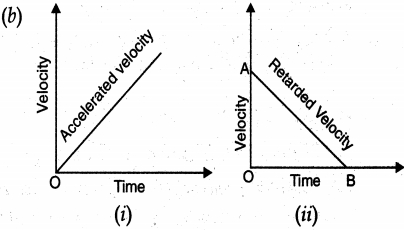
$(b)$ Draw velocity-time graphs for an object having:
$(i)$ Uniformly accelerated velocity.
$(ii)$ Uniformly retarded velocity.
$(b)$ Draw velocity-time graphs for an object having:
$(i)$ Uniformly accelerated velocity.
$(ii)$ Uniformly retarded velocity.
Solution
(N/A) Acceleration is defined as the rate of change of velocity of an object with respect to time. Mathematically,$a = \frac{v - u}{t}$. Its $SI$ unit is $m s^{-2}$.
$(b)$ The velocity-time graphs are as follows:
$(i)$ For uniformly accelerated velocity,the graph is a straight line sloping upwards from the origin (or starting from a non-zero initial velocity),indicating that velocity increases at a constant rate over time.
$(ii)$ For uniformly retarded velocity,the graph is a straight line sloping downwards,indicating that velocity decreases at a constant rate over time until it reaches zero.
0 likes
View Solution28
Medium
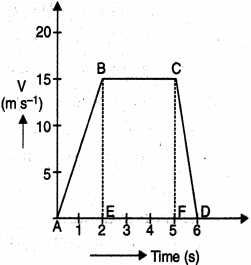
The velocity-time graph of a car is given below. The car weighs $1000 \ kg$.
$(i)$ What is the distance travelled by the car in the first $2 \ s$?
$(ii)$ What is the braking force at the end of $5 \ s$ to bring the car to a stop within one second?
$(i)$ What is the distance travelled by the car in the first $2 \ s$?
$(ii)$ What is the braking force at the end of $5 \ s$ to bring the car to a stop within one second?
Solution
(N/A) The distance travelled by the car in the first $2 \ s$ is equal to the area under the velocity-time graph from $t = 0$ to $t = 2 \ s$,which is the area of $\Delta ABE$.
Distance $= \text{Area of } \Delta ABE = \frac{1}{2} \times \text{base} \times \text{height}$
$= \frac{1}{2} \times 2 \ s \times 15 \ m/s = 15 \ m$.
$(ii)$ To find the braking force,we first calculate the acceleration (deceleration) from $t = 5 \ s$ to $t = 6 \ s$ using the slope of the line $CD$.
Initial velocity at $t = 5 \ s$ is $u = 15 \ m/s$.
Final velocity at $t = 6 \ s$ is $v = 0 \ m/s$.
Time interval $\Delta t = 6 \ s - 5 \ s = 1 \ s$.
Acceleration $a = \frac{v - u}{\Delta t} = \frac{0 - 15 \ m/s}{1 \ s} = -15 \ m/s^2$.
Using Newton's second law of motion,$F = m \times a$.
$F = 1000 \ kg \times (-15 \ m/s^2) = -15000 \ N$.
The negative sign indicates that the force is a braking force acting opposite to the direction of motion. Thus,the magnitude of the braking force is $15000 \ N$.
0 likes
View Solution29
Medium
What does the odometer of an automobile measure? Which of the following is moving faster? Justify your answer.
$(i)$ $A$ scooter moving with a speed of $300 \, m$ per minute.
$(ii)$ $A$ car moving with a speed of $36 \, km$ per hour.
$(i)$ $A$ scooter moving with a speed of $300 \, m$ per minute.
$(ii)$ $A$ car moving with a speed of $36 \, km$ per hour.
Solution
(B) The odometer of an automobile measures the distance traveled by the vehicle.
To compare the speeds,we convert both into $m \, s^{-1}$:
$(i)$ Speed of scooter $= 300 \, m / 60 \, s = 5 \, m \, s^{-1}$.
$(ii)$ Speed of car $= 36 \, km/h = 36 \times (1000 \, m / 3600 \, s) = 36 \times (5/18) \, m \, s^{-1} = 10 \, m \, s^{-1}$.
Since $10 \, m \, s^{-1} > 5 \, m \, s^{-1}$,the car is moving faster than the scooter.
0 likes
View Solution30
Medium
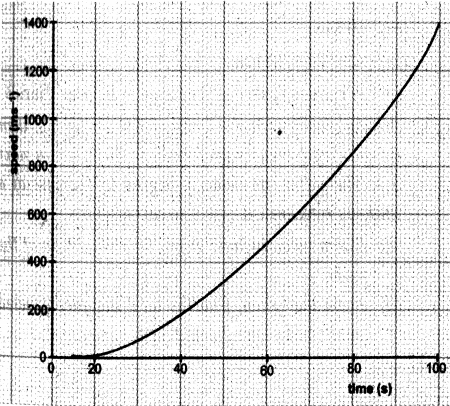
The following figure is the speed-time graph for a rocket from the moment when the fuel starts to burn,i.e.,at time $t=0$.
$(a)$ State the acceleration of the rocket at $t=0$.
$(b)$ State what happens to the acceleration of the rocket between $t=5 \, s$ and $t=60 \, s$.
$(c)$ Calculate the acceleration of the rocket at $t=80 \, s$. Give a reason for your answer.
$(d)$ The total mass of the rocket at $t=80 \, s$ is $1.6 \times 10^{6} \, kg$. Calculate the resultant force on the rocket at this time. Give a reason for your answer.
Solution
(N/A) At $t=0$,the speed is $0$ and the slope of the graph is $0$. Therefore,the initial acceleration is $0 \, m/s^2$.
$(b)$ Between $t=5 \, s$ and $t=60 \, s$,the slope of the speed-time graph is increasing. Since the slope of a speed-time graph represents acceleration,the acceleration of the rocket is increasing during this interval.
$(c)$ At $t=80 \, s$,the graph is a straight line. The slope of this line is constant. Calculating the slope between $t=60 \, s$ $(v \approx 480 \, m/s)$ and $t=100 \, s$ $(v = 1400 \, m/s)$: $a = \frac{1400 - 480}{100 - 60} = \frac{920}{40} = 23 \, m/s^2$. The acceleration is constant because the graph is linear in this region.
$(d)$ Using Newton's second law,$F = ma$. Given $m = 1.6 \times 10^{6} \, kg$ and $a = 23 \, m/s^2$,the resultant force $F = 1.6 \times 10^{6} \times 23 = 3.68 \times 10^{7} \, N$. The force is non-zero because the rocket is accelerating.
0 likes
View Solution31
Medium
$(a)$ Derive graphically the equation for velocity$-$time relation.
$(b)$ Name the device used to measure distance travelled by a vehicle.
$(c)$ Can displacement of a moving object be zero? Give reason.
$(b)$ Name the device used to measure distance travelled by a vehicle.
$(c)$ Can displacement of a moving object be zero? Give reason.
Solution
(N/A) Consider a velocity$-$time graph where an object starts with initial velocity $u$ at time $t=0$ and reaches final velocity $v$ at time $t$. The slope of the velocity$-$time graph represents acceleration $(a)$.
Slope $= \frac{\text{Change in velocity}}{\text{Time taken}} = \frac{v - u}{t}$.
Therefore,$a = \frac{v - u}{t}$,which gives $at = v - u$,or $v = u + at$.
$(b)$ The device used to measure the distance travelled by a vehicle is called an odometer.
$(c)$ Yes,the displacement of a moving object can be zero. This happens if the object returns to its initial starting position after completing its motion,as displacement is the shortest distance between the initial and final positions.
0 likes
View Solution32
Difficult
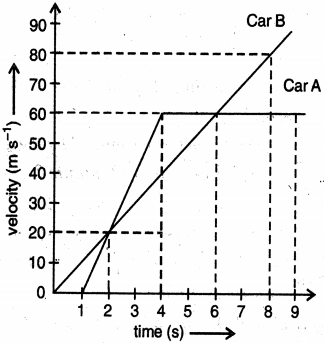
The velocity-time graph of cars $A$ and $B$ which start from the same place and move along a straight road in the same direction is shown below.
Calculate:
$(a)$ The acceleration of car $B$ between $2 \, s$ and $4 \, s$.
$(b)$ The time at which both the cars have the same velocity.
$(c)$ The distance travelled by the two cars $A$ and $B$ in $8 \, s$.
$(d)$ Which of the two cars is ahead after $8 \, s$ and by how much?
Calculate:
$(a)$ The acceleration of car $B$ between $2 \, s$ and $4 \, s$.
$(b)$ The time at which both the cars have the same velocity.
$(c)$ The distance travelled by the two cars $A$ and $B$ in $8 \, s$.
$(d)$ Which of the two cars is ahead after $8 \, s$ and by how much?
Solution
$(a)$ Acceleration is the slope of the velocity-time graph.
For car $B$, between $t = 2 \, s$ and $t = 4 \, s$, the velocity changes from $20 \, m/s$ to $40 \, m/s$.
$a = \frac{v_2 - v_1}{t_2 - t_1} = \frac{40 - 20}{4 - 2} = \frac{20}{2} = 10 \, m/s^2$.
$(b)$ Both cars have the same velocity where their graphs intersect. Looking at the graph, the intersection point is at $t = 2 \, s$ (velocity $= 20 \, m/s$) and $t = 6 \, s$ (velocity $= 60 \, m/s$).
$(c)$ Distance travelled is the area under the velocity-time graph.
For car $A$: The area is a trapezoid from $t = 1$ to $t = 4$ plus a rectangle from $t = 4$ to $t = 8$.
Area $= (\frac{1}{2} \times (4 - 1) \times 60) + (60 \times (8 - 4)) = (\frac{1}{2} \times 3 \times 60) + (60 \times 4) = 90 + 240 = 330 \, m$.
For car $B$: The area is a triangle from $t = 0$ to $t = 8$.
Area $= \frac{1}{2} \times \text{base} \times \text{height} = \frac{1}{2} \times 8 \times 80 = 320 \, m$.
$(d)$ After $8 \, s$, car $A$ has travelled $330 \, m$ and car $B$ has travelled $320 \, m$.
Therefore, car $A$ is ahead by $330 - 320 = 10 \, m$.
0 likes
View Solution33
Difficult
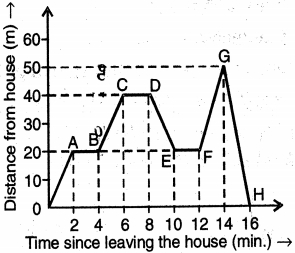
The following graph describes the motion of a girl going to meet her friend who stays $50 \ m$ from her house.
$(i)$ How much time does she take to reach her friend's house?
$(ii)$ What is the distance travelled by the girl during the time-interval $0$ to $12$ minutes?
$(iii)$ During which time-interval is she moving towards her house?
$(iv)$ For how many minutes was she at rest during the entire journey?
$(v)$ Calculate the speed by which she returned home.
Solution
(N/A) $(i)$ Looking at the graph,the girl reaches the $50 \ m$ mark (friend's house) at $14$ minutes.
$(ii)$ From $0$ to $2$ min,distance $= 20 \ m$. From $2$ to $4$ min,distance $= 0 \ m$. From $4$ to $6$ min,distance $= 40 - 20 = 20 \ m$. From $6$ to $8$ min,distance $= 0 \ m$. From $8$ to $10$ min,distance $= 40 - 20 = 20 \ m$. From $10$ to $12$ min,distance $= 0 \ m$. Total distance $= 20 + 0 + 20 + 0 + 20 + 0 = 60 \ m$.
$(iii)$ She moves towards her house when the distance from the house decreases. This happens during the intervals $8$ to $10$ minutes and $14$ to $16$ minutes.
$(iv)$ She is at rest when the distance remains constant (horizontal line). This occurs during $2-4$ min ($2$ min),$6-8$ min ($2$ min),and $10-12$ min ($2$ min). Total time at rest $= 2 + 2 + 2 = 6$ minutes.
$(v)$ She returns home from $14$ to $16$ minutes. Distance covered $= 50 \ m$. Time taken $= 2$ minutes. Speed $= \frac{\text{Total distance}}{\text{Total time}} = \frac{50 \ m}{2 \ min} = 25 \ m/min$.
0 likes
View Solution34
Medium
The $v-t$ graph of cars $A$ and $B$ which start from the same place and move along a straight road in the same direction is shown. Calculate:
$(i)$ The acceleration of car $A$ between $0$ and $8\, s$.
$(ii)$ The acceleration of car $B$ between $2\, s$ and $4\, s$.
$(iii)$ The points of time at which both the cars have the same velocity.
$(iv)$ Which of the two cars is ahead after $8\, s$ and by how much?
$(i)$ The acceleration of car $A$ between $0$ and $8\, s$.
$(ii)$ The acceleration of car $B$ between $2\, s$ and $4\, s$.
$(iii)$ The points of time at which both the cars have the same velocity.
$(iv)$ Which of the two cars is ahead after $8\, s$ and by how much?
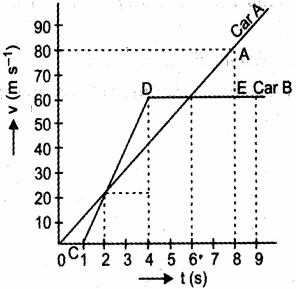
Solution
(N/A) $(i)$ Acceleration of car $A$ between $0$ and $8\, s$ is the slope of the line:
$a = \frac{v_f - v_i}{t_f - t_i} = \frac{80 - 0}{8 - 0} = 10\, m/s^2$.
$(ii)$ Acceleration of car $B$ between $2\, s$ and $4\, s$ is the slope of the line:
$a = \frac{v_f - v_i}{t_f - t_i} = \frac{60 - 20}{4 - 2} = \frac{40}{2} = 20\, m/s^2$.
$(iii)$ Both cars have the same velocity where the two lines intersect,which occurs at $t = 2\, s$ and $t = 6\, s$.
$(iv)$ Distance travelled is the area under the $v-t$ graph.
Distance travelled by car $A$ in $8\, s$ = Area of triangle with base $8\, s$ and height $80\, m/s$ = $\frac{1}{2} \times 8 \times 80 = 320\, m$.
Distance travelled by car $B$ in $8\, s$ = Area of triangle ($t=1$ to $2$) + Area of trapezium ($t=2$ to $4$) + Area of rectangle ($t=4$ to $8$).
Area = $(\frac{1}{2} \times 1 \times 20) + (\frac{20+60}{2} \times 2) + (4 \times 60) = 10 + 80 + 240 = 330\, m$.
Since $330\, m > 320\, m$,car $B$ is ahead by $330 - 320 = 10\, m$.
0 likes
View Solution35
Medium
$(a)$ Draw velocity-time graphs for the following cases:
$(i)$ When the object is at rest.
$(ii)$ When the object is thrown vertically upwards.
$(b)$ $A$ motorcyclist riding motorcycle $A$ who is travelling at $36 \, km \, h^{-1}$ applies the brakes and stops the motorcycle in $10 \, s$. Another motorcyclist of motorcycle $B$ who is travelling at $18 \, km \, h^{-1}$ applies the brakes and stops the motorcycle in $20 \, s$. Plot the speed-time graph for the two motorcycles. Which of the two motorcycles travelled farther before it came to a stop?
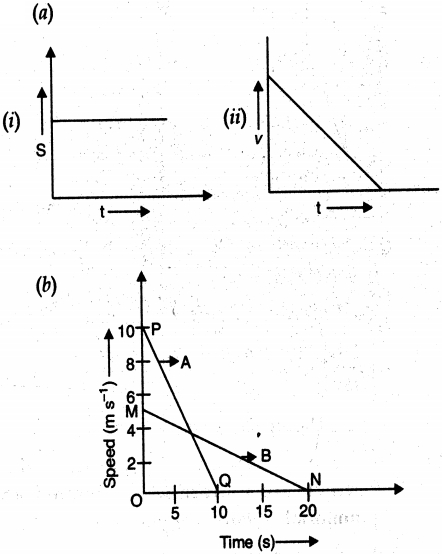
Solution
(N/A) For motorcycle $A$:
Initial velocity $u = 36 \, km \, h^{-1} = \frac{36 \times 5}{18} = 10 \, m \, s^{-1}$.
Final velocity $v = 0 \, m \, s^{-1}$.
Time $t = 10 \, s$.
For motorcycle $B$:
Initial velocity $u = 18 \, km \, h^{-1} = \frac{18 \times 5}{18} = 5 \, m \, s^{-1}$.
Final velocity $v = 0 \, m \, s^{-1}$.
Time $t = 20 \, s$.
Distance travelled is equal to the area under the speed-time graph.
Distance travelled by $A$ before stopping = Area of triangle $OPQ = \frac{1}{2} \times \text{base} \times \text{height} = \frac{1}{2} \times 10 \, s \times 10 \, m \, s^{-1} = 50 \, m$.
Distance travelled by $B$ before stopping = Area of triangle $OMN = \frac{1}{2} \times \text{base} \times \text{height} = \frac{1}{2} \times 20 \, s \times 5 \, m \, s^{-1} = 50 \, m$.
Conclusion: Both motorcycles travelled the same distance before they came to a stop.
0 likes
View Solution36
Medium
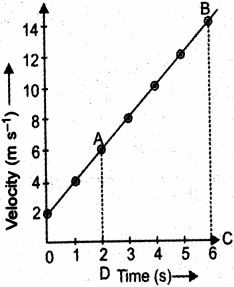
An object is moving along a straight line with uniform acceleration. The following table gives the velocity of the object at various instants of time.
Plot the graph.
From the graph:
$(i)$ Find the velocity of the object at the end of $2.5 \ s$.
$(ii)$ Calculate the acceleration.
$(iii)$ Calculate the distance covered in the last $4 \ s$.
| Time $(s)$ | $0$ | $1$ | $2$ | $3$ | $4$ | $5$ | $6$ |
| Velocity $(m s^{-1})$ | $2$ | $4$ | $6$ | $8$ | $10$ | $12$ | $14$ |
Plot the graph.
From the graph:
$(i)$ Find the velocity of the object at the end of $2.5 \ s$.
$(ii)$ Calculate the acceleration.
$(iii)$ Calculate the distance covered in the last $4 \ s$.
Solution
(N/A) $(i)$ By observing the velocity-time graph, at $t = 2.5 \ s$, the velocity is $7 \ m s^{-1}$.
$(ii)$ Acceleration $(a)$ is the slope of the velocity-time graph.
$a = \frac{v - u}{t} = \frac{14 - 2}{6 - 0} = \frac{12}{6} = 2 \ m s^{-2}$.
$(iii)$ The distance covered in the last $4 \ s$ (from $t = 2 \ s$ to $t = 6 \ s$) is equal to the area under the velocity-time graph between these time intervals.
This area forms a trapezium $ABCD$ where the parallel sides are the velocities at $t = 2 \ s$ $(6 \ m s^{-1})$ and $t = 6 \ s$ $(14 \ m s^{-1})$, and the height is the time interval $(6 - 2 = 4 \ s)$.
$S = \text{Area of trapezium } ABCD = \frac{1}{2} \times (\text{sum of parallel sides}) \times (\text{height})$
$S = \frac{1}{2} \times (6 + 14) \times 4 = \frac{1}{2} \times 20 \times 4 = 40 \ m$.
0 likes
View Solution37
Medium
$(a)$ Differentiate acceleration from velocity.
$(b)$ Can a body have acceleration without change in magnitude of velocity? Explain with an example.
$(c)$ $A$ motor boat starting from rest on a lake accelerates in a straight line at a constant rate of $3 \, m s^{-2}$ for $8 \, s$. How far does the boat travel during this time?
$(b)$ Can a body have acceleration without change in magnitude of velocity? Explain with an example.
$(c)$ $A$ motor boat starting from rest on a lake accelerates in a straight line at a constant rate of $3 \, m s^{-2}$ for $8 \, s$. How far does the boat travel during this time?
Solution
(C) Acceleration is the rate of change of velocity,whereas velocity is the rate of change of displacement.
$(b)$ Yes. In uniform circular motion,the magnitude of velocity (speed) remains constant,but the direction changes continuously. Since acceleration is a vector quantity,this change in direction results in centripetal acceleration.
$(c)$ Given: Initial velocity $u = 0 \, m s^{-1}$,acceleration $a = 3 \, m s^{-2}$,time $t = 8 \, s$.
Using the second equation of motion: $S = ut + \frac{1}{2}at^2$
$S = (0 \times 8) + \frac{1}{2} \times 3 \times (8)^2$
$S = 0 + \frac{1}{2} \times 3 \times 64$
$S = 3 \times 32 = 96 \, m$.
The boat travels $96 \, m$ during this time.
0 likes
View Solution38
Medium
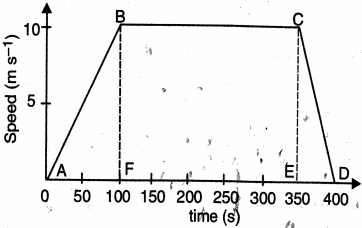
$A$ train starting from rest picks up a speed of $10\, m s^{-1}$ in $100\, s$. It continues to move at the same speed for the next $250\, s$. It is then brought to rest in the next $50\, s$. Plot a speed-time graph for the entire motion of the train and calculate:
$(i)$ acceleration of the train while accelerating,
$(ii)$ retardation of the train while retarding,
$(iii)$ the total distance covered by the train.
$(i)$ acceleration of the train while accelerating,
$(ii)$ retardation of the train while retarding,
$(iii)$ the total distance covered by the train.
Solution
(N/A) The speed-time graph is shown in the figure.
$(i)$ Acceleration is equal to the slope of the graph during the interval $0-100\, s$:
$a = \frac{\text{Change in speed}}{\text{Time taken}} = \frac{10\, m s^{-1} - 0\, m s^{-1}}{100\, s} = 0.1\, m s^{-2}$.
$(ii)$ Retardation is equal to the magnitude of the negative slope of the graph during the interval $350-400\, s$:
$a = \frac{0\, m s^{-1} - 10\, m s^{-1}}{50\, s} = -0.2\, m s^{-2}$.
Thus,retardation is $0.2\, m s^{-2}$.
$(iii)$ The total distance covered is equal to the area under the speed-time graph (Area of trapezium $ABCD$):
$\text{Area} = \frac{1}{2} \times (\text{Sum of parallel sides}) \times \text{Height}$
$\text{Area} = \frac{1}{2} \times (AD + BC) \times BF$
$\text{Area} = \frac{1}{2} \times (400\, s + 250\, s) \times 10\, m s^{-1} = \frac{1}{2} \times 650\, s \times 10\, m s^{-1} = 3250\, m$.
0 likes
View Solution39
Medium
$(a)$ Differentiate between speed and velocity.
$(b)$ When is a body said to have uniform velocity?
$(c)$ How can we describe the position of an object? Illustrate with a suitable example.
$(b)$ When is a body said to have uniform velocity?
$(c)$ How can we describe the position of an object? Illustrate with a suitable example.
Solution
(N/A) Speed is the distance traveled per unit time,whereas velocity is the displacement per unit time. Speed is a scalar quantity and is always positive,while velocity is a vector quantity and can be zero,positive,or negative.
$(b)$ $A$ body is said to have uniform velocity if it covers equal displacements in equal intervals of time,regardless of how small these time intervals may be.
$(c)$ The position of an object is described with respect to a fixed reference point,known as the origin. For example,if a bird is flying,its position can be described relative to a specific tree or the ground (the reference point).
0 likes
View Solution40
Medium
Account for the following:
$(a)$ Name the quantity which is measured by the area occupied below the velocity$-$time graph.
$(b)$ Give an example of an object moving in a certain direction with acceleration in the perpendicular direction.
$(c)$ Under what condition is the magnitude of average velocity of an object equal to its average speed?
$(d)$ Give an example of uniformly accelerated motion.
$(e)$ $A$ body is moving along a circular path of radius $r$. What will be the distance and displacement of the body when it completes half a revolution?
Solution
(N/A) The area under a velocity$-$time graph represents the displacement (or distance if the motion is in a straight line).
$(b)$ An example is the motion of a satellite in a circular orbit or uniform circular motion,where the acceleration is directed towards the center (centripetal acceleration) while the velocity is tangential.
$(c)$ The magnitude of average velocity is equal to the average speed when the object moves in a straight line without changing its direction.
$(d)$ The motion of a freely falling body under gravity is an example of uniformly accelerated motion.
$(e)$ For a circular path of radius $r$,after half a revolution,the distance covered is half the circumference,which is $\pi r$. The displacement is the shortest distance between the initial and final points,which is the diameter of the circle,$2r$.
0 likes
View Solution41
Medium
Account for the following:
$(a)$ What is the shape of the path of a body when it is in uniform motion?
$(b)$ Give one example of non-uniform motion.
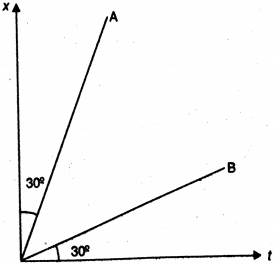
$(c)$ Two cars $A$ and $B$ have their $x-t$ graph as shown in the figure. Which has greater velocity?
$(d)$ What is the quantity which is measured by the area occupied below the velocity-time graph?
$(e)$ $A$ body is moving with a velocity of $10 \, m/s$. If the motion is uniform,what will be the velocity after $10 \, s$?
Solution
(N/A) The path of a body in uniform motion is a straight line.
$(b)$ An example of non-uniform motion is a car moving on a crowded city road where its speed changes frequently.
$(c)$ The velocity is determined by the slope of the $x-t$ graph. $A$ steeper slope indicates a higher velocity. Since the slope of line $A$ is greater than the slope of line $B$,car $A$ has a greater velocity.
$(d)$ The area under a velocity-time graph represents the magnitude of the displacement of the body.
$(e)$ In uniform motion,the velocity of the body remains constant over time. Therefore,if the body is moving with a velocity of $10 \, m/s$,its velocity after $10 \, s$ will still be $10 \, m/s$.
0 likes
View Solution42
Medium
$(a)$ Define uniform circular motion.
$(b)$ Ram goes for a morning walk in a circular park daily. He completes one revolution of the park in $4$ minutes. Find his speed if the diameter of the park is $420\, m$.
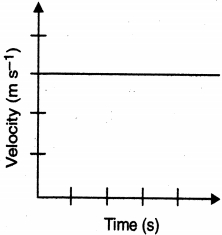
$(c)$ Draw velocity$-$time graph for uniform motion along a straight line. How can you find the distance covered by a body from this graph?
Solution
(N/A) body is said to be in uniform circular motion if it moves along a circular path with a constant speed.
$(b)$ Given:
Time $(t) = 4 \text{ minutes} = 4 \times 60 = 240 \text{ s}$
Diameter $(d) = 420 \text{ m}$
Radius $(r) = d / 2 = 420 / 2 = 210 \text{ m}$
Total distance $(S)$ covered in one revolution $= 2 \pi r = 2 \times (22 / 7) \times 210 = 1320 \text{ m}$
Speed $(v) = \text{Distance} / \text{Time} = 1320 / 240 = 5.5 \text{ m s}^{-1}$
$(c)$ The velocity$-$time graph for uniform motion along a straight line is a straight line parallel to the time axis. The area under the velocity$-$time graph gives the distance covered by an object.
0 likes
View Solution43
Difficult
$(a)$ $A$ car moving with uniform velocity $u$ and uniform acceleration $a$ covers a distance $S$ in time $t$. Draw its velocity-time graph and derive an expression relating all the given physical quantities.
$(b)$ $A$ boy revolves a stone tied to a string $0.7 \, m$ long. Find the distance and displacement covered by the stone in completing two revolutions from the starting point.
$(b)$ $A$ boy revolves a stone tied to a string $0.7 \, m$ long. Find the distance and displacement covered by the stone in completing two revolutions from the starting point.
Solution
(N/A) The velocity-time graph for uniform acceleration is a straight line inclined to the time axis. The area under the velocity-time graph gives the distance covered. By integrating or using the area of a trapezium (or rectangle + triangle),we derive the equation of motion: $S = ut + \frac{1}{2}at^2$.
$(b)$ Given: Radius $r = 0.7 \, m$. Number of revolutions $n = 2$.
Distance is the total path length covered: $\text{Distance} = n \times (2\pi r) = 2 \times 2 \times \frac{22}{7} \times 0.7 = 8.8 \, m$.
Displacement is the shortest distance between the initial and final positions. Since the stone completes two full revolutions,it returns to the starting point. Therefore,$\text{Displacement} = 0 \, m$.
0 likes
View Solution44
Medium
An object starts a linear motion with velocity $u$ and with uniform acceleration $a$,it acquires a velocity $v$ in time $t$.
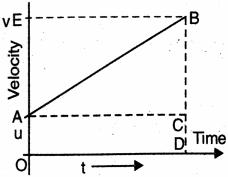
$(a)$ Draw its velocity-time graph.
$(b)$ Obtain the first equation of motion,$v = u + at$,for the velocity-time relation by using the velocity-time graph.
$(c)$ $A$ body moving with a velocity of $2 \, m s^{-1}$ acquires a velocity of $10 \, m s^{-1}$ in $5 \, s$. Find its acceleration.
$(a)$ Draw its velocity-time graph.
$(b)$ Obtain the first equation of motion,$v = u + at$,for the velocity-time relation by using the velocity-time graph.
$(c)$ $A$ body moving with a velocity of $2 \, m s^{-1}$ acquires a velocity of $10 \, m s^{-1}$ in $5 \, s$. Find its acceleration.
Solution
(N/A) The velocity-time graph is shown in the figure.
$(b)$ The slope of the velocity-time graph gives the acceleration of the motion.
Slope $= \frac{\text{Change in velocity}}{\text{Time taken}} = \frac{v - u}{t - 0} = \frac{v - u}{t}$
Since acceleration $a = \text{slope}$,we have $a = \frac{v - u}{t}$.
Rearranging this gives $at = v - u$,or $v = u + at$.
$(c)$ Given:
Initial velocity $u = 2 \, m s^{-1}$
Final velocity $v = 10 \, m s^{-1}$
Time $t = 5 \, s$
Using the first equation of motion $v = u + at$:
$10 = 2 + a(5)$
$10 - 2 = 5a$
$8 = 5a$
$a = \frac{8}{5} = 1.6 \, m s^{-2}$
Thus,the acceleration is $1.6 \, m s^{-2}$.
0 likes
View Solution45
Difficult
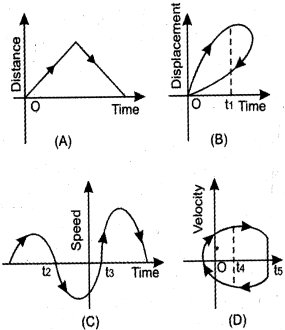
Explain with reason,which of the following graphs can possibly represent the motion of a particle observed in nature?
Solution
(NONE) This graph shows that with an increase in time,the distance first increases and then decreases. However,distance is a scalar quantity and can never decrease with time for a moving particle,so this graph is not possible.
$(B)$ This graph shows that at a certain time $t_{1}$,the body is present at two different positions simultaneously. Since a particle cannot be at two places at the same time,this graph is not possible.
$(C)$ This graph shows that speed is negative for some interval of time. Since speed is the magnitude of velocity and is always non-negative,this graph is not possible.
$(D)$ This graph shows that at a given instant of time,the particle has two different velocities. Additionally,it shows that at some time,it has infinite acceleration (where the graph is parallel to the velocity axis). Both these conditions cannot be achieved in practice; therefore,this graph is not possible.
Conclusion: None of the given graphs represent the motion of a particle observed in nature.
0 likes
View Solution46
Medium
In your everyday life,you come across a range of motions in which
$(a)$ acceleration is in the direction of motion.
$(b)$ acceleration is against the direction of motion.
$(c)$ acceleration is uniform.
$(d)$ acceleration is non$-$uniform.
Can you identify one example each of the above type of motion?
$(a)$ acceleration is in the direction of motion.
$(b)$ acceleration is against the direction of motion.
$(c)$ acceleration is uniform.
$(d)$ acceleration is non$-$uniform.
Can you identify one example each of the above type of motion?
Solution
(N/A) When the speed of a car on a road increases,the acceleration of the car is in the direction of motion.
$(b)$ When brakes are applied to a car in motion,its speed decreases. The acceleration produced in the car is against the direction of motion.
$(c)$ When a body is falling freely under the action of gravity,it has a uniform acceleration $g = 9.8 \ m \ s^{-2}$.
$(d)$ When a car is passing through city traffic,its acceleration or retardation is non$-$uniform depending on the volume of traffic.
0 likes
View Solution47
Medium
Out of the three speed-time graphs shown below,identify the graph for the following cases:
$(i)$ $A$ ball thrown vertically upwards and returning to the hand of the thrower.
(ii) $A$ body decelerating to a constant speed and then accelerating.
$(i)$ $A$ ball thrown vertically upwards and returning to the hand of the thrower.
(ii) $A$ body decelerating to a constant speed and then accelerating.
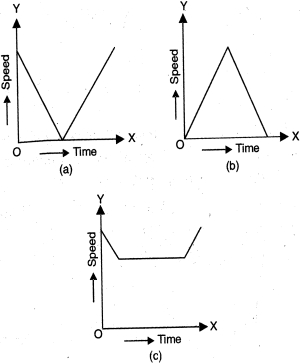
Solution
(N/A) $(i)$ Graph $(a)$ shows that the speed of a body decreases with time,becomes zero,and then again starts increasing. This graph,therefore,represents the case of a ball thrown vertically upwards and then caught by the thrower. Initially,the ball is thrown with some speed. As the ball rises up,its speed decreases at a constant rate and becomes zero at the maximum height. The ball then falls with a uniform acceleration until its speed becomes equal to the speed of projection.
(ii) Graph $(c)$ represents the deceleration of the body to some constant speed,and then accelerating after some time.
(ii) Graph $(c)$ represents the deceleration of the body to some constant speed,and then accelerating after some time.
0 likes
View Solution48
Medium
An aeroplane lands at $216 \ km \ h^{-1}$ and stops after covering a runway of $2 \ km$. Calculate the acceleration and the time in which it comes to rest.
Solution
(N/A) Given:
Initial velocity $u = 216 \ km \ h^{-1} = 216 \times \frac{5}{18} \ m \ s^{-1} = 60 \ m \ s^{-1}$.
Final velocity $v = 0 \ m \ s^{-1}$ (as it comes to rest).
Distance covered $S = 2 \ km = 2000 \ m$.
$(i)$ To find acceleration $(a)$,we use the equation $v^{2} - u^{2} = 2aS$:
$(0)^{2} - (60)^{2} = 2 \times a \times 2000$
$-3600 = 4000 \times a$
$a = -\frac{3600}{4000} = -0.9 \ m \ s^{-2}$.
$(ii)$ To find the time $(t)$,we use the equation $v = u + at$:
$0 = 60 + (-0.9) \times t$
$0.9t = 60$
$t = \frac{60}{0.9} \approx 66.67 \ s$.
0 likes
View Solution49
Medium
$A$ motorbike running at a speed of $90\, km h^{-1}$ slows down to $18\, km h^{-1}$ in $2.5\, s$. Calculate:
$(i)$ Acceleration
$(ii)$ Distance covered during the deceleration
$(i)$ Acceleration
$(ii)$ Distance covered during the deceleration
Solution
(N/A) Initial velocity $u = 90\, km h^{-1} = 90 \times \frac{5}{18} = 25\, m s^{-1}$.
Final velocity $v = 18\, km h^{-1} = 18 \times \frac{5}{18} = 5\, m s^{-1}$.
Time $t = 2.5\, s$.
$(i)$ Using the first equation of motion $v = u + at$:
$5 = 25 + a \times 2.5$
$5 - 25 = 2.5a$
$-20 = 2.5a$
$a = \frac{-20}{2.5} = -8\, m s^{-2}$.
Thus,the acceleration is $-8\, m s^{-2}$ (which indicates retardation).
$(ii)$ Using the third equation of motion $v^2 - u^2 = 2aS$:
$(5)^2 - (25)^2 = 2 \times (-8) \times S$
$25 - 625 = -16S$
$-600 = -16S$
$S = \frac{600}{16} = 37.5\, m$.
Thus,the distance covered is $37.5\, m$.
0 likes
View Solution50
DifficultMCQ
$A$ motor bike running at $90 \, km \, h^{-1}$ is slowed down to $54 \, km \, h^{-1}$ by the application of brakes over a distance of $40 \, m$. If the brakes are applied with the same force,calculate $(i)$ the total time in which the bike comes to rest and $(ii)$ the total distance travelled by the bike.
A
$N$/$A$
B
$N$/$A$
C
$N$/$A$
D
$N$/$A$
Solution
(N/A) Case $1$: Initial velocity $u = 90 \, km \, h^{-1} = 90 \times \frac{5}{18} = 25 \, m \, s^{-1}$.
Final velocity $v = 54 \, km \, h^{-1} = 54 \times \frac{5}{18} = 15 \, m \, s^{-1}$.
Distance $S = 40 \, m$.
Using the equation $v^2 - u^2 = 2aS$:
$(15)^2 - (25)^2 = 2 \times a \times 40$
$225 - 625 = 80a$
$-400 = 80a \implies a = -5 \, m \, s^{-2}$.
Case $2$: The bike comes to rest from $90 \, km \, h^{-1}$ $(u = 25 \, m \, s^{-1})$,so $v = 0$.
$(i)$ To find total time $t$,use $v = u + at$:
$0 = 25 + (-5)t$
$5t = 25 \implies t = 5 \, s$.
$(ii)$ To find total distance $S$,use $v^2 - u^2 = 2aS$:
$0^2 - (25)^2 = 2 \times (-5) \times S$
$-625 = -10S \implies S = 62.5 \, m$.
0 likes
View SolutionMOTION — Mix Examples - MOTION · Frequently Asked Questions
1Are these MOTION questions useful for JEE and NEET?
Yes. All questions in this section are mapped to JEE Main and NEET exam patterns. Previous year questions from JEE Main, NEET, GUJCET and state-level exams are included with full solutions.
2Can I switch to Hindi or Gujarati for these questions?
Yes. Use the language tabs in the hero section or the sidebar to view the same questions and solutions in English, Hindi or Gujarati.
3How do I generate a question paper from this subtopic?
Use the Vedclass Exam Paper Generator — select the chapter and subtopic, set difficulty, and generate Sets A, B, C, D automatically. First 3 chapters of every subject are free.
Vedclass Products
For Students
Vedclass Test Series
Mock tests in real JEE/NEET style with performance analysis. 5-day free trial.
Start Free TrialFor Teachers
Exam Paper Generator
Generate Set A/B/C/D papers from this chapter in 2 minutes. 3 chapters free.
Try FreeFor Institutes
Online Exam Module
Live online exams with unlimited students, 360° analytics & white-label branding.
See DemoFor Teachers & Institutes
Generate a MOTION Exam Paper in 2 Minutes
Select subtopic & difficulty — Sets A, B, C, D auto-generated with No Repeat logic.
First 3 chapters of every subject are free — no payment required.