
A English
Surface Area of a Combination of Solids Questions in English
Class 10 Mathematics · Surface Areas and Volumes · Surface Area of a Combination of Solids
122+
Questions
English
Language
100%
With Solutions
Showing 50 of 122 questions in English
1
MediumMCQ
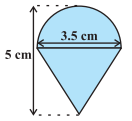
Rasheed got a playing top $(lattu)$ as his birthday present,which surprisingly had no colour on it. He wanted to colour it with his crayons. The top is shaped like a cone surmounted by a hemisphere (see figure). The entire top is $5 \, cm$ in height and the diameter of the top is $3.5 \, cm$. Find the area he has to colour (in $cm^2$). (Take $\pi = \frac{22}{7}$)
A
$39.6$
B
$35.2$
C
$42.9$
D
$30$
Solution
(A) The total surface area to be coloured is the sum of the curved surface area of the hemisphere and the curved surface area of the cone.
Given:
Diameter of the top $= 3.5 \, cm$
Radius $(r) = \frac{3.5}{2} = 1.75 \, cm$
Total height of the top $= 5 \, cm$
Height of the cone $(h) = \text{Total height} - \text{Radius of hemisphere} = 5 - 1.75 = 3.25 \, cm$
Slant height of the cone $(l) = \sqrt{r^2 + h^2} = \sqrt{(1.75)^2 + (3.25)^2} = \sqrt{3.0625 + 10.5625} = \sqrt{13.625} \approx 3.69 \, cm \approx 3.7 \, cm$
Curved surface area of hemisphere $= 2 \pi r^2 = 2 \times \frac{22}{7} \times 1.75 \times 1.75 = 19.25 \, cm^2$
Curved surface area of cone $= \pi r l = \frac{22}{7} \times 1.75 \times 3.7 = 20.35 \, cm^2$
Total area to be coloured $= 19.25 + 20.35 = 39.6 \, cm^2$.
0 likes
View Solution2
MediumMCQ
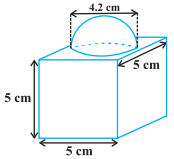
The decorative block shown in the figure is made of two solids - a cube and a hemisphere. The base of the block is a cube with edge $5 \, cm$,and the hemisphere fixed on the top has a diameter of $4.2 \, cm$. Find the total surface area of the block. (in $cm^2$) (Take $\pi = \frac{22}{7}$)
A
$172.56$
B
$163.86$
C
$189.63$
D
$159.82$
Solution
(B) The total surface area of the cube $= 6 \times (\text{edge})^2 = 6 \times 5 \times 5 \, cm^2 = 150 \, cm^2$.
Note that the part of the cube where the hemisphere is attached is not included in the surface area.
So,the surface area of the block $= \text{TSA of cube} - \text{base area of hemisphere} + \text{CSA of hemisphere}$.
$= 150 - \pi r^2 + 2\pi r^2 = (150 + \pi r^2) \, cm^2$.
Given diameter $= 4.2 \, cm$,so radius $r = 2.1 \, cm$.
$= 150 + \left(\frac{22}{7} \times 2.1 \times 2.1\right) \, cm^2$.
$= 150 + (22 \times 0.3 \times 2.1) \, cm^2 = 150 + 13.86 \, cm^2 = 163.86 \, cm^2$.
0 likes
View Solution3
DifficultMCQ
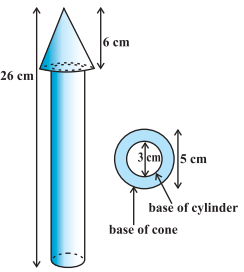
$A$ wooden toy rocket is in the shape of a cone mounted on a cylinder, as shown in the figure. The height of the entire rocket is $26\, cm,$ while the height of the conical part is $6\, cm.$ The base of the conical portion has a diameter of $5\, cm,$ while the base diameter of the cylindrical portion is $3\, cm.$ If the conical portion is to be painted orange and the cylindrical portion yellow, find the area of the rocket painted with each of these colours. (in $cm^2$) (Take $\pi=3.14$)
A
$190.480$
B
$200.055$
C
$195.465$
D
$170.856$
Solution
(C) Let the radius of the cone be $r$, slant height of the cone be $l$, height of the cone be $h$, radius of the cylinder be $r^{\prime}$, and height of the cylinder be $h^{\prime}$.
Given: $r = 2.5\, cm$, $h = 6\, cm$, $r^{\prime} = 1.5\, cm$, and $h^{\prime} = 26 - 6 = 20\, cm$.
The slant height $l = \sqrt{r^2 + h^2} = \sqrt{2.5^2 + 6^2} = \sqrt{6.25 + 36} = \sqrt{42.25} = 6.5\, cm$.
The conical portion has its circular base resting on the base of the cylinder. Since the base of the cone is larger than the base of the cylinder, a ring-shaped area at the base of the cone is also to be painted orange.
Area to be painted orange = ($CSA$ of the cone) + (Base area of the cone - Base area of the cylinder)
$= \pi r l + (\pi r^2 - \pi (r^{\prime})^2)$
$= 3.14 \times 2.5 \times 6.5 + 3.14 \times (2.5^2 - 1.5^2)$
$= 51.025 + 3.14 \times (6.25 - 2.25)$
$= 51.025 + 3.14 \times 4 = 51.025 + 12.56 = 63.585\, cm^2$.
Area to be painted yellow = ($CSA$ of the cylinder) + (Area of the bottom base of the cylinder)
$= 2 \pi r^{\prime} h^{\prime} + \pi (r^{\prime})^2$
$= \pi r^{\prime} (2h^{\prime} + r^{\prime})$
$= 3.14 \times 1.5 \times (2 \times 20 + 1.5)$
$= 4.71 \times 41.5 = 195.465\, cm^2$.
Thus, the area painted orange is $63.585\, cm^2$ and the area painted yellow is $195.465\, cm^2$.
0 likes
View Solution4
DifficultMCQ
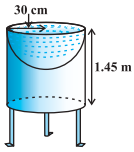
Mayank made a bird-bath for his garden in the shape of a cylinder with a hemispherical depression at one end (see figure). The height of the cylinder is $1.45\, m$ and its radius is $30\, cm$. Find the total surface area of the bird-bath in $m^2$. (Take $\pi = \frac{22}{7}$)
A
$2.1$
B
$4.9$
C
$8.8$
D
$3.3$
Solution
(D) Let $h$ be the height of the cylinder and $r$ be the common radius of the cylinder and the hemisphere.
Given: $h = 1.45\, m = 145\, cm$ and $r = 30\, cm$.
The total surface area of the bird-bath is the sum of the curved surface area of the cylinder and the curved surface area of the hemisphere.
Total Surface Area $= \text{CSA of cylinder} + \text{CSA of hemisphere}$
$= 2\pi rh + 2\pi r^2 = 2\pi r(h + r)$
$= 2 \times \frac{22}{7} \times 30 \times (145 + 30)\, cm^2$
$= 2 \times \frac{22}{7} \times 30 \times 175\, cm^2$
$= 2 \times 22 \times 30 \times 25\, cm^2$
$= 33000\, cm^2$
Since $1\, m^2 = 10000\, cm^2$,we have:
Total Surface Area $= \frac{33000}{10000}\, m^2 = 3.3\, m^2$.
0 likes
View Solution5
MediumMCQ
$2$ cubes each of volume $64 \, cm^3$ are joined end to end. Find the surface area of the resulting cuboid in $cm^2$.
A
$160$
B
$140$
C
$200$
D
$180$
Solution
(A) Given that,the volume of each cube is $64 \, cm^3$.
Let the edge of the cube be $a$.
Then,$a^3 = 64 \, cm^3$.
$a = \sqrt[3]{64} = 4 \, cm$.
When two such cubes are joined end to end,they form a cuboid.
The dimensions of the resulting cuboid are:
Length $(l)$ = $4 \, cm + 4 \, cm = 8 \, cm$
Breadth $(b)$ = $4 \, cm$
Height $(h)$ = $4 \, cm$
The surface area of a cuboid is given by the formula: $2(lb + bh + lh)$.
Surface area = $2(8 \times 4 + 4 \times 4 + 8 \times 4)$
$= 2(32 + 16 + 32)$
$= 2(80)$
$= 160 \, cm^2$.
Thus,the surface area of the resulting cuboid is $160 \, cm^2$.
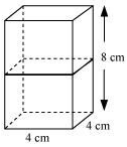
0 likes
View Solution6
MediumMCQ
$A$ vessel is in the form of a hollow hemisphere mounted by a hollow cylinder. The diameter of the hemisphere is $14 \, cm$ and the total height of the vessel is $13 \, cm$. Find the inner surface area of the vessel. [Use $\pi = \frac{22}{7}$] (in $, cm^2$)
A
$600$
B
$572$
C
$720$
D
$441$
Solution
(B) It can be observed that the radius $(r)$ of the cylindrical part and the hemispherical part is the same (i.e.,$7 \, cm$).
Height of the hemispherical part = Radius $= 7 \, cm$.
Height of the cylindrical part $(h) = 13 - 7 = 6 \, cm$.
Inner surface area of the vessel = $CSA$ of the cylindrical part + $CSA$ of the hemispherical part.
Inner surface area $= 2 \pi r h + 2 \pi r^2 = 2 \pi r (h + r)$.
Inner surface area $= 2 \times \frac{22}{7} \times 7 \times (6 + 7)$.
Inner surface area $= 44 \times 13 = 572 \, cm^2$.
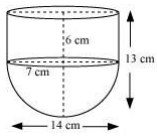
0 likes
View Solution7
MediumMCQ
$A$ toy is in the form of a cone of radius $3.5 \, cm$ mounted on a hemisphere of the same radius. The total height of the toy is $15.5 \, cm$. Find the total surface area of the toy (in $cm^2$). $\left[ \text{Use } \pi = \frac{22}{7} \right]$
A
$200$
B
$220.5$
C
$214.5$
D
$250$
Solution
(C) It can be observed that the radius of the conical part and the hemispherical part is the same (i.e.,$r = 3.5 \, cm = \frac{7}{2} \, cm$).
Height of the hemispherical part = Radius $(r) = 3.5 \, cm = \frac{7}{2} \, cm$.
Height of the conical part $(h) = 15.5 \, cm - 3.5 \, cm = 12 \, cm$.
Slant height $(l)$ of the conical part is given by $l = \sqrt{r^2 + h^2}$.
$l = \sqrt{\left( \frac{7}{2} \right)^2 + (12)^2} = \sqrt{\frac{49}{4} + 144} = \sqrt{\frac{49 + 576}{4}} = \sqrt{\frac{625}{4}} = \frac{25}{2} \, cm = 12.5 \, cm$.
Total surface area of the toy = $CSA$ of the conical part + $CSA$ of the hemispherical part.
Total surface area = $\pi r l + 2 \pi r^2 = \pi r (l + 2r)$.
Total surface area = $\frac{22}{7} \times \frac{7}{2} \times \left( 12.5 + 2 \times 3.5 \right) = 11 \times (12.5 + 7) = 11 \times 19.5 = 214.5 \, cm^2$.
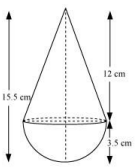
0 likes
View Solution8
MediumMCQ
$A$ cubical block of side $7 \, cm$ is surmounted by a hemisphere. What is the greatest diameter the hemisphere can have? Find the surface area of the solid (in $cm^2$). [Use $\pi = \frac{22}{7}$]
A
$330.1$
B
$337.8$
C
$432.5$
D
$332.5$
Solution
(D) From the figure,it can be observed that the greatest diameter possible for such a hemisphere is equal to the cube's edge,i.e.,$7 \, cm$.
Radius $(r)$ of the hemispherical part $= \frac{7}{2} = 3.5 \, cm$.
Total surface area of the solid $=$ Surface area of the cubical part $+$ $CSA$ of the hemispherical part $-$ Area of the base of the hemispherical part.
Total surface area $= 6(\text{Edge})^2 + 2\pi r^2 - \pi r^2 = 6(\text{Edge})^2 + \pi r^2$.
Total surface area of the solid $= 6(7)^2 + \frac{22}{7} \times 3.5 \times 3.5$.
$= 6(49) + \frac{22}{7} \times \frac{7}{2} \times \frac{7}{2} = 294 + 38.5 = 332.5 \, cm^2$.
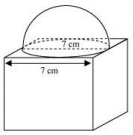
0 likes
View Solution9
Medium
$A$ hemispherical depression is cut out from one face of a cubical wooden block such that the diameter $l$ of the hemisphere is equal to the edge of the cube. Determine the surface area of the remaining solid. $\left[\text{Use } \pi=\frac{22}{7}\right]$
Solution
(N/A) Diameter of hemisphere $=$ Edge of cube $= l$
Radius of hemisphere $r = \frac{l}{2}$
Total surface area of the remaining solid $=$ Total surface area of the cube $+$ Curved surface area of the hemisphere $-$ Area of the circular base of the hemisphere
$= 6(\text{Edge})^2 + 2\pi r^2 - \pi r^2$
$= 6l^2 + \pi r^2$
Substituting $r = \frac{l}{2}$:
$= 6l^2 + \pi \left(\frac{l}{2}\right)^2$
$= 6l^2 + \frac{\pi l^2}{4}$
$= \frac{24l^2 + \pi l^2}{4}$
$= \frac{l^2}{4}(24 + \pi) \text{ unit}^2$

0 likes
View Solution10
DifficultMCQ
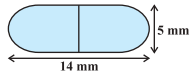
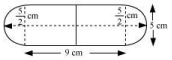
$A$ medicine capsule is in the shape of a cylinder with two hemispheres stuck to each of its ends (see figure). The length of the entire capsule is $14 \, mm$ and the diameter of the capsule is $5 \, mm$. Find its surface area. $\left[ \text{Use } \pi = \frac{22}{7} \right]$ (in $mm^2$)
A
$200$
B
$220$
C
$225$
D
$240$
Solution
(B) It can be observed that:
Radius $(r)$ of the cylindrical part $=$ Radius $(r)$ of the hemispherical part $= \frac{\text{Diameter of the capsule}}{2} = \frac{5}{2} \, mm = 2.5 \, mm$.
Length of the cylindrical part $(h) = \text{Length of the entire capsule} - 2 \times r$
$= 14 \, mm - 2 \times (2.5 \, mm) = 14 \, mm - 5 \, mm = 9 \, mm$.
Surface area of the capsule $= 2 \times \text{CSA of hemispherical part} + \text{CSA of cylindrical part}$
$= 2 \times (2 \pi r^2) + 2 \pi r h$
$= 4 \pi r^2 + 2 \pi r h$
$= 2 \pi r (2r + h)$
$= 2 \times \frac{22}{7} \times 2.5 \times (2 \times 2.5 + 9)$
$= 2 \times \frac{22}{7} \times 2.5 \times (5 + 9)$
$= 2 \times \frac{22}{7} \times 2.5 \times 14$
$= 2 \times 22 \times 2.5 \times 2$
$= 220 \, mm^2$.
0 likes
View Solution11
MediumMCQ
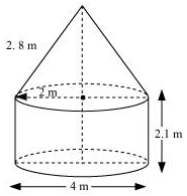
$A$ tent is in the shape of a cylinder surmounted by a conical top. If the height and diameter of the cylindrical part are $2.1 \, m$ and $4 \, m$ respectively,and the slant height of the top is $2.8 \, m$,find the area of the canvas used for making the tent. Also,find the cost of the canvas of the tent at the rate of $Rs. \, 500$ per $m^2$. (in $Rs.$) [Use $\pi = \frac{22}{7}$] (Note that the base of the tent will not be covered with canvas.)
A
$22500$
B
$23000$
C
$22000$
D
$21000$
Solution
(C) Given that,
Height $(h)$ of the cylindrical part $= 2.1 \, m$
Diameter of the cylindrical part $= 4 \, m$
Radius $(r)$ of the cylindrical part $= 2 \, m$
Slant height $(l)$ of the conical part $= 2.8 \, m$
Area of canvas used = $CSA$ of conical part + $CSA$ of cylindrical part
$= \pi rl + 2\pi rh$
$= \pi r(l + 2h)$
$= \frac{22}{7} \times 2 \times (2.8 + 2 \times 2.1)$
$= \frac{44}{7} \times (2.8 + 4.2)$
$= \frac{44}{7} \times 7 = 44 \, m^2$
Cost of $1 \, m^2$ canvas $= Rs. \, 500$
Cost of $44 \, m^2$ canvas $= 44 \times 500 = Rs. \, 22000$
Therefore,the cost of the canvas for making the tent is $Rs. \, 22000$.
0 likes
View Solution12
DifficultMCQ
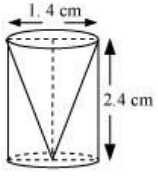
From a solid cylinder whose height is $2.4 \, cm$ and diameter is $1.4 \, cm$,a conical cavity of the same height and same diameter is hollowed out. Find the total surface area of the remaining solid to the nearest $cm^2$. [Take $\pi = \frac{22}{7}$]
A
$16$
B
$20$
C
$12$
D
$18$
Solution
(D) Given that,
Height $(h)$ of the conical part $=$ Height $(h)$ of the cylindrical part $= 2.4 \, cm$
Diameter of the cylindrical part $= 1.4 \, cm$
Therefore,radius $(r)$ of the cylindrical part $= 0.7 \, cm$
Slant height $(l)$ of the conical part $= \sqrt{r^2 + h^2}$
$= \sqrt{(0.7)^2 + (2.4)^2} = \sqrt{0.49 + 5.76}$
$= \sqrt{6.25} = 2.5 \, cm$
Total surface area of the remaining solid $= \text{CSA of cylindrical part} + \text{CSA of conical part} + \text{Area of cylindrical base}$
$= 2 \pi rh + \pi rl + \pi r^2$
$= 2 \times \frac{22}{7} \times 0.7 \times 2.4 + \frac{22}{7} \times 0.7 \times 2.5 + \frac{22}{7} \times 0.7 \times 0.7$
$= 4.4 \times 2.4 + 2.2 \times 2.5 + 2.2 \times 0.7$
$= 10.56 + 5.50 + 1.54 = 17.60 \, cm^2$
The total surface area of the remaining solid to the nearest $cm^2$ is $18 \, cm^2$.
0 likes
View Solution13
MediumMCQ
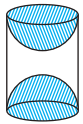
$A$ wooden article was made by scooping out a hemisphere from each end of a solid cylinder,as shown in the figure. If the height of the cylinder is $10 \, cm$ and its base radius is $3.5 \, cm$,find the total surface area of the article (in $cm^2$).
A
$374$
B
$350$
C
$360$
D
$395$
Solution
(A) Given that,
Radius $(r)$ of the cylindrical part $=$ Radius $(r)$ of the hemispherical part $= 3.5 \, cm$.
Height of the cylindrical part $(h) = 10 \, cm$.
The total surface area of the article is the sum of the curved surface area of the cylinder and the curved surface areas of the two hemispheres.
Total Surface Area $= \text{CSA of cylinder} + 2 \times \text{CSA of hemisphere}$
$= 2 \pi r h + 2 \times (2 \pi r^2)$
$= 2 \pi r h + 4 \pi r^2$
$= 2 \pi r (h + 2r)$
$= 2 \times \frac{22}{7} \times 3.5 \times (10 + 2 \times 3.5)$
$= 2 \times \frac{22}{7} \times 3.5 \times (10 + 7)$
$= 2 \times \frac{22}{7} \times 3.5 \times 17$
$= 44 \times 0.5 \times 17$
$= 22 \times 17 = 374 \, cm^2$.
0 likes
View Solution14
Easy
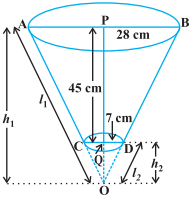
The radii of the ends of a frustum of a cone $45\, cm$ high are $28\, cm$ and $7\, cm$ (see figure). Find its volume,the curved surface area,and the total surface area (Take $\pi=\frac{22}{7}$).
Solution
(N/A) $(i)$ Volume of the frustum $= \frac{1}{3} \pi h (r_{1}^{2} + r_{2}^{2} + r_{1} r_{2})$
$= \frac{1}{3} \cdot \frac{22}{7} \cdot 45 \cdot [(28)^{2} + (7)^{2} + (28)(7)] \, cm^{3}$
$= \frac{1}{3} \cdot \frac{22}{7} \cdot 45 \cdot [784 + 49 + 196] \, cm^{3}$
$= \frac{1}{3} \cdot \frac{22}{7} \cdot 45 \cdot 1029 \, cm^{3} = 48510 \, cm^{3}$
$(ii)$ Slant height $l = \sqrt{h^{2} + (r_{1} - r_{2})^{2}} = \sqrt{(45)^{2} + (28 - 7)^{2}} \, cm$
$= \sqrt{2025 + (21)^{2}} = \sqrt{2025 + 441} = \sqrt{2466} \approx 49.66 \, cm$
Curved surface area $= \pi (r_{1} + r_{2}) l = \frac{22}{7} (28 + 7) (49.66) = \frac{22}{7} \cdot 35 \cdot 49.66 = 110 \cdot 49.66 = 5462.6 \, cm^{2}$
$(iii)$ Total surface area $= \pi (r_{1} + r_{2}) l + \pi r_{1}^{2} + \pi r_{2}^{2}$
$= 5462.6 + \frac{22}{7} (28)^{2} + \frac{22}{7} (7)^{2}$
$= 5462.6 + 2464 + 154 = 8080.6 \, cm^{2}$
0 likes
View Solution15
Difficult
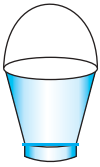
An open metal bucket is in the shape of a frustum of a cone,mounted on a hollow cylindrical base made of the same metallic sheet (see figure). The diameters of the two circular ends of the bucket are $45 \, cm$ and $25 \, cm$,the total vertical height of the bucket is $40 \, cm$ and that of the cylindrical base is $6 \, cm$. Find the area of the metallic sheet used to make the bucket,where we do not take into account the handle of the bucket. Also,find the volume of water the bucket can hold. (Take $\pi = \frac{22}{7}$)
Solution
(N/A) The total height of the bucket is $40 \, cm$,which includes the height of the base. So,the height of the frustum of the cone is $h = 40 - 6 = 34 \, cm$.
The radii are $r_1 = \frac{45}{2} = 22.5 \, cm$ and $r_2 = \frac{25}{2} = 12.5 \, cm$.
The slant height of the frustum is $l = \sqrt{h^2 + (r_1 - r_2)^2} = \sqrt{34^2 + (22.5 - 12.5)^2} = \sqrt{1156 + 100} = \sqrt{1256} \approx 35.44 \, cm$.
The area of the metallic sheet used is the sum of the curved surface area of the frustum,the area of the circular base (bottom),and the curved surface area of the cylindrical base.
Area $= \pi l(r_1 + r_2) + \pi r_2^2 + 2 \pi r_2 h_{base}$
$= \frac{22}{7} \times 35.44 \times (22.5 + 12.5) + \frac{22}{7} \times (12.5)^2 + 2 \times \frac{22}{7} \times 12.5 \times 6$
$= \frac{22}{7} \times (1240.4 + 156.25 + 150) = \frac{22}{7} \times 1546.65 \approx 4860.9 \, cm^2$.
The volume of water the bucket can hold is the volume of the frustum:
$V = \frac{1}{3} \pi h (r_1^2 + r_2^2 + r_1 r_2)$
$= \frac{1}{3} \times \frac{22}{7} \times 34 \times (22.5^2 + 12.5^2 + 22.5 \times 12.5)$
$= \frac{1}{3} \times \frac{22}{7} \times 34 \times (506.25 + 156.25 + 281.25) = \frac{1}{3} \times \frac{22}{7} \times 34 \times 943.75 \approx 33615.48 \, cm^3$.
0 likes
View Solution16
EasyMCQ
$A$ funnel (see figure) is the combination of

A
frustum of a cone and a cylinder
B
a cone and a cylinder
C
a hemisphere and a cylinder
D
a hemisphere and a cone
Solution
(B) By observing the figure,we can see that the upper part of the funnel is in the shape of a cone (specifically,a conical part) and the lower part is in the shape of a cylinder.
Therefore,a funnel is a combination of a cone and a cylinder.
Therefore,a funnel is a combination of a cone and a cylinder.
0 likes
View Solution17
EasyMCQ
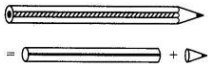
$A$ cylindrical pencil sharpened at one edge is the combination of
A
frustum of a cone and a cylinder
B
a cone and a cylinder
C
a hemisphere and a cylinder
D
two cylinders.
Solution
(B) sharpened pencil consists of a long cylindrical body and a conical tip at one end.
Therefore,the shape of a sharpened pencil is the combination of a cylinder and a cone.
Thus,the correct option is $B$.
Therefore,the shape of a sharpened pencil is the combination of a cylinder and a cone.
Thus,the correct option is $B$.
0 likes
View Solution18
EasyMCQ
$A$ surahi is the combination of
A
two hemispheres
B
a cylinder and a cone
C
a sphere and a cylinder
D
a hemisphere and a cylinder
Solution
(C) By observing the given figure,a surahi is formed by joining a spherical body with a cylindrical neck.
Therefore,a surahi is the combination of a sphere and a cylinder.
Therefore,a surahi is the combination of a sphere and a cylinder.
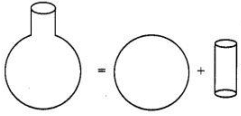
0 likes
View Solution19
EasyMCQ
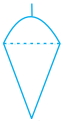
$A$ plumbline (sahul) is the combination of (see figure):
A
a cone and a cylinder
B
frustum of a cone and a cylinder
C
sphere and cylinder
D
a hemisphere and a cone
Solution
(D) By observing the given figure,it is clear that the plumbline is formed by joining the base of a hemisphere to the base of a cone.
Therefore,the plumbline is a combination of a hemisphere and a cone.
Therefore,the plumbline is a combination of a hemisphere and a cone.
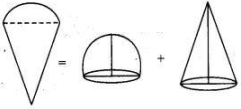
0 likes
View Solution20
EasyMCQ
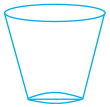
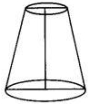
The shape of a glass (tumbler) (see figure) is usually in the form of:
A
frustum of a cone
B
a cone
C
a cylinder
D
a sphere
Solution
(A) glass (tumbler) is typically wider at the top and narrower at the bottom,with two circular bases of different radii.
This geometric shape,which is obtained by cutting a cone with a plane parallel to its base,is known as the frustum of a cone.
Therefore,the shape of a glass is in the form of a frustum of a cone.
This geometric shape,which is obtained by cutting a cone with a plane parallel to its base,is known as the frustum of a cone.
Therefore,the shape of a glass is in the form of a frustum of a cone.
0 likes
View Solution21
EasyMCQ
The shape of a gilli,in the gilli-danda game (see figure),is a combination of
A
two cylinders
B
two cones and a cylinder
C
a cone and a cylinder
D
two cylinders and a cone
Solution
(B) By observing the figure,the gilli consists of a central cylindrical part with two conical ends attached to its circular faces.
Therefore,the shape is a combination of:
$=$ Cone $+$ Cylinder $+$ Cone
$=$ Two cones and a cylinder
Therefore,the shape is a combination of:
$=$ Cone $+$ Cylinder $+$ Cone
$=$ Two cones and a cylinder

0 likes
View Solution22
EasyMCQ
$A$ shuttlecock used for playing badminton has the shape of the combination of
A
a cylinder and a sphere
B
a cylinder and a hemisphere
C
frustum of a cone and a hemisphere
D
a sphere and a cone
Solution
(C) The shape of a shuttlecock consists of two parts:
$1$. The cork part,which is in the shape of a hemisphere.
$2$. The feathered part,which is in the shape of a frustum of a cone.
Therefore,the shuttlecock is a combination of a frustum of a cone and a hemisphere.
$1$. The cork part,which is in the shape of a hemisphere.
$2$. The feathered part,which is in the shape of a frustum of a cone.
Therefore,the shuttlecock is a combination of a frustum of a cone and a hemisphere.
0 likes
View Solution23
MediumMCQ
The radii of the top and bottom of a bucket of slant height $45 \, cm$ are $28 \, cm$ and $7 \, cm$,respectively. The curved surface area of the bucket is (in $cm^2$)
A
$4951$
B
$4950$
C
$4952$
D
$4953$
Solution
(B) Given,the radius of the top of the bucket,$R = 28 \, cm$.
The radius of the bottom of the bucket,$r = 7 \, cm$.
The slant height of the bucket,$l = 45 \, cm$.
Since the bucket is in the form of a frustum of a cone,the curved surface area is given by the formula:
$\text{Curved Surface Area} = \pi l (R + r)$
Substituting the given values:
$\text{Curved Surface Area} = \frac{22}{7} \times 45 \times (28 + 7)$
$= \frac{22}{7} \times 45 \times 35$
$= 22 \times 45 \times 5$
$= 22 \times 225 = 4950 \, cm^2$.
Thus,the curved surface area of the bucket is $4950 \, cm^2$.
0 likes
View Solution24
EasyMCQ
If two solid hemispheres of same base radius $r$ are joined together along their bases, then the curved surface area of this new solid is (in $\pi r^{2}$)
A
$8$
B
$3$
C
$6$
D
$4$
Solution
(D) The curved surface area of a single solid hemisphere is given by $2 \pi r^{2}$.
When two solid hemispheres of the same base radius $r$ are joined together along their circular bases, they form a complete solid sphere.
The curved surface area of the resulting solid sphere is the sum of the curved surface areas of the two individual hemispheres.
Therefore, the curved surface area of the new solid $= 2 \pi r^{2} + 2 \pi r^{2} = 4 \pi r^{2}$.
0 likes
View Solution25
EasyMCQ
$A$ right circular cylinder of radius $r \, cm$ and height $h \, cm$ (where $h > 2r$) just encloses a sphere. What is the diameter of the sphere (in $cm$)?
A
$2r$
B
$r$
C
$h$
D
$2h$
Solution
(A) sphere is enclosed in a right circular cylinder such that it touches the top,bottom,and the curved surface of the cylinder.
Since the sphere touches the curved surface of the cylinder,the diameter of the sphere must be equal to the diameter of the cylinder.
The radius of the cylinder is given as $r \, cm$,so the diameter of the cylinder is $2r \, cm$.
Therefore,the diameter of the sphere is $2r \, cm$.
Since the sphere touches the curved surface of the cylinder,the diameter of the sphere must be equal to the diameter of the cylinder.
The radius of the cylinder is given as $r \, cm$,so the diameter of the cylinder is $2r \, cm$.
Therefore,the diameter of the sphere is $2r \, cm$.
0 likes
View Solution26
EasyMCQ
In a right circular cone,the cross-section made by a plane parallel to the base is a
A
circle
B
sphere
C
hemisphere
D
frustum of a cone
Solution
(A) right circular cone is a solid generated by the revolution of a right-angled triangle about one of its sides containing the right angle.
When a plane cuts a right circular cone parallel to its base,the resulting cross-section is always a circle.
Note that the portion of the cone between the base and the plane is called the frustum of the cone,but the cross-section itself is a circle.
When a plane cuts a right circular cone parallel to its base,the resulting cross-section is always a circle.
Note that the portion of the cone between the base and the plane is called the frustum of the cone,but the cross-section itself is a circle.
0 likes
View Solution27
Easy
Write 'True' or 'False' and justify your answer:
If a solid cone of base radius $r$ and height $h$ is placed over a solid cylinder having the same base radius and height as that of the cone,then the curved surface area of the shape is $\pi r \sqrt{h^{2} + r^{2}} + 2 \pi r h$.
If a solid cone of base radius $r$ and height $h$ is placed over a solid cylinder having the same base radius and height as that of the cone,then the curved surface area of the shape is $\pi r \sqrt{h^{2} + r^{2}} + 2 \pi r h$.
Solution
(A) True.
The curved surface area of the combined shape is the sum of the curved surface area of the cone and the curved surface area of the cylinder.
The curved surface area of a cone is given by $\pi r l$,where $l = \sqrt{h^{2} + r^{2}}$ is the slant height.
Thus,the curved surface area of the cone is $\pi r \sqrt{h^{2} + r^{2}}$.
The curved surface area of a cylinder is $2 \pi r h$.
Therefore,the total curved surface area of the combined shape is $\pi r \sqrt{h^{2} + r^{2}} + 2 \pi r h$.
0 likes
View Solution28
EasyMCQ
Write 'True' or 'False' and justify your answer:
Two identical solid cubes of side $a$ are joined end to end. Then the total surface area of the resulting cuboid is $12 a^{2}$.
Two identical solid cubes of side $a$ are joined end to end. Then the total surface area of the resulting cuboid is $12 a^{2}$.
A
True
B
False
Solution
(B) False.
The total surface area of a single cube with side $a$ is $6 a^{2}$.
When two such identical cubes are joined end to end,two faces (each of area $a^{2}$) are hidden inside the resulting cuboid.
The dimensions of the resulting cuboid are length $l = 2a$,breadth $b = a$,and height $h = a$.
The total surface area of a cuboid is given by the formula $2(lb + bh + hl)$.
Substituting the values: $2((2a \times a) + (a \times a) + (a \times 2a)) = 2(2a^{2} + a^{2} + 2a^{2}) = 2(5a^{2}) = 10 a^{2}$.
Therefore,the statement is false.
0 likes
View Solution29
Easy
Write 'True' or 'False' and justify your answer:
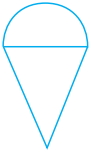
Total surface area of a lattu (top) as shown in the $Fig.$ is the sum of total surface area of hemisphere and the total surface area of cone.
Total surface area of a lattu (top) as shown in the $Fig.$ is the sum of total surface area of hemisphere and the total surface area of cone.
Solution
(FALSE) False.
The total surface area of the lattu (top) is the sum of the curved surface area of the hemisphere and the curved surface area of the cone.
This is because the circular base of the hemisphere and the circular base of the cone are joined together and are not exposed to the outside. Therefore,they are not included in the total surface area of the combined solid.
0 likes
View Solution30
EasyMCQ
Write 'True' or 'False' and justify your answer:
Two identical solid hemispheres of equal base radius $r \text{ cm}$ are joined together along their bases. The total surface area of the resulting solid is $6 \pi r^{2}$.
Two identical solid hemispheres of equal base radius $r \text{ cm}$ are joined together along their bases. The total surface area of the resulting solid is $6 \pi r^{2}$.
A
True
B
False
Solution
(B) False.
The curved surface area of one hemisphere is $2 \pi r^{2}$.
When two identical solid hemispheres are joined together along their circular bases,the bases are hidden inside the new solid.
Therefore,the total surface area of the resulting solid consists only of the two curved surfaces.
Total surface area $= 2 \pi r^{2} + 2 \pi r^{2} = 4 \pi r^{2}$.
Since $4 \pi r^{2} \neq 6 \pi r^{2}$,the statement is False.
0 likes
View Solution31
Easy
Write 'True' or 'False' and justify your answer:
$A$ solid cylinder of radius $r$ and height $h$ is placed over another cylinder of the same height and radius. The total surface area of the shape so formed is $4 \pi r h + 4 \pi r^2$.
$A$ solid cylinder of radius $r$ and height $h$ is placed over another cylinder of the same height and radius. The total surface area of the shape so formed is $4 \pi r h + 4 \pi r^2$.
Solution
(B) False.
The total surface area of a single cylinder with radius $r$ and height $h$ is given by $2 \pi rh + 2 \pi r^2$.
When one cylinder is placed on top of another cylinder of the same radius and height,the two circular faces (one from each cylinder) are hidden at the point of contact.
The new shape is a single cylinder with radius $r$ and total height $H = 2h$.
The total surface area of this new cylinder is the sum of its curved surface area and the areas of its two circular bases.
Total Surface Area $= 2 \pi r H + 2 \pi r^2 = 2 \pi r(2h) + 2 \pi r^2 = 4 \pi rh + 2 \pi r^2$.
Since $4 \pi rh + 2 \pi r^2 \neq 4 \pi rh + 4 \pi r^2$,the given statement is False.
0 likes
View Solution32
Medium
Write 'True' or 'False' and justify your answer:
$A$ solid cone of radius $r$ and height $h$ is placed over a solid cylinder having the same base radius and height as that of the cone. The total surface area of the combined solid is $\pi[\sqrt{r^{2}+h^{2}}+3r+2h]$.
$A$ solid cone of radius $r$ and height $h$ is placed over a solid cylinder having the same base radius and height as that of the cone. The total surface area of the combined solid is $\pi[\sqrt{r^{2}+h^{2}}+3r+2h]$.
Solution
(B) False.
The total surface area of the combined solid is the sum of the curved surface area of the cone,the curved surface area of the cylinder,and the area of the bottom base of the cylinder.
$1$. Curved surface area of the cone = $\pi r l$,where slant height $l = \sqrt{r^2 + h^2}$.
$2$. Curved surface area of the cylinder = $2\pi rh$.
$3$. Area of the bottom base of the cylinder = $\pi r^2$.
Total surface area = $\pi r l + 2\pi rh + \pi r^2$
$= \pi r (l + 2h + r)$
$= \pi r [\sqrt{r^2 + h^2} + 2h + r]$.
Since the calculated expression $\pi r [\sqrt{r^2 + h^2} + 2h + r]$ is not equal to the given expression $\pi [\sqrt{r^2 + h^2} + 3r + 2h]$,the statement is False.
0 likes
View Solution33
EasyMCQ
Write 'True' or 'False' and justify your answer:
The curved surface area of a frustum of a cone is $\pi l(r_{1}+r_{2})$,where $l = \sqrt{h^{2}+(r_{1}+r_{2})^{2}}$,$r_{1}$ and $r_{2}$ are the radii of the two ends of the frustum,and $h$ is the vertical height.
The curved surface area of a frustum of a cone is $\pi l(r_{1}+r_{2})$,where $l = \sqrt{h^{2}+(r_{1}+r_{2})^{2}}$,$r_{1}$ and $r_{2}$ are the radii of the two ends of the frustum,and $h$ is the vertical height.
A
True
B
False
C
Cannot be determined
D
None of the above
Solution
(B) The statement is False.
The curved surface area of a frustum of a cone is given by the formula $A = \pi l(r_{1} + r_{2})$.
In this formula,the slant height $l$ is defined as $l = \sqrt{h^{2} + (r_{1} - r_{2})^{2}}$,where $h$ is the vertical height,and $r_{1}$ and $r_{2}$ are the radii of the two circular ends.
The given expression for the slant height $l = \sqrt{h^{2} + (r_{1} + r_{2})^{2}}$ is incorrect because it uses the sum of the radii instead of the difference of the radii.
0 likes
View Solution34
Easy
Write 'True' or 'False' and justify your answer:
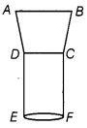
An open metallic bucket is in the shape of a frustum of a cone,mounted on a hollow cylindrical base made of the same metallic sheet. The surface area of the metallic sheet used is equal to curved surface area of frustum of a cone + area of circular base + curved surface area of cylinder.
An open metallic bucket is in the shape of a frustum of a cone,mounted on a hollow cylindrical base made of the same metallic sheet. The surface area of the metallic sheet used is equal to curved surface area of frustum of a cone + area of circular base + curved surface area of cylinder.
Solution
(A) True.
The total surface area of the metallic sheet used is the sum of the areas of the individual parts that make up the object.
$1$. The bucket is a frustum of a cone $(ABCD)$,so we include its curved surface area.
$2$. The bucket has a circular base at the bottom of the frustum,which is also the top of the cylinder. However,since the bucket is open and mounted on a cylinder,the metallic sheet used includes the curved surface of the frustum,the curved surface of the cylinder,and the circular base at the bottom of the cylinder $(EF)$.
$3$. The area of the metallic sheet = (Curved surface area of frustum of a cone) + (Curved surface area of cylinder) + (Area of the circular base at the bottom).
As shown in the figure,$ABCD$ is a frustum of a cone and $CDEF$ is a hollow cylinder.
0 likes
View Solution35
Medium
$A$ cone of maximum size is carved out from a cube of edge $14 \, cm$. Find the surface area of the cone and the surface area of the remaining solid left after the cone is carved out.
Solution
(N/A) The cone of maximum size carved out from a cube of edge $14 \, cm$ will have a base radius $r = 7 \, cm$ and height $h = 14 \, cm$.
The slant height $l = \sqrt{r^2 + h^2} = \sqrt{7^2 + 14^2} = \sqrt{49 + 196} = \sqrt{245} = 7\sqrt{5} \, cm$.
Surface area of the cone $= \pi r l + \pi r^2 = \frac{22}{7} \times 7 \times 7\sqrt{5} + \frac{22}{7} \times 7^2 = 154\sqrt{5} + 154 = 154(\sqrt{5} + 1) \, cm^2$.
Surface area of the cube $= 6 \times (14)^2 = 6 \times 196 = 1176 \, cm^2$.
When the cone is carved out,the circular base of the cone is removed from one face of the cube,but the curved surface area of the cone is added to the total surface area.
Surface area of the remaining solid $= (\text{Total surface area of cube}) - (\text{Area of circular base of cone}) + (\text{Curved surface area of cone})$.
$= 1176 - \pi r^2 + \pi r l = 1176 - 154 + 154\sqrt{5} = (1022 + 154\sqrt{5}) \, cm^2$.
0 likes
View Solution36
MediumMCQ
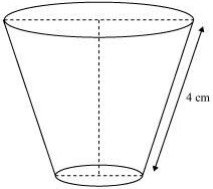
The slant height of a frustum of a cone is $4 \,cm$ and the perimeters (circumference) of its circular ends are $18 \,cm$ and $6 \,cm$. Find the curved surface area of the frustum in $cm^2$.
A
$96$
B
$48$
C
$21$
D
$46$
Solution
(B) Let the radii of the circular ends of the frustum be $r_1$ and $r_2$ respectively.
Given that the perimeters of the circular ends are $18 \,cm$ and $6 \,cm$.
So,$2 \pi r_1 = 18 \implies r_1 = \frac{9}{\pi} \,cm$.
And $2 \pi r_2 = 6 \implies r_2 = \frac{3}{\pi} \,cm$.
The slant height $(l)$ of the frustum is given as $4 \,cm$.
The formula for the curved surface area $(CSA)$ of a frustum of a cone is $CSA = \pi (r_1 + r_2) l$.
Substituting the values:
$CSA = \pi \left( \frac{9}{\pi} + \frac{3}{\pi} \right) \times 4$
$CSA = \pi \left( \frac{12}{\pi} \right) \times 4$
$CSA = 12 \times 4 = 48 \,cm^2$.
Thus,the curved surface area of the frustum is $48 \,cm^2$.
0 likes
View Solution37
Medium
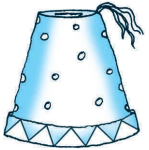
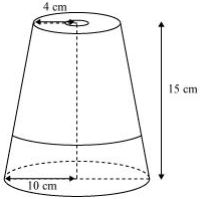
$A$ fez,the cap used by the Turks,is shaped like the frustum of a cone (see $Fig.$). If its radius on the open side is $10 \, cm$,radius at the upper base is $4 \, cm$ and its slant height is $15 \, cm$,find the area of material used for making it.
Solution
(N/A) Radius $(r_2)$ at the upper circular end $= 4 \, cm$.
Radius $(r_1)$ at the lower circular end $= 10 \, cm$.
Slant height $(l)$ of the frustum $= 15 \, cm$.
Area of material used for making the fez $=$ $CSA$ of the frustum $+$ Area of the upper circular end.
Area $= \pi(r_1 + r_2)l + \pi r_2^2$.
Area $= \pi(10 + 4) \times 15 + \pi(4)^2$.
Area $= \pi(14) \times 15 + 16\pi$.
Area $= 210\pi + 16\pi = 226\pi$.
Using $\pi = \frac{22}{7}$,Area $= 226 \times \frac{22}{7} = \frac{4972}{7} \, cm^2$.
Area $= 710 \frac{2}{7} \, cm^2$.
Therefore,the area of material used for making it is $710 \frac{2}{7} \, cm^2$.
0 likes
View Solution38
Medium
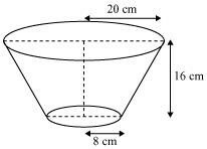
$A$ container,opened from the top and made up of a metal sheet,is in the form of a frustum of a cone of height $16 \, cm$ with radii of its lower and upper ends as $8 \, cm$ and $20 \, cm$,respectively. Find the cost of the milk which can completely fill the container,at the rate of $Rs. \, 20$ per litre. Also,find the cost of the metal sheet used to make the container,if it costs $Rs. \, 8$ per $100 \, cm^2$. (Take $\pi = 3.14$)
Solution
(N/A) Radius $(r_1)$ of upper end of container $= 20 \, cm$
Radius $(r_2)$ of lower end of container $= 8 \, cm$
Height $(h)$ of container $= 16 \, cm$
Slant height $(l)$ of frustum $= \sqrt{(r_1 - r_2)^2 + h^2} = \sqrt{(20 - 8)^2 + 16^2} = \sqrt{12^2 + 16^2} = \sqrt{144 + 256} = \sqrt{400} = 20 \, cm$
Capacity of container $=$ Volume of frustum $= \frac{1}{3} \pi h (r_1^2 + r_2^2 + r_1 r_2)$
$= \frac{1}{3} \times 3.14 \times 16 \times (20^2 + 8^2 + 20 \times 8) = \frac{1}{3} \times 3.14 \times 16 \times (400 + 64 + 160) = \frac{1}{3} \times 3.14 \times 16 \times 624 = 10449.92 \, cm^3 = 10.44992 \, litres \approx 10.45 \, litres$
Cost of $1 \, litre$ milk $= Rs. \, 20$
Cost of $10.45 \, litres$ milk $= 10.45 \times 20 = Rs. \, 209$
Area of metal sheet used $= \pi (r_1 + r_2) l + \pi r_2^2 = 3.14 \times (20 + 8) \times 20 + 3.14 \times 8^2 = 3.14 \times 28 \times 20 + 3.14 \times 64 = 1758.4 + 200.96 = 1959.36 \, cm^2$
Cost of $100 \, cm^2$ metal sheet $= Rs. \, 8$
Cost of $1959.36 \, cm^2$ metal sheet $= \frac{1959.36 \times 8}{100} = Rs. \, 156.7488 \approx Rs. \, 156.75$
Therefore,the cost of the milk is $Rs. \, 209$ and the cost of the metal sheet is $Rs. \, 156.75$.
0 likes
View Solution39
DifficultMCQ
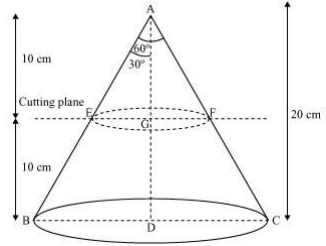
$A$ metallic right circular cone $20 \, cm$ high and whose vertical angle is $60^{\circ}$ is cut into two parts at the middle of its height by a plane parallel to its base. If the frustum so obtained is drawn into a wire of diameter $\frac{1}{16} \, cm$,find the length of the wire in meters. [Use $\pi = \frac{22}{7}$]
A
$7964.44$
B
$8000.32$
C
$1024$
D
$2200.9$
Solution
(A) In $\triangle AEG$,$\frac{EG}{AG} = \tan 30^{\circ}$. Since $AG = 10 \, cm$,$EG = 10 \tan 30^{\circ} = \frac{10}{\sqrt{3}} \, cm$. This is the radius $r_1$ of the top of the frustum.
In $\triangle ABD$,$\frac{BD}{AD} = \tan 30^{\circ}$. Since $AD = 20 \, cm$,$BD = 20 \tan 30^{\circ} = \frac{20}{\sqrt{3}} \, cm$. This is the radius $r_2$ of the base of the frustum.
The height $h$ of the frustum is $10 \, cm$.
The volume of the frustum is $V = \frac{1}{3} \pi h (r_1^2 + r_2^2 + r_1 r_2)$.
$V = \frac{1}{3} \times \frac{22}{7} \times 10 \left[ \left( \frac{10}{\sqrt{3}} \right)^2 + \left( \frac{20}{\sqrt{3}} \right)^2 + \left( \frac{10}{\sqrt{3}} \times \frac{20}{\sqrt{3}} \right) \right]$
$V = \frac{220}{21} \left[ \frac{100}{3} + \frac{400}{3} + \frac{200}{3} \right] = \frac{220}{21} \times \frac{700}{3} = \frac{22000}{9} \, cm^3$.
The wire has a radius $r = \frac{1}{32} \, cm$. Let its length be $l$.
Volume of wire = $\pi r^2 l = \frac{22}{7} \times \left( \frac{1}{32} \right)^2 \times l$.
Equating volumes: $\frac{22000}{9} = \frac{22}{7} \times \frac{1}{1024} \times l$.
$l = \frac{22000}{9} \times \frac{7 \times 1024}{22} = \frac{1000 \times 7168}{9} = \frac{7168000}{9} \approx 796444.44 \, cm$.
Converting to meters: $l = 7964.44 \, m$.
0 likes
View Solution40
MediumMCQ
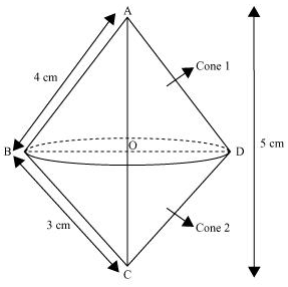
$A$ right triangle,whose sides are $3\, cm$ and $4\, cm$ (other than the hypotenuse) is made to revolve about its hypotenuse. Find the surface area of the double cone so formed. (Use $\pi = 3.14$) (in $cm^2$)
A
$30.14$
B
$2.4$
C
$52.75$
D
$75.75$
Solution
(C) Let the right triangle be $ABC$ with sides $AB = 3\, cm$,$BC = 4\, cm$,and $\angle B = 90^\circ$.
Hypotenuse $AC = \sqrt{3^2 + 4^2} = \sqrt{9 + 16} = \sqrt{25} = 5\, cm$.
When the triangle is revolved about the hypotenuse $AC$,a double cone is formed where the radius $r$ of the common base is the altitude $OB$ of the triangle $ABC$ to the hypotenuse $AC$.
Area of $\triangle ABC = \frac{1}{2} \times AB \times BC = \frac{1}{2} \times 3 \times 4 = 6\, cm^2$.
Also,Area of $\triangle ABC = \frac{1}{2} \times AC \times OB = \frac{1}{2} \times 5 \times OB$.
So,$\frac{1}{2} \times 5 \times OB = 6 \implies OB = \frac{12}{5} = 2.4\, cm$.
The surface area of the double cone is the sum of the curved surface areas of the two cones: $S = \pi r l_1 + \pi r l_2$,where $l_1 = AB = 3\, cm$ and $l_2 = BC = 4\, cm$.
$S = \pi r (l_1 + l_2) = 3.14 \times 2.4 \times (3 + 4) = 3.14 \times 2.4 \times 7 = 52.752\, cm^2 \approx 52.75\, cm^2$.
0 likes
View Solution41
Medium
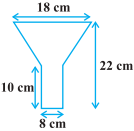
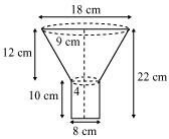
An oil funnel made of a tin sheet consists of a $10 \, cm$ long cylindrical portion attached to a frustum of a cone. If the total height is $22 \, cm$,the diameter of the cylindrical portion is $8 \, cm$,and the diameter of the top of the funnel is $18 \, cm$,find the area of the tin sheet required to make the funnel.
Solution
(N/A) Radius $(r_1)$ of the upper circular end of the frustum part $= \frac{18}{2} = 9 \, cm$.
Radius $(r_2)$ of the lower circular end of the frustum part $=$ Radius of the circular end of the cylindrical part $= \frac{8}{2} = 4 \, cm$.
Height $(h_1)$ of the frustum part $= 22 - 10 = 12 \, cm$.
Height $(h_2)$ of the cylindrical part $= 10 \, cm$.
Slant height $(l)$ of the frustum part $= \sqrt{(r_1 - r_2)^2 + h_1^2} = \sqrt{(9 - 4)^2 + (12)^2} = \sqrt{5^2 + 12^2} = \sqrt{25 + 144} = \sqrt{169} = 13 \, cm$.
Area of the tin sheet required $=$ Curved Surface Area $(CSA)$ of the frustum part $+$ $CSA$ of the cylindrical part.
Area $= \pi(r_1 + r_2)l + 2\pi r_2 h_2$.
Area $= \frac{22}{7} \times (9 + 4) \times 13 + 2 \times \frac{22}{7} \times 4 \times 10$.
Area $= \frac{22}{7} \times 13 \times 13 + \frac{22}{7} \times 80$.
Area $= \frac{22}{7} \times (169 + 80) = \frac{22}{7} \times 249 = \frac{5478}{7} \, cm^2$.
Area $= 782 \frac{4}{7} \, cm^2$.
0 likes
View Solution42
Difficult
Derive the formula for the curved surface area and total surface area of the frustum of a cone.
Solution
(N/A) Let $ABC$ be a cone. $A$ frustum $DECB$ is obtained by cutting the cone with a plane parallel to its base. Let $r_{1}$ and $r_{2}$ be the radii of the circular ends of the frustum,$h$ be the height of the frustum,and $l$ be the slant height of the frustum.
In $\triangle ABG$ and $\triangle ADF$,since $DF \parallel BG$,by the property of similar triangles:
$\triangle ABG \sim \triangle ADF$
Therefore,$\frac{DF}{BG} = \frac{AF}{AG} = \frac{AD}{AB}$
Let $h_{1}$ be the height of the full cone $ABC$ and $l_{1}$ be its slant height.
$\frac{r_{2}}{r_{1}} = \frac{h_{1}-h}{h_{1}} = \frac{l_{1}-l}{l_{1}}$
From $\frac{r_{2}}{r_{1}} = 1 - \frac{l}{l_{1}}$,we get $\frac{l}{l_{1}} = 1 - \frac{r_{2}}{r_{1}} = \frac{r_{1}-r_{2}}{r_{1}}$
So,$l_{1} = \frac{r_{1}l}{r_{1}-r_{2}}$ and $(l_{1}-l) = \frac{r_{2}l}{r_{1}-r_{2}}$
Curved Surface Area $(CSA)$ of frustum $DECB$ = $CSA$ of cone $ABC$ - $CSA$ of cone $ADE$
$CSA = \pi r_{1}l_{1} - \pi r_{2}(l_{1}-l)$
$CSA = \pi r_{1} \left( \frac{r_{1}l}{r_{1}-r_{2}} \right) - \pi r_{2} \left( \frac{r_{2}l}{r_{1}-r_{2}} \right)$
$CSA = \frac{\pi l (r_{1}^{2} - r_{2}^{2})}{r_{1}-r_{2}} = \pi l (r_{1} + r_{2})$
Total Surface Area $(TSA)$ = $CSA$ + Area of upper circular end + Area of lower circular end
$TSA = \pi (r_{1} + r_{2})l + \pi r_{1}^{2} + \pi r_{2}^{2}$

0 likes
View Solution43
MediumMCQ
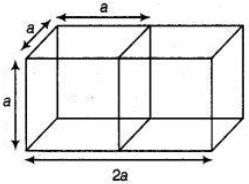
Two identical cubes each of volume $64 \, cm^{3}$ are joined together end to end. What is the surface area of the resulting cuboid? (in $cm^{2}$)
A
$180$
B
$130$
C
$150$
D
$160$
Solution
(D) Let the side length of a cube be $a \, cm$.
Given,the volume of the cube is $a^{3} = 64 \, cm^{3}$.
Therefore,$a = \sqrt[3]{64} = 4 \, cm$.
When two such cubes are joined end to end,they form a cuboid with dimensions:
Length $(l)$ = $2a = 2 \times 4 = 8 \, cm$
Breadth $(b)$ = $a = 4 \, cm$
Height $(h)$ = $a = 4 \, cm$
The surface area of the resulting cuboid is given by the formula $2(lb + bh + hl)$.
Surface Area = $2(8 \times 4 + 4 \times 4 + 4 \times 8)$
Surface Area = $2(32 + 16 + 32)$
Surface Area = $2(80) = 160 \, cm^{2}$.
0 likes
View Solution44
DifficultMCQ
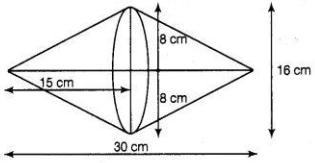
Two cones with the same base radius $8\, cm$ and height $15\, cm$ are joined together along their bases. Find the surface area of the shape so formed. (in $cm^2$)
A
$955$
B
$855$
C
$755$
D
$655$
Solution
(B) When two cones with the same base radius and height are joined together along their bases,the base area is hidden,and the total surface area of the resulting shape is the sum of the curved surface areas of the two cones.
Given:
Radius of the cone,$r = 8\, cm$
Height of the cone,$h = 15\, cm$
The slant height $l$ of each cone is given by $l = \sqrt{r^2 + h^2} = \sqrt{8^2 + 15^2} = \sqrt{64 + 225} = \sqrt{289} = 17\, cm$.
The total surface area of the resulting shape is the sum of the curved surface areas of the two identical cones:
Surface Area $= 2 \times (\pi r l)$
$= 2 \times \pi \times 8 \times 17$
$= 272\pi\, cm^2$
Using $\pi \approx \frac{22}{7}$:
$= 272 \times \frac{22}{7} = \frac{5984}{7} \approx 854.85\, cm^2$.
Rounding to the nearest whole number,we get $855\, cm^2$.
0 likes
View Solution45
MediumMCQ
$A$ factory manufactures $120000$ pencils daily. The pencils are cylindrical in shape,each of length $25 \,cm$ and circumference of base $1.5 \,cm$. Determine the cost of colouring the curved surfaces of the pencils manufactured in one day at $\operatorname{Rs.} 0.05$ per $dm^2$ (in $Rs.$).
A
$2200$
B
$2300$
C
$2250$
D
$2350$
Solution
(C) The curved surface area of a cylinder is given by $CSA = 2 \pi r h$,where $2 \pi r$ is the circumference of the base and $h$ is the length (height).
Given,circumference of the base $= 1.5 \,cm$ and length $h = 25 \,cm$.
Curved surface area of one pencil $= 1.5 \,cm \times 25 \,cm = 37.5 \,cm^2$.
Since $1 \,dm = 10 \,cm$,then $1 \,dm^2 = 100 \,cm^2$. Therefore,$1 \,cm^2 = 0.01 \,dm^2$.
Curved surface area of one pencil in $dm^2 = 37.5 \times 0.01 = 0.375 \,dm^2$.
Total curved surface area for $120000$ pencils $= 120000 \times 0.375 \,dm^2 = 45000 \,dm^2$.
Cost of colouring $= 45000 \,dm^2 \times \operatorname{Rs.} 0.05/dm^2 = \operatorname{Rs.} 2250$.
0 likes
View Solution46
DifficultMCQ
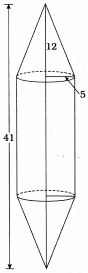
$A$ cylinder is closed at both the ends by $12 \, cm$ high cones. The radius of the cylinder is $5 \, cm$ and the total height of the combined article is $41 \, cm$. Find the total surface area of this article in $cm^2$. $(\pi = 3.14)$
A
$942$
B
$169$
C
$13$
D
$900$
Solution
(A) For both the cones:
Radius $r = 5 \, cm$ and height $h = 12 \, cm$.
For the cylinder:
Radius $r = 5 \, cm$.
Height of the cylinder $H = \text{Total height of the article} - 2 \times \text{Height of cone}$.
$H = 41 - 2 \times 12 = 41 - 24 = 17 \, cm$.
Slant height of the cone $l = \sqrt{r^2 + h^2}$.
$l = \sqrt{5^2 + 12^2} = \sqrt{25 + 144} = \sqrt{169} = 13 \, cm$.
Total Surface Area $(TSA)$ of the combined article:
$TSA = \text{CSA of the cylinder} + 2 \times \text{CSA of the cone}$.
$TSA = 2 \pi r H + 2 \times (\pi r l) = 2 \pi r (H + l)$.
$TSA = 2 \times 3.14 \times 5 \times (17 + 13)$.
$TSA = 3.14 \times 10 \times 30 = 3.14 \times 300 = 942 \, cm^2$.
Thus,the total surface area of the given article is $942 \, cm^2$.
0 likes
View Solution47
MediumMCQ
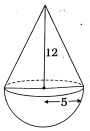
The base of a cone with radius $5 \, cm$ and height $12 \, cm$ is hemispherical. Find the total surface area of the article. $(\pi = 3.14)$ (in $cm^2$)
A
$371.9$
B
$361.1$
C
$261.9$
D
$345.7$
Solution
(B) Radius of the cone $=$ radius of the hemisphere $= r = 5 \, cm$.
Height of the cone $= h = 12 \, cm$.
The slant height of the cone is given by $l = \sqrt{r^2 + h^2}$.
$l = \sqrt{5^2 + 12^2} = \sqrt{25 + 144} = \sqrt{169} = 13 \, cm$.
The total surface area of the article is the sum of the curved surface area of the cone and the curved surface area of the hemisphere.
Total Surface Area $= \pi rl + 2\pi r^2 = \pi r(l + 2r)$.
Substituting the values: $3.14 \times 5 \times (13 + 2 \times 5) = 3.14 \times 5 \times (13 + 10) = 3.14 \times 5 \times 23$.
$= 15.7 \times 23 = 361.1 \, cm^2$.
0 likes
View Solution48
MediumMCQ
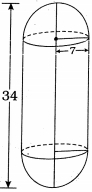
$A$ cylinder is closed at both the ends by hemispheres. The radius of the cylinder is $7 \, cm$ and the total height of the article is $34 \, cm$. Find the total surface area of the article. (in $cm^2$)
A
$1400$
B
$4434$
C
$1496$
D
$1504$
Solution
(C) The radius of the cylinder is equal to the radius of both the hemispheres,$r = 7 \, cm$.
The height of the cylinder is calculated by subtracting the radii of the two hemispheres from the total height of the article:
$h = 34 \, cm - (2 \times 7 \, cm) = 34 - 14 = 20 \, cm$.
The total surface area $(TSA)$ of the combined article is the sum of the curved surface area $(CSA)$ of the cylinder and the curved surface areas of the two hemispheres:
$TSA = CSA_{\text{cylinder}} + 2 \times CSA_{\text{hemisphere}}$
$TSA = 2 \pi r h + 2 \times (2 \pi r^2)$
$TSA = 2 \pi r (h + 2r)$
Substituting the values:
$TSA = 2 \times \frac{22}{7} \times 7 \times (20 + 2 \times 7)$
$TSA = 44 \times (20 + 14)$
$TSA = 44 \times 34 = 1496 \, cm^2$.
Thus,the total surface area of the given article is $1496 \, cm^2$.
0 likes
View Solution49
MediumMCQ
$A$ cylinder with radius $14 \, cm$ is closed at one end by a $48 \, cm$ high cone and at the other end by a hemisphere. If the height of the cylinder is $22 \, cm$,find the total surface area of the article (in $cm^2$).
A
$5478$
B
$5698$
C
$5123$
D
$5368$
Solution
(D) Radius of the cylinder = radius of the cone = radius of the hemisphere = $r = 14 \, cm$.
Height of the cylinder $H = 22 \, cm$.
Height of the cone $h = 48 \, cm$.
Slant height of the cone $l = \sqrt{r^2 + h^2} = \sqrt{14^2 + 48^2} = \sqrt{196 + 2304} = \sqrt{2500} = 50 \, cm$.
The total surface area $(TSA)$ of the combined article is the sum of the curved surface areas $(CSA)$ of the cylinder,the cone,and the hemisphere.
$TSA = CSA_{\text{cylinder}} + CSA_{\text{cone}} + CSA_{\text{hemisphere}}$
$TSA = 2\pi rH + \pi rl + 2\pi r^2 = \pi r(2H + l + 2r)$.
Substituting the values: $TSA = \frac{22}{7} \times 14 \times (2 \times 22 + 50 + 2 \times 14)$.
$TSA = 44 \times (44 + 50 + 28) = 44 \times 122 = 5368 \, cm^2$.
Thus,the total surface area of the article is $5368 \, cm^2$.
0 likes
View Solution50
MediumMCQ
Six wooden cubes of length $3 \, cm$ are arranged in a row touching each other face to face. Find the total surface area of the solid formed in this manner. (in $cm^2$)
A
$234$
B
$345$
C
$117$
D
$545$
Solution
(A) cuboid is formed by arranging six cubes touching each other face to face in a row.
For the cuboid so formed,the length $l = 6 \times 3 \, cm = 18 \, cm$.
The breadth $b = 3 \, cm$ and the height $h = 3 \, cm$.
The total surface area $(TSA)$ of the cuboid is given by the formula $2(lb + bh + hl)$.
Substituting the values: $TSA = 2(18 \times 3 + 3 \times 3 + 3 \times 18)$.
$TSA = 2(54 + 9 + 54) = 2(117) = 234 \, cm^2$.
Thus,the total surface area of the solid formed is $234 \, cm^2$.
0 likes
View SolutionSurface Areas and Volumes — Surface Area of a Combination of Solids · Frequently Asked Questions
1Are these Surface Areas and Volumes questions useful for JEE and NEET?
Yes. All questions in this section are mapped to JEE Main and NEET exam patterns. Previous year questions from JEE Main, NEET, GUJCET and state-level exams are included with full solutions.
2Can I switch to Hindi or Gujarati for these questions?
Yes. Use the language tabs in the hero section or the sidebar to view the same questions and solutions in English, Hindi or Gujarati.
3How do I generate a question paper from this subtopic?
Use the Vedclass Exam Paper Generator — select the chapter and subtopic, set difficulty, and generate Sets A, B, C, D automatically. First 3 chapters of every subject are free.
Vedclass Products
For Students
Vedclass Test Series
Mock tests in real JEE/NEET style with performance analysis. 5-day free trial.
Start Free TrialFor Teachers
Exam Paper Generator
Generate Set A/B/C/D papers from this chapter in 2 minutes. 3 chapters free.
Try FreeFor Institutes
Online Exam Module
Live online exams with unlimited students, 360° analytics & white-label branding.
See DemoFor Teachers & Institutes
Generate a Surface Areas and Volumes Exam Paper in 2 Minutes
Select subtopic & difficulty — Sets A, B, C, D auto-generated with No Repeat logic.
First 3 chapters of every subject are free — no payment required.