
અ Gujarati
Mix Examples - Heron’s Formula Questions in Gujarati
Class 9 Mathematics · Heron’s Formula · Mix Examples - Heron’s Formula
20+
Questions
Gujarati
Language
100%
With Solutions
Showing 20 of 20 questions in Gujarati
1
DifficultMCQ
ચતુષ્કોણ $ABCD$ આકારના એક બગીચામાં $\angle C = 90^{\circ}$,$AB = 9 \, m$,$BC = 12 \, m$,$CD = 5 \, m$ અને $AD = 8 \, m$ છે. તેનું ક્ષેત્રફળ કેટલું હશે ($, m^{2}$ માં)?
A
$80.5$
B
$75.5$
C
$70.1$
D
$65.5$
Solution
(D) ચતુષ્કોણ $ABCD$ ને બે ત્રિકોણમાં વિભાજિત કરવા માટે $B$ અને $D$ ને જોડો: $\Delta BCD$ અને $\Delta ABD$.
$1$. કાટકોણ ત્રિકોણ $\Delta BCD$ માં (કારણ કે $\angle C = 90^{\circ}$):
$\Delta BCD$ નું ક્ષેત્રફળ $= \frac{1}{2} \times \text{પાયો} \times \text{વેધ} = \frac{1}{2} \times 12 \times 5 = 30 \, m^{2}$.
$2$. પાયથાગોરસના પ્રમેયનો ઉપયોગ કરીને વિકર્ણ $BD$ ની લંબાઈ શોધો:
$BD^{2} = BC^{2} + CD^{2} = 12^{2} + 5^{2} = 144 + 25 = 169$.
$BD = \sqrt{169} = 13 \, m$.
$3$. $\Delta ABD$ માટે,બાજુઓ $a = 9 \, m$,$b = 8 \, m$ અને $c = 13 \, m$ છે.
અર્ધ-પરિમિતિ $s = \frac{9 + 8 + 13}{2} = \frac{30}{2} = 15 \, m$.
હેરોનના સૂત્રનો ઉપયોગ કરતા,$\Delta ABD$ નું ક્ષેત્રફળ $= \sqrt{s(s-a)(s-b)(s-c)} = \sqrt{15(15-9)(15-8)(15-13)} = \sqrt{15 \times 6 \times 7 \times 2} = \sqrt{1260} = 6\sqrt{35} \, m^{2}$.
$\sqrt{35} \approx 5.916$ લેતા,ક્ષેત્રફળ $\approx 6 \times 5.916 = 35.496 \approx 35.5 \, m^{2}$.
$4$. ચતુષ્કોણ $ABCD$ નું કુલ ક્ષેત્રફળ $= \text{Area}(\Delta BCD) + \text{Area}(\Delta ABD) = 30 + 35.5 = 65.5 \, m^{2}$.
0 likes
View Solution2
MediumMCQ
એક સમદ્વિબાજુ કાટકોણ ત્રિકોણનું ક્ષેત્રફળ $8 \, cm^{2}$ છે. તેના કર્ણની લંબાઈ કેટલી છે?
A
$4 \, cm$
B
$\sqrt{32} \, cm$
C
$\sqrt{48} \, cm$
D
$\sqrt{24} \, cm$
Solution
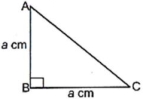
(B) ધારો કે સમદ્વિબાજુ કાટકોણ ત્રિકોણની બે સમાન બાજુઓ $a \, cm$ છે.
ત્રિકોણનું ક્ષેત્રફળ $\frac{1}{2} \times \text{પાયો} \times \text{વેધ}$ દ્વારા આપવામાં આવે છે.
તે સમદ્વિબાજુ કાટકોણ ત્રિકોણ હોવાથી,પાયો $= a$ અને વેધ $= a$ થશે.
તેથી,$\frac{1}{2} \times a \times a = 8$.
$a^{2} = 16$,જે આપણને $a = 4 \, cm$ આપે છે.
પાયથાગોરસના પ્રમેય મુજબ,કર્ણ $h = \sqrt{a^{2} + a^{2}} = \sqrt{4^{2} + 4^{2}} = \sqrt{16 + 16} = \sqrt{32} \, cm$ થાય.
0 likes
View Solution3
Easy
સાચું કે ખોટું લખો અને તમારા જવાબનું સમર્થન કરો.
$4 \, \text{cm}$ પાયો અને $6 \, \text{cm}$ વેધ ધરાવતા ત્રિકોણનું ક્ષેત્રફળ $24 \, \text{cm}^2$ છે.
$4 \, \text{cm}$ પાયો અને $6 \, \text{cm}$ વેધ ધરાવતા ત્રિકોણનું ક્ષેત્રફળ $24 \, \text{cm}^2$ છે.
Solution
(B) ત્રિકોણનું ક્ષેત્રફળ શોધવાનું સૂત્ર: $\text{ક્ષેત્રફળ} = \frac{1}{2} \times \text{પાયો} \times \text{વેધ}$.
અહીં,$\text{પાયો} = 4 \, \text{cm}$ અને $\text{વેધ} = 6 \, \text{cm}$ આપેલ છે.
સૂત્રમાં આ કિંમતો મૂકતા: $\text{ક્ષેત્રફળ} = \frac{1}{2} \times 4 \, \text{cm} \times 6 \, \text{cm} = 12 \, \text{cm}^2$.
આમ,ગણતરી કરેલ ક્ષેત્રફળ $12 \, \text{cm}^2$ છે,$24 \, \text{cm}^2$ નથી,તેથી આપેલ વિધાન ખોટું છે.
અહીં,$\text{પાયો} = 4 \, \text{cm}$ અને $\text{વેધ} = 6 \, \text{cm}$ આપેલ છે.
સૂત્રમાં આ કિંમતો મૂકતા: $\text{ક્ષેત્રફળ} = \frac{1}{2} \times 4 \, \text{cm} \times 6 \, \text{cm} = 12 \, \text{cm}^2$.
આમ,ગણતરી કરેલ ક્ષેત્રફળ $12 \, \text{cm}^2$ છે,$24 \, \text{cm}^2$ નથી,તેથી આપેલ વિધાન ખોટું છે.
0 likes
View Solution4
Easy
નીચેનું વિધાન સત્ય છે કે અસત્ય તે જણાવો અને તમારા જવાબનું સમર્થન કરો:
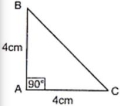
$\Delta ABC$ નું ક્ષેત્રફળ $8 \, cm^2$ છે,જેમાં $AB = AC = 4 \, cm$ અને $\angle A = 90^{\circ}$ છે.
$\Delta ABC$ નું ક્ષેત્રફળ $8 \, cm^2$ છે,જેમાં $AB = AC = 4 \, cm$ અને $\angle A = 90^{\circ}$ છે.
Solution
(TRUE) આપેલ છે કે $\Delta ABC$ એ કાટકોણ ત્રિકોણ છે જેમાં $\angle A = 90^{\circ}$,$AB = 4 \, cm$ અને $AC = 4 \, cm$ છે.
કાટકોણ ત્રિકોણના ક્ષેત્રફળનું સૂત્ર નીચે મુજબ છે:
ક્ષેત્રફળ $= \frac{1}{2} \times \text{પાયો} \times \text{વેધ}$
અહીં,આપણે $AC$ ને પાયો અને $AB$ ને વેધ તરીકે લઈ શકીએ છીએ.
ક્ષેત્રફળ $= \frac{1}{2} \times 4 \, cm \times 4 \, cm$
ક્ષેત્રફળ $= \frac{1}{2} \times 16 \, cm^2 = 8 \, cm^2$
ગણતરી કરેલ ક્ષેત્રફળ $8 \, cm^2$ હોવાથી,આપેલ વિધાન સત્ય છે.
0 likes
View Solution5
Difficult
સાચું કે ખોટું લખો અને તમારા જવાબનું સમર્થન કરો.
જો સમબાજુ ચતુષ્કોણની બાજુ $10 \, cm$ હોય અને એક વિકર્ણ $16 \, cm$ હોય,તો સમબાજુ ચતુષ્કોણનું ક્ષેત્રફળ $96 \, cm^2$ થાય.
જો સમબાજુ ચતુષ્કોણની બાજુ $10 \, cm$ હોય અને એક વિકર્ણ $16 \, cm$ હોય,તો સમબાજુ ચતુષ્કોણનું ક્ષેત્રફળ $96 \, cm^2$ થાય.
Solution
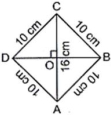
(A) ધારો કે $ABCD$ એ સમબાજુ ચતુષ્કોણ છે જેનો એક વિકર્ણ $AC = 16 \, cm$ છે. સમબાજુ ચતુષ્કોણની દરેક બાજુ $10 \, cm$ છે.
આપણે જાણીએ છીએ કે સમબાજુ ચતુષ્કોણના વિકર્ણો એકબીજાને કાટખૂણે દુભાગે છે,તેથી
$OA = OC = 8 \, cm$ અને $OB = OD$.
$\Delta AOB$ માં,$\angle AOB = 90^{\circ}$ છે.
તેથી,$AB^2 = OA^2 + OB^2$
$\Rightarrow OB^2 = AB^2 - OA^2$
$= (10)^2 - 8^2 = 100 - 64 = 36$
$OB = \sqrt{36} = 6 \, cm$.
$DB = 2(OB) = 2 \times 6 = 12 \, cm$.
આમ,સમબાજુ ચતુષ્કોણનું ક્ષેત્રફળ $= \frac{1}{2} \times \text{વિકર્ણોનો ગુણાકાર}$
$= \frac{1}{2} \times 16 \times 12 = 96 \, cm^2$.
તેથી,આપેલ વિધાન સાચું છે.
0 likes
View Solution6
Medium
નીચેનું વિધાન ખરું છે કે ખોટું તે જણાવો અને તમારા જવાબનું સમર્થન કરો:
$a$ બાજુવાળા નિયમિત ષટ્કોણનું ક્ષેત્રફળ એ $a$ બાજુવાળા પાંચ સમબાજુ ત્રિકોણના ક્ષેત્રફળોના સરવાળા જેટલું હોય છે.
$a$ બાજુવાળા નિયમિત ષટ્કોણનું ક્ષેત્રફળ એ $a$ બાજુવાળા પાંચ સમબાજુ ત્રિકોણના ક્ષેત્રફળોના સરવાળા જેટલું હોય છે.
Solution
(FALSE) આ વિધાન ખોટું છે.
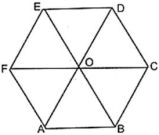
એક નિયમિત ષટ્કોણના કેન્દ્રને તેના દરેક શિરોબિંદુઓ સાથે જોડવાથી તેને છ સમબાજુ ત્રિકોણોમાં વિભાજિત કરી શકાય છે.
આ છ ત્રિકોણોમાંથી દરેક $a$ બાજુવાળો સમબાજુ ત્રિકોણ હોવાથી, નિયમિત ષટ્કોણનું કુલ ક્ષેત્રફળ આ છ સમબાજુ ત્રિકોણોના ક્ષેત્રફળના સરવાળા જેટલું થાય છે.
તેથી, $a$ બાજુવાળા નિયમિત ષટ્કોણનું ક્ષેત્રફળ $6 \times (\text{a બાજુવાળા સમબાજુ ત્રિકોણનું ક્ષેત્રફળ})$ થાય, ન કે પાંચ આવા ત્રિકોણોના ક્ષેત્રફળનો સરવાળો.
0 likes
View Solution7
Difficult
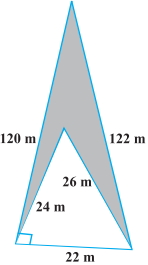
આકૃતિમાં દર્શાવેલ છાયાંકિત ભાગનું ક્ષેત્રફળ શોધો.
Solution
(N/A) આકૃતિ બે ત્રિકોણની બનેલી છે. છાયાંકિત ભાગનું ક્ષેત્રફળ એ મોટા ત્રિકોણ અને નાના ત્રિકોણના ક્ષેત્રફળનો તફાવત છે.
$1$. મોટા ત્રિકોણ માટે જેની બાજુઓ $a = 122 \ m$,$b = 120 \ m$ અને $c = 22 \ m$ છે:
અર્ધ-પરિમિતિ $s = \frac{122 + 120 + 22}{2} = \frac{264}{2} = 132 \ m$.
ક્ષેત્રફળ $= \sqrt{s(s-a)(s-b)(s-c)} = \sqrt{132(132-122)(132-120)(132-22)}$
$= \sqrt{132 \times 10 \times 12 \times 110} = \sqrt{1742400} = 1320 \ m^2$.
$2$. નાના ત્રિકોણ માટે જેની બાજુઓ $a = 24 \ m$,$b = 26 \ m$ અને $c = 22 \ m$ છે:
આકૃતિમાં દર્શાવ્યા મુજબ તે કાટકોણ ત્રિકોણ હોવાથી,આપણે સૂત્રનો ઉપયોગ કરી શકીએ: ક્ષેત્રફળ $= \frac{1}{2} \times \text{પાયો} \times \text{વેધ}$.
ક્ષેત્રફળ $= \frac{1}{2} \times 24 \times 10 = 120 \ m^2$.
$3$. છાયાંકિત ભાગનું ક્ષેત્રફળ $= \text{મોટા ત્રિકોણનું ક્ષેત્રફળ} - \text{નાના ત્રિકોણનું ક્ષેત્રફળ}$
$= 1320 \ m^2 - 120 \ m^2 = 1200 \ m^2$.
0 likes
View Solution8
Difficult
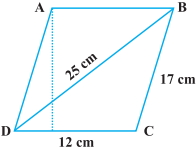
આકૃતિમાં આપેલ સમાંતરબાજુ ચતુષ્કોણનું ક્ષેત્રફળ શોધો. શિરોબિંદુ $A$ માંથી બાજુ $DC$ પર દોરેલા વેધની લંબાઈ પણ શોધો.
Solution
(N/A) $\Delta BCD$ ની બાજુઓ $a = 12 \text{ cm}, b = 17 \text{ cm}$ અને $c = 25 \text{ cm}$ છે.
$\therefore \Delta BCD$ ની અર્ધ-પરિમિતિ $(s)$:
$s = \frac{a + b + c}{2} = \frac{12 + 17 + 25}{2} = \frac{54}{2} = 27 \text{ cm}.$
$\therefore \Delta BCD$ નું ક્ષેત્રફળ = $\sqrt{s(s - a)(s - b)(s - c)}$ [હેરોનનું સૂત્ર વાપરતા]
$= \sqrt{27(27 - 12)(27 - 17)(27 - 25)}$
$= \sqrt{27 \times 15 \times 10 \times 2}$
$= \sqrt{(9 \times 3) \times (3 \times 5) \times (5 \times 2) \times 2}$
$= \sqrt{9 \times 9 \times 25 \times 4} = 3 \times 3 \times 5 \times 2 = 90 \text{ cm}^2.$
સમાંતરબાજુ ચતુષ્કોણનો વિકર્ણ તેને સમાન ક્ષેત્રફળવાળા બે ત્રિકોણમાં વિભાજિત કરે છે:
સમાંતરબાજુ ચતુષ્કોણ $ABCD$ નું ક્ષેત્રફળ = $2 \times \Delta BCD$ નું ક્ષેત્રફળ = $2 \times 90 = 180 \text{ cm}^2.$
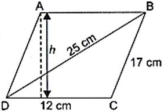
ધારો કે શિરોબિંદુ $A$ માંથી બાજુ $DC$ પરનો વેધ $h$ છે.
સમાંતરબાજુ ચતુષ્કોણ $ABCD$ નું ક્ષેત્રફળ = પાયો $\times$ વેધ
$180 = DC \times h$
$180 = 12 \times h$
$h = \frac{180}{12} = 15 \text{ cm}.$
આમ,સમાંતરબાજુ ચતુષ્કોણનું ક્ષેત્રફળ $180 \text{ cm}^2$ છે અને વેધની લંબાઈ $15 \text{ cm}$ છે.
0 likes
View Solution9
DifficultMCQ
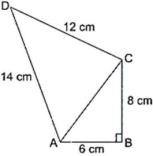
ચતુષ્કોણ $ABCD$ ની બાજુઓ અનુક્રમે $6 \, cm$,$8 \, cm$,$12 \, cm$ અને $14 \, cm$ (ક્રમમાં લેતા) છે,અને પ્રથમ બે બાજુઓ વચ્ચેનો ખૂણો કાટખૂણો છે. તેનું ક્ષેત્રફળ $cm^2$ માં શોધો.
A
$80.562$
B
$82.787$
C
$85.221$
D
$85.231$
Solution
(B) ચતુષ્કોણ $ABCD$ નું ક્ષેત્રફળ શોધવા માટે,આપણે તેને બે ત્રિકોણમાં વિભાજિત કરીએ છીએ: $\Delta ABC$ અને $\Delta ACD$.
$\angle B = 90^\circ$ હોવાથી,$\Delta ABC$ એ કાટકોણ ત્રિકોણ છે.
$\Delta ABC$ માં પાયથાગોરસના પ્રમેય મુજબ:
$AC = \sqrt{AB^2 + BC^2} = \sqrt{6^2 + 8^2} = \sqrt{36 + 64} = \sqrt{100} = 10 \, cm$.
$\Delta ABC$ નું ક્ષેત્રફળ $= \frac{1}{2} \times \text{પાયો} \times \text{વેધ} = \frac{1}{2} \times 6 \times 8 = 24 \, cm^2$.
હવે,$\Delta ACD$ માટે,બાજુઓ $a = 10 \, cm$,$b = 12 \, cm$ અને $c = 14 \, cm$ છે.
અર્ધ-પરિમિતિ $s = \frac{a + b + c}{2} = \frac{10 + 12 + 14}{2} = \frac{36}{2} = 18 \, cm$.
હેરોનના સૂત્રનો ઉપયોગ કરતા,$\Delta ACD$ નું ક્ષેત્રફળ $= \sqrt{s(s-a)(s-b)(s-c)} = \sqrt{18(18-10)(18-12)(18-14)} = \sqrt{18 \times 8 \times 6 \times 4} = \sqrt{3456} \approx 58.787 \, cm^2$.
ચતુષ્કોણ $ABCD$ નું કુલ ક્ષેત્રફળ $= \text{ક્ષેત્રફળ}(\Delta ABC) + \text{ક્ષેત્રફળ}(\Delta ACD) = 24 + 58.787 = 82.787 \, cm^2$.
0 likes
View Solution10
DifficultMCQ
$40 \, cm$ પરિમિતિ અને $12 \, cm$ વિકર્ણ ધરાવતી સમબાજુ ચતુષ્કોણ આકારની શીટને બંને બાજુએ $Rs \, 5$ પ્રતિ $cm^2$ ના દરે રંગવામાં આવે છે. રંગવાનો ખર્ચ (Rs માં) શોધો.
A
$985$
B
$990$
C
$960$
D
$980$
Solution
(C) સમબાજુ ચતુષ્કોણની પરિમિતિ $40 \, cm$ છે.
સમબાજુ ચતુષ્કોણની બધી બાજુઓ સમાન હોવાથી,બાજુની લંબાઈ $\frac{40}{4} = 10 \, cm$ થાય.
વિકર્ણ સમબાજુ ચતુષ્કોણને $10 \, cm, 10 \, cm$ અને $12 \, cm$ બાજુઓવાળા બે એકરૂપ ત્રિકોણમાં વિભાજિત કરે છે.
એક ત્રિકોણ માટે હેરોનનું સૂત્ર વાપરતા:
અર્ધ-પરિમિતિ $s = \frac{10 + 10 + 12}{2} = \frac{32}{2} = 16 \, cm$.
એક ત્રિકોણનું ક્ષેત્રફળ $= \sqrt{s(s-a)(s-b)(s-c)} = \sqrt{16(16-10)(16-10)(16-12)} = \sqrt{16 \times 6 \times 6 \times 4} = \sqrt{2304} = 48 \, cm^2$.
સમબાજુ ચતુષ્કોણનું ક્ષેત્રફળ $= 2 \times 48 = 96 \, cm^2$.
બંને બાજુ રંગવાનું હોવાથી,કુલ ક્ષેત્રફળ $2 \times 96 = 192 \, cm^2$ થાય.
$Rs \, 5$ પ્રતિ $cm^2$ ના દરે રંગવાનો કુલ ખર્ચ $192 \times 5 = Rs \, 960$ થાય.
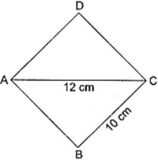
0 likes
View Solution11
MediumMCQ
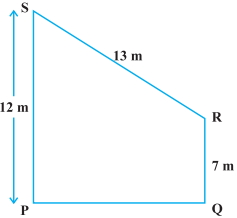
આકૃતિમાં આપેલ સમલંબ ચતુષ્કોણ $PQRS$ નું ક્ષેત્રફળ શોધો,જ્યાં ઊંચાઈ $PQ$ છે (in $m^2$).
A
$114$
B
$22$
C
$18$
D
$11$
Solution
(A) $RT \perp SP$ દોરો. આકૃતિ પરથી સ્પષ્ટ છે કે $RT = PQ = 7 \ m$ અને $PT = QR = 7 \ m$ છે.
કારણ કે $SP = 12 \ m$ છે,તેથી $ST = SP - PT = 12 \ m - 7 \ m = 5 \ m$ થાય.
હવે,કાટકોણ ત્રિકોણ $STR$ માં,પાયથાગોરસના પ્રમેય મુજબ:
$SR^2 = ST^2 + RT^2$
$13^2 = 5^2 + RT^2$
$169 = 25 + RT^2$
$RT^2 = 169 - 25 = 144$
$RT = 12 \ m$.
આમ,સમલંબ ચતુષ્કોણની ઊંચાઈ $12 \ m$ છે.
સમલંબ ચતુષ્કોણ $PQRS$ નું ક્ષેત્રફળ $= \frac{1}{2} \times (SP + QR) \times PQ$
$= \frac{1}{2} \times (12 \ m + 7 \ m) \times 12 \ m$
$= \frac{1}{2} \times 19 \ m \times 12 \ m = 19 \times 6 \ m^2 = 114 \ m^2$.
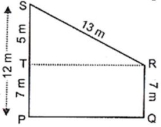
0 likes
View Solution12
DifficultMCQ
એક ખેતર સમલંબ ચતુષ્કોણ આકારનું છે જેની સમાંતર બાજુઓ $90 \, m$ અને $30 \, m$ છે. આ બાજુઓ ત્રીજી બાજુને કાટખૂણે મળે છે. ચોથી બાજુની લંબાઈ $100 \, m$ છે. જો ખેતરના $1 \, m^2$ ને ખેડવાનો ખર્ચ $\operatorname{Rs} 4$ હોય,તો ખેતરને ખેડવાનો કુલ ખર્ચ શોધો ($\operatorname{Rs}$ માં).
A
$19200$
B
$19562$
C
$19800$
D
$18900$
Solution
(A) ધારો કે સમલંબ ચતુષ્કોણ $ABCD$ છે જેમાં સમાંતર બાજુઓ $AB = 90 \, m$ અને $CD = 30 \, m$ છે. બાજુ $AC$ એ $AB$ અને $CD$ બંનેને લંબ છે.
$DM \perp AB$ દોરો. $ACDM$ એક લંબચોરસ બનાવે છે,તેથી $AM = CD = 30 \, m$ અને $DM = AC$ થાય.
હવે,$MB = AB - AM = 90 \, m - 30 \, m = 60 \, m$.
કાટકોણ ત્રિકોણ $\triangle DMB$ માં,પાયથાગોરસના પ્રમેય મુજબ:
$DM^2 = DB^2 - MB^2 = (100)^2 - (60)^2$
$DM^2 = 10000 - 3600 = 6400$
$DM = \sqrt{6400} = 80 \, m$.
આમ,સમલંબ ચતુષ્કોણની ઊંચાઈ $80 \, m$ છે.
સમલંબ ચતુષ્કોણ $ABCD$ નું ક્ષેત્રફળ $= \frac{1}{2} \times (\text{સમાંતર બાજુઓનો સરવાળો}) \times \text{ઊંચાઈ}$
$= \frac{1}{2} \times (90 + 30) \times 80 = \frac{1}{2} \times 120 \times 80 = 4800 \, m^2$.
ખેતર ખેડવાનો કુલ ખર્ચ $= \text{ક્ષેત્રફળ} \times \text{દર} = 4800 \times 4 = \operatorname{Rs} 19,200$.
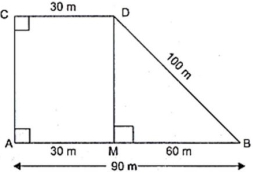
0 likes
View Solution13
Difficult
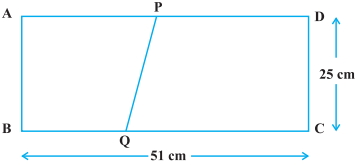
એક લંબચોરસ $ABCD$ ના પરિમાણો $51 \, cm \times 25 \, cm$ છે. આકૃતિમાં દર્શાવ્યા મુજબ લંબચોરસમાંથી એક સમલંબ ચતુષ્કોણ $PQCD$ કાપવામાં આવે છે,જેની સમાંતર બાજુઓ $QC$ અને $PD$ નો ગુણોત્તર $9:8$ છે. જો સમલંબ ચતુષ્કોણ $PQCD$ નું ક્ષેત્રફળ લંબચોરસના ક્ષેત્રફળના $\frac{5}{6}$ ભાગનું હોય,તો $QC$ અને $PD$ ની લંબાઈ શોધો.
Solution
(N/A) $ABCD$ એક લંબચોરસ છે જેમાં $AB = 51 \, cm$ અને $BC = 25 \, cm$ છે.
સમાંતર બાજુઓ $QC$ અને $PD$ નો ગુણોત્તર $9:8$ હોવાથી,ધારો કે $QC = 9x$ અને $PD = 8x$ છે.
સમલંબ ચતુષ્કોણ $PQCD$ ની ઊંચાઈ લંબચોરસની પહોળાઈ જેટલી જ એટલે કે $25 \, cm$ છે.
સમલંબ ચતુષ્કોણ $PQCD$ નું ક્ષેત્રફળ $= \frac{1}{2} \times (QC + PD) \times \text{ઊંચાઈ} = \frac{1}{2} \times (9x + 8x) \times 25 = \frac{1}{2} \times 17x \times 25$.
લંબચોરસ $ABCD$ નું ક્ષેત્રફળ $= \text{લંબાઈ} \times \text{પહોળાઈ} = 51 \times 25$.
આપેલ છે કે સમલંબ ચતુષ્કોણ $PQCD$ નું ક્ષેત્રફળ $= \frac{5}{6} \times \text{લંબચોરસ } ABCD \text{ નું ક્ષેત્રફળ}$.
તેથી,$\frac{1}{2} \times 17x \times 25 = \frac{5}{6} \times 51 \times 25$.
બંને બાજુ $25$ વડે ભાગતા અને $2$ વડે ગુણતા,આપણને મળે છે $17x = \frac{5}{6} \times 51 \times 2 = \frac{5}{3} \times 51 = 5 \times 17 = 85$.
આમ,$x = \frac{85}{17} = 5$.
તેથી,$QC$ ની લંબાઈ $= 9x = 9 \times 5 = 45 \, cm$.
અને $PD$ ની લંબાઈ $= 8x = 8 \times 5 = 40 \, cm$.
0 likes
View Solution14
MediumMCQ
$12\,cm$ બાજુની લંબાઈ ધરાવતા નિયમિત ષટ્કોણનું ક્ષેત્રફળ અને પરિમિતિ શોધો.
A
$69\,cm$,$189\sqrt{3}\,cm^2$
B
$70\,cm$,$315\sqrt{3}\,cm^2$
C
$67\,cm$,$213\sqrt{3}\,cm^2$
D
$72\,cm$,$216\sqrt{3}\,cm^2$
Solution
(D) નિયમિત ષટ્કોણ $6$ સમબાજુ ત્રિકોણનો બનેલો હોય છે,જેમાં દરેક બાજુની લંબાઈ $a = 12\,cm$ છે.
નિયમિત ષટ્કોણની પરિમિતિ $= 6 \times a = 6 \times 12\,cm = 72\,cm$.
એક સમબાજુ ત્રિકોણનું ક્ષેત્રફળ $= \frac{\sqrt{3}}{4} \times a^2 = \frac{\sqrt{3}}{4} \times 12^2 = \frac{\sqrt{3}}{4} \times 144 = 36\sqrt{3}\,cm^2$.
ષટ્કોણનું કુલ ક્ષેત્રફળ $= 6 \times 36\sqrt{3}\,cm^2 = 216\sqrt{3}\,cm^2$.
આમ,પરિમિતિ $72\,cm$ અને ક્ષેત્રફળ $216\sqrt{3}\,cm^2$ છે.
0 likes
View Solution15
DifficultMCQ
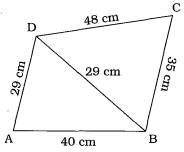
ચતુષ્કોણ $ABCD$ માં,$AB = 40 \, cm$,$BC = 35 \, cm$,$CD = 48 \, cm$,$DA = 29 \, cm$ અને $BD = 29 \, cm$ છે. ચતુષ્કોણ $ABCD$ નું ક્ષેત્રફળ શોધો. ($, cm^2$ માં)
A
$930$
B
$929$
C
$920$
D
$924$
Solution
(D) ચતુષ્કોણ $ABCD$ નો વિકર્ણ $BD$ તેને બે અતિવ્યાપી ન હોય તેવા ત્રિકોણો,$\Delta ABD$ અને $\Delta BCD$ માં વિભાજિત કરે છે.
$\Delta ABD$ માટે,બાજુઓ $a = 40 \, cm$,$b = 29 \, cm$ અને $c = 29 \, cm$ છે.
અર્ધ-પરિમિતિ $s_1 = \frac{40 + 29 + 29}{2} = \frac{98}{2} = 49 \, cm$.
$\Delta ABD$ નું ક્ષેત્રફળ $= \sqrt{s_1(s_1 - a)(s_1 - b)(s_1 - c)} = \sqrt{49(49 - 40)(49 - 29)(49 - 29)} = \sqrt{49 \times 9 \times 20 \times 20} = 7 \times 3 \times 20 = 420 \, cm^2$.
$\Delta BCD$ માટે,બાજુઓ $a = 29 \, cm$,$b = 48 \, cm$ અને $c = 35 \, cm$ છે.
અર્ધ-પરિમિતિ $s_2 = \frac{29 + 48 + 35}{2} = \frac{112}{2} = 56 \, cm$.
$\Delta BCD$ નું ક્ષેત્રફળ $= \sqrt{s_2(s_2 - a)(s_2 - b)(s_2 - c)} = \sqrt{56(56 - 29)(56 - 48)(56 - 35)} = \sqrt{56 \times 27 \times 8 \times 21} = \sqrt{(8 \times 7) \times (9 \times 3) \times 8 \times (3 \times 7)} = \sqrt{8^2 \times 7^2 \times 3^2 \times 9} = 8 \times 7 \times 3 \times 3 = 504 \, cm^2$.
ચતુષ્કોણ $ABCD$ નું ક્ષેત્રફળ $= \Delta ABD$ નું ક્ષેત્રફળ $+ \Delta BCD$ નું ક્ષેત્રફળ $= 420 + 504 = 924 \, cm^2$.
0 likes
View Solution16
DifficultMCQ
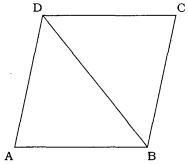
એક પ્લોટનો આકાર સમબાજુ ચતુષ્કોણ છે. તેની પરિમિતિ $340 \, m$ છે અને એક વિકર્ણ $72 \, m$ છે. તેનું ક્ષેત્રફળ શોધો. ($, m^2$ માં)
A
$5054$
B
$5544$
C
$5404$
D
$5064$
Solution
(B) ધારો કે $ABCD$ એ પ્લોટ છે જે વિકર્ણ $BD = 72 \, m$ દ્વારા બે સમાન ત્રિકોણમાં વિભાજિત થાય છે.
સમબાજુ ચતુષ્કોણની બધી બાજુઓ સમાન હોય છે.
પરિમિતિ $= 4 \times \text{બાજુ} = 340 \, m$.
તેથી,બાજુ $= \frac{340}{4} = 85 \, m$.
$\Delta ABD$ માં,બાજુઓ $a = 85 \, m$,$b = 85 \, m$ અને $c = 72 \, m$ છે.
અર્ધ-પરિમિતિ $(s) = \frac{85 + 85 + 72}{2} = \frac{242}{2} = 121 \, m$.
હેરોનના સૂત્રનો ઉપયોગ કરતા,$\Delta ABD$ નું ક્ષેત્રફળ $= \sqrt{s(s-a)(s-b)(s-c)}$
$= \sqrt{121(121-85)(121-85)(121-72)}$
$= \sqrt{121 \times 36 \times 36 \times 49}$
$= 11 \times 36 \times 7 = 2772 \, m^2$.
વિકર્ણ સમબાજુ ચતુષ્કોણને બે સમાન ત્રિકોણમાં વિભાજિત કરતું હોવાથી,સમબાજુ ચતુષ્કોણ $ABCD$ નું કુલ ક્ષેત્રફળ $= 2 \times \Delta ABD$ નું ક્ષેત્રફળ
$= 2 \times 2772 = 5544 \, m^2$.
0 likes
View Solution17
MediumMCQ
ચતુષ્કોણ $ABCD$ માં,$AB = 20 \, cm$,$BC = 15 \, cm$,$CD = 12 \, cm$,$DA = 17 \, cm$ અને $\angle B = 90^{\circ}$ છે. તો ચતુષ્કોણનું ક્ષેત્રફળ $cm^2$ માં શોધો.
A
$240$
B
$249$
C
$245$
D
$242$
Solution
(A) $1$. વિકર્ણ $AC$ દોરીને ચતુષ્કોણ $ABCD$ ને બે ત્રિકોણમાં વિભાજિત કરો.
$2$. $\triangle ABC$ માં,$\angle B = 90^{\circ}$ હોવાથી,તે કાટકોણ ત્રિકોણ છે.
$3$. $\triangle ABC$ નું ક્ષેત્રફળ $= \frac{1}{2} \times \text{પાયો} \times \text{વેધ} = \frac{1}{2} \times 20 \times 15 = 150 \, cm^2$.
$4$. $\triangle ABC$ માં પાયથાગોરસના પ્રમેય મુજબ,$AC^2 = AB^2 + BC^2 = 20^2 + 15^2 = 400 + 225 = 625$. તેથી,$AC = 25 \, cm$.
$5$. હવે,$\triangle ADC$ માં,બાજુઓ $a = 25 \, cm$,$b = 12 \, cm$,$c = 17 \, cm$ છે. અર્ધ-પરિમિતિ $s = \frac{25 + 12 + 17}{2} = \frac{54}{2} = 27 \, cm$.
$6$. $\triangle ADC$ નું ક્ષેત્રફળ $= \sqrt{s(s-a)(s-b)(s-c)} = \sqrt{27(27-25)(27-12)(27-17)} = \sqrt{27 \times 2 \times 15 \times 10} = \sqrt{8100} = 90 \, cm^2$.
$7$. ચતુષ્કોણ $ABCD$ નું કુલ ક્ષેત્રફળ $= \text{ક્ષેત્રફળ}(\triangle ABC) + \text{ક્ષેત્રફળ}(\triangle ADC) = 150 + 90 = 240 \, cm^2$.
0 likes
View Solution18
MediumMCQ
ચતુષ્કોણ $ABCD$ માં,$AB = 29 \, cm$,$BC = 35 \, cm$,$CD = 14 \, cm$,$DA = 50 \, cm$ અને $AC = 48 \, cm$ છે. તેનું ક્ષેત્રફળ શોધો. ($, cm^2$ માં)
A
$825$
B
$864$
C
$844$
D
$840$
Solution
(D) ચતુષ્કોણ $ABCD$ ને વિકર્ણ $AC = 48 \, cm$ દ્વારા બે ત્રિકોણ $\triangle ABC$ અને $\triangle ADC$ માં વિભાજિત કરવામાં આવે છે.
$\triangle ABC$ માટે,બાજુઓ $a = 29 \, cm$,$b = 35 \, cm$ અને $c = 48 \, cm$ છે.
અર્ધ-પરિમિતિ $s_1 = (29 + 35 + 48) / 2 = 112 / 2 = 56 \, cm$.
$\triangle ABC$ નું ક્ષેત્રફળ $= \sqrt{s_1(s_1-a)(s_1-b)(s_1-c)} = \sqrt{56(56-29)(56-35)(56-48)} = \sqrt{56 \times 27 \times 21 \times 8} = \sqrt{254016} = 504 \, cm^2$.
$\triangle ADC$ માટે,બાજુઓ $a = 50 \, cm$,$b = 14 \, cm$ અને $c = 48 \, cm$ છે.
અર્ધ-પરિમિતિ $s_2 = (50 + 14 + 48) / 2 = 112 / 2 = 56 \, cm$.
$\triangle ADC$ નું ક્ષેત્રફળ $= \sqrt{s_2(s_2-a)(s_2-b)(s_2-c)} = \sqrt{56(56-50)(56-14)(56-48)} = \sqrt{56 \times 6 \times 42 \times 8} = \sqrt{112896} = 336 \, cm^2$.
ચતુષ્કોણ $ABCD$ નું કુલ ક્ષેત્રફળ $= \text{Area}(\triangle ABC) + \text{Area}(\triangle ADC) = 504 + 336 = 840 \, cm^2$.
0 likes
View Solution19
MediumMCQ
ચતુષ્કોણ $ABCD$ માં,$AB = 9 \, cm$,$BC = 40 \, cm$,$CD = 28 \, cm$,$DA = 15 \, cm$ અને $\angle B = 90^{\circ}$ છે. તેનું ક્ષેત્રફળ શોધો. ($, cm^2$ માં)
A
$306$
B
$256$
C
$320$
D
$330$
Solution
(A) $1$. ચતુષ્કોણ $ABCD$ ને બે ત્રિકોણમાં વિભાજિત કરવા માટે $AC$ ને જોડો: $\triangle ABC$ અને $\triangle ADC$.
$2$. કાટકોણ $\triangle ABC$ માં,પાયથાગોરસના પ્રમેય મુજબ: $AC^2 = AB^2 + BC^2 = 9^2 + 40^2 = 81 + 1600 = 1681$. તેથી,$AC = \sqrt{1681} = 41 \, cm$.
$3$. $\triangle ABC$ નું ક્ષેત્રફળ $= \frac{1}{2} \times \text{પાયો} \times \text{વેધ} = \frac{1}{2} \times 40 \times 9 = 180 \, cm^2$.
$4$. $\triangle ADC$ માટે,બાજુઓ $a = 41 \, cm$,$b = 28 \, cm$ અને $c = 15 \, cm$ છે. અર્ધ-પરિમિતિ $s = \frac{41 + 28 + 15}{2} = \frac{84}{2} = 42 \, cm$.
$5$. $\triangle ADC$ નું ક્ષેત્રફળ $= \sqrt{s(s-a)(s-b)(s-c)} = \sqrt{42(42-41)(42-28)(42-15)} = \sqrt{42 \times 1 \times 14 \times 27} = \sqrt{(14 \times 3) \times 14 \times (9 \times 3)} = \sqrt{14^2 \times 3^2 \times 3^2} = 14 \times 3 \times 3 = 126 \, cm^2$.
$6$. ચતુષ્કોણ $ABCD$ નું કુલ ક્ષેત્રફળ $= \text{ક્ષેત્રફળ}(\triangle ABC) + \text{ક્ષેત્રફળ}(\triangle ADC) = 180 + 126 = 306 \, cm^2$.
0 likes
View Solution20
MediumMCQ
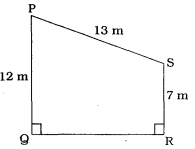
આકૃતિમાં આપેલ સમલંબ ચતુષ્કોણ $PQRS$ નું ક્ષેત્રફળ શોધો.
A
$114$
B
$123$
C
$126$
D
$120$
Solution
(A) સમલંબ ચતુષ્કોણ $PQRS$ નું ક્ષેત્રફળ શોધવા માટે,$PQ$ પર બિંદુ $T$ માંથી લંબ $ST$ દોરો.
$PQ \parallel SR$ અને $QR \perp PQ$ હોવાથી,$QR \perp SR$ પણ થાય. આમ,$TQRS$ એક લંબચોરસ છે.
આપેલ છે કે $PQ = 12 \, m$ અને $SR = 7 \, m$,તેથી $TQ = SR = 7 \, m$.
તેથી,$PT = PQ - TQ = 12 \, m - 7 \, m = 5 \, m$.
કાટકોણ ત્રિકોણ $\triangle PTS$ માં,પાયથાગોરસના પ્રમેય મુજબ:
$TS^2 = PS^2 - PT^2 = 13^2 - 5^2 = 169 - 25 = 144$.
તેથી,$TS = \sqrt{144} = 12 \, m$.
$TQRS$ લંબચોરસ હોવાથી,$QR = TS = 12 \, m$.
સમલંબ ચતુષ્કોણનું ક્ષેત્રફળ શોધવાનું સૂત્ર:
$\text{ક્ષેત્રફળ} = \frac{1}{2} \times (\text{સમાંતર બાજુઓનો સરવાળો}) \times \text{વેધ}$
$\text{ક્ષેત્રફળ} = \frac{1}{2} \times (PQ + SR) \times QR$
$\text{ક્ષેત્રફળ} = \frac{1}{2} \times (12 + 7) \times 12 = 19 \times 6 = 114 \, m^2$.
0 likes
View SolutionHeron’s Formula — Mix Examples - Heron’s Formula · Frequently Asked Questions
1Are these Heron’s Formula questions useful for JEE and NEET?
Yes. All questions in this section are mapped to JEE Main and NEET exam patterns. Previous year questions from JEE Main, NEET, GUJCET and state-level exams are included with full solutions.
2Can I switch to Hindi or Gujarati for these questions?
Yes. Use the language tabs in the hero section or the sidebar to view the same questions and solutions in English, Hindi or Gujarati.
3How do I generate a question paper from this subtopic?
Use the Vedclass Exam Paper Generator — select the chapter and subtopic, set difficulty, and generate Sets A, B, C, D automatically. First 3 chapters of every subject are free.
Vedclass Products
For Students
Vedclass Test Series
Mock tests in real JEE/NEET style with performance analysis. 5-day free trial.
Start Free TrialFor Teachers
Exam Paper Generator
Generate Set A/B/C/D papers from this chapter in 2 minutes. 3 chapters free.
Try FreeFor Institutes
Online Exam Module
Live online exams with unlimited students, 360° analytics & white-label branding.
See DemoFor Teachers & Institutes
Generate a Heron’s Formula Exam Paper in 2 Minutes
Select subtopic & difficulty — Sets A, B, C, D auto-generated with No Repeat logic.
First 3 chapters of every subject are free — no payment required.