
A English
Median of Grouped Data Questions in English
Class 10 Mathematics · Statistics · Median of Grouped Data
53+
Questions
English
Language
100%
With Solutions
Showing 50 of 53 questions in English
1
EasyMCQ
$A$ survey regarding the heights (in $cm$) of $51$ girls of Class $X$ of a school was conducted and the following data was obtained:
Find the median height.
| Height (in $cm$) | Number of girls |
| Less than $140$ | $4$ |
| Less than $145$ | $11$ |
| Less than $150$ | $29$ |
| Less than $155$ | $40$ |
| Less than $160$ | $46$ |
| Less than $165$ | $51$ |
Find the median height.
A
$145$
B
$149.03$
C
$141$
D
$155.5$
Solution
(B) To calculate the median height,we first convert the cumulative frequency distribution into a standard frequency distribution table.
Here,$n = 51$. So,$\frac{n}{2} = \frac{51}{2} = 25.5$.
The cumulative frequency just greater than $25.5$ is $29$,which corresponds to the class interval $145-150$. Thus,the median class is $145-150$.
Here,$l = 145$,$cf = 11$,$f = 18$,and $h = 5$.
Using the median formula: $\text{Median} = l + \left( \frac{\frac{n}{2} - cf}{f} \right) \times h$
$\text{Median} = 145 + \left( \frac{25.5 - 11}{18} \right) \times 5$
$\text{Median} = 145 + \left( \frac{14.5}{18} \right) \times 5 = 145 + \frac{72.5}{18} = 145 + 4.027... \approx 149.03 \ cm$.
| Class intervals | Frequency $(f)$ | Cumulative frequency $(cf)$ |
| Below $140$ | $4$ | $4$ |
| $140-145$ | $7$ | $11$ |
| $145-150$ | $18$ | $29$ |
| $150-155$ | $11$ | $40$ |
| $155-160$ | $6$ | $46$ |
| $160-165$ | $5$ | $51$ |
Here,$n = 51$. So,$\frac{n}{2} = \frac{51}{2} = 25.5$.
The cumulative frequency just greater than $25.5$ is $29$,which corresponds to the class interval $145-150$. Thus,the median class is $145-150$.
Here,$l = 145$,$cf = 11$,$f = 18$,and $h = 5$.
Using the median formula: $\text{Median} = l + \left( \frac{\frac{n}{2} - cf}{f} \right) \times h$
$\text{Median} = 145 + \left( \frac{25.5 - 11}{18} \right) \times 5$
$\text{Median} = 145 + \left( \frac{14.5}{18} \right) \times 5 = 145 + \frac{72.5}{18} = 145 + 4.027... \approx 149.03 \ cm$.
3 likes
View Solution2
Medium
The median of the following data is $525$. Find the values of $x$ and $y$,if the total frequency is $100$.
| Class interval | Frequency |
| $0-100$ | $2$ |
| $100-200$ | $5$ |
| $200-300$ | $x$ |
| $300-400$ | $12$ |
| $400-500$ | $17$ |
| $500-600$ | $20$ |
| $600-700$ | $y$ |
| $700-800$ | $9$ |
| $800-900$ | $7$ |
| $900-1000$ | $4$ |
Solution
(X=9, Y=15) First,we construct the cumulative frequency table:
Given that the total frequency $n = 100$,we have:
$76 + x + y = 100 \implies x + y = 24$ ........... $(1)$
The median is $525$,which lies in the class $500-600$. Thus,$l = 500$,$f = 20$,$cf = 36 + x$,and $h = 100$.
Using the median formula: $\text{Median} = l + \left( \frac{\frac{n}{2} - cf}{f} \right) \times h$
$525 = 500 + \left( \frac{50 - (36 + x)}{20} \right) \times 100$
$25 = (14 - x) \times 5$
$5 = 14 - x$
$x = 9$
Substituting $x = 9$ into equation $(1)$:
$9 + y = 24 \implies y = 15$.
Thus,$x = 9$ and $y = 15$.
| Class intervals | Frequency | Cumulative frequency |
| $0-100$ | $2$ | $2$ |
| $100-200$ | $5$ | $7$ |
| $200-300$ | $x$ | $7+x$ |
| $300-400$ | $12$ | $19+x$ |
| $400-500$ | $17$ | $36+x$ |
| $500-600$ | $20$ | $56+x$ |
| $600-700$ | $y$ | $56+x+y$ |
| $700-800$ | $9$ | $65+x+y$ |
| $800-900$ | $7$ | $72+x+y$ |
| $900-1000$ | $4$ | $76+x+y$ |
Given that the total frequency $n = 100$,we have:
$76 + x + y = 100 \implies x + y = 24$ ........... $(1)$
The median is $525$,which lies in the class $500-600$. Thus,$l = 500$,$f = 20$,$cf = 36 + x$,and $h = 100$.
Using the median formula: $\text{Median} = l + \left( \frac{\frac{n}{2} - cf}{f} \right) \times h$
$525 = 500 + \left( \frac{50 - (36 + x)}{20} \right) \times 100$
$25 = (14 - x) \times 5$
$5 = 14 - x$
$x = 9$
Substituting $x = 9$ into equation $(1)$:
$9 + y = 24 \implies y = 15$.
Thus,$x = 9$ and $y = 15$.
2 likes
View Solution3
Difficult
If the median of the distribution given below is $28.5,$ find the values of $x$ and $y$.
| Class interval | Frequency |
| $0-10$ | $5$ |
| $10-20$ | $x$ |
| $20-30$ | $20$ |
| $30-40$ | $15$ |
| $40-50$ | $y$ |
| $50-60$ | $5$ |
| Total | $60$ |
Solution
(A) The cumulative frequency for the given data is calculated as follows:
From the table,the total frequency $n = 60$.
Thus,$45+x+y = 60 \implies x+y = 15 \dots (1)$.
The median is $28.5$,which lies in the class interval $20-30$.
Therefore,the median class is $20-30$.
Lower limit $(l) = 20$,frequency $(f) = 20$,cumulative frequency $(cf) = 5+x$,and class size $(h) = 10$.
Using the median formula: $\text{Median} = l + \left( \frac{\frac{n}{2} - cf}{f} \right) \times h$.
$28.5 = 20 + \left( \frac{30 - (5+x)}{20} \right) \times 10$.
$8.5 = \frac{25-x}{2}$.
$17 = 25 - x \implies x = 8$.
Substituting $x=8$ into equation $(1)$: $8+y = 15 \implies y = 7$.
Thus,$x = 8$ and $y = 7$.
| Class interval | Frequency | Cumulative frequency |
| $0-10$ | $5$ | $5$ |
| $10-20$ | $x$ | $5+x$ |
| $20-30$ | $20$ | $25+x$ |
| $30-40$ | $15$ | $40+x$ |
| $40-50$ | $y$ | $40+x+y$ |
| $50-60$ | $5$ | $45+x+y$ |
From the table,the total frequency $n = 60$.
Thus,$45+x+y = 60 \implies x+y = 15 \dots (1)$.
The median is $28.5$,which lies in the class interval $20-30$.
Therefore,the median class is $20-30$.
Lower limit $(l) = 20$,frequency $(f) = 20$,cumulative frequency $(cf) = 5+x$,and class size $(h) = 10$.
Using the median formula: $\text{Median} = l + \left( \frac{\frac{n}{2} - cf}{f} \right) \times h$.
$28.5 = 20 + \left( \frac{30 - (5+x)}{20} \right) \times 10$.
$8.5 = \frac{25-x}{2}$.
$17 = 25 - x \implies x = 8$.
Substituting $x=8$ into equation $(1)$: $8+y = 15 \implies y = 7$.
Thus,$x = 8$ and $y = 7$.
1 likes
View Solution4
DifficultMCQ
$A$ life insurance agent found the following data for the distribution of ages of $100$ policy holders. Calculate the median age,if policies are given only to persons having age $18$ years onwards but less than $60$ years.
| Age (in years) | Number of policy holders |
| Below $20$ | $2$ |
| Below $25$ | $6$ |
| Below $30$ | $24$ |
| Below $35$ | $45$ |
| Below $40$ | $78$ |
| Below $45$ | $89$ |
| Below $50$ | $92$ |
| Below $55$ | $98$ |
| Below $60$ | $100$ |
A
$35$
B
$35.76$
C
$25.56$
D
$35.33$
Solution
(B) The given data is in the form of 'less than' cumulative frequency distribution. We first convert it into class intervals with their respective frequencies.
Here,$n = 100$,so $\frac{n}{2} = 50$.
The cumulative frequency just greater than $50$ is $78$,which corresponds to the class interval $35-40$.
Thus,the median class is $35-40$.
Lower limit $(l)$ $= 35$,class size $(h)$ $= 5$,frequency of median class $(f)$ $= 33$,and cumulative frequency of the class preceding the median class $(cf)$ $= 45$.
Using the median formula: $\text{Median} = l + \left( \frac{\frac{n}{2} - cf}{f} \right) \times h$
$\text{Median} = 35 + \left( \frac{50 - 45}{33} \right) \times 5$
$\text{Median} = 35 + \left( \frac{5}{33} \right) \times 5 = 35 + \frac{25}{33} \approx 35 + 0.76 = 35.76$.
Therefore,the median age is $35.76$ years.
| Age (in years) | Frequency $(f_i)$ | Cumulative frequency $(cf)$ |
| $18-20$ | $2$ | $2$ |
| $20-25$ | $6-2=4$ | $6$ |
| $25-30$ | $24-6=18$ | $24$ |
| $30-35$ | $45-24=21$ | $45$ |
| $35-40$ | $78-45=33$ | $78$ |
| $40-45$ | $89-78=11$ | $89$ |
| $45-50$ | $92-89=3$ | $92$ |
| $50-55$ | $98-92=6$ | $98$ |
| $55-60$ | $100-98=2$ | $100$ |
Here,$n = 100$,so $\frac{n}{2} = 50$.
The cumulative frequency just greater than $50$ is $78$,which corresponds to the class interval $35-40$.
Thus,the median class is $35-40$.
Lower limit $(l)$ $= 35$,class size $(h)$ $= 5$,frequency of median class $(f)$ $= 33$,and cumulative frequency of the class preceding the median class $(cf)$ $= 45$.
Using the median formula: $\text{Median} = l + \left( \frac{\frac{n}{2} - cf}{f} \right) \times h$
$\text{Median} = 35 + \left( \frac{50 - 45}{33} \right) \times 5$
$\text{Median} = 35 + \left( \frac{5}{33} \right) \times 5 = 35 + \frac{25}{33} \approx 35 + 0.76 = 35.76$.
Therefore,the median age is $35.76$ years.
0 likes
View Solution5
MediumMCQ
The lengths of $40$ leaves of a plant are measured correct to the nearest millimetre,and the data obtained is represented in the following table:
Find the median length of the leaves.
| Length (in mm) | Number of leaves |
| $118-126$ | $3$ |
| $127-135$ | $5$ |
| $136-144$ | $9$ |
| $145-153$ | $12$ |
| $154-162$ | $5$ |
| $163-171$ | $4$ |
| $172-180$ | $2$ |
Find the median length of the leaves.
A
$140$
B
$144.5$
C
$146.75$
D
$153.5$
Solution
(C) The given data does not have continuous class intervals. The difference between the upper limit of one class and the lower limit of the next class is $127 - 126 = 1$. Therefore,we subtract $0.5$ from the lower limit and add $0.5$ to the upper limit of each class to make them continuous.
Continuous class intervals and cumulative frequencies are as follows:
Here,$n = 40$,so $\frac{n}{2} = 20$. The cumulative frequency just greater than $20$ is $29$,which corresponds to the class interval $144.5-153.5$.
Median class $= 144.5-153.5$,lower limit $(l)$ $= 144.5$,class size $(h)$ $= 9$,frequency $(f)$ $= 12$,and cumulative frequency of the preceding class $(cf)$ $= 17$.
Using the median formula: $\text{Median} = l + \left( \frac{\frac{n}{2} - cf}{f} \right) \times h$
$\text{Median} = 144.5 + \left( \frac{20 - 17}{12} \right) \times 9 = 144.5 + \left( \frac{3}{12} \right) \times 9 = 144.5 + 2.25 = 146.75$.
Thus,the median length of the leaves is $146.75 \text{ mm}$.
Continuous class intervals and cumulative frequencies are as follows:
| Length (in mm) | Frequency $(f_i)$ | Cumulative Frequency $(cf)$ |
| $117.5-126.5$ | $3$ | $3$ |
| $126.5-135.5$ | $5$ | $8$ |
| $135.5-144.5$ | $9$ | $17$ |
| $144.5-153.5$ | $12$ | $29$ |
| $153.5-162.5$ | $5$ | $34$ |
| $162.5-171.5$ | $4$ | $38$ |
| $171.5-180.5$ | $2$ | $40$ |
Here,$n = 40$,so $\frac{n}{2} = 20$. The cumulative frequency just greater than $20$ is $29$,which corresponds to the class interval $144.5-153.5$.
Median class $= 144.5-153.5$,lower limit $(l)$ $= 144.5$,class size $(h)$ $= 9$,frequency $(f)$ $= 12$,and cumulative frequency of the preceding class $(cf)$ $= 17$.
Using the median formula: $\text{Median} = l + \left( \frac{\frac{n}{2} - cf}{f} \right) \times h$
$\text{Median} = 144.5 + \left( \frac{20 - 17}{12} \right) \times 9 = 144.5 + \left( \frac{3}{12} \right) \times 9 = 144.5 + 2.25 = 146.75$.
Thus,the median length of the leaves is $146.75 \text{ mm}$.
1 likes
View Solution6
DifficultMCQ
The following table gives the distribution of the lifetime of $400$ neon lamps:
Find the median lifetime of a lamp.
| Life time (in hours) | Number of lamps |
| $1500-2000$ | $14$ |
| $2000-2500$ | $56$ |
| $2500-3000$ | $60$ |
| $3000-3500$ | $86$ |
| $3500-4000$ | $74$ |
| $4000-4500$ | $62$ |
| $4500-5000$ | $48$ |
Find the median lifetime of a lamp.
A
$3000$
B
$3500$
C
$3400$
D
$3406.98$
Solution
(D) The cumulative frequencies with their respective class intervals are as follows:
Here,$n = 400$,so $\frac{n}{2} = 200$.
The cumulative frequency just greater than $200$ is $216$,which corresponds to the class interval $3000-3500$.
Thus,the median class is $3000-3500$.
Lower limit $(l)$ of the median class = $3000$.
Frequency $(f)$ of the median class = $86$.
Cumulative frequency $(cf)$ of the class preceding the median class = $130$.
Class size $(h)$ = $500$.
Using the median formula: $\text{Median} = l + \left( \frac{\frac{n}{2} - cf}{f} \right) \times h$
$\text{Median} = 3000 + \left( \frac{200 - 130}{86} \right) \times 500$
$\text{Median} = 3000 + \left( \frac{70}{86} \right) \times 500$
$\text{Median} = 3000 + \frac{35000}{86} \approx 3000 + 406.98 = 3406.98$.
Therefore,the median lifetime of a lamp is $3406.98 \text{ hours}$.
| Life time | Number of lamps $(f_i)$ | Cumulative frequency $(cf)$ |
| $1500-2000$ | $14$ | $14$ |
| $2000-2500$ | $56$ | $70$ |
| $2500-3000$ | $60$ | $130$ |
| $3000-3500$ | $86$ | $216$ |
| $3500-4000$ | $74$ | $290$ |
| $4000-4500$ | $62$ | $352$ |
| $4500-5000$ | $48$ | $400$ |
Here,$n = 400$,so $\frac{n}{2} = 200$.
The cumulative frequency just greater than $200$ is $216$,which corresponds to the class interval $3000-3500$.
Thus,the median class is $3000-3500$.
Lower limit $(l)$ of the median class = $3000$.
Frequency $(f)$ of the median class = $86$.
Cumulative frequency $(cf)$ of the class preceding the median class = $130$.
Class size $(h)$ = $500$.
Using the median formula: $\text{Median} = l + \left( \frac{\frac{n}{2} - cf}{f} \right) \times h$
$\text{Median} = 3000 + \left( \frac{200 - 130}{86} \right) \times 500$
$\text{Median} = 3000 + \left( \frac{70}{86} \right) \times 500$
$\text{Median} = 3000 + \frac{35000}{86} \approx 3000 + 406.98 = 3406.98$.
Therefore,the median lifetime of a lamp is $3406.98 \text{ hours}$.
2 likes
View Solution7
MediumMCQ
The distribution below gives the weights of $30$ students of a class. Find the median weight of the students.
| Weight (in kg) | $40-45$ | $45-50$ | $50-55$ | $55-60$ | $60-65$ | $65-70$ | $70-75$ |
| Number of students | $2$ | $3$ | $8$ | $6$ | $6$ | $3$ | $2$ |
A
$50$
B
$55$
C
$56.67$
D
$60$
Solution
(C) The cumulative frequencies with their respective class intervals are as follows:
Total number of students $n = 30$.
We calculate $\frac{n}{2} = \frac{30}{2} = 15$.
The cumulative frequency just greater than $15$ is $19$,which corresponds to the class interval $55-60$.
Thus,the median class is $55-60$.
Lower limit of the median class $(l)$ = $55$.
Frequency of the median class $(f)$ = $6$.
Cumulative frequency of the class preceding the median class $(cf)$ = $13$.
Class size $(h)$ = $5$.
Using the median formula: $\text{Median} = l + \left( \frac{\frac{n}{2} - cf}{f} \right) \times h$.
$\text{Median} = 55 + \left( \frac{15 - 13}{6} \right) \times 5$.
$\text{Median} = 55 + \left( \frac{2}{6} \right) \times 5 = 55 + \frac{10}{6} = 55 + 1.67 = 56.67$.
Therefore,the median weight of the students is $56.67 \text{ kg}$.
| Weight (in kg) | Frequency $(f_i)$ | Cumulative frequency $(cf)$ |
| $40-45$ | $2$ | $2$ |
| $45-50$ | $3$ | $5$ |
| $50-55$ | $8$ | $13$ |
| $55-60$ | $6$ | $19$ |
| $60-65$ | $6$ | $25$ |
| $65-70$ | $3$ | $28$ |
| $70-75$ | $2$ | $30$ |
Total number of students $n = 30$.
We calculate $\frac{n}{2} = \frac{30}{2} = 15$.
The cumulative frequency just greater than $15$ is $19$,which corresponds to the class interval $55-60$.
Thus,the median class is $55-60$.
Lower limit of the median class $(l)$ = $55$.
Frequency of the median class $(f)$ = $6$.
Cumulative frequency of the class preceding the median class $(cf)$ = $13$.
Class size $(h)$ = $5$.
Using the median formula: $\text{Median} = l + \left( \frac{\frac{n}{2} - cf}{f} \right) \times h$.
$\text{Median} = 55 + \left( \frac{15 - 13}{6} \right) \times 5$.
$\text{Median} = 55 + \left( \frac{2}{6} \right) \times 5 = 55 + \frac{10}{6} = 55 + 1.67 = 56.67$.
Therefore,the median weight of the students is $56.67 \text{ kg}$.
0 likes
View Solution8
Medium
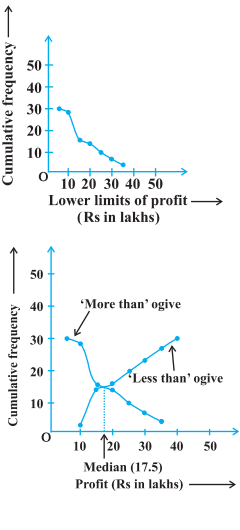
The annual profits earned by $30$ shops of a shopping complex in a locality give rise to the following distribution:
Draw both ogives for the data above. Hence,obtain the median profit.
| Profit (Rs in lakhs) | Number of shops (frequency) |
| More than or equal to $5$ | $30$ |
| More than or equal to $10$ | $28$ |
| More than or equal to $15$ | $16$ |
| More than or equal to $20$ | $14$ |
| More than or equal to $25$ | $10$ |
| More than or equal to $30$ | $7$ |
| More than or equal to $35$ | $3$ |
Draw both ogives for the data above. Hence,obtain the median profit.
Solution
(17.5) To draw the 'more than' ogive,we plot the points $(5, 30), (10, 28), (15, 16), (20, 14), (25, 10), (30, 7),$ and $(35, 3)$ on a graph where the horizontal axis represents the lower limits of profit and the vertical axis represents the cumulative frequency. We join these points with a smooth curve.
Next,we convert the given data into a frequency distribution table:
To draw the 'less than' ogive,we plot the points $(10, 2), (15, 14), (20, 16), (25, 20), (30, 23), (35, 27),$ and $(40, 30)$ on the same axes.
The abscissa of the point of intersection of the two ogives gives the median. From the graph,the point of intersection is at $x = 17.5$. Therefore,the median profit is $Rs. 17.5$ lakhs.
Next,we convert the given data into a frequency distribution table:
| Classes | $5-10$ | $10-15$ | $15-20$ | $20-25$ | $25-30$ | $30-35$ | $35-40$ |
| No. of shops | $2$ | $12$ | $2$ | $4$ | $3$ | $4$ | $3$ |
| Cumulative frequency | $2$ | $14$ | $16$ | $20$ | $23$ | $27$ | $30$ |
To draw the 'less than' ogive,we plot the points $(10, 2), (15, 14), (20, 16), (25, 20), (30, 23), (35, 27),$ and $(40, 30)$ on the same axes.
The abscissa of the point of intersection of the two ogives gives the median. From the graph,the point of intersection is at $x = 17.5$. Therefore,the median profit is $Rs. 17.5$ lakhs.
0 likes
View Solution9
Medium
During the medical check-up of $35$ students of a class,their weights were recorded as follows:
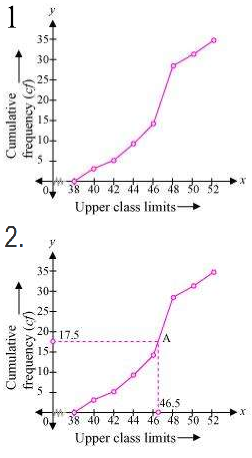
Draw a less than type ogive for the given data. Hence,obtain the median weight from the graph and verify the result by using the formula.
| Weight (in kg) | Number of students |
|---|---|
| Less than $38$ | $0$ |
| Less than $40$ | $3$ |
| Less than $42$ | $5$ |
| Less than $44$ | $9$ |
| Less than $46$ | $14$ |
| Less than $48$ | $28$ |
| Less than $50$ | $32$ |
| Less than $52$ | $35$ |
Draw a less than type ogive for the given data. Hence,obtain the median weight from the graph and verify the result by using the formula.
Solution
(N/A) The given cumulative frequency distributions of less than type are:
Taking upper class limits on the $x$-axis and their respective cumulative frequencies on the $y$-axis,the ogive is drawn as shown in the figure.
Here,$n = 35$.
So,$\frac{n}{2} = 17.5$.
Mark the point $A$ on the curve whose ordinate is $17.5$. The $x$-coordinate corresponding to this point is $46.5$. Therefore,the median of this data is $46.5$.
To verify using the formula,we first determine the class intervals and their frequencies:
The cumulative frequency just greater than $\frac{n}{2} = 17.5$ is $28$,which belongs to the class interval $46-48$.
Median class $= 46-48$.
Lower class limit $(l) = 46$.
Frequency $(f) = 14$.
Cumulative frequency of the class preceding the median class $(cf) = 14$.
Class size $(h) = 2$.
Using the median formula:
$\text{Median} = l + \left( \frac{\frac{n}{2} - cf}{f} \right) \times h$
$= 46 + \left( \frac{17.5 - 14}{14} \right) \times 2$
$= 46 + \left( \frac{3.5}{14} \right) \times 2$
$= 46 + \frac{7}{14} = 46 + 0.5 = 46.5$.
The result is verified.
| Weight (in kg) (upper class limits) | Number of students (cumulative frequency) |
|---|---|
| Less than $38$ | $0$ |
| Less than $40$ | $3$ |
| Less than $42$ | $5$ |
| Less than $44$ | $9$ |
| Less than $46$ | $14$ |
| Less than $48$ | $28$ |
| Less than $50$ | $32$ |
| Less than $52$ | $35$ |
Taking upper class limits on the $x$-axis and their respective cumulative frequencies on the $y$-axis,the ogive is drawn as shown in the figure.
Here,$n = 35$.
So,$\frac{n}{2} = 17.5$.
Mark the point $A$ on the curve whose ordinate is $17.5$. The $x$-coordinate corresponding to this point is $46.5$. Therefore,the median of this data is $46.5$.
To verify using the formula,we first determine the class intervals and their frequencies:
| Weight (in kg) | Frequency $(f)$ | Cumulative frequency $(cf)$ |
|---|---|---|
| $38-40$ | $3-0=3$ | $3$ |
| $40-42$ | $5-3=2$ | $5$ |
| $42-44$ | $9-5=4$ | $9$ |
| $44-46$ | $14-9=5$ | $14$ |
| $46-48$ | $28-14=14$ | $28$ |
| $48-50$ | $32-28=4$ | $32$ |
| $50-52$ | $35-32=3$ | $35$ |
The cumulative frequency just greater than $\frac{n}{2} = 17.5$ is $28$,which belongs to the class interval $46-48$.
Median class $= 46-48$.
Lower class limit $(l) = 46$.
Frequency $(f) = 14$.
Cumulative frequency of the class preceding the median class $(cf) = 14$.
Class size $(h) = 2$.
Using the median formula:
$\text{Median} = l + \left( \frac{\frac{n}{2} - cf}{f} \right) \times h$
$= 46 + \left( \frac{17.5 - 14}{14} \right) \times 2$
$= 46 + \left( \frac{3.5}{14} \right) \times 2$
$= 46 + \frac{7}{14} = 46 + 0.5 = 46.5$.
The result is verified.
0 likes
View Solution10
Medium
The following table gives the production yield per hectare of wheat of $100$ farms of a village.
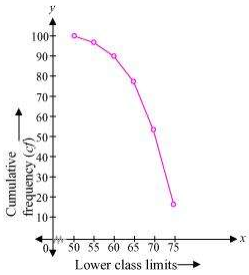
Change the distribution to a 'more than type' distribution,and draw its ogive.
| Production yield (in kg/ha) | Number of farms |
|---|---|
| $50-55$ | $2$ |
| $55-60$ | $8$ |
| $60-65$ | $12$ |
| $65-70$ | $24$ |
| $70-75$ | $38$ |
| $75-80$ | $16$ |
Change the distribution to a 'more than type' distribution,and draw its ogive.
Solution
(N/A) The cumulative frequency distribution of 'more than type' can be obtained as follows:
By plotting the points $(50, 100), (55, 98), (60, 90), (65, 78), (70, 54), (75, 16)$ on a graph paper,taking the lower class limits on the $x$-axis and their respective cumulative frequencies on the $y$-axis,we obtain the 'more than type' ogive.
| Production yield (lower class limits) | Cumulative frequency |
|---|---|
| More than or equal to $50$ | $100$ |
| More than or equal to $55$ | $100 - 2 = 98$ |
| More than or equal to $60$ | $98 - 8 = 90$ |
| More than or equal to $65$ | $90 - 12 = 78$ |
| More than or equal to $70$ | $78 - 24 = 54$ |
| More than or equal to $75$ | $54 - 38 = 16$ |
By plotting the points $(50, 100), (55, 98), (60, 90), (65, 78), (70, 54), (75, 16)$ on a graph paper,taking the lower class limits on the $x$-axis and their respective cumulative frequencies on the $y$-axis,we obtain the 'more than type' ogive.
0 likes
View Solution11
EasyMCQ
Construction of a cumulative frequency table is useful in determining the
A
median
B
mean
C
mode
D
all the above three measures
Solution
(A) cumulative frequency table is a statistical tool used to organize data by summing the frequencies of each class interval up to a certain point.
This table is specifically required to calculate the median of a grouped frequency distribution.
The formula for the median is $Median = l + \left( \frac{\frac{n}{2} - cf}{f} \right) \times h$,where $cf$ represents the cumulative frequency of the class preceding the median class.
While mean and mode can be calculated using simple frequency tables,the cumulative frequency is essential for the median.
0 likes
View Solution12
EasyMCQ
In the following distribution:
The number of families having an income range (in $Rs.$) of $16000-19000$ is:
| Monthly income range (in $Rs.$) | Number of families |
| Income more than $10000$ | $100$ |
| Income more than $13000$ | $85$ |
| Income more than $16000$ | $69$ |
| Income more than $19000$ | $50$ |
| Income more than $22000$ | $33$ |
| Income more than $25000$ | $15$ |
The number of families having an income range (in $Rs.$) of $16000-19000$ is:
A
$17$
B
$19$
C
$16$
D
$15$
Solution
(B) The given data is a 'more than' cumulative frequency distribution.
To find the number of families in the income range $16000-19000$,we subtract the number of families having income more than $19000$ from the number of families having income more than $16000$.
Number of families with income $> 16000 = 69$.
Number of families with income $> 19000 = 50$.
Number of families in the range $16000-19000 = 69 - 50 = 19$.
Therefore,the correct option is $B$.
0 likes
View Solution13
EasyMCQ
The abscissa of the point of intersection of the less than type and of the more than type cumulative frequency curves of a grouped data gives its
A
mean
B
mode
C
median
D
all the three above
Solution
(C) The cumulative frequency curves are also known as ogives. The 'less than' type ogive and 'more than' type ogive are plotted on the same graph. The point where these two curves intersect represents the median of the grouped data. The $x$-coordinate (abscissa) of this intersection point corresponds to the median value of the data set.
0 likes
View Solution14
MediumMCQ
Consider the following frequency distribution:
The upper limit of the median class is
| Class | $0-5$ | $6-11$ | $12-17$ | $18-23$ | $24-29$ |
| Frequency | $13$ | $10$ | $15$ | $8$ | $11$ |
The upper limit of the median class is
A
$17.5$
B
$7$
C
$18$
D
$18.5$
Solution
(A) To find the median class,we first convert the discontinuous class intervals into continuous ones by adjusting the boundaries. The difference between the upper limit of one class and the lower limit of the next is $1$. Thus,we subtract $0.5$ from the lower limit and add $0.5$ to the upper limit.
The total frequency $N = 57$. The median position is $N/2 = 57/2 = 28.5$. The cumulative frequency just greater than $28.5$ is $38$,which corresponds to the class interval $11.5-17.5$. Therefore,the median class is $11.5-17.5$. The upper limit of this class is $17.5$.
| Class | Frequency $(f)$ | Cumulative Frequency $(cf)$ |
| $-0.5-5.5$ | $13$ | $13$ |
| $5.5-11.5$ | $10$ | $23$ |
| $11.5-17.5$ | $15$ | $38$ |
| $17.5-23.5$ | $8$ | $46$ |
| $23.5-29.5$ | $11$ | $57$ |
The total frequency $N = 57$. The median position is $N/2 = 57/2 = 28.5$. The cumulative frequency just greater than $28.5$ is $38$,which corresponds to the class interval $11.5-17.5$. Therefore,the median class is $11.5-17.5$. The upper limit of this class is $17.5$.
0 likes
View Solution15
EasyMCQ
The times,in seconds,taken by $150$ athletes to run a $110\, m$ hurdle race are tabulated below:
The number of athletes who completed the race in less than $14.6\, s$ is:
| Class (seconds) | $13.8-14.0$ | $14.0-14.2$ | $14.2-14.4$ | $14.4-14.6$ | $14.6-14.8$ | $14.8-15.0$ |
| Frequency | $2$ | $4$ | $5$ | $71$ | $48$ | $20$ |
The number of athletes who completed the race in less than $14.6\, s$ is:
A
$11$
B
$71$
C
$130$
D
$82$
Solution
(D) To find the number of athletes who completed the race in less than $14.6\, s$,we need to sum the frequencies of all classes that are less than $14.6$.
The classes less than $14.6$ are:
$13.8-14.0$ (Frequency = $2$)
$14.0-14.2$ (Frequency = $4$)
$14.2-14.4$ (Frequency = $5$)
$14.4-14.6$ (Frequency = $71$)
Total number of athletes $= 2 + 4 + 5 + 71 = 82$.
The classes less than $14.6$ are:
$13.8-14.0$ (Frequency = $2$)
$14.0-14.2$ (Frequency = $4$)
$14.2-14.4$ (Frequency = $5$)
$14.4-14.6$ (Frequency = $71$)
Total number of athletes $= 2 + 4 + 5 + 71 = 82$.
0 likes
View Solution16
EasyMCQ
Is it correct to say that an ogive is a graphical representation of a frequency distribution? Give reason.
A
Yes,it is correct.
B
No,it is incorrect.
C
It depends on the data.
D
It is partially correct.
Solution
(B) No,it is not correct to say that an ogive is a graphical representation of a frequency distribution.
An ogive is specifically a graphical representation of a $cumulative$ frequency distribution.
$A$ frequency distribution is typically represented by a histogram,frequency polygon,or frequency curve.
Therefore,an ogive is used to represent the cumulative frequency,not the simple frequency distribution.
0 likes
View Solution17
Easy
The median of an ungrouped data and the median calculated when the same data is grouped are always the same. Do you think that this is a correct statement? Give reason.
Solution
(N/A) No,this is not a correct statement. The median of ungrouped data and the median calculated from grouped data are not always the same. This is because the formula used for calculating the median of grouped data,$\text{Median} = l + \left( \frac{\frac{n}{2} - cf}{f} \right) \times h$,is based on the assumption that the observations within each class interval are uniformly distributed. In reality,the actual distribution of data within classes may not be uniform,leading to a slight difference between the two values.
0 likes
View Solution18
Medium
Construct the cumulative frequency distribution of the following distribution:
| Class | $12.5-17.5$ | $17.5-22.5$ | $22.5-27.5$ | $27.5-32.5$ | $32.5-37.5$ |
| Frequency | $2$ | $22$ | $19$ | $14$ | $13$ |
Solution
(N/A) To construct the cumulative frequency distribution,we add the frequency of each class to the sum of the frequencies of all preceding classes.
| Class | Frequency | Cumulative frequency |
| $12.5-17.5$ | $2$ | $2$ |
| $17.5-22.5$ | $22$ | $2 + 22 = 24$ |
| $22.5-27.5$ | $19$ | $24 + 19 = 43$ |
| $27.5-32.5$ | $14$ | $43 + 14 = 57$ |
| $32.5-37.5$ | $13$ | $57 + 13 = 70$ |
0 likes
View Solution19
MediumMCQ
The percentage of marks obtained by $100$ students in an examination are given below:
Determine the median percentage of marks.
| Marks | $30-35$ | $35-40$ | $40-45$ | $45-50$ | $50-55$ | $55-60$ | $60-65$ |
| Frequency | $14$ | $16$ | $18$ | $23$ | $18$ | $8$ | $3$ |
Determine the median percentage of marks.
A
$54.4$
B
$45.4$
C
$50.8$
D
$23.4$
Solution
(B)
Here,$n = 100$.
Therefore,$\frac{n}{2} = \frac{100}{2} = 50$.
The cumulative frequency just greater than $50$ is $71$,which corresponds to the class interval $45-50$. Thus,the median class is $45-50$.
$l$ (lower limit of median class) $= 45$
$cf$ (cumulative frequency of class preceding median class) $= 48$
$f$ (frequency of median class) $= 23$
$h$ (class size) $= 5$
Median formula: $\text{Median} = l + \left( \frac{\frac{n}{2} - cf}{f} \right) \times h$
$\text{Median} = 45 + \left( \frac{50 - 48}{23} \right) \times 5$
$\text{Median} = 45 + \left( \frac{2}{23} \right) \times 5$
$\text{Median} = 45 + \frac{10}{23} \approx 45 + 0.4347 \approx 45.43$
Rounding to one decimal place,the median percentage of marks is $45.4$.
| Marks (Class) | Frequency $(f)$ | Cumulative Frequency $(cf)$ |
| $30-35$ | $14$ | $14$ |
| $35-40$ | $16$ | $30$ |
| $40-45$ | $18$ | $48$ |
| $45-50$ | $23$ | $71$ |
| $50-55$ | $18$ | $89$ |
| $55-60$ | $8$ | $97$ |
| $60-65$ | $3$ | $100$ |
Here,$n = 100$.
Therefore,$\frac{n}{2} = \frac{100}{2} = 50$.
The cumulative frequency just greater than $50$ is $71$,which corresponds to the class interval $45-50$. Thus,the median class is $45-50$.
$l$ (lower limit of median class) $= 45$
$cf$ (cumulative frequency of class preceding median class) $= 48$
$f$ (frequency of median class) $= 23$
$h$ (class size) $= 5$
Median formula: $\text{Median} = l + \left( \frac{\frac{n}{2} - cf}{f} \right) \times h$
$\text{Median} = 45 + \left( \frac{50 - 48}{23} \right) \times 5$
$\text{Median} = 45 + \left( \frac{2}{23} \right) \times 5$
$\text{Median} = 45 + \frac{10}{23} \approx 45 + 0.4347 \approx 45.43$
Rounding to one decimal place,the median percentage of marks is $45.4$.
1 likes
View Solution20
Medium
The following is the distribution of weights (in $kg$) of $40$ persons:
Construct a cumulative frequency distribution (of the less than type) table for the data above.
| Weight (in $kg$) | $40-45$ | $45-50$ | $50-55$ | $55-60$ | $60-65$ | $65-70$ | $70-75$ | $75-80$ |
| Number of persons | $4$ | $4$ | $13$ | $5$ | $6$ | $5$ | $2$ | $1$ |
Construct a cumulative frequency distribution (of the less than type) table for the data above.
Solution
(N/A) To construct a cumulative frequency distribution (less than type),we add the frequencies of all classes preceding the upper limit of the current class.
| Weight (in $kg$) | Cumulative Frequency |
| Less than $45$ | $4$ |
| Less than $50$ | $4 + 4 = 8$ |
| Less than $55$ | $8 + 13 = 21$ |
| Less than $60$ | $21 + 5 = 26$ |
| Less than $65$ | $26 + 6 = 32$ |
| Less than $70$ | $32 + 5 = 37$ |
| Less than $75$ | $37 + 2 = 39$ |
| Less than $80$ | $39 + 1 = 40$ |
0 likes
View Solution21
Medium
Find the unknown entries $a, b, c, d, e, f$ in the following distribution of heights of students in a class:
| Height (in $cm$) | Frequency | Cumulative frequency |
| $150-155$ | $12$ | $a$ |
| $155-160$ | $b$ | $25$ |
| $160-165$ | $10$ | $c$ |
| $165-170$ | $d$ | $43$ |
| $170-175$ | $e$ | $48$ |
| $175-180$ | $2$ | $f$ |
| Total | $50$ | - |
Solution
(A) To find the unknown entries,we use the definition of cumulative frequency,where each entry is the sum of the frequency of the current class and all previous classes.
$1$. For the first class $(150-155)$,the cumulative frequency is equal to the frequency: $a = 12$.
$2$. For the second class $(155-160)$,the cumulative frequency is $12 + b = 25$. Thus,$b = 25 - 12 = 13$.
$3$. For the third class $(160-165)$,the cumulative frequency is $c = 12 + b + 10 = 12 + 13 + 10 = 35$.
$4$. For the fourth class $(165-170)$,the cumulative frequency is $c + d = 43$. Substituting $c = 35$,we get $35 + d = 43$,so $d = 43 - 35 = 8$.
$5$. For the fifth class $(170-175)$,the cumulative frequency is $43 + e = 48$. Thus,$e = 48 - 43 = 5$.
$6$. For the sixth class $(175-180)$,the cumulative frequency is $f = 48 + 2 = 50$. Thus,$f = 50$.
Therefore,the values are: $a = 12, b = 13, c = 35, d = 8, e = 5, f = 50$.
0 likes
View Solution22
MediumMCQ
Weekly income of $600$ families is tabulated below:
Compute the median income (in $Rs.$).
| Weekly income | Number of families |
| $0-1000$ | $250$ |
| $1000-2000$ | $190$ |
| $2000-3000$ | $100$ |
| $3000-4000$ | $40$ |
| $4000-5000$ | $15$ |
| $5000-6000$ | $5$ |
| Total | $600$ |
Compute the median income (in $Rs.$).
A
$1336.45$
B
$1263.15$
C
$1263.85$
D
$1019.15$
Solution
(B) First,we construct a cumulative frequency table:
Given $n = 600$,we find $\frac{n}{2} = \frac{600}{2} = 300$.
The cumulative frequency just greater than $300$ is $440$,which corresponds to the median class $1000-2000$.
Here,lower limit $l = 1000$,frequency $f = 190$,cumulative frequency of the preceding class $cf = 250$,and class size $h = 1000$.
Using the median formula:
$\text{Median} = l + \left( \frac{\frac{n}{2} - cf}{f} \right) \times h$
$= 1000 + \left( \frac{300 - 250}{190} \right) \times 1000$
$= 1000 + \left( \frac{50}{190} \right) \times 1000$
$= 1000 + \frac{5000}{19}$
$= 1000 + 263.157... \approx 1263.16$
Rounding to two decimal places,the median income is $Rs. 1263.15$.
| Weekly income (in $Rs.$) | Number of families $(f_i)$ | Cumulative frequency $(cf)$ |
| $0-1000$ | $250$ | $250$ |
| $1000-2000$ | $190$ | $440$ |
| $2000-3000$ | $100$ | $540$ |
| $3000-4000$ | $40$ | $580$ |
| $4000-5000$ | $15$ | $595$ |
| $5000-6000$ | $5$ | $600$ |
Given $n = 600$,we find $\frac{n}{2} = \frac{600}{2} = 300$.
The cumulative frequency just greater than $300$ is $440$,which corresponds to the median class $1000-2000$.
Here,lower limit $l = 1000$,frequency $f = 190$,cumulative frequency of the preceding class $cf = 250$,and class size $h = 1000$.
Using the median formula:
$\text{Median} = l + \left( \frac{\frac{n}{2} - cf}{f} \right) \times h$
$= 1000 + \left( \frac{300 - 250}{190} \right) \times 1000$
$= 1000 + \left( \frac{50}{190} \right) \times 1000$
$= 1000 + \frac{5000}{19}$
$= 1000 + 263.157... \approx 1263.16$
Rounding to two decimal places,the median income is $Rs. 1263.15$.
0 likes
View Solution23
MediumMCQ
The maximum bowling speeds,in $km/h$,of $33$ players at a cricket coaching centre are given as follows:
Calculate the median bowling speed (in $km/h$).
| Speed $(km/h)$ | $85-100$ | $100-115$ | $115-130$ | $130-145$ |
| Number of players | $11$ | $9$ | $8$ | $5$ |
Calculate the median bowling speed (in $km/h$).
A
$108.25$
B
$110.32$
C
$109.17$
D
$121.21$
Solution
(C) Given total number of players $n = 33$.
$\therefore \frac{n}{2} = \frac{33}{2} = 16.5$.
To find the median class,we look at the cumulative frequencies:
- $85-100$: $11$
- $100-115$: $11 + 9 = 20$
Since $16.5$ lies in the cumulative frequency $20$,the median class is $100-115$.
Here,lower limit $(l) = 100$,frequency $(f) = 9$,cumulative frequency of the class preceding the median class $(cf) = 11$,and class width $(h) = 15$.
Using the median formula:
$\text{Median} = l + \left( \frac{\frac{n}{2} - cf}{f} \right) \times h$
$= 100 + \left( \frac{16.5 - 11}{9} \right) \times 15$
$= 100 + \left( \frac{5.5}{9} \right) \times 15$
$= 100 + \frac{82.5}{9} = 100 + 9.166... \approx 109.17$.
Hence,the median bowling speed is $109.17 \, km/h$.
0 likes
View Solution24
MediumMCQ
Find the median of the following frequency distribution:
| Class | $65-85$ | $85-105$ | $105-125$ | $125-145$ | $145-165$ | $165-185$ | $185-205$ |
| Frequency | $4$ | $5$ | $13$ | $20$ | $14$ | $8$ | $4$ |
A
$134$
B
$136$
C
$135$
D
$137$
Solution
(D) To find the median,we first prepare the cumulative frequency table:
Here,total frequency $n = 68$.
$\therefore \frac{n}{2} = \frac{68}{2} = 34$.
The cumulative frequency just greater than $34$ is $42$,which corresponds to the class interval $125-145$.
Thus,the median class is $125-145$.
Here,$l = 125$,$cf = 22$,$f = 20$,and class size $h = 20$.
Using the median formula: $M = l + \left( \frac{\frac{n}{2} - cf}{f} \right) \times h$
$M = 125 + \left( \frac{34 - 22}{20} \right) \times 20$
$M = 125 + 12 = 137$.
Therefore,the median of the given frequency distribution is $137$.
| Class | Frequency $(f)$ | Cumulative Frequency $(cf)$ |
| $65-85$ | $4$ | $4$ |
| $85-105$ | $5$ | $9$ |
| $105-125$ | $13$ | $22$ |
| $125-145$ | $20$ | $42$ |
| $145-165$ | $14$ | $56$ |
| $165-185$ | $8$ | $64$ |
| $185-205$ | $4$ | $68$ |
Here,total frequency $n = 68$.
$\therefore \frac{n}{2} = \frac{68}{2} = 34$.
The cumulative frequency just greater than $34$ is $42$,which corresponds to the class interval $125-145$.
Thus,the median class is $125-145$.
Here,$l = 125$,$cf = 22$,$f = 20$,and class size $h = 20$.
Using the median formula: $M = l + \left( \frac{\frac{n}{2} - cf}{f} \right) \times h$
$M = 125 + \left( \frac{34 - 22}{20} \right) \times 20$
$M = 125 + 12 = 137$.
Therefore,the median of the given frequency distribution is $137$.
0 likes
View Solution25
Medium
The median of the following frequency distribution is $28.5$ and the total frequency is $60$. Find the missing frequencies $x$ and $y$.
| Class | $0-10$ | $10-20$ | $20-30$ | $30-40$ | $40-50$ | $50-60$ |
| Frequency | $5$ | $x$ | $20$ | $15$ | $y$ | $5$ |
Solution
(X=8, Y=7)
Given total frequency $n = 60$.
Therefore,$45 + x + y = 60 \implies x + y = 15$ (Equation $1$).
Since $n = 60$,$\frac{n}{2} = 30$.
The median $28.5$ lies in the class $20-30$. Thus,the median class is $20-30$.
Here,$l = 20$,$cf = 5 + x$,$f = 20$,and class size $h = 10$.
Using the median formula: $Median = l + \left( \frac{\frac{n}{2} - cf}{f} \right) \times h$
$28.5 = 20 + \left( \frac{30 - (5 + x)}{20} \right) \times 10$
$8.5 = \frac{25 - x}{2}$
$17 = 25 - x \implies x = 8$.
Substituting $x = 8$ in Equation $1$: $8 + y = 15 \implies y = 7$.
The missing frequencies are $x = 8$ and $y = 7$.
| Class | Frequency $(f)$ | Cumulative frequency $(cf)$ |
| $0-10$ | $5$ | $5$ |
| $10-20$ | $x$ | $5+x$ |
| $20-30$ | $20$ | $25+x$ |
| $30-40$ | $15$ | $40+x$ |
| $40-50$ | $y$ | $40+x+y$ |
| $50-60$ | $5$ | $45+x+y$ |
Given total frequency $n = 60$.
Therefore,$45 + x + y = 60 \implies x + y = 15$ (Equation $1$).
Since $n = 60$,$\frac{n}{2} = 30$.
The median $28.5$ lies in the class $20-30$. Thus,the median class is $20-30$.
Here,$l = 20$,$cf = 5 + x$,$f = 20$,and class size $h = 10$.
Using the median formula: $Median = l + \left( \frac{\frac{n}{2} - cf}{f} \right) \times h$
$28.5 = 20 + \left( \frac{30 - (5 + x)}{20} \right) \times 10$
$8.5 = \frac{25 - x}{2}$
$17 = 25 - x \implies x = 8$.
Substituting $x = 8$ in Equation $1$: $8 + y = 15 \implies y = 7$.
The missing frequencies are $x = 8$ and $y = 7$.
0 likes
View Solution26
MediumMCQ
Find the median of the following frequency distribution:
| Class | $5-10$ | $10-15$ | $15-20$ | $20-25$ | $25-30$ | $30-35$ | $35-40$ | $40-45$ |
| Frequency | $5$ | $6$ | $15$ | $10$ | $5$ | $4$ | $2$ | $2$ |
A
$19$
B
$19.5$
C
$21$
D
$25.5$
Solution
(B)
Here,the total frequency $n = 49$.
$\therefore \frac{n}{2} = \frac{49}{2} = 24.5$.
The cumulative frequency just greater than $24.5$ is $26$,which corresponds to the class interval $15-20$.
Therefore,the median class is $15-20$.
Here,$l = 15$ (lower limit of median class),$cf = 11$ (cumulative frequency of the class preceding the median class),$f = 15$ (frequency of the median class),and $h = 5$ (class size).
Using the median formula: $M = l + \left( \frac{\frac{n}{2} - cf}{f} \right) \times h$
$M = 15 + \left( \frac{24.5 - 11}{15} \right) \times 5$
$M = 15 + \left( \frac{13.5}{15} \right) \times 5$
$M = 15 + \frac{13.5}{3} = 15 + 4.5 = 19.5$.
Thus,the median of the given frequency distribution is $19.5$.
| Class | Frequency $(f)$ | Cumulative frequency $(cf)$ |
| $5-10$ | $5$ | $5$ |
| $10-15$ | $6$ | $11$ |
| $15-20$ | $15$ | $26$ |
| $20-25$ | $10$ | $36$ |
| $25-30$ | $5$ | $41$ |
| $30-35$ | $4$ | $45$ |
| $35-40$ | $2$ | $47$ |
| $40-45$ | $2$ | $49$ |
Here,the total frequency $n = 49$.
$\therefore \frac{n}{2} = \frac{49}{2} = 24.5$.
The cumulative frequency just greater than $24.5$ is $26$,which corresponds to the class interval $15-20$.
Therefore,the median class is $15-20$.
Here,$l = 15$ (lower limit of median class),$cf = 11$ (cumulative frequency of the class preceding the median class),$f = 15$ (frequency of the median class),and $h = 5$ (class size).
Using the median formula: $M = l + \left( \frac{\frac{n}{2} - cf}{f} \right) \times h$
$M = 15 + \left( \frac{24.5 - 11}{15} \right) \times 5$
$M = 15 + \left( \frac{13.5}{15} \right) \times 5$
$M = 15 + \frac{13.5}{3} = 15 + 4.5 = 19.5$.
Thus,the median of the given frequency distribution is $19.5$.
0 likes
View Solution27
MediumMCQ
Find the median of the following frequency distribution:
| Class | $30-35$ | $35-40$ | $40-45$ | $45-50$ | $50-55$ | $55-60$ | $60-65$ | $65-70$ | $70-75$ |
|---|---|---|---|---|---|---|---|---|---|
| Frequency | $1$ | $2$ | $5$ | $10$ | $17$ | $15$ | $9$ | $5$ | $3$ |
A
$53.56$
B
$52.96$
C
$54.56$
D
$64.66$
Solution
(C) To find the median,we first calculate the cumulative frequency $(cf)$:
Total frequency $N = 67$. So,$N/2 = 67/2 = 33.5$.
Looking at the $cf$ column,the median class is $50-55$ because $33.5$ lies in this interval.
Here,lower limit $l = 50$,class size $h = 5$,frequency of median class $f = 17$,and cumulative frequency of the class preceding the median class $cf = 18$.
Using the median formula: $\text{Median} = l + \left( \frac{N/2 - cf}{f} \right) \times h$
$\text{Median} = 50 + \left( \frac{33.5 - 18}{17} \right) \times 5$
$\text{Median} = 50 + \left( \frac{15.5}{17} \right) \times 5$
$\text{Median} = 50 + \frac{77.5}{17} \approx 50 + 4.5588 \approx 54.56$.
| Class | Frequency $(f)$ | Cumulative Frequency $(cf)$ |
|---|---|---|
| $30-35$ | $1$ | $1$ |
| $35-40$ | $2$ | $3$ |
| $40-45$ | $5$ | $8$ |
| $45-50$ | $10$ | $18$ |
| $50-55$ | $17$ | $35$ |
| $55-60$ | $15$ | $50$ |
| $60-65$ | $9$ | $59$ |
| $65-70$ | $5$ | $64$ |
| $70-75$ | $3$ | $67$ |
Total frequency $N = 67$. So,$N/2 = 67/2 = 33.5$.
Looking at the $cf$ column,the median class is $50-55$ because $33.5$ lies in this interval.
Here,lower limit $l = 50$,class size $h = 5$,frequency of median class $f = 17$,and cumulative frequency of the class preceding the median class $cf = 18$.
Using the median formula: $\text{Median} = l + \left( \frac{N/2 - cf}{f} \right) \times h$
$\text{Median} = 50 + \left( \frac{33.5 - 18}{17} \right) \times 5$
$\text{Median} = 50 + \left( \frac{15.5}{17} \right) \times 5$
$\text{Median} = 50 + \frac{77.5}{17} \approx 50 + 4.5588 \approx 54.56$.
0 likes
View Solution28
MediumMCQ
Find the median of the following frequency distribution:
| Class | $60-70$ | $70-80$ | $80-90$ | $90-100$ | $100-110$ | $110-120$ |
| Frequency | $5$ | $15$ | $20$ | $30$ | $20$ | $8$ |
A
$90$
B
$91$
C
$92$
D
$93$
Solution
(D) To find the median,we first calculate the cumulative frequency $(cf)$:
Total frequency $N = 98$. So,$N/2 = 98/2 = 49$.
The cumulative frequency just greater than $49$ is $70$,which corresponds to the class interval $90-100$. Thus,the median class is $90-100$.
Here,$l = 90$,$f = 30$,$cf = 40$,and $h = 10$.
Using the formula: $\text{Median} = l + \left( \frac{\frac{N}{2} - cf}{f} \right) \times h$
$\text{Median} = 90 + \left( \frac{49 - 40}{30} \right) \times 10$
$\text{Median} = 90 + \left( \frac{9}{30} \right) \times 10 = 90 + 3 = 93$.
| Class | Frequency $(f)$ | Cumulative Frequency $(cf)$ |
| $60-70$ | $5$ | $5$ |
| $70-80$ | $15$ | $20$ |
| $80-90$ | $20$ | $40$ |
| $90-100$ | $30$ | $70$ |
| $100-110$ | $20$ | $90$ |
| $110-120$ | $8$ | $98$ |
Total frequency $N = 98$. So,$N/2 = 98/2 = 49$.
The cumulative frequency just greater than $49$ is $70$,which corresponds to the class interval $90-100$. Thus,the median class is $90-100$.
Here,$l = 90$,$f = 30$,$cf = 40$,and $h = 10$.
Using the formula: $\text{Median} = l + \left( \frac{\frac{N}{2} - cf}{f} \right) \times h$
$\text{Median} = 90 + \left( \frac{49 - 40}{30} \right) \times 10$
$\text{Median} = 90 + \left( \frac{9}{30} \right) \times 10 = 90 + 3 = 93$.
0 likes
View Solution29
DifficultMCQ
Find the median of the following frequency distribution:
| Class | Frequency $(f)$ |
|---|---|
| $110-120$ | $6$ |
| $120-130$ | $25$ |
| $130-140$ | $48$ |
| $140-150$ | $72$ |
| $150-160$ | $116$ |
| $160-170$ | $60$ |
| $170-180$ | $38$ |
| $180-190$ | $22$ |
| $190-200$ | $3$ |
A
$153.79$
B
$125.95$
C
$195.95$
D
$190$
Solution
(A) To find the median,we first calculate the cumulative frequency $(cf)$:
| Class | Frequency $(f)$ | Cumulative Frequency $(cf)$ |
| :--- | :--- | :--- |
| $110-120$ | $6$ | $6$ |
| $120-130$ | $25$ | $31$ |
| $130-140$ | $48$ | $79$ |
| $140-150$ | $72$ | $151$ |
| $150-160$ | $116$ | $267$ |
| $160-170$ | $60$ | $327$ |
| $170-180$ | $38$ | $365$ |
| $180-190$ | $22$ | $387$ |
| $190-200$ | $3$ | $390$ |
Total frequency $N = 390$. So,$N/2 = 390/2 = 195$.
The cumulative frequency just greater than $195$ is $267$,which corresponds to the class interval $150-160$.
Thus,the median class is $150-160$.
Here,lower limit $l = 150$,frequency of median class $f = 116$,cumulative frequency of the class preceding the median class $cf = 151$,and class size $h = 10$.
Using the median formula: $\text{Median} = l + \left( \frac{N/2 - cf}{f} \right) \times h$
$\text{Median} = 150 + \left( \frac{195 - 151}{116} \right) \times 10$
$\text{Median} = 150 + \left( \frac{44}{116} \right) \times 10 = 150 + \frac{440}{116} \approx 150 + 3.79 = 153.79$.
0 likes
View Solution30
MediumMCQ
Find the median of the following frequency distribution:
| Class | $0-20$ | $20-40$ | $40-60$ | $60-80$ | $80-100$ |
| Frequency | $5$ | $15$ | $20$ | $18$ | $2$ |
A
$60$
B
$50$
C
$150$
D
$55.5$
Solution
(B) To find the median,we first calculate the cumulative frequency $(cf)$:
Total frequency $N = 60$. So,$N/2 = 60/2 = 30$.
The cumulative frequency just greater than $30$ is $40$,which corresponds to the median class $40-60$.
Here,lower limit $l = 40$,class size $h = 20$,frequency of median class $f = 20$,and cumulative frequency of the class preceding the median class $cf = 20$.
Using the median formula: $\text{Median} = l + \left( \frac{\frac{N}{2} - cf}{f} \right) \times h$
$\text{Median} = 40 + \left( \frac{30 - 20}{20} \right) \times 20$
$\text{Median} = 40 + \left( \frac{10}{20} \right) \times 20 = 40 + 10 = 50$.
| Class | Frequency $(f)$ | Cumulative Frequency $(cf)$ |
| $0-20$ | $5$ | $5$ |
| $20-40$ | $15$ | $20$ |
| $40-60$ | $20$ | $40$ |
| $60-80$ | $18$ | $58$ |
| $80-100$ | $2$ | $60$ |
Total frequency $N = 60$. So,$N/2 = 60/2 = 30$.
The cumulative frequency just greater than $30$ is $40$,which corresponds to the median class $40-60$.
Here,lower limit $l = 40$,class size $h = 20$,frequency of median class $f = 20$,and cumulative frequency of the class preceding the median class $cf = 20$.
Using the median formula: $\text{Median} = l + \left( \frac{\frac{N}{2} - cf}{f} \right) \times h$
$\text{Median} = 40 + \left( \frac{30 - 20}{20} \right) \times 20$
$\text{Median} = 40 + \left( \frac{10}{20} \right) \times 20 = 40 + 10 = 50$.
0 likes
View Solution31
DifficultMCQ
Find the median of the following frequency distribution:
| Class | $0-10$ | $10-20$ | $20-30$ | $30-40$ | $40-50$ | $50-60$ | $60-70$ | $70-80$ |
| Frequency | $2$ | $6$ | $8$ | $16$ | $20$ | $18$ | $16$ | $14$ |
A
$55$
B
$50$
C
$49$
D
$49.5$
Solution
(C) To find the median,we first calculate the cumulative frequency $(cf)$:
Total frequency $N = 100$. So,$N/2 = 50$.
The cumulative frequency just greater than $50$ is $52$,which corresponds to the class interval $40-50$.
Thus,the median class is $40-50$.
Here,$l = 40$,$f = 20$,$cf = 32$,and $h = 10$.
Using the median formula: $\text{Median} = l + \left( \frac{N/2 - cf}{f} \right) \times h$
$\text{Median} = 40 + \left( \frac{50 - 32}{20} \right) \times 10$
$\text{Median} = 40 + \left( \frac{18}{20} \right) \times 10 = 40 + 9 = 49$.
| Class | Frequency $(f)$ | Cumulative Frequency $(cf)$ |
| $0-10$ | $2$ | $2$ |
| $10-20$ | $6$ | $8$ |
| $20-30$ | $8$ | $16$ |
| $30-40$ | $16$ | $32$ |
| $40-50$ | $20$ | $52$ |
| $50-60$ | $18$ | $70$ |
| $60-70$ | $16$ | $86$ |
| $70-80$ | $14$ | $100$ |
Total frequency $N = 100$. So,$N/2 = 50$.
The cumulative frequency just greater than $50$ is $52$,which corresponds to the class interval $40-50$.
Thus,the median class is $40-50$.
Here,$l = 40$,$f = 20$,$cf = 32$,and $h = 10$.
Using the median formula: $\text{Median} = l + \left( \frac{N/2 - cf}{f} \right) \times h$
$\text{Median} = 40 + \left( \frac{50 - 32}{20} \right) \times 10$
$\text{Median} = 40 + \left( \frac{18}{20} \right) \times 10 = 40 + 9 = 49$.
0 likes
View Solution32
MediumMCQ
Find the median of the following frequency distribution:
| Class | $0-5$ | $5-10$ | $10-15$ | $15-20$ | $20-25$ | $25-30$ | $30-35$ |
|---|---|---|---|---|---|---|---|
| Frequency | $5$ | $15$ | $15$ | $8$ | $4$ | $2$ | $1$ |
A
$21.90$
B
$23.67$
C
$12.57$
D
$11.67$
Solution
(D) To find the median,we first calculate the cumulative frequency $(cf)$:
Total frequency $N = 50$. So,$N/2 = 25$.
The cumulative frequency just greater than $25$ is $35$,which corresponds to the class interval $10-15$.
Thus,the median class is $10-15$.
Here,$l = 10$,$f = 15$,$cf$ (of preceding class) $= 20$,and $h = 5$.
Using the median formula: $\text{Median} = l + \left( \frac{\frac{N}{2} - cf}{f} \right) \times h$
$\text{Median} = 10 + \left( \frac{25 - 20}{15} \right) \times 5$
$\text{Median} = 10 + \left( \frac{5}{15} \right) \times 5 = 10 + \frac{25}{15} = 10 + 1.666... = 11.67$.
| Class | Frequency $(f)$ | Cumulative Frequency $(cf)$ |
|---|---|---|
| $0-5$ | $5$ | $5$ |
| $5-10$ | $15$ | $20$ |
| $10-15$ | $15$ | $35$ |
| $15-20$ | $8$ | $43$ |
| $20-25$ | $4$ | $47$ |
| $25-30$ | $2$ | $49$ |
| $30-35$ | $1$ | $50$ |
Total frequency $N = 50$. So,$N/2 = 25$.
The cumulative frequency just greater than $25$ is $35$,which corresponds to the class interval $10-15$.
Thus,the median class is $10-15$.
Here,$l = 10$,$f = 15$,$cf$ (of preceding class) $= 20$,and $h = 5$.
Using the median formula: $\text{Median} = l + \left( \frac{\frac{N}{2} - cf}{f} \right) \times h$
$\text{Median} = 10 + \left( \frac{25 - 20}{15} \right) \times 5$
$\text{Median} = 10 + \left( \frac{5}{15} \right) \times 5 = 10 + \frac{25}{15} = 10 + 1.666... = 11.67$.
0 likes
View Solution33
Difficult
The median of the following frequency distribution is $525$ and the total frequency is $100$. Find the missing frequencies $x$ and $y$.
| Class | $0-100$ | $100-200$ | $200-300$ | $300-400$ | $400-500$ | $500-600$ | $600-700$ | $700-800$ | $800-900$ | $900-1000$ |
| Frequency | $2$ | $5$ | $x$ | $12$ | $17$ | $20$ | $y$ | $9$ | $7$ | $4$ |
Solution
(A) Given,total frequency $N = 100$.
Sum of frequencies: $2 + 5 + x + 12 + 17 + 20 + y + 9 + 7 + 4 = 100$
$76 + x + y = 100 \implies x + y = 24$ --- $(1)$
Since the median is $525$,the median class is $500-600$.
Here,$l = 500$,$f = 20$,$cf = (2 + 5 + x + 12 + 17) = 36 + x$,$h = 100$,and $N/2 = 50$.
Using the median formula: $\text{Median} = l + \left( \frac{\frac{N}{2} - cf}{f} \right) \times h$
$525 = 500 + \left( \frac{50 - (36 + x)}{20} \right) \times 100$
$25 = (14 - x) \times 5$
$5 = 14 - x \implies x = 9$
Substituting $x = 9$ in $(1)$: $9 + y = 24 \implies y = 15$.
Thus,$x = 9$ and $y = 15$.
0 likes
View Solution34
Difficult
The median of the following frequency distribution is $46$ and the total frequency is $230$. Find the missing frequencies $x$ and $y$.
| Class | $10-20$ | $20-30$ | $30-40$ | $40-50$ | $50-60$ | $60-70$ | $70-80$ |
| Frequency | $12$ | $30$ | $x$ | $65$ | $y$ | $25$ | $18$ |
Solution
(N/A) Given total frequency $N = 230$.
Sum of frequencies: $12 + 30 + x + 65 + y + 25 + 18 = 230$
$150 + x + y = 230 \implies x + y = 80$ ---(Equation $1$)
Since the median is $46$,the median class is $40-50$.
Here,$l = 40$,$h = 10$,$f = 65$,$N = 230$,and cumulative frequency of the class preceding the median class $cf = 12 + 30 + x = 42 + x$.
Using the median formula: $\text{Median} = l + \left( \frac{\frac{N}{2} - cf}{f} \right) \times h$
$46 = 40 + \left( \frac{115 - (42 + x)}{65} \right) \times 10$
$6 = \left( \frac{73 - x}{65} \right) \times 10$
$6 \times 6.5 = 73 - x$
$39 = 73 - x \implies x = 34$.
Substituting $x = 34$ in Equation $1$: $34 + y = 80 \implies y = 46$.
Thus,$x = 34$ and $y = 46$.
0 likes
View Solution35
Medium
The median of the following frequency distribution is $50$ and the total frequency is $60$. Find the missing frequencies $x$ and $y$.
| Class | $0-20$ | $20-40$ | $40-60$ | $60-80$ | $80-100$ |
| Frequency | $5$ | $x$ | $20$ | $y$ | $2$ |
Solution
(A) Given total frequency $N = 60$.
Sum of frequencies: $5 + x + 20 + y + 2 = 60 \implies x + y + 27 = 60 \implies x + y = 33$ (Equation $1$).
Since the median is $50$,the median class is $40-60$. Here,$l = 40$,$h = 20$,$f = 20$,$cf = 5 + x$,and $N/2 = 30$.
Using the median formula: $\text{Median} = l + \left( \frac{\frac{N}{2} - cf}{f} \right) \times h$.
$50 = 40 + \left( \frac{30 - (5 + x)}{20} \right) \times 20$.
$50 = 40 + (25 - x)$.
$50 = 65 - x \implies x = 15$.
Substituting $x = 15$ in Equation $1$: $15 + y = 33 \implies y = 18$.
Thus,$x = 15$ and $y = 18$.
1 likes
View Solution36
Medium
The median of the following frequency distribution is $49$ and the total frequency is $100$. Find the missing frequencies $x$ and $y$.
| Class | $0-10$ | $10-20$ | $20-30$ | $30-40$ | $40-50$ | $50-60$ | $60-70$ | $70-80$ |
| Frequency | $2$ | $6$ | $8$ | $x$ | $20$ | $18$ | $y$ | $14$ |
Solution
(A) Given total frequency $N = 100$,so $2 + 6 + 8 + x + 20 + 18 + y + 14 = 100$.
$68 + x + y = 100 \implies x + y = 32$ (Equation $1$).
Since the median is $49$,the median class is $40-50$. Here $l = 40$,$f = 20$,$cf = 2 + 6 + 8 + x = 16 + x$,and $h = 10$.
Using the median formula: $\text{Median} = l + \left( \frac{\frac{N}{2} - cf}{f} \right) \times h$.
$49 = 40 + \left( \frac{50 - (16 + x)}{20} \right) \times 10$.
$9 = \frac{34 - x}{2} \implies 18 = 34 - x \implies x = 16$.
Substituting $x = 16$ in Equation $1$: $16 + y = 32 \implies y = 16$.
Thus,$x = 16$ and $y = 16$.
1 likes
View Solution37
EasyMCQ
In the formula $M = l + \frac{(\frac{n}{2} - cf)}{f} \times h$ for the median,$l = \ldots \ldots \ldots$
A
Cumulative frequency of the class preceding the median class
B
Lower limit of the median class
C
Frequency of the median class
D
Total frequency
Solution
(B) In the formula for the median of grouped data,$M = l + \left( \frac{\frac{n}{2} - cf}{f} \right) \times h$,the term $l$ represents the lower limit of the median class.
0 likes
View Solution38
EasyMCQ
In the formula $M = l + \frac{(\frac{n}{2} - cf)}{f} \times h$ for the median,$n = \ldots \ldots \ldots$
A
lower limit of the median class
B
class length
C
total frequency
D
frequency of the median class
Solution
(C) In the formula for the median,$M = l + \frac{(\frac{n}{2} - cf)}{f} \times h$,the term $n$ represents the total frequency of the given data distribution,which is the sum of all individual frequencies,i.e.,$n = \sum f_i$.
0 likes
View Solution39
EasyMCQ
In the formula $M = l + \frac{(\frac{n}{2} - cf)}{f} \times c$ for the median,$cf = \ldots \ldots \ldots$
A
cumulative frequency of the class preceding the median class
B
lower limit of the median class
C
frequency of the median class
D
class length
Solution
(A) In the median formula,$cf$ represents the cumulative frequency of the class preceding the median class. Here,$l$ is the lower limit of the median class,$n$ is the total number of observations,$f$ is the frequency of the median class,and $c$ is the class size (or class length).
0 likes
View Solution40
EasyMCQ
In the formula $M = l + \frac{(\frac{n}{2} - cf)}{f} \times h$ for the median,$f = \ldots \ldots \ldots$
A
cumulative frequency of the class preceding the median class
B
frequency of the median class
C
lower limit of the median class
D
class size
Solution
(B) In the formula for the median,$M = l + \frac{(\frac{n}{2} - cf)}{f} \times h$,the term $f$ represents the frequency of the median class.
0 likes
View Solution41
EasyMCQ
In the formula $M = l + \frac{(\frac{n}{2} - cf)}{f} \times h$ for the median,$h = \ldots \ldots \ldots$
A
cumulative frequency of the class preceding the median class
B
frequency of the median class
C
class size (class length)
D
lower limit of the median class
Solution
(C) In the formula for the median of grouped data,$M = l + \left( \frac{\frac{n}{2} - cf}{f} \right) \times h$,the term $h$ represents the class size or class length of the median class. Therefore,$h = \text{class length}$.
0 likes
View Solution42
EasyMCQ
For the following data,the median class is $\ldots \ldots \ldots$
| Class | $0-10$ | $10-20$ | $20-30$ | $30-40$ | $40-50$ |
| Frequency | $12$ | $18$ | $20$ | $17$ | $13$ |
A
$10-20$
B
$40-50$
C
$30-40$
D
$20-30$
Solution
(D) To find the median class,we first calculate the cumulative frequency $(cf)$ for the given data:
$1$. Class $0-10$: Frequency $12$,$cf = 12$
$2$. Class $10-20$: Frequency $18$,$cf = 12 + 18 = 30$
$3$. Class $20-30$: Frequency $20$,$cf = 30 + 20 = 50$
$4$. Class $30-40$: Frequency $17$,$cf = 50 + 17 = 67$
$5$. Class $40-50$: Frequency $13$,$cf = 67 + 13 = 80$
The total number of observations $N = 80$.
We find $N/2 = 80/2 = 40$.
The median class is the class interval whose cumulative frequency is greater than or equal to $N/2 = 40$.
Looking at the cumulative frequencies $(12, 30, 50, 67, 80)$,the first value greater than $40$ is $50$.
Therefore,the corresponding class interval is $20-30$.
0 likes
View Solution43
EasyMCQ
Cumulative frequency curve is also known as ........
A
frequency polygon
B
column gram
C
ogive
D
bar diagram
Solution
(C) cumulative frequency curve is a graphical representation of the cumulative frequency distribution.
It is plotted by taking the upper class limits on the $x$-axis and the corresponding cumulative frequencies on the $y$-axis.
This curve is commonly referred to as an $ogive$.
It is plotted by taking the upper class limits on the $x$-axis and the corresponding cumulative frequencies on the $y$-axis.
This curve is commonly referred to as an $ogive$.
0 likes
View Solution44
EasyMCQ
The formula to find the median of a grouped data is $\ldots \ldots \ldots \ldots .$
A
$M = 3Z - 2\bar{x}$
B
$M = l + \left( \frac{\frac{n}{2} - cf}{f} \right) \times h$
C
$M = l + \left( \frac{\frac{n}{2} - cf}{f_1 - f_2} \right) \times h$
D
$M = l + \left( \frac{f_1 - f_0}{2f_1 - f_0 - f_2} \right) \times h$
Solution
(B) The median of grouped data is calculated using the formula:
$M = l + \left( \frac{\frac{n}{2} - cf}{f} \right) \times h$
Where:
$l$ = lower limit of the median class
$n$ = total number of observations
$cf$ = cumulative frequency of the class preceding the median class
$f$ = frequency of the median class
$h$ = class size (width of the class interval).
$M = l + \left( \frac{\frac{n}{2} - cf}{f} \right) \times h$
Where:
$l$ = lower limit of the median class
$n$ = total number of observations
$cf$ = cumulative frequency of the class preceding the median class
$f$ = frequency of the median class
$h$ = class size (width of the class interval).
0 likes
View Solution45
EasyMCQ
For a given frequency distribution,the frequencies of the first,second,and third class are $8$,$15$,and $18$ respectively. Then,the cumulative frequency of the third class is $\ldots \ldots \ldots \ldots .$
A
$23$
B
$33$
C
$41$
D
$26$
Solution
(C) The cumulative frequency of a class is the sum of the frequencies of all classes up to that class.
Cumulative frequency of the third class = (Frequency of first class) + (Frequency of second class) + (Frequency of third class)
Cumulative frequency of the third class = $8 + 15 + 18 = 41$.
Cumulative frequency of the third class = (Frequency of first class) + (Frequency of second class) + (Frequency of third class)
Cumulative frequency of the third class = $8 + 15 + 18 = 41$.
0 likes
View Solution46
EasyMCQ
For a given frequency distribution,the cumulative frequency of the fourth class is $25$ and the frequency of the fourth class is $10$. Then,the cumulative frequency of the third class is ...............
A
$35$
B
$22$
C
$20$
D
$15$
Solution
(D) The cumulative frequency of a class is the sum of the frequencies of all classes up to that class.
Let $cf_n$ be the cumulative frequency of the $n^{th}$ class and $f_n$ be the frequency of the $n^{th}$ class.
We know that $cf_n = cf_{n-1} + f_n$.
Therefore,$cf_{n-1} = cf_n - f_n$.
Given that the cumulative frequency of the fourth class $(cf_4)$ is $25$ and the frequency of the fourth class $(f_4)$ is $10$,we have:
$cf_3 = cf_4 - f_4$
$cf_3 = 25 - 10 = 15$.
Thus,the cumulative frequency of the third class is $15$.
0 likes
View Solution47
EasyMCQ
The median class in the following frequency distribution is ..........
| Class | $20-25$ | $25-30$ | $30-35$ | $35-40$ | $40-45$ | $45-50$ | $50-55$ |
| Frequency | $2$ | $5$ | $8$ | $10$ | $7$ | $10$ | $3$ |
A
$35-40$
B
$30-35$
C
$40-45$
D
$45-50$
Solution
(A) First,calculate the cumulative frequency $(cf)$ for each class:
- $20-25$: $cf = 2$
- $25-30$: $cf = 2 + 5 = 7$
- $30-35$: $cf = 7 + 8 = 15$
- $35-40$: $cf = 15 + 10 = 25$
- $40-45$: $cf = 25 + 7 = 32$
- $45-50$: $cf = 32 + 10 = 42$
- $50-55$: $cf = 42 + 3 = 45$
The total frequency $n = 45$.
We need to find $\frac{n}{2} = \frac{45}{2} = 22.5$.
The median class is the class whose cumulative frequency is just greater than $22.5$.
Looking at the cumulative frequencies,$25$ is the first value greater than $22.5$,which corresponds to the class interval $35-40$.
Therefore,the median class is $35-40$.
0 likes
View Solution48
EasyMCQ
The median class in the following frequency distribution is $\ldots \ldots \ldots \ldots .$
| Class | $10-25$ | $25-40$ | $40-55$ | $55-70$ | $70-85$ | $85-100$ |
| Frequency | $5$ | $21$ | $21$ | $8$ | $25$ | $20$ |
A
$70-85$
B
$25-40$
C
$40-55$
D
$55-70$
Solution
(D) First,calculate the cumulative frequency $(cf)$ for each class:
$1$. Class $10-25$: $cf = 5$
$2$. Class $25-40$: $cf = 5 + 21 = 26$
$3$. Class $40-55$: $cf = 26 + 21 = 47$
$4$. Class $55-70$: $cf = 47 + 8 = 55$
$5$. Class $70-85$: $cf = 55 + 25 = 80$
$6$. Class $85-100$: $cf = 80 + 20 = 100$
The total frequency $n = 100$.
Calculate $\frac{n}{2} = \frac{100}{2} = 50$.
The median class is the class whose cumulative frequency is just greater than or equal to $\frac{n}{2} = 50$.
Looking at the cumulative frequencies: $5, 26, 47, 55, 80, 100$. The first cumulative frequency greater than $50$ is $55$,which corresponds to the class $55-70$.
Therefore,the median class is $55-70$.
0 likes
View Solution49
EasyMCQ
The median class of the following frequency distribution is ...........
| Class | $10-20$ | $20-30$ | $30-40$ | $40-50$ | $50-60$ | $60-70$ | $70-80$ |
| Frequency | $6$ | $10$ | $5$ | $6$ | $4$ | $2$ | $2$ |
A
$30-40$
B
$20-30$
C
$40-50$
D
$50-60$
Solution
(A) To find the median class,we first determine the total frequency $n = \sum f_i = 6 + 10 + 5 + 6 + 4 + 2 + 2 = 35$.
The median class is the class interval corresponding to the cumulative frequency just greater than $\frac{n}{2}$.
Here,$\frac{n}{2} = \frac{35}{2} = 17.5$.
Let's calculate the cumulative frequencies $(cf)$:
Class $10-20$: $cf = 6$
Class $20-30$: $cf = 6 + 10 = 16$
Class $30-40$: $cf = 16 + 5 = 21$
Since $21$ is the first cumulative frequency greater than $17.5$,the corresponding class interval $30-40$ is the median class.
0 likes
View Solution50
EasyMCQ
The median class of the following frequency distribution is ...........
Total frequency $n = 50$.
| Class | $0-10$ | $10-20$ | $20-30$ | $30-40$ | $40-50$ | $50-60$ |
| Frequency | $4$ | $5$ | $9$ | $10$ | $14$ | $8$ |
Total frequency $n = 50$.
A
$20-30$
B
$30-40$
C
$40-50$
D
$50-60$
Solution
(B) To find the median class,we first calculate the cumulative frequency $(cf)$ for each class:
$1$. For class $0-10$,$cf = 4$.
$2$. For class $10-20$,$cf = 4 + 5 = 9$.
$3$. For class $20-30$,$cf = 9 + 9 = 18$.
$4$. For class $30-40$,$cf = 18 + 10 = 28$.
$5$. For class $40-50$,$cf = 28 + 14 = 42$.
$6$. For class $50-60$,$cf = 42 + 8 = 50$.
The total number of observations is $n = 50$.
We need to find the class where the cumulative frequency is greater than or equal to $\frac{n}{2} = \frac{50}{2} = 25$.
Looking at the cumulative frequencies: $4, 9, 18, 28, 42, 50$.
The first cumulative frequency greater than $25$ is $28$,which corresponds to the class interval $30-40$.
Therefore,the median class is $30-40$.
0 likes
View SolutionStatistics — Median of Grouped Data · Frequently Asked Questions
1Are these Statistics questions useful for JEE and NEET?
Yes. All questions in this section are mapped to JEE Main and NEET exam patterns. Previous year questions from JEE Main, NEET, GUJCET and state-level exams are included with full solutions.
2Can I switch to Hindi or Gujarati for these questions?
Yes. Use the language tabs in the hero section or the sidebar to view the same questions and solutions in English, Hindi or Gujarati.
3How do I generate a question paper from this subtopic?
Use the Vedclass Exam Paper Generator — select the chapter and subtopic, set difficulty, and generate Sets A, B, C, D automatically. First 3 chapters of every subject are free.
Vedclass Products
For Students
Vedclass Test Series
Mock tests in real JEE/NEET style with performance analysis. 5-day free trial.
Start Free TrialFor Teachers
Exam Paper Generator
Generate Set A/B/C/D papers from this chapter in 2 minutes. 3 chapters free.
Try FreeFor Institutes
Online Exam Module
Live online exams with unlimited students, 360° analytics & white-label branding.
See DemoFor Teachers & Institutes
Generate a Statistics Exam Paper in 2 Minutes
Select subtopic & difficulty — Sets A, B, C, D auto-generated with No Repeat logic.
First 3 chapters of every subject are free — no payment required.